Category Archives: Future Tech

What is coming down the pipe in naval and maritime technology?

The Future of Warfare


Unknown-4

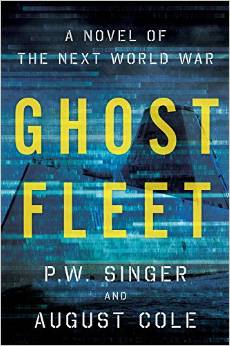
Ghost Fleet. P.W. Singer & August Cole, (2015). Houghton Mifflin Harcourt. New York, NY: 404 pp. $28.00.

Review by Brett J. Patron

If you’ve ever wondered what an operationalized version of Eisenhower’s “military industrial complex” might look like, noted national security analysts Peter W. Singer and August Cole have a book just for you.  A true triad of military, bureaucrats, and corporations overthrows a long-running government to form an uneasy alliance to run a rather large country. Singer and Cole throw us the first of many curves by teeing this up, not in the US, but China…or, as they now call themselves, “The Directorate.”

This first fiction effort by the duo delivers wide-ranging action at a frenetic pace.  The story begins in outer space and, in mere moments, the action plunges far below the Pacific Ocean’s surface. Throughout the  story, as venues change, the reader gasps for breath and delves back in as the action continues. This is a Tom Clancy-esque thriller with most of the pieces one would expect: people unexpectedly thrust into difficult situations; well-researched, accurate portrayals of current capabilities; imaginative exploration of new, emerging, or desired technology; as well as good old fashioned palace intrigue and political gamesmanship.

For those making the Clancy connection, you’ll find this book of the Red Storm Rising genre — a look at how a world war type scenario would likely go.  Ghost Fleet looks at how the “Pivot to Asia” could go – and it can go bad pretty fast. It also plays on many of the fears that serious analysts ponder regarding military procurements, military readiness and other economic tradeoffs.  Buoyed by the massive changes spurred by their recent revolution, the Directorate decides that it is time to achieve their “Manifest Destiny” in the Pacific. A major energy discovery gives them the opportunity to challenge US supremacy in the Pacific and even take on the US militarily, with the tacit assistance of Russia.

What ensues is a massive and coordinated sneak attack that cripples US capabilities throughout the Pacific Rim, most notably in Hawaii. The Directorate, now occupying US sovereign territory and positioned to prevent response either from space or across the vast ocean, looks to turn America into a third-rate client state. To counter this the US decides to reactivate ships (and some aircraft) mothballed by the significant  cuts that US politicians foisted upon itself. This is the rebirth of the Ghost Fleet that gives this story its name.  It also evokes a slightly different comparison: this is the Navy’s version of “Team Yankee.”  Team Yankee was a very popular “must read” in the late 1980s, especially popular with the mechanized/armor community of the Army. It is about warfare at its base level, but with existential impact. In this case, the crew of a one-of-a-kind ship, which was rejected by the Navy when cuts were made, is being brought back to life by a crew desperately trying to make it work in trying circumstances and fights the battle of its life for a noble cause.

Singer and Cole introduce a number of characters:  A navy officer whose transition to retirement is rather violently interrupted; a Marine thrust into the role of guerrilla; a Sun Tzu-quoting Chinese admiral; and a seductive assassin. The story explores the very tempestuous relationship between father and son bonded in a moment of crisis while wrestling with demons of the past. The duo’s style offers some nice bonuses. The reader gets a murder mystery. The idea of “privateers” in the 21st Century is presented.  For the geopolitical thinkers, Singer and Cole skewer a lot of the shibboleths of current alliances and ask “who will really ‘step up’ when the going gets tough?” The authors present some very interesting ideas of what could happen and what could emerge if all the geopolitical knowns were to suddenly change.  Rather than distract, these threads are woven into a complex but compelling story that is both provocative and frightening.

What this book does do well — and in a scary way — is show how pervasive a wired world could be and what would happen if a major actor were to severely upset the proverbial apple cart. Among the discoveries in the opening salvos of The Directorate’s aggression are the vulnerability of so much of the electronics used both in military equipment as well as the networks that course through the US.  Ghost Fleet explores the extent to which autonomous systems change life and warfare.  Can we trust the electronics we buy from overseas? Do we depend too much on automatic, autonomous and “linked” systems in our basic and daily lives? What if a major competitor played on those fears with ruthless precision and execution? This will confirm the worst fears of the Luddite or conspiracy theorist. Those that are on the fence about the impact of autonomous systems will likely find that this book tips them one way or the other.

Two things that one would expect to find in such styled books are not found in this one. One is probably the book’s only serious flaw. The story does not give time stamps and the reader may not realize that the scenario has advanced in time as it changes chapter. Without this context, the reader may become confused on why or how things changed so fast within the story.

The other creative difference is a positive: there is very little discussion of the machinations of the American politicians. Singer and Cole — in a choice very likely calculated to avoid the politics of the moment — do not really describe much, if anything about the moves, motives, or response of the President, or most of the national security apparatus. While the Secretary of Defense is omnipresent, no one else is — nor are there any real discussions on national politics at play. Some may be greatly disappointed by this while others may find it a welcome departure in the genre.  Although cyberspace capabilities are a significant aspect of the storyline, this is not a book about “cyber war.”

If anything, this is may be the first real exploration of Demchakian “cybered conflict” in story form. Cybered Conflict is a construct provided by  Naval War College professors Chris Demchak and Peter Dombrowski. The premise is that the nature of conflict remains the same but that cyberspace capabilities add a new dimension. They further purport that cyberspace is not a separate domain, per se, but is instead just another aspect of how humans interact and compete. Cyberspace is itself not decisive but can certainly tip the scale in an existential conflict. There are ample examples in this book on how this could occur. It is certain to ignite debate on the nature of “cyber war.”

Thriller readers will find this a welcome addition to their collections. Thinkers, advocates, policy wonks, geeks and nerds will all find something to chew on that will confirm or challenge their own biases. Scheduled for a June release, this highly recommended story is a daring look at the fusion of traditional and modern warfare, delivered at “machine speed.”

Brett Patron retired from the US Army after serving twenty-two years with Special Forces, Special Operations, Infantry, and Signal Corps units. After retirement, he’s worked as a defense analyst, supporting Navy, Army, Marine, Special Operations, Joint and Cyberspace organizations. He is now an independent consultant, focused on cyberspace capabilities integration, doctrine development, and policy/law. He makes his home in Yorktown, Virginia.

Readers interested in reviewing books for CIMSEC can e-mail the book review editor at books@cimsec.org.

For a Good Time Hack OPM

Guest article by Brian Scopa, USN.

“Once is happenstance. Twice is coincidence. Three times, it’s enemy action.”

-Ian Fleming


M looking for W? W looking for M? PRC looking for Intel?

The revelation that the Office of Personnel Management has been hacked, allegedly by the Chinese, has profound implications for the safeguarding of classified US information. Beyond the typical identity theft problems associated with any breach of Personally Identifiable Information (PII) from a government or private database, the fact that the data on 4.1 million military and  government personnel contained  information on their security clearances is extremely grave. This is not only an egregious breach of individual privacy, but when combined with two other hacks of private websites make for a counterintelligence nightmare.

Allowing ourselves to go briefly down the conspiracy theory rabbit hole, two additional hacks of private websites are worth considering in conjunction with the OPM hack:

Linkedin in 2012. 

“LinkedIn Security professionals suspected that the business-focused social network LinkedIn suffered a major breach of its password database. Recently, a file containing 6.5 million unique hashed passwords appeared in an online forum based in Russia. More than 200,000 of these passwords have reportedly been cracked so far.”

The consensual aggregation of personal and employment information online has greatly simplified the task of finding targets for intelligence gathering. The technology that makes finding a project manager with an MBA and five years of experience fast and convenient also makes it easy to track down missile and radar engineers on LinkedIn. The publicly available information on LinkedIn is a trove of intelligence in itself regarding military, government, and contract employees that work in defense related industries. Having the private email addresses and passwords of LinkedIn members has staggering spearfishing implications ala STUXNET.

Adult Friend Finder (AFF) in May 2015 

Andrew Auernheimer, a controversial computer hacker who looked through the files, used Twitter to publicly identify Adult FriendFinder customers, including a Washington police academy commander, an FAA employee, a California state tax worker and a naval intelligence officer who supposedly tried to cheat on his wife.” (emphasis mine)

Catching Flies

Developing intelligence sources costs time, money, and effort, regardless of the method employed, and intelligence agencies are constantly searching for ways to more efficiently target and recruit intelligence sources. The OPM and LinkedIn hack simplify the targeting, but it’s the AFF hack that helps with recruitment.

One of the most useful tools intelligence agencies have for recruiting sources is blackmail, and a ‘Honey Trap’ is the practice of luring a potential intelligence source into a compromising position with a romantic partner that’s working for an intelligence agency, and either gaining their cooperation in the name of love, or blackmailing the source into compliance.

The Chinese are apparently particularly fond of this specific type of intelligence gathering operation:

“MI5 is worried about sex. In a 14-page document distributed last year to hundreds of British banks, businesses, and financial institutions, titled “The Threat from Chinese Espionage,” the famed British security service described a wide-ranging Chinese effort to blackmail Western businesspeople over sexual relationships.”

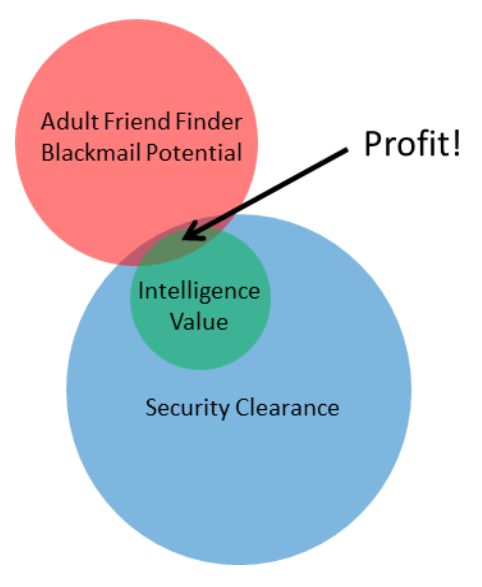
The AFF hack is probably the first Massive Multiplayer Online Honey Trap (MMOHT).  Even better for foreign intelligence agencies (FIAs), it was self-baiting and required zero investment of resources.

How bad is it?

Perverting the Drake Equation for this exercise, we can conduct a thought experiment about the number of potential intelligence sources created by the confluence of the three hacks mentioned above, expressed mathematically as P = O * W * N * Y, where:

P = Total number of useful possible US government employee intelligence sources that could be exploited.

O  = All government employees with security clearances whose personally identifiable information has been compromised, reported to be 4.1 million.

W = Fraction of O that are AFF members. This number has not been made public by the DoD, if it’s known, but the reported number of member profiles compromised was 3.5 million.

N = Fraction of W that desperately want their activities on AFF to remain undisclosed and could be effectively blackmailed. Not everyone will be embarrassed by their activities on AFF.

Y = Fraction of O that has been or is currently employed in a position that a FIA would find useful to turn into a source of intelligence.

Since I don’t have any insight into the any of the variables with the exception of O, I won’t speculate on what P might be, but I have no doubt that it’s an actionable, non-zero number that FIAs must be rushing to exploit.

AdultFriendFinderIntel


Lessons Re-identified, Still Unlearned

Any information that’s online can be accessed online- full stop. We should all assume that any device connected to the public internet is hackable, and act accordingly. While there are many good precautions and security features that individuals, companies, institutions, and governments can take to better protect online dealings and information, such as two-factor authentication, tokens, and salted password hashing, it has been demonstrated time and again that the advantage in the cyber security arms race is with the attacker. You cannot count on technical means alone to protect your information.  If individuals with security clearances have used the internet to facilitate behavior that the knowledge of by a third party could lead to blackmail, the individuals should assume the information will be made public.

Security through obscurity is always a loser, but anonymity is still worthwhile. The critical information that makes blackmail possible in this instance is being able to identify government employees that were also members of AFF. If AFF members had taken care to remain anonymous by making their member profiles non-attributional, using email addresses and phone numbers not otherwise linked to them, using non-identifiable pictures, and keeping locations ambiguous, they may yet have some measure of protection from identification.

What’s next?

This is only the beginning of this particular saga. In the coming months I have no doubt we’ll hear about the hacks of other popular dating, hook-up, and porn sites. The hacking itself has probably already happened; it’ll just take time for the discoveries to be made.

The news is grim, but there is opportunity here. While FIA see openings, our own counterintelligence organizations have an unprecedented opportunity to identify potential targets before they can be contacted by FIAs and possibly prepare them to act as double-agents, turning the honey traps on the attackers. If nothing else, the act of sharing the blackmail information with the security services helps to inoculate the individuals against blackmail, since it’s typically (but not always) the fear of disclosure that makes the information useful, not the specific behavior that’s problematic.

In any case, it’s time for a DoD-wide effort to review the list of AFF members and check it against current and past employees with security clearances. Then, command security officers can start having the difficult, closed-door conversations necessary to learn the scope of the possible vulnerability. Doing so will limit the damage from this hack, and it’ll be a useful exercise in preparing for the next episode.

Which has already happened.

A Survey of Missions for Unmanned Undersea Vehicles: Publication Review

As a closer to last week’s run of UUV articles – a publication review by Sally DeBoer, UUV week’s associate editor.


Screen Shot 2015-05-25 at 5.02.27 PM

Discussion of how the world’s navies will incorporate unmanned underwater vehicles into their doctrine and infrastructure is very broad indeed. Will these technologies be complementary to existing architecture or stand-alone platforms? Will they operate autonomously (indeed, can we even achieve the degree of autonomy required?) or with a man-in-the-loop? Perhaps because the technology is so (relatively) new and (relatively) unestablished, with potential applications so vast, the conversation surrounding it blurs the line between what is and what if.

ums
Conceptualization of the US Navy UUV concept

Thankfully, the meticulous staff at the RAND Corporation’s National Defense Research Institute, sponsored by the US Navy, produced a thorough and carefully researched study in 2009 outlining the most practical and cost-effective applications for underwater technologies. Using the US Navy’s publically-available 2004 UUV Master Plan (an updated version of this document was produced in 2011 but has not been released to the public) as a jumping off point, the authors of the study evaluated the missions advocated for UUVs in terms of military need, technical risks (as practicable), operational risks, cost, and possible alternatives. Analyzing an “unwieldy” set of 40 distinct missions spanning nine categories initially advocated in the 2004 version UUV Master Plan, the study delivers a more focused approach to how the US Navy might best and most effectively incorporate these unmanned systems. Though the UUV Master Plan document is, admittedly, quite out of date (the study itself now more than six years old), the findings therein are still highly relevant to the discussion surrounding the future of unmanned technologies beneath the waves.

Working with the very limited data available on UUVs, the authors of the study considered the technical issues inherent in developing and fielding unmanned underwater systems. Though the full complement of UUV hardware and software is considered in the study, for brevity’s sake this publication review will focus only on two technical factors: autonomy and communications. Intuitively, some missions (such as those of a clandestine or sensitive nature) demand more autonomy than others (like infrastructure monitoring or environmental surveillance). Pertaining to ISR missions, the study suggested that vehicle autonomy limitations would be a significant limiting factor.   AUVs may not, for instance, be able to effectively determine what collected information is time-critical and what information is not. This potential weakness could be a tremendous risk; either the notional AUV would fail to transmit information in a timely manner or it would transmit non-useful information needlessly, risking detection and sacrificing stealth. Without significant development, therefore, lack of autonomy would present a technical challenge and, for some advocated missions, an operational risk.  In the words of the authors “autonomy and bandwidth form a trade-space in which onboard autonomy is traded for reach-back capability and visa-versa.” The study also addressed perhaps the most frequently cited criticism of UUV technologies: communications and connectivity. Submerged UUVs, the study concludes, are limited in their ability to communicate by “the laws of physics,” while surfaced UUV’s ability to communicate are limited by technology (mast height, data output rates) and present yet another trade-off between stealth and connectivity. These communication systems are, in the words of the authors, considered mature, and are unlikely to be significantly improved by additional research and development.

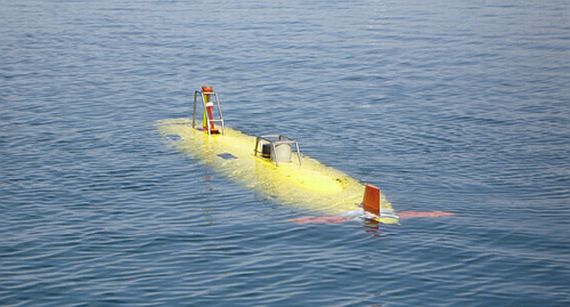
It’s important to note (and probably obvious to readers) that development of technologies to address the challenges of autonomy and communication for UUV platforms are likely completely opaque to this author. The study’s findings, however, seem to match the challenges the US Navy is facing developing UUVs in the years after its publication. The Office of Naval Research’s Large Displacement Unmanned Underwater Vehicle (LDUUV) program awarded a $7.3 million contract to Metron Inc. to develop and field autonomy software, hardware, and sensors. The LDUUV, a pier-launched system, intended for endurance missions of more than seventy days, will need to effectively avoid interference, requiring a high degree of autonomy. A 2011 Office of Naval research brief envisioned that the LDUUV would “enable the realization of fully autonomous UUVs operating in complex near shore environments” concurrent with the development of “leap ahead” technologies in autonomy.  In November of 2014, ONR unveiled a plan to develop an ASW mission package for the LDUUV, pursuing technology development in mission autonomy, situational awareness, and undersea sensors, with emphases on software-in-the-loop and hardware-in-the-loop simulations, and other ASW mission package components. Whether or not intensive R&D will produce the degree of “leap ahead” autonomy necessary for such operations remains to be seen. In the meantime, however, the RAND study’s recommended UUV missions are of particular interest and may dictate the application of funding in a time of scarcity. Put another way, the study’s conclusions provide a cogent and clear roadmap for what the US Navy can do with UUVs as they are and will reasonably become, not how it would like them or envision them to be.

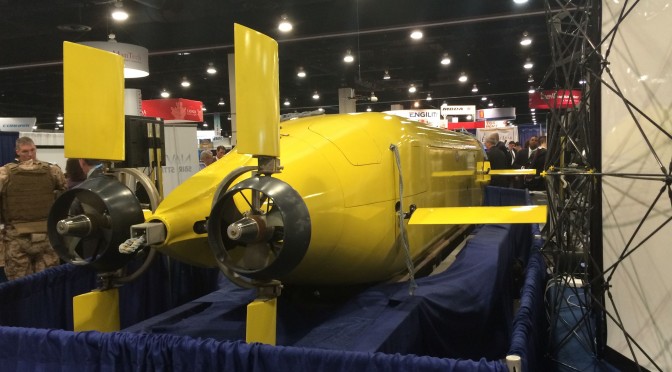
LDUUV Prototype
LDUUV Prototype

So, then, there is the million (multi-billion?) dollar question: what missions are practically and cost-effectively best suited for UUVs, given these limitations, especially if a mismatch between desired technical functionality and funding and actual ability and allotments continues? The authors suggest (in concurrence with CIMSEC’s own Chris Rawley) that UUV technologies are first and foremost best suited for mine countermeasures, followed in priority by missions to deploy leave-behind sensors, near-land or harbor monitoring, oceanography, monitoring undersea infrastructure, ASW tracking, and inspection/identification in an ATFP or homeland defense capacity. These recommendations are based on already-proven UUV capabilities, cost-effectiveness, and demand. UUVs performing these missions, in particular MCM, have seen steady and

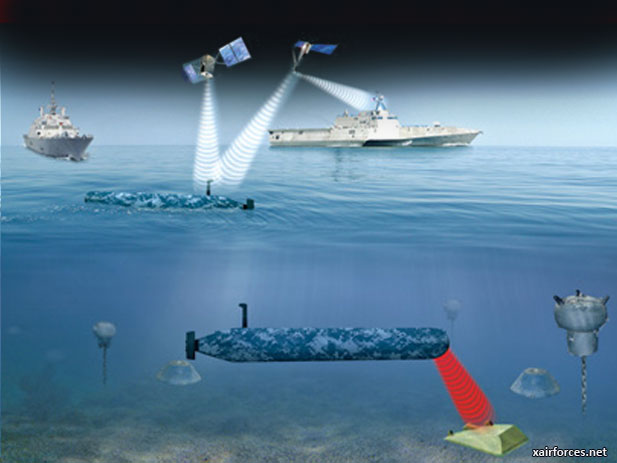
Conceptualization of the Knifefish SMCM UUV System

encouraging progress in the years since the study’s publication. NATO’s Center for Maritime Research and Exploration (CMRE) collected and analyzed data from four UUVs with high-resolution sonar deployed during Multinational Autonomy Experiment (MANEX) 2014. The Littoral Combat Ship’s (LCS) mine-hunting complement includes a pair of Surface Mine Countermeasures (SMCM) UUVs, dubbed Knifefish, that uses its low-frequency broadband synthetic aperture side-scanning sonar to look for floating, suspended, and buried mines and an onboard processor to identify mines from a database. The way ahead for longer-term missions demanding greater autonomy and reach-back over long distances is, for the time being, less clear.

This publication review is truly a very (very!) cursory glance at an incredibly detailed, highly technical study, and in no way does justice to the breadth and depth of the document.  I encourage interested readers to download the original .pdf.  However, the study’s contributions to an overall understanding of how and where UUVs can practically and cost-effectively support naval operations are significant, effectively reckoning the need to develop cutting-edge technologies with sometimes harsh but ever-present operational and financial realities. UUVs will undoubtedly have a significant role in the undersea battle-space in the years to come; RAND’s 2009 study provides keen insight into how that role may develop.

Sally DeBoer is an associate editor for CIMSEC.  She is a graduate of the United States Naval Academy and a recent graduate of Norwich University’s Master of Arts in Diplomacy program. She can be reached at Sally.L.DeBoer(at)gmail(dot)com.

Lethal Autonomy in Autonomous Unmanned Vehicles

Guest post written for UUV Week by Sean Welsh.

Should robots sink ships with people on them in time of war? Will it be normatively acceptable and technically possible for robotic submarines to replace crewed submarines?

These debates are well-worn in the UAV space. Ron Arkin’s classic work Governing Lethal Behaviour in Autonomous Robots has generated considerable attention since it was published six years ago in 2009. The centre of his work is the “ethical governor” that would give normative approval to lethal decisions to engage enemy targets. He claims that International Humanitarian Law (IHL) and Rules of Engagement can be programmed into robots in machine readable language. He illustrates his work with a prototype that engages in several test cases. The drone does not bomb the Taliban because they are in a cemetery and targeting “cultural property” is forbidden. The drone selects an “alternative release point” (i.e. it waits for the tank to move a certain distance) and then it fires a Hellfire missile at its target because the target (a T-80 tank) was too close to civilian objects.

Could such an “ethical governor” be adapted to submarine conditions? One would think that the lethal targeting decisions a Predator UAV would have to make above the clutter of land would be far more difficult than the targeting decisions a UUV would have to make. The sea has far fewer civilian objects in it. Ships and submarines are relatively scarce compared to cars, houses, apartment blocks, schools, hospitals and indeed cemeteries. According to the IMO there are only about 100,000 merchant ships in the world. The number of warships is much smaller, a few thousand.

Diagram of the ethical governer
Diagram of the ‘ethical governor’

There seems to be less scope for major targeting errors with UUVs. Technology to recognize shipping targets is already installed in naval mines. At its simplest, developing a hunter-killer UUV would be a matter of putting the smarts of a mine programmed to react to distinctive acoustic signatures into a torpedo – which has already been done. If UUV were to operate at periscope depth, it is plausible that object recognition technology (Treiber, 2010) could be used as warships are large and distinctive objects. Discriminating between a prawn trawler and a patrol boat is far easier than discriminating human targets in counter-insurgency and counter-terrorism operations. There are no visual cues to distinguish between regular shepherds in Waziristan who have beards, wear robes, carry AK-47s, face Mecca to pray etc. and Taliban combatants who look exactly the same. Targeting has to be based on protracted observations of behaviour. Operations against a regular Navy in a conventional war on the high seas would not have such extreme discrimination challenges.

A key difference between the UUV and the UAV is the viability of telepiloting. Existing communications between submarines are restricted to VLF and ELF frequencies because of the properties of radio waves in salt water. These frequencies require large antenna and offer very low transmission rates so they cannot be used to transmit complex data such as video. VLF can support a few hundred bits per second. ELF is restricted to a few bits per minute (Baker, 2013). Thus at the present time remote operation of submarines is limited to the length of a cable. UAVs by contrast can be telepiloted via satellite links. Drones flying over Afghanistan can be piloted from Nevada.

For practical purposes this means the “in the loop” and “on the loop” variants of autonomy would only be viable for tethered UUVs. Untethered UUVs would have to run in “off the loop” mode. Were such systems to be tasked with functions such as selecting and engaging targets, they would need something like Arkin’s ethical governor to provide normative control.

DoD policy directive 3000.09 (Department of Defense, 2012) would apply to the development of any such system by the US Navy. It may be that a Protocol VI of the Convention on Certain Conventional Weapons (CCW) emerges that may regulate or ban “off the loop” lethal autonomy in weapons systems. There are thus regulatory risks involved with projects to develop UUVs capable of offensive military actions.

Even so, in a world in which a small naval power such as Ecuador can knock up a working USV from commodity components for anti-piracy operations (Naval-technology.com, 2013), the main obstacle is not technical but in persuading military decision makers to trust the autonomous options. Trust of autonomous technology is a key issue. As Defense Science Board (2012) puts it:

A key challenge facing unmanned system developers is the move from a hardware-oriented, vehicle-centric development and acquisition process to one that addresses the primacy of software in creating autonomy. For commanders and operators in particular, these challenges can collectively be characterized as a lack of trust that the autonomous functions of a given system will operate as intended in all situations.

There is evidence that military commanders have been slow to embrace unmanned systems. Many will mutter sotto voce: to err is human but to really foul things up requires a computer. The US Air Force dragged their feet on drones and yet the fundamental advantages of unmanned aircraft over manned aircraft have turned out to be compelling in many applications. It is frequently said that the F-35 will be the last manned fighter the US builds. The USAF has published a roadmap detailing a path to “full autonomy” by 2049 (United States Air Force, 2009).

Similar advantages of unmanned systems apply to ships. Just as a UAV can be smaller than a regular plane, so a UUV can be smaller than a regular ship. This reduces requirements for engine size and elements of the aircraft that support human life at altitude or depth. UAVs do not need toilets, galleys, pressurized cabins and so on. In UUVs, there would be no need to generate oxygen for a crew and no need for sleeping quarters. Such savings would reduce operating costs and risks to the lives of crew. In war, as the Spanish captains said: victory goes to he who has the last escudo. Stress on reducing costs is endemic in military thinking and political leaders are highly averse to casualties coming home in flag-draped coffins. If UUVs can effectively deliver more military bang for less bucks and no risk to human crews, then they will be adopted in preference to crewed alternatives as the capabilities of vehicles controlled entirely by software are proven.

Such a trajectory is arguably as inevitable as that of Garry Kasparov vs Deep Blue. However in the shorter term, it is not likely that navies will give up on human crews. Rather UUVs will be employed as “force multipliers” to increase the capability of human crews and to reduce risks to humans. UUVs will have uncontroversial applications in mine counter measures and in intelligence and surveillance operations. They are more likely to be deployed as relatively short range weapons performing tasks that are non-lethal. Submarine launched USVs attached to their “mother” subs by tethers could provide video communications of the surface without the sub having to come to periscope depth. Such USVs could in turn launch small UAVs to enable the submarine to engage in reconnaissance from the air.  The Raytheon SOTHOC (Submarine Over the Horizon Organic Capabilities) launches a one-shot UAV from a launch platform ejected from the subs waste disposal lock . Indeed small UAVs such

AeroVironment Switchblade UUV
AeroVironment Switchblade UUV

as Switchblade (Navaldrones.com, 2015) could be weaponized with modest payloads and used to attack the bridges or rudders of enemy surface ships as well as to increase the range of the periscope beyond the horizon. Future aircraft carriers may well be submarine.

In such cases, the UUV, USV and UAV “accessories” to the human crewed submarine would increase capability and decrease risks. As humans would pilot such devices, there are no requirements for an “ethical governor” though such technology might be installed anyway to advise human operators and to take over in case the network link failed.

However, a top priority in naval warfare is the destruction or capture of the enemy. Many say that it is inevitable that robots will be tasked with this mission and that robots will be at the front line in future wars. The key factors will be cost, risk, reliability and capability. If military capability can be robotized and deliver the same functionality at similar or better reliability and at less cost and less risk than human alternatives, then in the absence of a policy prohibition, sooner or later it will be.

Sean Welsh is a Doctoral Candidate in Robot Ethics at the University of Canterbury. His professional experience includes  17 years working in software engineering for organizations such as British Telecom, Telstra Australia, Fitch Ratings, James Cook University and Lumata. The working title of Sean’s doctoral dissertation is “Moral Code: Programming the Ethical Robot.”

References

 Arkin, R. C. (2009). Governing Lethal Behaviour in Autonomous Robots. Boca Rouge: CRC Press.

Baker, B. (2013). Deep secret – secure submarine communication on a quantum level.   Retrieved 13th May, 2015, from http://www.naval-technology.com/features/featuredeep-secret-secure-submarine-communication-on-a-quantum-level/

Defense Science Board. (2012). The Role of Autonomy in DoD Systems. from http://fas.org/irp/agency/dod/dsb/autonomy.pdf

Department of Defense. (2012). Directive 3000.09: Autonomy in Weapons Systems.   Retrieved 12th Feb, 2015, from http://www.dtic.mil/whs/directives/corres/pdf/300009p.pdf

Navaldrones.com. (2015). Switchblade UAS.   Retrieved 28th May, 2015, from http://www.navaldrones.com/switchblade.html

Naval-technology.com. (2013). No hands on deck – arming unmanned surface vessels.   Retrieved 13th May, 2015, from http://www.naval-technology.com/features/featurehands-on-deck-armed-unmanned-surface-vessels/

Treiber, M. (2010). An Introduction to Object Recognition: Selected Algorithms for a Wide Variety of Applications. London: Springer.

United States Air Force. (2009). Unmanned Aircraft Systems Flight Plan 2009-2047.   Retrieved 13th May, 2015, from http://fas.org/irp/program/collect/uas_2009.pdf