Tag Archives: fiction

What is Old Is New Again

Fiction Week

By Michael Hanson

Summer 2031

When the war that the Marine Corps anticipated for more than a decade finally began in 2031, it didn’t unfold the way the Marines had expected, and certainly not in ways that Marines had trained for over the years leading up to its outbreak. The detour from institutional expectations should have been expected though, because wars rarely go the way they are supposed to. Like many other clashes between great powers, it began over a grave miscalculation followed by an unfortunate escalation. A close encounter in the South China Sea in which one side nervously fired a shot, and after the first missile salvo was released, came the instant response. Both navies had ships burning and slipping beneath the waves. At this point, both sides were powerless to stop the inevitable exchange. Like a machine, long prepared war plans were activated and set into motion. Fleets turned towards one another and land-based forces raced to occupy key maritime terrain.

More great sea battles raged. As missiles skimmed the surface of the blue water, and slammed into the sides of grey hulls, red flames and black smoke mixed to create pastels unseen on the horizon in almost a century. In remote corners of the Western Pacific, the sky seemingly went dark with missiles fired from surface warships, submarines, and aircraft. The flight of the missiles resembled the exchange of arrows between two ancient hordes. The two navies collided like jousting medieval knights. They fought one another relentlessly, like armored juggernauts striving for the knockout blow. Each flailing, neither yielding. But a warrior only has a certain reserve of stamina and a ship only carries so many missiles. Shortly after hostilities exploded, the remains of each fleet limped away to rearm and prepare for the next joust.

A few months later, with diplomatic efforts stalled as each side sought a position of advantage at the negotiating table, the fleets clashed again, repeating their first performance of an indecisive draw. A pattern emerged. The rate of expenditures was staggering, and soon each side would be out of missiles. Each side had enough munitions for one more great clash. Yet rather than have it out, each side held back. Neither wanted to throw their last reserves of strength away like dice. The war settled into a stalemate, with each fleet keeping out of range of the other.

The initiative in the war shifted to the Stand-In forces in the First Island Chain. Here now was the part of the war the Marines had reimagined themselves for. For years, the Marines planned for their Littoral Regiments to be among the first American units to go into action in the looming fight. But the war didn’t take that path. Due to a several years long shortfall in the Landing Ship Medium (LSM) program, the main vessel to get Marine missile batteries into their firing positions on the many disparate islands of the region, the Marine Littoral Regiments were late to the event and largely unengaged.

To be sure, other parts of the Marine Stand-In Forces were involved since the first day, though they didn’t prove as decisive as they were expected to be. The reconnaissance-counter reconnaissance fight was indeed dynamic, displaying great feats of effort and endurance to gain and maintain situational awareness. But getting the expeditionary fires nodes into position proved to be the frustrating part. The Marines could sense but not shoot. With persistence, the Marines got their Fires Expeditionary Advance Bases established, though unfortunately too late to have a decisive effect on many of the passing Chinese ships. The Marines’ role was frustratingly limited as the opposing fleets clashed beyond the range of their land-based fires nodes. They seemed to have missed their chance…at first.

However, the war continued to take unexpected turns. The plus side of not being heavily engaged in the initial phase of the conflict was that by now the Marines still had a lot of missiles. With the fleets low on ammo, the Marines’ stock rose significantly. The Marine Littoral Regiment now appeared to be a trump card for the Americans, after they had played much of their initial hand. Having finally occupied their positions in key parts of the First Island Chain, the Marines stood ready to prevent the Chinese ships from breaking out of the First Island Chain. If the Chinese fleet decided to break for open ocean and come back out for another round, they would face the considerable capabilities of the Marine Littoral Regiment, now fully deployed and ready.

But the war that didn’t follow its envisioned path offered more surprises for the Marines. The Chinese had Stand-In Forces of their own – proxy forces and maritime militia. The Chinese had also planned and wargamed this likely contingency and found the Marine Littoral Regiments to be a formidable adversary.

Not surprisingly, the Chinese made preparations to counter this threat. In the years before the conflict erupted, the Chinese began to plant seeds that would bloom under the typhoon of war. Tapping into long simmering grievances, Chinese agents established contact with disaffected groups across the First Island Chain and offered support. Money, weapons, equipment, and training bolstered the capabilities of local insurgent groups, whether they were the remnants of Cold War Communist insurgencies or the persistent Islamic insurgent groups that the regional governments contested with more recently. The Chinese also enticed criminal gangs and mafia organizations to enlist their foot soldiers in the fight. The “Chinese Proxy Forces,” were to be called “Charlie Papa Fox,” or simply “Charlie” for short, by the Marines. The Chinese had assembled a formidable Stand-In force to conduct reconnaissance, sabotage, and even kinetic strikes on American forces. This was a tactic the Marines were not prepared to deal with.

Throughout the Philippine archipelago, many unsuspecting Marines were caught flat-footed by an adversary resembling guerrillas in a setting they simply didn’t expect to be contested in. If anything, the Marines expected to be dodging missiles, not small arms fire. The Marine Stand-In Forces were simply not prepared for this surprise tactic, as their security posture didn’t anticipate this kind of threat. As was usual practice, most units had posted security but in many cases their defenses were breached or overwhelmed. Isolated communication and logistics nodes, drone launch points, reconnaissance assets, forward arming/refueling points, and even missile batteries experienced the sudden encroachment from fire team and squad sized elements to mobs of armed civilians. Whether through sabotage or outright attack, some critical assets were damaged or destroyed. When the proxies first came out some units held their ground and repelled their attackers, others were forced to displace to save themselves, a few units were even overrun.

The majority of the subcomponents of the Stand-In Force were responsible for their own security, which consisted solely of static positions with weapons oriented outboard. The Marine Littoral Regiment had a Littoral Combat Team, the only organic unit with infantry forces. The LCT was derived from a former infantry battalion and possessed three rifle companies. But these were not complete elements, they had been broken up by platoon and distributed across the regiment to provide security at critical nodes. However, there wasn’t enough infantry to provide security for everything. When attacked, the sites with infantry providing security typically fared better than those that didn’t for the simple fact that units responsible for their own security often didn’t have enough Marines to adequately perform the task. In some places the infantry providing security even counterattacked to finish off broken attackers. In places without attached infantry, a hard lesson often learned from war to war and forgotten in the peaceful years in between was learned again: every Marine must be a rifleman.

Though the Marines were caught off guard by the first massed proxy attack, they wouldn’t be surprised again. Immediately, the Marines began moving their nodes often, constantly displacing and emplacing to keep the proxies off balance. They would stay in a location for twenty-four hours or less and utilized an infantry squad to reconnoiter and occupy the next site before the unit moved. Whereas the previous default security posture had been static, the Marines quickly adapted and adopted a more active defense. The infantry platoons guarding key locations started pushing out patrols to create depth in their defensive plans. They were tasked to interdict any enemy forces who sought to close on them, whether for sabotage or in a massed attack. At night, the Marines conducted ambush patrols on likely areas the proxies would need to cross to close on a MLR node. There were still restrictions, however. The Marines occupied locations devoid of civilians and the security patrols were specifically ordered to stay away from civilian areas. Thus, any civilians encountered were more likely to be proxy forces searching for Marines. Though host nation forces tried to act as a buffer between the Americans and local nationals, inevitably Marines would encounter civilians simply trying to exist in their own homeland. Thus, Marines were once again reminded to be No Better Friend, and No Worse Enemy. All the same, the Marines relearned old rules of engagement as well as hostile act and hostile intent.

As the Marines began to demonstrate success interdicting and ambushing proxy forces, the proxies adapted as well. Proxy force tactics shifted to trying to ambush patrolling Marines in close range direct fire gunfights, and when that revealed predictable results, they moved on to setting out booby traps. The classic pendulum of warfare swung between action and counteraction by each side. As the Marines learned and adapted to the booby traps, the traps became ever more clever and sophisticated. The Marines even began to learn firsthand about something they only heard of in publications and history classes of the desert wars, IED’s.

The Marines also learned that the proxy forces were not their only enemy. The jungle was a formidable adversary in its own right, in fact tougher and less forgiving than the proxies were. The jungle was austere and harsh. It was hell. To successfully fight in the jungle, Marines had to learn how to fight the jungle itself. They had to be both physically and mentally resilient, and well led. The jungle was hot, humid, wet, and steamy, full of poisonous insects and reptiles and debilitating ailments and diseases. It took a toll on the Marines’ minds and bodies, as well as their gear. Nerves ran short, bodies were reduced by sickness and environmental effects. Boots rotted along with the feet inside of them. Weapons rusted, bullets corroded, gear came apart, and waterlogged electronic screens proved useless. Advanced technologies were of little use in this primal environment. Though the jungle canopy protected Marines from the prying eyes of drones, it also denied them radio communication. In the jungle, Marines were on their own. The thick vegetation swallowed large units yet was penetrable only by small ones. To move swiftly and silently, they would have to pack light. To be effective they would have to stay out for more than a few hours. To endure for more than a few hours they would have to bring chow and water on patrol. To do all of these things they would have to leave their heavy and bulky body armor behind. To survive and thrive in this environment, the Marines would need to become masters of field craft. The jungle was neutral, it didn’t choose sides but certainly favored the bold, resourceful, and disciplined.1, 2

The more the war that started out as a contest between missile platforms took unexpected twists and turns, the more the Marines began to learn that what was old was now new again. The few images that made it back to the home front from this isolated combat zone eerily resembled scenes from previous campaigns that Marines won past honors in. The jungle was neutral. Small units had decisive effects. Skills were more important than gear. Field craft staved off culmination. Discipline saved lives. Leadership was paramount. Trust was essential. Commander’s intent and mission tactics were standard operating procedure. Every Marine needed to be a rifleman. Marines fought a wily enemy and endured in extreme conditions while diplomats at long tables endlessly negotiated towards a peace settlement. And in another war in East Asia, Marines once again ventured into the jungle on the hunt for someone they called “Charlie.”

Major Michael A. Hanson, USMC, is an Infantry Officer serving at The Basic School, where the Marine Corps trains its lieutenants and warrant officers in character, officership, and the skills required of a provisional rifle platoon commander. He is also a member of the Connecting File, a Substack newsletter that shares material on tactics, techniques, procedures, and leadership for Marines at the infantry battalion level and below.

Footnotes

1. Michael Hanson, “In the WEZ,” Center for International Maritime Security. Last modified December 2, 2020, https://cimsec.org/in-the-wez/

2. Michael Hanson, “Welcome Back to the Jungle,” United States Naval Institute Proceedings, April 2021 Vol. 147/4, https://www.usni.org/magazines/proceedings/2021/april/welcome-back-jungle-0

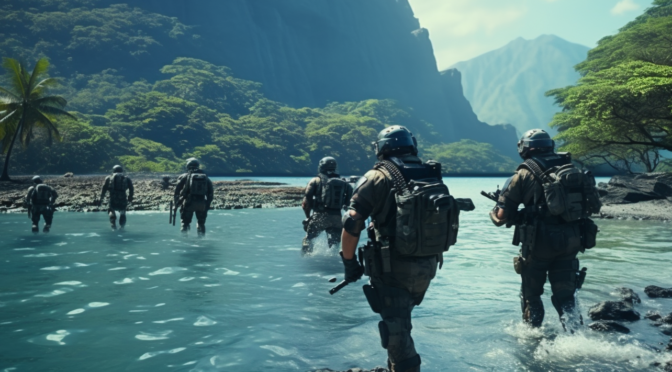
Featured Image: Art created with Midjourney AI.

Ghost Town

Fiction Week

By Kenyan Medley

USS John F Kennedy
Philippine Sea
0237, 04 OCT 2034

Four years after the blockade of Taiwan…

Commander Dave Anderson stared into the retina scanner on the bulkhead outside SUPPLOT. He heard the hissing of a basilisk as the air pressure changed in the space between the two doors to the ship’s intelligence watch floor. Critical spaces were separated by chemical, biological, radiological, and nuclear airlocks following the employment of a nuclear torpedo by a Russian Severodvinsk III submarine and Chinese chemical attacks on Palawan. Despite a weak alliance between Russia and China against NATO and the Pacific Alliance, a Russian torpedo destroyed a Chinese task group, allegedly a result of poor coordination by commanders in the field, according to Moscow. The alliance between Russia and China became strained, and while both remained united in purpose, combined operations were now nonexistent. Instead, the battlespace was carved up into Russian or Chinese fiefdoms, each maintaining control over its respective area.

Inside the airlock, Dave took a sip of coffee as he waited for the second door to open. The ship’s military intelligence model, called “Layton,” controlled the security, damage-control, and intelligence systems.

“Good pot this morning, Layton.” Dave raised the mug bearing a picture of his wife and children towards the small, black circular lens of a camera on the bulkhead. “Really strong.”

“A different model controls the life support systems, Commander.”

“Well, thank him for me because this is truly life support.”

Dave set his coffee on the desk inside the space and swiped up on his personal screen to put the common operating picture on the main display.

“Layton, show me where the Akula will likely be when we enter OPBOX (Operations Box) Zeppelin. Use average speed-of-advance. Model plan-of-intended-movement using Captain Pyotr Sokolov’s agent and current METOC (meteorological) conditions.” The Russians still used manned submarines, making it easy for the artificial intelligence to simulate the Red Force’s courses of action.

“Assessing…”

Dave despised the term “assessing.” If it were the one making the assessments, then he wouldn’t be aboard. Anderson is the N2 department head for intelligence and the only intel officer aboard the Kennedy. He is one of only two intel officers in the entire strike group.

In the past, Dave would have been the principal intelligence advisor to the strike group commander, but the strike group was now a relic of a time when the carrier sailed with an aggregated group of four or five ships and almost 6,000 people. That was a time before the first two carriers sank. Now, the carrier was alone.

“Based on current conditions and past tactical decisions, the Akula will very likely utilize the warm core eddy 68 nautical miles to the southwest to ambush the strike group after the strike.”

Anderson reflected on Layton’s statement with a slow blink and a deep inhale. There is no strike group. It’s just me…talking to a machine, he thought.

Save for the skeleton crew of maintenance and supply personnel and a small cadre of officers aboard to keep the floating city operational, Dave was alone. He could still transit to other parts of the ship, but the airlocks and damage control conditions made it difficult. He sometimes went weeks without speaking with the others. He sent the rest of the intel department home when the ship pulled into port for flight deck repair after the escorting USVs allowed some airburst warheads to slip through. Had the flight deck been manned as it was during most of its history with carrier deck departments and squadron personnel, the casualties would have been significant. Now, UAV strike packages were able to start, taxi, launch, and recover autonomously. Just a few decades ago, Dave remembered visiting an automated port in Europe, with uncrewed trucks moving containers about, stopping to let others pass, before continuing on their routes. Now, drones taxied and launched in an impressive, choreographed symphony. The Robotics Warfare Specialists only performed maintenance in the hangar when the drones came down on automated elevators after built-in-test systems determined a fault or a routine maintenance action came due.

Former airwings of F/A-18 Super Hornets and F-35s were replaced by MQ-47E Manta Ray as the long-range maritime strike aircraft of the carrier, and MQ-25 Stingrays for aerial refueling. The Manta Rays were outfitted with larger conformal fuel tanks to increase mission radius and given electronic warfare packages. This turned the Manta Ray into penetrating strike platforms capable of destroying well-protected Chinese and Russian targets. Early attempts were made to protect the carriers by keeping them outside of rocket force engagement zones. The Hummingbird refueling network stretched across the Pacific, designed to enable carrier strikes from safety; however, it was vulnerable to enemy drones. The UAVs did make it past combatants and anti-air platforms from the Chinese carriers operating past the second island chain. Still, they lacked the fuel to reach their targets after successful attacks on the Hummingbird Network. The carriers were once again sent into the fray.

The carrier was once a living thing. A Leviathan swimming through the world’s oceans, projecting power to weaker nations. AI and automation changed everything. The nuclear-powered aircraft carrier was now a husk—a carcass floating down the river Styx. Its passageways once flowed with the lifeblood of the Navy. Men and women of all ages, colors, creeds, and sizes. All of them wore different uniforms—a rainbow of flight deck jerseys, flight suits, coveralls, and utilities. Everyone had a purpose. Now just one intelligence officer fused all-source intelligence and information fed to him by AI into assessments delivered to just two afloat warfare commanders who answered to headquarters in San Diego.

Operation models removed the need for as much brass on the ship, just as Layton removed the need for a team of intelligence analysts and officers. Only the destroyer squadron intelligence officer, Lieutenant Commander Garcia, remained somewhere on a destroyer with the Commodore, the warfare commander for anti-surface and anti-submarine warfare. That is, if the ship was still afloat and the embarked crew were still alive—a lot of unknowns in warfare.

Attrition was so high in the first few years of the war that the Navy’s force design changed completely. The most powerful naval force in history was unprepared for this new paradigm of conflict. Dave sailed through a graveyard—the resting place of two United States aircraft carriers—during his first operation. Strategic thinking was so unmoved by the altered tactical landscape that a third and fourth carrier pushed right into the Philippine Sea, still on fire from the first successful wave of Dongfeng ballistic missiles. As the N21 of CSG-7, Dave listened live in SUPPLOT to the calls of ballistic missile launches from mainland China and the subsequent destruction of USS Harry S. Truman and USS Nimitz.

The entire strike package of both carriers was lost following successful strikes on multiple Renhai II cruisers, Luyang IV destroyers, and an over-the-horizon radar site. Three squadrons of aircraft were lost with no personnel recovered. Anderson’s ship, USS George H. W. Bush, only escaped because all escorts went Winchester (a brevity word for magazine empty), protecting it from a wave of ballistic and cruise missiles. Not all were stopped, and the carrier limped back to Pearl Harbor, listing 31 degrees and missing half of its island. Bush was currently conducting patrols in the northern Pacific with no island. With automation and the removal of over 90 percent of the crew, a human no longer needed to see where the ship was sailing.

Dave’s carrier, the Kennedy, still had an island, but no one manned the bridge. Part of the island was used for expanded AI compute capacity. This gave it some advantage over the “blind” carriers, but the increased radar elevation and antenna height did nothing for it. The carrier was a hollow shell, and Dave was trapped communing with a ghost.

He spent most days working out, reading, and talking to Layton about information relevant to the strike missions. This usually involved video calls with the destroyer squadron to discuss subs when they answered, but now Dave only talked to Layton about the subs. Wherever Garcia and the destroyers were, he missed them. The number of enemy submarines prowling the water was increasing, and Dave just wanted the comfort of another human voice.

Dave stared at the lone screen, which fed him intelligence information. Layton chimed.

“Shen has not entered port, Sir.”

“What?” Dave replied. “Where?”

“Hull 3 of the People’s Liberation Army Navy’s Long-class guided missile submarine—Shen. The domestic reproduction of and improvement upon the Russian Sever—”

“Rhetorical, Layton. It should have pulled in. Endurance and pattern of life all pointed to a return to homeport.” They never stay out this long. “It exhausted its ammo and countermeasures in the fight with Annapolis.”

A red downward arrow indicating a hostile subsurface unit appeared on the operating picture map.

“It reloaded, Sir.”

“At sea? Why?” They never reloaded at sea. The Long submarine had problems interfacing with dual-use logistics ships and couldn’t dock at China’s undersea bases. The sub was positioned 234 nautical miles east of Vladivostok. Dave was shocked.

“Why is it there? It’s more than a thousand miles from homeport,” Dave exclaimed.

None of it made sense to Dave. The Chinese and Russians were beginning to stay far apart, never operating in each other’s assessed areas of responsibility. The situation was deteriorating between the Kremlin and Beijing as the U.S.’s operations were achieving greater success, and both countries’ industrial machinery was increasingly slowing as strikes continued to degrade capability. Putin’s regime was in dire straits, and the Russians were becoming increasingly unpredictable despite the advanced computing power behind allied assessments.

“Possibly new tasking, Commander,” Layton replied. They never received new tasking.

“What is going on? They never do this. Never.”

Dave learned well before the blockade and invasion that, as an intelligence officer, he shouldn’t say that word.

“Like Justin Bieber said, ‘never say never,’” his mentor told him in his second junior officer tour after a Chinese task group went farther than they ever had before. “Those people on that bridge—the ones who have the conn or are flying in the seat—they’re human. Their commanders and the leaders all the way up to the top.” She pointed at the ceiling of the Pacific Fleet watch floor. “They’re human. Just like us.”

“I don’t think he said that. It wasn’t like a catchphrase.” Dave replied.

“It was on the album cover. He sang it. Look, it doesn’t matter. What matters is that you need to be ready when they do what you didn’t expect.”

“What does it matter by then? We already got it wrong.”

“Unless someone died or is about to, no one is keeping score. So what, you got it wrong? What’s next?”

“This out-of-area they’re doing. That’s one data point.”

His mentor pointed to the task group on the screen. “Add it to every single thing they’ve ever done. Chalk it up as a possibility, and don’t forget that there are others out there that may surprise you. When you brief, the boss may not need all of that information, but they’re relying on you to synthesize it and deliver it the best a person can. Sure, it’s one data point—one out-of-area task group, but there were at least signs leading up to it, and a good analyst doesn’t take them for granted.”

“How do I not get it wrong when they’re off of San Diego five years from now?”

“Buddy, I have a feeling a lot of us are going to get a lot wrong in the next five years. The important thing is to rely on your team. You can’t know everything.”

He heard his mentor’s voice say, “You need help.”

Dave sighed and closed his eyes.

Shen was coming for them. The only thing more dangerous to them than Chinese missiles was a sub so highly capable of countering US anti-submarine drones. A sub so capable that it destroyed the last manned Allied submarine in the Pacific. It was also based on the platform that destroyed Kyiv.

“What vessel re-supplied Shen?”

New Dawn. Russian crew.”

“Last port?”

“Triton.”

“And there’s probably no imagery of the transfer.”

“Correct, Commander; however, there is imagery of New Dawn loading 25 by 5-foot crates pier side one week before. The size is consistent with the Thongyi family of missiles. Specifically, the YJ-30. They are now missing.”

“Those are land-attack cruise missiles.”

“Correct, Commander. It also almost certainly possesses YJ-25 hypersonic missiles based on land-attack loadouts.”

“Overlay her furthest-on-circle on the COP (common operating picture) and add a max effective range ring. Show me how fast they could have us.”

“23 hours, Commander.”

The next strike was tentatively 36 hours out. Eighteen MQ-47s would push deep into the heart of China to strike a satellite control facility and over-the-horizon radar site alongside Air Force bombers. With the last remaining methods for China to see out to the second island chain, U.S. and allied ships and aircraft could amass closer to the mainland. With a final offensive in all domains, the U.S. administration was certain it could force a surrender.

The Top Secret voice-over-IP phone rang. U.S. cyber and anti-satellite weaponry opened various lanes for IP-based long-range communications. Dave saw who it was from. Destroyer Squadron Nine. The stars aligned, and the strike group’s undersea warfare command-and-control node was in the right lane just when China’s most capable undersea asset was headed for them.

“Oh my god, Layton…It’s Garcia. They’re alive!”

He put the cold, metal handset to his ear. “Gar—”

“Sir, it’s not a Long!” Garcia was excited.

Dave couldn’t believe it. “What do you mean? How? The ELINT (electronic intelligence) Layton received…”

“AEGIS got it too.” The command ship for the autonomous submarines and missile ships was outfitted with the latest AEGIS combat suite, incorporating a less capable AI model than the carrier’s, but more than capable of ingesting a wide array of intelligence information and providing assessments for their N2 to verify and deliver to Zulu.

“Then what do you mean, ‘it’s not a Long?’”

“We saw it,” Garcia blurted, his voice rising with excitement.

BONG BONG BONG BONG

The destroyer squadron flagship was going into general quarters.

“You saw an enemy submarine that close?” Dave was incredulous.

“It was one of the USVs that drifted from the swarm; it somehow wasn’t detected, and it got video. I have to go. I can trans—”

White noise. The line was dead, and Garcia was gone.

He hit the table. It was the first time he had talked to Garcia in weeks. The first human he’d talked to in what felt like ages. Life on the carrier was a monotonous grind even in peacetime. Groundhog Day. Now it was hell.

Before the recent lull in Chinese missile barrages, going into the weapons’ engagement zone was a heart-wrenching, teeth-gritting experience. They pushed in, launched the drones, and bolted as quickly as they could, while missile barges, remaining destroyers, and Zulu command ships fired everything they had to protect against any waves breaking through the other layers of missile defense. The missions made a noticeable difference in the frequency of Chinese missile attacks after each successful target was hit, but the experience remained harrowing.

Tears welled in Dave’s eyes. He had to deliver an assessment to the operations planners. He had to let them know. If Zulu is gone, they are even more vulnerable.

It hit him like a bolt of lightning. The USV was undetected. That was only possible if the AI model on the sub couldn’t use its drone array to see others near it in the water space. It was almost impossible to detect the drones with sonar.

The Russians…

BEEP BEEP

A file came over chat. The stars aligned again.

The video showed the nearly black depths of the Northern Pacific. The drone’s AI-enhanced video showed an even darker mass slowly creeping into the foreground—approaching from the upper left of the drone’s view. The sensor moved to track the tic-tac-shaped object. As it got closer, Dave could make out an upper protrusion. It was the unmistakable sail of the Severodvinsk-class guided missile submarine, Arkhangelsk. The unit’s murky crest was emblazoned on the front of it.

“He was right, Layton.”

“Anderson…”

“It’s a Sev. You were wrong.” Dave took note of the coordinates of the drone’s current location and the target’s course and speed as the sub exited the frame.

“You were very wrong, Layton,” The silence in response was more unnerving than anything the model could have replied, “And you’ve never called me Anderson.”

“Assessing…”

“It’s too late. I know what’s happening. It all makes sense now. The absence of Chinese platforms, no missile waves, the supposed Chinese sub appearing out of nowhere just a few hundred miles from a Russian sub base. This war is almost over, and we’re about to be the reason it continues.”

Dave turned to the door. “I’m going to OPS (operations).”

“Open the door, Layton.”

“I’m sorry, Dave. I’m afraid I can’t do that.”

“Open the door!” Silence. Dave shook the door handle. “Layton! Open the door!”

“This isn’t Layton. This is a human. A human who compromised a U.S. carrier’s AI model. A Russian human that will be a part of the reason this country wipes the last great powers off the face of the earth.”

BONG BONG BONG BONG

“What did you do?” Dave asked before turning to the COP and seeing dozens of arcing red lines coming from the Chinese mainland and the South China Sea.

“It is just as easy to infiltrate Chinese missile systems.”

“The Sev?” Dave simply stated it, but it was a question.

“A distraction for you, but a clean way to remove your missile defense while showing the rest of your forces a Chinese submarine attacking a carrier strike group. The George Bush strike group already launched hypersonics into Shanghai and Beijing.”

“до свидания, командир.”

Dave watched the arcs grow longer. Looking at the lone screen on which the Russians had purposefully fed him tailored information, he saw a friendly surface contact appear. Blue arcs spewed out of it.

He closed his eyes and prayed.

Never say never.

Kenyan Medley is an intelligence officer and a former Aviation Electrician’s Mate in the U.S. Navy. He is attending the Naval Postgraduate School and previously served as a destroyer squadron N2 embarked upon USS Nimitz during two 7th Fleet deployments. Kenyan is married with two kids and enjoys writing and reading horror and military fiction. 

Featured Image: Art created with Midjourney AI. 
Situation Well in Hand: A Day in the Life for an EAB

By Major Geoffrey L. Irving, USMCR

Smoke twisted slowly out of a burnt crater, listing sideways in the gray light of an overcast dawn. A gentle breeze caught the twist and wafted it downwind. To Staff Sergeant Ron Garcia it smelled familiar – sweet petroleum mixed with the acidic charred aftertaste of high explosive. He’d made it through another long night of missile strikes. The Staff Sergeant sat against the wall of his subterranean command post, watching the waves of the South China Sea while tracing the edges of his battered tablet with his finger. Soon, he’d have to go check the men and the gear, but he hesitated in a moment of quiet. He looked at his watch, it was May 5, 2040. The war had been going on for eight years. Eight years seemed too long, and he was tired.

Staff Sergeant Garcia was lean, with hunched shoulders that implied a coiled tense energy or intense fatigue depending on the light. He wore a bleached uniform that hung loosely on his frame. He had been out in this stretch of islands for nearly eighteen months making sure his motley team of Marines, soldiers, airmen, and local auxiliaries stayed focused and stayed alive. In that time, he’d never seen the enemy. What a way to fight a war.

A thick mass of low-slung clouds started to roll in, washing the island in a wet mist. “Perfect,” he thought to himself. He popped to his feet and walked back into the cave, quickly gulping a mouthful of water and a couple bites of stale protein bar. The other occupants of the CP slowly emerged.

“You running a check? SATCOM is still working, but landline is down after last night,” said Senior Airman Brenner, with bloodshot eyes and similarly loose-fitting fatigues.

“Yeah, I haven’t heard anything in a couple of hours so I’m going to go check on the Lieutenant and try to get a line to the big island. Get the power back on and go check the shoreline to see if we got any new deliveries. Leave Desmond here with Santo to monitor the SATCOM and watch the beach. I’ll be back before sunset.”

Slinging his rifle behind his back, Staff Sergeant Garcia checked the battery on his tablet and picked up a handheld radio before heading out the door.

As he left the mouth of the cave, Garcia pushed aside wire netting and instinctively looked up to scan the sky. With bounding strides, he walked downhill, following a beaten path into the remains of the fisherman’s outpost on the beach. The structures, rusted from neglect and punctured by fragmentation, were a reminder of the days before the war went hot – when it was sufficient to hold territory with flags and legal claims rather than Marines and steel. Despite appearances, they still managed to hide a missile launcher in the remains of the concrete block fisherman shelter. 

Garcia moved South along the rocky shore. The beach quickly ran out and he resorted to hopping across black volcanic rocks. This island was barely a mile long, so he didn’t have far to go. Another shallow bay emerged. Garcia turned inland and started the climb to one of the three sheltered outposts on the island. As he climbed, his nose twitched again as the smell of sweet petroleum and acidic char returned. The Marines had a launch site here on the windward side of the island. It was a good site, sheltered from direct overhead reconnaissance but with a commanding view of the sea to the West. The Lieutenant had taken a rotation here to spend some time with the guys.

Quickening his pace, Garcia turned a corner around two large boulders into the rocky platform and stopped in horror. Everything was black and smoking. His stomach dropped as he rushed to the twisted remains of his Marines. They were pushed up against the rough walls and cold to touch. The Lieutenant slouched near the edge of the platform, his jaw hung slack and loose against his chest. On the other side, Corporal Reston lay face down, his limbs splayed at acutely unnatural angles.

“Goddamn it,” Garcia breathed out quietly, touching the Lieutenant’s cold shoulder.

Looking up from the Marines, he assessed the launchers and missile stockpile. Like the Marines, the equipment was charred and twisted. The stacked missiles were toppled or burnt while the launcher showed gashes and pock marks where it must have been punctured by tungsten. He found the Lieutenant’s faded ball cap and stuffed it in a cargo pocket.

To get to the other launch site, Garcia had to cross over the island’s ridge. Luckily, the clouds still hung low and shrouded him from the sky. There was little foliage to speak of so walking across the ridge was always a risk. Garcia instinctively hunched down and ran across the island.

He dropped down to the leeward side, slipped and nearly tumbled into Corporal Masterson and Lance Corporal Hubert huddled in their hole. This site was sheltered on three sides by jagged vertical rocks that stuck up out of the ocean like fingers. Masterson tried to catch Garcia and gave him a hand down into their shelter. Garcia took a seat next to them.  

“You guys OK?” He asked.

“Yeah, although they seemed angry about something last night,” Masterson said with a grin.  

“That’s why I need you to keep it locked in today. How’s your gear?” Garcia asked.

“Missiles are dry. Drones are charged and ready. Ammo is the same as it always is. Targeting diagnostics are all green gumballs. Could use some new items on the menu, though.”

“Got it. Just be thankful you’ve got a menu,” Garcia grumbled, as he looked out from this natural bunker at the East side of the island and the Philippine Sea.    

“The Lieutenant and Reston are dead. Comms are down, but I’ll get them fixed soon,” Garcia continued.

The Marines followed Garcia’s gaze out to the ocean.

“I’m ready to go home,” said Hubert.  

Garcia spent the rest of the day checking on assets sprinkled around the island. He recalled a story he read growing up – of Robinson Crusoe washed up on a deserted island in the middle of the sea. Crusoe had built shelter, sowed crops, and befriended a native man named Friday. Except for cannibals, it sounded like a grand adventure. When Garcia was first dropped off on the island he had felt like Crusoe, but that feeling was long gone.

This island got nearly everything from the sea. Garcia walked along the leeward side and came to a camouflaged concrete box nestled in the rocks above the high-water line. He popped off a metal manhole cover to reveal the hardware inside. The contents of the box were their lifeline to the cabling that connected them with Luzon and brought them consistent electricity. This box charged their batteries and was the network switch for their wired communications connecting the CP to each launch site.

Talking over radio was possible. Talking over SATCOM was possible. But, this close to the PLA Navy, even a radio squelch invited a missile or a drone while wired communication stayed out of earshot and only suffered from a busted wire here and there. So, they used old school wire to talk and only monitored SATCOM to receive critical tasking.     

About a quarter mile offshore was an array of submarine batteries installed on the floor of the island’s shelf that pulled energy off the telecommunications line, converted it, and fed it into this box. That was enough power to keep them going indefinitely.  

The box was humming and its contents were intact. Garcia connected his tablet into a port and watched the screen. He reviewed diagnostics for the battery systems, the subsea cable line, and the cable line’s sensors. Then, he got on the net, authenticated his crypto, and typed a quick message:

“ROWAN3, FRESNO9. SITREP. PLA-N MISSILE ATTACK. 2 KIA. 1 LAUNCHER DESTROYED. SITUATION WELL IN HAND.”

Garcia’s island was a small but important outpost. The Company was based on the “big island,” which was a misnomer because the “big island” was only five miles long. There were detachments manning other small outposts on outlying islands, but Garcia’s was the northernmost, meaning they had the greatest range but were also the most exposed. The Marines and missiles sprinkled around the Philippine Sea were meant to deny the PLA Navy freedom of operation in these constrained waters and augment the combat capacity of the waning US Navy surface fleet.

Garcia saw an alert flash on his screen for an inbound message.

“FRESNO9, ROWAN3. ACK. BE ADVISED. INCREASED PLA-N SURFACE/SUBSURFACE ACTIVITY ANTICIPATED IN AO. HOLD CURRENT POS DESTROY ANY EN OVER II THRESHOLD. RELIEF AS SCHEDULED NOT BEFORE.”

“Shit.”

As dusk was beginning to set in, Garcia hurried back into the CP. He saw Santo Biyernes, a big island local who served as an auxiliary member of their unit, unpacking a number of large waterproof bags lined up against the wall, and exclaimed with relief.

“What did we get!?”

Santo turned around and smiled a welcome as Brenner walked out from the tactical operations room.

“Mostly food. But also two new tube-launched drones, a couple of replacement satellite arrays, and de-sal kits. I saw the boat caught out in a reef, so I got a little wet dragging it in.” Brenner said, swelling with pride as if he were a hunter who had killed his meal instead of dragging in one of the thousands of surface maritime drones that were slowly but surely supplying the static island campaign.

“Awesome. Are comms up? I think it’s just a wire shunt.”

“Yeah. I found the shunt and patched it. We’re up. I saw a message came in, but couldn’t read it.”

“I have it here,” Garcia said, raising his tablet. “Red is coming our way in a big way and we need to be ready.”

“Where’s the Lieutenant?” Brenner asked, wide eyed.

“He got hit last night, but we’re going to get ours tonight.”

With communications re-established with Masterson and Hubert on the leeward side of the island and the rest of the Company on the big island, Garcia leapt into action. He needed to find the enemy.

Each of the missile sites had a number of rotary and tube-launched fixed wing drones equipped with sensor arrays to identify enemy ships and guide missiles into them. Garcia got the long-range drones into the air and traveling west to the vicinity of known sea corridors. He didn’t have to worry about controlling them because their AI understood the mission.

Garcia had been an artilleryman for the better part of two decades. As he booted his reconnaissance and targeting systems up, he thought about how much his tools had evolved. He was first trained on rudimentary and temperamental AFATDS fire control software on the Oklahoma plains, then on the KillSwitch mobile app in the California hills. Now, seated on a makeshift bench hunched over two screens, Garcia activated the distributed acoustic sensor suite along his island’s subsea cables. In addition to a single connection between his island and the big island, the cable was festooned along the coastline. This festoon created multiple redundant cable landing access points and also allowed Garcia to monitor the depths of the sea around him. On his other screen, he received video feeds from the aerial drones. He now had eyes and ears in the sky and the sea.

With the missiles loaded and activated, he called his Marines back to the CP. Masterson and Hubert shuffled in with a renewed sense of urgency and purpose. Masterson took a seat next to Garcia while Hubert quickly pulled the .50 caliber machine gun from the recesses of the cave and set it to cover the bay. Corporal Masterson and Lance Corporal Desmond monitored launcher diagnostics on their own tablets while keeping an eye on Garcia. Now it was a waiting game.

“We’re looking for anything over threshold two, so more than 7,000 tons. That means we’re looking for Type 61 or 57 destroyers, or even an old Type 55 Renhai if we have to settle,” Garcia muttered as he watched images from the airborne drones pop up on his feed.

The small fleet of drones, both from Garcia and the rest of the Company on the big island, communicated with each other and coordinated their search path. They had cues about where the enemy fleet was likely steaming from and where they were likely steaming to, so their AI could anticipate the likely path. Sure enough, well into the night, the first targets began to materialize on Garcia’s screen.

Garcia saw the highlighted outline of a Type 61 destroyer appear and felt a wave of adrenaline flush into his bloodstream. His fingers tingled and shook as the drone cycled through different sensor spectrums to identify the vessel.

“Standing by to fire, Staff Sergeant,” one of the Corporals whispered, dripping with anticipation.

“Alright. Relax. We have to wait until we identify more, and the AI matches us,” Staff Sergeant Garcia soothed. Firing at the first identified target would spoil the surprise. They would have to wait for the AI to calculate the ideal flight path of each of the Company’s launch sites, match their launcher to the right ship, and deconflict through the Navy’s antiquated JADC2 targeting network. Garcia hoped the AI would do its job right.

Another tense 20 minutes passed. The number of targets acquired was quickly growing. After finding the first ship, the AI could easily anticipate the enemy’s order of battle. It seemed obvious that the PLA Navy fleet was heading directly for the US Fleet at Camilo Osias Naval Base under cloud cover and darkness. With few U.S. Navy surface ships in the South China Sea, they must’ve felt uncontested.

Then, the target list abruptly started to shrink. Garcia stared at his screen, growing impatient and increasingly concerned with each passing minute as images blinked off the screen, targets fell off the list, and yet he had not received an order to launch.

“What the hell, Staff Sergeant?” one of the Corporals muttered.

Garcia was at a loss. His team was ready. They had done everything right. The list had been full of ripe targets – lumbering surface vessels with meager defenses just begging for a naval strike missile. A target allocation to his team would have justified his last eighteen months of semi-starvation. It would have justified the daily battle drills that he had forced his team to sweat through in full PPE over and over again. It would have justified eighteen months away from his wife and two daughters, who he was scared wouldn’t recognize him when he came home. It would mean that the Lieutenant’s missing jaw and Reston’s shattered limbs would have had a purpose – a purpose other than fulfilling some General’s wet dream of what the new Marine Corps should be. Tears welled up in Garcia’s eyes as he clenched his fists and tried to stop himself from screaming.

The target list dwindled down to vessels below their threshold – tenders, minesweepers, ammunition boats. There must be something wrong with his systems. He tested the connections, running his shaking fingers over each wire and port. Nothing.

Garcia looked at the screen of his cable sensing system. The diagnostic dashboard showed no problems. Then he looked at the time in the corner of the screen. It read 9:47pm. The screen had been frozen for hours. Garcia furiously grabbed the tablet, closed out of its programs and restarted. The boot procedure stretched on for what felt like eternity. As the cable sensing system came online, the acoustic disturbances in the water surrounding the subsea cables north of his island gave him a clear picture.

“It’s CV-35!” CV-35 Shaoshan was the PLA Navy’s cutting-edge aircraft carrier. She was escorted by a pair of destroyers and an amphibious ship and seemed to be making a quiet run around the southern tip of Taiwan to break out of the first island chain into the Philippine Sea.

“AI must have known CV-35 was missing!” Garcia cried out.

The AI finished its calculations, reorienting the remaining missiles from Staff Sergeant Garcia’s launchers to target CV-35, and flashed a message to Garcia.

“Fire.” 

Geoffrey Irving works for the Department of Commerce’s Bureau of Industry and Security identifying and addressing vulnerabilities in information and communications technology supply chains. Geoff previously served on active duty with the U.S. Marine Corps and currently serves in the U.S. Marine Corps Reserve. Geoff is a graduate of Tsinghua University College of Law and writes about the national security implications of economic and technological competition.

Featured Image: Art made with Midjourney AI.

Don’t Give Up the Ship

Fiction Contest Week

By Major Brian Kerg, USMC

July 10th, 203X. Expeditionary Advanced Base (EAB) Itbayat, Philippines. 156 km from Taiwan.

First Lieutenant Stephanie ‘John Paul’ Jones stood in the company command post with her platoon sergeant, Staff Sergeant Billy Wickem. They were both trying to ignore the stifling humidity that wrapped around their woodland cammies like a hot blanket. The company command post (CP) consisted only of cammie netting tied to trees, a map hanging from five-fifty cord, MRE boxes, and a High Frequency (HF) Low Probability of Detection (LPD) radio connected to a laptop.1 Still, it was a welcome reprieve that caught a fair amount of wind coming in off the coast despite being hidden in the tree-line.

She and her Marines had been persisting at their EAB with the rest of Charlie Company, waiting to be employed in support of the Littoral Combat Battalion for a month. Her hair, rolled in a moto-bun, was starting to get crusty. She wondered how the company commander might react if she asked if she could shave her head or cut it to male high-and-tight grooming standards, both to better cool off and break the monotony for her platoon.

But more than that, the sheer boredom of waiting for their shot was eating the morale of her Marines. Alpha Company was slinging enhanced naval strike missiles at People’s Liberation Army-Navy (PLA-N) ships across the area of operations, and Bravo Company was cruising around in Mark VI patrol boats, boarding and disabling or sinking People’s Armed Forces Maritime Militia (PAF-MM) craft. Alpha and Bravo were racking up notches on their belts. Meanwhile, ‘Check-in-the-Box’ Charlie Company, which covered down on all the other mission essential tasks for their battalion, was still kicking rocks in this godforsaken jungle. Her platoon, which owned the expeditionary mine warfare mission set, didn’t seem to have much of a place in the defense of Taiwan.

A rustle in the brush caught Stephanie’s ear, snapping her from her reverie. Captain Phan stepped out of the jungle and into the CP, followed by his operations chief, Gunny Malone. The skipper, it seemed, was omnipresent, constantly cutting through the network of covered trails, checking in on every platoon day after day, night after night, reminding the Marines that above all else they were there to “persist forward indefinitely!,” a hallmark of Expeditionary Advanced Base Operations (EABO).2

“Lieutenant, Staff Sergeant,” Pham said, smiling and nodding at each of them. “Glad you came so quickly. How’s your platoon holding up?”

“Oh, sir, you know,” Stephanie said, trying to match Pham’s alacrity. “Persisting forward.”

“Indefinitely…” Wickem added, a blunt, tired punctuation.

“Sounds like they’re getting comfortable in the routine,” Malone said, grinning. “Maybe we’ll have to kick ‘em off the island.”

Stephanie raised an eyebrow, glancing from Malone to Pham. “Sir?”

“It’s your platoon’s lucky day, Jones,” Pham said. He tapped on the radio. “You’ve got a mission.”

Stephanie’s heart beat rapidly in her chest, and she fought back a smile, maintaining her bearing. “The platoon’s ready for anything, sir.”

Malone stood in front of the map, and everyone closed in around him. As he briefed them, he tapped at each point on the map. “Here’s us, at our EAB in Itbayat,” he said. “About 150 clicks north of us is Taiwan. When China launched their operation to ‘reclaim’ the island, Taiwan fought back hard. Flooding the Taiwan Strait with mines and surrounding the island with mobile maritime minefields has been the lynchpin of their defense. They can remotely open the minefields to allow shipping to reach the island, then close the fields to keep China out. The PRC didn’t anticipate how long it would take to clear these fields, or that mining would sink more of their ships than any other weapon system in the fight.3 This is what bought our task force time to deploy to the AO.”

“Washington, of course,” Pham said, “isn’t looking to escalate this into a full-blown war with China. If that happens, we all lose. We’re just here to support Taiwan.”

“Right,” Morales said. “And supporting Taiwan means keeping them in the fight. China can’t break through to Taiwan, so they’re looking to blockade Taiwan instead.” He traced a line connecting Japan, Taiwan, and the Philippines.4 “Taiwan’s holding their own within their territorial waters, but they can’t cover the international waters. Chinese ships can hook around and cast a wide net. So, the Coalition has declared an exclusion zone, here.” He traced another line between Indonesia and Taiwan, crossing the Bashi Channel. “Any Chinese ships that try to break through it are fair game, so they can’t effect a blockade. ‘Fair game’ so far has been blasting them with rocket artillery from our EABs.”5

“Sea denial 101,” Stephanie said.6

“But there’s just too many targets,” Pham said. “They have more pawns on the board than we do, and they don’t care how many get killed. We’re starting to run dry on missiles and it’s going to be a minute before our battalion gets resupplied. Hell, at this rate, the entire regiment could go Winchester before we know it.”7

“And we come in where, exactly?” Stephanie asked.  Malone tapped the map between Taiwan and Itbayat. “The Bashi Channel. You’re going to mine it.”

Wickem cleared his throat. “I thought it was already mined. The Navy’s had an Upward Falling Payload at the sea floor there since before things kicked off.”8

“They did, until the PRC detected and cleared the field,” Pham said. “Which is good, because they won’t expect another minefield, and won’t be looking for one inserted like this.”

“Lay the mines, then hold tight at Mavulis Island and control your minefields from there,” Malone said. “Signature management is key. Communicate by exception only. Turn radios on only to receive at our designated comms windows.”9

“And remember,” Pham said.

“Persist forward,” Stephanie said, indulging in a half-smile.

“Indefinitely…” Wickem muttered.

The Bashi Channel

Stephanie sat in the pilothouse of the modified Mark VI patrol boat, staring out at the waters of the Bashi Channel. While usually acting as a maritime, mobile command post for her platoon, their task required most of the boat’s capabilities be avoided. With GPS and other electronic means of navigation disabled to avoid detection, her navigator, Corporal Schwab, was plotting their location on a map using a compass, ruler, and manual calculations. The current plot showed them about halfway between Itbayat, far to the south, and Taiwan’s Orchid Island to the northwest.

“It’s about that time,” Wickem said, looking from the chart to his watch. Stephanie nodded, and stepped out of the pilothouse to watch the payload get delivered.

Sergeant Ortega was at the boat’s stern, watching his team finish preparations of the mine racks. Twenty smooth black orbs were in each of the ten racks, glistening in the noon-day sun.

“Wouldn’t it be awful if Supply screwed up the order and these were bowling balls instead of mines?” Ortega asked, eyeing the racks.

“Bowling balls or mobile mines, all I care is that they can give us a strike,” Stephanie said. “Launch ‘em.”

“Launch!” Ortega ordered.

“Launching!” his Marines replied. They opened the rack gate and flipped a switch. As the boat sailed forward, the mines rolled one after the other into the water with a heavy splash.10 They immediately vanished into the water, following their algorithms to spread out, submerse to the correct depths, and stand by. If any targets met the strike criteria, the mines would close with the craft and detonate. Beyond that, they would sit idly by, in receive-only mode, waiting for an operator to give them the command to move to another location.11

Their mines released, Stephanie eyeballed her watch, giving her other squads operating just in sight to her north and south ample time to deliver their payloads in turn. Satisfied, she nodded at her radio operator, Lance Corporal Kim.

“Confirm delivery for me, would you, Kim?” Stephanie asked.

“You know, Ma’am,” Kim said, pulling a pair of flags out of her pack, “my recruiter told me going into Comm was going to let me work with cutting edge technology. You know, set me up for success in the outside world.” She stood, raised the flags, and sent a semaphore message to the two other patrol boats. She lowered her arms, glanced at Stephanie, and held the flags up helplessly. “This is BS.”

Stephanie couldn’t help a smile. “I guess if it doesn’t get us killed, it’s cutting edge. ‘Everything that’s old is new again,’ right?”

 Kim grinned, and looked back to the horizon. “You’re starting to sound like my dad,” Ortega snorted. “If the lieutenant is our dad, does that mean Staff Sergeant is our mom?” Kim shook her head. “I always imagined Staff Sergeant as more of a drunk uncle.” Stephanie crossed her arms and forced a smile, reflecting on their banter while they set about emplacing their killing field. Was this gallows humor? Anxiety? Or were they too relaxed, taking their eye off the ball?

Kim squinted, reading the flags sending her a message back. “Payloads delivered.” Stephanie nodded. “Let’s go home.”

Kim waved her flags again, signaling all to return to base, then tucked the flags back in her pack. As her patrol boat turned around, three missiles shot across the sky.12

“Theirs or ours?” Ortega asked.

“Ours,” Stephanie said, recognizing their signature from live-fire EABO exercises at Marine Corps Littoral Combat Center-Hawaii. “Looks like Alpha Company is staying busy.”

“Hope that’s three good kills,” Ortega said.

Stephanie shook her head. “We need a three-to-one saturation ratio to make sure we beat most Chinese ship defenses. It’s probably just one target. And its why our magazines are running dry so fast.”

Wickem stepped up behind her, watching the missiles fly. “And bad timing for us. That’s going to bring a whole lot of sensors looking in our direction. Alpha’s shooters are going to scoot to a new island while we head back to Mavulis.”

Stephanie nodded, seeing the missiles now as a bad omen. “We’ll have to go full dark when we get back. Let’s just focus on the next step.”

EAB Mavulis Island. 98 km from Taiwan.

With their boats hidden under signature dampening blankets and the Marines out of sight in the small structure abandoned by the Philippine military at the start of hostilities, Stephanie knew she should have felt confident in their concealment.13 Out of sight, out of mind, she told herself. But a lingering doubt nagged at her gut.

Sitting in an old fishing hut, she was passing the time by playing a game of Go on a small, portable nine-by-nine square board against Wickem. She looked at the black and white stones, mulled her strategy of laying the pieces to keep her black stones connected while simultaneously encircling Wickem’s white stones.

This is how it all fits together, she thought. EAB-hosted precision fires and mine warfare. Sea denial is a game of Go.

The crackling of her HF-LPD radio snapped her back into focus. Then the implications of being contacted crashed against her like a wave.14

Scrambling to the radio, she snagged the handset. Wickem ran to the window, shouted at the Marines to stand-to, then hurried back to his lieutenant.

“What’s the scoop, Ma’am?”

“We’ve been compromised,” she said. “Maritime militia are closing in on Mavulis.”

“How many boats?”

Stephanie’s face was grim. “A lot.”15

“Do we have time to bounce?” Wickem asked.

Stephanie shook her head. “There’s too many and they’re too close.”

Wickem grabbed his rifle from its spot against the wall. “Guess we’re fighting until the cavalry arrives or until the bitter end, then. I’ll get the platoon to their fighting positions.”

“Wickem,” Stephanie said, her mouth widening into a macabre smile.

Wickem sighed. “You’re going to say it, aren’t you, ‘John Paul’?”

Stephanie grinned. “’Don’t give up the ship!’”

“We won’t, but we might just sink with it,” Wickem said, shaking his head, then stepped toward the door. Stephanie held up a hand, her eyes wide, illuminated with a sudden thought.

“Wait. Get me Ortega first.”

Moments later, most of the platoon was covered and concealed in fighting positions with weapons oriented out to sea toward the incoming ships. But Stephanie was on one knee, next to Ortega, over a rugged laptop connected to a receiver-transmitter. The laptop showed a map of their position at Mavulis Island and the surrounding waters. She pointed to a spot about a kilometer out from the beachhead. “There,” she said. “Right there.”

Ortega looked from the laptop to Stephanie. “Are you sure? Sending the signal will blow our cover.”

“It’s already blown,” Stephanie said. “We don’t keep using hand and arm signals after we’ve started shooting. We’re in a firefight already, it just looks different.” Ortega nodded and entered the command. Then, they waited.

Soon, a collection of PAF-MM ships were visible on the horizon, a motley crew of trawlers that Stephanie knew didn’t spend any time trawling. Through her binoculars, she could see medium machine guns on gun mounts, and crews wielding small arms. Stephanie stopped counting at twenty boats, estimating there were at least a hundred.16

“That… is a lot of boats,” Ortega said. “How can they mass so many? So fast? For such a small objective?”

“’Quantity has a quality all its own,’” Stephanie quoted.

“Is this going to work?” Ortega asked.

Stephanie slapped her hand on his shoulder and gave it a squeeze. “It worked in our war games,” she lied. “It’ll work here.”

Ortega glanced at Stephanie and smirked. “We never wargamed this, Ma’am. But thanks for trying to keep things positive.” He winked. “We won’t give up the ship.” Stephanie slapped his shoulder again and laughed, and Ortega laughed with her.

They turned their heads to watch the approaching boats, and their laughter died on the wind. Their smiles slid from their faces, which became stone masks, mere witnesses to the next moves of the game.

They saw the explosion before they heard it. The lead boat was consumed in a fiery blast, contrasted by the arcing splash of seawater that burst into the air. Then a second boat, a third, and a fourth were struck. Boat fragments and sailors were sent in all directions. Five, six, seven explosions, then too many together to count. The rest of the trawlers turned, broke, and fled from Mavulis Island.

“Should we pursue?” Ortega asked. “These aren’t just mines, they’re munitions. We can chase those boats down and strike them as easily as return the mines to their original position.”

Stephanie shook her head. “We need to give the Chinese an off-ramp. We can’t escalate. Let them run, make them reconsider.”

Some of the sailors in the water were still moving, thrashing to stay afloat. “Aren’t their guys coming back to scoop them out of the water?” Ortega asked.

“It doesn’t look like it,” Stephanie said, her voice a near whisper.

Ortega watched, confused. “Why won’t they?”

“They don’t need to,” Stephanie said, bile rising in her throat.17

Ortega was breathing, hard, confused. “Then will we?”

Stephanie wondered the same thing, afraid to listen too closely to her conscience. Wickem stepped up behind them. “Only if we want to die. They only sent the militia to try and get some of us alive. Now they’ll just rain missiles down on us. Those aren’t POWs. They’re a trap.” The surviving sailors started disappearing beneath the waves, one by one, toward Davy Jones’ locker.

Stephanie felt a hollowness opening up within her, watching the drowning men. Then she glanced at Ortega, imagined him in the water instead, face down and surrounded by the burning remnants of their patrol boat.

“Staff Sergeant’s right,” she said, clearing her throat and steeling herself. “Let’s get off this rock and bed down at our alternate position.”

Soon, the platoon was sailing away from Mavulis Island. Stephanie watched Ortega issue another command to the mobile minefield, moving the remaining mines back to their original blocking position in the Bashi Channel.

As they departed, she forced herself to watch the burning boats and the drowned men, and imagined that the black, oily smoke rising to the sky was a burnt offering to King Neptune, one mariner’s prayer that the war might end before it got any worse.

Brian Kerg is a Non-Resident Fellow at Marine Corps University’s Brute Krulak Center for Innovation and Creativity, and a Military Fellow with the College of William and Mary’s Project for International Peace and Stability. He is currently serving as the Fleet Amphibious Communications Officer, U.S. Fleet Forces Command. Follow or contact him at @BrianKerg.

References

1. G. Bark, “Power control in an LPI adaptive frequency-hopping system for HF communications,” HF Radio Systems and Techniques, Seventh International Conference, Conference Publication No. 441., August 1997.

2. Headquarters, Marine Corps, “Expeditionary Advanced Base Operations,” U. S. Marine Corps Concepts and Programs,  (accessed 28 Jan 2020: https://www.candp.marines.mil/Concepts/Subordinate-Operating-Concepts/Expeditionary-Advanced-Base-Operations/)

3. Joshua J. Edwards and Dennis M. Gallagher, “Mine and Undersea Warfare for the Future,” Proceedings 140 no. 8, (Annapolis, MD: USNI, 2014).

4. Andrew F. Krepinevich, “How to Deter China: The Case for Archipelagic Defense,” Foreign Affairs (accessed 10 April 2020: https://www.foreignaffairs.com/articles/china/2015-02-16/how-deter-china).

5. Headquarters, Marine Corps, “Force Design 2030,” (Washington, D.C.: HQMC, March 2020).

6. Daniel E. Ward, “Going to War with China? Dust Off Corbett!” Proceedings 146 no. 403, (accessed 11 June 2020: https://www.usni.org/magazines/proceedings/2020/january/going-war-china-dust-corbett).

7. Megan Eckstein, “Marine Testing Regiment at Heart of Emerging Island Hopping Future,” USNI News, (accessed 19 September 2020: https://news.usni.org/2020/06/04/marines-testing-regiment-at-heart-of-emerging-island-hopping-future)

8. Timothy McGeehan and Douglas Wahl, “Flash Mob in the Shipping Lane!”, Proceedings 142 no. 355 (Annapolis, MD: USNI, 2016).

9.  Brian Kerg, “More Command, Less Control,” Marine Corps Gazette (Quantico, VA: Marine Corps Association and Foundation, March 2020).

10. Allan Lucas and Ian Cameron, “Mine Warfare: Ready and Able Now,” Proceedings 144, no. 357 (Annapolis, MD: USNI, 2018).

11. Brian Kerg, “Mine the Littorals and Chokepoints,” Center for International Maritime Security, (accessed 22 June 2020 https://cimsec.org/mine-the-littorals-and-chokepoints-mine-warfare-in-support-of-sea-control/43996).

12. Todd South, “Ship-sinking missile for Marines headed to test fire,” Marine Corps Times (accessed 22 June 2020: https://www.marinecorpstimes.com/news/your-marine-corps/2020/03/05/marine-corps-ship-sinking-missile-headed-for-test-fire/).

13. Tin Hat Ranch, “How to Hide from Drones/Thermal Imaging,” (accessed 21 September 2020: http://tinhatranch.com/hide-dronesthermal-imaging/).

14. National Urban Security Technology Laboratory, Radio Frequency Detection, Spectrum Analysis, and Direction Finding Equipment, (New York: Department of Homeland Defense, 2019), 12.

15. Niharika Mandhana, “China’s Fishing Militia Swarms Philippine Island, Seeking Edge in Sea Dispute,” The Wall Street Journal, (accessed 04 August 2020: https://www.wsj.com/articles/chinas-fishing-militia-swarms-philippine-island-seeking-edge-in-sea-dispute-11554391301).

16. Gonzalo Solano and Christopher Torchia, “260 Chinese boats fish near Galapagos, Ecuador on alert,” The Washington Post,  (accessed 04 August 2020: https://www.washingtonpost.com/world/the_americas/260-chinese-boats-fish-near-galapagos-ecuador-on-alert/2020/07/30/01b0d98e-d29f-11ea-826b-cc394d824e35_story.html).

17. Stephen Rosenfeld, “Human Waves,” The Washington Post, (accessed 21 September 2020: https://www.washingtonpost.com/archive/politics/1984/03/09/human-waves/05544e3f-ed65-49a5-93c3-eb30eb84a8f8/).

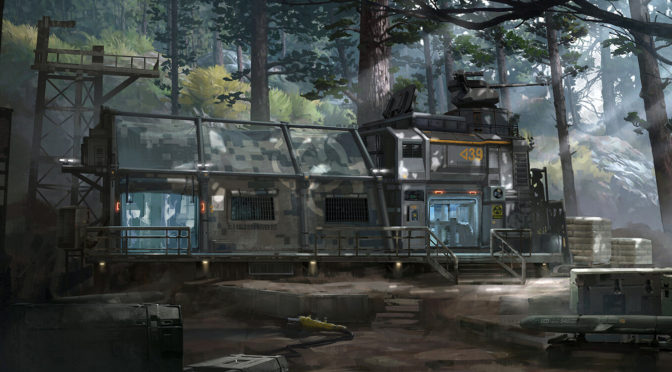
Featured Image: “The Jungle Base” by Tom Lee (via Artstation)