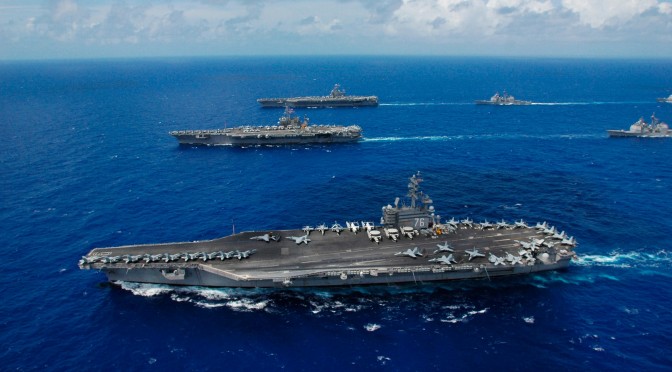
As a man who as spent entirely too much time flying in the immediate vicinity of the colloquial Death Star (and by that, I mean the aircraft carrier) over the last year, I know firsthand how forgone a conclusion naval aviation can seem. Naval aviation, as the world knows it, is a multibillion dollar power projection leviathan that literally catapults fire control solutions from mobile sovereign territory to the bad guys du jour, right? Kick the tires, light the fires, open and shut case… Or is it? From future capabilities to current funding limitations, reality is inescapably more complex.
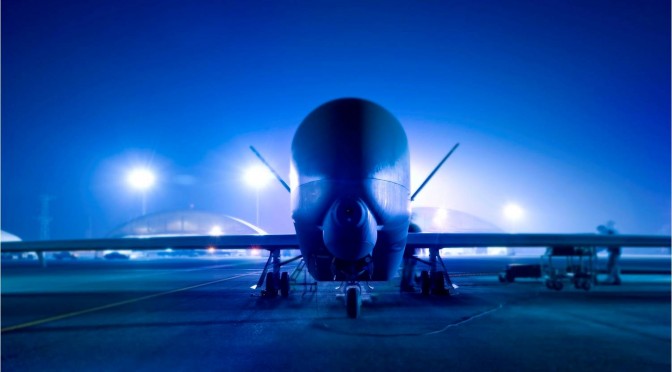
Speaking of ISR, how did an article summarizing the future of naval aviation go four full paragraphs without mentioning drones? Ben Ho Wan Beng arrived in time to keep my bitterness against unmanned aviation in check with a fantastic look at the rise of UAS proliferation among littoral states seeking bang for their maritime buck in his piece, “What’s the Buzz: Ship-Based Unmanned Aviation & Its Influence on Littoral Navies.”
Jon Paris gave us a taste of the war none of us want to fight in his article, “Parallax and Bullseye Buoys.” An edge-of-your-seat thriller, Jon straps you into the cockpit for an IMC, EMCON recovery onboard a lights-out carrier in hostile skies. I don’t want to live in that world, and fortunately we aren’t in that kind of extremis yet, but Jon prepares the reader. He articulated the complexities of navigating in GPS-denied airspace and the necessity of electromagnetic spectrum fluency for the modern A2/AD environment, an issue recently addressed by CAPT Mark Glover at C4ISR.
Meanwhile, what good is a debate on the direction of military planning without a healthy dose of fiscal reality? Bridging the well funded past to the unaffordable future, Timothy Walton gave us a sneak peek from next month’s reportdue fromThe Hudson Institute’s Center for American Seapower. He reviewed the shrinking scale of the carrier air wing by the numbers and illustrated unmistakable mission gaps created along the way. From the salad days of the Tomcats to the uncertain future of the Joint Strike Fighter, Mr. Walton illuminated the reduced footprint of the current air wing and possible ramifications facing the CSG of the future in “The Evolution of the Modern Carrier Air Wing.”
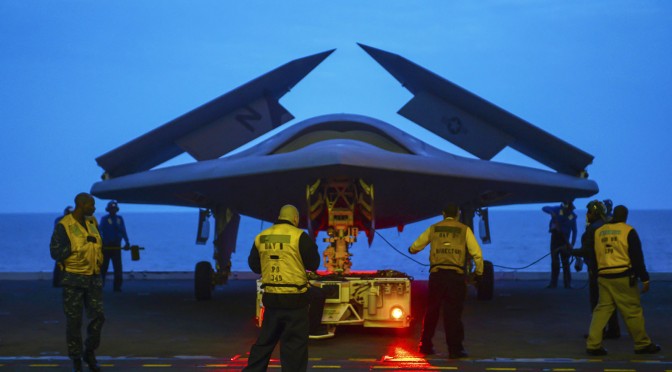
CDR Gregory Smith broadened the topic of integrated manned and unmanned operations with his article, “Trusting Autonomous Systems: It’s More Than Technology.” Beyond the short-term friction of terrified Djiboutian air traffic controllers, CDR Smith illustrated the essential progress required to instill the confidence required for fully integrated manned and unmanned combat operations. From C2 structures in flight to command structures in the Pentagon, the ground truth on drone warfare at sea has yet to reach IOC by any definition. CDR Smith’s article provided clear context for the way ahead.
Michael Glynn delivered the cold, hard truth on data collection efforts in Naval Aviation: if a P-8A Poseidon collects 900GB of data on a sortie with no client for the information, does it validate its R&D costs? His article, “Information Management and the Future of Naval Aviation,” provided a resounding YES while detailing the challenges facing efficient data extraction from maritime ISR operations.
Peter Marino adds international affairs into the mix by assessing the scope and implications of American technology transfer to India for the development of a powerful new carrier. Through a video review of “Making Waves: Aiding India’s Next Generation Aircraft Carrier,” he explores the unique value of naval aviation in foreign policy.
Our selections here delve into the challenges that lay ahead. I find the common thread unifying all of our authors to be the pursuit of value to the proverbial customer in an environment defined by change. What is it, exactly, that we are creating with all of this jet fuel?
The delivery of value to the stakeholder is incumbent on any military initiative from weapons safe to weapons free. On the one hand, that means providing maritime security and intelligence collection in the absence of conflict. Our authors speak from ground truth experience on the importance of developing and maintaining a cogent strategy for the proliferation of ISR and the subsequent decoding of the data collected.
On the other hand, delivering to the stakeholder requires a conscientious investment in fire control solutions against technologically advanced adversaries in denied airspace. There is no future without U-CLASS and there is no future without the JSF. These have to be integrated into the future of naval combat at least in the intermediate term. But what good is a fire control solution without C2 assurance? Are we ready for a GPS-denied environment? What will it take for tomorrow’s navy to compete in the conflicts of the future?
Ultimately, the sting of sequestration and the pain of acquisitions make the road ahead formidable. The hardest question to answer may be the most simple. What ends are we attempting to achieve by the means of naval aviation? Once our days of busting bunkers in the Middle East with precision guided munitions no longer carry the bulk of our workload, how do we leverage the unique capabilities of naval aviation across the entire spectrum of the rules of engagement to provide value to the theater commander?
It’s an exciting time to be a part of naval aviation. With such seismic shifts in sensor capabilities, adversary technological acumen, and A2/AD threat proliferation cast against cutthroat funding and acquisitions, this is not a sport for the faint of heart. Vision, flexibility, and creativity will define the success or failure of our transition to the next war we fight. Please join me in congratulating our authors on a job well done for their contribution to the next step, and feel free to join the discussion with your own feedback at nextwar@cimsec.org!
LT W. W. Hobson is an MH-60R pilot. The views expressed in this article are entirely his own and are not endorsed by the US Navy.
How will naval aviation employ unmanned aerial vehicles (UAVs) in the future? The answer is, of course, “it depends.” It depends on technology, on the economy and budgets, on whether we are at war or peace, and on leadership. It also depends on less interesting things like how squadrons and air wings are organized. Given the rapid advances in unmanned systems technology and the success of unmanned platforms like Predator and BAMS-D,1 UAVs will certainly proliferate and significantly impact the future of naval aviation. If properly integrated, future manned-unmanned teams could deliver exponential increases in combat power, but integration of unmanned aircraft requires a level of trust in autonomous systems that does not yet exist in naval aviation. Building trust will require technical improvements that increase the “trustworthiness” of UAVs, but it will also require naval aviation to establish organizations that enhance trust in UAVs with the goal of fully integrating them into the fight. Indeed, organization will likely be the limiting factor with regard to the pace of integrating trusted UAVs. Therefore, naval aviation should consider the impact organization will have on the ability of aviators to trust UAVs and balance this among the competing requirements for introducing new unmanned platforms.
The Issue is Trust
Although naval aviators are perceived as natural risk-takers, they are trained to take no unnecessary risk and to mitigate risk throughout every evolution. Therefore, UAV integration will occur only when aviators trust UAVs to the same extent that they trust another aviator flying in close proximity as part of a strike package or during coordinated antisubmarine warfare sorties today.
The proliferation and success of UAVs in the past decade belies the fact that aviators still do not trust them. The vast majority of unmanned aircraft continue to fly only scheduled sorties in pre-established air space in order to ensure separation from manned aircraft. In addition, naval aviators operate with an abundance of caution around UAVs. Aircrews are briefed on planned UAV routes and orbits prior to a mission and routinely deviate from airspace assignments or coordinate new air space in flight to ensure safe separation from UAVs. Being notified that an operator has lost communications with a nearby UAV (i.e. it is autonomously executing a pre-programmed reacquisition profile) assists manned aircraft, but it also raises the hair on the back of an aviator’s neck. In the terminal area it becomes necessary to fly closer to UAVs, which is accomplished safely with the assistance of ground air traffic controllers. Still, as with any congestion, the threat to manned aircraft increases, especially in expeditionary locations. After several, near mid-air collisions with UAVs in 2010, one task force commander grounded his manned aircraft at a remote operating location until he was assured that the local control tower and UAV operators, who were physically located half-way around the world, would improve procedural compliance. Anecdotes like these abound, demonstrating both the adaptability and skepticism of aviators flying near UAVs. After nearly a decade of sharing the sky with UAVs, most naval aviators no longer believe that UAVs are trying to kill them, but one should not confuse this sentiment with trusting the platform, technology, or operators.
Building trust in autonomous systems should be a goal of those who will design the UAVs of the future as well as those who will employ them in the Fleet, because establishing trust in autonomous systems may be the tipping point that will unleash the revolutionary combat potential of UAVs. Naval aviation could fully integrate trusted UAVs into every mission area of every community. Unmanned tankers, wingmen (wingbots?), jammers, decoys, missile trucks, minesweepers, and communications relays could be launched from the decks of aircraft carriers, destroyers, support ships, from bases ashore, or from aircraft cargo bays, wing pylons and bomb bay stations in the coming decades, truly revolutionizing naval aviation. However, lack of trust is a critical obstacle which must be overcome before such a proliferation of UAVs can occur.
There are several technological improvements that can contribute to trust by enhancing situational awareness and the safety of both manned and unmanned platforms. Improvements in see-and-avoid technology are needed to assist UAV operators when the UAV is flying in proximity of manned platforms. UAV command and control architectures and traffic collision avoidance systems (TCAS), as well as radars and data links, require improved reliability, security, and flexibility to ensure survivability in an anti-access environment or in the face of cyber or space attacks. Systems that provide manned platforms with increased situational awareness regarding the location of UAVs and the intended flight profile would also enhance trustworthiness. Today, the vast majority of naval aviation is not comfortable sharing an altitude block with a UAV in day, visual meteorological conditions (VMC), much less during war at sea in an anti-access environment. Technological improvements that make UAVs more trustworthy are necessary but not sufficient for establishing trust between an aviator and a machine. Sufficient trust will also require training, mission experience, and technical understanding of the system.
Organization Matters
Given the technological enhancements described above, it is not a stretch to imagine a manned F-35 establishing a CAP station with a UAV wingman, or a P-8 crew employing UAVs or unmanned undersea vehicles (UUVs) to search for a submarine, or an E-2D using a UAV to extend the range of its radar or data link, or an EA-18G commanding a UAV to jam air defenses or deliver an electromagnetic pulse. There remain challenges to fielding these capabilities, but the technology will soon exist to safely integrate UAVs into these naval aviation missions and many more. This level of integration raises numerous questions about UAV organizations and their personnel.
Who would be responsible for the success, failure, and safety of the missions? Would each community operate UAVs that support its mission or would a UAV community operate all UAVs performing the full spectrum of naval aviation missions? How would a UAV operator develop the expertise to execute complex tactical tasks in close coordination with manned platforms? What tactical and technical training will be required to integrate UAVs in this manner? How are the skills of pilots and UAV operators similar? How are they different? What portions of the unmanned sorties are accomplished autonomously and which require a link with a UAV operator? From where will UAVs launch and recover? From where will they be controlled and who will control them?
The answers to these questions depend on how squadrons of the future will be organized to command, operate and maintain the UAVs. In turn, each organizational model significantly influences the amount of additional training, coordination, and experience required to achieve the trust necessary to fully integrate UAVs. Consider the issue of who controls the UAVs. Some options include: control by the pilot of a manned aircraft themself; control by another aviator in the same aircraft or section; control by an aviator from the same naval aviation community outside the section; control by a UAV operator from a UAV community — aboard ship, ashore, or airborne; and fully autonomous operation. The amount of trust required to execute complex missions in close proximity to UAVs is the same regardless of how the UAV is controlled, but the amount of trust inherent in each scenario varies greatly. Decisions about these elements will significantly influence how quickly aviators will be able to trust, and therefore integrate, UAVs. As technology overcomes the challenges posed by the various capabilities implied above, organizational structures will determine how quickly UAVs can be integrated into the fight.
Beyond U-CLASS
Naval aviation’s plans for its next UAV, the Unmanned Carrier Launched Airborne Surveillance System (U-CLASS), will prudently focus on ensuring the safe introduction of a novel platform in a budget constrained environment. Yet, looking beyond U-CLASS, there is the potential for naval aviation to exponentially increase its combat effectiveness by integrating UAVs in every mission area. Technological innovation is necessary to make UAVs more trustworthy, but naval aviation should also understand how organization will facilitate or impede the integration of trusted UAVs. The optimal structure of future UAV units will maximize trust between manned and unmanned platforms and allow for innovation and growth in integration.
Commander Smith is a Naval Flight Officer and the former Commanding Officer of VP-26. These are his views and do not reflect the views of the United States Navy.
This article featured as a part of CIMSEC’s September 2015 topic week, The Future of Naval Aviation. You can access the topic week’s articles here.
“Unmanned aviation” has been a buzzword in the airpower community during recent years with the growing prevalence of unmanned systems to complement and in some cases replace peopled ones in key roles like intelligence, surveillance and reconnaissance (ISR). Insofar as unmanned aerial vehicles (UAVs) are increasingly used for strike, their dominant mission is still ISR because of the fledging state of pilotless technology. This is especially the case for sea-based drones, which are generally less capable than their brethren ashore. That said, several littoral navies have jumped on the shipborne UAV bandwagon owing to its relative utility and cost-effectiveness.1 And with access to such platforms, how would these entities be affected during combat?
For littoral nations without an aerial maritime ISR capability in the form of maritime patrol aircraft (or only having a limited MPA capability), the sea-based drone can make up for this lacuna and improve battlespace/domain awareness. On the other hand, for littoral nations with a decent maritime ISR capability, the shipborne UAV can still play a valuable, albeit, complementary role. The naval drone also offers the prospect of coastal forces amassing more lethality as it refines the target-acquisition process, enabling its mother ship to attack the adversary more accurately.
The Littoral Combat Environment
Littoral operations are likely to be highly complex affairs. As esteemed naval commentator Geoffrey Till said: “The littoral is a congested place, full of neutral and allied shipping, oil-rigs, buoys, coastline clutter, islands, reefs and shallows, and complicated underwater profiles.”2One key reason behind the labyrinthine nature of littoral warfare is that it involves clutter not only at sea, but also on land and in the air. Especially troublesome is the presence of numerous ships in the littorals. To illustrate, almost 78,000 ships transited the Malacca Strait, one of the world’s busiest waterways, in 2013.3
Such a complex operating milieu would place a premium on the importance of battlespace awareness, which could make or break a campaign. As fabled ancient Chinese military philosopher Sun Tzu asserted: “With advance information, costly mistakes can be avoided, destruction averted, and the way to lasting victory made clear.” This statement was made over 2,000 years ago and is still as relevant today, especially when considered against the intricacies of littoral combat that hinder sensor usage. Indeed, shipborne radar performance during littoral operations can be significantly degraded by land clutter. For instance, the 1982 Falklands conflict manifested the problems sea-based sensors had in detecting and identifying low-flying aircraft with land clutter in the background.4 Campaigning in congested coastal waters would also necessitate the detection and identification of hostile units in the midst of numerous other sea craft, which is by no means an easy task. All in all, the clutter common to littoral operations presents a confusing tactical picture to naval commanders, and the side with a better view of the situation – read greater battlespace awareness – would have a distinct edge over its adversary. Sea-based UAVs can provide multispectral disambiguation of threat contacts from commercial shipping by virtue of onboard sensor suites, yielding enhanced situational awareness to the warfare commander.
Improved Battlespace Awareness
Traditional manned maritime patrol aircraft (MPA) would be the platform of choice to perform maritime ISR that helps in raising battlespace awareness in a littoral campaign. However, not all coastal states own such assets, which can be relatively expensive5, or have enough of them to maintain persistent ISR over the battlespace, a condition critical to the outcome of a littoral operation. This is where the sea-based drone would come in handy. Unmanned aviation has a distinct advantage over its manned equivalent, as UAVs can stay airborne much longer than piloted aircraft. To illustrate, the ScanEagle naval drone, which is in service with littoral navies such as Singapore and Tunisia and commonly used for ISR, can remain on station for some 28 hours.6 In stark contrast, the corresponding figure for the P-3 Orion MPA is 14 hours.7 The sensor capabilities of some of the naval drones currently in service make them credible aerial maritime ISR platforms. Indeed, they are equipped with sophisticated technologies such as electro-optical and infrared sensors, as well as synthetic aperture radar (SAR) systems.
To be sure, the shipborne UAV is incomparable to the MPA vis-à-vis most performance attributes, and the two platforms definitely cannot be used interchangeably. The utility of the naval drone lies in the fact that it can complement the MPA by taking over some of the latter’s routine, less demanding surveillance duties. This would then free up the MPA to concentrate on other, more combat-intensive missions during a littoral campaign, such as attacking enemy ships. And for a littoral nation without MPAs, the shipborne UAV would be especially valuable as it can perform aerial ISR duties for a prolonged period.
The naval drone can contribute to information dominance in another way. In combat involving two littoral navies, the side with organic airpower tends to have better domain awareness over the other, ceteris paribus. However rudimentary it may be, the shipborne drone constitutes a form of organic sea-based airpower that extends the “eyes” of its mother platform. The curvature of the Earth limits the range of surface radars, but having an “eye in the sky” circumvents this and improves coverage significantly. Being able to “see” from altitude allows one to attain the naval equivalent of “high ground,” that key advantage so prized by land-based forces. Indeed, the ScanEagle can operate at an altitude of almost 5,000 meters.8 In the same vein, the Picador unmanned helicopter has a not inconsiderable service ceiling of over 3,600m.9 In essence, the UAV allows its mother ship to detect threats that the latter would generally be unable to using its own sensors.
All in all, shipborne drones enable littoral fleets to have a clearer tactical picture, translating into improved survivability by virtue of the greater cognizance of emerging threats that they offer to surface platforms. Having greater battlespace awareness also means that the naval force in question would be in a superior position to dish out punishment on its adversary.
Increased Lethality
Sea-based UAVs would enable a littoral navy to target the opposing side more accurately as they can carry out target acquisition, hence increasing their side’s lethality. In this sense, the drone is reprising the role carried out by floatplanes deployed on battleships and cruisers in World War Two. During that conflict, these catapult-launched aircraft acted as spotters by directing fire for their mother ships during surface engagements. In more recent times, during Operation Desert Storm, Pioneer UAVs from the American battleship Wisconsin guided gunfire for their mother ship. Several current UAVs can fulfill this role. For instance, the Eagle Eye can be used as a guidance system for naval gunfire; ditto the Picador with its target-acquisition capabilities. There is also talk of drones carrying out over-the-horizon targeting so as to facilitate anti-ship missile strikes from the mother platforms.10
Though land-based UAVs are increasingly taking up strike missions, the same cannot be said for their sea-based counterparts as very few of the latter are even in service today in the first place due to their complexity and cost. The Fire Scout is one such armed naval UAV. This United States Navy rotorcraft can be armed with guided rockets and Hellfire air-to-surface missiles; however, with a unit cost of US$15-24 million11, it is not a low-end platform. All in all, unarmed shipborne drones are likely to be the order of the day for littoral navies, at least in the near term, and such platforms can only carry out what they have been doing all this while, tasks like ISR and target acquisition.
Conclusion
In summary, the sea-based drone can, to some extent, complement the maritime patrol aircraft in the aerial ISR portfolio at sea by helping to maintain battlespace awareness for the littoral navy during a conflict. The naval UAV’s target-acquisition capability also means that it can improve its owner’s striking power to some extent. These statements, however, must be qualified as current shipborne drones can only operate in low-threat environments – in contested airspace, their survivability and viability would be severely jeopardized, as they are simply unable to evade enemy fighters and anti-aircraft fire. In the final analysis, it can perhaps be maintained that the rise of sea-based UAVs constitutes incremental progress for littoral navies, as the platform does not offer game-changing capabilities to these entities.
Going forward, ISR is likely to remain the main mission for sea-based drones in the near future. Though the armed variant seems to offer a breakthrough in this state of affairs, it must be stressed that it is neither a simple nor cheap undertaking. If and when defense industrial players provide lower-cost solutions to this issue in the future, however, the striking power of coastal fleets would increase considerably and with that, the nature of littoral and naval warfare in general would profoundly change. Until then, the sea UAV-littoral navy nexus will be characterized by evolution, not revolution.
Ben Ho Wan Beng is a Senior Analyst with the Military Studies Programme at the S. Rajaratnam School of International Studies in Singapore; he received his master’s degree in strategic studies from the same institute. The ideas expressed above are his alone. He would also like to express his heartfelt gratitude to colleague Chang Jun Yan for his insightful comments on a draft of this article.
This article featured as a part of CIMSEC’s September 2015 topic week, The Future of Naval Aviation. You can access the topic week’s articles here.
Endnotes
1 For instance, the Scan Eagle drone has a unit cost of $100,000. See www.nytimes.com/2013/01/25/us/simple-scaneagle-drones-a-boost-for-us-military.html?_r=0.
2Geoffrey Till, Seapower: A Guide for the Twenty-first Century (London: Routledge, 2013), 268.
3Marcus Hand, “Malacca Straits transits hit all-time high in 2013, pass 2008 peak,” Seatrade Maritime News, February 10, 2014, accessed September 4, 2015, www.seatrade-maritime.com/news/asia/malacca-straits-transits-hit-all-time-high-in-2013-pass-2008-peak.html.
4Milan Vego, “On Littoral Warfare,” Naval War College Review 68, No. 2 (Spring 2015): 41.
5 Some of the more common MPAs include the P-3 Orion, which is in service with nations like New Zealand and Thailand which has a unit cost of US$36 million, according to the U.S. Navy. See www.navy.mil/navydata/fact_display.asp?cid=1100&tid=1400&ct=1.
6 “ScanEagle, United States of America,” naval-technology.com, accessed September 5, 2015, www.naval-technology.com/projects/scaneagle-uav.
Network-Centric Warfare derives its power from the strong networking of a well-informed but geographically dispersed force. – VADM Arthur Cebrowski, Proceedings 1998
Almost twenty years ago the pages of Proceedings carried an article by RDML Cebrowski that introduced the concept of network-centric, or net-centric, warfare.[1] The concept transformed the manner in which the United States (U.S.) Navy operates and fights. The principles that defined net-centric warfare remain relevant as they support Navy’s current pillars of Information Dominance: Battlespace Awareness, Assured Command and Control (C2), and Integrated Fires. The success of net-centric warfare has not gone unnoticed. Navies around the world are working to develop their own net-centric solutions. As a result, the U.S. Navy should not be surprised when enterprising individuals around the world similarly take note and make the evolutionary leap from traditional piracy to net-centric piracy.
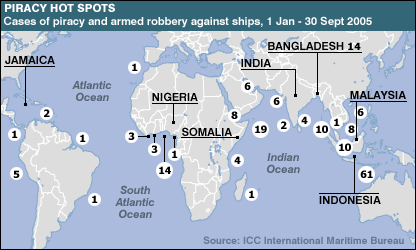
While piracy has been a scourge for the duration of human history, the technological advances of the 21st century provide potential pirates transformational means, methods and opportunities. While the world has yet to witness a case of net-centric piracy, the two scenarios below present possible piracy events leveraging today’s technology.
Basic Net-centric Piracy
Sixty-two nautical miles south east of Singapore – 17JUL15 1154C: An Indonesian pirate opens his laptop and logs onto the internet via satellite phone. His homepage is a commercial Automated Identification System (AIS) website providing real-time track data from coastal and satellite receivers.[2] The laptop, satellite phone and website subscription were all funded by his investors.[3] As he scans his homepage, he looks for AIS contacts that meet his desired vessel profile for cargo type, transportation firm, flag, and speed of advance. Today there are two AIS tracks of interest matching his profile and likely to pass through his preferred zone of operation, MV OCEAN HORIZONS and MW ORIENTAL DAWN. He then checks weather conditions and determining that they are favorable, he sends individual texts messages containing coordinate and track data for the AIS tracks of interest. The text recipients are two fishing boat captains, one located in Belawan, Indonesia and the other in Dungun, Malaysia.
From: The Maritime Executive – Indonesian Pirates
Forty-six nautical miles east of Belwan, Indonesia – 17JUL15 1646C: MV ORIENTAL DAWN passes a non-descript fishing boat 46 nautical miles off the coast of Indonesia. Unbeknownst to the crew of the MV ORIENTAL DAWN, this fishing boat is captained by the pirate’s associate from Belawan. The fishing boat’s captain discretely observes the passing vessel through a pair of high-powered binoculars. Seeing barbed wire along the railings and an individual on the ship’s deck that does not appear to be a member of the crew, the fishing boat captain utilizes a satellite phone to call and report his observations to his Indonesian pirate contact. Based on this information the Indonesian pirate determines that MV ORIENTAL DAWN is not a suitable target.
One-hundred seventeen nautical miles east of Singapore – 17JUL15 1707C: The Indonesian pirate receives a call. This time it is the fishing boat captain from Dungun. The captain reports that the MV OCEAN HORIZONS is loaded down creating a smaller freeboard and there does not appear to be any additional security measures present. Given this assessment, the Indonesian pirate decides that MV OCEAN HORIZONS is a target of opportunity. He immediately has the crew of his ship alter course.
Thirty-seven nautical miles east of Pekan, Malaysia – 18JUL15 0412C: The Indonesian pirate launches two high-speed skiffs from his ship, both carrying multiple armed personnel. The Indonesian pirate mothership remains over the horizon, but in radio contact while the skiffs conduct the remainder of the intercept.
Sixty-two nautical miles east of Pekan, Malaysia – 18JUL15 0642C: The armed personnel from the skiffs board MV OCEAN HORIZONS and catch the crew off guard. Once in control of the ship, they contact the Indonesian pirate via radio and report their success. The Indonesian pirate immediately opens his laptop and reports his success to his investors. He also lists the ship’s cargo for auction on a dark website and sends a ransom demand to the employer of the MV OCEAN HORIZON crew.
Sophisticated Net-centric Piracy
Moscow, Russia – 17JUL15 0126D: After a series of all-nighters over the last week, a Russian hacker has gained access to a crewmember’s computer onboard the MV PACIFIC TREADER.[4] Using this access he maps the shipboard network. Discovering a diagnostic and maintenance laptop used for the ship’s automation and control system on the network, he quickly exploits the laptop’s outdated and unpatched operating system to install a tool on the automation and control system.[5] The tool enables a remote user to either trigger or disable a continual reboot condition. Once installed, the hacker posts the access information for the tool’s front end user interface in a private dark web chatroom.
Prague, Czech Republic – 16JUL15 2348A: Sitting in his Prague apartment, a pirate receives a message on his cellphone via a private dark web chatroom. The message is from one of several hackers he contracted to gain access to control or navigation systems onboard vessels operated by the TRANS-PACIFIC SHIPPING LINE. With the posted access information, he logs onto his laptop and tests his access into the MV PACIFIC TREADER automation and control system. After successfully establishing a connection he closes out of the tool and electronically transfers half of a contracted payment due to his hired hacker. Next using a commercial AIS website providing real-time track data from coastal and satellite receivers, he determines that MV PACIFIC TREADER is likely headed into port in Hong Kong.[6] Posting a message in a different private dark web chatroom, the pirate provides the identifying information for MV PACIFIC TREADER.
Hong Kong, China – 19JUL15 0306H: On a rooftop in Hong Kong, a young college student pulls an aerial drone out of her backpack. She bought it online and it is reportedly one of the quietest drones on the market. She also pulls three box-shaped objects out of her backpack. Hooking one of the objects to the drone, she launches it and flies it across Hong Kong harbor in the direction of a ship she identified during the day as the MV PACIFIC TREADER. Using the cover of darkness she lands the drone on the top of the pilot house and releases the object. Repeating this process twice more, she places the box shaped objects on other inconspicuous locations on the ship. After bagging up her drone, she posts a message to a dark web chatroom simply stating that her task is complete. Almost immediately afterwards she receives a notification that a deposit was made into her online bank account.
Prague, Czech Republic – 25JUL15 1732A: After eating a home-cooked meal, the pirate sits down at his laptop and checks the position of MV PACIFIC TREADER via the commercial AIS website he subscribes to. Observing that the MV PACIFIC TREADER is relatively isolated in the middle of the Pacific Ocean, he opens the remote tool that provides him access to the ship’s automation and control system. He sends a text message and then clicks to activate the tool.
Two-thousand ninety-three nautical miles north east of Hong Kong – 26JUL15 0332K: Onboard MV PACIFIC TREADER an explosion engulfs the bow of the ships sending flames into the dark air. Immediately, the ship’s engines roll to a stop as the navigation and ship’s control system computers go into a reboot cycle. The lone watchstander on the bridge is paralyzed to inaction by the surprise and violence of the events unfolding around him. The Master immediately comes to the bridge, completely confused by the events occurring onboard his ship.
Prague, Czech Republic – 25JUL15 1736A: The pirate confirms via his remote tool that the ship’s automation and control system is in a continuous reboot cycle, then he re-checks the commercial AIS website and confirms that MV PACIFIC TREADER is dead in the water. He immediately sends an email to the TRANS-PACIFIC SHIPPING LINE demanding a ransom, stating MV PACIFIC TREADER will remain dead in the water and more explosive devices will be activated until he is paid.
New Means – Same Motive
These scenarios illustrate how the evolution of technology and the increased connectivity of systems and people potentially enable a fundamental shift in the nature of piracy. Despite the change in means and geographic distribution of actors, net-centric and traditional piracy both utilize physical force or violence, or the threat thereof, by a non-state actor to seize or detain a vessel operating on the high seas. The key enabler of net-centric piracy is the Internet.
The Internet is the net-centric pirate’s “high-performance information grid that provides a backplane for computing and communications.”[7] Admiral Cebrowski argued that this information grid was the entry fee for those seeking net-centric capabilities.[8] What Admiral Cebrowski did not know was how rapidly the Internet would evolve and enable near-instantaneous global communications at relatively low costs, allowing anyone who desires access to a high-performance information grid.
As the net-centric pirate’s high-performance information grid, the Internet serves as a command and control network as well as the means for disseminating intelligence information, such as vessel location or the presence of physical security measures. The intelligence that is disseminated may also have resulted from collections performed via the Internet. One collection means is to leverage the vast area of private and commercial data sources available for public consumption, again at little or no cost, such as shipping schedules and AIS data. A second means of collection uses the Internet to conduct intelligence, surveillance and reconnaissance (ISR) via cyber techniques; however, only the most sophisticated net-centric pirates will possess this capability. Similarly, highly sophisticated net-centric pirates may be able to achieve global weapons reach by producing physical effects via cyber means over the Internet, eliminating the need for the pirate to be physically present in order to seize or detain a vessel.
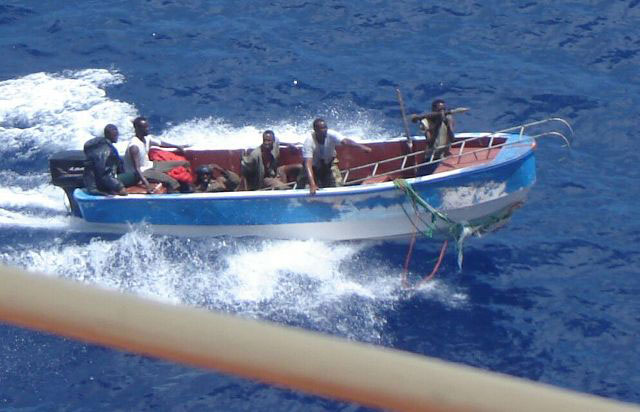
From: OCEANUSLive – Somali Pirates
The attractiveness of net-centric piracy is the low barrier to entry, both in risk and cost. Since the Internet is the key enabler of net-centric piracy, its low cost and ease of use vastly expand the potential pirate population. The anonymity of the Internet also allows potential net-centric pirates to meet, organize, coordinate and transfer monetary funds with a great degree of anonymity. As a result, the risks of arrest or capture are significantly reduced, especially since a net-centric pirate may not be able to identify any of their co-conspirators. Similarly, the ability of net-centric piracy to enable remote intelligence gathering or even produce physical effects via cyber techniques removes a significant element of physical risk associated with traditional piracy. The monetary gain from the successful capture of a vessel compared to the low cost and risk currently associated with net-centric piracy make it an attractive criminal enterprise.
Countering Net-centric Piracy
The United Nations Convention of the Law of the Sea (UNCLOS) Article 101 defines piracy as:
any illegal acts of violence or detention, or any act of depredation, committed for private ends by the crew or the passengers of a private ship or a private aircraft, and directed:
on the high seas, against another ship or aircraft, or against persons or property on board such ship or aircraft;
against a ship, aircraft, persons or property in a place outside the jurisdiction of any State;
any act of voluntary participation in the operation of a ship or of an aircraft with knowledge of facts making it a pirate ship or aircraft;
any act of inciting or of intentionally facilitating an act described in subparagraph (1) or (2).[9]
Under this internationally recognized legal definition of piracy, net-centric piracy clearly results in violence against or detention of vessels on the high seas for private ends. It is also clear from this definition that any activities associated with facilitating a piracy event, such as intelligence collection or compromising a vessel’s computerized control systems, are also considered piracy under international law. International law also states that “All States shall cooperate to the fullest possible extent in the repression of piracy on the high seas or in any other place outside the jurisdiction of any State.”[10] As a result, the international community must resolve how it will counter net-centric piracy, where pirates need not operate on the high seas and may be located thousands of miles from the target vessel.
The challenge facing the international community from net-centric piracy is compounded by immaturity of international cyber law. Currently the authorities and responsibilities of international organizations, governments and law enforcement agencies with regards to the use of the Internet to commit piracy are undetermined. This challenge is further complicated by the fact that the Internet is a manmade domain where all potions are essentially within the territory of one state or another. As a result, disrupting net-centric piracy operations will require a significant degree of international coordination and information sharing. Extensive international cooperation will also be required to identify, locate, and apprehend individuals involved in net-centric piracy.
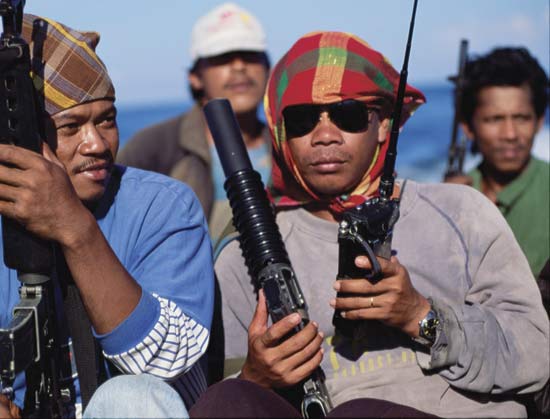
From: Encyclopedia Britannica – Pirates utilize a range of weapons and technology
While an occurrence of net-centric piracy has yet to occur, the opportunity and capabilities required for such an event exist today. The U.S. Navy should not be caught off guard. Instead, the Navy should take the following actions:
Raise awareness within the international maritime community regarding the risks and realities of net-centric piracy
Provide best practice and limited cybersecurity threat information to transnational maritime shipping companies
Work with partner Navies to develop means and methods for disrupting net-centric piracy, including developing an appropriate framework for information sharing and coordination
Work with Coast Guard, law enforcement and international partners to develop a cooperative construct for identifying, locating and apprehending net-centric pirates
Engage with the State Department to advance international dialog on net-centric piracy, including the need for consensus on international law and processes for prosecution of net-centric pirates
An enduring lesson of human history is that opportunity for profit, regardless of difficulty or brevity, will be exploited by someone somewhere. Net-centric piracy represents an opportunity to generate revenue without requiring the physical risks of traditional piracy. The anonymity and distributed nature of the cyber domain also creates new counter-piracy challenges. Add to this the low cost and availability of unmanned system components coupled with the low barrier of entry for cyber, and the question becomes not whether net-centric piracy will occur but when. With a global interest in maintaining the international maritime order and ensuring the uninterrupted flow of commerce on the high seas, the U.S. Navy must be ready to meet the challenges of net-centric piracy.
LCDR Brian Evans is a U.S. Navy Information Dominance Warfare Officer, a member of the Information Professional community, and a former Submarine Officer. He is a graduate of the U.S. Naval Academy and holds advanced degrees from Johns Hopkins University, Carnegie Mellon University, and the Naval War College.
The views expressed in this article are those of the author and do not reflect the official policy or position of the United States Navy, Department of Defense or Government.
[1] VADM Arthur K. Cebrowski and John H. Garstka, “Network-Centric Warfare – Its Origin and Future,” U.S. Naval Institute Proceedings, Volume 124/1/1,139 (January 1998).
[5] Mate J. Csorba, Nicolai Husteli and Stig O. Johnsen, “Securing Your Control Systems,” U.S. Coast Guard Journal of Safety & Security at Sea: Proceedings of the Marine Safety & Security Council, Volume 71 Number 4 (Winter 2014-2015).
[7] VADM Arthur K. Cebrowski and John H. Garstka, “Network-Centric Warfare – Its Origin and Future,” U.S. Naval Institute Proceedings, Volume 124/1/1,139 (January 1998).
[8] Ibid.
[9] United Nations, United Nations Convention on the Law of the Sea (New York: United Nations, Article 101, 1994).
[10] United Nations, United Nations Convention on the Law of the Sea (New York: United Nations, Article 100, 1994).