All posts by Dmitry Filipoff

Flotilla SITREP: Surface Navy Tactical Excellence, Bonhomme Richard Fire, and Carriers

By Dmitry Filipoff

The CIMSEC Warfighting Flotilla, our new naval professional society, is off to a strong start. After last month’s public launch, new signups prompted the membership to more than triple to nearly 200 members, an exciting start for the Flotilla.

Our first round of post-launch discussion sessions were well-attended, insightfully candid, and further illuminated the exciting potential of this new community. Our November session topics, their prompts, and the recommended read aheads are listed down below for reference.

Sign up through the form below to become a Flotilla member and receive invites to our upcoming off-the-record December sessions. Feel free to visit the Flotilla homepage to learn more about this community, its activities, and what drives it.

We hope to see you at a session soon!

______________________________________________________________________________________

The State of Tactical Excellence in the Surface Navy

The Surface Navy is looking to improve its tactical skillsets to meet the demands of high-end warfighting. But after decades of focusing on power projection missions, extensive checklists, and significant maintenance demands, the state of tactical excellence in the Navy could have room for improvement. What is the state of tactical learning today in the Surface Navy, and how are things trending? How can the Surface Navy better organize for enhanced tactical learning, especially with respect to great power threats? Join us to consider these questions and more as we consider the state of tactical excellence in the Surface Navy.

Recommended Read Aheads:

“The Surface Navy: Still in Search of Tactics,” by Captain Christopher H. Johnson, U.S. Navy, CIMSEC (republication), July 10, 2018.

“What Got Us Here Won’t Get Us There,” by Vice Admiral Roy Kitchener, Rear Admiral Brad Cooper, and Rear Admiral Paul Schlise, U.S. Navy, Proceedings, January 2021.

Warfighting Lessons from the Bonhomme Richard Fire

The loss of the Bonhomme Richard, according to the Navy’s investigation, was the result of “repeated failures [that] allowed for the accumulation of significant risk and an inadequately prepared crew, which led to an ineffective fire response.” What warfighting lessons can the Navy take from the loss of the Bonhomme Richard? Are there implications for damage control readiness, training, and organization? Join us to discuss these questions and more as we consider what can be learned from the Bonhomme Richard fire.

Recommended Read Aheads:

“Long Chain of Failures Left Sailors Unprepared to Fight USS Bonhomme Richard Fire, Investigation Finds,” by Sam LaGrone and Gidget Fuentes, USNI News, October 19, 2021.
“Fire, Fire, Fire: How Navy Failures Destroyed the Bonhomme Richard,” by CW4 Michael Carr (ret.), gCaptain, October 26, 2021.

How To Use The Carrier in the High-End Fight

The role of the aircraft carrier in high-end warfighting is under intense scrutiny as peer competitors develop ever more powerful capabilities. What could the role of the aircraft carrier be in modern, networked fleet combat? How could the aircraft carrier figure into Distributed Maritime Operations? Join us to discuss these questions and more as we consider future warfighting roles for the aircraft carrier.

Recommended Read Ahead: “Use Carriers Differently in a High-End Fight,” by Captain Robert “Barney” Rubel, U.S. Navy (ret.), Proceedings, September 2018.
______________________________________________________________________________________

Dmitry Filipoff is CIMSEC’s Director of Online Content and Community Manager of the Warfighting Flotilla. Contact him at Content@cimsec.org.

Fiction Contest Week Kicks Off on CIMSEC

By Dmitry Filipoff

Fiction Contest Week is finally here! Through the next week, CIMSEC will run the top stories submitted in response to our Short Story Fiction Contest, launched in partnership with the U.S. Naval Institute for the second consecutive year.

The winners were ultimately selected by our panel of judges which included August Cole, David Weber, Larry Bond, Kathleen McGinnis, Peter Singer, and Ward Carroll. 

The winning stories will be jointly featured by the U.S. Naval Institute’s Proceedings and CIMSEC. Additionally, the top 10 stories that advanced to the final round of judging will be featured in CIMSEC’s Fiction Contest Week.

These exciting and thoughtful stories explore the future of maritime security and conflict. The emerging threats, concepts, and capabilities of today are deftly envisioned, and with sometimes unexpected scenarios and results. Through these stories we can peer into the challenges of tomorrow and probe deeper into the unthinkable.

The top 10 stories are below, which are not necessarily listed in the order they placed or will appear. Stay tuned to the very end to find out who won!

“#CancelMolly,” by Major Brian Kerg, USMC
“Security by Obsolescence,” by Captain James Schmitt, USAF

“The Dream of Russia: The Events of September 23rd, 2024,” by Billy Bunn
“Reality Hack,” by Robert Williscroft
“Any Clime and Place,” by Karl Flynn
“First Move,” by Dylan Phillips-Levine and Trevor Phillips-Levine

“Fishbowl in a Barrel,” by Keith Nordquist
“Bone Daddy,” by Michael Barretta 

“The Baffin Bay Turkey Shoot,” by Mike Matson
“Task Force Foo Fighter,” by Jon Paris

Dmitry Filipoff is CIMSEC’s Director of Online Content. Contact him at Content@cimsec.org.

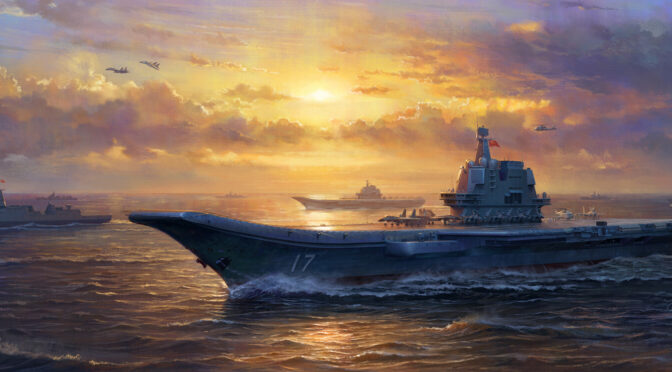
Featured Image: “PLA Carrier Fleet (#16 Liaoning & #17 Shandong)” by jeffbearholy via Artstation.

Announcing the CIMSEC Warfighting Flotilla — Join Our New Naval Professional Society Today

By Dmitry Filipoff

Today we announce a CIMSEC initiative long in the making — a new naval professional society where warfighters and interested individuals can come together to discuss naval warfighting, force development, and the naval profession. Through this naval society — the CIMSEC Warfighting Flotilla — members will have candid, off-the-record discussions about the ever-changing nature of naval warfighting, how to better organize tactical learning, and how to refine naval professional development to meet warfighting challenges.

Through a months-long series of trial discussions we have amassed more than 60 plank-owning members, a strong and exciting start for our growing membership. These off-the-record conversations have been lively and candid, focusing on topics such as Warfare Tactics Instructor programs, air defense concepts, integrating for cross-community anti-submarine warfare, and much more. The connections made between our members has fostered professional development and expanded personal networks of tactically-minded individuals.

Today we make the Flotilla public and open for any interested individuals to join as members. Fill out the form below to join today and receive invites to our upcoming November sessions. Read on to learn more about the principles driving our growing community.

The Flotilla takes its name from the Torpedo Flotilla of the Atlantic Fleet, an early 20th century naval formation commanded by renowned naval commander and thinker William S. Sims. Sims transformed the Flotilla into an at-sea laboratory for the development of tactics and doctrine on the eve of the First World War. Sims systematically convened Flotilla sailors in equitable and candid conversations about the development of tactics and doctrine, which would inform subsequent at-sea exercises and formal publications. Many of the U.S. Navy’s senior leaders of the Second World War passed through Sims’ Flotilla as junior officers, where their professional development was no doubt enhanced by a collaborative spirit singularly focused on excelling at naval warfighting.

And those two core features are what animate the CIMSEC Warfighting Flotilla. Today the attention of warfighters is often pulled in myriad directions and across numerous burdens, often forcing the in-depth professional development of tactically-focused skills to take a backseat. The Flotilla’s discussion sessions are exclusively on topics of naval warfighting and force development to guarantee a tight focus on matters immediately relevant to warfighting excellence.

To ensure candid and equitable exchanges, Flotilla conversations are off-the-record, respectful, and collaborative. Issues are explored, solutions are offered, and individuals emerge from conversations with the potential for new relationships and fresh insights. Unless otherwise specified, all Flotilla members participate in a personal, unofficial capacity, ensuring all have an equitable opportunity to speak and be heard. In this community we recognize in earnest that helpful ideas and insights can come from any background and level of experience.

The CIMSEC Warfighting Flotilla will help advance the conversations surrounding naval warfighting and force development, while building community and enhancing professional development. Together we will build a strong community of tactically-minded members focused on advancing naval warfighting excellence. 

Join our new naval professional society today to participate and be kept apprised of future activities and member-only opportunities. There is much more to come from the Flotilla soon!

Dmitry Filipoff is CIMSEC’s Director of Online Content and Community Manager of the Warfighting Flotilla. Contact him at Content@cimsec.org.

Emerging Tech Week Concludes on CIMSEC

By Dmitry Filipoff

In recent weeks CIMSEC featured submissions sent in response to our call for articles on emerging technologies, issued in partnership with the Naval Warfare Studies Institute and Lockheed Martin, for CIMSEC’s Project Trident.

The evolution of technology has been a driving force in how naval forces are developed and employed. Technology has been central to defining how naval platforms can contribute to the fight, what systems can constitute a naval asset, and how sailors interact with machines to exercise naval power in all its forms. 

Emerging technologies today constitute some of the greatest risks and most pressing opportunities that face naval forces. Artificial intelligence could transform the nature of naval command and control while augmenting what decision-making the warfighter can contribute to the fight. Autonomous undersea vehicles could broadly proliferate and pose widespread yet silent threats. Virtual reality could offer new avenues and methods of training warfighters and exploring future threat environments. 

Amidst all this change, the pursuit of emerging technologies and the drive to harness their warfighting potential is characterized by competition. A range of actors and great powers are in an accelerating race to explore these technologies, capitalize on their supposed advantages, and be best prepared to employ or guard against them.

Below are the authors and articles that featured during CIMSEC’s Emerging Technology week. We thank them for their excellent submissions.

“The Influence of Technology on Fleet Architecture,” by J. Noel Williams

“It is critical that strategy-derived functions and missions, operating concepts to accomplish these missions, and technological opportunity guide the development of naval forces to realize a fleet fit for the purposes required by national, defense, and military strategies. Measuring the benefit of a new platform by comparing its performance to its predecessor or comparing a class of ship to an adversary’s like ship class does not answer the question.”

“Leviathan Wakes: China’s Growing Fleet of Autonomous Undersea Vehicles,” by Ryan Fedasiuk

“Over the past decade, details have sporadically emerged about China’s unmanned (UUV) and autonomous undersea vehicle (AUV) projects, but questions linger about which kinds of vessels the Chinese defense industry may be developing, and how the People’s Liberation Army (PLA) might use them in a future conflict.”

“Red Cell Analysis of a Mobile Networked Control System Supporting a Ground Force,” by Larry Wigington, Ruriko Yoshida, and Doug Horner

“Our analytical models correctly identified the ground force’s intended movements in both scenarios. The ground force’s predicted path deviated from the actual path by an average of only 39 meters. The implications of these results are far-reaching as DoD begins to focus on competing with near-peer adversaries in the Indo-Pacific Theater, and the Marine Corps identifies the need for reconnaissance and counter-reconnaissance capabilities when conducting operations within the ‘weapons engagement zone.'”

“A Roadmap to Successful Sonar AI,” by LT Andrew Pfau

“Recently, NORTHCOM has tested AI/ML systems to search through radar data for targets, a project that has received interest and participation from all 11 combatant commands and the DoD as a whole. Due to its niche uses, however, passive sonar ML systems cannot match this level of department wide investment and so demands strong advocacy within the Navy.”

“Solving Communications Gaps in the Arctic with Balloons,” by Walker D. Mills

“Communications issues are a consequence of the polar operating environment and an obstacle for the military services operating there. But just because the environment is difficult does not mean that US forces have to go without persistent and reliable communications. High-altitude balloons could plug the communications gap not just for maritime forces but also for the Army and special operations units operating in these extreme latitudes.”

“Cognitive Lasers: Combining Artificial Intelligence with Laser Weapon Systems,” by Dr. Bonnie Johnson

“In many cases, the human operators may be well-served with an automated decision support system that can quickly calculate preferred weapon options based on the situation, such as doctrine statements. The emerging capabilities of artificial intelligence can be leveraged to enable automated decision aids for laser weapons—thus creating a cognitive laser approach for laser weapon systems.”

“Responding to the Proliferation of Uninhabited Underwater Vehicles,” by Andro Mathewson

“UUVs are becoming an important tool within the realm of international security. Naval forces across the world are quickly developing and acquiring a variety of UUVs due to their furtive nature, dual-use capabilities, and multifaceted functionalities. While the technology is still in relatively early development stages and leaves much to be desired, UUVs have quickly become an integral element of modern navies but also appear in the arsenals of lesser developed armed forces and non-state actors due to their utility as an asymmetric tool for sea denial.”

“Human Factors Meets New Technology in 2025,” by John Cordle and Robert Sweetman

“The Navy has monitored the temperatures and pressures of its fluid systems, and the voltage and current of its electrical ones, for literally centuries; the idea of doing the same for its people was a long time coming. To assess his alertness, J.T. then looks into the eyepiece of a Psychomotor Vigilance Self-Test (PVT) machine, pressing the mouse with each flash of light, speaking into the voice machine, and after three minutes is cleared, by a series of proven technologies leveraged together, to take the watch.” 

“Drones and Starlink: Combining Satellite Constellations With Unmanned Navy Ships,” by Brandon Wall and Nicholas Ayrton

“It is these two emerging technologies, maritime drone vessels and large satellite communication constellations, that could allow for the Navy to solve some of its ongoing issues and permit the creation of a more nimble, lean, and modern force able to better confront the rising security threats facing the United States in the years and decades to come.”

“Use Virtual Reality to Prepare Maritime Crews For Terrorist and Piracy Attacks,” by Selina Robinson and Dr. Amy Meenaghan

“The future of VR has a rightful place in maritime security. Already, the use of VR has been implemented by armies around the world who are able to train in battlefield scenarios and normalize high stress situations, whilst improving a range of fundamental skills from effective communications to critical combat techniques. In the maritime industry, the unexpected and ongoing attacks at sea require a different way of thinking and a different point of view on safety and procedures.”

Dmitry Filipoff is CIMSEC’s Director of Online Content. Contact him at Content@cimsec.org.

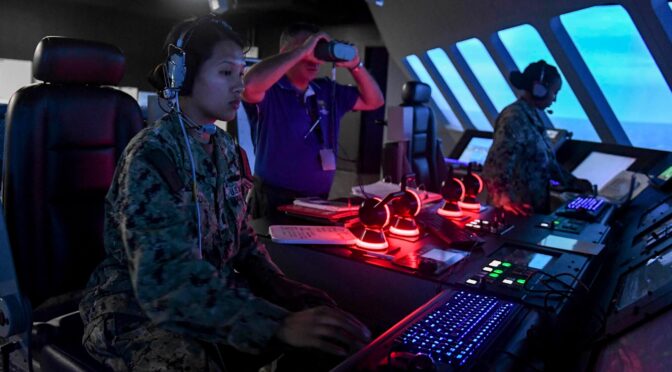
Featured Image: Lt. j.g. Sheryl Anne Acuna, assigned to the Freedom-class littoral combat ship USS Fort Worth (LCS 3), plays Officer of the Deck during live-action, interactive virtual-reality training at the Littoral Training Facility, Naval Station Mayport, June 27, 2019. (U.S. Navy photo by Mass Communication Specialist 3rd Class Alana Langdon)