Tag Archives: US Navy

Shifting to Shore Power?

By J. Overton

The concept that a nation’s means to compel its will originates “from the sea” is a fallacy.

For history’s greatest maritime powers, greatest navies, and greatest naval actions, the sea is at best a temporary operating environment. Sea power has always been created, tended, and entirely dependent on land. This is true even for the world’s largest and most globally-active modern Navy. The U.S. Fleet, its Sailors, civilian workers, and Navy family members spend most of their time ashore, in the United States. But this fact is conspicuously absent from both the 2015 version of the maritime strategy, “A Cooperative Strategy for 21st Century Seapower: Forward, Engaged, Ready” (CS21R) and its 2007 predecessor. In these and other recent strategic documents, the Navy’s largest, oldest, most expensive, most resilient, and most complex operational platforms, shore installations in the United States, suffer almost total neglect. [1][*]

To understand the role of America’s Navy in this young century, however, requires understanding the role of Navy shore infrastructure in America. To that end, the following offers a reality check on CS21R, an examination of how the naval resources concentrated in Navy bases gives them a power all their own, and an exploration of the capabilities these bases really contribute.

Design, Organize and Employ the Sea Services

“This maritime strategy describes how we will design, organize, and employ the Sea Services in support of our national, defense, and homeland security strategies. It also sets maritime priorities in an era of constrained resources, while emphasizing warfighting capabilities and forward naval presence to advance national interests today and guide preparations for tomorrow’s challenges.”CS21R[2]

Defining the meaning of “strategy” is difficult, defining a strategy itself even more so. Joint Publication 1-02, Department of Defense Dictionary of Military and Associated Terms, as reliable a source as we have, tells us that strategy is “A prudent idea or set of ideas for employing the instruments of national power in a synchronized and integrated fashion to achieve theater, national, and/or multinational objectives.” [3] CS21R is indeed a set of ideas for employing instruments of national power to achieve objectives, with the employment ideas mostly involving warfighting capabilities and forward naval presence. Many of the instruments mentioned, such as the 300-plus ship fleet, various technological advances, and even some partnerships mentioned, are not currently in existence. They are on wish lists which may never be realized.  Of those which do exist, most are not now employed primarily either for warfighting or in providing forward presence.
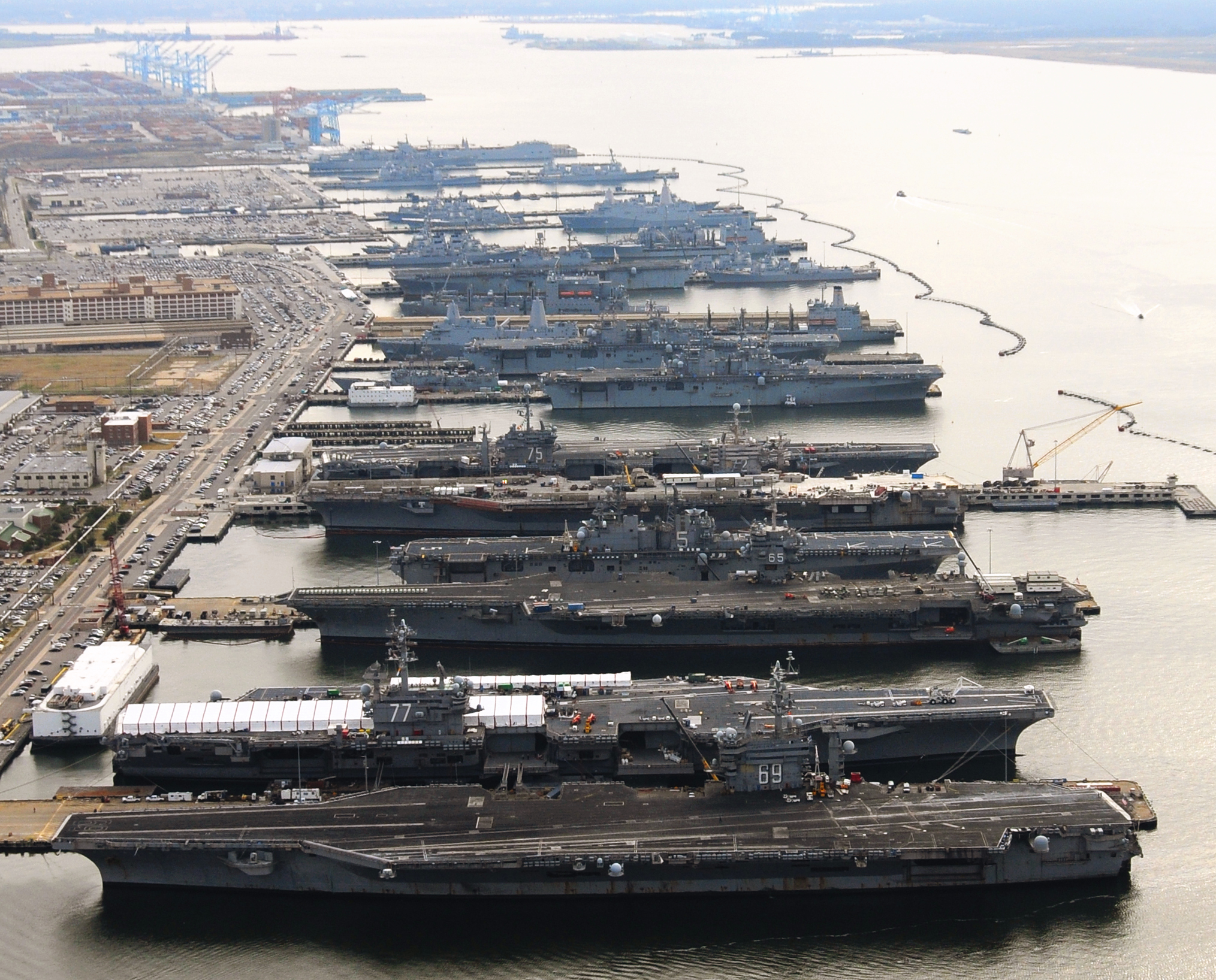
121220-N-ZN152-178NORFOLK (Dec. 20, 2012) The aircraft carriers USS Dwight D. Eisenhower (CVN 69), USS George H.W. Bush (CVN 77), USS Enterprise (CVN 65), USS Harry S. Truman (CVN 75), and USS Abraham Lincoln (CVN 72) are in port at Naval Station Norfolk, Va., the worldÕs largest naval station. (U.S. Navy photo by Mass Communication Specialist 2nd Class Ernest R. Scott/Released)
The aircraft carriers USS Dwight D. Eisenhower (CVN 69), USS George H.W. Bush (CVN 77), USS Enterprise (CVN 65), USS Harry S. Truman (CVN 75), and USS Abraham Lincoln (CVN 72) in port at Naval Station Norfolk, Va., (U.S. Navy photo by Mass Communication Specialist 2nd Class Ernest R. Scott/Released).

Another definition of strategy, perhaps more cynical if equally applicable, is “what you’re doing right now, intended or not.” [4] A snapshot “Status of the Navy,” taken in March  2016, shows that of the U.S. Navy’s 272 deployable battle force ships, about 49%  are deployed either underway or overseas. Of the 326,046 active duty Sailors, it can be assumed that a similar percentage is deployed or underway. This leaves less than half of the U.S. Navy’s deployable battle force ships in port, about the same number of her Sailors, and almost all of the 107,115 reservists, 195, 258 civilian employees, and hundreds of thousands of Navy dependents berthed and working ashore in the United States [5]

Strategic proclamations aside, shore installations are where, at any given moment in the year 2016 and the many years preceding it, one finds the majority of the U.S. Navy’s deployable platforms, people, and money.

Where it Matters, When it Matters

“The Navy’s current budget submission will provide for more than 300 ships and a forward presence of about 120 ships by 2020, up from an average of 97 in 2014, to be “where it matters, when it matters.” CS21R[6]

Although some Navy bases are inland, most are necessarily in the littoral, that narrow near-shore area where what happens on land influences the sea and what happens at sea influences the land. When applied to strategic thinking about foreign lands, the littoral realm is often considered a place inundated with both opportunities and threats. This is true when planning for combat or humanitarian operations in developing nations, but true for the continental United States as well. Our coastal areas tend to be the most populated, have the most desirable and expensive real estate, be the most environmentally sensitive, and be the most vulnerable to natural and man-made disasters.[7] They are also, of course, where the majority of Navy installations must exist. Those bases, many consisting of more than one geographic installation separated physically but under a single Commanding Officer, are mostly clustered into a few fleet concentration areas: [8] Significant naval presence in these regions pre-dates World War II, the aircraft carrier, submarine, diesel-power, and in some places, even the formation of the United States as a nation.
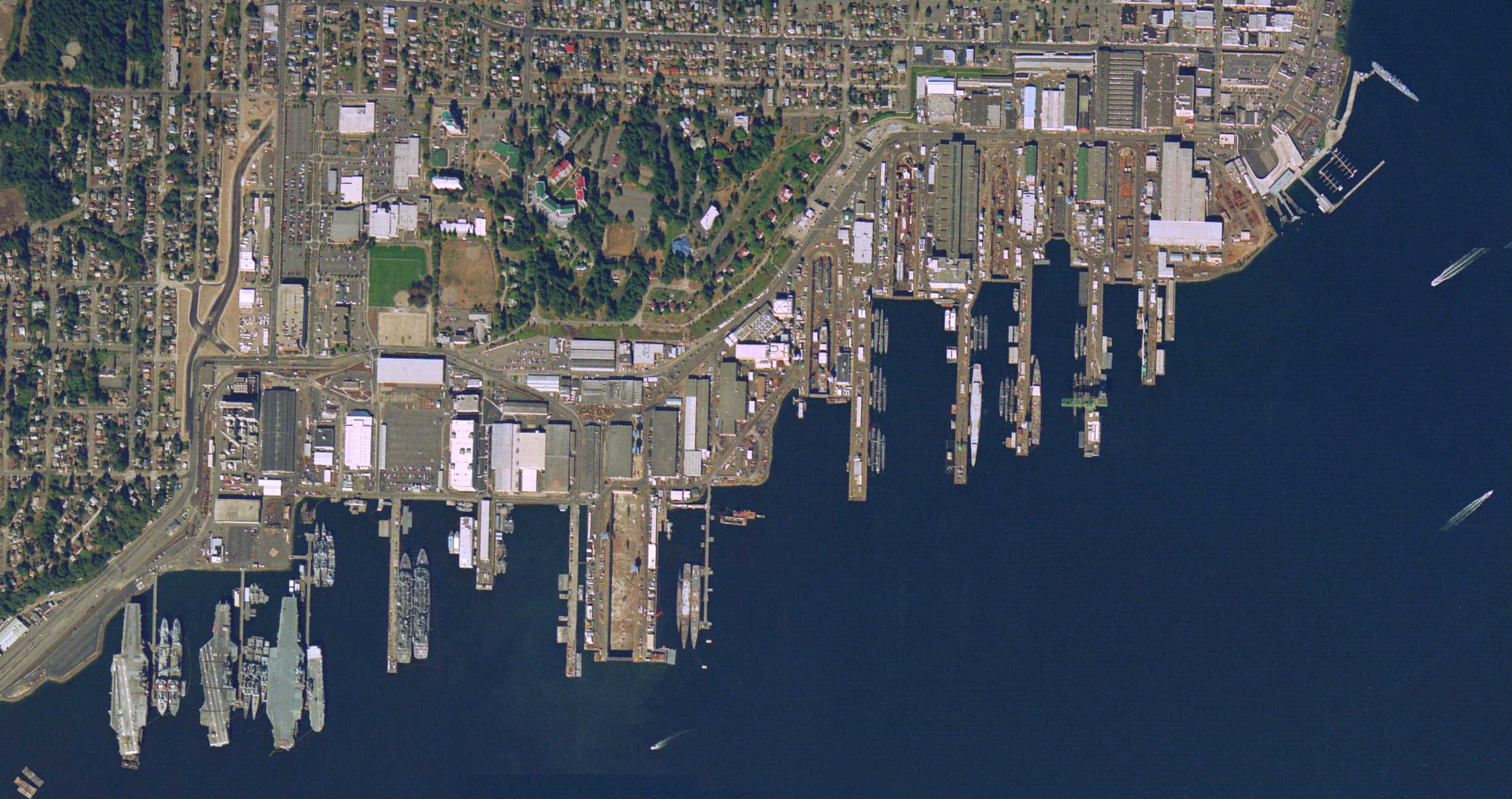
Bremerton naval base 2
An overhead view of Puget Sound Naval Shipyard in Bremerton,Washington.

For more than a decade Navy has stated its need for total fleet number somewhere in excess of 300 ships. Deployable force ships now stand at about 280, and haven’t been over 300 since 2003. [9] The extra 20 or 30 ships wished for may or may not arrive to fit themselves into CS21R. While there is much debate and handwringing over the optimal size and mission-set of the U.S. fleet and its overseas bases, ships can be built relatively quickly and cheaply compared to acquisition and maintenance of the real estate from which they’ll be based, and the long-term viability of bases not on U.S. soil is never assured.

Stateside shore installations are where it matters, when it matters: here, and now. And they’ve developed their own type of power to sustain them, without major course changes, for the foreseeable future.

Self-Sustaining Naval Forces

Our self-sustaining naval forces, operating in the global commons, ensure the   protection of the homeland far from our shores, while providing the President with decision space and options to deny an adversary’s objectives, preserve freedom of action, and assure access for follow-on forces.” CS21R [10]

There is no robust discussion or controversy about the need for the current fleet concentration areas, or even for most individual Navy bases in the United States.  Navy leadership implicitly recognizes the strategic value of their finite real-estate and unlike the Army and Air Force, is not currently calling for consolidation or closing of their shore infrastructure. [11] The decisions that usually matter about bases are those of policy makers, particularly Congress. Political leadership, generally of both parties and certainly going down from Capitol Hill to mayors and county commissioners of Navy base-dependent communities, has shown little desire to close bases, even if they do espouse curtailing some of the base’s more onerous operations. The smaller overall number of bases now in operation since previous rounds of Base Realignment and Closure, and their concentration into fewer Regions, means that most installations are a major source, if not the major source, of economic life for their immediate locale.

This economic power keeps Navy installations in the U.S. relatively safe from existential political threats. They have developed what journalist Walter Russell Mead refers to as “Sticky Power… [a power] based neither on military compulsion nor on simple coincidence of wills. Consider the carnivorous sundew plant, which attracts its prey with a kind of soft power, a pleasing scent that lures insects toward its sap. But once the victim has touched the sap, it is stuck; it can’t get away. That is sticky power…”[12]Mead was referring to the relationships between countries, such as that between China and the United States, but his theory is applicable for most major Navy bases and their local civilian communities. The two cannot extricate themselves from one another without mutually assured damage. Politicians, business leaders, education officials, and all manner of non-profits physically close to Navy bases are supporters of their local base, even if they disagree with overall U.S. military policy, or have an ignorance or contempt of traditional naval hard-power missions.
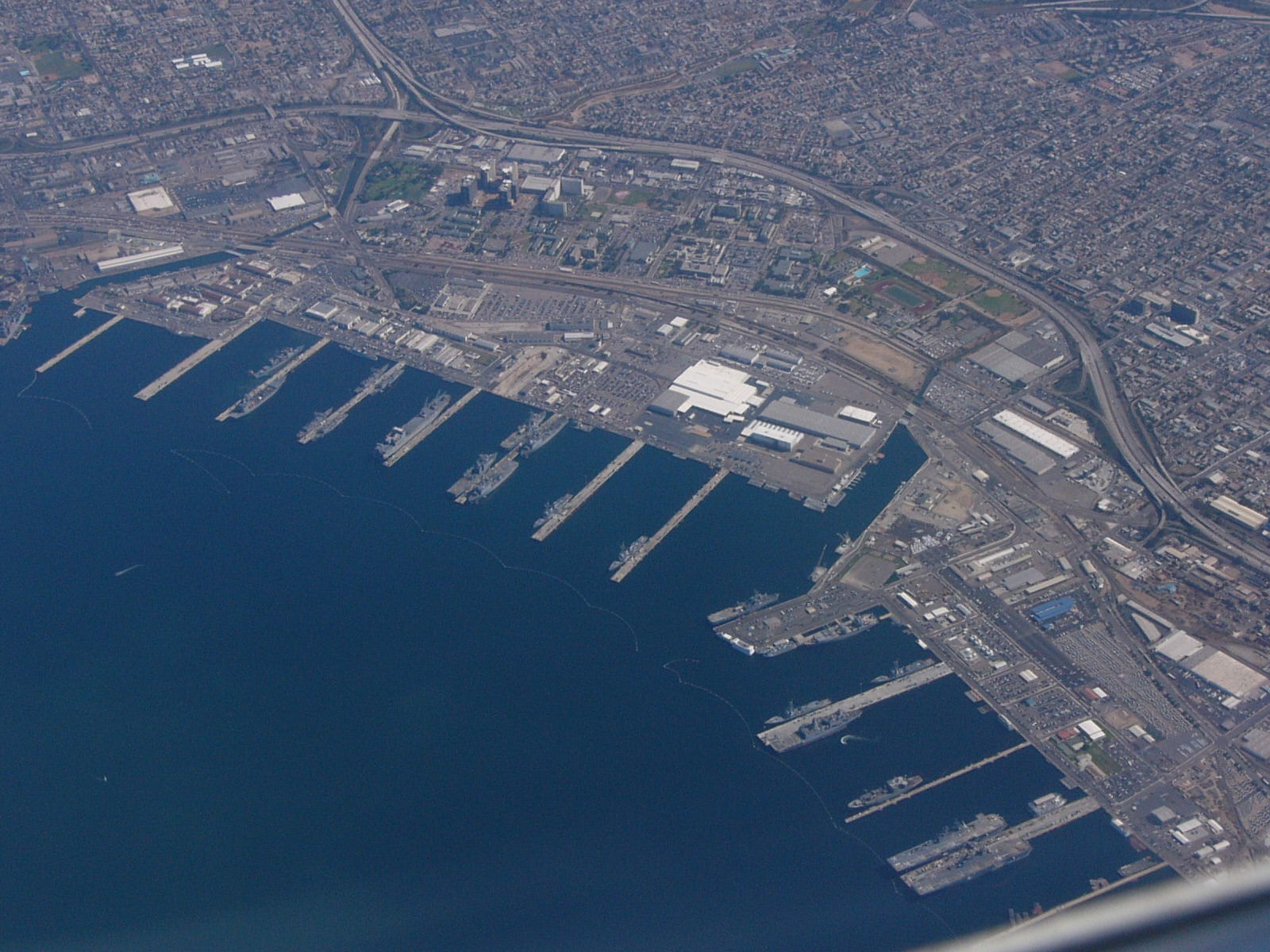
San Diego Naval base
San Diego Naval Base, as seen from a commercial airliner. Source: Wikipedia.

The effect of CONUS Naval installations’  power, rooted more in economics than grand strategy or traditional notions of Mahan or Corbett, leaves America a dispersed and networked range of Navy bases fairly secure from foreign attack, fairly secure from political infringement, and fairly secure from credible, capable local opposition. [13].

That Unique Capability: Presence

“Looking at how we support our people, build the right platforms, power them to achieve efficient global capability, and develop critical partnerships will be central to its successful execution and to providing that unique capability: presence.”CS21R [14]

To paraphrase a dead Prussian General, the first, the supreme, the most far-reaching act of judgment that must be made is to establish what a Navy base actually does, neither mistaking it for, nor trying to turn it into, something that is alien to its nature. The disparate missions these bases perform go well beyond simply supporting the Navy’s families and deploying Fleets and fighters. They are not, in the parlance of our most recent strategies and Sailing Directions, fighting wars or operating forward. But they are engaged, and they are ready.

Perhaps the best analogy for the collective power and capability they provide America would be that of a “Fleet in Being,” a concept historically applied to a naval force which, though not deployed or concentrated for battle, provided a deterrence function or caused some reaction on the part of an opposing force.[15] A “Fleet in Being” has a strategic value because, even if seemingly uninvolved in the most pressing contemporary operation, it has great potential.

Likewise, U.S. Navy bases are on American soil. They are dispersed around America, and nearly all share each of the following attributes: on Federal property; located in or near major commercial ports; located in areas prone to natural disasters; and having ample and diverse infrastructure, equipment, and personnel under Federal control.
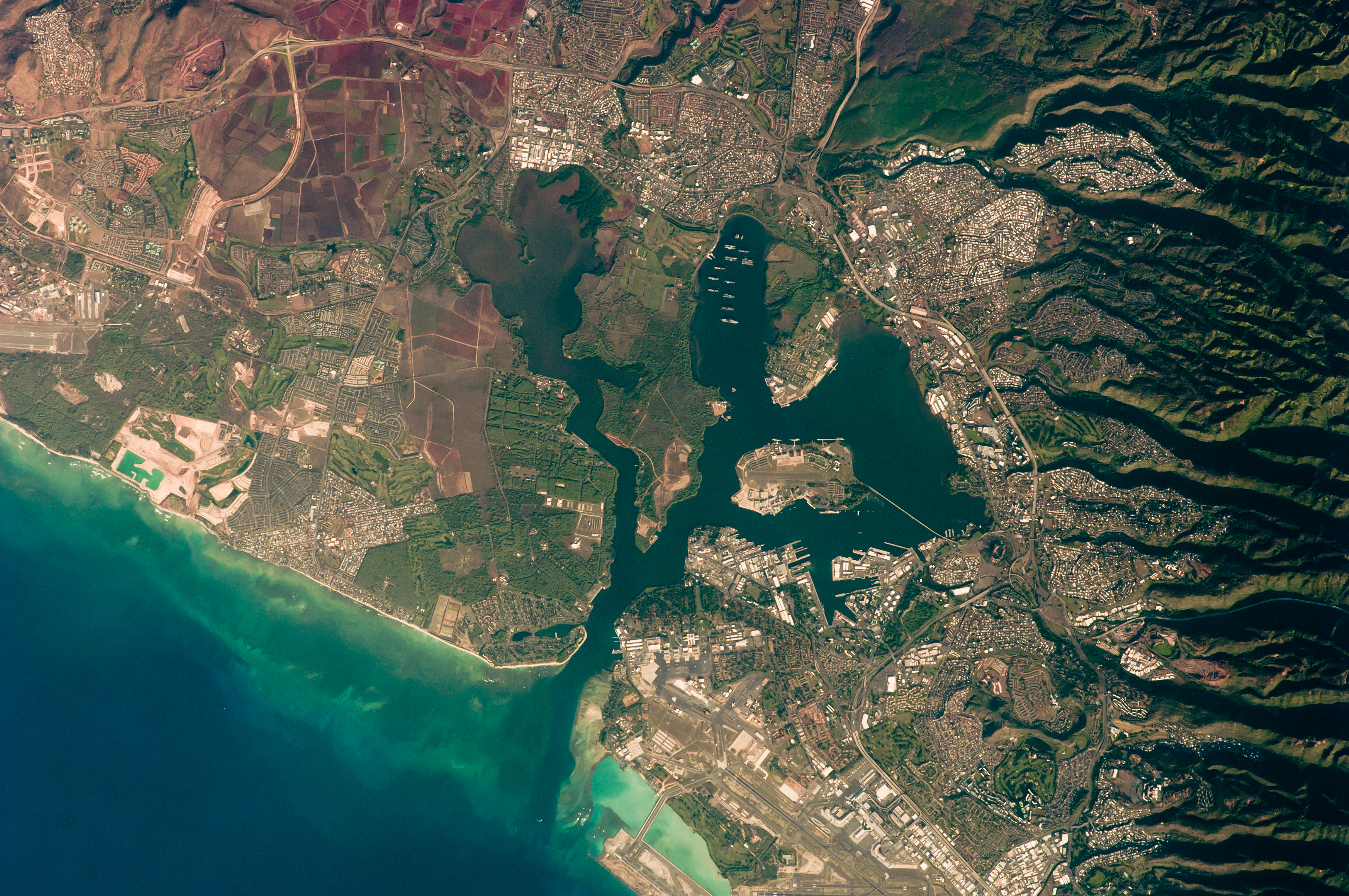
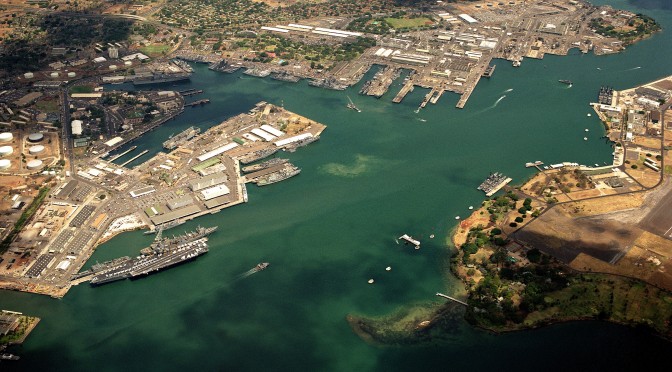
Pearl Harbor naval base 4
A satellite view of Pearl Harbor. Photo Source: NASA.

This simple but rare combination of characteristics gives the Navy base great flexibility and potential. In recent years they have done essentially whatever need they were able to do, when they were asked. Navy bases in the United States have been used as relief, staging, and command centers during floods, fires, and terrorist attacks. They’ve hosted educational and entertainment venues and events for their local communities. They’ve provided environmental restoration and mitigation functions to local and national organizations. They’ve been used as test cases for experimental energy initiatives. They were even on tap to house unaccompanied migrant children from Central America. [16] Navy bases are the best and only option for decision makers to use in so many situations that have no resemblance to traditional naval missions. Their presence, individually and when used in concert with multiple installations, makes them a unique element of U.S. power.

Building the Future Force

“In building the future force, we will make institutional changes and take prudent risk as we balance investment in readiness, capability, and capacity.” CS21R [17]

None of this is to argue for or against a shift to shore power, be that defined as more bases, more funding for bases, or fewer deployable platforms. Nor is it to argue that such a shift is now underway. Rather, it’s a reminder of what could be described as the Navy’s real strategy, if your strategy is what you’re doing right now: Despite repeated emphasis on forward presence and warfighting, in 2016, the U.S. Navy spends the majority of its time and resources at shore installations in the United States. [18] These shore installations also have their own inherent strategy for self-sustainment, and provide an uncodified but vital national capability. They are the most enduring and most visible instruments of American sea power. Barring the most Stranglovian conflict scenario or a radical adjustment in the current course of budgets and funding, they will outlast the service life of today’s ships, sailors, and maritime strategies. The Navy’s future force has already been here for long time, and it’s not going anywhere anytime soon.

 J. Overton is a civilian writer/editor for the U.S. Navy, and has been an adjunct professor for the Naval War College and Marine Corps Command and Staff College. The views and opinions expressed are those of the author and do not necessarily state or reflect those of the United States Government.

[*] CS21R encompasses the U.S. Navy, Marine Corps, and Coast Guard, but this essay focuses mainly on just the U.S. Navy. The other sea services have differing installation realities and requirements.

[1]    “A Cooperative Strategy for 21st Century Seapower: Forward, Engaged, Ready” available at http://www.navy.mil/local/maritime/150227-CS21R-Final.pdf. Commander, Navy Installation Command (CNIC) has issued various Shore Investment Strategies or Strategic Guidance documents which focus on “warfighter” support and saving money rather than the range of installation missions. See “CNIC Visit to NAF Atsugi Reveals Navy Shore Priorities” at http://www.navy.mil/submit/display.asp?story_id=87620 and  “Chief of Naval Operations Shore Investment Guidance” at http://www.public.navy.mil/bupers-npc/reference/messages/Documents/NAVADMINS/NAV2015/NAV15128.txt

[2] “A Cooperative Strategy for 21st Century Seapower: Forward, Engaged, Ready,” pg.iii

[3] “The Joint Publication 1-02, Department of Defense Dictionary of Military and Associated Terms” available at http://www.dtic.mil/doctrine/new_pubs/jp1_02.pdf 

[4] Ron Ratcliff, “Strategy is Execution” (Newport: Naval War College, 2005), 1.

[5] “Status of the Navy” accessed on March 25, 2016 , available at http://www.navy.mil/navydata/nav_legacy.asp?id=146

[6] “A Cooperative Strategy for 21st Century Seapower: Forward, Engaged, Ready” and “Department of the Navy Releases Fiscal Year 2016 Budget Proposal” available at  http://www.navy.mil/submit/display.asp?story_id=85430

[7] J. Overton “Don’t Forget Seapower’s Dry Foundation”, The Northwest Navigator, August 19, 2011, pg. 4

[8] Commander, Navy Installation’s Command web site – http://cnic.navy.mil/about.html

[9]  “US Ship Force Levels” Naval History and Heritage Command http://www.history.navy.mil/research/histories/ship-histories/us-ship-force-levels.html

[10] “A Cooperative Strategy for 21st Century Seapower: Forward, Engaged, Ready” pg. 2

[11] “CNO: Navy is not pushing for BRAC” available at  http://archive.militarytimes.com/article/20140324/NEWS05/303240037/CNO-Navy-not-pushing-BRAC

[12] Walter Russell Mead, “America’s Sticky Power,” available at http://foreignpolicy.com/2009/10/29/americas-sticky-power/

[13]  “The Battle Is On to Save Military Bases from Closure” available at http://www.thefiscaltimes.com/2015/04/10/Battle-Save-Military-Bases-Closure  and “CNO: Navy is not pushing for BRAC”

[14] A Cooperative Strategy for 21st Century Seapower: Forward, Engaged, Ready” pg. i

[15] The Merriam-Websters Dictionary has a concise definition at http://www.merriam-webster.com/dictionary/fleet%20in%20being), and the following Naval War College Review article has a more in-depth and nuanced discussion “The Idea of a Fleet in Being in Historical Perspective” https://www.usnwc.edu/getattachment/b128b7e6-aa98-494e-be55-8000ba30db29/The-Idea-of-a–Fleet-in-Being–in-Historical-Persp.aspx  

[16] “Navy Supports Firefighting Efforts and Families” at  http://www.navy.mil/submit/display.asp?story_id=32740,  “NASNI Provides Makeshift Shelter Wildfire Victims” http://www.navy.mil/submit/display.asp?story_id=32776 and “California naval base becomes home to detained Central American children at http://www.cnn.com/2014/06/13/us/children-immigrant-crisis/

[17] “A Cooperative Strategy for 21st Century Seapower: Forward, Engaged, Ready” pg. 26

Featured Image: Naval Station Pearl Harbor. 
Members’ Roundup: March 2016 Part One

By Sam Cohen

Welcome to part one of the March 2016 members’ roundup. Over the past month CIMSEC members have examined several international maritime security issues, including an increase in Russian naval activities and deployments, recent U.S. naval exercises demonstrating the Fleets’ application of the distributed lethality concept, laser technologies and the U.S. defense acquisition program and as usual, the increasingly tense security environment in the Asia-Pacific.  

Paul Pryce begins the roundup in the Asia-Pacific with a discussion, on what he refers to as, the new era in Singaporean defense procurement. In his article at Offiziere, Mr. Pryce highlights that previous procurement strategies for the country’s Navy have focused on acquiring mainly European designed vessels, either built specifically for Singapore or purchased following a short period of service in the initial European country. However, the planned construction of eight indigenous Independence-class littoral mission vessels beginning in 2016 and the expected procurement of a domestically built light aircraft carrier through 2021 suggests that the Singapore’s shipbuilding capacity and overall maritime force projection capabilities are becoming increasingly strengthened – a significant implication for Singapore’s role in South East Asian security dynamics.

[otw_shortcode_button href=”https://cimsec.org/buying-cimsec-war-bonds/18115″ size=”medium” icon_position=”right” shape=”round” color_class=”otw-blue”]Donate to CIMSEC![/otw_shortcode_button]

Alex Calvo, for Asian Military Review, discusses the challenge Taiwan faces in securing a replacement for its four aged hunter-killer submarines (SSKs), two of which are vintage Tench-class World War II boats while the other two were commissioned in the Netherlands in 1987 and 1988. Mr. Calvo explains how Europe has become reluctant to support Taiwanese military procurement needs for fear of angering China while the United States no longer produces SSKs. He suggests that Taiwan may look to Japan as an alternative source for its SSK replacement largely due to recent efforts by the Japanese shipbuilding industry to win the contract for the Royal Australian Navy’s SSK procurement requirements while also noting a lack of other feasible alternatives.

Kyle Mizokami, for Popular Mechanics, discusses China’s plans to establish aircraft carrier battle groups tasked with defense of the country’s territorial sovereignty, maritime rights and overseas interests both regionally and perhaps globally. Mr. Mizokami highlights the nature of China’s first operational aircraft carrier, the Liaoning, as he explains its training role and limited capacity to carry large numbers of combat capable aircraft. However, he also notes that China has confirmed the construction of the Dalian carrier, which will have more hangar space for support and combat aircraft – but will still only displace about 50 000 tons, or half that of a modern U.S. carrier.

Leaving the Asia-Pacific, Dave Majumdar outlines the implications of Russia’s planned massive live-fire nuclear exercise being conducted by two Project 955 Borei-class ballistic missile submarines deployed with the Northern Fleet. In his article at The National Interest, Mr. Majumdar explains how one of the missile boats will sequentially launch all sixteen of its RSM-56 Bulava missiles at a depth of 164ft while highlighting that such an exercise, whether a U.S. or Russian ballistic missile boat, would only launch their entire payload in conflict as part of full-scale retaliatory or offensive nuclear strike. In a second article at The National Interest, Mr. Majumdar discusses the spotting of a Russian Project 667 BDRM Delfin-class ballistic missile submarine near French territorial waters – the boat carries sixteen missiles capable of carrying four nuclear warheads each with a range of 7500 miles.

Bryan McGrath, for the War on the Rocks, provides the ‘First Principles’ that will help guide the difficult task of structuring the U.S. Navy’s future fleet. Mr. McGrath emphasizes that the Navy must be sized and shaped into a fleet that allows for both combat-credible and presence forces to be positioned globally in a manner that secures national interests while effectively deterring major power conflict. He also mentions the implementation of the distributed lethality concept, where individual platform lethality is increased even as the force becomes geographically dispersed. On this point, Mr. McGrath argues that an individual combat capacity increase should not compel policy makers to reduce the size of the fleet, as one does not necessarily balance the others strategic importance. On the same topic at The National Interest, Dave Majumdar describes a recent test of the SM-6 missile where it was revealed that the system now retains effective anti-surface capability, a major step for distributed lethality implementation across the fleet.

Members at CIMSEC were also active elsewhere during the first part of March:

CIMSEC has also recently (February) published a compendium discussing a range of strategies, challenges and policy options concerning Distributed Lethality. You can find a download link for all of the articles here.

At CIMSEC we encourage members to continue writing, either here on CIMSEC or through other means. You can assist us by emailing your works to dmp@cimsec.org.

Sam Cohen is currently studying Honors Specialization Political Science at Western University in Canada. His interests are in the fields of strategic studies and defense policy and management.

[otw_shortcode_button href=”https://cimsec.org/buying-cimsec-war-bonds/18115″ size=”medium” icon_position=”right” shape=”round” color_class=”otw-blue”]Donate to CIMSEC![/otw_shortcode_button]

‘A Fiscal Pearl Harbor’

I will focus more of this discussion on the first 20 years of the Navy’s plan, covering the years 2016 through 2035, because the third decade of the Navy’s plan is necessarily quite speculative. Nevertheless, keeping an eye on the longer, 30-year perspective is important. While it is true that the nature of warfare, technology, and costs cannot be predicted decades into the future, it is today’s decisions that are most important for the long-run perspective. The President proposes a budget and Congress makes appropriations year-to-year. The Department of Defense provides Congress with a five-year Future Years Defense Program (FYDP), but without the presence of the 30-year plan, the long-range effect on the Navy of the incremental decisions made in each year’s budget cycle would not be understood. For example, in the 1990s, the service built an average of one submarine every other year, and that low rate of construction had no effect on the existing inventory, because coming off the boon years of the 1980s, the attack submarine force was young. Submarine procurement could be reduced during the 1990s without affecting the existing force structure at all. But in the next decade those decisions would manifest themselves in a declining SSN force in a world that today looks like it will get more dangerous and more competitive, not less, and for which some observers of international and naval affairs think having more submarines would be a valuable asset for the Navy.

What to Buy and at What Cost?

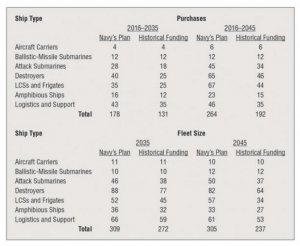
Between 2016 and 2035, the Navy plans to buy 178 ships, including 12 expensive Ohio -class replacement ballistic-missile submarines. The rest of those purchases comprise 4 aircraft carriers, 28 attack submarines, 40 large surface combatants, 35 littoral combat ships (LCSs) and frigates, 16 amphibious ships, and 43 combat logistics and support ships.

Screen Shot 2016-03-13 at 10.41.08 PM
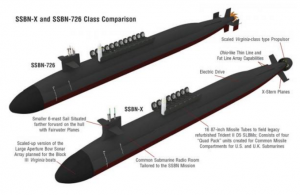
J. M. Caiella – The Ohio-class sub replacement (SSBN – X) is “the 800-pound gorilla in the room” when it comes to the Navy’s shipbuilding ledger. “At around $6 billion apiece, buying those new boomers poses a substantial fiscal and budgetary challenge to the Navy.”

The Congressional Budget Office, in a report that I authored, estimates the cost of building those ships at an average $18.7 billion per year in Fiscal Year 2015 dollars. 2 But that amount is for new construction only. It does not include all of the other activities that the Navy must fund from its shipbuilding account, such as refueling aircraft carriers, outfitting and post-delivery, and other items. They add another $2 billion to the Navy’s funding requirements, resulting in an average shipbuilding budget of $20.8 billion per year for the next two decades.

The dilemma the Navy faces is that in recent decades shipbuilding budgets have been much lower. Since 1986, the Navy has received an average of only $15.8 billion per year, after adjusting for inflation, for all of its shipbuilding activities. And in the most recent decade, 2006–2015, it was even less—$15 billion. Thus, in order to fund the Navy’s plan, the shipbuilding budget will need to increase by an average of 40 percent compared to the past ten years, or about $6 billion per year.

As readers of Proceedings will know, the 800-pound gorilla in the room is the Ohio Replacement Program. The Navy plans to replace its aging force of 14 Ohio -class ballistic-missile submarines with a new, as-yet unnamed class of 12 boats, with procurement funding starting in 2017 and continuing through 2035. At around $6 billion apiece, buying those new boomers poses a substantial fiscal and budgetary challenge to the Navy. Declared to be the Navy’s top budgetary priority, the question, in the view of some members of Congress, is not whether the Ohio replacements will be funded, but rather how they will be funded. Will the Navy receive increases in its shipbuilding budget to pay for the new submarines, or will the Navy have to buy those submarines from a budget that is not increasing? If so, what happens to the rest of the fleet?

Future Fleet, Historical Funding Level

In the 2014 National Defense Authorization Act, Congress directed the Navy to assess what would happen to its shipbuilding plan if, on average, future shipbuilding budgets matched historical budgets. So far, the Navy has not responded to that congressional directive.

The CBO’s analysis shows that constraining future shipbuilding budgets to an average of $16 billion per year results in a much smaller fleet over time. The assumptions that were made in doing such an assessment were as follows:

• The Navy builds all 12 Ohio replacement submarines.

• Production of aircraft carriers is not cut, because Congress mandates the 11-ship force level in law.

• All other ship programs are cut roughly proportionately.

With those assumptions and applying the budgetary constraint, the Navy would purchase 131 ships over the next 20 years, instead of the 178 in the 2016 shipbuilding plan. Specifically, those purchases would include:

• 4 aircraft carriers

• 12 ballistic-missile submarines

• 18 attack submarines

• 25 destroyers

• 25 LCSs and frigates

• 12 amphibious-warfare ships

• 35 combat logistics and support ships.

Reducing the shipbuilding program by 47 ships over 20 years results in a fleet no larger than today’s by 2035. Over the entire 30 years of the Navy’s plan, the fleet would drift down to 237 ships if the historical funding level does not budge much from $16 billion. (See the accompanying table). That is a reduction of 13 percent compared to today’s Navy and 22 percent compared to the fleet of 2045 projected under the 2016 plan.

Screen Shot 2016-03-13 at 10.41.12 PM
Our future fleet.

Is There a Solution?

What are the alternatives to a decline of the Navy’s fleet? Are the alternatives viable? Let us consider each one in turn.

Increase the shipbuilding budget. The first and immediately obvious solution would be to increase the size of the Navy’s shipbuilding budget. Shipbuilding represents about 3 percent of the overall defense budget, a relatively small fraction. As my counterpart at the Congressional Research Service, Ron O’Rourke, has noted in his work, increasing ship construction by $5 billion per year would represent less than 1 percent of defense spending. Yet, even such a small increase faces three powerful headwinds—one short-term, one long-term, and one that is a constant—that are political and budgetary in nature. In the near term, any increase in the defense budget faces the caps imposed by the Budget Control Act (BCA) of 2011 and the various amendments, including the Bipartisan Budget Act of 2015. While the BCA says nothing about how much of the DOD budget may be spent on any particular account, the fact that the BCA caps defense spending below the President’s 2016 FYDP makes it extremely difficult to find the money to increase any category of spending, including shipbuilding. The 2016 FYDP allocated $121 billion more for defense spending over the years 2016 to 2020 than the amounts allowed under the revised caps of the BCA. Thus, widespread cuts are the order of the day, not funding increases.

Although the BCA is set to expire in 2021, presumably making it easier to increase the defense budget in the long term, the large fiscal challenges facing the United States will not. Between now and 2040, the CBO projects that the demands by a growing older population and rising medical costs will increase spending on Social Security and Medicare by 27 percent and 80 percent respectively. But the dedicated revenues that support those programs will remain nearly flat. 3 Because federal deficits over that period will persist and increase the national debt, the CBO also projects that spending on interest will increase by 230 percent; at the same time, revenues from federal income taxes will increase by only 25 percent. Stiff competition for federal resources will remain a fact of our budget debates for decades to come, and the Navy will not be immune.

Finally, within the defense budget itself are the competing demands and priorities of the services and their supporters. If the military branches were unified in the perspective that naval shipbuilding, including the Ohio replacement, should be the nation’s first military priority—or at least the first acquisition priority—it might be a relatively simple thing to shift 1 percent of the defense budget in its favor. But that is not a universally held view. As the threats to U.S. national security become more varied in this emerging new strategic era, the competing demands of all parts of the military for more resources make shifting even a small amount of the defense budget a difficult proposition, especially with the demands on federal resources continuing to grow. 4

Adopt alternative ship designs and fleet architecture. If more money does not flow into the Navy’s shipbuilding accounts, what are the other alternatives? Are there ways to squeeze more out of the current budget? Can you keep ships around longer and modernize them? Does the Navy really need to buy the fleet it is proposing, or would an alternative be better? These are large, wide-ranging questions that deserve serious attention and debate. My purpose in raising and discussing them briefly in this article is to show that even if such suggestions were adopted, they would have little effect on the fleet over the next 10 years and only a marginal effect over the next 20 years.

Let us very briefly consider two examples of alternative fleet architectures proposed by two knowledgeable and experienced men in the business of fleet design: Captain Arthur “Trip” Barber and Captain Wayne Hughes. 5Both are retired Navy officers who then spent many more years thinking about alternative fleet architectures and ship designs. They still do.

In a 2014 Proceedings article, Captain Barber recommends that the Navy do a number of things differently in what he sees as an unending period of federal fiscal constraint. He suggests changing the capabilities of existing ship platforms as well as changing the ways the Navy deploys or stations ships in order to get more deployed time out of these expensive capital assets. However, he also recommends exploring several alternative ship designs that, he argues, would reduce shipbuilding costs, including using a single new ship design for both aircraft carriers and large-deck amphibious-assault ships, developing several classes of surface combatant that perform different missions but share a common hull, and repeating that common-hull approach for various support-ship missions.

Screen Shot 2016-03-13 at 10.41.16 PM
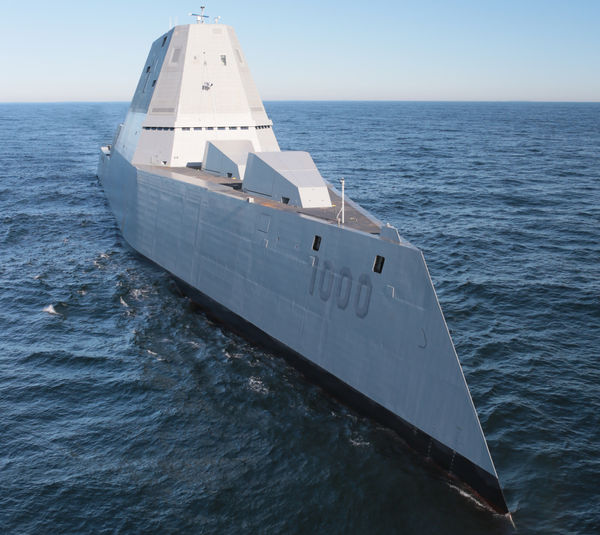
U.S. Navy (Sam Shavers) – Secretary of the Navy Ray Mabus delivers remarks at the christening of the USS Jackson (LCS-6) in December. The Secretary of Defense recently called for cuts to the LCS shipbuilding program, which might be said to have experienced its share of setbacks and controversy.

Captain Hughes equally reimagines the future fleet, although he believes his plan is affordable within existing shipbuilding budgets. The New Navy Fighting Machine, as Captain Hughes describes it, would develop even more new ship types than would Captain Barber’s. Specifically, Captain Hughes envisions new conventionally powered submarines, light aircraft carriers, small land-attack arsenal ships, and a substantial green-water force, as well as continuing to build numerous ship types that are already part of the Navy’s 2016 plan.

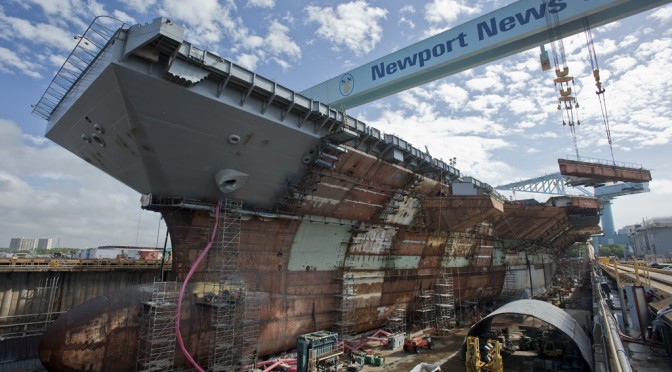
Nevertheless, however thought-provoking the suggestions offered by both men, making such major changes to the fleet will not be easy or quick. Alternative ship designs and fleet architectures take a long time to implement. For example, the LCS was first proposed in 2001. Fifteen years later the Navy has commissioned six of those small, relatively inexpensive 3,000-ton ships. A large all-new ship design, such as the DDG-1000 Zumwalt -class destroyer, has been in development, design, and construction for 20 years and won’t commission into the fleet until later this year. The same is true for the new Ford -class aircraft carrier. Under the Navy’s shipbuilding plan, in 15 years—2031—the Navy will have only eight new combat ships of entirely new design: three Ford -class carriers, three Zumwalt -class destroyers, and two Ohio replacement ballistic-missile submarines. Another 48 combat ships will be commissioned that have a modified design of existing warships: 21 Arleigh Burke –class Flight III destroyers, 20 frigates based on the LCS (or just 12 under Secretary Carter’s directive), and seven LX-R amphibious ships based on the existing LPD-17 hull. The Navy will also have another 28 combat logistics and support ships of some new type. Overall, in 2031 at least three-quarters of the fleet will still be composed of ships with designs that are in service today.

Thus, unless the ship-acquisition process can be changed such that it dramatically speeds up the introduction of new ship designs into the fleet, most of the suggestions by Captains Barber and Hughes would not have a meaningful effect on the composition of the fleet until, coincidentally, the Ohio Replacement Program is essentially completed in 2035. This is a point that Captain Hughes explicitly acknowledges and addresses (and one that Captain Barber recognizes but does not address), but, based on the Navy’s acquisition history, the former may be optimistic about what is achievable in 10–20 years. 6

Screen Shot 2016-03-13 at 10.41.23 PM
Huntington Ingalls – A rigger oversees a small-unit flip during construction currently underway on the second Gerald R. Ford-class aircraft carrier, the future USS John F. Kennedy (CVN-79) at Newport News Shipbuilding. “In 15 years – 2031 – the Navy will only have eight new combat ships of an entirely new design,” including three Fords.

Keep older ships in the fleet. A less time-intensive alternative to new ship designs or fleet architectures would be to modernize older ships and keep them in the fleet. But this approach has its own problems. Paradoxically, the Navy is already doing this to a large extent, so it is not clear that more can be done, but also historical experience suggests that the service dislikes doing so. Over the past 20 years, senior Navy leaders have extended the service lives of more than 100 submarines, destroyers, and amphibious ships relative to their original design lives. At the same time, the Navy retired dozens of ships that had many years of useful service life remaining, rather than purchasing slightly fewer new ships to pay for keeping the older ships in the fleet.

Specifically, in the early 2000s, the Navy increased the service life of the Ohio -class ballistic-missile submarines from 30 years to 42. If that had not been done, we would have debated the merits and means to pay for the Ohio replacement more than a decade ago, when the United States was fully engaged in two wars in Afghanistan and Iraq. Similarly, the service life of Los Angeles –class attack submarines was increased from 30 years to 33. The Navy now assumes its large-deck amphibious-assault ships will serve for 43 to 45 years, which is up from 40 years. And since the release of the 2009 shipbuilding plan, the Navy has assumed its Arleigh Burke –class destroyers would serve in the fleet for 40 years, rather than 35 years in earlier plans, which is up from the original design life of 30.

Extending the service lives of these ships further is impossible in some cases and questionable in others. The submarines will be at the limit for the number of cyclings (submerging and surfacing) that their pressure hulls can tolerate, and the energy in their reactors will be exhausted. Conventionally powered surface ships, however, could in theory be upgraded if the Navy chose to do so. Properly maintained, conventional hulls can last for many decades. Ships that were retired from the U.S. Navy and sold or transferred to other countries often serve for decades longer as a result. But at a certain point, a ship that is still useful in a South American or Asian navy would no longer be valuable to the U.S. Navy, because physical limitations may prevent a modernization of her combat systems to perform high-end missions. Further, keeping older ships in the fleet even longer would require the Navy to modernize combat systems and fully fund maintenance programs. But budgetary constraints and long, frequent deployments have made it hard for the service to do so. Thus, if it is not clear that Burkes can serve for 40 years, it seems even less likely they could serve for 45 to 50 years performing missions the Navy would find valuable.

At the same time the Navy was extending the service lives of some ships, it was retiring others well before the end of their design lives. In the late 1990s through the mid-2000s, the Navy retired the entire class of Spruance destroyers. To keep those ships in the fleet the Navy would have had to spend money on improving their material condition as well as upgrading their combat systems. It also would have cost money to continue to operate those ships. But a decade later, the surface-combatant force is overworked with long deployments because there are insufficient ships to meet the demand. In addition, the original plan was to retire the Oliver Hazard Perry –class frigates sooner and keep the Spruances around, but that decision was reversed because it was cheaper to operate the smaller ships. Relative capabilities apparently did not figure strongly in the decision.

Similarly, the Navy retired 17 Los Angeles –class attack submarines at an average age of 22 years, rather than pay to refuel those boats and keep them in the fleet. Paying for all 17 refuelings would have cost less than the price of two new Virginia -class submarines. Again, the Navy would have had to budget resources to operate those ships, but at about $40 million per submarine per year, that was not an insurmountable obstacle.

And more recently, the Navy proposed to retire seven Ticonderoga -class cruisers and two amphibious ships to help conform to the budgetary caps of the Budget Control Act, rather than reduce new ship purchases further. Congress intervened, however, directing the Navy to keep those ships in the fleet and provided additional appropriations to do so. But if the Navy had had its way two years ago, the fleet today would number 264 ships. In that event, the strain on large surface combatants and amphibious ships, which now routinely deploy for seven to ten months, would be even greater.

Size? Capabilities? Both?

One way for a policymaker or anyone interested in naval matters to think about these issues is to figure out what your objective is. Do you care most about the size of the fleet? Or are the capabilities of the fleet more important? Of course, both are important. But the tension between size and capabilities is in many ways a proxy for the tension between the Navy’s day-to-day responsibilities and its high-end warfighting requirements. In an unendingly tight fiscal environment, a larger Navy is one that is better able to provide overseas presence and perform the many, varied peacetime missions that our naval forces are routinely called on to conduct—without overly stressing the ships and crews. 7 However, ships with the high-end warfighting capabilities that would be needed in an unlikely, but far from impossible, future conflict with a peer or near-peer competitor are expensive. The Navy cannot afford to build as many of them as it would like under historical funding levels.

If this seems like a daunting set of challenges for shipbuilding, that’s because it is. Yet, it may be possible that a little bit of everything could close the gap. If the Congress can shift a fraction of 1 percent of the defense budget toward shipbuilding, if improving acquisition can squeeze a fraction of 1 percent of the defense budget toward more shipbuilding, and if the Navy invests in some of its older ships to keep them in service, then perhaps it can step off the path toward a fleet of 237 ships that history says it is on. But that combination of outcomes would be difficult to achieve.

Dr. Labs, writing here as a private citizen, is Senior Analyst for Naval Forces and Weapons at the Congressional Budget Office. He specializes in issues related to the procurement, budgeting, and sizing of the forces for the Department of the Navy. Dr. Labs has testified before Congress several times and published numerous studies under the auspices of the CBO as well as a number of articles and papers in academic journals and conferences.

1. Report to Congress on the Annual Long-Range Plan for Construction of Naval Vessels for Fiscal Year 2016 (Washington, DC: Department of the Navy, March 2015), http://tinyurl.com/ocrqtfc [8] .

2. Congressional Budget Office, An Analysis of the Navy’s Fiscal Year 2016 Shipbuilding Plan , October 2015, www.cbo.gov/publication/50926 [9] .

3. Congressional Budget Office, The 2015 Long-Term Budget Outlook , June 2015, www.cbo.gov/publication/50250 [10] , 3.

4. Ronald O’Rourke, A Shift in the International Security Environment: Potential Implications for Defense—Issues for Congress , Congressional Research Service, 20 November 2015,www.hsdl.org/?view&did=788858 [11] .

5. CAPT Arthur H. Barber, USN (Ret.), “Rethinking the Future Fleet,” U.S. Naval Institute Proceedings , vol. 140, no. 5 (May 2014), 48–52. CAPT Wayne P. Hughes, USN (Ret.), The New Navy Fighting Machine: A Study of the Connections Between Contemporary Policy, Strategy, Sea Power, Naval Operations, and the Composition of the United States Fleet , (Monterey, CA: Naval Postgraduate School, 2009). See also his “A Bimodal Force for the National Maritime Strategy,” Naval War College Review , vol. 60, no. 7 (Spring 2007), 29–47.

6. Megan Eckstein, “CNO: Navy Needs More Agile Procurement to Keep Pace with ‘4-Plus-1’ Threat Set,” USNI News, 7 December 2015, http://news.usni.org/2015/12/07/cno-navy-needs-more-agile-procurement-to… [12] .

7. Congressional Budget Office, Preserving the Navy’s Forward Presence With a Smaller Fleet , March 2015, www.cbo.gov/publication/49989 [13] .

Featured Image Credit: Chris Oxley.

February Members’ Roundup Part One

By Sam Cohen

Welcome to part one of the February 2016 members’ roundup. Over the past month CIMSEC members have examined several international maritime security issues, including recent Indian Navy maritime policy developments, aspects of the U.S. Navy’s defense procurement program, components of a notional South China Sea naval conflict between China and the U.S. and capability challenges for the U.S. Navy Littoral Combat Ship (LCS).

Beginning the roundup at Offiziere, Darshana Baruah discusses India’s Cold War non-aligned strategy and the implications this strategy has had on India’s maritime security policy in the post-Cold War period. Ms. Baruah explains that India must realize that non-alignment does not equate to non-engagement and that committing to a policy of engagement is critical to manage the complexities of the developing Asian maritime security environment. She references the bilateral MALABAR naval exercises between the U.S. and India as well as the Maritime Security Strategy document released by the Indian government as developments hinting to a changing Indian maritime policy.

[otw_shortcode_button href=”https://cimsec.org/buying-cimsec-war-bonds/18115″ size=”medium” icon_position=”right” shape=”round” color_class=”otw-blue”]Donate to CIMSEC![/otw_shortcode_button]

Ankit Panda, at The Diplomat, also discusses India’s maritime strategy with an analysis on potential joint patrol operations in the South China Sea between Indian and U.S. navies. Mr. Panda highlights that there is no indication whether these jointly conducted patrols would reflect recent U.S. FONOPs or less contentious passing patrols, however, he notes that the potential for these patrols to occur reflects a shift in India’s maritime doctrine to ‘act East’. Also at The Diplomat, Mr. Panda explains the conditions and challenges of completing a Boeing-India F/A-18 Super Hornet deal where the Indian Defense Forces would receive an advanced multi-role fighter to supplement its next-generation indigenously built Vikrant-class aircraft carrier and raise the potential for increased technology sharing between the U.S. and India.

Bryan McGrath, at War on the Rocks, discusses the concept of distributed lethality and recent weapons tests and developments that have brought this concept to maturity for the U.S. Navy’s surface force. Mr. McGrath explains how the successful launch of a Tomahawk Land Attack Missile (TLAM) from a U.S. Navy destroyer has now increased the anti-surface warfare combat range of about 90 U.S. cruisers and destroyers currently operating with the Vertical Launch System (VLS) to 1000 miles. Mr. McGrath also identifies the additional capability introduced to the long-range supersonic SM-6 missile, now capable of engaging enemy surface combatants, as a critical development for distributed lethality implementation across the fleet.

Kyle Mizokami, for Popular Mechanics, discusses the planned purchase of 14 F/A-18 Super Hornets as a result of the fighter shortfall in carrier air-wings caused by delays in the Joint Strike Fighter Program. He explains that the delays will also reflect the slow introduction the F-35C will have entering into service within the Navy with only four planes to be purchased in 2017. Mr. Mizokami also outlines surface combatant purchases included in the Navy’s FY2017 budget, highlighting the procuring of two Virginia-class attack submarines and two Arleigh Burke-class guided missile destroyers – the destroyers to be equipped with the new Air and Missile Defense Radars that boost the ship’s ballistic missile defense capabilities. Also at Popular Mechanics, Mr. Mizokami provides an analysis on the U.S. Navy’s LCS live fire exercise against an enemy fast-attack swarm that demonstrated potentially serious flaws in the ships design, revealed by combatants entering the ‘keep-out’ range of the ship and technical issues arising throughout the test – albeit the exercise only tested certain weapon and fire control systems.

To conclude the roundup in the Asia-Pacific, Harry Kazianis for The National Interest provides an outline of potential tactics China’s PLA would emphasize during a notional conflict with the U.S. Navy. Mr. Kazianis explains that over the past two decades China has feared the U.S. ability to rapidly deploy naval assets throughout multiple domains in China’s areas of interests largely due to limited PLA capabilities. Mr. Kazianis identifies the employment of large volumes of rudimentary sea-mines and missiles as a simple mechanism for overwhelming U.S. Navy defenses and a feasible strategy to achieve an asymmetric edge over U.S. fleets in theatre.

Members at CIMSEC were also active elsewhere during the first part of February:

  • Chuck Hill, for his Coast Guard Blog, discusses the possibility that the U.S. Army may develop an anti-access/ area-denial (A2AD) strategy along the First Island Chain in the Asia-Pacific and the implications these anti-air and anti-ship systems would have on the Army’s role in U.S. domestic coastal defense. In a second article for his CG Blog, Hill outlines the participants and talking points of a multi-lateral coast guard meeting between the U.S., Japan, Australia and the Philippines.
  • At USNI News, Sam LaGrone discusses the Request for Proposal Naval Air Systems Command is set to release later this year concerning the Carrier Based Refueling System (CBARS) or the unmanned aerial refuelling tanker. Mr. LaGrone explains how the CBARS is a follow-on program that will incorporate many components and systems from the Unmanned Carrier Launched Airborne Surveillance and Strike program (UCLASS).
  • Robert Farley, for The National Interest, provides an analysis on the Zhenbao Island conflict between the Soviet Union and China in 1969 and how the sovereignty dispute nearly escalated to a nuclear confrontation. Mr. Farley explains the avenues of escalation that may have led to Soviet tactical strikes on Chinese nuclear facilities and the implications this would have had on U.S.-NATO-Soviet stability in Europe.
  • James Stavridis, for Nikkei Asian Review, provides five strategies for Pacific-Asian countries that will reduce the potential of an outbreak conflict in the region. Mr. Stavridis suggests that direct military-to-military contact can create a framework of deconfliction procedures thereby reducing escalatory conditions within the region. He also explains how the use of international negotiation platforms to resolve territorial disputes can contribute to a sustainable stability. In an article at The Wall Street Journal, Stavridis highlights the ‘icebreaker gap’ the U.S. has developed with only four large icebreakers to be active by 2020 while Russia will have at least 42. He explains how acquisition processes to close this gap are extremely strained with the current defense budgetary restrictions the government is experiencing.
  • Dave Majumdar, for The National Interest, explains how the next generation of U.S. Navy surface combatants will incorporate digital and information technologies into the core foundations of ship design to allow for time and cost efficient technological upgrades. In a second article at The National Interest, Majumdar highlights the strategy shift that has occurred within the U.S. Navy’s UCLASS approach. The article outlines how the move to CBARS away from the UCLASS ISR and light strike capability will assist the Navy in developing a sophisticated unmanned aviation infrastructure for future carrier operations.

At CIMSEC we encourage members to continue writing, either here on CIMSEC or through other means. You can assist us by emailing your works to dmp@cimsec.org.

Sam Cohen is currently studying Honors Specialization Political Science at Western University in Canada. His interests are in the fields of strategic studies and defense policy and management.

[otw_shortcode_button href=”https://cimsec.org/buying-cimsec-war-bonds/18115″ size=”medium” icon_position=”right” shape=”round” color_class=”otw-blue”]Donate to CIMSEC![/otw_shortcode_button]

Fostering the Discussion on Securing the Seas.