Tag Archives: US Navy

Unleashing Unit Lethality: Revising Operational & Promotion Paradigms

Distributed Lethality Topic Week

By ENS Daniel Stefanus

As the US Navy begins to pivot away from dependent tactical group paradigms and towards more independent striking units under distributed lethality, it will become increasingly necessary to revise our operational dynamics. The rapid increase in communications and tracking has led to an era in which a remote admiral can guide the hand of all units under his or her purview. We must resist such temptations. The remote warfighter knows significantly less than the commanding officer (CO) on the scene. Moreover, the administrative and procedural burden placed upon these commanding officers has sapped much of their tactical creativity and tenacity, as Ian Akisoglu has argued. Equipping ships with upgraded combat systems is all well and good, but the warfighters who utilize them and their operational paradigms must also be upgraded. We must decentralize tactical authority back down to the unit level and significantly enhance tactical knowledge and creativity.

[otw_shortcode_button href=”https://cimsec.org/buying-cimsec-war-bonds/18115″ size=”medium” icon_position=”right” shape=”round” color_class=”otw-blue”]Donate to CIMSEC![/otw_shortcode_button]

The Naval Surface and Mine Warfighting Development Center (NSMWDC)’s Warfare Tactics Instructors (WTI) program is a huge step towards a low centralization, high unit proficiency operational model. As these WTIs spread throughout the Fleet disseminating ideas and rising to command, we will see a manifest change in unit-level tactical understanding and ability. However, the WTIs alone cannot overhaul our tired Preplanned Responses (PPRs) and outdated doctrines. They need to be empowered with the flexibility and out-of-the-box thinking that are the hallmarks of successful, evolutionary organizations. Our overly rigid combat procedures cannot handle the complexities of gray wars and supersonic conflict. Hence we must accomplish this shift through both the WTI program and a cocktail of long-term reforms: create accelerated CO pipelines with longer CO billets, enhance and widely distribute warfighting simulators, expand Personnel Exchange Program (PEP) billets, and form an across-the-board “task force” to resolve the over-management of unit commanders.
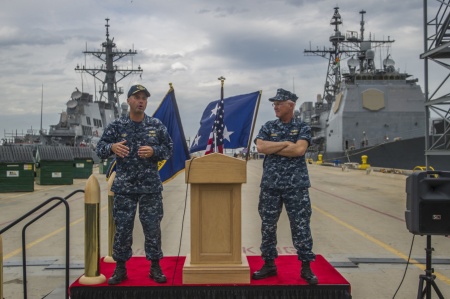
450x299_q95
Vice Admiral Tom Rowden and Rear Admiral Jim Kilby speak at the inaugural ceremony of the Surface and Mine Warfare Development Center in June 4, 2015 (US Navy Photo).

The Surface Warfare Officer (SWO) community has long suffered from having truly great officers mired in bureaucratic office jobs while their surface skills atrophy. Yes, it is crucial that our rising stars learn from staff and Pentagon billets, but their command leadership must be prioritized if they are to be retained. As VADM Rowden explained during the previous distributed lethality topic week, “Distributed Lethality is MUCH more than just putting more missiles on ships—it is about investing in warfighting expertise.” In this spirit we must push our rising stars to the tip of the spear as fast as possible. We must provide an accelerated command pipeline for our most able officers if we are going to get the elite commanding officers that are the bedrock of distributed lethality’s effective implementation. By giving these high potential candidates more early command opportunities and accelerated pipelines to CO/XO billets, we will keep our best and brightest plugged into the Fleet with the latest tactics.
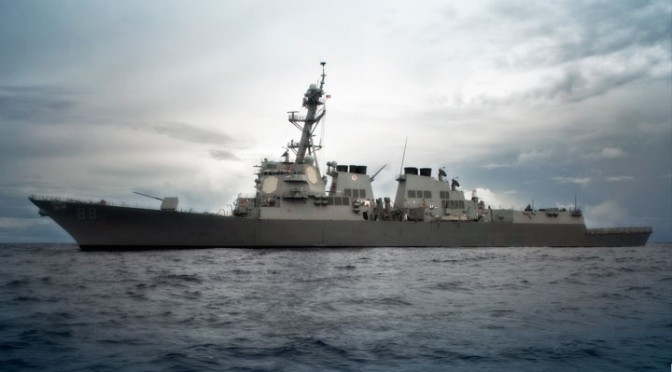
130616-N-KA046-009 MEDITERRANEAN SEA (June 16, 2013) The guided-missile destroyer USS Barry (DDG 52) is underway in the Mediterranean Sea. Barry is on a scheduled deployment supporting maritime security operations and theater security cooperation efforts in the 6th Fleet area of responsibility. (U.S. Navy photo by Mass Communication Specialist 2nd Class James Turner/Released)
USS Barry (DDG 52) steaming in the Mediterranean Sea.

Far too many officers have wasted years waiting for command only to then get short 12-15 month stints. This is a misunderstanding of what kind of commanding officers we want and how to utilize talent. A crew does not care about making sure every decent SWO gets the opportunity to command, they care about having the best CO possible. We push for quantity over quality for no real end as most post-command SWOs go on to do staff and other mostly dead-end oversight-based administrative jobs before retiring. Instead we must focus on providing our best prospective command officers with multiple years of command and sea time in order to make them the great, salty warfighters we need in future conflicts.

This adjustment will also renew Sailors’ faith in the position of CO as an elite surface warrior. One talented, highly-experienced CO with three years of DDG command is more valuable than three “good” quick-stint COs who are not able to come into their full leadership and warfighting potential in such a short time. If a CO is doing a great job, then there is no reason to rotate him or her out at 15 months just to let another officer wear the crown. Bureaucracy and entitlement should not get in the way of us accelerating, retaining, and utilizing the very best SWOs. No one should be destined for CO just because of good FITREPs. Only our very finest should assume command, and they should do so for multiple years to gain the critical, diverse experiences required of a true warfighting commanding officer. By allowing the best SWOs to skip obligatory shore duties and be screened early for command, and allowing more fleet elements to be commanded by early command LCDRs, we can offer an enticing value proposition to our most elite SWOs and keep them firing on all cylinders on their path to being the world’s finest naval captains. These COs are the glue that will make distributed lethality effective in practice.

Another crucial step is rolling out well-made, easy to use, and highly accurate warfighting simulators. These can proliferate at all levels and will have demonstrable impacts on units’ tactical knowledge, understanding, and performance. As a child I played Jane’s Fleet Command (1997) ad nausem. In the process I became an 8 year-old who could speak intelligently about Exocet missiles and the dangers of submarine operations in the Taiwan straits. By allowing SWOs to continuously fight the enemy, wargame, revise tactics, and practically learn of the world’s military capabilities, we will have a more engaged and competent cohort of warfighters. We must find a way to leverage the enormous advances in computing technology and wargaming in order to best equip the minds of those who will be on the frontlines in future conflicts. Drills, PowerPoint, and brief-based schools are banal compared to the image of a cruiser being struck by an SS-N-22 while you scramble an F-18 squadron to counterattack against a flotilla of enemy DDGs hiding in the shadows of mountainous islands. Instinct and competence are forged in the fire of conflict, so – sans conflict – we must utilize highly-realistic simulators as the best alternative. 
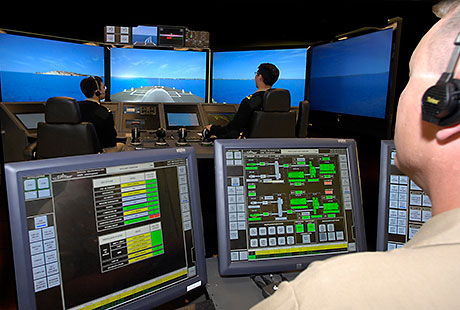
LCS simulator used to prepare crews (Lockheed Martin photo).

Moreover, our officer corps must not remain a closed system, an echo chamber of similar sounds. In order to best equip our frontline leaders with a diverse understanding of how to fight and know how other navies think and operate, we must go to these other navies. Seeing how a foreign navy functions can be incredibly illuminating and provide crucial perspective on what we do right and how we can improve. From the Dutch to the Japanese, we have a broad array of powerful naval allies who use alternative systems and doctrines to pursue their national maritime objectives. The Personnel Exchange Program (PEP) as it exists today is a woefully inadequate means of accomplishing such an exchange of ideas. Only a handful of SWOs are able to participate and gain critical foreign insight and experience. By ramping up PEP, we will open our officer corps to a diversity of ideas, procedures, and technologies that can only help our critical thinking and tactical skills in unpredictable and complex conflict scenarios. The core of distributed lethality’s effectiveness will lie in COs’ ability to harness their wardrooms’ creativity and diverse experiences to fight unexpectedly in spontaneous, unusual battlefields. This skillset can be enhanced by observing and understanding other navies and their methods.

Ultimately, the most critical and immediate reform that is necessary is a Task Force designed to peel back the red-tape and operational micromanagement of COs. This group would be composed of all levels of officers from ensigns to admirals. It would discuss and delineate exactly which procedures and processes are absolutely necessary for a flag officer to control and kick all other authorities back down to the unit CO. In combat there is no time to wait for the admiral’s move; the unit commander must be able to execute in an innovative and effective manner in order for distributed lethality to succeed. The CO needs to feel that they are the one fighting a battle, not their boss a thousand miles away.

All too often we are slaves to procedure and protocol even when they don’t make tactical or operational sense. This environmental context is the key to tactical victory and must be exploited, not glossed over by a PPR. In the end, distributed lethality can only succeed if it is executed by well-versed, innovative, and empowered commanding officers and their crews. If individual units cannot fight independently, then distributed lethality will become little more than beefed-up units operating in the same defensive strike group arrangements we currently utilize. Therefore the solution to our current tactical weakness is twofold: restrain over-management and bureaucratization while enhancing opportunities for our best talent in order to produce independent, highly capable warfighters with the operational latitude to sink fleets and win wars. We must do everything in our power to make this a reality now before the first missiles fly in a hot conflict.

ENS Daniel Stefanus is an associate editor at CIMSEC and a graduate of the Duke University NROTC unit. He currently serves as the Electrical Officer onboard USS ANCHORAGE (LPD 23) in San Diego, CA. The views expressed here are his own.

[otw_shortcode_button href=”https://cimsec.org/buying-cimsec-war-bonds/18115″ size=”medium” icon_position=”right” shape=”round” color_class=”otw-blue”]Donate to CIMSEC![/otw_shortcode_button]
Distributed Lethality: Old Opportunities for New Operations

Distributed Lethality Topic Week

By Matthew Hipple

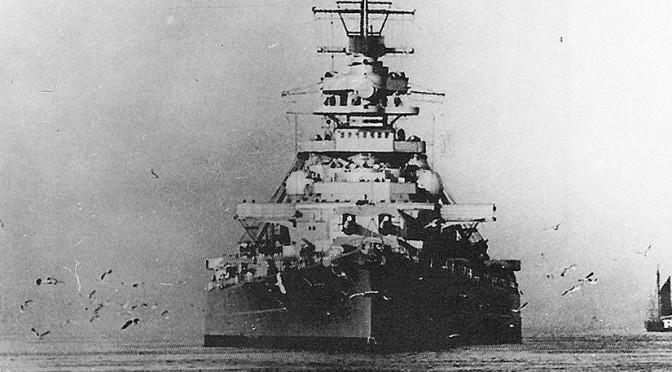
The BISMARCK, a single ship capable of striking fear into the heart of an entire nation.
The BISMARCK, a single ship whose threat was sufficient to muster an entire fleet for the hunt.

The essence of naval warfare has always been opportunism – from the vague area of gravity generated by an in-port “fleet in being,” to the fleet-rallying threat generated by even a BISMARK or RANGER alone. The opportunity is generated by forces more mobile and self-contained than any army, more persistent than an air force, and empowered to act with no connection to higher authority in a domain that leaves no trace.  It is that ability for a small number of independent ships, or even a single vessel, to provide opportunity and create, “battlespace complexity,” that is distributed lethality’s core. Distributed lethality is not naval warfighting by new principles; it is a return to principles.

[otw_shortcode_button href=”https://cimsec.org/buying-cimsec-war-bonds/18115″ size=”medium” icon_position=”right” shape=”round” color_class=”otw-blue”]Donate to CIMSEC![/otw_shortcode_button]

The best defense is not an overwhelming obsession with defense.

Unfortunately, the virtuous autonomy of the past was, in part, only protected by the limited technology of the day. As technology allowed, decentralized execution was replaced by the luxury and false confidence of constant connection to higher authority through an electronic umbilical. It is the kind of devolution that turned into Secretary Gates’ nightmare, “I was touring a [Joint Special Operations Command] in Kabul and discovered a direct line to somebody on the NSC, and I had them tear it out while I was standing there.” In parallel, America began the ahistorical project of investing all offensive opportunity not even in a single class of ship, but a single ship surrounded by a fleet obsessed with its defense.  As early as 1993, President Clinton stated that when a crisis broke out, his first question would be, “where is the nearest carrier.” Sorry, other ships! For the Navy to sensibly rebalance, distributed lethality must succeed. For distributed lethality to succeed, we must decentralize and de-tether mission command, weapons release authority, and weapons support systems.

Decentralized and disconnected methods of command must be embraced, as centralization is only an imagined luxury. Modern centralization is based on the assumption we will have the connectivity appropriate for it. This is no longer tenable in a world of increasingly advanced peers and hyundaized lesser adversaries. Anti-Access, Area-Denial (A2/AD) depends on opponents making themselves visible, of which electronic emission is critical. A2/AD will also inevitably seek to disrupt our C2 connections.

doyle-dday
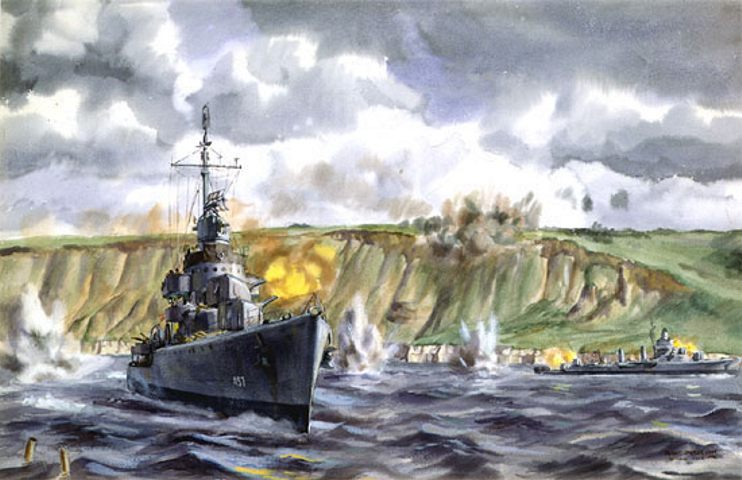
“Permission? We don’t need no stinkin’ permissions.” “The Battle for Fox Green Beach,” watercolor by Dwight Shepler, showing the Gleaves class destroyer USS Emmons(DD 457) foreground and her sister-ship, the USS Doyle, to the right, within a few hundred yards of the landing beach, mixing it up with German shore batteries on D-Day.

The current major-node CWC concept will need to be broken down to a more compact, internal model designed around the Hunter Killer Surface Action Group. Rules of Engagement must be flexible to the point that American commanders need not look over their shoulders to a higher OPCON. Consider, the destroyer CO’s at Normandy didn’t consider waiting for direction or requesting approval before shifting from small boat screening to shore bombardment from the shoals. They recognized the opportunity – the necessity – and executed of their own will.

In contrast, today it might be a regular occurrence to double-and-triple check our actions with American OPCON while operating with NATO in TACON off Somalia. American CO’s could use the freedom to make pragmatic, on-the-spot decisions not only for immediate concerns of mission effectiveness, but as representatives of their higher military command and, potentially, the state. Coalition commanders would have greater trust in the spot decisions of their American counterparts, rather than worry they sit precariously atop a changing several-step staffing process.

Though encouraging equivalent RoE flexibility for coalition partners may be challenging, our autonomy may encourage our partners to interpret their home nation guidance in a flexibility equivalent to their trust in the US commander they fight beside. That lack of hesitancy will be critical during a conflict, and in that sudden moment in the South China Sea or Mediterranean when a small SAG of coalition partners find themselves in the midst of a conflict that has just begun. Imposing the peacetime discipline necessary to trust the CO’s we have trained, prepared, and empowered to do their jobs is the only thing that will jump-start a shift in a mind-set now dominated by subordination. 

In the execution of more flexible orders, ships must be re-invested with control of their own weapon systems. CO’s oversee non-nuclear weapon systems that they do not control – that are solely the purview of off-ship authorities. In particular, as weapon systems like Tomahawk become deployable for ASuW, off-ship authority’s iron grip on their control must break.  This decentralization also matters outside the stand-up fight at sea. The organic ability to program and deploy Tomahawk missiles for land strike allows surface ships to execute attacks of opportunity on land infrastructure, or execute and support opportunistic maritime raids as groups of marines harass adversaries, or turn isolated islands into temporary logistics or aviation operations bases. For winning the sudden-and-deadly fight in the littoral environment but integrating with opportunistic amphibious operations, the surface fleet could find some inspiration from the USS BARB, the only submarine in WWII to “sink” a train with its crew-come-amateur-commandos. From Somalia to the South China Sea, naval commanders should be told what to do, not how – and be allowed to do it. The less reliant the force is on these ephemeral links and the less these links are unnecessarily exercised in peacetime, the greater a force’s instinct to operate independently and with confidence in an imposed or needed silence. 

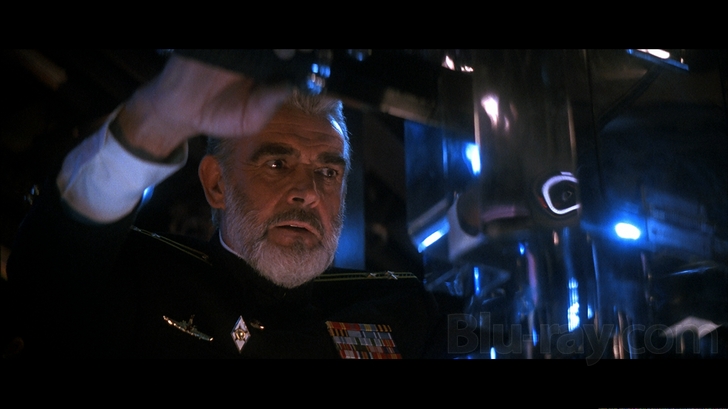
CAPT Ramius, relieved to discover he is not dealing with "some buckaroo."
CAPT Ramius, relieved to discover he is not dealing with “some buckaroo.”

There may be a level of discomfort with decentralization and disconnection. If leaders fear the impact of a “strategic corporal,” surely a “buckaroo,” as  CAPT Ramius would call him, that would be truly horrifying. That fear would be a reflection of a failure of the system to produce leaders, not the importance and operational effectiveness of independence. There is a reason the US once considered the Department of the Navy to be separate and peer to the Department of War – noting the institution and its individual commanders as unique peace and wartime tools for strategic security and diplomacy. Compare today’s autonomy and trust with that invested in Commodore Perry during his mission to Japan or Commodore Preble’s mission to seek partnership with Naples during the First Barbary Pirates War. Reliance on call-backs and outside authority will gut a naval force’s ability to operate in a distributed manner when those connections disappear. Encouraging it by default will ensure the muscle memory is there when needed.

Finally, Distributed Lethality requires the hardware to allow surface combatants to operate as effective offensive surface units in small groups. The kinetic end of the spectrum, upgraded legacy weapons and an introduction of new weapon systems has been extensively discussed since the 2015 Surface Navy Association National Symposium when VADM Rowden and RADM Fanta rolled out Distributed Lethality in force. However, weapon systems are only as good as the available detection systems. Current naval operations rely heavily on shore-based assets, assets from the carrier, and joint assets for reconnaissance. In the previous Distributed Lethality topic week, LT Glynn argued for a suite of surveillance assets, some organic to individual ships, but most deploying from the shore or from carriers.  Presuming a denied environment, and commanders empowered to seek and exploit opportunities within their space, the best argument would be for greater emphasis on ship-organic assets. They may not provide the best capabilities, but capabilities are worthless if assets cannot find, reach, or communicate with a Hunter-Killer SAG operating in silence imposed by self or the enemy. They also prevent an HKSAG from being completely at the mercy or limitations of a Navy or joint asset coordinator – while simultaneously relieving those theater assets for higher-level operations and opportunity exploitation.

Ultimately – distributed lethality is the historical default mode of independent naval operations given a new name due to the strength of the current carrier-based operational construct. Admiral Halsey ordered CAPT Arleigh Burke to intercept a Japanese convoy at Bougainville, “GET ATHWART THE BUKA-RABAUL EVACUATION LINE ABOUT 35 MILES WEST OF… IF ENEMY CONTACTED YOU KNOW WHAT TO DO.” The surface fleet must embrace a culture assuming our commanders “KNOW WHAT TO DO.” We must build an operational construct in which acting on that instinct is practiced and exercised in peacetime, for wartime. The operational and diplomatic autonomy, as well as the OLD IRONSIDES style firepower of single surface combatants, is necessary to rebalance a force gutted of its many natural operational advantages. Distributed lethality must return the surface force to its cultural and operational roots of distributed autonomy, returning to the ideas that will maximize opportunity to threaten, undermine, engage with, and destroy the adversary.

Matthew Hipple is the President of CIMSEC and an active duty surface warfare officer. He also leads our Sea Control and Real Time Strategy podcasts, available on iTunes.

[otw_shortcode_button href=”https://cimsec.org/buying-cimsec-war-bonds/18115″ size=”medium” icon_position=”right” shape=”round” color_class=”otw-blue”]Donate to CIMSEC![/otw_shortcode_button]
People Not Parts: Returning Ingenuity and Tenacity to our Officer Corps

By Ian Akisoglu

Since the end of the Second World War, the military dominance of the United States has rested on its relative technological superiority over its adversaries, what has been underwritten by its impressive economic strength and high-tech domestic industries. For the first time in seventy years, the United States military is forced to contemplate a long-term strategy without the implicit guarantee that it will enjoy decisive technological superiority as its most likely adversaries come closer and closer to achieving parity in both technological and economic strength. In order to remain viable in future conflicts, the American military will have to rethink its operational paradigm and learn to rely more heavily on the creativity and individual zeal of its leaders and less on its hard assets.

For much of its history, the American military has fought its major conflicts without the overwhelming technological and financial superiority that it has enjoyed since the end of the Second World War. I believe that this phenomenon can best be explained by the following paradigm: raised in an age where American military power was relatively lacking on the world stage, the American officer corps did not possess any of the bad habits or laziness of thought engendered in today’s officer corps. Looking down on the rest of the world’s militaries from a plateau of overwhelming superiority and relative security, we have become haughty and ignorant of our peers’ capabilities. Previously generations of American military officers were forced to contend with a world in which the United States Army and Navy were not the best – indeed, not even in the top ten at times.

This forced American military leaders to develop and utilize a currently unimaginable level of organizational, operational, and strategic creativity comparably unknown to the armed forces of today, where an over-reliance on financial superiority has led to an over-reliance on technological superiority, which has led to an over-reliance on established procedures and doctrine. In order for the armed forces of the United States of America to continue to enjoy success in the future, both on the battlefield and as a viable instrument of soft power, American military leaders must look to lessons from the past and re-learn how to plan and fight wars without the assumption that they will always enjoy superiority of force.

[otw_shortcode_button href=”https://cimsec.org/buying-cimsec-war-bonds/18115″ size=”medium” icon_position=”right” shape=”round” color_class=”otw-blue”]Donate to CIMSEC![/otw_shortcode_button]
A humorous quote from a European officer highlights the benefit of this, “One of the serious problems in planning against American doctrine is that the Americans do not read their manuals nor do they feel any obligations to follow their doctrine.” This emphasizes the extensive freedom of judgment American commanders previously enjoyed while executing missions in complex operational environments. From the author’s perspective as a contemporary unrestricted line officer in the U.S. Navy, this freedom of judgment is virtually non-existent nowadays. Instead, American military commanders are so hamstrung by strict adherence to the protocol and procedures that have been enshrined throughout their military upbringings that they are often afraid to rely on their own intuition, experience, and creativity. This risk aversion is not unjustified since the risk to reward ratio for officers willing to try new ideas has shifted so heavily to the risk side, that many deem the potential gains not worth imperiling their careers over. The main problem with this method of doing business is that operational arenas are not the static playing fields that we presuppose them to be in most exercise and operation briefs. They are constantly evolving, which requires adaptability and ingenuity instead of a flow-chart approach to missions.

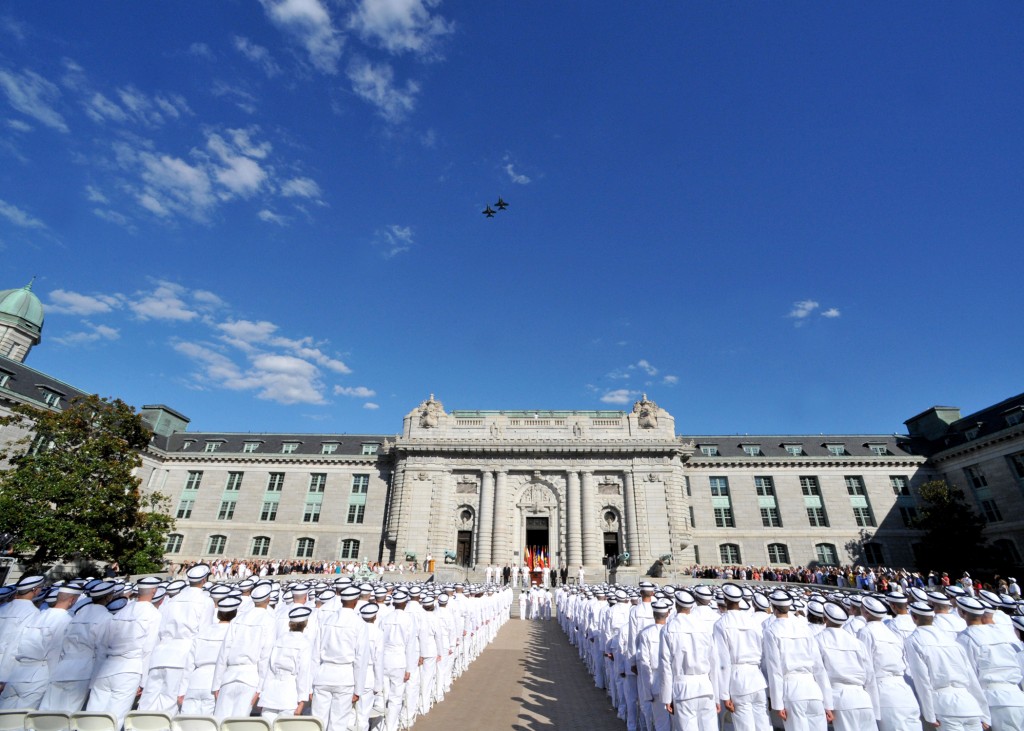
Members of the U.S. Naval Academy Class of 2014 participate in the Oath of Office ceremony at Tecumseh Court. (U.S. Navy photo by David Tucker/Released)

This is not meant to be a rebuke of procedural compliance – far from it. Procedural compliance is important to ensure the safety and proper execution of our technical missions: safety and maintenance. However, it is important to also recognize its inherent limitations, and understand that it’s impossible to write “winning a war” into procedural compliance, since procedures only extend to the realm of what is known, and war often devolves into the area of the unknown. Simply put, officers should be proficient at procedural compliance and planned execution, but once the situation is no longer covered by procedures, strategic entrepreneurship and improvisation must take over seamlessly. If we consistently deny our Navy leadership the ability to improvise and test their creative problem solving abilities for fear of imperiling their careers, how and when can this creative solution seeking process be fostered?

The key question then is how do we recapture the ingenuity of the individual officer? I assert that it must start at the earliest possible point in the officer’s career – for creativity once lost is nearly impossible to rediscover. The Navy should develop programs that both encourage and train officers to think of creative solutions to problems early on in their careers. The best time to start this is at the O-2 and O-3 levels, directly after the completion of an officer’s initial warfare qualifications and first operational tour.

The importance of instilling and encouraging the idea of creative thought early on in the officer corps cannot be overstated. Senior officers that attend the Naval War College relatively late in their careers to explore ideas on war and its strategic theory have already come to depend on the rigidity of the Navy establishment for their paychecks and lifestyle, and thus are less willing to question the institution or its authority. The junior officer, relatively fresh and with fewer mental harangues, owes no such allegiance to the organization and does not see it through the same cynical lens, allowing them to see the flaws in our organization much more clearly than a dyed-in-the-wool career officer. These junior officers are still willing to question the military’s fatal deficiencies and flaws before becoming completely indoctrinated into the system.

One way to implement this would be to establish a school that officers attend with peers from their warfare areas concentrated around every major career milestone. The goal of such a school would be to gather high-flying officers into small groups where they would be posed complex operational problems. However, they would face them with handicaps and constraints put in place, making normal doctrine and pre-planned responses obsolete, and forcing them to develop creative solutions to real world problems. Officers would return to the course at every major career milestone, such as in between division officer tours, prior to starting their department head tours, prior to beginning their XO/CO fleet-up, and prior to achieving flag rank.

One of the most resonant lessons that has been gleaned from the attacks on the USS Stark, USS Samuel B. Roberts, and USS Cole is that in unexpected situations, conventional procedures often are inadequate, and improvisation dominates. Generations of American military officers have become complacent through the knowledge of their nation’s technological and financial superiority. It is time to train them to think and fight absent this implicit safety net once again. It is better to start learning these critical skills now, while remaining in control of the pace, than to be forced to learn them under fire in a future conflict.

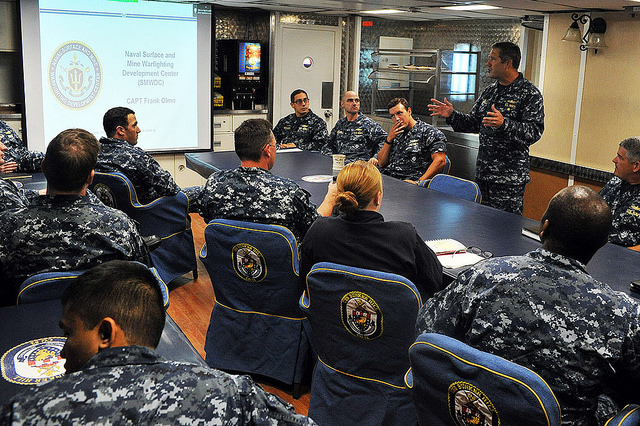
Capt. Frank Olmo, deputy commander, Naval Surface and Mine Warfighting Development Center (SMWDC), introduces SMWDC and the new career opportunities it provides junior surface warfare officers (SWOs) during a brief aboard USS Bunker Hill (DDG 52). U.S. Navy photo).
Capt. Frank Olmo, deputy commander, Naval Surface and Mine Warfighting Development Center (SMWDC), introduces SMWDC and the new career opportunities it provides junior surface warfare officers (SWOs) during a brief aboard USS Bunker Hill (DDG 52). (U.S. Navy photo).

Secondly, while an understanding of mathematics and the sciences remain ever important in an increasingly technical and specialized military, officer programs must also recapture the emphasis on liberal arts education and creative thinking that has steadily dwindled in the twentieth and twenty-first century formation of modern military officers. At the United States Naval Academy it is a requirement that sixty-five percent of those graduates must complete degrees in the science, technology, engineering, or mathematics disciplines. Of students commissioning from ROTC programs around the country – which, combined with the Naval Academy, contribute roughly two thirds of new officer accessions the fleet each year – eighty-five percent of available scholarships are rewarded to those students who choose majors in the STEM fields. Those remaining fifteen percent who do express interest in studying disciplines outside of these fields, ignominiously referred to as “Tier 3” majors, find their options for earning scholarships and commissioning more limited.

Technical courses do an excellent job training officers to operate complex combat systems and nuclear reactors, where every aspect can be distilled to checklists and procedures, but do a poor job in training strategic and creative thought. Such critical thinking skills are ultimately where officers render the greatest value to the armed forces as leaders and warfighters, not technicians. At a minimum, a certain number of liberal arts courses in subjects such as philosophy, history, literature, and economics should be required for certain officer programs in just the same way that calculus, physics, and other mathematics and science courses are. An officer able to harness the problem-solving ability taught by an education in engineering with the propensity for creative though that comes from a study of the liberal arts would be the best equipped to execute all of the Navy’s missions.

Thirdly, the United States military must push decision-making back down the chain of command to the unit level. In our age of global real-time communication we have achieved the ability to control even the minutest detail from the highest level. We must resist the temptation to do so, for this robs on-scene commanders of the crucial experience that comes from tense, independent decision-making. Instead, we must once again become comfortable with giving commanders autonomy over their units and operations, giving direction only in broad strokes and leaving the details to the “man on the spot,” who is inevitably the subject matter expert on what is happening within and directly around his unit. In today’s fleet, the number of daily updates that a deployed warship is required to provide up the chain of command off-ship has become a full-time job on top of the full-time job of running the ship and executing its mission. No effective leader has two full-time jobs.

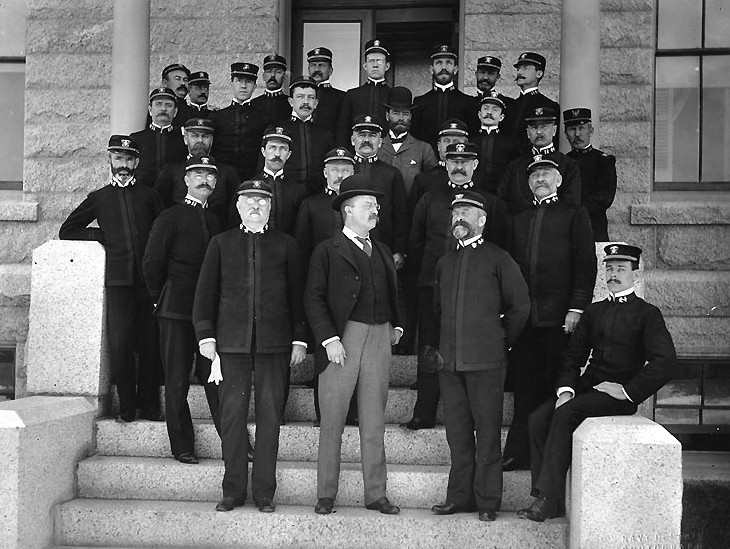
Assistant Secretary of the Navy Theodore Roosevelt on the steps of the Naval War College.

And all of this for what? It is absolutely ludicrous to imagine that a remote commander and their staff, often years detached from single-unit leadership, require or need all of the information now required to be tracked on a daily basis. The massive off-ship administrative burden that this places on the wardroom of an operational unit, simultaneously interfering with their ability to effectively do their job within the lifelines of the ship, significantly degrades morale and unit-level success. By fostering a culture in which officers are afraid of making even the smallest decisions themselves, we are handicapping the abilities of junior officers to develop leadership skills and to learn to take the initiative, resulting in the ones who adapt to this climate being cautious to a fault for the rest of their careers, and inducing those individuals who want more control and autonomy to seek opportunities elsewhere.

Finally, the United States military must consider drawing talent into its ranks from untraditional sources outside the military and recognize that its rigid and traditional career path that exclusively emphasizes hiring and promotion from within might have to change. This is not entirely without precedent – the Navy already does this for many of its staff corps officers who have demonstrated experience and proficiency in their civilian careers. There are many individuals with different backgrounds and specialties who hear the call to serve their country at different points in their life. A master software engineer at Google with ten years in the industry would be an incredible asset to the military’s cyber warfare communities, but at that point in his career he would likely be too old to enlist and would have his talents wasted as a newly-commissioned ensign while also being grossly under-compensated. Instead, why not bring this cyber star in as a Lieutenant Commander? This arrangement would offer significant benefits and opportunities to both the military and the individual.

If the United States wants to avoid catastrophe on the battlefield in the coming decades, it will need to come to terms with the fact that having more money and better technology will no longer be enough to win the next war against the next foe – who may very well enjoy parity in these domains, if not even superiority. Accepting this, rather than continuing to do the same thing while expecting a different result, is a required preliminary step.

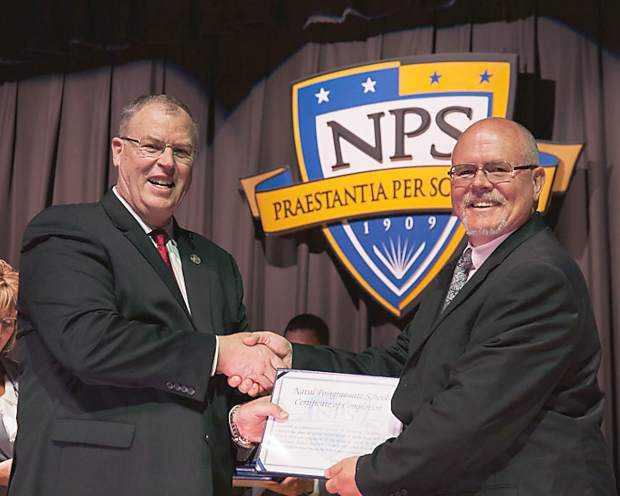
Deputy Secretary of Defense presents a Master of Science diploma to Ken Thomas at the Naval Postgraduate School.
Deputy Secretary of Defense Robert Work presents a Master of Science diploma to Ken Thomas at the Naval Postgraduate School.

The United States military must fundamentally change the way it does business and drive its officer corps to rediscover skills that gave way to technology and money when they seemed to no longer be needed or valued. In order to do this, we must encourage creative thought in our officers starting at a very junior level – both by commissioning a greater portion of our officers with backgrounds in the liberal arts as well as technical majors, and by creating incubator programs at multiple levels of officer career tracks to cultivate and stimulate creative thought. The military must also learn to re-delegate greater amounts of control and authority to unit commanders while unit commanders must learn to do the same to their subordinates. This ensures that if subordinate commanders are fighting a conflict in which they are cut off from communication with headquarters or things are not going quite as they had expected them to, they aren’t paralyzed with indecision, experiencing what is in effect their first ever real experience with high-stakes decision making.

Finally, the United States must harness the huge pool of potential talent that exists in the form of civilians who want to serve but don’t fit into the current recruiting construct. By allowing experienced non-military personnel to enter the organization at mid and even upper-level officer positions, the military can harness a huge untapped reservoir of private sector talent. The same skills that our military forefathers used to achieve victory on the battlefield when outclassed in technology, money, manpower, and weapons – creativity, zeal, initiative, and guile – are needed once again. All that is lacking is the will and tenacity to bring them back.

Lieutenant Junior Grade Ian Akisoglu is a Surface Warfare Officer living in Norfolk, Virginia.  He graduated from American University with a Bachelor of Arts in economics and history and was subsequently commissioned through Officer Candidate School.  The views expressed here are his own and do not represent those of the U.S. Department of Defense or the Department of the Navy.  He can be reached at ian.akisoglu@gmail.com.

[otw_shortcode_button href=”https://cimsec.org/buying-cimsec-war-bonds/18115″ size=”medium” icon_position=”right” shape=”round” color_class=”otw-blue”]Donate to CIMSEC![/otw_shortcode_button]
Bibliography:

Kimbrough IV, James M. MAJ, USA. (2008). Examining U.S. Irregular Warfare Doctrine. 14.

United States Naval Academy. (2015). Academics – Majors and Courses.

Population Representation in the Military Services FY 2013 Report: Appendix B: Active Component Enlisted Accessions, Enlisted Force, Officer Accessions, and Officer Corps Tables.

United States Navy ROTC. (2015). Naval Reserve Officers Training Corps Scholarship Selection Criteria.

Long, Roger D. The Man On The Spot: Essays on British Empire History. (Ed.), Praeger, First Edition (Sep 26, 1995).

January 2016 Members’ Round-Up Part One

Welcome to part one of the January 2016 members’ round-up! Over the past month CIMSEC members have examined several international maritime security issues, including future development programs for the U.S. Navy, Japanese naval strategy in the Asia-Pacific, North Korea’s nuclear weapons test, legal discussions over the U.S. South China Sea Freedom of Navigation Operations (FONOP) and China’s aircraft carrier procurement challenges.

Beginning the round-up at the Center for Strategic and Budgetary Assessments, Bryan Clark discusses the new Chief of Naval Operation’s vision for the future of the U.S. Navy. Mr. Clark explains that adaptability is a critical factor that the Navy must retain in order to effectively navigate the complex issues the force will see in the future maritime environment. Further to this, he elaborates on the potential challenges the Navy will face implementing an adaptability design as the Navy’s organization, training and equipping functions historically have not been developed for such fluid flexibility. Also discussing the CNO’s new design for the Navy, Chuck Hill for his Coast Guard Blog highlights the key developments raised within the CNO’s “Maintaining Maritime Superiority” document, including the changing dynamics of the global maritime environment and the recognition of increased competition U.S. naval forces are facing in the maritime domain from Russia and China.

[otw_shortcode_button href=”https://cimsec.org/buying-cimsec-war-bonds/18115″ size=”medium” icon_position=”right” shape=”round” color_class=”otw-blue”]Donate to CIMSEC![/otw_shortcode_button]
Sam LaGrone, at U.S. Naval Institute News, discusses the future surface combatant study taking place this upcoming summer. Mr. LaGrone explains that the study intends to comprehensively identify the capabilities that will need to be acquired by the Navy to effectively manage the threats the surface fleet will face in the future. Additionally, Mr. LaGrone highlights the strategic and fiscal importance of the future surface fleet having substantial multi-mission capability and an ability to remain relevant through technological advancements in weapon and sensor systems by ensuring the fleet is capable of handling frequent upgrades.

Bryan McGrath, for Information Dissemination, analyzes the ongoing debate concerning the procurement of the Ford-class aircraft carriers and more generally, the strategic benefits the aircraft carrier brings as a key component of the Navy’s force structure. Mr. McGrath outlines five underlying features surrounding the current debate, including the immediate costs of procuring large high-end carriers and the necessity for the air-wing to evolve to provide long-range stealth-strike capabilities, sea control, organic refueling and intelligence, surveillance and reconnaissance (ISR) operations.

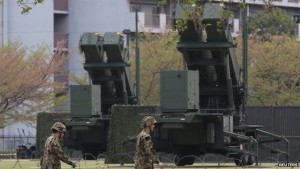
Entering the Asia-Pacific, Harry Kazianis for The National Interest examines Japan’s strategy to develop an anti-access/ area-denial (A2/AD) capability to restrain Chinese naval and air operations in the region. Mr. Kazianis explains that a primary component of this strategy is the placement of anti-ship and anti-aircraft missile batteries along 200 islands in the East China Sea stretching 870 miles from mainland Japan towards Taiwanese territory.

Members of the Japan Self-Defence Forces deploy Patriot Advanced Capability-3 (PAC-3). BBC, 2013.

Mira Rapp-Hooper at Lawfare provides a breakdown of Defense Secretary Ash Carter’s detailed explanation of the USS Lassen’s South China Sea FONOP. Ms. Rapp-Hooper explains how Carter’s letter clarifies that freedom of navigation operations are merely intended to challenge excessive maritime and territorial claims according to international law and not to affirm support for any country involved in the dispute. She also outlines the letter’s second key assertion, which states that the USS Lassen operation in the South China Sea was consistent with the principle of ‘innocent passage’, suggesting that the operation consisted of no illegal activities or actions.

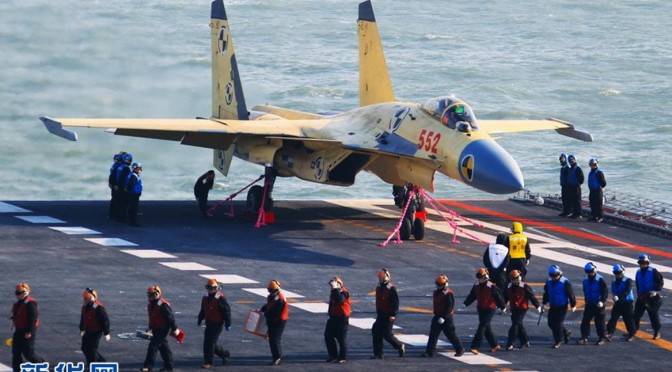
To conclude this edition of the member’s round-up, James Goldrick at The Interpreter discusses recent developments in China’s aircraft carrier program and outlines the PLA-N’s intentions for at least four carrier battle groups to be introduced as a means to support Chinese maritime and security interests in the region. Mr. Goldrick explains that for China’s carrier program to yield successful results, the volume of indigenous Chinese expert shipbuilders needs to substantially increase to meet the design and concept demands their high-end naval programs are requiring – including the PLA-N’s conventional and nuclear submarine development programs.

Members at CIMSEC were also active elsewhere during the first part of January:

At CIMSEC we encourage members to continue writing, either here on the CIMSEC site or through other means. You can assist us by emailing your works to dmp@cimsec.org.

Sam Cohen is currently studying Honors Specialization Political Science at Western University in Canada. His interests are in the fields of strategic studies and defense policy and management.

[otw_shortcode_button href=”https://cimsec.org/buying-cimsec-war-bonds/18115″ size=”medium” icon_position=”right” shape=”round” color_class=”otw-blue”]Donate to CIMSEC![/otw_shortcode_button]