Tag Archives: Strategy

A Call for an EU Auxiliary Navy – under German Leadership

By Dr. Sebastian Bruns

A popular quote reads “A ship in port is safe. But that’s not what ships are made for.” Correspondingly, one could quip “Navies are very good in constabulary tasks. But that’s not what they’re maintained for,” echoing noted political scientist Samuel Huntington in the process. More than sixty years ago, Huntington wrote about the purpose of naval forces in the early Cold War, yet some of his thoughts have an enduring value for 2016. In the Mediterranean, not one but two naval task groups are working hard to contain a humanitarian crisis at sea. While their service is admirable and strictly necessary, even as it is only a drop in a bucket, naval capabilities which are in high demand elsewhere are bound in a mission that is only a secondary role for navies. Instead, Germany should lead the way in investing in an EU auxiliary force.
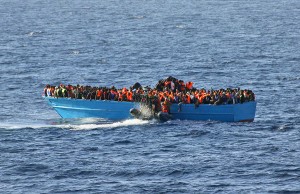
A crowded boat with migrants awaits rescue by EU NAVFOR MED.

In May 2015, the German Navy began participating in the search and rescue mission in the Central Mediterranean north of the Libyan coast, dubbed EU NAVFOR MED (Operation “Sophia”) shortly thereafter. The pressure to act had become unbearable for political decision-makers in Berlin and Brussels after yet another devastating humanitarian catastrophe which occurred somewhere on the High Seas between Libya and Italy. An overloaded boat sank during the night of 18/19 April, costing the lives of up to 800 migrants. Hundreds others had perished in the Mediterranean during the months before. Following a European Council decision and a parliamentary green light, the German Navy dispatched the frigate Hessen (F221) and the combat support ship Berlin (A1411) to provide a presence north of Libyan territorial waters. At the time, both ships were operating off the Horn of Africa and in the Easter Mediterranean to provide the German Navy with an operational reserve. Hessen and Berlin joined a number of other EU vessels, which ranged from warships to auxiliary and coast guard ships. EU NAVFOR MED was just the latest mission that the German government engaged its shrinking military forces in; on the maritime domain alone, Germany is continuously involved in naval operations in the central Mediterranean (ACTIVE ENDEAVOUR, since 2002), off the coast of Lebanon (UNIFIL, since 2006), and on the Horn of Africa (EU NAVFOR Atalanta, since 2008). German Navy participation in one or often two of the four Standing NATO Maritime Groups, exercises, training, and out-of-the-schedule naval operations such as providing cover for the destruction of Syrian chemical weapons at sea in 2014 have added pressure to (wo)men and material.
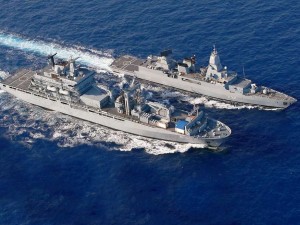
Combat support ship Berlin and frigate Hessen steam side by side in the initital provision of humanitarian assistance on the Southern flank.

Cue: Queen, “Under Pressure”

Since the summer of 2015, rotating up to two ships in and out of the EU NAVFOR MED mission – such as the Berlin’s sister ship Frankfurt (A1412), or the tender Werra (A514) – put a truly severe strain on German military-operational planning. It goes without saying that adapting these venerable warships and supply vessels, which are optimized for many things other than housing, feeding, and medically caring for hundreds of castaways on board, has put a strain on the Deutsche Marine. The noble task of saving lives at sea has challenged the well-trained crews of the ships, but it hardly obscured the fundamental problem that more than two decades of defense budget cuts, strategic disorientation, and a larger disinterest in all things hard power by the German public (and most of its political masters) have caused. By default, the German Navy has turned into a low-end, operationally-minded force, where high intensity should be a design guide.

The German Navy’s dilemma, at 16,000 people and just 62 vessels at the smallest it has ever been by a December 2015 count, was illustrated best right before Christmas. In response to the November attacks in Paris, the frigate Augsburg (F213) was re-assigned from EU NAVFOR MED to provide air defense for the French aircraft carrier Charles de Gaulle in the Eastern Mediterranean and Persian Gulf. The mine hunter Weilheim (M1059), en route to return from UNIFIL to its homeport on the Baltic Sea right in time for the holidays (and probably the least-capable vessel to offer space for potentially hundreds of migrants), was tasked to remain in the Central Mediterranean. It joined the corvette Ludwigshafen am Rhein (F264), another warship tasked with a humanitarian assistance task that was hardly envisioned by strategic and operational planners in Berlin and Rostock, site of the naval command. Samuel Huntington, who warned that navies should concentrate on providing high end options and not be used for low-end missions, would probably turn over in his grave. This is not to say that other countries did not have their own challenges in providing assets to the mission, but some of them are better equipped to attend to low-end missions. The Royal Navy, for instance, dispatched HMS Enterprise (H88), a multi-role hydrographic oceanographic vessel.
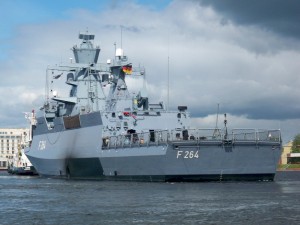
The corvette Ludwigshafen am Rhein is currently part of Germany's contribution to EU NAVFOR MED. Germany's naval missions can sometimes be as complicated as its ship-naming policy.
The corvette Ludwigshafen am Rhein is currently part of Germany’s contribution to EU NAVFOR MED. Germany’s naval missions can sometimes be as complicated as its ship-naming policy.

When all you have is a hammer, every problem looks like a nail

In February 2016, the German Navy is still tied up in the EU NAVFOR MED. Privately owned platforms such as the Phoenix, operated by the Malta-based Migrant Offshore Aid Station (MOAS), and two vessels operated by Doctors without Borders (Medicines Sans Frontiers, MSF), the offshore supply ships Bourbon Argos and Dignity 1, have also at some point joined the operation (although they are not integrated into the EU force). At the same time, the Aegean Sea, which offers the shortest distance between Turkey and Greece, has moved into focus for human trafficking. The cold of winter has hardly deterred the refugees from mounting unseaworthy dinghies, rubber boats, or derelict fishery vessels that the criminal networks of human traffickers operate. In response, NATO stepped in and dispatched its Standing NATO Maritime Group 2 (SNMG2). The task force is commanded by the German rear admiral Jörg Klein and currently consists of the German Navy combat support Ship Bonn (A1413) and four frigates from Turkey, Italy, Greece, and Canada. As the New York Times noted in an article on 11 February,

“while the hastily made decision reflected the growing urgency of the situation, it was not clear that it would have much practical effect on the flow of refugees fleeing Syria’s five-year civil war: The alliance said it would not seek to block the often rickety and overcrowded migrant vessels or turn them back, and military officials were scrambling to determine precisely what role their warships would play.”
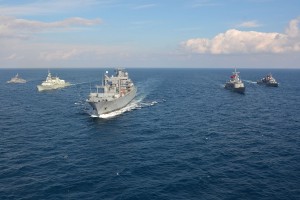
Standing NATO Maritime Group 2, seen here steaming in formation, is currently tasked with operating on the Aegan Sea refugee route.

A European Auxiliary Navy

Granted, the political leverage for European integration is low at the moment. The European Union is struggling to fend off tendencies that call not for an ever closer union, but in fact work towards dismantling some of the EU’s accomplishments in the wake of the refugee crisis. Still, with security and defense in increasing demand, including maritime security from on Europe’s southern flank, there need to be fresh ideas that can be operationalized quickly. In the face of the deteriorating relations between the West and Russia and the disintegrating Middle East, warships should contribute to the more robust stance against political aggression and hard threats, thus focusing on more of their core tasks (no doubt requiring doctrinal and conceptual re-assessments in some European capitals). This would give NATO a stronger role, and leave the EU to take care of the low-end maritime task. It could thus serve as an example of burden-sharing between the two entities.

Germany could play a leadership role in drawing up a European auxiliary navy, reenergizing the European spirit of cooperation in the process. Such a task force could have a number of political advantages. First, it would send a strong signal that European nations are willing to work together to address the ramifications of maritime trafficking. Second, Germany would address calls from inside and outside to do more. As a maritime nation with strong normative impulses, the Federal Republic would also demonstrate to the electorate (long weary of military engagement) that it is aware of the utility of naval forces in crisis response. Naturally, German investment into an auxiliary EU navy should not come at the expense of more robust naval tasks with the German Navy, but these could be better tailored if the combat support ships, frigates, and corvettes need not be used in lesser operations. Third, if and when the current migrant crisis ebbs, the European auxiliary navy could concentrate on the public diplomacy role of naval forces, providing anything from humanitarian assistance to the provision of medical services on goodwill tours around the world (like the U.S. Navy and the Chinese PLAN routinely do already). This auxiliary navy could also lend a hand to regional coastal and constabulary navies and coast guards (e.g. in West or East Africa) to train and exercise.
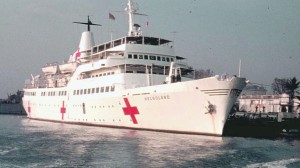
The last dedicated German hospital ship was the MS Helgoland, which saw extensive action in Saigon (South Vietnam) between 1966 and 1972. The ship was operated by the German Red Cross.

To this end, it is strictly necessary to inject some fresh thinking into how such as force could be tailored. It is imperative that an idea such as this can be put into action rather quickly before being brought to grinding snail speed by bureaucrats in Brussels or Berlin. First, one should look at the market of commercial vessels. Ro/Ro ships or offshore supply ships are available, usually even on short notice. They could be painted gray or white, manned by a mixed civilian-military crew, and quickly form the backbone of an auxiliary navy.
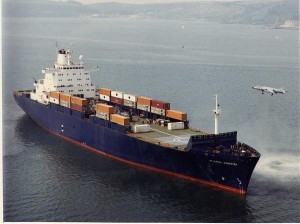
The Royal Navy used the Ro/Ro vessel Atlantic Conveyor in the 1982 campaign to retake the Falkland Islands from Argentina. The makeshift helicopter and Harrier carrier was sunk by Argentine forces in the course of the conflict.

Other opportunities arise as well. The offshore patrol vessel L’Adroit (P725) is a demonstrator vessel built by French shipbuilder DCNS and was placed at the disposal of the French Navy for three years, a period that is now drawing to a close. The ship could be introduced as a French contribution to the auxiliary navy, which need not limit itself to state-run ships. If done properly, NGOs like SOS Mediterranee could be integrated (the non-profit organization operates the MS Aquarius, a former German fishery protection vessel). The former rescue cruiser Minden, built in 1985 and serviced by volunteers from the German Maritime Search and Rescue Service, will join what is already emerging as a multinational, civilian, and military task force in the Mediterranean.
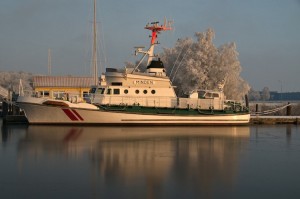
The former SAR cruiser Minden, for thirty years operated in the North Sea and Baltic Sea by an NGO, will soon begin rescue operations in the Mediterranean.

In the medium term, one could consider the charter of vessels which could be converted quickly as dedicated hospital ships, also crewed by civilian mariners and military. A logistics ship would also come in handy, as well as a simplistic command platform. To provide range, ships taken up from trade (not such a novel concept after all) could be selected if they provide the opportunity to operate reconnaissance drones or helicopters. In the long term, there are even further ideas that could be floated. For example, the 2016 German federal budget has earmarked the procurement of three new patrol vessels for the Bundespolizei See, Germany’s quasi Coast Guard. It is entirely plausible that these ships could also be detached as part of the EU’s auxiliary fleet, akin to NATO’s SNMGs – that is, if Germany politically resolves its constitutional conflict between police and military jurisdiction and respective responsibilities. To go even further, the German Navy is currently in the early stages of procuring the future multi-role combat ship MKS180, designed as a modular warship. Is it too far-fetched to consider adding a civilian variant, a MKS180CIV, for the auxiliary “Great EU White Fleet”?
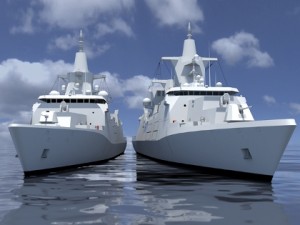
The German Navy's next project: Multi-role combat ships MKS180 (artist conception).
The German Navy’s next project: Multi-role combat ships MKS180 (artist conception).

To be clear: Such an auxiliary navy would have to be organized, trained, and equipped properly. This requires financial and political investments. The task force, more of a 10-ship navy than a 100- or even 1000-ship navy, would provide a vision for European cooperation. EU or United Nations mandates would be desirable. It appears that it is also a much more sensible road leading to further defense and security cooperation than political soap-box oratories about the need for a European army could ever do. Politically and operationally, it could provide Berlin with a sense of regaining some degree of initiative when it comes to maritime security.

Sebastian Bruns directs the Center for Naval Strategy and Security at the Institute for Security Policy, University of Kiel (Germany). He is the editor of “The Routledge Handbook of Naval Strategy and Security” (Routledge: London 2016). 
Avatar: Shock and Awe-fully Dumb

Written by Matthew Hipple for Movie Re-Fights Week

The blockbuster Avatar is not only remarkable for its stunning visuals and brow-beating politics, but for the colossal  incompetence of the corporate and military leadership of the Resource Development Administration (RDA). 

Sure, humanity may be counting on you for their survival. Sure, you have arrived on an alien planet armed with the ability to transmit your consciousness into proxy flesh suits hewn together with the most advanced science. But hey, why not just “YOLO” it and see what happens? What could go wrong? It’s not like you’re 4.5 light years from earth with limited resources!

[otw_shortcode_button href=”https://cimsec.org/buying-cimsec-war-bonds/18115″ size=”medium” icon_position=”right” shape=”round” color_class=”otw-blue”]Donate to CIMSEC![/otw_shortcode_button]


Tactical Failure: If It Looks Smart and Doesn’t Work – It’s Stupid

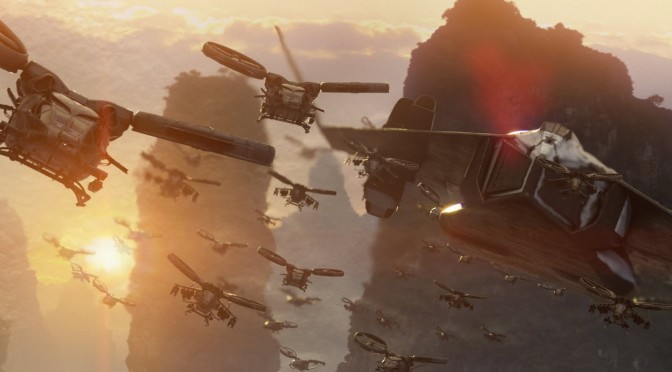
Having thoroughly pissed off the blue bees nest on Pandora, RDA command is ordering you to destroy a tiny, purple-glowing “Tree of Souls.” The critical node in a vast planet-wide biological neural net, it is located  in the middle of an area of heavy radar interference and the aerial equivalent of deadly shoal water.

That's it? It's the size of a town Christmas tree! How hard could it be?
That’s it? It’s the size of a small town Christmas tree! Why does this have to be complicated?

RDA commanders probably read the old classic “Starship Troopers” and had heard of Star Craft’s “Zerg” and Halo’s “Flood” from the History Channel. Biological hive minds always end in billions of dead terrans. The mission was probably too important not to staff to death.

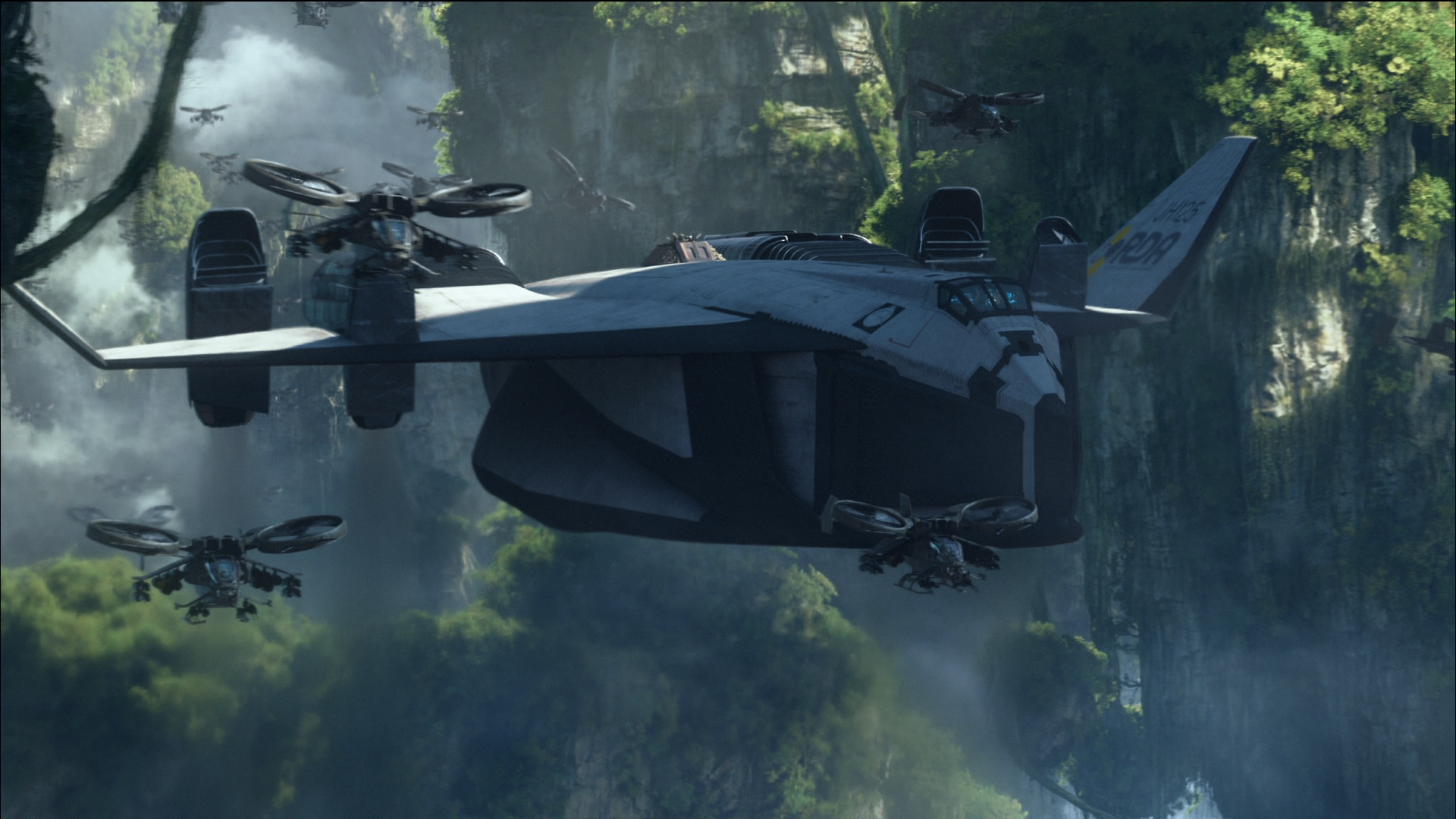
What would be more perfect than assigning a massive, vulnerable transport ship carrying a comically lashed-together bomb of mining ordnance through this rock mine-field? Granted, the target is only the size of a Denny’s… OH! Let’s add a ground assault through dense jungle with little to no air support. Never pass up an excuse to party “Ellen Ripley” style in an exo-suit. The plan looked awesome on power point, as one can see from the many unnecessary parts: a militarized space barge and a ground assault. The words “decisive,” “domain,” and “disruptive” probably appeared multiple times.

Yeah... this feels good. I'll sacrifice all my mobility to protect this lumbering militarized space barge.
Yeah… this feels good. We’ll sacrifice all our mobility to protect this lumbering militarized space barge. We look TOTALLY cool right now.

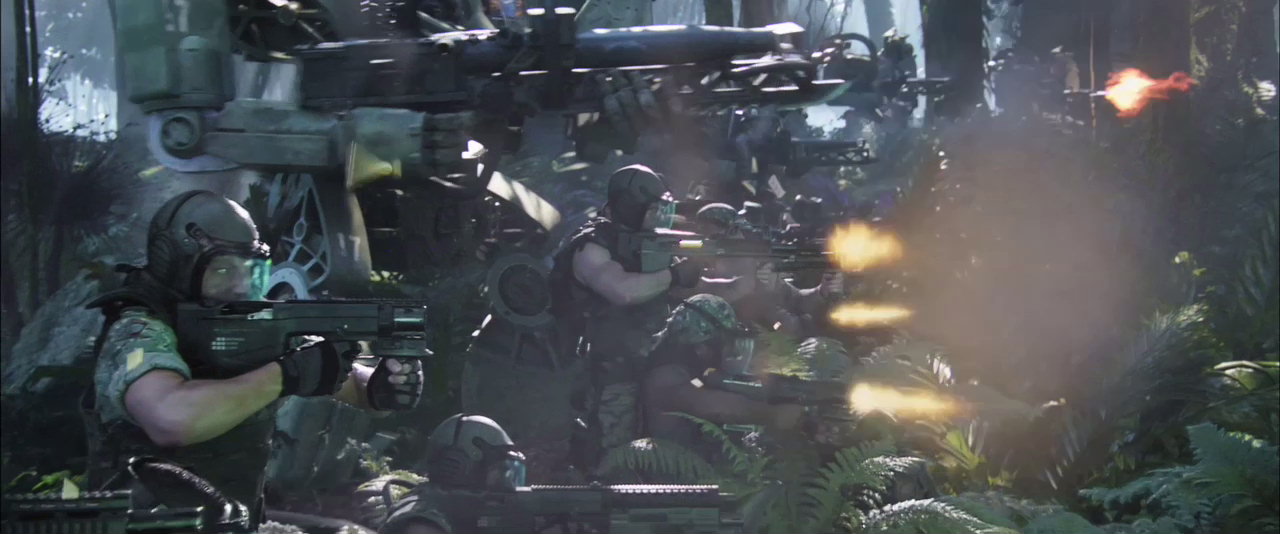
However, RDA had JUST blown up the Home Tree – a facility the size of a small city – using nothing but a token force of deadly and agile VTOL gunships. Not only was Operation Soul Tree against a far smaller and more fragile target – but it would be in a physically and electronically denied environment.  Why suddenly trade mobile lethality for for static defense on a flying dump truck? Why risk losing your entire ground force in a superfluous assault through dense jungle?  Seriously, how could this NOT go wrong?

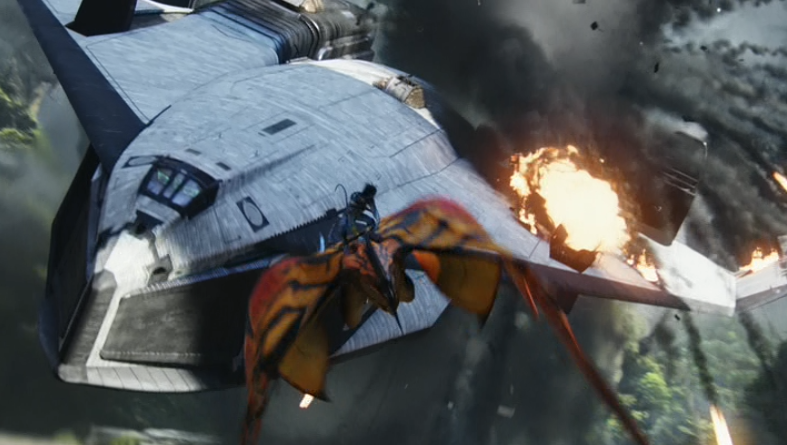
Aurgh! A total disaster we could have NEVER predicted!
Noooooo! A total disaster we could have NEVER predicted!

Now, had the RDA forces learned the lesson of their own experience – they would have executed a multi-axis raid on the “Soul Tree” using a primary assault by gunships and a feint by a faux “bomber.” The ground assault would have been completely scrubbed.

Maintaining a “feint” – preferably using gunships and a transport on rudimentary auto-pilot – would draw enemy forces away from the actual angle of attack. The windows of the aircraft used for the feint would have to be blacked out. Recon for Airborne Pandoran forces would quickly discover that the cockpits were empty, and realize the bomber is a feint.

Detaching the primary aerial assault force from the  bomber would have allowed pilots speed and flexibility denied to them in the original plan to guard a militarized transport. With Pandoran forces distracted by the potential bombardment by the transport ship, the main assault force would move through the floating boulders at top speed, devastating the Soul Tree with their ordnance before quickly retreating back to base.

I love the smell of victory in the morning.

With the ground component completely scrubbed, the RDA would retain a significant force to continue defense of their facilities. While these bases are heavily defended already, these are static defenses that require augmentation from mobile components. It would be wise to keep some of the aerial component in reserve as well, in the off chance that Operation Soul Tree failed and human forces would have to hold out until military re-supply from Earth.

Of course, unlike in Operation Guard the Slow and Useless Target, we get to win this time.

Strategic Failure: That Escalated Quickly

Sooo... now that I randomly burned down all your homes just so I can dig under your tree, we're cool - right?
Sooo… now that I randomly burned down all your homes just so I can dig under your tree, we’re cool – right?

But let’s take a step back here – why did the RDA get to the point where it believed it had to commit all its forces to a winner-take-all assault on this Soul Tree network node? Oh, that’s right, they chose to burn down some blue people’s entire capital city.

Granted, the tree is sitting on top of an unobtanium stockpile critical to humanity’s survival… but this is the same human civilization that is capable of creating avatar meat-puppets that can be operated remotely to any location anywhere on this alien planet. Certainly, we can learn the ancient art of lateral drilling?

We can bring genetically engineered soldier suits trillions of miles through space - but can only dig like Gold-rush era miners.
We can bring genetically engineered soldier suits trillions of miles through space – but can only dig  like Gold-rush era miners.

The vast mining infrastructure operated by the RDA, and the automated technology available to it, would allow humanity some options OTHER than blowing a native city into oblivion to access the resources. It’s the future, surely there are automated mining units that aren’t the size of office buildings, or tunnel-boring machines that could serve this mission.

And let’s be real here – the outfit sent to collect all these resources is the “Resource Development Administration.” Mining should be their specialty.

Force Planning: Phoning it in

The mining technology angle leads us to a more general problem with the technology employed by the RDA. Considering the military and commercial operational needs, the capabilities developed from the technology available seem oddly under developed.

The lack of orbital strike capabilities is notable. From cracking open a large hole for mining to cracking open a target – the RDA would have found great use for an orbital weapon of some sort. It’s not like the mission’s importance to earth didn’t warrant the resources. They certainly had the technology for it. You could destroy ANY  tree you really felt necessary – and you wouldn’t have to risk any military forces. Hell, the Pandorans wouldn’t even know it was you. They don’t know how satellites work.

You came this far, with ALL this technology... and couldn't bring a space cannon?
You came this far, with ALL this technology… and couldn’t bring a space cannon?

More concerning is the lack of a real military application of the avatar technology the movie is named after. Sure, the modified blue people are a nice touch. Hearts and minds is always the better path then a tough military campaign in someone else’s backyard.

However, why settle for tall skinny blue people? Why not create a legion of 10 foot tall super-Cena ? You could add extra arms, camouflage skin, or even millions of tiny spider-like hairs for extra grip! Perhaps lower cost methods could be employed to save human personnel and maximize combat effectiveness, like making the combat exo-suits neural net operated. Perhaps remote neural control could operate the gunships… or even gunship swarms controlled by a single consciousness. In the movie Surrogates, the DoD was fighting wars with legions of brain-controlled robots… and they weren’t even advanced enough to land a mining operation in another solar system.

You can biologically engineer a whole new life-form that can be remotely controlled anywhere on the planet... and all you can make is REALLY tall blue people?
Why don’t we try this with 2-3 more feet in height, 5x the muscle mass, and 2 more arms for faster magazine change-outs, multiple melee and ranged weapon use, and better climbing abilities. Maybe the skin can be a color that blends in better with the environment. Really, we can do better than super-tall blue hipsters.

Hell, if the RDA had the ability to hack into the neurological network of a surrogate body remotely – why wasn’t anyone trying to tap into this planetary neural net? Imagine the processing capacity of a planet-sized biological computer, or the influence one could have on inter-tribal planetary politics with neural-net access. At the very least, the intelligence gathering potential would be invaluable for a force operating in a potential adversary’s backyard.

Conclusion: Insanity or Laziness

Humanity is in a tight spot – an energy crisis along with dwindling terrain resources mean that unobtanium is humanity’s only way out. Unfortunately, the RDA decision makers on Pandora has decided to phone it in.

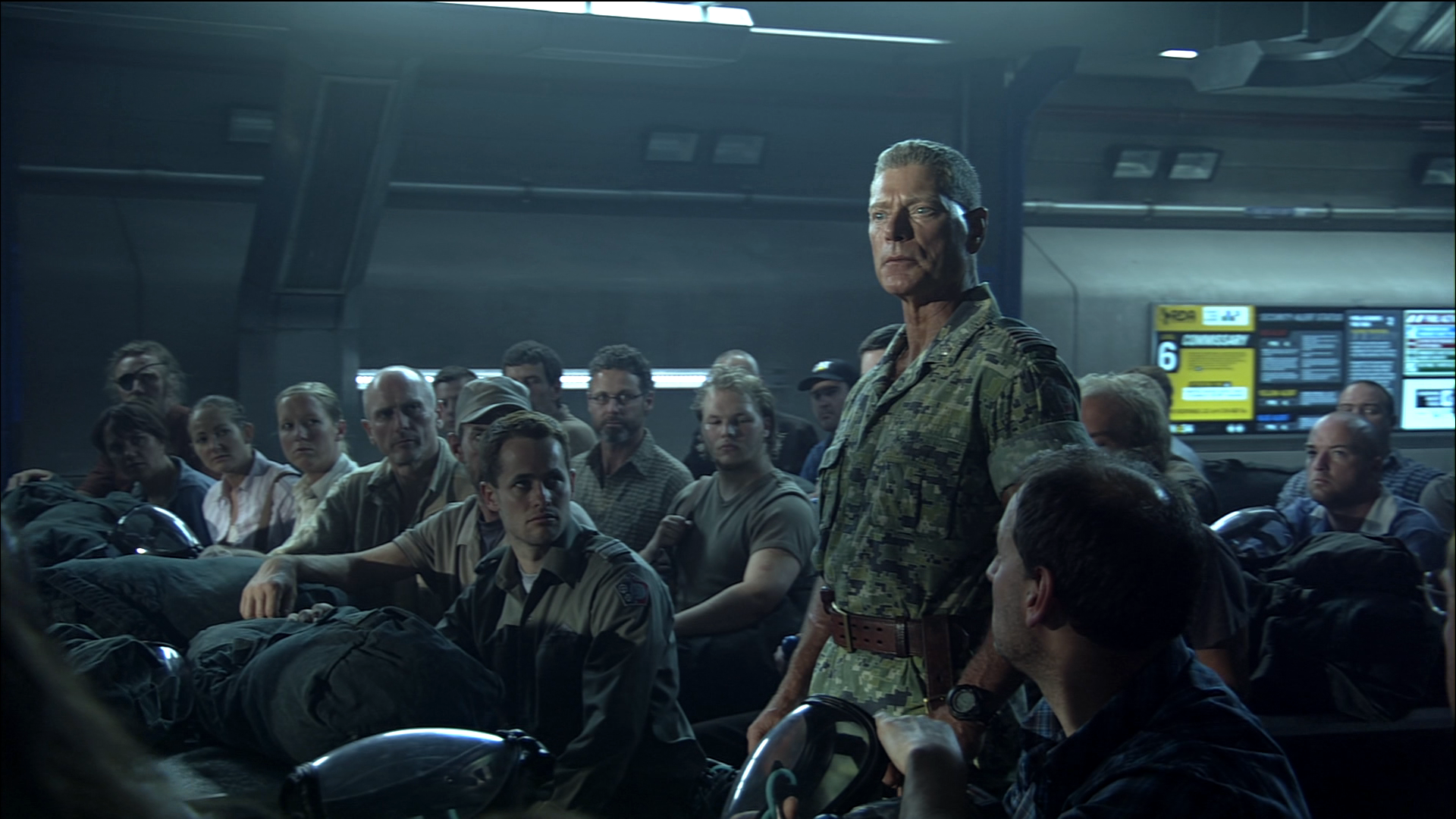
You ask me for strategy? I offer you something better - a myopic pursuit of frontal assaults. I offer you the obsessions of a man who has clearly never seen the movie "Zulu" or read a Kipling poem, and has only been fighting wildlife for at least a decade.
You ask me for strategy? I offer you something better – a myopic pursuit of frontal assaults and kinetic effects. I offer you the obsession of a man who has clearly never seen the movie “Zulu” or read a Kipling poem. I assure you, though my experience in military operations was once great, I have done nothing but slowly go mad from the isolation and fight wildlife for at least a decade.

Perhaps it’s the cabin fever spending so much time away from civilization. Perhaps it’s the simplicity of mission requirements that involve fighting either animal opponents or blue people armed with sticks. Maybe it’s even the lack of good reading material. Whatever the case, those who were clearly once capable corporate, technical, and military leaders had long ago started slacking off – thinking down predictable or silly stovepipes in their execution of the Pandora mission. It makes a good case for regular leadership rotation. It pays to ensure one’s leadership does not become stale… or even lose their minds from isolation.

Whoever humanity sends to re-take Pandora – and capture the traitor, Jake Sully – will be a bit more on the ball.

We'll be back, hippies.
We’ll be back, hippies.

Matthew Hipple is the President of CIMSEC and host of our Sea Control and Real Time Strategy podcasts. He is also an active duty Surface Warfare Officer, whose opinions do not necessarily represent those of the Department of the Navy, the Department of Defense, or the Resource Development Administration.

[otw_shortcode_button href=”https://cimsec.org/buying-cimsec-war-bonds/18115″ size=”medium” icon_position=”right” shape=”round” color_class=”otw-blue”]Donate to CIMSEC![/otw_shortcode_button]

November Member Round-Up

Welcome to the November 2015 Member Round-Up. Over the past several weeks CIMSEC members have examined several international maritime security issues, including the modernization of U.S. Naval capabilities and strategies, France’s air war against ISIS, Russian military involvement in the Syrian conflict, the future of the U.S. Air-Sea Battle operational concept and growing maritime trilateral relations between India, Japan and the U.S.

[otw_shortcode_button href=”https://cimsec.org/buying-cimsec-war-bonds/18115″ size=”medium” icon_position=”right” shape=”round” color_class=”otw-blue”]Donate to CIMSEC![/otw_shortcode_button]

Beginning the Round-Up at The Center for Strategic and Budgetary Assessments, Bryan Clark discusses the unsustainable operational stress the U.S. Navy and Marine Corps are facing with longer and more frequent deployments in multiple areas of operation. As the U.S. combats ISIS across Africa and the Middle East while also addressing Chinese and Russian international boundary conflicts, Mr. Clark explains that current processes to prepare forces for deployment are insufficient and limit the abilities for naval and marine forces to deliver certain capabilities effectively. Also at CSBA, Mr. Clark explains the affects of a decreasing Defense Department budget and the possible steps it can take to minimize the impact of reduced spending levels.

Chuck Hill, for his Coast Guard Blog, discusses the development of the National Fleet Plan and its objective to increase cooperation between the U.S. Navy and Coast Guard through increased opportunities of commonality and interoperability. Mr. Hill describes the strategic laydown of the plan concerning shared facilities and ports, particularly the stationing of Coast Guard Offshore Patrol Cutters at U.S. Naval bases.

At The War on the Rocks, Bryan McGrath provides an analysis outlining key components of Republican presidential candidate Marco Rubio’s military modernization platform. Mr. McGrath is supportive of Rubio’s focus to place priority on undersea and electronic warfare technologies considering these features of naval power are imperative for the U.S to maintain primacy in the maritime domain. Further to this, the strategy supports the development and construction of the Navy’s next ballistic missile submarine (SSBN(x)), the Air Force’s LRS-B and modernization of the U.S. nuclear arsenal to enhance strategic deterrence in the future.

Also on the future of U.S. military and naval strategy, Harry Kazianis at The National Interest shares an interview he recently participated in with the Air-Sea Battle Office. In the interview Mr. Kazianis poses several questions concerning the operational capabilities of U.S. forces within challenging environments where advanced Anti-Area/Access-Denial strategies are in effect. The interview focuses on the applicability and difficulties key components of the ASB concept encounter within A2/AD environments and the corresponding development of the Joint Concept for Access and Maneuver in the Global Commons (JAM-GC) framework.

Entering the Asia-Pacific, Mira Rapp-Hooper at Lawfare discusses the U.S.S. Lassen’s freedom of navigation operation (FONOP) in the Spratly Islands and the legal implications the operation has concerning the status of the U.S. government’s recognition of the artificially constructed islands. Ms. Rapp-Hooper analyzes the U.S.S. Lassen FONOP attempting to establish whether the operation was an exercise of innocent passage or a demonstration of normal military operations within the surrounding Chinese-claimed 12 n.m. territorial waters. Ankit Panda, at The Diplomat, also interprets tensions in the South China Sea with an explanation of the political statements released from senior Chinese and American officials. Mr. Panda discusses the opposing remarks provided by Chinese President Xi Jinping and U.S. Defense Secretary Ashton Carter concerning U.S. FONOP’s in the South China Sea and the overall security of the region’s maritime domain.

Paul Pryce, for Offiziere, explains aspects of the Papua New Guinea Defense Force procurement strategy and the regional pressures demanding its success. Mr. Pryce suggests that Papua New Guinea become a more independent actor in terms of patrolling and monitoring its territorial waters without extensive foreign assistance from regional allies such as Australia. The procurement of affordable high-capacity offshore patrol vessels as opposed to advanced and expensive frigates is crucial for New Guinea to develop the ability to control its expansive EEZ territory and contribute to maritime stability within the region.

To conclude the November Round-Up, Darshana M. Baruah also for Offiziere, discusses the evolving trilateral relationship between Japan, India and the U.S. in the Indo-Pacific. An analysis of the trilateral naval exercise Malabar 2015, where an aircraft carrier, missile cruisers and frigates participated, reveals that the alignment of Indian, American and Japanese interests are consistent with the developing geo-strategic landscape of the region. Ms. Baruah suggests that the rise of China and the changing dynamics of maritime security and naval strategy have resulted in the need for these new political and strategic arrangements.

Members at CIMSEC were also active elsewhere during the month of November:

At CIMSEC we encourage members to continue writing, either here on the NextWar site or through other means. You can assist us by emailing your works to dmp@cimsec.org.

Sam Cohen is currently studying Honors Specialization Political Science at Western University in Canada. His interests are in the fields of strategic studies and defense policy and management.

[otw_shortcode_button href=”https://cimsec.org/buying-cimsec-war-bonds/18115″ size=”medium” icon_position=”right” shape=”round” color_class=”otw-blue”]Donate to CIMSEC![/otw_shortcode_button]

Is Russia’s Maritime Strategy Adrift?

By Ben Hernandez

This article originally appeared on The Strategy Bridge. You can read it in its original format here. This article originally featured on CIMSEC on Aug. 20, 2015, and has been updated for inclusion into the Russia Resurgent Topic Week

The Russian defense industry has always had a flair for the dramatic. The Soviet military-industrial complex carried so much sway in the Politiburo that at times, it operated with little oversight from the General Secretary.1 It produced wonder weapons and prestige platforms with little regard for their cost and strategic value.

The past few years have seen a resurgence of this mindset. Russia has embarked on a massive recapitalization project, seeking to replace aging Soviet-era platforms that were often built to lax production standards. Their military-industrial complex takes great pride in trumpeting its achievements and ambitious projects through Russian language media and state-owned foreign language outlets, such as RT.com. While it is important to listen to what an adversary is saying, it is also important to see what is behind the bluster. In fact, many of Russia’s wonder weapon projects are far too grand to come to fruition — and may even signal a revival of the same discord within the Russian defense industry that plagued the Soviet Union; a discord that acted as a key forcing-function in the destabilizing Cold War arms race that brought the world to the brink of ruin.

Evidently, the RFN has even grander designs: a squadron of what would effectively be nuclear powered battlecruisers.

Consider the notional future Russian Federation Navy (RFN). Their fleet, once outnumbering the U.S. Navy 3.5:1, now spends most of its time in port. 2 Russia’s major shipyards are now going full tilt, building frigates and nuclear powered — and armed — submarines. Evidently, the RFN has even grander designs: a squadron of what would effectively be nuclear powered battlecruisers.

Dubbed the Lider class, these warships would feature the nuclear power and armament capacity of the massive Soviet-era Kirov battlecruisers. For reference, the 28,000 ton Kirov class has thrice the displacement of and carries roughly twice the armament of its nominal U.S. Navy counterpart, the AEGIS cruiser. Cutting a distinctive silhouette, the Lider would easily outgun the largest ships in the US or Chinese arsenals. Their nuclear power plants would allow them to sortie worldwide, limited only by food and ammunition supplies — the finest naval power projection to be found outside of aircraft carriers.

Given the grandiose design of the ship, it is worth examining whether the Russian military intends for it to ever exist at all or if it is nothing but a propaganda piece. Recently, the Russians have announced truly fantastic projects, such as a fleet of supersonic stealth transport aircraft capable of covertly inserting an armored division overseas.3 Open sources show that the RFN has desired a next-generation, medium to large surface combatant for years, and that more reasonable proposals gained traction before losing out to the current design.4 Additionally, a video about the Lider focuses on the wide array of Russian corporations contributing to its construction rather than the ship’s actual capabilities. Moreover, it was produced by an industry-focused media concern rather than the expected propaganda outlets, such as RT.5

Building these battlecruisers will almost certainly devour the vast majority of Russia’s shipbuilding budget and capacity.

Russian officials announced they will build twelve of these battlecruisers.6Realistically, most observers should expect to see one or two. A ship’s size tends to drive the cost of constructing it, and there’s a catch to building ships with the massive weapons capacity and power plant of the old Soviet battlewagons: they’re probably going to be about the same size. Some sources suggest they’ve even been designed by the same firm responsible for the Kirovs.7 This implies the Lider will be a budget breaker like its predecessor.

Russian designs on this Lider class represent a gulf between strategic direction and capabilities. Building these battlecruisers will almost certainly devour the vast majority of Russia’s shipbuilding budget and capacity. If the RFN succeeds in acquiring them, it will find itself with a handful of massive power projection tools unsuited to any of the conflicts it is most likely to fight.

One side is building towards a strategically defensive Cold War-era doctrine, the other toward an essentially all new doctrine based on power projection.

The Russians are setting themselves up for a major discontinuity between ends and means. A recent statement by the CEO of Russia’s state owned shipbuilding conglomerate reveals that his view that future submarine construction should focus on defending ballistic missile submarines, a mission that would take place relatively near to Russian territorial waters.8The acquisition of the Lider battlecruisers — plus recently announced plans to acquire a nuclear powered supercarrier — may suggest the forces that drive the development of the surface fleet are not in synch with the forces driving the submarine fleet. One side is building towards a strategically defensive Cold War-era doctrine, the other toward an essentially all new doctrine based on power projection. Neither of these tracks would be of much value should Russia attempt to invade one of the Baltic states, a prospect that recently gained some overt support in the Russian government.9

The Russian military is at a conventional disadvantage against NATO. As oil money begins to dry up and sanctions take their bite, the Russians do not appear to be adjusting their acquisition efforts to compensate. On one hand, they appear to be gravely concerned about the security of their nuclear deterrent. The Strategic Rocket Forces, fearing US missile defense efforts, have invested heavily in new ICBMs. Similarly, the submarine force is building new ballistic missile submarines and advanced new missiles to go with them. On the other hand, the Russians are also attempting to achieve some kind of conventional parity with NATO by producing new stealth fighters, tanks, and apparently battlecruisers. A budget is by definition zero-sum, and as Russia’s economy slowly recovers from its free-fall, the money to build all their desired means simply will not exist. This could leave Russia with an arsenal of top-of-the-line nuclear weapons while intensifying its conventional disadvantage against NATO.

Russia’s plans to build nuclear-powered battlecruisers is emblematic of a dangerously non-coherent national military strategy which haphazardly fuses Cold War paranoia with modern revanchism.

So, what is there to worry about here? Why not celebrate as the Russians procure themselves into the hole, spending exorbitant sums to acquire prestige platforms that do not contribute to their strategy? Because Russia may well attempt to achieve its ends through whatever means are available. The weaker and less focused its conventional forces are, the more likely it is to resort to the use of tactical nuclear weapons to win a conflict with NATO. Painted into a corner by their belligerence and poor acquisition decisions, Russia may become dangerously prone to acting upon its “escalate to de-escalate” doctrine.

Russia’s plans to build nuclear-powered battlecruisers is emblematic of a dangerously non-coherent national military strategy which haphazardly fuses Cold War paranoia with modern revanchism. It seeks to achieve ends (building a “buffer zone” of pro-Russian states by force while protecting its nuclear deterrent) through dangerous ways (“hybrid” and conventional warfighting, with the option to “escalate to de-escalate”) without the means to fully execute those ways. The end result could be disastrous for all involved.


Ben Hernandez is one of the hundreds of students under instruction at Naval Station Newport, R.I. The views expressed here are the author’s alone and do not reflect those of the U.S. Navy, the Department of Defense or the U.S. Government.

Read other contributions to Russia Resurgent Topic Week.

1 Hoffman, David, The Dead Hand (Anchor Books, New York, N.Y., 2010)

2 Director of Central Intelligence William J. Casey, Soviet Naval Strategy and Programs through the 1990s, NIE 11–15–82/D. (CIA Historical Review Program, approved for release 31 January 1995)

3 RT.com, Future Russian Army Could Deploy Anywhere In the World — In 7 hours, 19 March 2015, accessed 17 July 2015, http://www.rt.com/news/242097-pak-ta-russian-army/

4 GlobalSecurity.org, New Construction Destroyer, accessed 17 July 2015,http://www.globalsecurity.org/military/world/russia/ddg-newcon.htm

5 Concern Agat — Russia Leader-Class Nuclear Guided Missile Destroyer Concept, 16 August 2014, https://www.youtube.com/watch?v=ORVVK6OCr74

6 Sputnik News, The Destroyer “Leader” and the Future of the Russian Navy, 16 March 2015, http://in.sputniknews.com/russia/20150316/1013781801.html

7 Hassan, Abbass, World Defense Review, Russian Navy approves the proposed future destroyer, 14 February 2013, accessed 17 July 2015.

8 Keck, Zachary, Russia’s New Nuclear Submarines to Target U.S. Aircraft Carriers, 6 July 2015, http://nationalinterest.org/blog/the-buzz/russia-building-aircraft-carrier-killer-nuclear-submarines-13266

9 Laurinavicius, Marius, Russia’s Dangerous Campaign in the Baltics, 16 July 2015, http://www.cepa.org/content/russias-dangerous-campaign-baltics