Tag Archives: Strategy

The Baltic Sea and Current German Naval Strategy

The following article is adapted from part of the 2015 Kiel Conference proceedings.

By Dr. Sebastian Bruns

With the deteriorating relations between the West and Russia in the wake of Crimea’s annexation and the hybrid war in Eastern Ukraine since early 2014, the Baltic Sea is suddenly thrust back into the spotlight of naval planners, policy analysts, and students of strategic geography alike.1 This article lays out some principles of looking at the Baltic Sea through the lens of the German Navy, which – while busy conducting a host of maritime security operations (MSO) in such far-flung places as the Horn of Africa, the coast of Lebanon, and the Central Mediterranean for more than two decades – finds itself returning conceptually to one of its home waters. It was the Baltic Sea and related military contingencies that dominated Germany’s naval DNA during the Cold War. Operating in the Baltic Sea was a fundamental part of the German Bundesmarine (Federal German Navy) coming-of-age. In fact, some of the legacy platforms still operated by the German Navy stem from an era that was entirely focused on the shallow and confined waters between Jutland, Bornholm, and farther east.
BalticSea
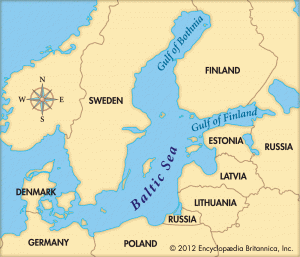
The Baltic Sea. (Encyclopedia Brittanica)

Since 2014, Germany finds itself in need to return to the Baltic Sea operationally, conceptually, and strategically. However, with a smaller navy increasingly stretched for resources, manpower and vessels, Germany cannot afford the luxury of ignoring other maritime security focus areas of the world worthy of a more expeditionary navy. This spells hard choices for the German Navy and its political masters who have depleted many maritime resources while simultaneously expanding the naval operational portfolio. To underline the conceptual reorientation that this strategic challenge demands, this essay first sketches what characterizes this ‘third phase’ of the German Navy (the first phase being the coastal/escort West-German Navy period from 1956 to about 1990, the second phase the expeditionary period from 1990 to about 2014). Second, the piece will discuss a few of the current political dynamics as they relate to naval and political relationships in the Baltic Sea in particular and the German Navy in general. Third, this essay addresses some of the fundamental naval-strategic shortcomings that put a coherent and believable strategic approach at risk. Fourth and finally, a handful of policy recommendations are provided.2

Three Phases of the Modern German Navy

To put the recent challenges to the German Navy into perspective, just as the service is celebrating its 60th anniversary, it is instructive to briefly touch upon some of the conceptual and intellectual frameworks that govern German maritime and naval strategy. Problems with periodization aside, it is helpful to frame the strategic evolution of the German Navy and how it is intellectually and conceptually approaching the return of the Baltic Sea as an area of responsibility.  
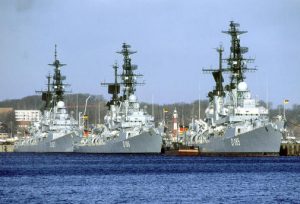
The three Charles-F-Adams-type destroyers MOELDERS, LUETJENS and ROMMEL were the backbone of the Cold War West-German Navy and were a mainstay in Kiel naval base (photo: Frank Behling, Kieler Nachrichten).
The three Charles-F-Adams-type destroyers MOELDERS, LUETJENS and ROMMEL were the backbone of the Cold War West-German Navy and a mainstay in Kiel naval base (Frank Behling, Kieler Nachrichten).

In very broad terms, the ‘first phase’ of the modern German Navy – keeping in mind that the navies before 1945 officially hold no traditional value for the post-war service and are consequently not a point of departure 3  – ran from the inception of the Bundesmarine in 1956 to German reunification in 1990.4 After the devastation of World War II and the demise of the Third Reich, only ten years passed until Germany once again fielded a military. Before the German flag was hoisted again on a warship, a handful of predecessor organizations existed for tasks such as mine-clearing, intelligence gathering, and border patrol. When the Bundesmarine came into being, it was a product of the emerging Cold War and the bipolar world order. There was considerable Anglo-American support after 1945, both covertly and openly, for a new German maritime defense.5 In contrast to the grander aspirations of the decades before, the West German navy was limited to coastal defense (including mine warfare, submarine operations, and air defense) in the North Sea and the Baltic Sea. From the outset and bound by constitutional and political imperatives, the German navy fashioned itself as a territorial defense and alliance force with strict limitations on where and how to operate. Its geographic restriction was eased in the 1970s when missions such as convoy protection in the North Atlantic emerged and more trust was bestowed by NATO allies on West Germany as well as the modernized equipment its navy fielded. From 1980, the Concept of Maritime Operations (CONMAROPS) integrated German posture in the Baltic Sea into the broader NATO-led maritime defense:

“CONMAROPS highlighted the importance of containing Soviet forces through forward operations, of conducting defense in depth, and of gaining and maintaining the initiative at sea. CONMAROPS was based first on deterrence. Should deterrence fail, the strategy was designed to mount a defense far forward in order to protect the territory of the alliance’s European member nations. The concept bracketed NATO’s naval operations into five operational areas or campaigns: the Mediterranean lifelines, the eastern Mediterranean, the Atlantic lifelines, the ‘shallow seas,’ and the Norwegian Sea.” (Børresen 2011: 99)

While increasing cooperation and temporary integration into the Standing NATO Maritime Groups (SNMG) became an integral part of the maritime mindset, Baltic contingencies still formed a key pillar of German strategic naval DNA. The fleet of diesel submarines, mine warfare ships, fast-patrol boats, anti-submarine and air warfare destroyers and frigates, as well as naval warplanes, reflected this.  
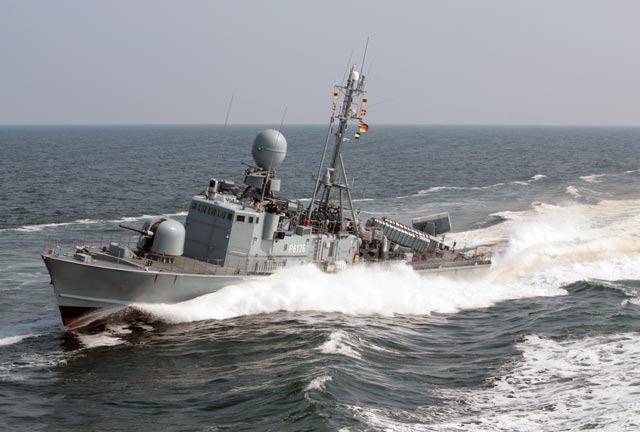
Fast patrol boat FRETTCHEN plows through the Baltic Sea (Photo: German Navy).
Fast patrol boat FRETTCHEN plows through the Baltic Sea (German Navy).

The ‘second phase’ of the German Navy began with the transition from the Cold War posture and lasted for more or less a quarter of a century. The 1990-2014 timeframe was initially characterized by the absorption of the East-German Navy and a shrinking set of assets in the wake of a dramatically changing strategic environment. Real-world crises from 1990 onward mandated a transition of the German escort navy to a more expeditionary force (Chiari 2007: 139). Consequently, the German Navy was no longer confined to waters in its near abroad. Instead, it practiced more diverse, but nonetheless challenging operations in the Mediterranean and the Persian Gulf (Bruns 2016a: 285-287).

Politically, the Baltic Sea, once a contested and disputed area between the East and the West, became a true ‘NATO lake’ with the accession of former Warsaw Pact member states to the North Atlantic Treaty Organization in 1999 and 2004, respectively. To address maritime security and safety challenges, a set of governance regimes was installed, most notably the Maritime Surveillance network (MARSUR) for maritime situational awareness and Sea Surveillance for the Baltic Sea (SUCBAS). The military integration along the Baltic littoral was complemented politically and economically by the expansion of the European Union into Central and Eastern Europe in the early 2000s.6 In the absence of the very Cold War scenarios that the German Navy had practiced for until 1990, the Baltic Sea became little more than a ‘flooded meadow’7 – a site for training and testing, or a theatre of Partnership for Peace (PfP) initiatives with non-NATO members. The commercial use of the Baltic Sea rose significantly with an increase in maritime traffic (both cargo and passenger vessels) and a surge in exploitation of the maritime realm for energy purposes (such as offshore wind farms and gas pipelines), but that did not nearly require as much military attention on the part of Germany as it did in the years prior to the fall of the Berlin Wall.
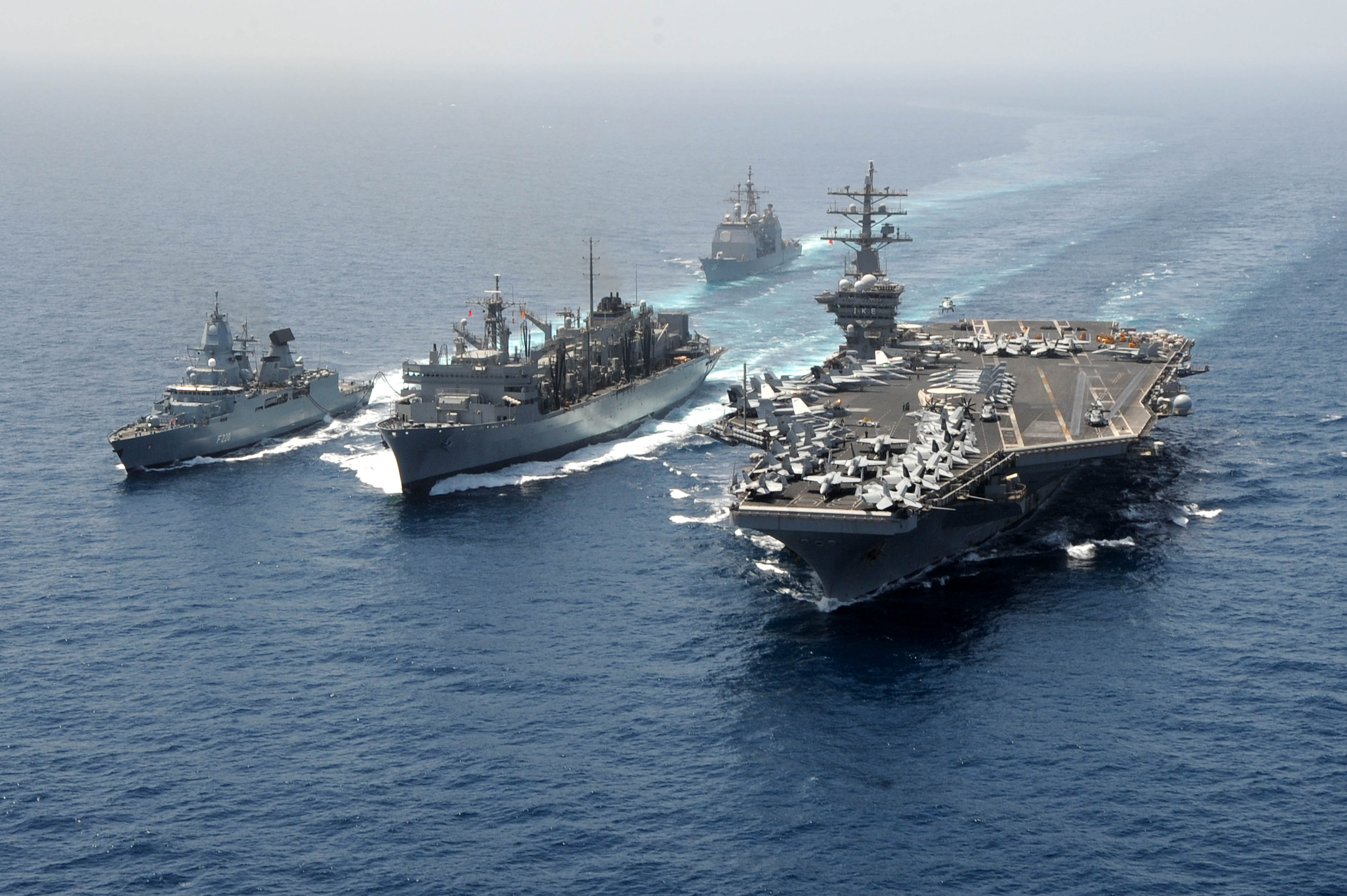
The German Navy frigate FGS Hamburg (F220), left, and the aircraft carrier USS Dwight D. Eisenhower (CVN 69), right, take on fuel and stores from the Military Sealift Command fast combat support ship USNS Bridge (T-AOE 10), center, during a replenishment-at-sea in the Arabian Sea on March 23, 2013. (U.S. Navy photo by Mass Communication Specialist 2nd Class Ryan D. McLearnon/Released)

Coupled with the broadened mission set and the distance to the German Navy’s post-Cold War operating areas, this mindset fundamentally shaped how the institution and its people thought about and practiced maritime strategy as a whole. To them, it was something that was designed to address expeditionary challenges in the Mediterranean, off the coast of Africa, or in the Persian Gulf, and nothing that dealt with the ‘Fulda gap’ equivalent at sea near Fehmarn. The Cold War generation of naval leaders and a new generation of officers schooled at fighting pirates, upholding embargoes, providing humanitarian assistance, or patrolling the sea lines of communication existed in parallel for a period of time, often utilizing the very same platforms that were originally designed for fleet-on-fleet tasks envisioned for a NATO-Warsaw Pact conflict. Whereas the warships and maritime patrol aircraft hardly changed, the German naval and maritime strategic horizon, and the public and political understanding of the role and value of the German Navy in the 21st century, did.  

The ‘third phase’ began in the wake of Crimea’s annexation and the Ukraine quasi-civil war in 2014. Since Russia’s return to the world stage as a powerful actor willing to use military force rather indiscriminately for political ends, defying the Western model and conceptions about NATO-Russian partnerships, much has changed in threat perception. Spillover effects into the Baltic Sea include Russian harassment of the three Baltic countries (Estonia, Latvia, and Lithuania) as well as Scandinavian allies, the reevaluation of all bilateral and multilateral political and economic relations with Russia, and a significant rearmament of the Kaliningrad exclave. Concurrently, the ever-smaller German Navy, challenged by an unsustainable force structure trajectory which has hampered modernization, readiness, recruitment, and operations, finds itself under significant strain.
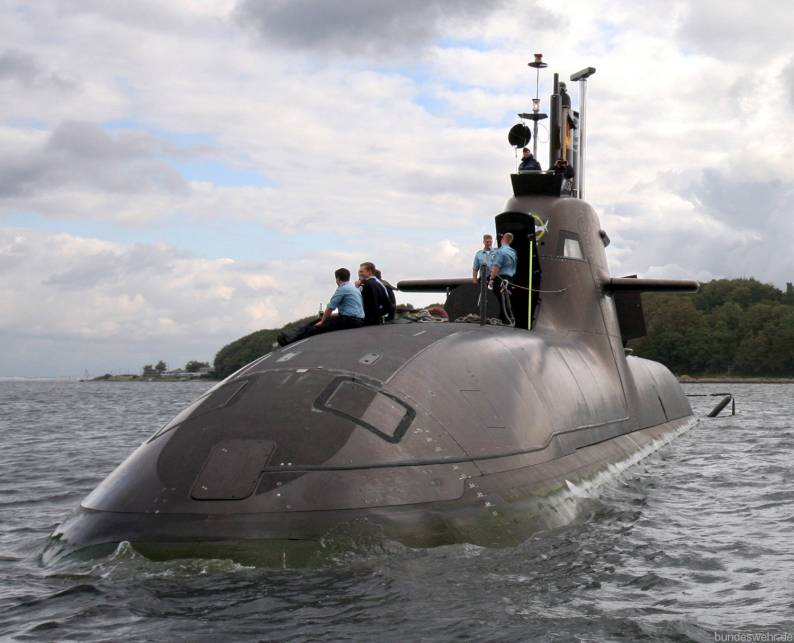
German Navy Type 212 submarine (Bundeswehr)

The German Navy is not the only force which needs to refocus on the Baltic Sea, as Denmark and Sweden have also reduced many of their capabilities that they no longer regarded as necessary for their own maritime transitions since 1990. Still, the German Navy finds itself as the largest Western Navy in the Baltic Sea, despite the transfer of the naval bomber arm to the Luftwaffe in 1993 (and the loss of respective capability), the phasing out of the Bremen-class frigates since 2012, the scheduled decommissioning of the remaining fast-attack boats of the Gepard-class in 2016, and the shrinking of the submarine and mine countermeasures (MCM) force. At the same time, the German Navy is forced to refashion its contribution to German defense and national security. The upcoming White Book on German defense policy (the first since 2006), a new European Union global strategy due out this summer as well, and plans to update NATO’s Alliance Maritime Strategy (AMS) of 2011 are the push factors that frame how the Navy must articulate its missions. Keeping in mind that strategic cultural change is very hard, if not impossible, to mandate, there are two capstone documents being planned /written to complement and operationalize the White Book. First, a dedicated top-level service vision dubbed Dachdokument Marine,and second, a more focused naval operational strategy dubbed Militärische Seefahrtstrategie. The thrust of both documents is that the German Navy is no longer afforded the luxury of choosing their maritime focus areas. It must be both, a homeland and alliance defense force, as well as a capable integrated regional power projection navy.  

Current Baltic Sea Maritime Challenges

Such a shift of attention and focus is challenging. Until recently, German politics has been very consumed by mass migration from Africa and the Middle East. In fact, not one, but two naval missions (one in the central Mediterranean and one in the Aegean Sea) with significant German Navy participation speak volume to the size of the problem perceived by Berlin – although these missions are hardly what navies are built and maintained for.9 Meanwhile, there is a larger sense in Berlin that the German Navy is overstretched and underfunded. Given its hollow force structure, the dire human resources situation in the wake of transforming the Bundeswehr into an all-volunteer force, and the strain of ever-longer deployments with increasingly overburdened warships, the need for improved strategic guidance and more resources for Berlin’s 911-force of choice is evident.

For the time being, such political challenges cloud the deteriorating relationship with Russia over the Baltic Sea. Russia’s intimidating actions are widely seen with a grain of salt within the security community, but the wider German public is hardly critical of the shift and fails to comprehend Moscow’s motives as well as the complexities of international politics. A case in point was the recent ‘buzzing’ of the U.S. Navy’s Arleigh-Burke-class destroyer USS Donald Cook (DDG-75) in international waters in the Baltic Sea. Susceptible to Russian and anti-American narratives, it was questioned why the U.S. Navy operated in the Baltic Sea in the first place.
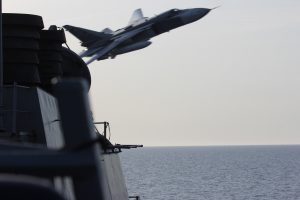
BALTIC SEA - A Russian Sukhoi Su-24 attack aircraft makes a very-low altitude pass by the USS Donald Cook (DDG 75) April 12, 2016. Donald Cook, an Arleigh Burke-class guided-missile destroyer, forward deployed to Rota, Spain is conducting a routine patrol in the U.S. 6th Fleet area of operations in support of U.S. national security interests in Europe. (U.S. Navy photo/Released) BALTIC
BALTIC SEA – A Russian Sukhoi Su-24 attack aircraft makes a very-low altitude pass by the USS Donald Cook (DDG 75) April 12, 2016. (U.S. Navy photo/Released)

German-Russian relations in the Baltic Sea realm are still fundamentally about economic ties, some with considerable personal investment of high-ranking policy-makers like former chancellor Gerhard Schröder. The Northstream pipeline, which transfers Russian gas to Germany on the seabed, might offer a point of departure to exert political leverage on Moscow, but it also raises fears of a tainted German-Russian deal over Central European countries’ national interests, as has happened in the past. For the German Navy, the Baltic Sea has lost little of its ‘flooded meadow’ characteristics, at least when it comes to potential naval missions in the area. Four of the five major German Navy installations (Eckernförde (class 212A submarine base), Kiel (home of Flotilla 1 and the Centre of Excellence for Operations in Confined and Shallow Waters), Neustadt/Holstein (damage control training facility), and Rostock (home of the naval command and home port to the largest German Navy surface combatants in the Baltic Sea) are located here, but conceptual and strategic innovation in terms of smart power beyond good order at sea remain scarce.

German Shortcomings

There are a number of areas where shortcomings are evident, and these need to be addressed now. While it would be easy to simply ask for more money to be poured into the Army and Luftwaffe-centric German defense budget, the more fundamental challenge is that of an intellectual kind. Little has changed from this 2013 assessment:

“The German Navy’s contributions to NATO’s maritime roles fall mainly within the lower end of the operational spectrum. Germany’s cruising navy provides little in the way of power projection but, for out-of-area operations, the fleet adds to alliance maritime security and cooperative security, and, though the sea-control capabilities resident in these platforms, it can contribute to collective defense.” (McGrath 2013: 6)

The question that begs an answer then is just what role sea power plays for the government in Berlin, and just how the German Navy can provide the necessary options to the political decision makers (including the respective price tags).

While Germany is lacking certain capabilities worthy of a medium-sized navy (such as the vaunted joint support ships capable of launching and supporting, amphibious operations from the sea), it is also lacking vocabulary for a more confrontational stance requiring hard-power capabilities on the one hand, and a clearer understanding of the roles and missions of naval forces on the other hand. One will be hard-pressed to find anyone in Berlin or Rostock who is war-gaming in earnest anti-access/area denial (A2/AD) scenarios in the Baltic Sea, or who is discussing with salience the naval side of deterrence and hybrid scenarios in the Mare Balticum. This is all the more discomforting because Germany has signed up to, but obviously not understood, NATO’s Alliance Maritime Strategy. This document from 2011 contains language that should inform partner nations’ naval outlook. The AMS mentions four areas for alliance naval activity: deterrence and defense, crisis and conflict prevention, partnership and cooperation, and maritime security. If one decides to focus on particular areas over others, such cherry-picking will amount in demonstrating a lack of coherence and conviction, which is both disastrous for the navy as a foreign policy tool, German standing, and for those Baltic Sea neighbors keen for alliance protection.

The challenge for any workable strategy is to prioritize. With finite resources, and certainly for a powerful country such as Germany, the task is to balance the force adequately so that it can do both. It needs to be able to conduct expeditionary operations under an international EU, UN, or NATO mandate together with other navies (think anti-piracy off the coast of Somalia or naval capacity-building such as in Lebanon), and also provide sustained territorial and alliance defense for and from the home waters. A flawed appreciation for strategy or an unwillingness to even think and act strategically is guaranteed to make such endeavors outright impossible. The objective is, to put it in the words of one analyst, “strategic flexibility and ambiguity of response” (Kofman 2016) against a changing strategic landscape in the Baltic Sea. The German government would be well-served to look into the NATO treaty, in particular Article 5, and make all efforts to provide adequate resources for its military to honor previous commitments. It would follow that the German Navy, which has all but lost its ability in many traditional naval mission areas such as anti-air warfare (AAW), antisubmarine warfare (ASW), and anti-surface warfare (ASuW), would require better intellectual and financial preparation. 

Window of Opportunity: A Few Policy Recommendations

A popular saying notes that in the long-run, the pessimist may be proven right, but the optimist has the better time on the trip. In that spirit, there is a window of opportunity.

First, now is the time for a broader and more focused German maritime and German naval strategy. Self-evidently, these documents would need to carry the thrust of the government and in their scope and relevance not be limited to a particular service or department. They would also need to be deconflicted with the White Book and with relevant emerging EU and NATO strategies, while also honoring commitments from previous national and multinational capstone documents. Such a German naval strategy can focus on high-end design for its forces, extrapolated from its defined naval missions in support of Germany’s security and defense policy.

Second, it would embrace temporary integration with its allies beyond the Standing NATO Maritime Groups (SNMG) to finally provide teeth to the concept of shared and pooled resources. Third, low-end maritime security operations on the side would still be in the portfolio, but ships and aircraft would do these on the side, so to speak, rather than this being the chief strategic concern.
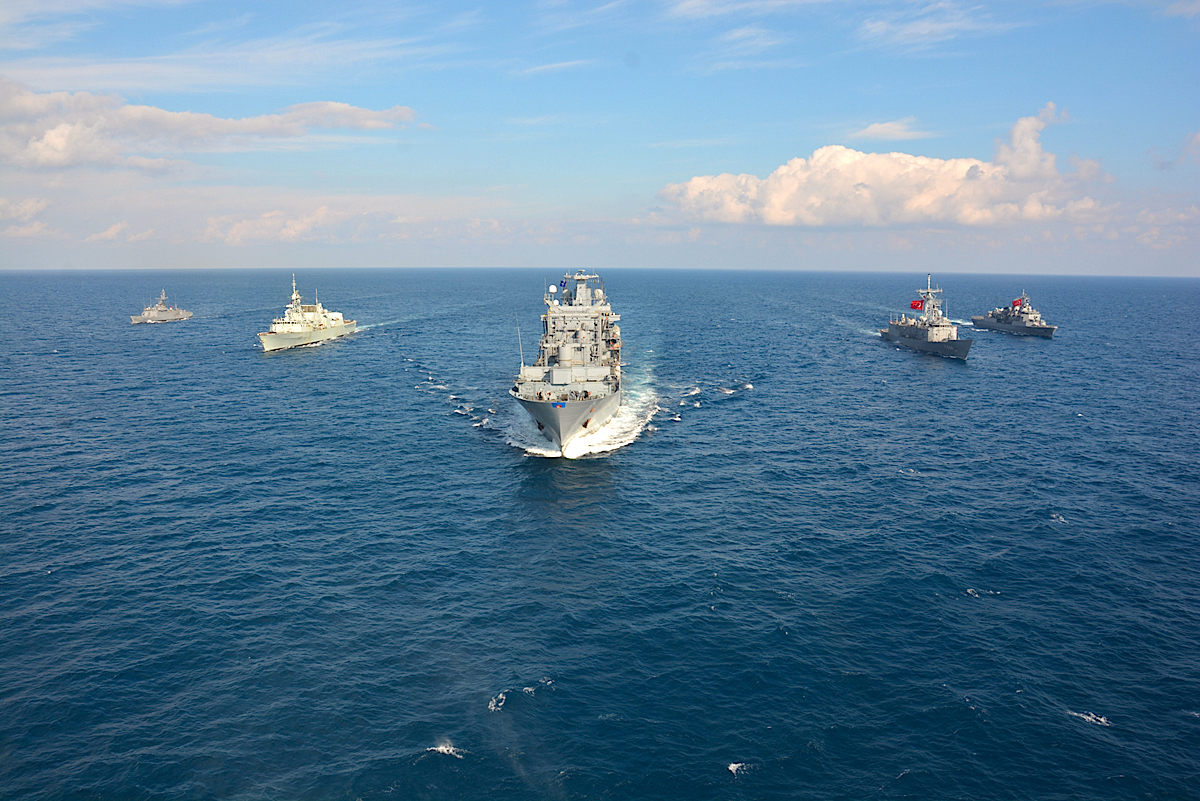
Standing NATO Maritime Group 2, seen here steaming in formation, is currently tasked with operating on the Aegan Sea refugee route. (NATO)

Fourth, it would address the intellectual gaps that have emerged in Germany on the role of naval forces as a foreign policy tool, speak on contemporary maritime scenarios such as hybrid or asymmetry, and provide a sense of direction for the navy. This would definitely strengthen the European pillar of NATO. A return to the ‘bracketing’ approach of CONMAROPS could serve to connect areas of alliance maritime interests. Fifth, it would give the service and its political masters the sense that the maritime challenges of the 21st century are not entirely new. In fact, such a capstone document could address some of the constants of naval issues and initiate a hard look at recent (Cold War) history to address the dynamics of a forward-operating focus, and the role of maritime power for Germany.

Sixth, a capstone document would give allies (and opponents) the opportunity to read about what Germany is up to in the maritime domain. It would sketch avenues to engage with the German Navy. This could mean more exercises, also in the Baltic Sea and beyond such established annual events as BALTOPS. Eventually, it would also provide a sense of direction for those countries in the Baltic who feel most threatened.

It should not come as a surprise that the Baltics are determined to defend against Russia, but they seek German leadership as a responsible lead nation in the Baltic Sea area. Germany should take this seriously.

Dr. Sebastian Bruns directs the Center for Maritime Strategy and Security at the Institute for Security Policy at Kiel University (ISPK). He recently published the edited volume Routledge Handbook of Naval Strategy and Security (London 2016) together with Joachim Krause. Dr. Bruns, a former Congressional staffer in Washington, D.C., is also one of the project directors of the Kiel Conference on maritime security challenges, soon in its third iteration. This article is part of the 2015 Kiel Conference proceedings, available upon request by e-mail or online (www.ispk.org).

Endnotes

Børresen, Jacob (2011), Alliance Naval Strategies and Norway in the Final Years of the Cold War, Naval War College Review Vol. 64 (2), 97-115.

Breyer, Siegfried/Lapp, Peter Joachim (1985), Die Volksmarine der DDR: Entwicklung, Aufgaben, Ausrüstung, Bonn: Bernhard & Graefe.

Bruns, Sebastian (2016b), A Call for an EU Auxiliary Navy – under German Leadership, Center for International Maritime Security (CIMSEC), 1 March 2016, https://cimsec.org/a-call-for-an-eu-auxiliary-navy-under-german-leadership/22385 (18 May 2016).

Bruns, Sebastian (2016a), Elements of Twenty-First-Century German Naval Strategy, in: Joachim Krause/Sebastian Bruns (eds.), Routledge Handbook of Naval Strategy and Security, London: Routledge, 283-295.

Bruns, Sebastian (2005), “The Role of the United States Navy in the Formation and Development of the Federal German Navy, 1945-1970”, Washington, D.C.: Naval History and Heritage Command, http://www.history.navy.mil/research/library/online-reading-room/title-list-alphabetically/r/the-role-of-the-united-states-navy-in-the-formation-and-development-of-the-federal-german-navy-1945-1970.html (18 May 2016).

Chiari, Bernard (2007), Von der Escort Navy zur Expeditionary Navy: Der deutsche Marineeinsatz am Horn von Afrika, in: Wegweiser zur Geschichte. Horn von Afrika, im Auftrag des Militärgeschichtlichen Forschungsamtes herausgegeben von Dieter H. Kollmer und Andreas Mückusch, Paderborn et al.: Schöningh, 126-139.

Kofman, Michael (2016), “Fixing NATO Deterrence in the East or: How I Learned to Stop Worrying and Love NATO’s Crushing Defeat by Russia”, Warontherocks, 12 May 2016, http://warontherocks.com/2016/05/fixing-nato-deterrence-in-the-east-or-how-i-learned-to-stop-worrying-and-love-natos-crushing-defeat-by-russia/ (26 May 2016). 

McGrath, Bryan (2013), “NATO at Sea: Trends in Allied Naval Power”, National Security Outlook No. 3, Washington, D.C.: American Enterprise Institute.

Peifer, Douglas (2002), The Three German Navies: Dissolution, Transition, and New Beginnings, 1945-1960, Gainesville: University of Florida Press.

Pfeiffer, Ingo (2014), Seestreitkräfte der DDR. Abriss 1955-1990, Berlin: Miles.

1. A selection of further reading (of only the very recent analyses) includes Lucas, Edward (2015), “The Coming Storm. Baltic Sea Security Report”, Centre for European Policy Analysis (CEPA), Washington, D.C.; Lundqvist, Stefan & Widen, JJ (2015), “The New US Maritime Strategy. Implications for the Baltic Sea”, The RUSI Journal, 160:6, pp. 42-48;  Kramer, Franklin & Nordenman, Magnus (2016), “A Maritime Framework for the Baltic Sea Region”, Atlantic Council Brent Scowcroft Center on International Security, Washington, D.C.

2. This chapter is based on a presentation given in Arlington (Virginia), United States, on 21 March 2016. The author wishes to acknowledge the Center for Naval Analyses (CNA), sponsor and facilitator of that roundtable discussion, for its support.

3. See Douglas Peifer (2002) for an interpretation which pushes back against the perception that there were little continuities from the Kriegsmarine in the post-World War German navies. Quite the contrary was the case. 

4. The East German Volksmarine (People’s Navy) was disestablished in 1990 with much of its materiel decommissioned/sold; the majority of its officers and enlisted personnel were laid off. The service thus remains but an episode in German naval history without much resonance in its post-1990 DNA and is therefore not subject to deeper consideration for this article. For (German-language) introductions to the Volksmarine, see Siegfried Breyer/Peter Joachim Lapp (1985) and Ingo Pfeiffer (2014).   

5. See Bruns (2005) for an annotated bibliography of U.S. Navy influence on the development of the West-German navy for the 1945-1970 timeframe.

6. The EU has fielded its own Baltic Sea Strategy which focuses entirely on environment and good governance aspects.

7. The Baltic Sea is frequently referred to as little more than a flooded swamp, in particular by members of the German naval community. This affectional characterization is based in the shallow and confined hydrography of this particular body of water and the strategic geography it entails, making it a unique area for naval operations and the political use of sea power. 

8. Full disclosure: This author has been part of the group that was tasked with conceptualizing and writing the drafts of that document.

9. For a pledge to consider establishing an auxiliary navy to address low-end maritime missions (a European Coast Guard by another name), see Sebastian Bruns (2016b).

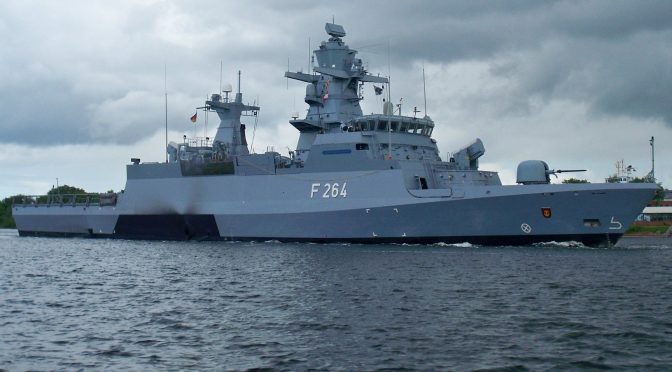
Featured Image: Corvette Ludwigshafen am Rhein ( F 264 ) in magnetic surveying at the Wilhelmshaven Wiesbaden Bridge (Ein Dahmer)

Members’ Roundup: June 2016

By Sam Cohen

Welcome to the June 2016 members’ roundup. Throughout June, CIMSEC members examined several international maritime security issues, including increased competition in the undersea environment, the Taiwanese Navy’s pursuit of an enhanced air defense capability, Russia’s modernization of the Black Sea Fleet, developments in unmanned aerial vehicle (UAV) technology and carrier based operations, and finally, growing piracy threats off the coast of Libya. 

Beginning the roundup at the Bulletin of the Atomic Scientists, Bryan Clark discusses undersea cables and the future of submarine competition. Mr. Clark explains how at least 95% of voice and internet traffic in addition to more than $4 trillion per year in financial transactions travels through about 300 transoceanic fiber-optic cables along the seabed. Due to the likely economic and military impacts a cable break or sabotage would induce on international security and economic dynamics, the ability to threaten or protect undersea cables and their shore landings will become an increasingly important aspect of future conflict – with procurement of advanced submarine and unmanned underwater vehicle (UUV) technology being critical for  addressing this evolving threat. Mr. Clark highlights several of these technologies, including the rise of a new predominant sensing technology characterized by low-frequency active sonar, the use of undersea ‘battle networks’ and the deployment of fixed seabed-based sensors and outposts to augment UUV and submarine operations.

Harry Kazianis, for The National Interest, provides an analysis on the proliferation of anti-ship ballistic and cruise missiles around the globe and the implications the spread of these weapon systems will have on future U.S. aircraft carrier operations in peace and in conflict. Mr. Kazianis notes that the carrier has been at the forefront of every major U.S. combat operation since World War II, but the short ranges of current carrier based fighter aircraft relative to the longer ranges of certain anti-ship missiles – such as China’s DF-21D, or DF-26 ASBM – may limit the usefulness of the carrier as both an effective deterrent and a reliable platform for power projection in contested areas of operation. The article highlights additional variables affecting the relevance of the flattop in A2/AD environments, including the likelihood of successfully targeting a moving carrier at sea deploying an array of countermeasures.

Ankit Panda, for The Diplomatprovides an overview of a Chinese Naval vessel entering Japanese territorial waters and the incident’s reflection of growing tensions between the two countries. Mr. Panda explains that a Type 815 Dongdiao-class spy ship entered Japanese territorial waters on June 15, a move Beijing has not repeated since 2004, when a Chinese nuclear submarine entered Japan’s 12 nautical mile territorial sea near the Sakishima Islands. The article examines whether the Chinese spy ship was abiding by international law, particularly the provisions governing ‘innocent passage’ under the United Nations Convention on the Law of the Sea. Considering the Chinese vessel was a spy ship and sailed within Japanese waters for several hours, Mr. Panda explains that the Japanese Defense Ministry is investigating whether the PLAN vessel was operating in accordance with international law and if follow-up legal action should be taken.

Michal Thim and his colleague Liao Yen-fan, for Taiwan in Perspective, discuss the restructuring of the Taiwanese Navy, and the goal to acquire enhanced air defense capabilities for the fleet. The authors explain that modernization plans have identified interchangeable Aegis-like integrated combat systems (ACS) that pair powerful radars with advanced anti-air and anti-ship weapons as priority procurement targets. However, the recent breakdown in negotiations between Lockheed Martin and Taiwan’s National Chung-Shan Institute of Science and Technology (NCSIST) over the acquisition and technology transfer of the Mk.41 vertical launch system may limit the Navy’s ability to deploy ACS. They add that this breakdown and the resulting procurement limitations represent inherent challenges associated with Taiwan’s arms indigenization objectives.

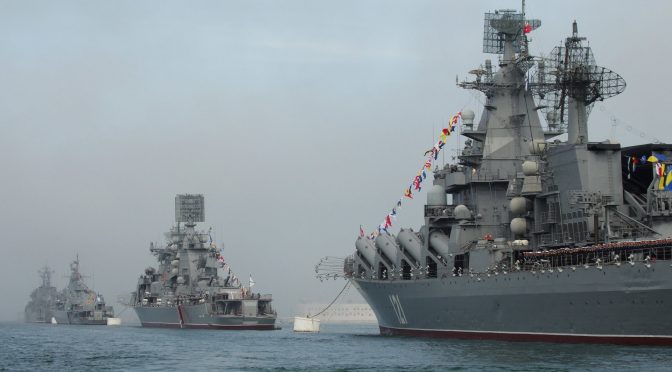
To conclude the June members’ roundup, Sam LaGrone for U.S. Naval Institute News provides an overview of Russia’s first deployment of a new frigate to the Black Sea Fleet since the end of the Cold War. The Project 11356-class Admiral Grigorovich was sent to a Russian naval base in Crimea, which Mr. LaGrone explains is the first of many new surface ships the Russian Navy intends to base in the Black Sea. He adds that the delivery of the multi-mission surface combatant, capable of engaging submarine, air and surface threats, is part of a $2.43 billion Black Sea Fleet expansion program that will allow for increased power projection capabilities throughout the Fleet’s area of operation.

Members at CIMSEC were also active elsewhere during the month of June:

  • Bryan McGrath, for The War on the Rocks, explains how the lack of naval competition in the post-Cold War period has resulted in a U.S. fleet posture with limited offensive power. He explains how the Navy has prioritized a defensive mindset for too long, with survivability and defensive capabilities outcompeting offensive capabilities for platform space, budgetary resources and strategic inquiry. Mr. McGrath emphasizes that by adopting and implementing the distributed lethality concept across the fleet – that is increasing the unit-level lethality of virtually every ship in the Navy – U.S. naval forces will increase their capacity to successfully deter and challenge nations opposing U.S. interests and international law at sea.
  • Jerry Hendrix, for Defense One, advocates that the X-47B should be reinserted into carrier operations before the U.S. Navy begins to spend more time and fiscal resources on a new, expensive carrier-based UAV. Mr. Hendrix identifies that the Navy needs a long-range strike asset similar to the X-47B design, while it does not need a long-range surveillance platform – an asset the Navy seems to be leaning towards even though 68 unmanned MQ-4C Triton broad area maritime surveillance vehicles have recently been acquired. He also notes the possibility of evolving the X-47B into a joint strike-refueling platform, which would provide two useful, additional capabilities aboard the carrier that are more appropriate and necessary than a surveillance UAV.
  • Michael McDevitt, for The National Interest, discusses China’s ambitions as a maritime power by contextualizing the maritime environment from Beijing’s perspective. The article examines how China seeks to position itself in the maritime environment both regionally and globally, with the Coast Guard, PLA Navy, shipbuilding capacity, merchant fleet, distant-water fishing challenges, territorial disputes and both strategic and tactical level operations taken into consideration.
  • Paul Pryce, at Offiziere, provides an analysis on the current state of the Libyan Navy and the growing threat of piracy operations off of the country’s coastline. Mr. Pryce explains that the Navy’s one active ship, a Koni-class frigate, in addition to the lack of command and control governing the Navy – the same issue facing all Libyan security forces – is contributing to the refugee problem in the Mediterranean and the rising volume in piracy incidents throughout the region.
  • Robert Farley, for The National Interest, discusses Canada’s late 1950’s CF-105 Avro Arrow high-performance interceptor and the aircraft’s unsung potential as a dominating platform in early Cold War airspace, if only the program had not been cancelled due to shifts in Canadian technology, policy and security priorities. In a second article at The National Interest, Farley examines Russia’s Type 705 Lyra Cold War submarine that was regarded by the West as a profound threat to NATO’s undersea dominance.
  • Christian Davenport, for The Washington Post, highlights new technological advancements that may be transforming the way the pentagon outlines its defense strategy, particularly developments within the fields of robotics, drone swarms, and artificial intelligence. The article highlights emerging communication channels between the technology industry in Silicon Valley and the Pentagon, with Defense Secretary Ashton B. Carter recently meeting with executives at SpaceX and Google.
  • Kyle Mizokami, for Popular Mechanics, discusses the deployment of two U.S. carrier battle groups to the Philippine Sea to conduct exercises following the UN court ruling on China and its claims in the South China Sea. Mr. Mizokami explains that the carrier strike groups (CSGs) consist of two nuclear-powered aircraft carriers, two guided-missile cruisers, six guided-missile destroyers and likely two nuclear attack submarines – although their presence was not confirmed by the Navy. He adds that this is the first two-carrier exercise in the Western Pacific in two years.
  • Dave Majumdar, for The National Interest, examines the Russian submarine threat to NATO’s maritime forces and U.S. naval forces stationed throughout EuropeThe article explains how Russia has successfully incorporated highly agile, technologically advanced and lethal submarines into their overall A2/AD bubble strategy throughout European waters and the significant threat this poses to U.S. and allied undersea posture in the region.  

At CIMSEC we encourage members to continue writing, either here on CIMSEC or through other means. You can assist us by emailing your works to dmp@cimsec.org.

Sam Cohen is currently studying Honors Specialization Political Science at Western University in Canada. His interests are in the fields of strategic studies, international law and defense policy.

Featured Image: Naval vessels of Russia’s Black Sea Fleet (RT)

The Concept of ‘Reach’ in Grasping China’s Active Defense Strategy: Part II

This publication was originally featured on Bharat Shakti and is republished with permission. It may be read in its original form here.

By Vice Admiral Pradeep Chauhan AVSM & Bar, VSM, IN (Ret.)

Editor-in-Chief’s Note

Part I of this two-part article introduced the geoeconomic and geostrategic imperatives that shape China’s geopolitical drives. It also presented the overarching concept of “reach” as an aid to understanding the international import of China’s military strategy. Read Part I here.

In this second and concluding part of the article series the author explores Chinese strategic intent and its ramifications. The article provides an account of the naval facilities China is promoting or constructing on disputed islands among littoral states of the Indian Ocean; assesses China’s economic linkages with African nations; and projects the growth curve of the Chinese Navy, all of which are important to keep in view while analyzing the trajectory of Chinese geo-strategic intent.

By emphasizing the factor of temporal strategic-surprise (in contrast to spatial surprise), the author offers clues to understanding the links between China’s military strategy and her geopolitical international game-moves as they are being played out within a predominantly maritime paradigm. As in the famous Chinese game of Go—perhaps a more apt analogy than chess—the People’s Republic is putting in place the pieces that will shape her desired geopolitical space. The author explores the spatial and temporal dimensions of the Chinese strategy and the related vulnerabilities of the opposing Indian establishment.

In his 2006 dissertation written at the US Army War College then-Lt. Col Christopher J. Pehrson, USAF, termed the Chinese geostrategy the “String of Pearls.” This expression, first used in January 2005 in a report to U.S. military officials prepared by the U.S. consulting firm of Booz Allen Hamilton, caught the attention of the world’s imagination. Pehrson posited China as a slightly sinister, rising global power, playing a new strategic game, as grandiose in its concept, formulation and execution as the “Great Game” of the 19th century. Despite vehement and frequent denials by Chinese leadership of any such geostrategic machinations designed at the accumulation of enhanced geopolitical and geoeconomic power and influence, the expression rapidly embedded itself into mainstream consciousness.

Image Courtesy: Chinausfocus.com
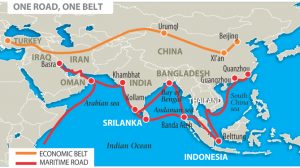
China’s One Road, One Belt economic infrastructure initiative. (Chinausfocus.com)

As a net result, for over a decade, China has chafed under the opprobrium heaped upon it for a concept that (to be fair) it had never once articulated by the state. However, in a brilliant rebranding exercise by Beijing in 2014, the world’s attention is being increasingly drawn away from the negative connotations associated with the phrase String of Pearls and towards the more benign-sounding 21st century Maritime Silk Route Economic Belt, also known as “One Road, One Belt.” This presents an alternative expression, while it nevertheless covers essentially the very same geostrategic maritime game-plays that Colonel Pehrson explained a decade ago. The new expression emphasizes transregional inclusiveness and evokes the romance of a shared pan-Asian history with the implied promise of a reestablishment of the economic prosperity that the Asian continent’s major civilizational and socio-cultural entities, namely China and India, enjoyed until the 18th century.

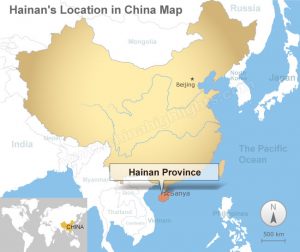
Each “pearl” in the String of Pearls construct—or in more contemporary parlance, each “node” along the Maritime Silk Route—is a link in a chain of Chinese geopolitical and geostrategic influence. For example, Hainan Island, with its recently upgraded military facilities and sheltered submarine base, is a pearl/node.

It is by no means necessary for a line joining these pearls/nodes to encompass mainland China in one of the concentric ripples typified by the Island Chains strategy. In fact, since the Maritime Silk Route is a true maritime construct, it is highly unlikely that the nodes would do so.

Image Courtesy: chinahighlights.com
The location of Hainana Province, China. (chinahighlights.com)

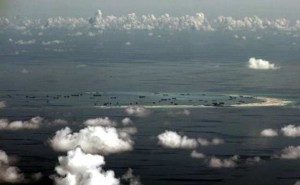
Other pearls/nodes include the recent creation of artificial islands in the Paracel and Spratly islands incorporating, inter alia, the ongoing construction/upgrade of airstrips on Woody Island—located in the Paracel Islands, some 300 nm east of Vietnam—as also on Mischief Reef and Fiery Cross Reef in the Spratly Islands. Additional pearls/nodes have been obtained through Chinese investments in Cambodia and China’s continuing interest in Thailand’s Isthmus of Kra.

China’s development of major maritime infrastructure abroad—the container terminal in Chittagong, Bangladesh; the Maday crude oil terminal in Myanmar’s Kyakpyu port; the development of ports such as Hambantota in Sri Lanka, Gwadar in Pakistan, Bagamoyo in Tanzania, Beira in Mozambique, Walvis Bay in Namibia, Kribi in Cameroon, the Djibouti Multipurpose Port (DMP), and the offer to even develop Chabahar in Iran (checkmated by a belated but vigorous Indian initiative), along with the successful establishment of a military (naval) base in Djibouti—all constitute yet more pearls/nodes. The development of an atoll in the Seychelles, oil infrastructure projects in Sudan and Angola, and the financing of newly discovered massive gas finds in offshore areas of Mozambique, Tanzania and the Comoros, are similarly recently acquired pearls/nodes. Even Australia yields a pearl/node, as does South Africa, thanks to Chinese strategic investment in mining in general and uranium-mining companies in particular, in both countries.

Chinese maritime policing vessel.
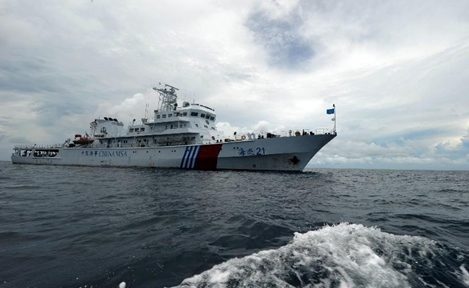
Chinese maritime policing vessel. (SCMP.com)

From an Indian perspective, China’s new strategic maritime-constructs (by whichever name) are simultaneously operative on a number of levels, several of which are predominantly economic in nature and portend nothing more than fierce competition. At the geostrategic level, however, the economy is at its apex and is China’s and India’s greatest strength and greatest vulnerability, at the same time; therefore, the economy is the centerpiece of the policy and strategy of both countries. This is precisely why, as the geographical competition space between India and China coincide in the Indian Ocean, there is a very real possibility of competition transforming into conflict, particularly as the adverse effects of climate change on resources and the available land area becomes increasingly more evident.

“Reach” has both spatial and temporal dimensions. The spatial facets of China’s geopolitical moves are evident, as illustrated in the preceding String of Pearls discussion. It is critical for India’s geopolitical and military analysts to also understand the temporal facets of this construct. The terms short term, medium term and long term are seldom used with any degree of digital precision. A nation tends to keep its collective “eye on the ball” in the short term and, by corollary, tends to assign far less urgency to something that is assigned to the long term. This ill-defined differentiation is how strategic surprise may be achieved in the temporal plane. For instance, in China, the short term generally implies 30 to 50 years. This is an epoch that is far in excess of what in India passes as the long term. Consequently, India fails to pay as close attention to developments in China as she might have were the developments to unfold in a duration corresponding to India’s own short term of 2-5 years. This distinction permits China to achieve strategic surprise, and this is as true of military strategy as it is of grand strategy and geoeconomics.

On the one hand, it should be remembered that these strategic constructs are not only about maritime infrastructure projects, involving the construction of ports, pipelines and airfields, though these developments constitute their most obvious and visibly worrisome manifestation. The strategy is equally about new, renewed or reinvigorated geopolitical and diplomatic ties between the People’s Republic of China and nation states across a very wide geographical swath (including the African littoral and the island nations of both the Indian Ocean and the Pacific Ocean). On the other hand, China’s strategic maritime constructs have some important military spin-offs, which closely align to the furtherance of geostrategic reach. Thus, by developing friendly ports of call (if not bases), facilities and favorable economic dependencies in the various pearls/nodes, the logistics involved in the event of an engagement in maritime power-projection are greatly eased.

1_091223153841_1
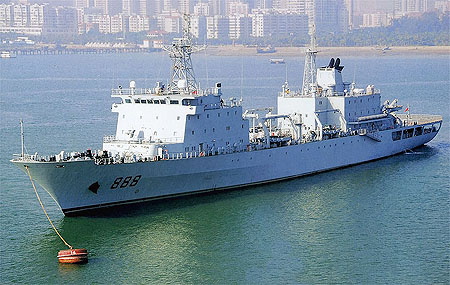
Type 904 (Dayun Class) Transport Ship (globalmil.com)

Supplementing the pearls/nodes are the Chinese Navy’s five impressive stores/ammunition supply ships of the Dayun Class (Type 904) and six underway replenishment tankers of the Qiandaohu Class (Type 903A). In addition, China requires ground control stations to meet her satellite-based needs of real-time surveillance. Unlike the United States, China simply does not have adequate ground control/tracking stations within the Indian Ocean to affect requisite ground control and real-time downlinking of her remote-sensing satellites. This forces her to deploy a number of ships (the Yuanwang Class) for this purpose. These constitute a severe vulnerability that China certainly needs to overcome. One way to do so is to establish infrastructure and acceptability along the IOR island states and along the East African littoral, as China is currently attempting to do.

The principal lack in the Chinese strategy to provide military substance to the country’s geoeconomic and geostrategic reach comes in the form of integral air power through aircraft carriers. China is rapidly learning that while one can buy or build an aircraft carrier in only a couple of years, it takes many more years to develop the human, material, logistic and doctrinal skills required for competent and battle worthy carrier-borne aviation. For nearly a decade now, China has demonstrated her ability to sustain persistent military (naval) presence in the Indian Ocean—albeit in a low threat environment. Combat capability is, of course, quite different from mere presence or even the ability to maintain anti-piracy forces, since the threat posed to China by disparate groups of poorly armed, equipped and led pirates can hardly be equated with that posed by a powerful and competent military adversary in times of conflict.

Despite the impressive growth of the Chinese Navy and the vigor of the Chinese military strategy, China may not, in the immediate present, have the combat capability to deploy for any extended period of time in support of its geoeconomic and geostrategic reach were they to be militarily contested by a major navy. However, as James Holmes points out, if India were to continue to cite shortfalls in current Chinese capability and conclude that it will take the PLA Navy at least fifteen years to station a standing, battle worthy naval squadron in the Indian Ocean, this would lull Indians into underplaying Chinese determination and the speed of that country’s military growth. This would carry the very real consequent possibility of India suffering a massive strategic surprise. Is that something that India can afford?

Vice Admiral Pradeep Chauhan retired as Commandant of the Indian Naval Academy at Ezhimala. He is an alumnus of the prestigious National Defence College.

The Concept of ‘Reach’ in Grasping China’s Active Defense Strategy: Part I

This publication originally featured on Bharat Shakti and is republished with permission. It may be read in its original form here.

The article will be presented in two parts. In this part, the author explores China’s dependence on crude oil that traverses across the oceans to feed the country’s growth. These circumstances have prompted China to develop its naval forces, since its greater security concerns are in the oceans. The author initiates his discourse on Chinese strategy by detailing the foremost core imperatives that drive the Communist Party of China and its stated core national interests.

By Vice Admiral Pradeep Chauhan AVSM & Bar, VSM, IN (Ret.)

Much thought needs to be given to possible politico-military circumstances under which the Government of India might realize that a Sino-Indian military build-up, stand-off or confrontation is no longer a mere skirmish between their respective armies but a clash in which the Republic of India in its entirety becomes engaged in armed conflict against the People’s Republic of China. Within the context of these circumstances—themselves a matter of both conjecture and debate—this article seeks to initiate an analysis of contemporary Chinese military strategy, using the concept of “reach.”

In common with many such analyses, China’s White Paper of May 2015 forms the basis of our understanding of China’s Military Strategy, i.e. the plans by which the country’s military seeks to achieve national objectives at the strategic level.

Image Courtesy: Reuters
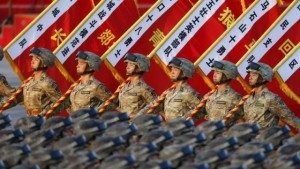
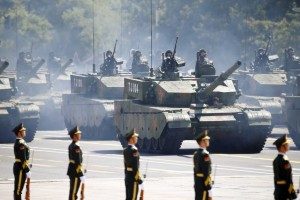
Chinese military parade. Image Courtesy: Reuters

The core imperatives that drive the Communist Party of China’s relationship to the State and the State’s relationship with the world at large include: 1) regime survival 2) “saving face” 3) domestic stability and 4) territorial integrity.

These resonate well with the more formally-stated six core national interests of China: 1) state sovereignty 2) national security 3) territorial integrity 4) national reunification 5) China’s political system established by the Constitution and overall social stability and 6) basic safeguards for ensuring sustainable economic and social development.

The commonly used term core interest, as used by the Chinese leadership, does not have direct correspondence with the same term used by India or, for that matter, by almost all other nation-states. The People’s Republic of China uses the term “to signal a more vigorous attempt to lay down a marker, or a warning, regarding the need for the United States and other countries to respect (indeed, accept with little if any negotiation) China’s position on certain issues”—in other words, “issues it considers important enough to go to war over.”

Along with the exponential growth of China’s “outward-leaning” economy in recent decades the country has experienced an equally meteoric increase in the geopolitical clout that it wields. Geopolitics is largely the sum of geoeconomics and geostrategy. Consequently, as China’s geoeconomic power has affected and dwarfed other regional and State economies, its asserted geostrategy has incrementally incorporated an number of geographic regions as its “core interests.” Examples include Xinjiang, the Tibet Autonomous Region (TAR), the Diaoyu/Senkaku islands in the East China Sea, and very nearly the whole of the South China Sea.

Image Courtesy: Defence Alert
Image Courtesy: Defence Alert.

China’s geoeconomy has not only generated a more aggressive geostrategy but has also marked an inclination for other nation-states to acquiesce to China’s latest “core interest.” Within the Chinese state-apparatus, this acquiescence appears to have been understood as tacit acknowledgement of China’s intrinsic and inherent superiority to all other geopolitical entities and peoples. This concept of self is driven by the millennia-old Chinese belief that China is the “Middle Kingdom,” at the very center of global civilization, surrounded by barbarian vassals. It is a view that largely defines China’s sense of national identity. Thus, amongst the Chinese power-elites within the Communist Party of China (CPC) and the Central Military Commission (CMC), the lack of any “pushback” from other global and regional powers to China’s assertions has led to a sense of disdain bordering on hubris.

Image Courtesy: NDTV

In analyzing China’s military strategy, it is essential to understand three central features of the People’s Republic. The first is the critical importance of continuity and supremacy of the CPC. The second is the Chinese economy. The third is the uniquely Chinese concept of “face.” All three are closely linked. If the economy should falter or fail, the continuity of the CPC (regime continuity), or at the very least its continued supremacy, will become uncertain. Likewise, the Chinese sense of identity is inextricably linked to this concept of face and a national loss of face is likely to be far less acceptable than a mere “temporary” loss of territory or military assets. This critical feature offers India several military-strategic options in dealing with China.

The 2015 White Paper clarifies that China characterizes outer space and cyberspace as the “new commanding heights in strategic competition among all parties.” It likewise declares China’s intent to focus upon building a reliable second-strike capability. However, the sharpest thrust has been reserved for the oceans, which is understandable given the prominence that the 2015 White Paper accords to the contemporary strategic concerns of the People’s Republic. These strategic concerns include America’s pivot towards the Indo-Pacific, Japan’s recasting of its military and security policies, and the resistance being offered by Philippines and Vietnam to China’s 9-Dash Line and its assertive activities in the Spratly Islands.

The Chinese Armed Forces are charged with the preservation and protection of the country’s core interests, and this tasking determines China’s military strategy. As war evolves towards “informatization,” a key strategic task of Chinese armed forces is safeguarding China’s security interests in new domains such as Global Positioning Systems, Electronic Warfare (EW) and Cyber/Information Warfare. The latest White Paper has also reaffirmed the centrality of active defense as the guiding strategy for China’s military forces. Thus, offense at the tactical and operational levels is consistent with an overall defensive orientation at the strategic level. By this logic, cyber-attacks are integral elements of the Chinese military’s efforts to “resolutely safeguard China’s sovereignty, security and development interests” in cyberspace. Indeed, in the cyber and maritime domains alike, Beijing consistently rationalizes assertive activities as justified responses to prior provocations.

Despite the inevitable hype that has accompanied analyses of the 2015 White Paper, this is a Chinese strategic concept that predates the People’s Republic itself. Its first articulation within China may be attributed to Mao Zedong, the CPC’s founding chairman, who codified it in a much studied 1936 essay on the “Problems of Strategy in China’s Revolutionary War,” which outlined “the strategy that the Red Army used in order to overcome stronger Nationalist and Japanese opponents—right from the Party’s inception in 1921 until its greatest triumph in 1949.”

Image Courtesy: AFP
Image Courtesy: AFP

“Active defense may be accurately described as a strategically defensive posture that a big, resource rich but (militarily) weak combatant assumes to weary and turn the tables on a stronger antagonist. Such a combatant needs time to tap its resources—natural riches, manpower, martial ingenuity—so it protracts the war. It makes itself strong over time, raising powerful armed forces, while constantly harrowing the enemy. It chips away at enemy strength where and when it can. Ultimately the weaker becomes the stronger contender, seizes the offensive, and wins. It outlasts the foe rather than hazarding a battle early on—a battle where it could lose everything in an afternoon.”

Obviously, a nation needs physical and strategic maneuvering space to work this strategy. Originally, this strategy was confined solely to the geospatial imperatives of the land war fought by the Red Army, wherein Mao’s peasant troops had the luxury of withdrawing into the remote interior of China. This move forced the enemy forces to choose between breaking contact and ceding the initiative or giving chase and overextending themselves. In the latter case, Red Army units, operating closer to their own logistics base could raid and harry the overstretched enemy, cut supply routes, and fall upon and annihilate isolated units. It was a strategy that the Russians, too, had used a century earlier when, in 1812, they seduced Napoleon deep into the Russian interior, leading to military disaster for France.

The term active defense remains contemporary in militaries other than the People’s Republic of China. The US Department of Defense, for instance, also uses the term, albeit predominantly (if not solely) with distinctly tactical connotations and defines it as “the employment of limited offensive action and counterattacks to deny a contested area or position to the enemy.” The Chinese, however, apply this as a general strategic principle applicable across all levels, from the tactical to the strategic. At the level of geostrategy, the required “maneuver space” shifts from the hinterland to the largely maritime expanse of the Indo-Pacific.

Here, the concept of strategic maneuver has intimate linkages with geoeconomics, much of which, as a result of the geographic element within that term, is maritime in nature. As the renowned Chinese Professor Lexiong Ni put it, “When a nation embarks upon a process of shifting from an ‘inward-leaning economy’ to an ‘outward-leaning economy,’ the arena of national security concerns begins to move to the oceans. This is a phenomenon in history that occurs so frequently that it has almost become a rule rather than an exception.”

Perhaps a good way to understand the application of this strategy at the grand-theater level is to simply abandon the lexicon of the standard Western approach to active defense, which in Indian analyses is all too frequently simply “copied-and-pasted,” and instead examine this stated strategy through a different prism, one that I call “reach.” We need to consider reach as an overarching ability with internal (e.g., political/societal) as well as external (geopolitical) facets and with spatial as well as temporal dimensions.

Internal reach may be considered as the ability to tap into the intrinsic sources of China’s strength—its people (including its global diaspora) and their conditioned sense of identity, their value system with the centrality that it gives to the concept of “face,” their industriousness, their innovativeness, their ability to reverse-engineer everything from contemporary and evolving concepts to cutting-edge and state-of-the-art military-hardware, their fierce determination to regain “face” that was lost in the Century of Humiliation and to not lose it ever again, etc. This is, in effect, the contemporary re-creation of the Chinese people as a roughly homogeneous mass—the peasant army in a modern, sophisticated avatar—no longer peasants but retaining the quality of “mass” all the same.

At the geoeconomic level, economic reach is the ability of China to build its own economy and sustain its economic growth by gaining and maintaining access to geographically diverse external sources of economic wealth (whether by way of access to raw materials from foreign lands or through market expansion of Chinese products in foreign lands). China’s geostrategy translates economic reach into geographical reality over a time frame that is predetermined by the state.

In other words, at the geostrategic level, strategic reach is the ability to shape the probable battlespace by enabling access and logistic support to Chinese commercial and State entities (including military entities) throughout China’s areas of geopolitical interest, so as to enable and/or facilitate economic reach while avoiding placing all geoeconomic eggs in a single basket.

In some cases, this geoeconomic reach can be realized within a purely land-centric (continental) frame of geographic access. For instance, Mongolia, which has substantial reserves of high quality coking coal, is an important focus of China’s overland strategic reach. Likewise, Russian overland exports of oil, gas and
minerals (especially iron ore) increasingly feed the voracious economic appetite of China and have catapulted China into
Russia’s largest trade partner, ahead of Germany. In the case of Vietnam, too, where the principal exports to China are oil and coal, a significant amount of the trade is overland, since the 1,300 km border is shared between the Chinese provinces of Yunnan and Guangxi and eight provinces of Vietnam. Both China and Vietnam have invested billions in highway and railway infrastructure to facilitate their bilateral overland trade. China’s significant imports of refined copper and copper ore from Laos also move predominantly along overland trade routes.

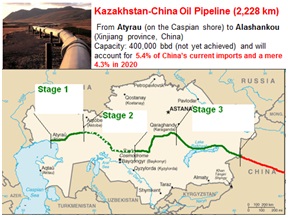
myanmar-kazakhstan-oil-gas-pipelineHowever, to meet the ever-growing demand for mineral resources and petroleum-based energy that is required to sustain China’s economic growth, the bulk of China’s imports of these resources are being drawn from increasingly distant areas that are either accessible only by sea or where seaborne transit offers the most cost-effective movement in terms of volume, time, and space. In fact, the maritime component of her geostrategy is so large that China is increasingly forced to venture into the uncertainties of becoming very nearly a pure maritime power. In China today, there is widespread recognition that a competent and well-balanced blue-water navy is the only military instrument that can obtain and sustain a favorable geopolitical situation in all the dynamic shifts that characterize international relations between China and the nation states upon which her geoeconomy depends. Indeed, the economy is simultaneously China’s greatest strength and its greatest vulnerability, and therefore, it is the centerpiece of the country’s policy and strategy. This is, of course, true of India as well.
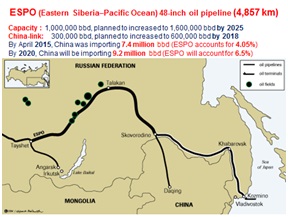
ESPOAn ever-increasing demand for energy fuels China and India’s economic growth. Although the share of coal is still the largest in the energy-basket of both countries, oil consumption is growing so rapidly that it is driving the foreign policy and security perspectives of both China and India.  In 1985, China was East Asia’s largest exporter of oil. In 1993, China became a net importer, and in 2015, she became the largest importer of crude oil on the planet. By April 2015, China was importing a staggering 7.4 million barrels per day (bbd) and by 2020, China will be importing an estimated 9.2 million bbd of crude-oil.
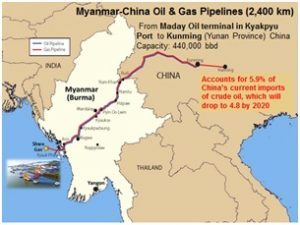
myanmar-china-oil-gas-pipeline-300x225For all the marvelous engineering, the three main crude oil pipelines into China (the Eastern Siberia-Pacific Ocean pipeline (ESPO), the Kazakhstan-China oil Pipeline and the Myanmar-China oil pipeline), taken in aggregate, cater for a mere 15% of China’s crude oil imports. Almost all of the enormous quantity of crude oil that China imports either lies within or must travel across the Indian Ocean and must transit one or more of the chokepoints that connect the Indian and the Pacific Oceans. These are: the Malacca Strait, the Sunda Strait, the Lombok strait, and the Ombai-Wetar strait. Of these, the Malacca Strait and the Lombok Strait of are particular importance to China and constitute what Chinese leaders term the “Malacca Dilemma.”

It is prudent to remember that the terms “energy security” and “security-of-energy” are not mere semantic variations. Energy security is the degree to which the available or assured and affordable energy exceeds the demand. The security-of-energy, on the other hand, is the physical security of the energy as it flows across or under the sea or over the land. Consequently, China, as a country, concerns itself with energy security, while the Chinese Navy concerns itself with the security-of-energy.

Conscious of all this, China is executing a geostrategy that will enable her to assure her geoeconomic needs. As in the famous Chinese game of Go, the People’s Republic is putting in place the pieces that will shape her desired geopolitical space.

The second part of this article will explore China’s geostrategic execution further.

Vice Admiral Pradeep Chauhan retired as Commandant of the Indian Naval Academy at Ezhimala. He is an alumnus of the prestigious National Defence College.