Tag Archives: Strategy

The Hohenzollern Chinese Navy? Part Two

The High Seas Fleet and the PLAN: Striking Similarities in Strategy, Force Structure and Deployment

The first part of this series examined the nearly identical origins, and dismal, early combat histories. This second installment compares the equally similar strategy, operational art, and force structure, and concludes with observations on the PLAN can avoid the fate of the High Seas Fleet. Read Part One here.

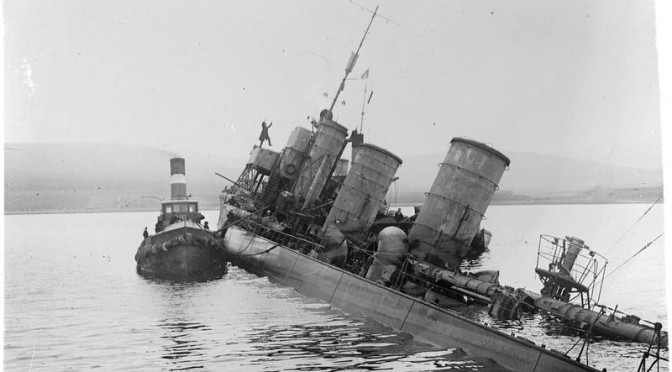
Both new fleets entered their identifiable “blue water” eras with similar strategies, operational concepts and tactics. The German High Seas Fleet retained robust coastal defense force structures even as its focus moved to the maritime space outside its own near abroad. This dual aspect of coastal and blue water operations was a key element in German strategy that was designed to defeat Great Britain’s Royal Navy (RN). High Seas Fleet architect Admiral von Tirpitz believed that a German Navy 2/3 the strength of the RN would be sufficient to defeat the British Navy in a battle if waged in German terms. Tirpitz envisioned drawing a portion of the RN into battle in the North Sea, but reasonably coast to German bases where torpedo craft (surface and subsurface), minefields and even shore batteries on advanced locations such as Heligoland Island might support the High Seas Fleet. German naval historian Holger Herwig suspects that Tirpitz never intended to attack Britain, but hoped that “British recognition of the danger posed by the German Fleet concentrated in the North Sea”, would “Allow the Emperor to conduct a greater overseas policy.”1 The possibility would always exist that if Great Britain still defeated the German Navy in battle that it would be too damaged and perhaps, “Find itself at the mercy of a third strong naval power or a coalition (France and Russia).2 Herwig also suggests that other would-be maritime powers might be inspired by Germany’s example and perhaps convince those nations to seek Germany as an ally. To achieve these ends, Tirpitz in effect attempted to create the early 1900’s equivalent of an Anti-Access/Area Denial (A2/AD) zone in the Heligoland Bight of the North Sea.
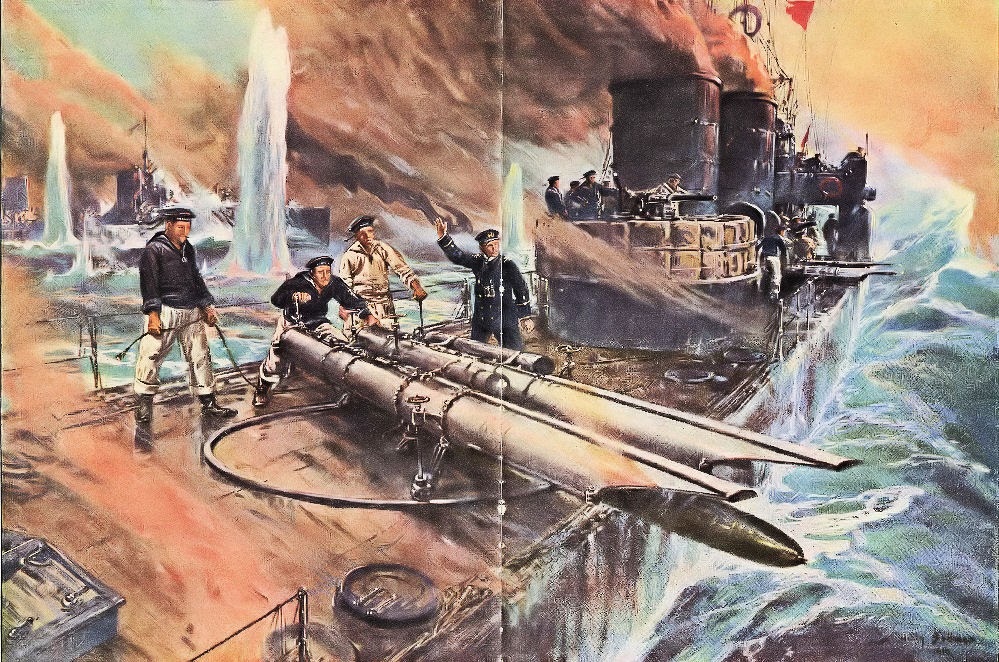
Artwork featuring German coastal defense torpedo craft.

Evidence suggests that the PLAN is following a similar strategy. The Chinese are well on their way to building a very credible, regional naval capability.3 The PLAN’s emphasis on operations within the Chinese defined “first island chain” seems to mirror Tirpitz’s focus on decisive battle in the North Sea. There is no evidence to suggest the Chinese are planning to launch an aggressive naval war against the United States, but are building naval forces sufficient to convince the United States and other would be opponents that the risk involved in combating such a force will entail significant naval losses. As Germany acquired the island of Heligoland in 1890 in order to secure the naval approaches to its significant ports from blockade, China is seeking to control and expand islets in the South China Sea in order to create a buffer zone around its sea lines of communication with its primary hydrocarbons supply sources in the Persian Gulf. Control of the South China Sea would also support potential military operations to place Taiwan under Communist Chinese control. Tirpitz thought his fleet would prevent Britain from considering a preemptive attack on Germany, as it had done on a nascent Danish Navy at Copenhagen in 1805. China appears to be creating its own A2/AD network to similarly deter U.S. action against the People’s Republic in the event of conflict over Taiwan, or contested islands in the South and East China Seas. Like Great Britain a century ago, the U.S. today must consider, “whether the U.S. Navy in coming years will be large and capable enough to adequately counter improved Chinese maritime forces while also adequately performing other missions around the world.”4
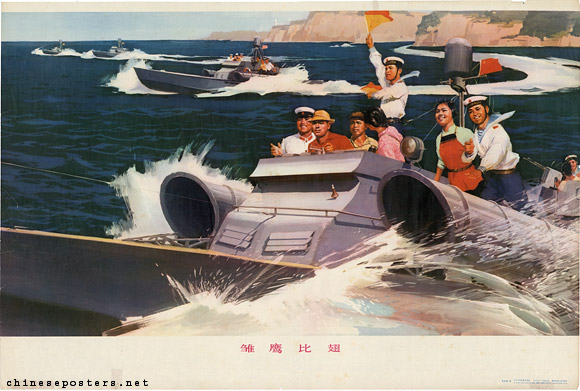
PLAN torpedo boat
Artwork featuring PLAN coastal defense torpedo craft.

Although it is clearly building a “blue water” fleet that includes aircraft carriers, capable surface ships and submarines, the PLAN also maintains large forces of missile-armed littoral combatants analogous to the large German light forces of the early 20th century. China also has a much more powerful equivalent to the German shore batteries in the form of the Anti-ship Ballistic Missile, but this weapon does not yet appear to have been successfully tested against a moving target at sea.5 With the bulk of its blue water fleet concentrated in home waters, and supported by similarly-based aircraft, submarines, land-based missiles and light naval forces, China has deployed a naval force structure remarkably similar to that of Imperial Germany. It appears focused on the control of its immediate sea zone and intended to deter the maritime hegemon from interference in its growing global economic, political and possible military activity.

There are some trends to suggest some of the new blue water PLAN units will deploy beyond the first island chain and operate in regular deployments abroad as the U.S. Navy has done since 1948.6 Such deployments are fraught with peril if unsupported by a large global naval support structure and close allies. Admiral Graf von Spee’s crack cruiser squadron was deployed overseas at the German Pacific colony of Tsingtao (now the Chinese city and naval base of Qingdao) in 1914, but Tirpitz otherwise kept the heavy units of the High Seas fleet almost entirely in home waters for deterrence and potential combat against the Royal Navy. A future Chinese von Spee might wreak havoc on shipping and naval forces in the Indian Ocean or Red Sea, but would also be, “a cut flower in a vase, fair to see, yet bound to die” as Churchill said of the German commander.7

A Similar Potential for Catastrophic Failure

Both navies also share similar traits that eventually led to catastrophic failure in war for the High Seas Fleet. Admiral von Tirpitz based his strategy for victory against the Royal Navy on superior technology and highly trained personnel as well as specific numbers of capital ships. German warships were slower, had smaller guns and more austere in accommodation than their British counterparts, but had better gunnery optics, had thicker armor, and would prove more survivable in combat thanks to superior internal subdivision. German naval personnel were also expected to be more technically expert and better disciplined than their RN equivalents. This entailed adopting some of the harsher attributes of the Prussian Army to the naval service rather than forging a unique German naval culture to compete with that of the RN, who was the “motherhouse” for a multitude of world navies including those of the United States and Imperial Japan. Looking back in 1929, Germany’s official naval historian Admiral Eberhard von Mantley described the German naval culture of the Hohenzollern period as, “A Prussian Army Corps transplanted on to iron barracks.”8

The PLAN is likewise inured with the culture of a non-naval organization. The Communist Party of China plays a role in the Chinese navy similar to that played by the Imperial hierarchy in Hohenzollern Germany. The political work within the Chinese navy was once described as the “lifeline” of the service and essential to its support from the Chinese Communist Party.9 The current commander of the PLAN, Admiral Wu Shengli, has long had close ties to the Communist Party through his father who was a Red Army political officer and governor of Zhejiang. Admiral Wu may also have had close ties to future Chinese President Jiang Zemin, who served as Shanghi Party Secretary when Wu was Deputy Chief of Staff for the Shanghai naval Base in the 1970’s and 1980’s. Like the support from the Chinese Communist Party, the Kaiser’s patronage, support and favor toward the Hohenzollern German Navy was that force’s connection to the German ruling elite and they budgetary support that connection supported.

Naval historian Norman Friedman has suggested that one of the great flaws of the Hohenzollern fleet is that it was built without a clear strategic objective in Germany’s overall national military strategy.10 Admiral von Tirpitz was very effective in assembling political and public support for a large fleet of capital ships, but when war did occur he did not have a defined plan as to how this very expensive fleet would be used. Friedman also points out that the German General Staff also no idea of what to do with the High Seas Fleet and that neither naval nor military leadership ever exploited its potential until late in the war with the U-boat campaign, which did not involve Tirpitz’ heavy surface units. German naval officers, especially those of senior rank also had little or no combat experience in 1914 against which to measure their operational performance at the outset of war.

While the Chinese have long planned on using naval forces to support the potential reclamation of Taiwan, and to protect vulnerable littoral areas bordering the Chinese state, their construction of larger warships such as carriers and large surface combatants has wider and more uncertain strategic ends. The PLAN and Chinese Army/Air Force elements can certainly dominate the South China Sea and its immediate surroundings in the event of a major Pacific War for a significant period of time. Would it be possible, however, for the PLAN alone to venture further afield to break likely distant blockades of Chinese hydrocarbon supplies and trade with a core fleet of “two aircraft carriers, 20-22 AEGIS like destroyers and 6-7 nuclear attack submarines?”11 Like Tirpitz fleet of a century ago, an enlarged PLAN is strong enough in its own backyard, but risks considerable losses if it ventures away from bases and meets the combined strength of US and allied joint forces. This “prestige” element of the PLAN, like the High Seas Fleet, may be equally lacking in full strategic assessment as was its German counterpart. In addition, senior PLAN officers, like their High Seas Fleet counterparts from 1914, lack combat experience in war at sea.

Dr. Friedman suggest one other potentially chilling possibility when he references German historian Volker Berghahn’s claim that the German General Staff and aristocratic establishment may have seen war as a means of preventing the rise of a Center left Reichstag as a political check against traditional Prussian authority.12 A war was seen by military and Prussian establishment leaders as a means of rallying the increasing working class around national objectives and recreating the unifying environment that produced the German Empire at the conclusion of the Franco-Prussian War.

China’s stagnating economy, which slowed to 7.4% in 2014, a low figure not seen in 25 years, and the results of that change on the average Chinese citizen, has the potential to cause similar global unrest.13 The Communist Chinese essentially made a bargain with Chinese citizens in the wake of the 1989 Tiananmen Square riots. It would “deliver stability and prosperity” in return for continued loyalty and support of the Communist Party. The party has kept that promise for the last quarter century and delivered a 20 fold increase in the average income.14 With this economic tide now cresting and perhaps beginning to recede, might Communist leaders seek to rally the Chinese public to international and security issues in order to distract from a looming economic downturn and maintain its control over the Chinese state? It is interesting to note that belligerent Chinese rhetoric on its South and East China Seas claims, and associated land reclamation efforts accelerated as economic advances waned. Could Communist leaders resort to more aggressive international efforts in order to preserve their rule as some historians have suggested Hohenzollern Germany did in 1914?

U.S. writer Mark Twain is reputed to have said, “History dos not repeat itself, but it sometimes rhymes.” The development of the PLAN over the course of the Cold War and especially the last twenty five years seems to rhyme very closely with that of the Hohenzollern High Seas Fleet. There are, however, some comforting differences. China is not nominally ruled by a mercurial Kaiser and has no Admiral von Tirptiz that is fully disconnected from other state organs of national security planning. It is not likely planning actual war with the United States or its close Pacific allies. That said, whether in mitigation of internal economic issues or paranoia over its seaborne hydrocarbon supply routes, China has engaged in a direct challenge to U.S. maritime superiority not seen since the Soviet Union created a global navy in the early 1970’s. While the Soviet effort was in the context of a wider Cold War, the Chinese maritime buildup has taken place in what has been a zone of relative peace since the end of the 1970’s.

No nation, or group of nations has denied China’s rise to the very top of world economic indicators, or its right to build whatever military establishment it desires. The crux of the problem is China’s aggressive bid to use elements of maritime power to close off sections of heretofore international waters. It is similar to the Communist state’s past land-based activities such as seizing Tibet and engaging in punitive expeditions against Vietnam. Like Hohenzollern Germany, another land-based power looking to move seaward, China fails to comprehend the dangers in aggression directed toward powers dependent on the free flow maritime trade. China would be well served to turn its naval expansion program toward less provocative ends.

Steve Wills is a retired surface warfare officer and a PhD candidate in military history at Ohio University. His focus areas are modern U.S. naval and military reorganization efforts and British naval strategy and policy from 1889-1941. 

1 Holger Herwig. The Luxury Fleet, The Imperial German Navy, 1888-1918, Abington/Oxon, UK and New York, Routledge Library Editions (reprint), The First World War, 2014, p. 36.

2 Ibid.

3 http://thediplomat.com/2015/07/will-china-have-a-mini-us-navy-by-2020/

4 Ronald O’Rourke. China Naval Modernization: Implications for U.S. Navy Capabilities—Background and Issues for Congress”, Congressional Research Service, Washington D.C., 01 June 2015, p. ii.

5 Ibid, p. 6.

6 http://inss.ndu.edu/Portals/68/Documents/stratperspective/china/ChinaPerspectives-9.pdf, p. 3.

7 Winston S. Churchill, The World Crisis, 1911-1918, New York, Free Press/Simon and Schuster, 2005 edition, p. 177.

8 Herwig, p.120.

9 http://www.idsa-india.org/an-jan00-7.html

10 Norman Freidman, Fighting the Great War at Sea, Strategy, Tactics and Technology, Annapolis, Md, Naval Institute Press, 2014, p. 22.

11 http://thediplomat.com/2015/07/will-china-have-a-mini-us-navy-by-2020/

12 Friedman, p. 21.

13 http://www.wsj.com/articles/china-gdp-growth-is-slowest-in-24-years-1421719453

14 http://www.institutionalinvestor.com/blogarticle/3347789/blog/a-generation-after-tiananmen-china-blends-amnesia-and-assertiveness.html#.Vbrq9PbbLIU
The Hohenzollern Chinese Navy? Part One

The Hohenzollern High Seas Fleet

Recent Chinese pronouncements regarding the shift of their Navy from defensive to potential offensive operations contain a refrain with which naval historians are most familiar. It is a song once sung by another continental military power newly flush with a successful and expanding international economy.

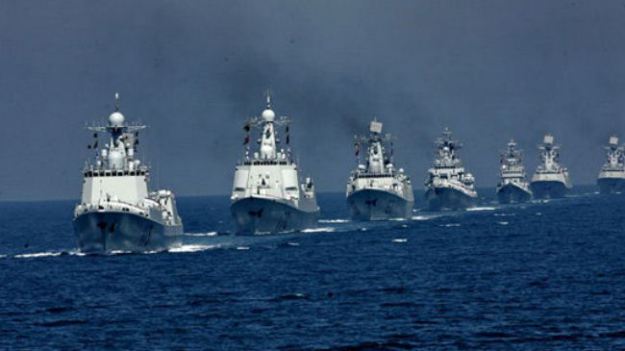
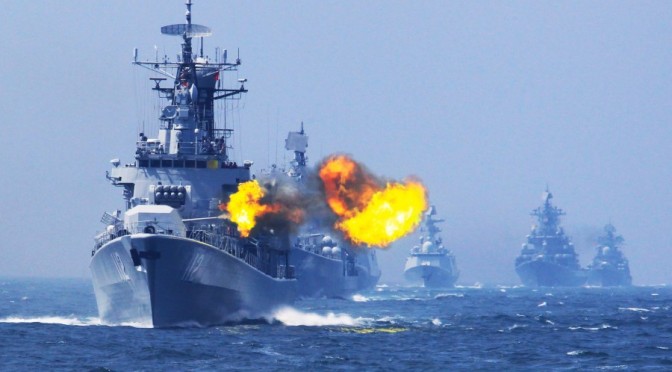
South China Sea fleet vessels.

China’s shift toward an offensive naval capability sounds very similar to the formation of the Imperial German High Seas Fleet (Hochseeflotte) in 1907. The Chinese and Hohenzollern navies have many commonalities in origin, training and choice of force structure. Their strategy, operational art and tactics are also remarkably similar to Kaiser Wilhelm’s fleet of the late 19th and early 20th century. The Chinese Navy may have also replicated the fatal flaw that left the High Seas Fleet incapable of achieving the victory it came so close to achieving in late 1917. Like the German imperial elite of the late 19th century, the Chinese Communist Party is now also seeking “a place in the sun” through President Hu Jinatao’s “new historic missions” assignment of 2004. China may too think that “its future is on the water” as did the Kaiser’s navy over a century ago. Such visions, however, for a fleet that has not seen battle against a peer opponent since 1894, can be dangerous.

Similar National Origins and Early Dismal Performance

Like Imperial Germany, the People’s Republic of China (PRC) is a continental land power that must look far into its past to find naval virtue. The Kaiser had to search back to the fifteenth century Hanseatic League in order to find heroic German maritime exploits that might be emulated by his own 20th century sailors. The PRC must equally rely on the historically remote Islamic Admiral Zheng He, who served the Ming Dynasty Yongle Emperor in the early 15th century as both a land and ocean-going commander. Both fleets were traditionally led by army officers and designed for coastal or at best littoral operations.

Both the German and Chinese fleets suffered from timid national leadership, and a paucity of training and operations that led to enforced idleness or defeat as late as the 19th century. Other Baltic powers often made short work of the Prussian Navy in war. The Swedes completely annihilated a Prussian fleet at the Battle of Frisches Haff in 1759. The Prussian Navy played practically no role in the three 19th century conflicts precipitated by Chancellor Otto von Bismarck that led to German unification. Its Danish, Austrian and French opponents either ignored, blockaded, or chased the small Prussian Navy from the seas. The Imperial Chinese Navy also suffered from neglect and poor performance from the Early Modern Period into the 20th century. The forces of the East India Company and the British Empire made short work of primitive Chinese warships in the two Opium wars of the mid 19th century. The French Navy destroyed the Chinese Fujian Fleet at the Battle of Fuzhou in 1884 and the Imperial Japanese Navy decisively defeated the Chinese Beiyang Fleet at the Battle of the Yalu River in 1894. The post-1949 People’s Liberation Army Navy (PLAN) has fought minor skirmishes against the Vietnamese, but has yet to engage anything approaching a regional, nor peer opponent in naval combat.

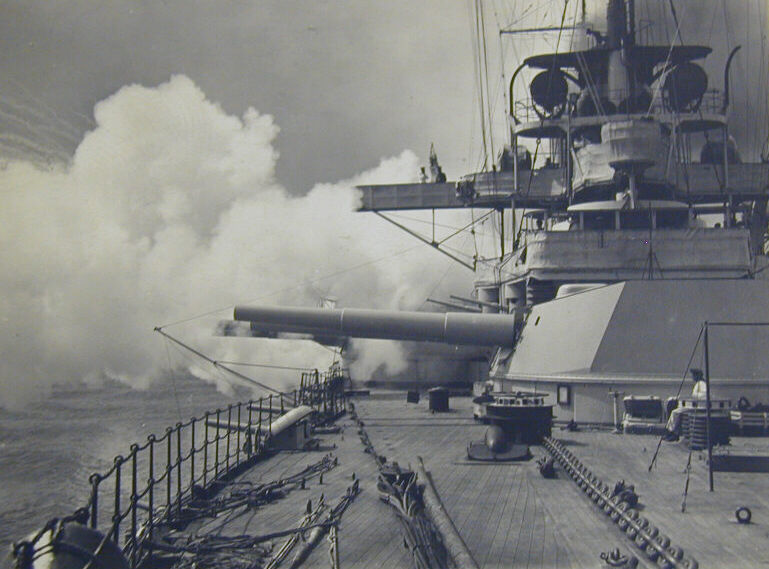
SMS Rheinland-focsle1914.
SMS Rheinland participates in a gunnery exercise, 1914.

The German High Seas Fleet and the PLAN both had to be “reborn” in new political and economic environments of their respective nations.  The united German state surged to new economic power between 1871 and 1906 and surpassed the British in steel production halfway into the first decade of the 20th century.1 Germany also came close to equally British world trade and coal production by 1914.2 Great Britain continued to prosper as both Germany and the United States surpassed Britain in key economic indicators and Britain’s Gross National Product grew from 1.32 billion to 2.1 billion Pounds over the period from 1870-1900.3 Despite these changes, the British Empire did not regard either Germany of the U.S. as a potential enemy, and Canada’s shared border with the U.S. caused more concern to the British in 1900 than did Germany’s economic growth.4 Germany, however, despite its unchallenged economic success decided to engage the British Empire in a naval building race that the British did nothing to instigate. Some historians have said the British detainment of several German ships transporting relief supplies to Dutch Boers during the Second Boer War (1899-1902), served as a catalyst for the passage of the German Second Naval Law which was much more provocative and aimed at Great Britain than its predecessor.5 Emboldened by economic success and military strength, and baited into action by its inability to influence sea lines of communication outside its sphere of influence, Germany embarked on a risky warship building competition with the established naval hegemon at the time and made that challenge right on that naval power’s home doorstep.

China has had an equally meteoric economic rise since the time it also changed political organization by throwing off its Maoist past and embracing state-sponsored capitalism. Like Imperial Germany, post Mao China has combined pride in economic growth with its aggressive continental past. The People’s Republic appears to have had the same sort of decisive “maritime moment” as Imperial Germany when the U.S. deployed two aircraft carriers to the Taiwan Strait in 1996 as a response to simmering tensions between the PRC and Taiwan. There appears to have been a similar rage amongst the Chinese Communist Party and military leadership over the 1996 US deployment, as there was from German Aristocrats, businessmen and military leaders over the seizure of German relief ships off South Africa in 1900. It is this kind of significant public support that allowed for the growth in the German Navy of the early 20th century and may play a role in public support for an expanded PLAN.

Both fleets also began as coast defense organizations led by Army officers and dependent on inexpensive denial capabilities. The early German Imperial Navy was first led by infantry General Albrecht von Stosch and General (and later Imperial Chancellor) Leo von Caprivi. It had few large ships and invested much of its effort in the development of torpedo craft and mine warfare. The architect of the High Seas battlefleet, Admiral von Tirpitz, and many of the Imperial Navy’s future senior officers came out of the German Navy’s torpedo boat arm. While Kaiser Wilhelm II played a very public advocacy role for larger and more capable surface ships, such expansion would not have been possible in the absence of strong support from the German business and political community. While perhaps not fervent navalists like the Kaiser, they certainly thought that having a Navy to protect emerging commercial interests was a good investment, and were willing to invest in Germany’s new naval effort. The spirit of American navalist Alfred Thayer Mahan’s writings on the importance of a battle fleet to a nation’s political and global economic health found as many adherents in Germany as it did in Great Britain, the United States, and Japan.

The early PLAN was also led by Army Generals. The most prominent advocate of improving Chinese naval capabilities was General Liu Huaqing, who served as PLAN commander from 1982-1987.6 China’s naval strategy from 1949 through the 1980’s was also remarkably similar to Germany’s in that it was focused on coastal defense and emphasized missiles, torpedoes and mines deployed from small, coastal combatants. China appears to have also embraced the theories of Alfred Thayer Mahan as Germany did a century ago and added the study of the American navalist’s works to the curriculum of its advanced naval education courses.7 

Part two of this article will examine how Hohenzollern Germany and the People’s Republic of China developed striking similarities in force structure, naval strategy, and deployment of their naval forces.

Read Part Two here.

Steve Wills is a retired surface warfare officer and a PhD candidate in military history at Ohio University. His focus areas are modern U.S. naval and military reorganization efforts and British naval strategy and policy from 1889-1941. 

1 Aaron Friedberg, The Weary Titan; Britain and the Experience of Relative Decline, 1895-1905, Princeton, NJ, Princeton University Press, 1988, p. 25.

2 Ibid, pp. 24-25.

3 Ibid, p. 24.

4 Ibid, pp 185-186.

5 Keith Wilson, editor, The International Impact of the Boer War, Abingdon Oxon, UK, Routledge, 2014, pp. 36-38.

6 https://cimsec.org/father-modern-chinese-navy-liu-huaqing/13291, last assessed 16 June 2015.

7 Howard J. Dooley, “The Great Leap Outward: China’s Maritime Renaissance”, The Journal of East Asian Affairs, 01 March 2012, p. 69.

10 Things You May Have Missed in DoD’s Asia-Pacific Maritime Security Strategy

CIMSEC content is and always will be free; consider a voluntary monthly donation to offset our operational costs. As always, it is your support and patronage that have allowed us to build this community – and we are incredibly grateful.

Select a Donation Option (USD)

Enter Donation Amount (USD)

This post originally appeared on Navy Grade 36 Bureaucrat. It can be found in its original form here.

At first glance, the recently released Asia-Pacific Maritime Security Strategy looks like a rehash of a lot of old points about the US’ position on Pacific matters.  But upon closer examination, there is a key shift in language that those of us who watch the region will take note of.  Here are ten things you might have missed:

1. It calls out the Senate directly on UNCLOS, but doesn’t address ISA.

Normally DoD publications don’t delve too much into policy matters with Congress.  But it’s hard to say that about this statement:

“This is why the United States operates consistent with – even though the U.S. Senate has yet to provide its advice and consent – the United Nations Convention on the Law of the Sea”

UNCLOS was originally opposed due to the International Seabed Authority (ISA), which does such un-American things like taxing sea bed mining for distribution to other countries and mandating technology transfer.  The military normally focuses on the navigation portion of UNCLOS, which it has abided by since the Regan era.  The problem comes when the US is encouraging nations to use UNCLOS while not actually having ratified the treaty.  There isn’t an easy solution, short of removing the ISA from UNCLOS, but expect to see UNCLOS ratification cries in the near future.

2. It calls out everyone on the South China Sea.

 It’s not just China.  Every claimant in the South China Seas has issues.  This document clearly spells that out, taking away a talking point from the PRC that the US is overlooking the other countries to focus on China.  But it pulls no punches on China, going after the “so-called Nine-Dash Line” as an excessive claim.

3. It spells out why the Senkakus became a problem.

Most people view the Senkakus as a bunch of rocks that China and Japan hold in dispute.  Very few know that the Japanese government bought them in order to prevent the Governor of Tokyo from buying them.  This was actually an attempt to prevent a clash with China, since the Governor was rightwing and would likely have stoked the issue.  This narrative has been lost to China’s narrative about how Japan “changed the status quo,” so it’s good to see it spelled out here.

4. It puts India as a model for dispute resolution. 

Comparing the India/Bangladesh maritime dispute resolution to what is occurring in the South China Sea is no accident.  This document clearly spells out US support to India, likely in an attempt to spur continued Indian investment in their “Look East” strategy.

5. It denies territorial sea around reclaimed islands.

This is big. 

“At least some of these features were not naturally formed areas of land that were above water at  high  tide and, thus, under international law as reflected in the Law of the Sea  Convention, cannot generate any maritime zones (e.g., territorial seas or exclusive economic zones).  Artificial islands built on such features could, at most, generate 500-meter safety zones, which must be established in  conformity with requirements specified in the Law of the Sea Convention.”

This is a clear US denial of any Chinese territorial claim of these features.  This has been implied before, but not ever strongly stated. On that same note…

6. Freedom of Navigation (FON) is coming to you.

One paragraph in particular tells us to expect more FON operations:

“Over the past two years, the Department has undertaken an effort to reinvigorate our Freedom of Navigation program, in concert with the Department of State, to ensure that we regularly and consistently challenge excessive maritime claims.”

Coming on the heels of stating that PRC reclaimed land is an excessive claim, this is a really good sign, although realize that future FON operations will likely include challenges to all claimants (and make diplomatic efforts interesting).

7. It accuses China of changing the status quo.

If you sit on a beach, you’ll watch the waves crash against rocks.  The seawater slowly erodes the rocks until they split open at seams you couldn’t have seen before.  This is analogous to China’s strategy in the East and South China Seas.  They have slowly worn away at seams around every other claimant, always claiming to “maintain the status quo” when in reality they are waiting for the other claimant to make the first move, then instantly cry that they are the victim.  Scarborough Reef is a classic example, yet the media has essentially ignored the issue.  Luckily, this document calls it out, stating “China is unilaterally altering the physical status quo in the region.”

8. It calls out A2/AD and how we would stop any short war.

It gives vague language to DoD efforts to combat A2/AD, but it does say that it’s happening, with “robotics, autonomous systems, miniaturization, big data, and additive manufacturing.”  It also later mentions that we’ll be dispersing around the Pacific, into more Japanese bases and places like Australia.  This complicates PRC targeting.  Will the PRC risk war with the US if we have units spread out everywhere?  They don’t have enough missiles to hit everything, and striking into a country like Australia means that any sort of “short, sharp war” on their part quickly expands…something that will cause a lot of angst on their end. 

9. It calls out information sharing with allies.

“This is why DoD is working closely with partners in the Asia-Pacific region to encourage greater information sharing and the establishment of a regional maritime domain awareness network that could provide a common operating picture and real-time dissemination of data.”

I’ve long argued that sharing data with allies is too hard.  At the CJOS-COE we worked hard to make Carrier Strike Groups use networks that supported integrating ships from non-“Five Eyes” countries, like Germany and Norway.  We proved that successfully, and in the Pacific we’ve integrated South Korean and Japanese ships before.  But what about Malaysia? Indonesia?  Brunei?  We get some play at RIMPAC, but not enough.  The disaster that was ABDA in World War 2 wasn’t that long ago.  We need to get friendly nation integration right before any shooting starts.

10. It’s got great graphics.

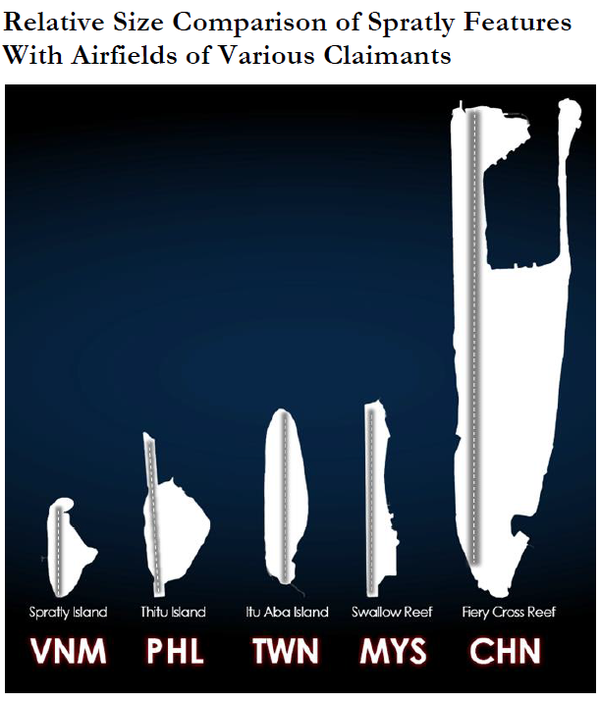
From the scale model of Fiery Cross Reef reclamation to a very nice and detailed map of South China Sea features, this is one of the few documents that uses more than just pretty pictures of military equipment.  Well done to the authors who picked quality illustrations to help drive their points home…almost as good as my choice of memes 🙂

Ryan Haag is the Hawaii CIMSEC President and an Information Warfare Officer navigating the uncharted waters of the Information Dominance Corps. He can be reached through his blog at The Navy’s Grade 36 Bureaucrat.

‘Indo-Asia Pacific’ Explained: An Assessment of US Maritime Strategy 2015

CIMSEC content is and always will be free; consider a voluntary monthly donation to offset our operational costs. As always, it is your support and patronage that have allowed us to build this community – and we are incredibly grateful.

Select a Donation Option (USD)

Enter Donation Amount (USD)

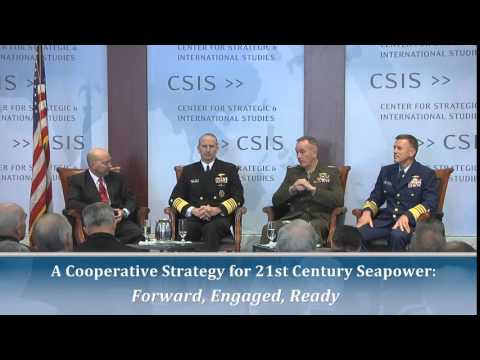
In March 2015, the United States published a new maritime strategy document titled ‘A Cooperative Strategy for 21st Century Seapower’ (Strategy-2015). It supersedes the one of the same title published eight years ago in October 2007 (Strategy-2007). It is the first maritime strategy to be released after the US announced its ‘Rebalance to Asia’ in 2011, and comes amidst seminal developments with far-reaching geopolitical and security ramifications. This view-point attempts to analyze Strategy-2015, including in comparison to Strategy-2007.

Jointness and Political Interface

Strategy-07 was the first-ever combined strategy of the three US Sea Services (Navy, Marine Corps and Coast Guard). Strategy-2015 maintains this feature, with is appropriate since the maritime environment is essentially ‘joint’’, and therefore, any strategy relating to the maritime realm cannot be a single-service articulation. Besides, due to fiscal uncertainties the US is facing today, an inter-service synergy is necessary to avoid duplication of resources and optimise investments for capability development.

Notably, unlike the 2007 document, the new strategy contains a ‘Preface’ by the Secretary of the Navy, which indicates an enhanced political interface with the Sea Services, possibly in terms of both oversight and support of the higher national leadership.

Indo-Asia-Pacific

The new strategy contains an explicit focus on the region that it calls the “Indo-Asia-Pacific.” While US officials have been increasingly using this phrase, the 2015 Strategy document is the first official articulation. The inference is two-fold:

• First, it denotes the realisation of the ‘inadequacy’ of ‘Asia-Pacific’ to address the emerging geopolitical, economic and security dynamics of the rising Asia.

• Second, while the phrase ‘Indo-Pacific’ has become more prevalent in Asia since 2007, the US preference to use “Indo-Asia-Pacific” indicates that it wishes to be part of Asia’s ‘rise’ and derive the attendant gains.

Ends, Ways and Means

The term ‘strategy’ is defined as an articulation of ‘ways’ and ‘means’ to achieve the ‘ends’. In this context, Strategy-07 was merely a ‘primer’ to strategy. It referred to ‘ends’ in very broad terms, without going into specifics of security challenges. It avoided naming countries, either as adversaries, or allies and partners. While it mentioned maritime threats like piracy, it did not contextualize these with specific areas. It was also frugal in expounding on the ‘ways’ and ‘means.’

In comparison, Strategy-15 is a detailed articulation. It echoes the spirit of the US ‘Rebalance’ policy in terms of China’s naval ascendency as both an opportunity and a challenge. It seeks to temper Beijing’s revisionist stance and dissuade its politico-military assertiveness through multifaceted engagement. It is also more forthright in defining the “military challenges”, such as the “Russian military modernization (and) aggression” and the (Chinese) “anti-access/area denial (A2/AD) capabilities that challenge our global maritime access….” Furthermore, it is more explicit on the ‘geography’ of piracy, the effects of religious radicalism and the fundamentalist groups. In terms of the ‘ways’ and ‘means’ too, Strategy-2015 reveals as much as a document in the public domain possibly can. It provides much detail on the US plans to allocate forces for the ‘Rebalance.’

Strategic and Operational Access

Since the middle of 20th century when the US rose to superpower status with the ability to influence events worldwide, unimpeded strategic access to the global commons and freedom of operational manoeuvre have been the cornerstones of its military strategy.

While Strategy-2007 did acknowledge the operational salience of dominating the realms of space, cyber and the electromagnetic (EM) spectrum – as integral to sea control, for instance – it conceived strategic access largely in the geospatial context: sea, land and air. Strategy-2015 goes beyond this to seek access and freedom of action in any domain—the sea, air, land, space, and cyberspace, as well as in the EM spectrum. In all likelihood, this is a declaration meant to counter China’s declaratory policy of A2/AD in the western Pacific, including the asymmetric challenges in the space, cyber and EM domains that Chinese military forces may impose upon their US counterparts.

Forward Presence and Partnership

Strategy-2007 had laid much emphasis on forward presence of the US Sea Services as essential for a major power like the US that seeks inter alia to shape developments in its areas of interest, be better prepared to respond to adverse contingencies, deter and dissuade potential adversaries, reassure allies and friends.

While maintaining the emphasis on forward presence, Strategy-2015 also explains how the US intends to achieve this more effectively, both operationally and fiscally. It adds that the forward naval presence would enable a quick and seamless access to the US joint military forces, if and when the occasion demands.

Given that resource limitations envisaged by the US Sea Services, ‘forward naval presence’ is closely enmeshed with the need to develop partnerships with local maritime forces. The Thousand Ship Navy (TSN) concept propounded by the US Navy’s Chief of Naval Operations (CNO) Admiral Mike Mullen in 2005 was rephrased as the ‘Global Maritime Partnership’ (GMP) initiative in Strategy-2007. As a set of informal arrangements, the GMP was also intended to “send powerful messages to would-be aggressors that we will act with others to ensure collective security….”

Strategy-2015 furthers the appeal for the partnership, now rephrased as a “global network of navies.” The document effectively communicates to the potential partners the rationale for such “plug and play” cooperation with the US forces sans “commitment.”

Force Design and Employment

Strategy-2015 describes “a force that balances warfighting readiness with our Nation’s current and future fiscal challenges.” This statement seems to be the mainstay of the force design and employment strategy of US Sea Services.

Strategy-2007 had laid down the intent to “tailor” maritime forces “to meet the unique and evolving requirements particular to each geographic region.” Strategy-2015, possibly driven by fiscal prudence, seems to have adopted a less ‘ambitious’ approach. It aims only to “align (existing) capability, capacity, and platforms to regional mission demands…by ensuring that our most modern and technologically advanced forces are located where their combat power is needed most.” It also seeks to enhance the effectiveness of naval forces by employing “new warfighting concepts… and…. innovation.” The innovations stipulated by the document include increasing forward-basing of forces “to reduce costly rotations…” and developing modular platforms like Littoral Combat Ships (LCS) to enable swapping mission modules in lieu of costly ship rotations.

In sum, Strategy-2015 is not only a quantum improvement over the preceding strategy document of 2007, but also sets a model for the other existing and emerging major powers to emulate in the interest of transparency in military concepts and capability development. Such transparency is essential among maritime-military forces that operate in the international medium, and particularly those belonging to the “Indo-Asia-Pacific” region that is becoming increasingly volatile, as recent developments indicate.

Captain Gurpreet S Khurana, PhD is the Executive Director, National Maritime Foundation (NMF), New Delhi. The views expressed are his own and do not reflect the official policy or position of the Indian Navy, the NMF or the Government of India. He can be reached at gurpreet.bulbul@gmail.com.