
Tag Archives: Strategy

Towards a More Intelligent Debate over Air-Sea Battle

One of the curious aspects of the debate over Air-Sea Battle has been that the arguments taking place often dwell not on substance, but on definitional disagreements. For example, one side will critique ASB out of concerns of strategy or the nature of our relationship with China; the other side will rightly complain that these concerns belong in a separate, well-deserved debate because ASB is an operational concept, not a strategy. CIMSEC has commissioned an entire week on ASB in the hope that we can move past this inescapable logic-loop. On that note, I recently came across two pieces (both published journal articles) that are stand-ins for where we do and do not want this debate to go.

One is a recent article published in the journal Military Review, entitled “A Role for Land Warfare Forces in Overcoming A2/AD,” written by COL Vincent Alcazar and COL Thomas Lafleur, formerly Air Force co-lead and Army strategist for the Air-Sea Battle Office, respectively. Sounds promising! Unfortunately, what followed was a jargon-laced, logically questionable, and utterly indefensible article. In a sentence, they argued that ASB is not sufficient to meet the A2/AD challenge of the future. Instead we should land a Brigade Combat Team on the soil of our future putative enemies to conduct reconnaissance, raids, and seizures of key A2/AD capabilities. What an incredible argument! Without any reference to actual scenarios, concrete adversaries, or political costs this is not just a useless argument, it is a dangerous one, because someone somewhere out there might actually take it seriously. Beyond substantively bad ideas, this article is also marred by poor writing. For example:

Land warfare forces are not an invasion or long-term occupation force, or utilized as the vanguard of a nation-building effort; even “kicking in the door” comes later. Early land warfare force employment against A2/AD is about tailored BCTs and slices of BCTs that enter the neighborhood to shape its places for the joint force subsequently to kick in the doors to the key houses, which themselves constitute key opponent targets. (p. 80)

If you can understand that, I’m not sure I can congratulate you. The entire article reads like this. A final problem is that the article bizarrely confuses strategy, operations, and tactics. One choice quotation: “Nations employing A2/AD have four goals; however, it is inaccurate to conflate these ‘goals’ with ends. Rather, these goals are considered a framework to explain the strategic and operational so what of A2/AD.” (ital. original) (p. 82-83) How are the authors distinguishing “goals” from “ends?” How can you even talk about strategy without referring to specific countries? What does the term “so what” mean? In sum this article indicates to me that even within the ASBO itself people are still confused over definitions, and basic logic. Pardon the overwrought nautical metaphor, but it does not instill in me much confidence that the ship is being steered in the right direction.

Striking a completely different tone, Jonathan Solomon’s recent article published in Strategic Studies Quarterly, “Demystifying Conventional Deterrence: Great-Power Conflict and East Asian Peace,” was a tour de force. Even though I do not necessarily agree with his conclusions, Solomon expertly defends the necessity of Air-Sea Battle and long-range conventional strike systems through a clear and logical (if dense) elucidation of conventional deterrence theory. He also makes criticisms of blockades that proponents of competitors to ASB, like Offshore Control, must contend with: that over-land blockade running or rationing could thwart a blockade; that a blockade might harm third-party allied countries; and that an adversary could put the US in a situation where it had to choose between further escalation or compromising the integrity of the blockade.

But I still have issues with an article even as well written as this. First, the author is largely talking about an “end of the world” scenario in which China initiates a premeditated first strike a la Pearl Harbor. Solomon spends comparatively little time addressing lower-order conventional deterrence/crisis escalation scenarios, except to say that high-end conventional deterrence is still useful between levels of escalation and that U.S. and allied constabulary functions are still necessary. While some argue that China has an incentive in certain situations to conduct a preemptive strike, it seems likely that such a strike would come in the context of an ongoing political crisis rather than as a bolt out of the blue attack. In this case, lower-end deterrence (defusing the crisis) would be more important than higher-end deterrence.

Second, Solomon intelligently lays out example after example of how both conventional and nuclear deterrence could fail due to strategic misperceptions, psychological issues, China becoming more volatile, and the U.S. fiscal situation weakening, etc. But then he pins the solution on confidence-building measures and multi-track diplomacy. But what happens when multi-track diplomacy does NOT work and China continually rejects confidence-building measures? I am actually one of the biggest proponents of Sino-U.S. mil-mil cooperation, but I am NOT confident that, as Solomon puts it, the United States and China “educate” each other about “their respective escalatory threshold perceptions.” (p. 133)

This is why it is important to craft a more conservative deterrence policy that does not depend on having perfect knowledge of the adversaries’ intentions, doctrine, strategic culture, or leadership psychology. As is well documented by history, intelligence has often been catastrophically wrong, and signaling has been imperfectly interpreted or outright failed—such as the fine-tuned signaling intended by U.S. strategic bombing during the Vietnam War, or when the United States thought it was fighting an anti-communist war in Vietnam while the Vietnamese thought they were fighting a nationalist and anti-colonialist war. We absolutely must try to increase transparency and mutual understanding, but we also have to be aware that we could fail, with catastrophic results. It seems as if Solomon is well aware of these issues, but at times he contradicts himself; there is even one section where he suggests “overt, predeclared ‘automaticity’ in [the] deterrent posture,” which clashes with his warnings against misperceptions, etc. (p. 136)

Finally, the author rightly points out that a Chinese first-strike would inflame the Clausewitzian passions of the U.S. and allied publics and would provide a psychological boost to our side. Why then wouldn’t U.S. retaliatory strikes against mainland targets (even if they are only against counterforce targets) not inflame the passions of the Chinese public, making de-escalation on the Chinese side that much more difficult? We have ample evidence of the nationalist sentiments of the Chinese public, and the below-the-surface antipathy towards the United States that could erupt (e.g. the Belgrade embassy bombing). CCP leaders could fear popular revolt if they capitulated, even if they understood themselves to be in a long-term losing situation. The CCP’s interest in maintaining their leadership position may not be the same as China’s national interest. That is a scary thing to consider.

These two articles seem to strike out two different future intellectual trajectories for the military and our national security apparatus. In one, alternative strategies are debated with an eye towards academic theory, well-informed history, and sound logic. In the other, a gob of reheated mush is coated in incomprehensible jargon and delivered to us as “fresh thinking.” Which direction do we want to go? We can have intelligent or unintelligent debates about ASB. The choice will directly influence our national security, and whether we stumble into yet more undesired wars or keep an uneasy peace. It is my hope that this week at CIMSEC will steer us in the right direction.

William Yale is a graduate student at Johns Hopkins SAIS. He has lived in China for two years, and worked at the Naval War College and the U.S. State Department. He tweets @wayale and blogs at williamyale.com.
Sea Control 20 – McGrath on Maritime Strategy

seacontrolemblemBryan McGrath joins Matt and Chris to discuss his ideas for the future of maritime security. From the focused threat of China to McGrath’s ideas on a unified sea service, this is one of our best podcasts yet. Enjoy Sea Control 20- McGrath on Maritime Strategy (download).

Remember, we are available on iTunes and Stitcher Stream Radio. Tell your friends, leave a comment, and do us the favor of a five-star rating.

The Case for Pickets

(Editor’s Note: Hey! Corvette week is going so well, we decided to extend it!)

“They Were Expendable” makes for a good movie title, but U.S. naval personnel in the 21st century are not such a disposable commodity.  They Were Expendable

This line in Steven Wills’ article points at a very pivotal question of naval force design, and he’s probably on the wrong side of history.

Small ships and boats – corvettes, avisos, frigates – were historically used for many support functions by battle fleets. These functions did not focus on the destruction or deterrence of enemies until the advent of practical torpedoes in the late 19th century, when the torpedo-boat destroyer was introduced in order to counter torpedo boats. The nature of the torpedo and the difficulties caused by the speed and small size of torpedo boats forced navies to adopt a pattern known from warfare on land: The detachment of small and preferably quick forces to positions between the main forces of both belligerents. Later anti-submarine screens by destroyers, destroyer escorts, sloops and corvettes were even more obvious analogies to their land warfare equivalent. The radar picket destroyers of 1945 were another extreme example.

These security efforts were indispensable for saving marching army corps the disruptions of raids, for countering hostile reconnaissance efforts, for providing reconnaissance and for delaying attacks until the own main force is ready to offer battle or has slipped away.

The core concept behind this is to expose a few assets to great risks in order to spare the bulk of the forces much risk. Small detachments were “expendable,” while an entire army corps caught in an unfavorable situation would be a disaster.

Mr. Wills is correct that this approach has lost much appeal to 21st century people in the Western World. In fact, this approach lost ground by the 1970’s already when the escorts – destroyers and frigates – grew to what’s now widely perceived ”capital ship” status because of the demands by powerful missile armaments.

Years of patrolling the very confined Persian Gulf did not help the idea that depth of defence may be gained by having picket ships such as the radar picket destroyers used to warn about incoming kamikaze aircraft in 1945. AEW and MPA aircraft had largely assumed the picket role.

Yet the HMS Sheffield’s fate on picket duty (substituting for an AEW asset) demonstrated both the need for a picket and the relative unsuitability of large ships in such a role: A picket itself must not be a worthy prize. Its survivability should rest on its unworthiness as a target. It should cause enough trouble to the enemy to help its own fleet, but not enough to become an intentional target itself.

Mr. Wills thinks a corvette crew of 35 would be too large for such an exposure, and he’s probably correct. The problem of existing corvette designs may be that they’re neither large enough to be a powerful and thus useful asset nor small enough to be a suitable picket, exposing themselves to protect the capital ships. The very smallest coastal corvettes known from Sweden may be close to a suitable picket hull, though.

A few more words about the possibilities of pickets:

Radar and infrared sensor suites of capital ships still have for plain physical reasons great difficulties with a timely detection of sea-skimming missiles. Less elaborate sensor suites deployed forward could detect incoming missiles much earlier than gold-plated ones on capital ships. The same applies to torpedoes.

Furthermore, advanced multi-static sonar concepts demand the use of multiple vessels with miles of spacing in between. The full potential of low frequency active sonars is likely not going to be exploited without such forward-deployed  vessels, and the smallest hulls to be called “corvettes” may just be the right hull size for this purpose unless we use modified civilian vessels for the purpose.

Detached boats could also serve as decoys, but the fashionable unmanned vessels are the natural choice for this mission.

Sven Ortmann is a German blogger. Since 2007, his blog, “Defence and Freedom,” has covered a range of military, defence policy and economic topics, with more than a million page views. His personal military background is his service in the Luftwaffe. He has guest-blogged at the Small Wars Journal Blog and other blogs on military topics.  http://defense-and-freedom.blogspot.com/

Can South Korea’s Military Successfully Reorient Its Strategic Priorities?

ROK-Navy-2010

A continuation of The Hunt for Strategic September, analysis on the relevance of strategic guidance to today’s maritime strategy(ies). As part of the week we have encouraged our friendly international contributors to provide some perspective on their national and alliance strategic guidance issues.

In an earlier article for CIMSEC, I argued that in order for the U.S.-South Korean alliance to effectively counter threats emanating from North Korea (DPRK), South Korea (ROK) must gradually move away from its Army-centric culture to accommodate jointness among the four services. In particular, as Liam Stoker has noted, naval power may offer the “best possible means of ensuring the region’s safety without triggering any further escalation.”

The appointment last week of former ROK Chief of Naval Operations Admiral Choi Yoon-hee as the new Chairman of the Joint Chiefs of Staff seems to augur a shift in focus in the ROK’s strategic orientation. Given that the ROK’s clashes with the DPRK have occurred near the contested Northern Limit Line throughout the late 1990s and 2000s, President Park Geun-hye’s appointment of Admiral Choi as Chairman of ROK JCS seems to be appropriate. Indeed, during his confirmation hearings two weeks prior, Admiral Choi repeatedly vowed retaliatory measures in the event of another DPRK provocation.

Furthermore, by tapping Admiral Choi to head the ROK JCS, President Park also appeared to signal that she is mindful of the feverish East Asian naval race. The ongoing naval race among three East Asian naval powers (China, Japan, and South Korea) is rooted in historical grievances over Japan’s wartime atrocities and fierce competition for limited energy resources. These two factors may explain the ROK’s increased spending to bolster its naval might.

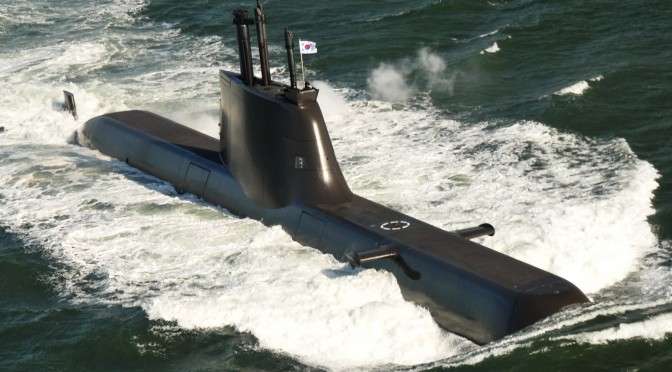
Indeed, the ROK Navy has become a great regional naval power in the span of a decade. The ROKN fields an amphibious assault ship, the Dokdo, with a 653 feet-long (199 meters) flight deck. The ship, named after disputed islets claimed by both the ROK and Japan, is supposedly capable of deploying a Marine infantry battalion for any contingencies as they arise. Given that aircraft carriers may offer operational and strategic flexibility for the ROK Armed Forces, it is perhaps unsurprising that “funding was restored in 2012” for a second Dokdo-type aircraft carrier and more in 2012 and that Admiral Choi has also expressed interest in aircraft carrier programs. Moreover, the ROKN hassteadily increased its submarine fleet in response to the growing asymmetric threats emanating from North Korea and Japan’s alleged expansionist tendencies. As the Korea Times reported last Wednesday, the ROKN has also requested three Aegis destroyers to be completed between 2020 and 2025 to deal with the DPRK nuclear threats and the naval race with its East Asian neighbors.

Thus, at a glance, it would appear that the ROK has built an impressive navy supposedly capable of offering the Republic with a wide range of options to ensure strategic and operational flexibility. However, this has led some analysts to question the utility and raisons d’être for such maintaining such an expensive force.

Kyle Mizokami, for example, argues South Korea’s navy is impressive, yet pointless. He may be correct to note that the ROK “has prematurely shifted resources from defending against a hostile North Korea to defeating exaggerated sea-based threats from abroad.” After all, at a time when Kim Jŏng-ŭn has repeatedly threatened both the ROK and Japan, it may be far-fetched to assume that Japan may “wrest Dokdo/Takeshima away by force.” It would also make no sense to purchase “inferior version of the Aegis combat system software that is useless against ballistic missiles” which does not necessarily boost its naval might.

roknavydestroyers

However, what Mizokami may not understand is that the seemingly impressive posturing of the ROKN does not necessarily mean the expansion of the Navy at the expense of diminishing Army’s capabilities. As my January piece for the Georgetown Journal of International Affairs and Michael Raska’s East Asia Forum article argue, the greatest barriers to service excellence for the ROKN may be South Korea’s uneven defense spending, and operational and institutional handicaps within the conservative ROK officer corps. One telling indication which bears this out may be the fact that the expansion of the ROKN and Admiral Choi’s chairmanship of the ROK JCS did not lead to the reduction of either the budget allocated for the ROK Army or of the existing 39 ROK Army divisions in place.

Moreover, if, as Mizokami argues, the ROK seems bent on pursuing strategic parity with Japan—and to a lesser extent, China—I should point out that it does not even possess the wherewithal to successfully meet this goal. As I notedin late August, in order for the ROK to achieve regional strategic parity with its powerful neighbors, South Korea must spend at least 90% of what its rivals spend on their national defense. That is, the ROK’s $31.8 billion defense budget is still substantially smaller than Japan’s $46.4 billion. If anything, one could argue that the ROK’s supposedly “questionable” strategic priorities have as much to do with political posturing and show aimed at domestic audience as much as they are reactions to perceived threats posed by its powerful neighbors.

Finally, neither the ROK military planners nor Mizokami seem to take into account the importance of adroit diplomatic maneuvers to offset tension in East Asia. In light of the fact that the United States appears reluctant to reverse its decision to hand over the wartime Operational Control (OPCON) in 2015, the ROK may have no other recourse but to deftly balance its sticks with diplomatic carrots to avert a catastrophic war on the Korean peninsula.

In short, it remains yet to be seen whether the ROK will successfully expand the scope of its strategic focus from its current preoccupation with the Army to include its naval and air capabilities. One cannot assume that this transformation can be made overnight because of an appointment of a Navy admiral to the top military post, or for that matter, because it has sought to gradually bolster its naval capabilities. Nor can one assume that they are misdirected since a service branch must possess versatility to adapt to any contingencies as they arise. Instead, a balanced operational and strategic priority which encompasses the ground, air and maritime domain in tandem with deft diplomacy may be what the ROK truly needs to ensure lasting peace on the Korean peninsula and in East Asia.

Photo credit: U.S. Forces Korea, SinoDefence, ITV

Jeong Lee is a freelance writer and is also a Contributing Analyst for Wikistrat’s Asia-Pacific Desk. Lee’s writings on US defense and foreign policy issues and inter-Korean affairs have appeared on various online publications including East Asia Forum, the Georgetown Journal of International Affairs, the World Outline and CIMSEC’s NextWar blog. This article appeared in its original form at RealClearDefense on October 24th, 2013.