Tag Archives: Strategy

Airpower-R-US: The Old, New Way of Doing Business?

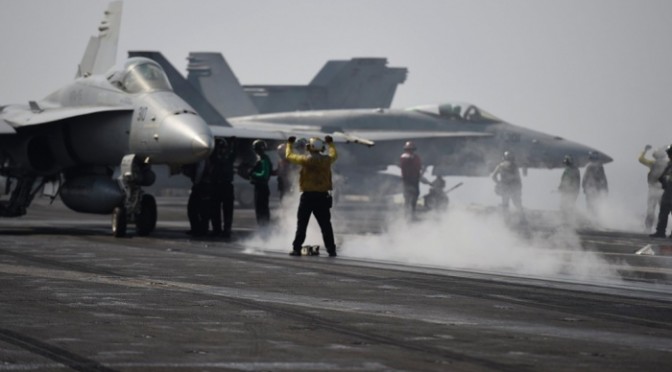
“Kurdish Forces, Backed by Coalition Airstrikes, Move Toward Mosul” announced a recent headline from the front in the war against the so-called Islamic State (ISIS) in Iraq and Syria.  As I read this headline the slogan that popped into my mind was Toys-R-US, or more to the point, Airpower-R-US; and in a more joint context, Fires-R-US. The US stands for United States. The metaphor here involves going to the store (the US) and getting what one needs to handle one’s military and political problems. The toys, of course, are the array of capabilities that the US Department of Defense can provide, courtesy of the National Security Council and with the blessing of the President; especially combat aircraft and the best trained crews for them in the world.

With all the handwringing about the future of warfare and the 21st century “threat”  being bandied about in security policy circles, perhaps the new norm should be identified as the US’s propensity for “loaning out” its air power and fires capabilities. These tend to be assigned to causes US leaders perceive as “righteous” or at least worthwhile enough (to US interests) to apply the military component of national power. The Kurds for example might provide the ground troops and we provide the air/fire power to help them achieve their goals (and maybe even air defense and ballistic missile defense).  Or perhaps to simply prevent US enemies (like ISIS) from achieving their goals, or rather, more of their goals.

This approach to the use of military power seems to be something we previewed for everyone as early as World War II, and then practiced more deliberately in places like Vietnam, Iraq (1990- present), Bosnia, Kosovo, Afghanistan, Libya, and now Syria (whose conflict now overlaps with Iraq). In order to provide value, a brief review of the history of the evolution of Airpower-R-US is in order. As a reminder, the pattern we are discussing is a tendency to eschew the commitment of ground forces in favor of commitment of air power (including things like sea-launched land attack cruise missiles and Predator drones with hardkill payloads).

World War II: The Pattern in Preview

The US first previewed a pattern of providing high tech additives, primarily air power, in its strategic planning and initial execution of operations in World War II.

Its leaders, especially President Franklin Roosevelt and the air power lobby, initiated this practice during World War II, providing first the equipment (Lend-Lease) and then the manned air forces to sustain the major ground fights, primarily in the Soviet Union but also as a strategy for the Pacific in China.  Claire Chennault, for example, was sent to Nationalist China to help build, train, and employ its (American-built) air force against the Japanese in 1937. As for Europe, the air power advocates produced the overall air plan designed to achieve victory shortly after the war in Europe began in 1939 and over the course of 1940 and early 1941. It was designated AWPD-1.   Here is a summary that leaves no doubt about what it intended to do:

The primary target systems were selected on the basis of an air offensive embracing the entire strategic air force, after it had reached full strength and lasting for six months. Moreover, the offensive was planned to be completed before the invasion, if an invasion should prove necessary. Target schedule for the beginning of the main air offensive was taken as one year and nine months after the outbreak of war. One year was for the production, training, and organization of the force. Nine months were reserved for deployment overseas, build up, and initial combat experience of the force. By that time, we anticipated there should be a total bomber force of nearly 4,000 bombers in place. [emphases original]

However, both of these we-provide-the air-(and navy) and you-provide-the-troops strategies did not completely pan out.   It may have in Europe had the US accepted the probable loss of Western Europe to the Soviets. In any case, large numbers of US ground troops ended up being committed in combat.  This was a preview of an emerging pattern.

This pattern, it might be assumed, had proven itself somewhat less than efficacious, at least in terms of avoiding the commitment of US ground forces, although what was committed was the result of a gamble, that air power would work and the US only needed 90 divisions at most to win the war.  In fact it came dangerously close to running out of ground power by the end of the war.  The World War II pattern in many ways repeated itself just five short years later in Korea, when deterrence with atomic weapons delivered by air power came up short and there was precious little conventional air power on hand to help not only the South Koreans but even US ground forces until the crisis at Pusan had passed.

Vietnam and Beyond

At this point the pattern seemed to take a holiday.  That holiday was known as Vietnam; or more correctly the years of primarily advisory support to the government of South Vietnam (1959-1965).   However, with the failure of the advisory effort by Military Assistance Command, Vietnam (MAC-V), the pattern re-emerged as President Lyndon Johnson intervened with ground forces, initially as security forces for US and South Vietnamese air bases at places like Bien Hoa and Da Nang. However, ground forces soon got sucked into the fighting and the war assumed a two track character:  General William Westmoreland and the South Vietnamese Army (ARVN) fought the ground war while five separate air forces (four of them US) fought the air war.  The crowning jewel of the air war was Operation ROLLING THUNDER, an air campaign intended to actually win the war by sending “signals” to the North Vietnamese leaders in Hanoi to cease and desist with their aggressions in the south.  It failed miserably and was cancelled by Johnson during the chaotic year of 1968.  In contrast, the ground war achieved a stalemate as a result of the defeat of the North Vietnamese Army (NVA) and Viet Cong during the Tet Offensive.
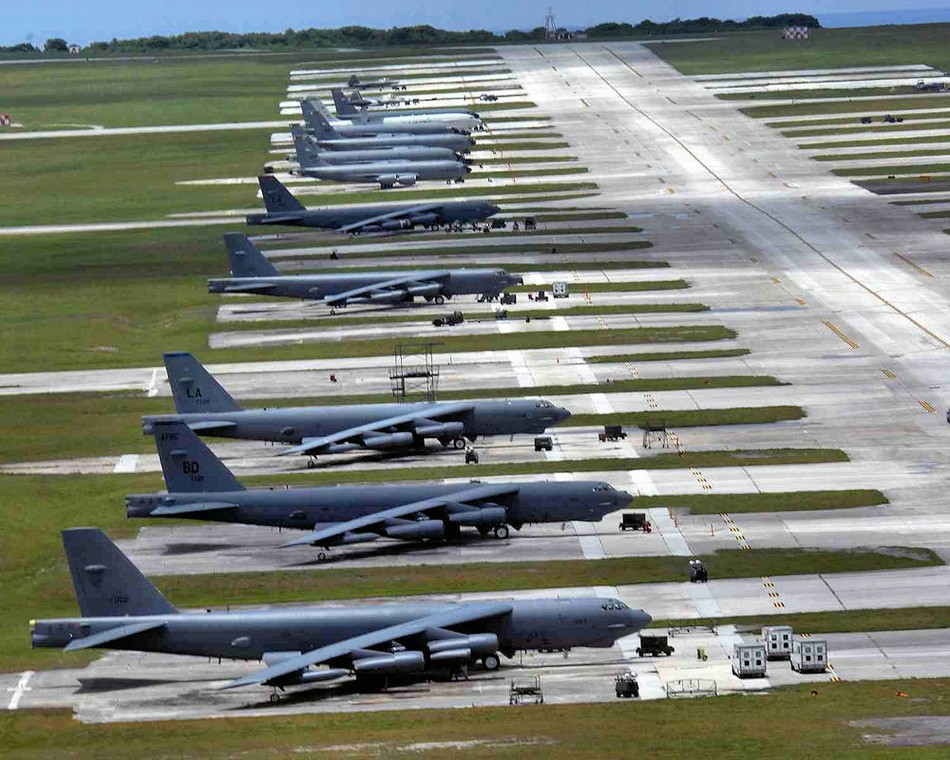
                              B-52 bombers at Andersen AFB, Guam

Failure and stalemate in Vietnam in 1968 led to the first realization of what today’s pattern, on display in places like Yemen, Syria, and Iraq, might look like.  Johnson’s successor as commander in chief, Richard Nixon, decided to “Vietnamize” the war.   Critical to this approach was the withdrawal of ground combat forces (as in Iraq and Afghanistan, today).   However, Nixon gave the South Vietnamese leaders assurances that their military would be supported by US air power and in 1972 this was successfully tested as the ARVN bore the brunt of the so-called Easter Offensive by the NVA in its attempt to conquer the south in one fell swoop.  Massive application of US air power in the two LINEBACKER air campaigns, along with some hard fighting by the ARVN, saved the day, albeit only temporarily. The Pattern (it now deserves formal noun status), had worked.  US air power and indigenous ground forces had staved off disaster, against one of the best armies in the world.  Until they didn’t—after two years (50 years ago this year) and Nixon was no longer President.   The US refused to use Airpower-R-US in 1975 to help its “abandoned” client in Saigon and the NVA achieved its long sought goal of unifying Vietnam under communist rule.

There was something like the Pattern in the US support of the Afghan Mujahedeen in their fight against the Soviets during the last decade of the Cold War, but instead of US pilots, the hardware was of the smaller variety, most especially surface-to-air missiles, an Anti-Airpower-R-US variant.   Similarly, the small Gulf States accessed a sea power version of US power in the late 1980s with the reflagging of Kuwaiti ships in response to Iranian mining threats.  In that case the US provided all of the maritime firepower during Operations . But these operations reflect something of the Pattern.  One might advance the idea that it was also a partial component behind Operations DESERT SHIELD and DESERT STORM, especially the seven week air campaign that preceded the ground offensive.  During the planning for that component of the operations, the air force chief of staff was relieved for suggesting that air power might do it alone, without the commitment of substantial US and coalition ground forces to actual combat beyond their coercive value as a threat.  As it turned out the US had to make good on that threat to use ground forces after all to retake Kuwait.

However, the Pattern, now in its mature form, emerged after the end of the Cold War.   The author experienced it directly while flying missions for the Navy during operations DENY FLIGHT and DELIBERATE FORCE, wherein NATO conducted overlapping air campaigns to stabilize the situation in Bosnia from 1994 to 1995.  NATO air power finally conducted limited bombing attacks, measurably aided by an offensive of Bosnian-Croat ground forces that led to the signing of the Dayton Accords in the Fall of 1995 by all parties (including the Bosnia Serb factions).  This same dynamic occurred again four years later with Operation ALLIED FORCE, the air campaign against Serbia and in support of the Kosovar Albanians.  It has been characterized as “winning ugly,” but for those folks interested in limited war, Airpower-R-US provided more evidence to support the efficacy of this approach, no matter how messy.  The commander of US forces in Europe, General Wesley Clark, even cached the experience into a book proclaiming that this was the face of modern war.

As with all things, after the terrorist attacks on 9/11, the US entered something of an interregnum, or interval, in which the Pattern was not the primary choice.  Both the Afghanistan and Iraq campaigns, although relying heavily on air power, employed substantial ground forces. Of the two, the initial phases of Operation ENDURING FREEDOM in Afghanistan most closely approximate the Pattern when US air power, special forces, and indigenous forces took the fight to Al Qaeda and the Taliban in 2001.  However, by Operation Anaconda in March of 2002, substantial US ground forces were back in the game and the utility of the Pattern presumably inadequate to achieving further national interests in that desolate place.

The sobering experiences in Iraq and Afghanistan from 2001 to 2014 led to a full-fledged return of the Pattern.   Its first widespread use has already occurred with the proliferation of armed drones, sometimes with the permission of governments, and, in the case of Pakistan, sometimes not .  The point at which use of the Pattern can definitely be characterized as the norm came with the so-called “Arab Spring,” most especially in the oddly named Operation ODYSSEY DAWN, although the bulk of NATO air power employed to help the Libyan insurgents against the forces of Muammar Gaddafi was US. Questions of its ultimate efficacy aside, it did get the job done of pairing up US/NATO air power (and sea power) in support of indigenous “boots on the ground” to accomplish regime change.  Whether this result was for better or worse is a different matter and beyond the scope of this discussion.

Which brings us back to today’s headlines and the current air campaign in Iraq and Syria—Operation .  The Pattern here supports a variety of different entities and their ground forces including: the government of Iraq, various rebel groups fighting ISIS, the aforementioned Kurds, and whether we like to admit it or not, Bashar Al Assad.   We might even throw in the enemy of our enemy, Iran.   The Obama administration’s embrace of this approach, similar to that of the earlier Clinton administration, has potentially far reaching implications in what it tells us about the evolving American Way of War.  Are these really “new” norms, or are they now established norms?  And based on this review of pertinent recent history, how new are they, really?

Today: Old-New Ways of War

In sum, The US has established a pattern of providing high tech capabilities, primarily air power, to the ground forces of others (nations as well as non-states like the Kurds and the Kosovo Liberation Army), as a means to achieve its national interests and objectives.  This US approach places air power alongside venerable mercenary icons such as the Swiss Landsknecht and the Italian Condottierri of the 15th and 16th Centuries.  Is Airpower-R US an updated version the infamous army of General Albrecht von Wallenstein that hired itself out to various bidders during the 30 Years War? Has it become a sort of paradigm mercenary force available for hire as a means to maintain and defend US (and sometimes Western) interests?  Instead of receiving money as payment, though, the US forgoes commitment of ground troops and gets stability in return (or maintains the stability of the existing system).

Is this approach worth preserving, or even improving?  Whatever the road ahead, it is here and it is in active use today in Iraq, Syria and elsewhere.   It might be in use in the near future in Ukraine and it is incumbent on US policymakers to think a bit more intensely about what they design the military instrument of national power to do, and not do, for the future.   In a time of relatively low risk, it makes some sense.  But does it need to be so expensive, and can we get the same bang for the buck for a lot less?  These are the questions we should be asking ourselves about Airpower-R-US, and certainly a few other related issues, as we await the next crisis in which we might employ it.

About the author:

Dr. John T. Kuehn is the General William Stofft Chair for Historical Research at the U.S. Army Command and General Staff College CGSC).  He retired from the U.S. Navy 2004 at the rank of commander after 23 years of service as a naval flight officer flying both land-based and carrier-based aircraft.  He has taught a variety of subjects, including military history, at CGSC since 2000.  He authored Agents of Innovation (2008), A Military History of Japan:  From the Age of the Samurai to the 21st Century (2014), and co-authored Eyewitness Pacific Theater (2008) with D.M. Giangreco as well as numerous articles and editorials and was awarded a Moncado Prize from the Society for Military History in 2011.  His latest book, due out from Praeger just in time for the 200th Anniversary of the Battle of Waterloo is Napoleonic Warfare: The Operational Art of the Great Campaigns.

The views are those of the author and do not reflect the official policy or position of the Department of the Army, Department of Defense, or the U.S. Government.
Members’ Roundup Part 17

Welcome back to another edition of the Members’ Roundup, where we share with the rest of the CIMSEC readership the great work that our members have produced elsewhere. From the geopolitical situation in the Indian Ocean region to military science-fiction, there will definitely be an article for every interest.

Automation has long colonised jobs that were once performed through manual labour; changes to military operations will be no less profound. In an article for a joint War on the rocks – Center for a New American Security on military robotics and autonomous weapons, Paul Scharre reminds us that beneath all of the technological developments is the human element driving the military application. Nations and militaries that are able to better understand the policy, strategic and operational challenges will be better placed to succeed on the battlefield. You can access his article here.

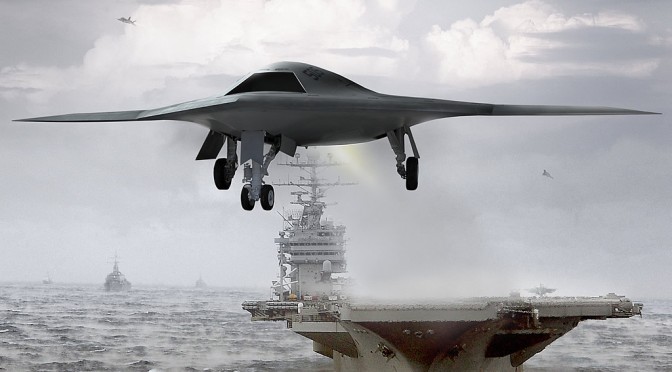
Over at Real Clear Defense, Emil Maine presents a stark assessment of the state of the  United States’ munition stockpile. According to Maine: ‘unless policy makers act to raise discretionary caps on defense in the upcoming fiscal year, the severity of weapon shortfalls will only intensify.’ Given that the preference by coalition partners is to avoid committing boots on the ground, there will be a future need for a consistent supply of munitions in order to sustain the current rate of operations.

193636993
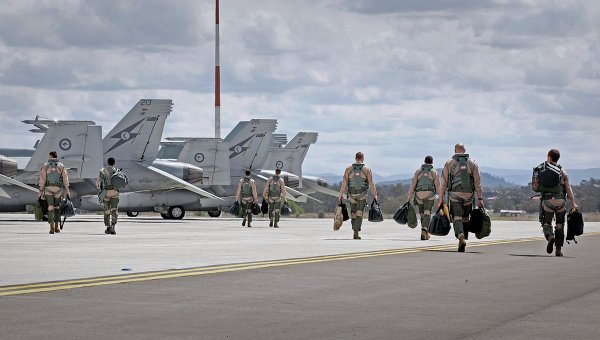
Royal Australian Air Force F/A-18 crews prepare for another mission against ISIS.

This week we have two contributions from Vijay Sakhuja. The first is an article for the National Maritime Foundation, based in India, and it analyses the bilateral relationship between India and the Seychelles.  President James Michel’s Blue Economy project presents many opportunities for cooperation, but how this will be implemented is the challenge. The second article features in the Nikkei Asian Review; Vijay discusses the nature of Chinese infrastructure development in the Indian Ocean region and the ‘maritime silk road.’ In spite of growing tensions, many Asian countries continue to invite Chinese investment, leading to a win-win situation.

CIMSEC’s very own Scott Cheney-Peters features in this week’s edition of the Roundup with his short story “Red Light Challenge” published on the Atlantic Council’s Art of Future Warfare website. The story is about a start-up team’s journey, with undertones of a hacker counterculture amongst the members, as they begin designing a flight-capable exoskeleton for the military. Throughout the piece, however, we see the human side during the project development; each character has their own traits and reasons for participating in the challenge. You can read Scott’s story here, as well as a follow-up interview about it here.

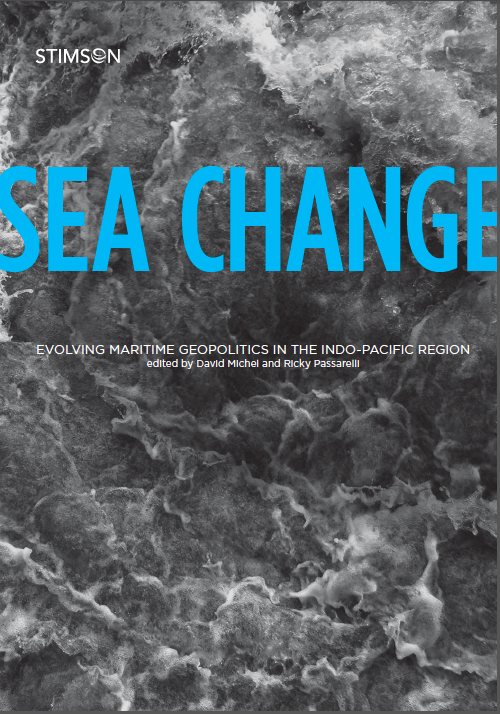
Sea ChangeThe Indo-Pacific region is rapidly emerging as a key focus of maritime geopolitics. In June last year, the Stimson Center and the Observer Research Foundation co-hosted a three-day conference titled Sea Change: Evolving Maritime Geopolitics in the Indo-Pacific Region. Two CIMSECians were invited to speak at the event; Scott Cheney Peters presented a paper on U.S. security relationships in the region and Nilanthi Samaranayake presented on the strategic importance of island states in a region of great powers. A copy of the publication can be accessed through the Stimson Center’s website.

In the latest Proceedings MagazineJohn Morton explains that the Third Offset Strategy needs more Mahanian thinking than meets the eye. Mahanian doctrine holds that a properly conceived national interest reflects the foundational sinews and national establishment of the era and must inform implicit long-term grand strategy. Today, the information age and globalised economy are what is important for long-term prosperity. You can read more of John’s article here.

Over at The National Interest there are three CIMSECians whose work I wish to draw attention to for this week’s edition of the Roundup. Zachary Keck reports that most Chinese citizens believe the PLA could seize islands in the East and South China Seas, even if the U.S. military were to intervene in the conflict. Earlier in the week, Keck cited a Heritage Foundation report that assessed America only had ‘marginal’ capacity to defend vital interests in the current threat environment. You can access that post here. Harry Kazianis continues the theme with an assessment of sequestration’s affect on America’s military readiness. Across the board, munitions levels are considerably low and it risks putting lives in danger. It is not, however, all doom and gloom. You can read more of Harry’s article to find out why. Kyle Mizokami presents his own roundup of the Top 5 most deadly anti-ship missiles of all time.

Finally, a quick and shameless spruik for my own work over at Young Australians in International Affairs. Earlier this week I wrote a blog post posing the question of what Australia’s military would look like if there was an opportunity to start with a blank canvas. Many of us in the military understand that force structure and procurement are constrained by fiscal and structural realities, but sometimes it is important to break down the fundamental requirements of national defence to truly understand what is needed to achieve the task.

At CIMSEC we encourage members to continue writing, either here on the NextWar blog or through other means. You can assist us by emailing your works to dmp@cimsec.org.

The New US Maritime Strategy

Editor’s Note: The U.S. Navy, U.S. Coast Guard, and U.S. Marine Corps today released the revised maritime strategy, unveiling it at an event at CSIS. You can download it here, and access a fact sheet on it here.

CS21R%20banner

By Joshua Tallis

A Cooperative Strategy Reboot

A Cooperative Strategy for 21st Century Seapower: Forward, Engaged, Ready (CS21R) is different from its 2007 predecessor in both tone and content in a number of critical ways. Some of the changes are merely those of diction, others those of new threats and previously ignored regions. Yet, all of these changes suggest an important evolution in the scope and attitude of the United States’ maritime services: the Navy, Marine Corps, and Coast Guard.

Parsing the Tone

The Tone of CS21R is set early on as the document’s authors seek to explain why an adapted strategy has become necessary. First and foremost on this list is the budget, a note that mirrors the tenor of more recent strategy documents (see the 2014 QDR, for example), but is absent from the original 2007 version. Before the end even of the preface, written by Secretary of the Navy Ray Mabus, the document makes reference to fiscal constraints. And this theme remains an undercurrent throughout the white paper.

In addition to budget, the document is quick to remark on the increasing complexity of the world’s dynamic threat environment. This too is found in Secretary Mabus’ preface, and continues through the foreword (signed by all three maritime service chiefs) and onward into the strategy itself. And again in this way CS21R sets itself apart from its predecessor. As the Chief of Naval Operation noted at the launch event at CSIS, the 2007 document was the product of a vastly different environment. Multiple conventional carriers were still afloat, the United States was heavily engaged on the ground in both Iraq and Afghanistan, and cyber was not yet the buzzword it has become in policy circles. In many ways the original document was a product of a wartime environment, one broad in scope but nevertheless clear in direction and purpose. The revised strategy favors the term complex where the earlier document uses evolved, a small change in diction that perhaps suggests a greater uncertainty in the future responsibilities of the maritime services. Yet, tone only suggests so much. The document, which is slightly longer than the original, provides greater content and thus a more sophisticated representation of its purpose than its predecessor.

Analyzing the Strategy

There are myriad ways one could parse the new document with respect to the old. It is vastly more robust in its attention to the cyber domain (which garners only side mentions in the 2007 version). It also pays far greater attention to Africa than the 2007 paper, which only mentions the continent once by name. In fact the revised version goes into far greater depth on all geographic regions, with a section (II) detailing each specifically. One unique change here is in a shift from the term ‘Asia-Pacific’ to a vastly more expansive ‘Indo-Asia-Pacific,’ defined as “spanning from the West Coast of the United States to the eastern coast of Africa.” (CS21R 3) This of course widely expands a geography the Navy in particular has had a growing interest in, though how it influences the rebalance to the Asia-Pacific is unclear. China still features heavily in the document, and the service chiefs all noted that the country weighed on their minds as the document evolved. It is likely in response to China, as well as threats posed by Russia and Iran, that induced one of the greatest changes to the document, the addition of “All Domain Access” as a pillar of seapower alongside the more traditional columns of deterrence, sea control, power projection, and maritime security. All domain access is defined as the “ability to project military force in contested areas with sufficient freedom of action to operate effectively.” (CS21R 19) This of course brings to mind anti-access/area denial (A2/AD) challenges posed chiefly by China, though the document indicates that this principle extends even into the cyber domain and the electromagnetic spectrum. (CS21R 21)

None of these changes will go unnoticed. Greater geographic specificity, the expansion of interest in securing the cyber realm, and the inclusion of a fifth pillar in the sea services’ conception of what seapower means are all ‘above the fold’ revisions to the original strategy. What may go unnoticed to those focused on traditional geopolitics is the documents marked increase in interest in maritime security. Human trafficking makes its debut in the revised document, while greater significance is given to those non-state threats mentioned in the 2007 white paper. The first section of the strategy detailing geopolitical changes since the publication of the first document is peppered with references not only to extremism and terrorism but also to transnational organized crime (TOC), the growing significance of population expansion in the littorals, and the threats posed by under-governed zones ashore.

As to be expected, each of the service chiefs highlighted certain portions of the cooperative strategy over others. When asked against what greatest threats the updated strategy was intended to prioritize, the Chief of Naval Operations pointed towards North Korea, Iran, Russia, cyber, and a host of non-state actors (mostly terror organizations such as Isis and Boko Haram). The Commandant of the Marine Corps also noted violent extremism, but leaned heavily on conventional threats such as Russia, China, North Korea and nuclear proliferation. The Commandant of the Coast Guard, however, highlighted throughout the launch event the primacy of a range of maritime security threats emphasized in CS21R. Chief among them was transitional crime, which the admiral estimates is worth $750 billion annually. The commandant also repeated the Coast Guard’s unique placement as a law enforcement operator with dozens of mutual legal assistance treaties negotiated across the world enabling easier Coast Guard access to littorals where other maritime forces may have operational restrictions.

International partners, most of whose navies are closer in scope and composition to the U.S. Coast Guard than the U.S. Navy, are a related component to this energized perspective on maritime security. The document makes continued reference to the need for partnerships, and Admiral Greenert noted at the launch that the document was already in the process of being translated to allow for greater dialogue with international partners. In West Africa, the Caribbean, Central America, the Middle East, and Southeast Asia in particular, many of these partners’ primary concerns are of matters of maritime security, terrorism, and organized crime. The Coast Guard’s partner programs in the South China Sea and its counter-narcotics mission in the Caribbean and Central America were highlighted in the event as examples of maritime security cooperation outside of the traditional navy-to-navy framework.

Finally, the document goes into greater detail than its predecessor with respect to implementation. Section IV on force design included components on force readiness and composition, personnel, strategic development, and capabilities. At the launch, Admiral Greenert noted that the strategy captures how the navy is organizing, equipping, and training its sailors in new ways. General Dunford made reference to personnel and training shifts to precipitate in the coming years, guided in part by CS21R, and Admiral Zukunft emphasized that the Coast Guard was on the threshold of the largest recapitalization effort in the service’s history.

Conclusion

In many of the most significant ways, A Cooperative Strategy for 21st Century Seapower: Forward, Engaged, Ready is not so much a revision but a replacement of its 2007 incarnation. Longer, more detailed, more expansive, and more inclusive, the revised document builds heartily on the framework established eight years ago, the result being a document distinctly different in both tone and content. While great attention will no doubt be paid to many of these differences, equally important if perhaps subtler changes were made regarding how the maritime services face non-state issues, including the illicit traffic in people, narcotics, and weapons. As CS21R continues the tropes increasingly familiar in strategy documents—budget uncertainty, evolving threat complexity, a shift towards the Asia-Pacific—it brings the maritime services into a more nuanced, if perhaps ambitious, vision of what seapower will mean in the future.

About the Author

Since 2011 Joshua has served as the manager for research and analysis at Security Management International (SMI), an intelligence services provider in Washington, DC. Josh has co-authored several articles in the Journal of Counterterrorism and Homeland Security International with SMI associates. Since 2013 Joshua has also been a frequent contributor to spaceflightinsider.com, a member of The Spaceflight Group’s community of aerospace news websites. He is a PhD candidate at the University of St. Andrews’ Centre for the Study of Terrorism and Political Violence, where he researches maritime security. Joshua is a Summa Cum Laude graduate of The George Washington University where he received a BA in Middle East Studies from the Elliott School of International Affairs.

Can China Rise Peacefully? What Does History Suggest?

John J. Mearsheimer concludes his book, The Tragedy of Great Power Politics, with the chapter “Can China Rise Peacefully?” This is certainly on the minds of many, as over the the past few years the size of China’s economy has overtaken that of the U.S. While China’s economy grows, so too has her aggressive stance on her territorial claims in the South China Sea, Scarborough Shoal and the Senkaku Islands. Coupled with her rapid double digit increases in military spending, one would be hard pressed not to conclude that China is quickly rising to “Great Power” status, if not there already.

At the same time, China’s leadership has gone out of its way to promote its policy of “peaceful development.” It has embarked on a program of “neighborhood diplomacy” emphasizing “friendship and partnership” and “good neighborliness.”  It has even enshrined this policy of peaceful development and eschewed hegemonic intentions in the Chinese Communist Party doctrine.

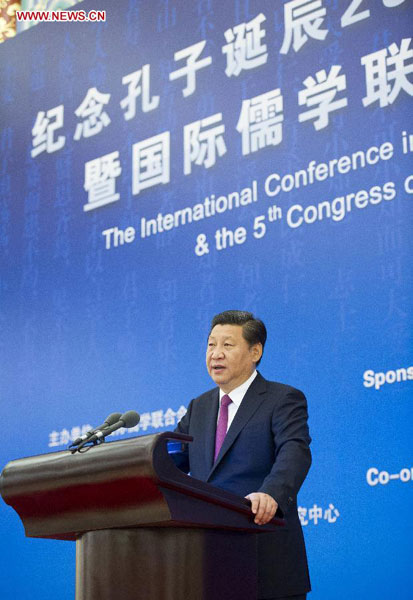
ConfuciusChina asserts that unlike Western powers, it can rise peacefully due to its unique Confucian cultural tradition. In 2014, China celebrated the 2,565th birthday of Confucius (551-479 BC), and President Xi Jinping provided the keynote address marking the occasion. In it, he sought to emphasize that China’s Confucian heritage, integrated within Communist doctrine (naturally) would promote social harmony at home and peaceful understanding with its neighbors and the world. Martin Jacques, author of When China Rules the World, suggests as much when he describes China as a “civilization state” rather than a “nation state.

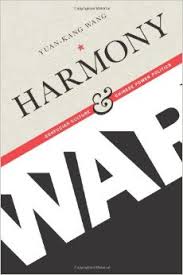
So what are we to make of this? Will China’s “Confucian exceptionalism” exempt her from the traditional historical patterns of conflict when rising powers bump up against status quo powers like the United States? Yuan-kang Wang, assistant professor at Western Michigan University addresses that question in his book, Harmony and War: Confucian Culture and Chinese Power Politics. In it, he asks, “To what extent does culture influence a state’s use of military force against external security threats?” This is the central concern to those in the world outside of China, as history tends to suggest that when a rapidly rising power threatens an established power, competition almost inevitably leads to conflict – the dreadful Thucydides’s Trap. (There is a good argument that the trap may already have been sprung.)

Harmony and WarReturning to China and its Confucian tradition, what does history suggest? The premise of Dr. Wang’s book is to address head on whether “cultural theories [which] argue that ideational factors … can transform the harmful effects of [state system anarchy] and have an independent effect of state behavior.” Therefore, China’s strategic behavior in the past should largely reflect and be explained by the cultural traditional of “Confucian pacifism.”

Confucian pacifism has four key features: a culture of antimilitarism, defensive grand strategy, the theory of just war and limited war aims. Antimilitarism suggests that China has a historic bias toward civil virtue over martial virtue as shown by its state promotion of Confucian ideology. Its tradition of nonviolence led it to favor a defensive grand strategy over aggressive expansion, relying on “cultural attraction” or the “benevolent way” as opposed to the Western tradition of the “hegemonic way.”

Even Confucius understood that military preparedness was important to state survival. However, he argued for “righteous war” (similar to Western just war), and suggested that force be used “only when defensive options are exhausted.” Confucius also maintained that force is justified “when the ruler of another state is morally depraved,” similar to the current theory of “humanitarian intervention.” Yet this should be punitive in nature, and not for the purpose of annexing territory or expansion. War aims should be limited to the restoration of the status quo ante, never for the total destruction of the enemy.

So does Chinese history bear out its Confucian pacifism? Dr. Wang looks at two periods in China’s history, the Northern and Southern Song Dynasty (960-1179 AD) and the Ming Dynasty (1368 – 1644 AD) and finds that “Confucian culture did not constrain the leaders’ decision to use force; in making such decision, leaders have been mainly motivated by their assessment of the balance of power between China and its adversary.” This largely aligns with the expectations of structural realism theory as opposed to cultural realism theory.

Dr. Wang argues that three themes emerge in Chinese history. First, “China’s decision makers frequently probed for weakness in the country’s adversaries and took advantage of it when found.” Imperial China was never reluctant to use force, nor did it use force only as a last resort. China is not as pacifist as some scholars (and its political leadership) would suggest.

Second, its use of coercive force largely correlated with its relative power position. When strong, Imperial China adopted “offensive-oriented” strategies. When it considered itself weaker, they sought to maintain a defensive posture and be more accommodating “while embarking on domestic reforms aimed at strengthening its military forces and improving its economy.” Indeed, court documents and transcripts indicate that officials would most often refer to Sun Tzu’s strategy of subduing the enemy without fighting only when in a position of weakness rather than as a matter of universal policy.

Finally, war aims were not limited to “defensive border protection” or “restoration of the status quo.” This was evident in both policy debates within the Imperial Court and in actual behavior. Indeed when China had to adopt a more defensive posture, this was less a cultural preference and more a result of insufficient offensive capabilities.

Great WallTake China’s construction of The Great Wall. This is often pointed to as an example of both Confucian pacifism and China’s historically defensive nature. However, Dr. Wang’s review of court transcripts on the decision making process and historical context that led to its construction paint a different picture. Construction of the today’s recognizable wall began in 1474 AD, during the Ming Dynasty, amid constant conflict with the Mongols. Debate amongst the Ming court showed a preference for launching an attack on the Mongols to recover lost territory and bring them to heel. However, they were constrained not by a cultural predilection for defensive strategy but rather a lack of offensive capabilities. Indeed, the Confucian traditionalists “lamented that a country as great as China should come under the mercy of the culturally inferior nomads” – themes that would be echoed by Chinese leadership today when recalling China’s “Century of Humiliation.” In short, an assessment of military weakness drove the Ming to build The Great Wall, not Confucian tradition.

Xi Jinping Confucius
Chinese President Xi Jinping addresses an international seminar to mark the 2,565th anniversary of the birth of Confucius, which is concurrent with the Fifth Congress of the International Confucian Association (ICA), at the Great Hall of the People in Beijing, capital of China, Sept. 24, 2014. (Xinhua/Huang Jingwen)

Dr. Wang’s historical study challenges the popular narrative of China’s historic cultural pacifism. This has implications for future relations between China, her neighbors and the United States, as China’s leaders use this Confucian tradition as a legitimizing mechanism of its peaceful development and growing military power. He ends his study by suggesting that “based on theory and history, China will gradually shift to an offensive grand strategy when it has accumulated sufficient power.”

Of course, one should not be fatalistic or succumb to historical determinism. Conflict need not be inevitable. However, while history does not repeat itself, it does rhyme. American policy makers (and our friends and allies around the world) would do well to consult Dr. Wang’s book.

About the Author:

LT Robert “Jake” Bebber USN is an Information Warfare officer assigned to U.S. Cyber Command and is a contributor to the CIMSEC NextWar Blog. His articles have appeared in Orbis, Proceedings, Small Wars Journal and elsewhere. Jake holds a PhD in Public Policy from the University of Central Florida. He is supported by his wife, Dana and their son, Vincent. The views expressed here are his own and do not reflect those of the U.S. Department of Defense, the U.S. Navy or U.S. Cyber Command. He welcomes your comments at jbebber@gmail.com.