Tag Archives: Russia

The Role of Cruisers in Promoting Russian Presence and Deterrence in Peacetime

The following is a two-part series on the role cruisers played in the Soviet and Russian Navy. The first part examines historical inspiration for developing a cruiser-focused force, concepts of employment, and strategic rationale. Part II will focus on how cruisers shaped the environment through forward presence during the Cold War, and how the nature of presence may evolve into the future. 

By Alexander Clarke

“A Man-of-War is the best ambassador.”

This is an often quoted phrase of Britain’s 17th Century Lord Protector Oliver Cromwell;1 a phrase stated in an age when seapower had shown promise of potential,2 but not yet attained the capabilities, or achieved the feats, that would truly make it demonstratively so.3 This words were said before the ministry of William Pitt (the Younger, Prime Minister 1783-1801 & 1804-6),4 before the works of Alfred Thayer Mahan5 and Julian Stafford Corbett6 were published, and before the age of Empire and Gunboat Diplomacy.7 Yet still, in just eight simple words, it sums up the root construct of all this history and thought that have, does, and will continue to shape the world and relations between states to this day. It does this because it succinctly sums up a principle function, and duty, of warships in ‘peacetime.’ A function, which is entirely entwined with navies’ roles of maintaining maritime security8 – enabling freedom of trade, as well as access to the bounty of the sea, and presence,the protection of interests, reassurance of allies, and deterrence of potential aggressors.

Maritime Security and Presence are big missions for navies, they are the roles of ‘peacetime’ which make ‘peace’ such a relative term for navies in comparison to armies.10 A situation accelerated by the fact that in ‘peacetime’ the rules of engagement become by necessity stricter, the constabulary duties (fishery protection, counter piracy, counter smuggling, etc.) get greater focus, and engagements with other nations, both friend or potential foe, become more nuanced and subjective. This though is nothing new, and despite the recent phraseological development of the ‘Oceanic Global Commons,’11 patrolling the world’s original super highway – the sea,12 has been the subject of discussion and debate probably since humans first set to sea. The best lesson that has been drawn from these discussions, is that there is always more to be learned.

So with the discussion started, it is necessary to explain the question, why focus on the Soviet, and successor Russian navy? That is explained by the fact that while the Soviets and the Russians have never achieved dominant status at sea, they have successfully managed to enhance their status, maximize their presence, and achieve a growing level of influence through leveraging the capability they had/have in ways that have limited other nations ability to interfere with their interests. This success has not been achieved by accident, instead it is a product of long running analysis;13 analysis which has diverged at a significant point from the traditional Anglo-American Western naval model14 – not through a different understanding of warfighting, but a different perspective on operations outside of warfighting.

As students of history the Soviets had seen how a land power, Germany, had not really gained anything, but lost a lot strategically by building a fleet which was shaped directly to challenge the largest sea power prior to WWI15 – conversely the same nation had got far closer to success with a more asymmetric approach both in that war and WWII. The prime example of this is a weapon of sea denial, the submarine.

Unfortunately, the experience of both WWI and WWII showed that submarines alone were not enough in war time; furthermore, it showed they are only really useful in wartime. In ‘peacetime’ they are good for intelligence gathering, Special Forces operations, and practicing for war. Submarines are so limited in conducting presence operations because they are by their very nature stealth units, and the visibility required for presence goes against this fundamental attribute. Furthermore, due to the physical and technological sensitivity of their hull coats and sonic signatures, even port visits to the closest of allies are fraught with potential risks that are more sensibly avoided. The use of submarines in the presence mission, therefore usually comes at the point of it becoming focused towards ‘conventional’ deterrence16 – rather than just overt presence.

This is where surface combatants come in, and it explains the evolving Russian approach with a growing focus on designs which were far more general purpose than specialists despite their often stated role of Anti-Submarine Warfare.17 No area is this seen more clearly than in the consistent focus on cruisers, and the ‘cruising mission.’18 Understanding the difference is something which will begin to matter more, not only because of the resurgent Russia, but the growth of other navies, for example China and India. These nations have not merely acquired equipment, they also draw heavily from the Russian (and by extension, Soviet) naval experience and practice in conceptualizing naval operations.

How and why the Soviets used the Cruiser…

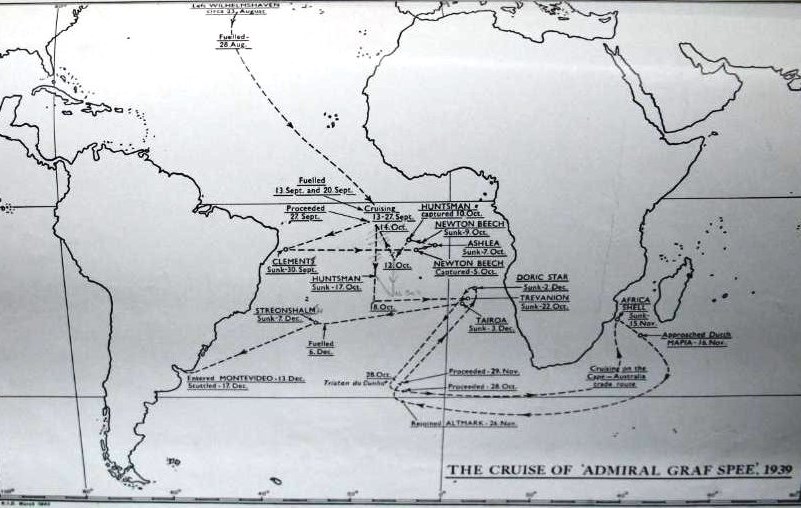
The post-WWII Sverdlov class19 was where the Soviet navy started to bring their vision of cruiser capability to fruition. Pre-war plans had been very conventional and these post-war plans were heavily influenced by their understanding of WWII German naval surface raider operations.20 These operations had tied down large amounts of Royal Navy (RN) combatants, and had been very successful. For example the cruise of the ‘Pocket’ Battleship, the Admiral Graf Spee, whilst ending heroically (for both sides21) at the Battle of the River Plate,22 had sunk nine merchant ships, captured two ships, and ‘frightened’ at least one other. Although these are the easily measurable effects, there is no real way of quantifying how many Captains changed or altered their course, how many loads were late or connections missed, all as a result of the fear of where the German raider was – or just as strong, the fear of where it might be.

In any case, the effects were not limited to the merchant marine. According to the Soviet Historian L.M. Eremeev23 in his work Some Results of the Cruiser Operations of the German Fleet, the RN mobilized numerous forces to catch the Admiral Graf Spee, including Commodore Harwood’s South Atlantic Squadron, seven cruisers, two aircraft carriers, a battlecruiser, and at least three destroyers (although considering the escorts required by the capital ships mobilized, he was likely underestimating this number by a long way). This demonstrated to the Soviet Union the potential of surface ships, if used in a ‘cruiser warfare’ manner, to exert great impact upon operations disproportionate to the realistic capabilities of the vessel.
grafspee
Figure 1.The Cruise of the Admiral Graf Spee, illustrating not only the number of its success but the range and breadth of them. (UK National Archives)24

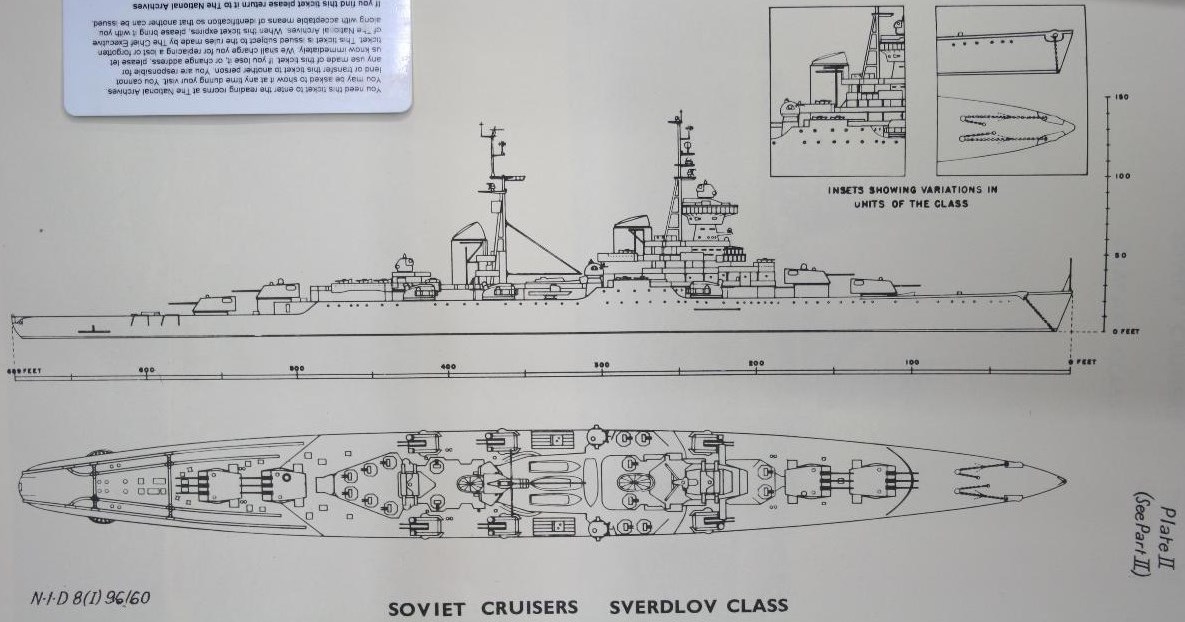
Eremeev not only discusses these wartime achievements, but the political and national impacts of such ships being built. The Sverdlov class were (even in the post-WWII/early Cold War era), powerful looking ships, fitted with the very best radars the Soviets had available,25 and had an impressive array of weaponry (see Figure 2) for the period.26 They were also big – displacing 16,000 tons,27 which is roughly double that of a modern RN Type 45 Daring-class destroyer or the U.S. Navy’s Flight I Arleigh Burke-class destroyers. The Sverdlovs were ships which were just as useful for solo raiding missions and Task Group commands as they were for peacetime ‘impression presence’ and diplomacy missions. What’s more, the Sverdlov was a light cruiser design28 and there were even bigger ships planned.29

Maximum benefit was sought from every rouble of the naval budget30 by making the most of unit presence for peacetime missions and multiplication of assets to make any opponent’s attempts to use the sea as complex as possible.31 Warfighting was about sea denial, raiding, and the tying down of enemy forces while simultaneously making their movement difficult.32 Peacetime was for building relationships, strengthening alliances, for stretching muscles, gaining experience, and hindering other actors such as Britain and the United States in their attempts to shape the world whilst simultaneously seeking to shape it themselves.33 The 1950s Sverdlovs were not though the only class of ship built by the Soviets that would fit into this mould. They were more the beginning of a story, which would continue into the 1970s with the Slava-class, Kara-class,34 and the behemoth 28,000 ton Kirov-class ‘Battlecruisers.’35 Alongside these vessels were other cruiser designs, less capable in terms of combat and command, but still with comparable status, size and armament of cruisers;36 just as large a statement of intent and capability. This capability was different from western navies, as it was not built upon the warfighting prowess of aircraft carriers. The cruiser-centered force better suited the strategic vision and peacetime presence mission profile for the Soviet Union better than any other available option. 
cruiser
Figure 2: The Sverdlov class: this plan illustrates how heavily armed the ship class was with twelve 152mm in four triple mountings, twelve 105mm in six double mountings all combined with a heavy anti-aircraft armament, torpedoes, sophisticated sensors, a top speed of 33kts, and a range of 9000 nautical miles.37 (UK National Archives)38

The advantages were that cruisers are cheaper and easier to build and operate than aircraft carriers, can physically enter more ports to support diplomacy, and while being lesser in range of combat power than aircraft carriers were not necessarily lesser in combat capability within that more limited scope. This made them powerful tools for a nation which was seeking to flex its muscles around the world as a method of spreading its influence but not foment a naval arms race in the way that it was already in a strategic arms race.39 The Soviets realized that aircraft carriers, like Germany’s pre-WWI dreadnought battleships,40 would be seen as provocation and direct challenge. Cruisers were enough of challenge to be status worthy, but did not represent a direct confrontation of the carrier-centric NATO navies41 – therefore, would not be a direct attack on their confidence and thus a provocation. This is a policy though which did not stop with the end of the Cold War; in fact modern Russia has gone to great lengths to continue it.
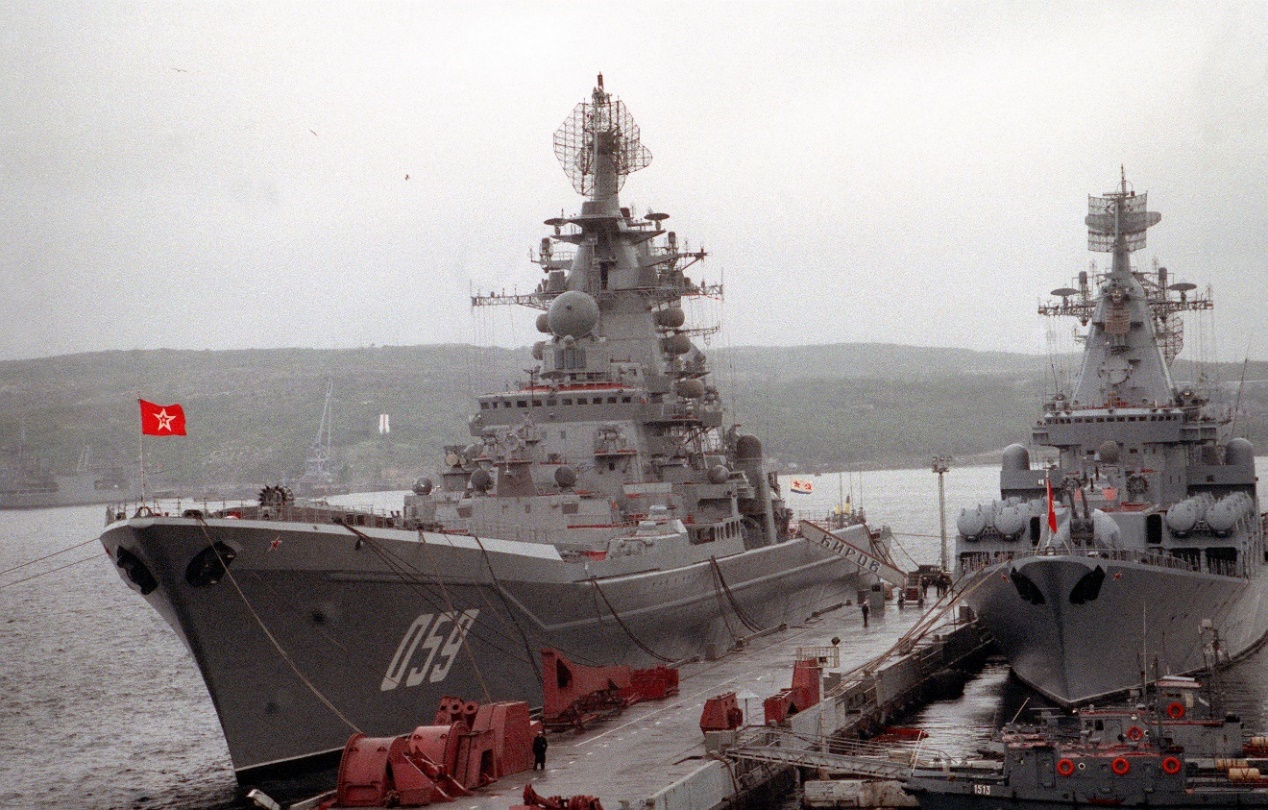
Figure 3: the Kirov class cruiser that used to be called the Kirov, but in 1992 when this photo was taken had its name changed to Ushakov, alongside a Slava class cruiser which had also been renamed from the Admiral Flota Lobov to Marshal Ustinov. Source: CWO2 Tony Alleyne via Wikimedia Commons.42
Figure 3: The Kirov-class cruiser Ushakov that was formerly known as the Kirov alongside a Slava-class cruiser which had also been renamed from the Admiral Flota Lobov to the Marshal Ustinov. (CWO2 Tony Alleyne via Wikimedia Commons)42

They have done this by keeping as many of the Soviet-era ships in service as they are able to. Soviet cruisers are still the core of the Russian fleet and its capability to project influence worldwide.43 There has also been a resurgence in submarine production,44 and perhaps more interestingly, a focus on the procurement of new corvette-sized combatants.45 Additionally, there has been a significant reconstituting of amphibious warfare capability.46 Based, as this policy is, in a fairly simple and straightforward analysis of international relations that there are:

  • Actors – nations which take charge and command events
  • Reactors – nations which flow with the tide of events, only reacting to what happens
  • Contractors – nations which get others to act on their behalf

These are classifications which can, and do change from circumstance to circumstance. The Russians have clearly chosen to equip themselves to be ‘actors’ as often as possible. This is understandable as they do not have enough reliable, capable, allies to be ‘contractors’ – and even if they did, possible ‘contractors’ often do not have sufficient influence over the course of events to satisfy and sustain Russian interests. Being a ‘reactor’ would mean that Russia would automatically cede any influence on the pace and circumstance of events. This is more than just theory and direction, it is a policy which has been illustrated by real world events in Georgia,47 Syria48 and Ukraine.49

Dr. Clarke graduated with a PhD in War Studies from KCL in 2014, the thesis of which focused upon the Royal Navy’s development of naval aviation and aircraft carrier design in the 1920s and 1930s. He was supervised during this by Professor Andrew Lambert. Alongside this he has published works on the 1950s with British Naval History, and has also published on current events with European Geostrategy and the Telegraph online as part of the KCL Big Question series. He has maintained an interest in digital history, and is organizing, hosting, and editing a series of Falklands War veterans interviews for the Center for International Maritime Security and Phoenix Think Tank. Recent research outputs include presenting a paper at the National Maritime Museum’s 2016 conference on the ASW capabilities of the RNAS in WWI, and will be presenting a paper on the design & performance of Tribal Class Destroyers in WWII at the  forthcoming BCMH (of which he is a member) New Researchers Conference.  

1. Tsouras (2005), p.396

2. Rodger, The Safeguard of the Sea; A Naval History of Britain, 660-1649 (2004), pp.263-71

3. Rodger, The Command of the Ocean (2004)

4. Ibid, pp.364-6

5. Mahan (1987)

6. J. S. Corbett (1911)

7. Cable, Gunboat Diplomacy 1919-1979, Political Applications of Limited Naval Force (1981), and Clarke, August 2013 Thoughts: Naval Diplomacy – from the Amerigo Vespucci to a Royal Yacht (2013)

8. Clarke, Protecting the Exclusive Economic Zones – Part I (2014), and Clarke, Protecting the Exclusive Ecconomic Zone – Part II (2014)

9. Clarke, October 2013 Thoughts (Extended Thoughts): Time to Think Globally (2013)

10. Air forces, as has been highlighted recently also experience issues – with other nations probing air space; but still they do not face potential problems on the scale or diversity that navies could experience, especially navies belonging to nations with far flung territories strewn around the globe.

11. Flournoy and Brimley (2009)

12. Hipple (2014)

13. TNA: ADM 223/714 (1959), and TNA: ADM 239/533 (1960)

14. Sergey Gorshkov (1980, p.230) goes into great detail as to the diference between the idea of dominance at sea adopted by Russian in comparison to England, and America which had inherited the English model.

15. Massie (2005) – a conclusion which is further supported by the experience of Japan in WWII, it had also chosen to build a scaled battlefleet, and whilst with its challenges this did make some sense – its lack of infrastructure to support a rapid expansion of its fleet to equivalent levels meant that although it suited the cultural/political perception of its national leaders, it was not necessarily as sensible as a less conventional fleet structure might have been (Stille, The Imperial Japanese Navy in the Pacific War 2014).

16. A. Clarke, August 2013 Thoughts: Sea Based Conventional Deterrence; more than just gunboat diplomacy!  (2013)

17. Polmar (1991), and TNA: ADM 239/821 (1959), both highlight how often ships with very capable surface-to-surface and surface-to-air weaponry, for example the Kara Class (Polmar (1991), pp.155-7) are described as ASW Guided Missile Cruisers, yet both their SA-N-3 Anti-Aircraft missiles, and SS-N-14 anti-submairne missiles, had significant anti-ship capability (especially the latter, which being torpedos at their terminal stage are arguably more dangerous than a pure missile system)…furthermore as the class was built, one of the class, Azov, had it’s air-defence upgraded to include the far better SA-N-6 (which also has an anti-ship capability), and all of the class were built with extenseive command and control facilities.

18. Clarke, Europe and the Future of Cruisers (2014)

19. Clarke, Sverdlov Class Cruisers, and the Royal Navy’s Response (2014)

20. TNA: ADM 223/714 (1959)

21. TNA: ADM 116/4109 (1940)

22. TNA: ADM 116/4109 (1940), TNA: ADM 116/4320 (1941), and TNA: ADM 116/4470 (1940)

23. TNA: ADM 223/714 (1959)

24. TNA – Admiralty: 116/4109 (1940)

25. A. Clarke, Sverdlov Class Cruisers, and the Royal Navy’s Response (2014)

26. Rohwer & Monakov (2006), pp.199

27. Ibid, pp.197-9

28. Rohwer & Monakov (2006), pp.197-9, and Polmar (1991), p.164

29. Rohwer & Monakov (2006), pp.194-7

30. Gorshkov (1980), p.248, and Dismukes & McConnell (1979), pp.88-114

31. Gorshkov (1980), pp.213-77, and Dismukes & McConnell (1979), pp.1-30

32. Rohwer & Monakov (2006), pp.215-6, G. S. Clarke (2007), and Gorshkov (1980), pp.213-22

33. Rohwer & Monakov (2006), pp.215-6, G. S. Clarke (2007), and Gorshkov (1980), pp.245-53

34. Polmar (1991), pp.155-7

35. Ibid, pp.148-51

36. For example the Slava, Kresta and Kynada classes (Polmar (1991), pp.152-4 & 158-63)

37. Rohwer & Monakov (2006), p.199, and TNA: ADM 239/533 (1960)

38. TNA – Admiralty: 239/533 (1960)

39. Rohwer & Monakov (2006), illustrates this in their work by highlight how many grandiose naval schemes were planned, and enver completed; when if the will had been present, and decision had been made, then the Soviets under Stalin could have allocated the resources to do it.

40.  Massie (2005)

41. Clarke, Sverdlov Class Cruisers, and the Royal Navy’s Response (2014)

42. Wikimedia Commons (2015)

43. Janes (2006), or for those wanting quick verification of this then there is the Russian Navy Website (http://rusnavy.com/nowadays/strength/) or Wikipedia (https://en.wikipedia.org/wiki/List_of_active_Russian_Navy_ships) for those preferring something slightly more straightforward.

44. Cavas (2015)

45. Pike (2015)

46. Keck (2015), and Defence Industry Daily Staff (2015)

47. Georgia: McGuinness (2013), and King (2008)

48. Syria: Keck, Russia’s Aircraft Carrier to Visit Syrian Naval Base (2013), and Daily Mail Reporter (2011)

49. Ukraine: Harress (2015)

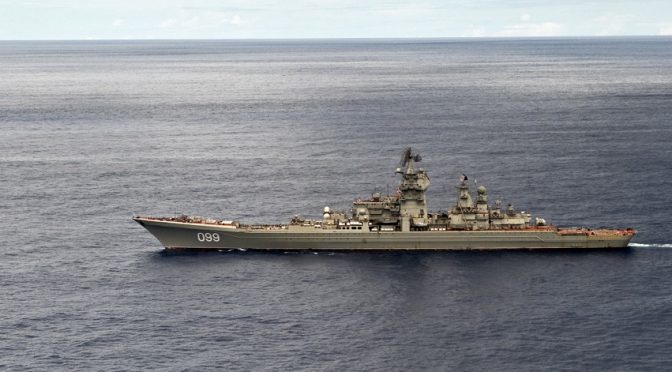
Featured Image: The Pyotr Veliky nuclear-powered Kirov-class cruiser. (Wikimedia Commons)
Members’ Roundup: September 2016

By Sam Cohen

Welcome to the September 2016 members’ roundup. Throughout the month, CIMSEC members examined several international maritime security issues, including the successful testing of Raytheon’s SM-6 surface-to-air-missile by a Ticonderoga-class Aegis cruiser, developments surrounding the Littoral Combat Ship (LCS) program, the rise of non-state actors in international maritime security affairs, continued hostility between China and regional nations relating to the South China Sea maritime disputes, and the worsening of security tensions between American and Russian air and naval forces patrolling the Black Sea. 

Dave Majumdar, for The National Interest, discusses the Raytheon SM-6 Standard surface-to-air missile test that recently set a new record for the longest-range over-the-horizon intercept in naval history. The interceptor, which also has a long-range anti-ship variant, is a central component of the U.S. Navy’s Naval Integrated Fire Control – Counter Air (NIFC-CA) battle network. He highlights that the missile is effective against cruise missiles, aircraft, ballistic missiles, and enemy surface combatants while its range is estimated to be as great as 250 nautical miles. He also explains that the SM-6 interceptor is a major reason for why the U.S. Navy is confident in its ability to operate in highly contested environments, including regions where near-peer competitor powers have employed anti-access/area-denial weapons, such as the Baltics or the Western Pacific.

Bryan McGrath, for Scout Warrior, provides several recommendations for how the U.S. Navy should methodically approach future fleet architecture and force structure planning. He explains that developing the fleet to meet the challenges of great power competition should be central to this approach, largely because the capabilities this requires will allow for other critical security demands to be met as a byproduct, including control over trade routes, combating non-state actors, and enforcing maritime security. He also suggests that the relationship between the Navy and the Marine Corps should be funded as an asymmetric advantage unique to American seapower capabilities, while Congress should increase the overall resource allocation the Navy receives in order to meet the rigors of growing great power dynamics and the increasingly complex, multi-domain operational objectives associated with those adversaries.  

Steven Wills, for U.S. Naval Institute News, provides a review of the changes made to the Littoral Combat Ship (LCS) program and explains that although the ships’ new training procedures, modularity, and operational organization may seem revolutionary, these new features simply reinforce the ship’s core missions. He explains that the majority of the LCS force will be forward deployed in support of operational commander tasking while personnel swaps will be undertaken to keep the ships forward deployed for longer periods of time. He also adds that mission modules will be exchanged between different LCSs to meet strategic operational requirements. Although the LCS has received significant opposition from both military and political officials, he notes that the large numbers of LCSs planned for forward deployment will meet the fleet’s specific demand for 52 small combatant vessels, and more generally, the need for increased warfighting capacity across the force. 

Paul Pryce, for The NATO Association of Canada, discusses the rise of non-state actors across the international maritime environment, highlighting the People’s Liberation Army Navy (PLAN) and the Chinese Coast Guard’s training and funding of fishing militias to support China’s territorial claims in the South China Sea. He explains that the advent of these actors and their practices represent an overall increase in hybrid warfare on the oceans, a development which is likely to undermine regional security across the highly contested waters in the Asia-Pacific. With non-state actors offering plausible deniability for the states that support their activities, he suggests that states should seek greater cooperation in the enforcement of international maritime law by launching frequent and functional joint patrols as a means of building mutual trust between countries. He explains that this trust will increase constructive dialogue towards resolving ongoing disputes and will mitigate the tensions non-state actors and militias can induce between nations. 

Members at CIMSEC were active elsewhere during the month of September:

At CIMSEC we encourage members to continue writing, either here on CIMSEC or through other means. You can assist us by emailing your works to dmp@cimsec.org.

Sam Cohen is currently studying Honors Specialization Political Science at Western University in Canada. His interests are in the fields of strategic studies, international law and defense policy.

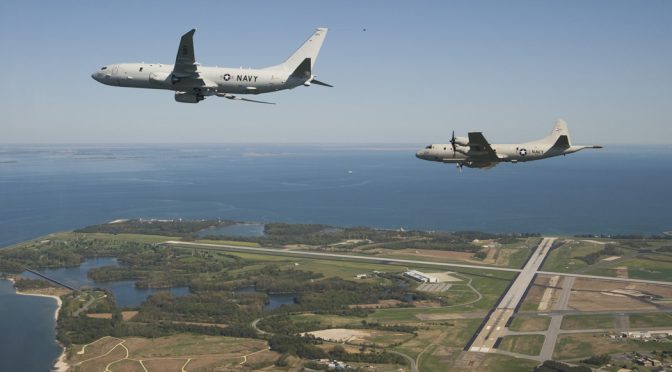
Featured Image: A P-8A Poseidon flying alongside a Lockheed P-3 Orion, close to Naval Air Station Patuxent River, Maryland, 2010 (U.S. Navy photo by Liz Goettee)

Entering the Bear’s Lair: Russia’s A2/AD Bubble in the Baltic Sea

The following article originally featured on The National Interest and is republished with permission. Read it in its original form here

By Bret Perry

On the cold, cloudy afternoon of March 18th, 2018, the 22nd Marine Expeditionary Unit (MEU) and its Amphibious Readiness Group steamed through the Baltic Sea about 100 miles south of the Swedish island of Gotland, just west of Lithuania and Latvia. With its full squadron of three amphibious assault ships, including the USS Bataan Landing Helicopter Dock, and three Arleigh Burke-class destroyers, this impressive US military presence in the Baltic Sea was unprecedented. In response to unusual Russian military activity near Estonia, including the presence of ‘little green men’ in the border town of Narva, the new White House administration was determined to send a message to Moscow.

Two US Marine Corps F-35Bs, flown by call sign Yukon and his wingman Zeus, surged off the deck of the USS Bataan to conduct a combat air patrol (CAP) to reinforce the NATO presence in the area. Banking south, Yukon heard the NATO E-3 Sentry Airborne Early Warning and Control (AWACS) operator Showboat say through his thick Dutch accent, “Yukon, Showboat, you have a pop-up group of two Bogeys, Bullseye 207 degrees for 150 kilometers, 1,300 meters.”

“Copy, Showboat. Intercepting,” Yukon responded as he throttled his jet up to Mach 1.6. Another aggressive Russian flyby, he thought.

About four minutes later, Yukon and Zeus had positioned their aircraft about 250 feet behind the two Su-30SM Flanker-C bandits. But unlike previous intercepts of Russian fighter over Baltic Sea, the Su-30s were clearly armed with more than the typical, short range Archer (R-73) air-to-air missiles.

“Zeus, any idea what they’re carrying?” Yukon asked his wingman.

“Negative, but they’re not playing around today,” she responded.

“Copy. Take a closer look for me.”

“Roger,” Zeus responded. She slowly began to creep her aircraft closer to the Su-30 on the left.

“Showboat, Yukon, tally-ho on two Flanker-Cs. We think…” Yukon’s voice trailed off as he watched a disaster unfold in an instant.

As Zeus approached the bandits, one of the Su-30s tried to barrel-roll over her F-35B. But as Zeus held steady 100 feet from the Flankers, the Su-30 pilot misjudged the maneuver, and slammed the Russian jet into the right wing of Zeus’ F-35B. The wing snapped off, sending Zeus spinning, while the Su-30 pitched over into a nosedive.

“Eject! Eject! Eject!” Zeus yelled into the radio.

In response to the chaos, the remaining Su-30 banked right, and bugged out. When Yukon looked to his left, he felt relief and horror at what he saw.

He could see Zeus’ parachute. But… there was no sign of the Russian pilot.

Although the aforementioned vignette is fictional, it captures the increasingly worrisome military implications of Russia’s posture in Kaliningrad. The presence of Russian ground, naval, and air forces in Kaliningrad is not new, but Russia has essentially transformed the tiny area into a major “pop-up” Anti-Access/Area-Denial (A2/AD) zone from what had been a Cold War-era Soviet outpost. Despite traditionally being associated with the Asia-Pacific or even the Persian Gulf, Russia’s deployments in Kaliningrad reflect the potential for the emergence of localized A2/AD zones in Europe. Not only is A2/AD now a critical component in European security dynamics, but it is also a global phenomenon that has truly ‘broken out’ of the Pacific’s First Island Chain. With NATO’s eyes on the defense of its Baltic members and a growing view that Poland is NATO’s new center of gravity in the East, a Kaliningrad A2/AD zone projects advanced ground, naval, and air threats, creating significant security challenges.

visualizing_a2_ad_map_300dpi_beige_rgb1
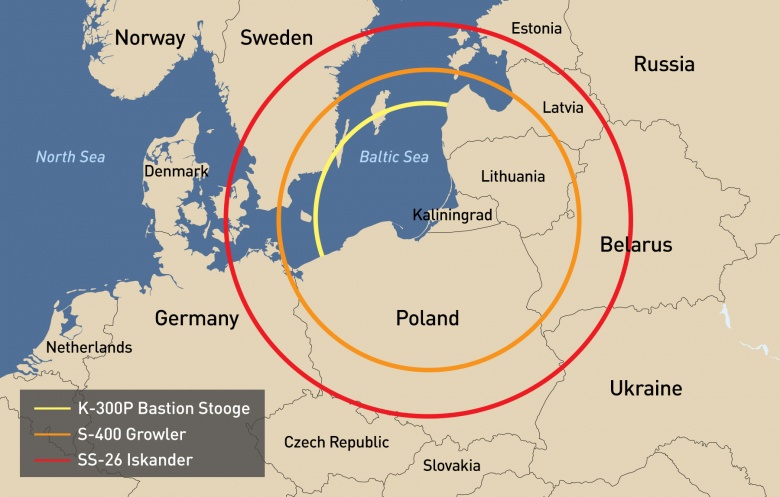
Range rings of Russian missile systems in Kaliningrad. (Avascent)

Achieving Integrated Air and Missile Defense (IAMD) and air dominance is a critical component in countering A2/AD zones. Although Russia’s defense industry faces challenges with upgrading the state’s fighter fleet, both the Russian Aerospace Forces and Russian Naval Aviation possess formidable 4G and 4.5G tactical aircraft capable of executing advanced air-to-air combat and challenging NATO’s air dominance. In Kaliningrad, two Naval Aviation fighter regiments maintain several squadrons of Su-27 fighters and Su-24 bombers out of two separate air bases. As Russian Naval Aviation purchases at least 50 new Su-30SMs by 2020, the forward deployment of these units to Kaliningrad would significantly sharpen Russia’s sword in the Baltic airspace. Specifically, Kaliningrad’s position provides Russian forces with the ability to scramble their tactical aircraft within close proximity to NATO forces while under the protection of extensive Russian air-defense systems.

15 minutes later, Yukon continued circling, waiting for the other Su-30SM to return and hamper the USS Bataan’s search and rescue efforts. Suddenly, he heard Showboat shout over the radio.

“Unidentified track, Bullseye 163 degrees for 380 kilometers, 2,300 meters, hot!”

Yukon saw the new contact marked by Showboat on his Tactical Situation Display (TSD) located on the front left of his F-35B’s cockpit. It was tagged as unknown, but moving rapidly across the screen at 4,500 mph towards Showboat. Yukon’s gut told him something was wrong, so he quickly switched his APG-81 radar onto “active” mode.

In a second, the Active Electronically Scanned Array (AESA) radar on Yukon’s F-35B scanned the object and autonomously identified it as a Russian 40N6 missile. As the F-35B’s datalink automatically transferred its identification to Showboat’s AWACS and other forces in the area, he said, “Showboat, Yukon, Bullseye, 230 degrees for 340 kilometers, 5,000 meters, SAM launch! Break left! Break left!”  

But the 40N6 surface-to-air missile (SAM), flying at over 4,500 mph, was too fast.

Within 10 seconds, Yukon heard Showboat shout “Break…Mayday! Mayday! May…!” All what was left was static. On his TSD, the icon denoting Showboat’s AWACS was gone from his display.

Launched from an S-400 “Growler” SAM launcher near the small coastal town of Yantarny in Kaliningrad, the 40N6 missile is a long-range weapon with an active- and semi-active seeker designed to destroy high-value targets, such as AWACS, electronic warfare, and other special mission aircraft. In 2012, Russia began outfitting at least two battalions in Kaliningrad with its new S-400 SAM system. The S-400s joined Kaliningrad’s S-300 SAMs, also an important threat.

Moscow’s deployment of S-400 missiles to Kaliningrad was key in transforming the outpost into an effective A2/AD zone. With a maximum range of 250 miles (although the system most likely can only detect advanced stealth aircraft with much smaller radar cross-sections, such as the F-22, at closer ranges), Kaliningrad’s S-400s are capable of turning the airspace over much of the Baltic Sea, Latvia, Lithuania, and half of Poland (including the capital, Warsaw), into a no-fly zone at the flip of a switch. General Frank Gorenc, the commander of US Air Forces in Europe, explained that Moscow’s SAMs and other systems “creates areas that are very tough to get into.” Although an assortment of stealth aircraft, electronic warfare capabilities, and long-range strike weapons can neutralize the S-400, strikes in Kaliningrad carry strategic consequences due to the risk of Russian escalation, ultimately making the suppression of enemy air defenses a complex challenge.

Without Showboat, Yukon and the naval forces accompanying the 22nd MEU were in the dark without any early warning capability. Yukon’s F-35B acted as the eyes and ears of the fleet with its AESA radar. But as he was miles south of the MEU and the closest AWACS replacement was in Germany, the decision was made to have one of the escort destroyers turn on its radar’s “active” mode. This decision would give away the MEU’s precise location, but was necessary to establish a 360-degree view of the deteriorating situation.

The USS Truxtun powered on its SPY-1D radar and Mk 99 fire control system to restore awareness. Although the Truxtun could now detect targets over 100 miles away, Yukon’s F-35B continued to play a role with its powerful AESA radar.

But within a minute of firing up its radar, “Overlord,” Truxtun’s operations specialist announced “10 unidentified tracks, Bullseye 187 degrees for 280 kilometers, and closing fast.”

Yukon looked down on his TSD and saw the unidentified tracks appear near the top edge of the screen. They were moving quickly down the display at an angle towards the MEU, but not as fast as the S-400 missile’s earlier observed path. At the current pace, they would reach the fleet in about 410 seconds. Yukon banked his plane and burned towards the unknown contacts.

About a minute later, Yukon’s AESA radar picked up all ten of the contacts, identifying them as P-800 Oniks anti-ship cruise missiles. The F-35B’s computer immediately transmitted the data to the Truxtun and other NATO forces in the immediate area. Within less than a second, the Truxton’s AEGIS Combat System processed the threat information and autonomously launched 20 SM-2 SAMs towards the incoming Oniks missiles, targeting each Oniks with two SM-2s.

Yukon burned towards the Oniks missiles, prepared to intercept. But Overlord was wary of Yukon going “winchester,” or running out of missiles, especially if additional Russian aircraft emerged.

About 150 seconds later, the Truxton’s SM-2s reached the incoming Oniks missiles. Four of the missiles struck their targets, but debris from their impact knocked the Truxton’s remaining SAMs off course. Detecting its error, the Truxton’s AEGIS system automatically launched 12 new SM-2s towards the remaining Oniks missiles.

“Overlord” ordered Yukon to engage one of the Oniks even though they were nearly out of range. The nervousness in Overlord’s voice was unmistakable. Yukon acknowledged the command, responding with “Fox Three” as one of his AIM-120 Advanced Medium-Range Air-to-Air Missiles (AMRAAM) dropped out of the F-35B’s weapons bay, firing towards the Oniks.

90 seconds later, the Truxton’s second wave of SM-2s reached the remaining Oniks missiles. They knocked two Oniks missiles out of the sky, but four more remained. 10 seconds later, Yukon’s AMRAAM smashed into an Oniks, leaving three. The Truxton’s AEGIS Combat System immediately launched six of its RIM-162 Evolved SeaSparrow Missiles, which were tailored to counter supersonic maneuvering anti-ship missiles such as the Oniks.

Within 60 seconds, the RIM-162s found their targets. Two of the Oniks were hit, but a sudden last-minute maneuver by the last Russian missile kept it airborne.

10 seconds later, this final missile struck the Truxton’s bow at supersonic speeds, delivering a crippling blow to the American warship.

Responsible for launching the Oniks, the K-300P Bastion is one of the most advanced anti-ship cruise missile systems fielded. With a range of 186 miles, this system is capable of launching supersonic missiles that can fly as low as 15 feet and conduct evasive maneuvers to counter a target’s anti-missile defenses. Impressed by its capabilities, Russian and Indian engineers used the Bastion’s P-800 Oniks missiles to form the basis for the jointly-developed BrahMos, the world’s fastest anti-ship cruise missile in operation. Essentially, the Bastion not only lets its operators engage distant naval targets, but also allows them to launch advanced missiles capable of overwhelming sophisticated anti-air defenses systems.

Although Russia has not yet equipped its coastal missile regiment based in Kaliningrad with the advanced Bastion anti-ship missile system (the regiment in Kaliningrad is reportedly deployed with the less advanced SSC-1 ‘Sepal’ missiles), the aforementioned scenario is important as it still showcases how easily Russia can assemble the necessary elements in Kaliningrad to deny access to the Baltic Sea. Further, as Moscow already decided to deploy the Bastion to controversial areas, such as the Kuril Islands in the Pacific, and Crimea in the Black Sea, Kaliningrad forces could also soon be armed with the Bastion as Moscow continues to pursue A2/AD in Europe. Coastal missile forces aside, Kaliningrad’s three diesel-electric submarines, two destroyers, and assortment of smaller vessels provide Russian forces with enough maritime power to contest a NATO naval presence in the Baltic Sea. As commander of US Army Europe, Lieutenant General Ben Hodges, explained, Russia “could make it very difficult for any of us [US] to get up into the Baltic Sea if we needed to in a contingency.”

About 25 minutes later, Yukon was about 50 miles north of Kaliningrad, flying low. Miles behind him, five other F-35Bs had taken off from the Bataan and were en route to join him.

It was time to strike back.

But Yukon and his fellow Marine aviators would not be leading the strike. That was the job for the Polish Air Force.

Committed to NATO, Poland activated contingency plans to scramble a squadron of F-16s to conduct a Strike/CAP tasking soon after Showboat’s F-35B went down. In response to heavy usage, Poland had just upgraded its F-16s to be some of the most advanced aircraft of that type anywhere. Equipped with AESA radars, a next-gen datalink pod, and advanced strike munitions, the Polish F-16s would deliver the punch against Russian forces in Kaliningrad.

Specifically, the Polish F-16s were equipped with AGM-158 Joint Air-to-Surface Standoff Missiles (JASSM) that could strike targets as far as 230 miles away. The Polish squadron was split into two, flying “nap-of-the-earth” to avoid Kaliningrad’s Growler SAMs. In support were Bataan’s F-35Bs, which would engage any Russian air threats with their AMRAAM missiles and jam their sensors and communications with their electronic warfare systems. Since Yukon was closer to Kaliningrad, he would provide the Polish pilots with targeting information via a secure next-gen datalink that wouldn’t give away their positions, unlike legacy Link-16 systems. At this point, his AESA radar was switched to passive mode, allowing the stealthy F-35B to fly undetected towards Kaliningrad.

When Yukon was 45 miles from the shore, still unseen by Russian radar operators, he powered on his advanced Electro-Optical Targeting System (EOTS). Since the miniaturized EOTS sensor was built into the F-35’s nose, he didn’t have to worry about the sensor eroding his aircraft’s stealth profile. On the screen Yukon steered towards the target into a “bump-up” position.

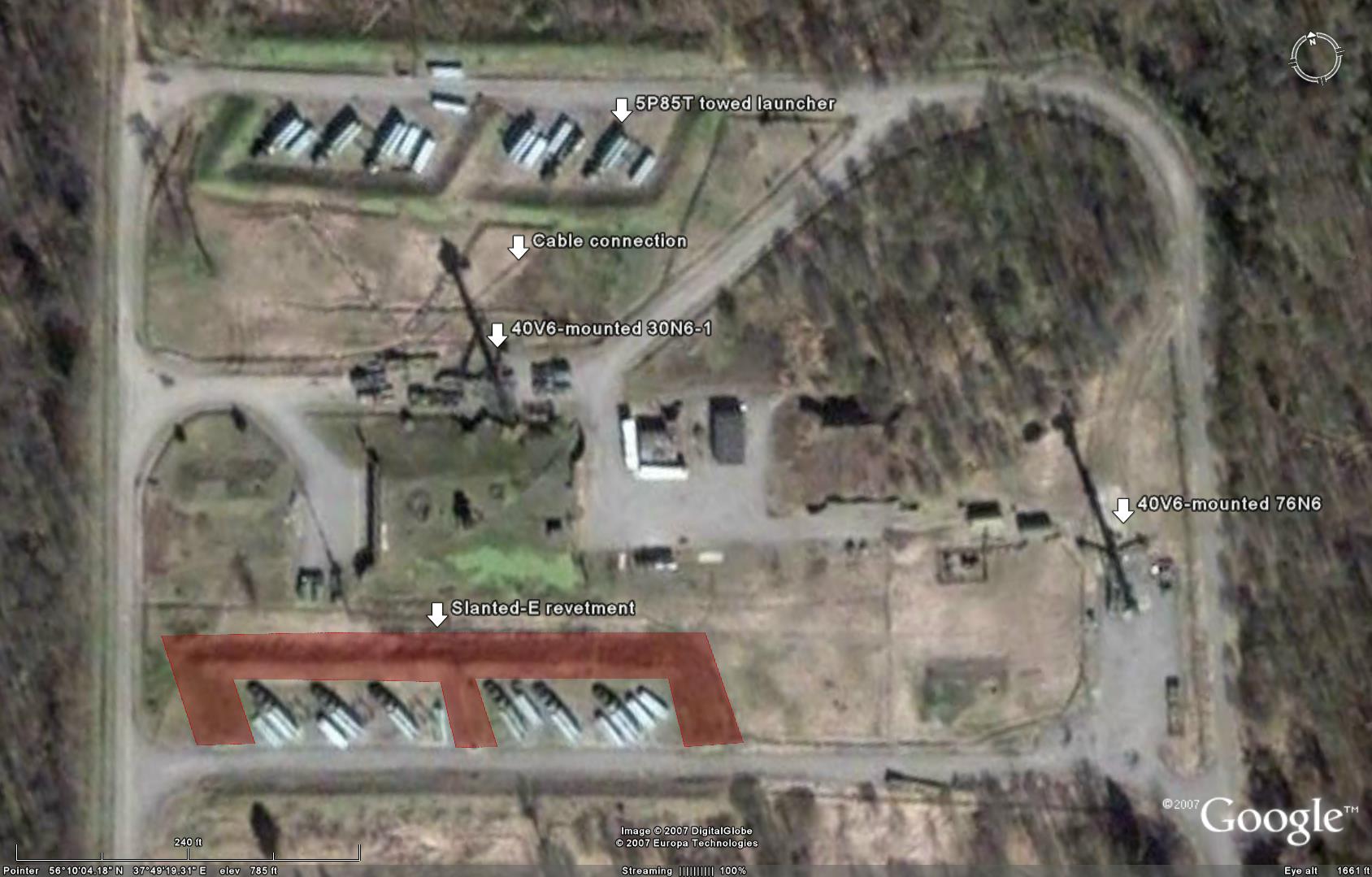
Yukon’s display showed several Growler SAM’s in their “slanted-E” revetments. He was about to confirm the target when he noticed something else—a skinny object standing up.

It was an Iskander “Stone” transporter erector launcher (TEL) in firing position.

The Iskander, also referred to as the SS-26, is a modern short-range ballistic missile system capable of launching missiles with conventional high-explosive fragmentation warheads, fuel-air explosives, bunker buster, and electromagnetic pulse payloads. Additionally, the Iskander’s maximum range of 310 miles makes it a potent system. But the Iskander’s most lethal trait is its ability to launch nuclear warheads with as much power as 50,000 tons of TNT.

In 2015, Russia began rotating its newest Iskander-M systems in Kaliningrad in response to NATO’s renewed commitment to Eastern European defense. Moscow may permanently deploy the missiles to Kaliningrad by the end of the decade. Also troubling, some NATO partners believe that Moscow is secretly stockpiling tactical nuclear warheads in Kaliningrad for use atop the Iskanders. The Kaliningrad deployments were a surprise as Moscow previously used threats to position these missiles in Kaliningrad as a bargaining tool to reduce NATO’s European missile defense deployments. Even though the Iskander is just a tactical missile system, its deployment in Kaliningrad has strategic implications for NATO attempts to “deflate” an A2/AD bubble there. With or without nuclear warheads, Kaliningrad’s Iskanders have the ability to strike an array of key NATO positions in the Baltics. Morever, the confusion whether an Iskander system is armed with conventional or nuclear payloads by itself could foul NATO’s crisis decision making.

40 minutes later, Yukon was just a couple miles away from “Banker,” a Dutch KC-10 Extender aerial refueling tanker aircraft. The joint USMC-Polish retaliatory strike had been called off as pressure from several NATO partners and other states forced the US to step back and resolve the crisis diplomatically. The Russian propaganda machine was in full swing, asserting that its Kaliningrad forces acted entirely in self-defense. Russian Deputy Prime Minister Boris Vorshevsky claimed that Zeus deliberately crashed her F-35B into the Russian Su-30 and that Kaliningrad’s military commanders had no choice but to launch “a couple” Oniks missiles when the “trespassing” US forces turned on their fire control systems. Vorshevsky’s comments were retweeted and broadcasted around the world.

Waiting to refuel from the Dutch tanker, Yukon reflected on how close he’d come to attacking Russian forces. All he could think about was that he’d back up flying a CAP the next day and who knew what the Russians had in store tomorrow.

Again, this scenario is fictional and some liberties were taken for narrative purposes. As well, the reality of such a scenario unfolding would be even more complex, especially in the political domain. But the point that US forces will struggle to maneuver in new European A2/AD bubbles is unquestionable.

“Popping” Russia’s European A2/AD bubbles wherever they may be established is ultimately a tough challenge without easy answers for NATO. Purely surging an overwhelming amount of force into the bubble is simply not feasible due to resource constraints and the risk that Russia would respond with tactical nuclear weapons. However, by making its forces more survivable, the US and NATO allies can naturally degrade the potential effectiveness of Russia’s A2/AD zones and establish some credible level of conventional deterrence.

There are examples worth considering for inspiration, such as the US Navy’s Naval Integrated Fire Control-Counter Air (NIFC-CA) capability. NIFC-CA is a US Navy concept using an array of advanced data links to transform a carrier air wing and carrier battle group into a larger network of distributed ‘sensors’ and ”shooters.” Created to counter the air-breathing threat elements of Chinese A2/AD in the Asia-Pacific, NIFCA-CA is a redundant, “networked-enhanced” system capable of functioning even if a handful of sensors are neutralized or jammed. Essentially in NIFC-CA, every aircraft and destroyer is linked directly to each other to make the force more survivable.

A NIFC-CA-like capability scaled for the European theater is a crucial step for defeating Russia’s European A2/AD bubbles through neutralizing air-breathers and broadly enabling more effective air operations. Simply, NATO cannot expect to conduct SEAD, CAS, or other types of air operations to ‘pop’ Russia’s A2/AD bubble without removing the air-breather threats. Although critics rightfully point to Russia’s advanced EW capabilities (as demonstrated in the Ukrainian conflict) as a key challenge, this only reinforces the need for NATO to invest in a more networked, resilient force.

The “NATO Integrated Fire Control-Counter Air” concept must be service agonistic (e.g., not just a Navy concept, but inclusive of Air Force assets as well) as conflict in the European theater will not solely revolve around the carrier air wing; the appropriate air, naval, and relevant ground platforms should be incorporated. Furthermore, this integrated fire control concept must include the systems of non-US NATO members. In Europe, the US has partners—some of which are positioned within Russia’s emerging A2/AD bubbles—with platforms already in place that can provide immediate support. Challenges associated with information assurance, interoperability, and 5G-to-4.5G communications make developing a ‘common datalink’ a difficult task, but one that is crucial to maximize the effectiveness of NATO’s air assets.

Whether it is turning an American US Air Force F-15C/D, USMC F-35B, or Polish F-16 C/D into sensors and shooters networked directly with each other, a ‘NATO IFC-CA’ would diminish the potency of Russia’s A2/AD zones. But ultimately, Russia’s new way of operating in Europe requires the US and NATO to increase their investments in the appropriate capabilities, hone joint multinational operations through regional exercises, and most importantly, assess how their current strategy, doctrine, and tactics match up against this evolving threat.

Bret Perry is an analyst at Avascent, an aerospace and defense consulting firm. The opinions and views expressed in this article are those of the author alone and are presented in his personal capacity. They do not necessarily reflect those of any organization.

The author would like to thank August Cole, Dominik Kimla, Alex Chang, Steve Ganyard, Jacqueline Phan, and Cate Walsh for their advice and comments.

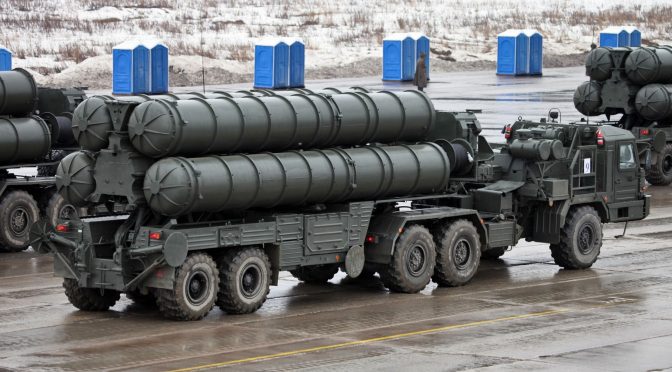
Featured Image: S-400 Triumf air defense systems from Russia (defencetalk.com)

Members’ Roundup: July 2016 Part Two

By Sam Cohen

Welcome to Part Two of the July 2016 members’ roundup. Throughout the second part of July, CIMSEC members examined several international maritime security issues including joint Russian and Chinese military exercises in the South China Sea, the Royal Canadian Air Force’s procurement options for a new search-and-rescue aircraft, the relationship between free trade and security dynamics in the South China Sea, Russia’s offer to fulfill India’s tender for a multirole nuclear aircraft carrier, and Germany’s evolving military and strategic priorities. Read Part One here.

Kyle Mizokami, for Popular Mechanics, reviews the U.S. Navy’s failed Harpoon anti-ship missile test during a sinking drill at the RIMPAC 2016 multinational naval exercises. During the sinking operation, the littoral combat ship USS Coronado launched a Harpoon 1C missile at the retired frigate USS Crommelin, which was 20 miles away. He explains that that the Navy is investigating why the missile was lost from radar contact and never impacted the target ship. The missile exercise reflects the Navy’s continued testing of various missile systems in an attempt to update and improve the fleets’ surface-to-surface warfare capability. He notes that the Navy will likely adopt the Long Range Anti-Ship Missile (LRASM), Norwegian Naval Strike Missile or the Harpoon Block II+ as the next-generation surface-to-surface combat missile for the fleet’s surface ships.

Sam LaGrone, for U.S. Naval Institute News, discusses the upcoming joint Russian and Chinese military exercises set be conducted near the South China Sea in September. Joint Sea 2016 follows last years joint exercise – Joint Sea 2015 II – held off of Russia’s Pacific coast in August, where over 20 ships from the two navies conducted joint training that included anti-submarine warfare, live fire drills, air defense training, and a 400 marine amphibious landing. He adds that in addition to last year’s Pacific drills, joint exercises were also conducted in the Mediterranean Sea, while cooperation in the Black Sea region was also apparent with two Chinese frigates visiting the Russian Novorossiysk naval base stationed near Crimea.

Harry Kazianis, at The National Interest, discusses China’s imminent response to the South China Sea arbitration ruling in relation to the upcoming G-20 Summit Beijing is set to host on September 4-5 in the city of Hangzhou. He suggests that leading up to the summit Beijing will limit contentious actions in the South China Sea as to not risk any drama at the gathering of world leaders or risk positioning themselves where losing face during the summit’s proceedings is a possibility. He adds that China may be timing their next major South China Sea move for the post-summit months when the soon-to-leave Obama administration will be uninterested in jumping into an Asia-Pacific crisis in addition to the U.S. public being preoccupied with developments in the American election cycle. He notes that if China were to declare a South China Sea Air Defense Identification Zone (ADIZ) or start reclamation work at Scarborough Shoal, the U.S. will be unlikely to have the political unity or willpower to respond effectively to Beijing’s actions.

Paul Pryce, for the NATO Association of Canada, provides an analysis on the three aircraft the Canadian government is considering for procurement as the country’s new Fixed-Wing Search and Rescue (FWSAR) aircraft – the C295W from Airbus Defence, the C-27J Spartan from Alenia, and the KC-390 from Embraer. The search for a new SAR aircraft to replace the country’s aging CC-115 Buffalo fleet has been ongoing since a Request for Proposal (RFP) was released by Public Services and Procurement Canada in 2002. He explains that each of the aircraft being considered are similar enough in size and design to the CC-115 Buffalo that it would not be difficult for Royal Canadian aircrews to adapt to operating them and that each plane has significantly greater range and payload capacity than the Buffalos. He adds that these capability improvements will be especially beneficial for search-and-rescue operations in the remote northern regions of Canada.

Robert Farley, for The Diplomat, examines India’s pending decision of whether to accept or not to accept Russia’s offer to construct a multirole nuclear aircraft carrier for the country’s Navy. He explains that very few countries have the capacity to build a modern, nuclear aircraft carrier, and that there are few countries willing to export such technology. He also adds that Russia has played a major role in India’s naval aviation program having modernized the INS Vikramaditya, and having supplied the Indian Navy with carrier aircraft. Russian shipbuilders and military planners are likely familiar with Indian Navy carrier needs and specifications. From the opposite perspective, he argues that Russia’s lack of recent nuclear propelled surface vessel construction should deter India from awarding Russia the contract. He adds that if India were to rely on an export option for its next carrier (INS Vishal), it risks losing the shipbuilding expertise and capacity that it has begun to develop with the construction of the carrier INS Vikrant – a capacity that is critical for India’s long-term maritime interests.

Members at CIMSEC were active elsewhere during the second part of July:

At CIMSEC we encourage members to continue writing either here on CIMSEC or through other means. You can assist us by emailing your works to dmp@cimsec.org.

Sam Cohen is currently studying Honors Specialization Political Science at Western University in Canada. His interests are in the fields of strategic studies, international law and defense policy.

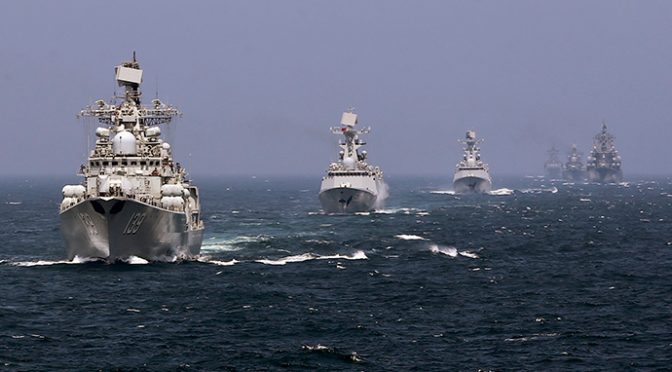
Featured Image: Chinese and Russian naval vessels participate in the Joint Sea-2014 naval drill outside Shanghai on the East China Sea, May 24, 2014 (Reuters / China Daily)