Tag Archives: drones

The Future of Sea-Air Drones and Protecting Maritime Assets

By Jack Whitacre

What are some of the ways the U.S. and other countries could defend maritime assets against swarms of Sea-Air drones? Consider a convoy system with human centered technology, algorithms from nature, and elements of gaming.

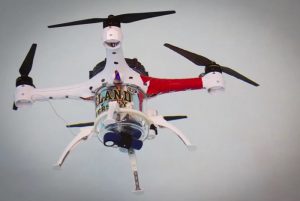
Loon-Copter-Drone
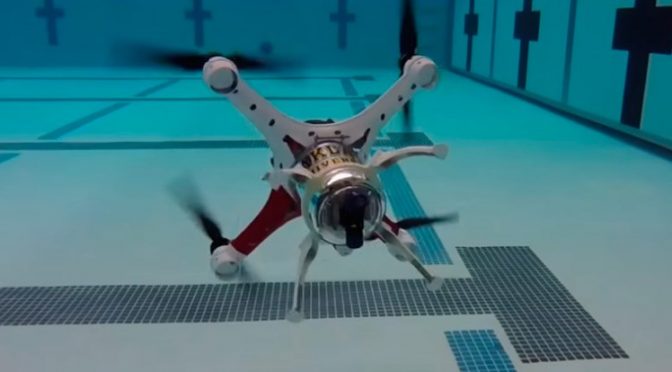
Oakland University’s Loon Copter works equally well above and below the water’s surface. Photo: Oakland University

The FAA estimated that one million drones would be sold during this 2015 holiday season. This estimate was based primarily on the proliferation of flying drones, however new domains of operation may open up soon. Premiering in 2015, the Loon Copter proves that, in time, these devices will be capable of traditional aerial flight, on-water surface operations, and sub-aquatic diving. Embedded Systems Research at Oakland University created the Loon Copter in 2014. In 2016, the design placed third in the UAE Drones for Good competition. The system works in air as well as in water because the four rotors balance and cut through air and water equally well.  

dronemap1
A map of nations with a drone program as of 2011. Courtesy Defense One, via RAND Corporation.

According to the New America Foundation, at least 19 countries possessed or were acquiring armed drone technology as of 2015. The Washington Post and The Aviationist reported in July of 2014 that even non-state actors like Hamas have manufactured drones capable of firing rockets or missiles. At the time of reporting it was unknown whether this specific group had the ability to launch missiles, but the story does show the willingness of non-state actors to weaponize technology. The same Washington Post article describes how low-tech “suicide” drones effectively function as guided missiles. With the history of state actors increasingly acquiring armed drones and non-state actors weaponizing drones, Sea-Air drones could open new realms of battlespace.

“The profound influence of sea commerce upon the wealth and strength of countries was clearly seen long before the true principles which governed its growth and prosperity were detected.” –Alfred Thayer Mahan 

Sea-Air drones are not currently available off the shelf, so their ramifications are not yet recognized. If non-state or state actors designed suicide drones with sufficient range, it would be very difficult to defend global maritime trade against these threats due to the sheer size of the oceans. The Canadian Military Journal hypothesized that it is only a matter of time before pirates use drones offensively. Articles like these contemplate an important issue, but are limited by only considering the skies. Currently, our ability to detect air drones far exceeds capabilities to detect devices beneath the surface of the ocean. Even by diving ten or fifteen meters beneath the surface, Sea-Air drones may be able to elude satellites. NASA’s Ocean surface topography site describes how the best satellites measuring ocean temperature pierce only one inch below the ocean’s surface.

Shrouded by shadowy depths, would-be aggressors could potentially take down or ransom large freight vessels and trade flows that are so essential to many countries’ survival. According to Rose George in Ninety Percent of Everything,” nearly 90% of goods are transported by sea. The stakes are high and the arena is huge. While it’s unlikely that every inch of the sea will become a combat zone, NOAA estimates that there are nearly 321,003,271 cubic miles of water in the world’s oceans. To this end, DARPA is re-thinking distributed defense by creating small aircraft carrier cooperatives. In the face of such a large and deep strategic chessboard, what are some of the ways the U.S. and other maritime nations could defend shipping from Sea-Air Drones? One option would be to revive the convoy system. The tipping point for such a decision may have to unfortunately be a tragedy with lives lost at sea. By contemplating these scenarios now, we could build in defenses before deaths occur.

“When [the enemy] concentrates, prepare against him.” –Sun Tzu

The cost of drone technology, like other innovations, continues to decrease; beginners models are available for less than $100. As this trend is likely to also occur in the maritime arena, it would be wise to match high-value vessels with an accompanying group of friendly Sea-Air drones offering constant defensive protection. In other words, a convoy must have the ability to destroy or electronically neutralize attacking drones. A ship with a 24/7 security presence would likely be safer than standard battle group coordinated operations. This is because there are simply too many ships at sea at any given time to protect them all through traditional means. The International Chamber of Shipping estimates there are least 50,000 merchant ships plying the oceans at any given time. Having constant convoys would reduce vulnerability amidst the uncertainty of when, where, and how an enemy might attack.

These convoys could be combinations of complex programmable drones capable of truly autonomous decisions and human operated systems. The most successful formations might be inspired from millions of years of evolution and derived through phenomena like flocks of birds and schools of fish. In such swarms it would be possible to make a human operator the “lead,” balancing machine autonomy with human decision-making. To this end, P.W. Singer and August Cole’s futuristic Ghost Fleet novel describes human helicopter pilots flying missions in conjunction with drones. The video below shows many different formations that could be programmed for swarms.

In order to recruit talent, the defense community might consider incorporating crowd-sourcing and gaming to meet increasing demands, at least until convoy defense systems can function in fully automatized ways. Pilots could be given a convoy interface (like Eve Online) and point systems tied to real world rewards to incentivize behavior. With this approach, the U.S. could capitalize upon large reserves of talent to protect trade, coasts, and even fishing vessels. This is merely an opening suggestion. There would, of course, be clear difficulties with such a strategy, such as ensuring a clearance system, similar to that of the Merchant Marine, payments to operators, and contract stipulations surrounding the use of force. However, the proliferation of third-party defense contracting proves that new types of defense arrangements can be made quickly in the face of emergent threats.
 
It may be many years before Sea-Air drones, suicide drone piracy, and other forms of maritime threats emerge in full force. However, there are already clear modes of attack and high valued targets. The future may be hard to predict but that shouldn’t it preclude it from strategic thinking.  

Jack Whitacre is an entrepreneur and former boat captain who studied international security and maritime affairs at The Fletcher School of Law and Diplomacy.

OK, Explain Again Just Why the American Taxpayer Should Pay For All This (Series Finale)

CIMSEC content is and always will be free; consider a voluntary monthly donation to offset our operational costs. As always, it is your support and patronage that have allowed us to build this community – and we are incredibly grateful.

Select a Donation Option (USD)

Enter Donation Amount (USD)

OK, Explain Again Just Why the American Taxpayer Should Pay For All This

This article, the sixth of the series, presents reasons why Congress and the American taxpayer should pay for all the drones, buoys, railguns and the additional necessary ships to deploy them at sea introduced earlier in the series. Some of the justifications briefly discussed below are sure to be familiar to the reader, some less so. In either event, please feel free to mentally rearrange them according to your own priorities. Read Part One, Part Two, Part Three, Part Four, Part Five

Expensive Assets

These are not inexpensive assets that can be squeezed into the Navy’s spending plans somehow. With a likely cost of $3 billion plus for the CVLN and CARN classes, less the cost of at least one, possibly two DDGs that a CARN replaces in a carrier task force and $2 billion plus cost for an AORH, Congress and the American taxpayer are going to have to be persuaded to purchase these as additional assets for the Navy. So why should they do so?

Deterrence

Adding large quantities of ISR and ASW drones along with a dozen, or more, railguns as a matter of routine will provide a credible defense against the increasing A2AD threat the Navy faces. Presenting a potential adversary with overwhelming force in a potential area of conflict is a time proven technique for preventing conflict and promoting dialogue. It should also be noted that while these additional assets are expensive, combined they are still less than half the construction cost of just the CVN being protected, much less the air wing embarked aboard.

Protection

For CVNs

Much of the surface warfare assets the Navy possesses are routinely dedicated to protecting other critical ship classes and their embarked sailors. The CVNs operating in their dedicated task forces normally find themselves free to go where they please given the protection against air, submarine and surface threats the surrounding ships provide. Adding a CVLN and a CARN to this operating procedure is simply adding to a proven recipe by countering the increasingly formidable A2AD assets other nations are steadily acquiring.

For amphibious assaults

The Marine Corp routinely catches a ride on an ARG provided by the Navy. Most of the time there is no need to provide the extra protection provided by the suggested new ship classes. Come the big moment though, both during the few days leading up to and then during an amphibious assault placing a CARN, an AORH and a Zumwalt class destroyer between the opposing forces ashore and the ARG can very substantially improve the chances of success and measurably lower the anticipated casualty rates amongst the Marines making the landing. By providing substantial ASW assets in the coastal waters involved, numerous ISR and target spotting assets from the AORH, formidable fire support abilities from the CARN and Zumwalt and substantial anti-missile, rocket or artillery shell protection courtesy of the twelve railguns the new ship classes will significantly improve the Navy’s ability to support an amphibious invasion. Plus the Marines making the ride ashore will be able to start from just over the horizon thanks to the presence of multiple targeting drones and railguns instead of the much discussed fifty mile seasick inducing slog currently anticipated.

Ally reassurance

Protecting the carrier strike groups also means reassuring our allies that we will be able to fulfill the defense commitments we have made, particularly in the Western Pacific. However, building and deploying the means to allow the fleet to go where it wants is a globally useful capability, allowing the U.S. to confidently assert it will be there in time of need.

Multi-polar world

We live in a multi-polar geopolitical structure. China, Russia, India, Europe, the Gulf States, Brazil and others already are jostling with the U.S. for influence and trade. Including a China who already is in some respects, and will remain our economic equal in world affairs. This economic equivalence is something the U.S. has not had to deal with since our enormous industrial expansion in the last three decades of the 19th Century. We need to refresh our thinking with some of the concepts that worked well for us as we dealt with Great Britain, the existing economic power back then.

That said being a rival is not the same as being an enemy. There certainly are many areas where the U.S. and China will find ways to cooperate to our mutual benefit. We are certain to jostle each other though, especially in China’s immediate area as that proud civilization looks to ‘put things right’ after their many difficulties of the last two centuries. As mentioned above, we want to deter everyone in the area from using violence to bring about change, instead encouraging patience while the various nations involved discover mutually acceptable adjustments via discussion.

Playing defense to maintain the world as it is

There are other issues that come with being in a multi-polar world. In the new global circumstances the U.S., and the Navy in particular, need to execute defense, and first things first, keep our ships afloat. Something we have not had to overly concern ourselves with since the demise of the Soviet Union or the destruction of the Imperial Japanese Navy in the 1940s. Increasingly we will no longer be able to exercise the freedom of the seas and engage in whatever activity we want, whenever we want to. Russia is already building a submarine and long-range bomber force to potentially contest our passage. Others, China in particular, will be able to invest steadily increasing resources in military assets that make sense for their geo-political situation. Investments that mean the U.S Navy may have to fight our way across the North Pacific or North Atlantic before we commence operations at the location of our choice.

Hawaii has to eat

Our geography as a nation includes Hawaii, control of which easily translates into the control of the bulk of the Pacific Ocean. Yet Hawaii is a series of islands, thousands of miles from the mainland with a population of 1.4 million. Again, the change to a multi-polar world means we have to give thought to just how we can ensure the population on the islands can eat when trouble arrives. Russia already has the submarine assets needed to threaten mining or torpedoing ships crossing the North Pacific. Obviously the naval assets based at Pearl Harbor and the West Coast should be able to prevent that. However, we can no longer just take it for granted. The Navy needs to consciously add this to its long list of missions to accomplish.

The same issues apply to Guam, though the much smaller population can be fed by air if necessary, which means the mission is more one of being able to get our needed fuel and ammunition supplies delivered. Once more, the local air and naval forces should be able to ensure it happens. This is an area where the rise in China’s capabilities means we cannot take free passage for granted there either.

Maritime Commons

Protecting the global commons to ensure free passage of American trade was one of the primary reasons the U.S navy was originally built in the 18th Century. The need, a global need in the 21st Century, continues unabated.

Blockade

Occasionally over the years the U.S. has chosen to impose a blockade during a dispute. This is a capability, or more importantly for our relationship with China, a potential capability that we need to maintain. And the world needs to be reminded of on occasion.

Protection

As many others have noted over the last few years, a British citizen in the 19th Century could travel the world secure in the realization that the local government, regardless of whether it got along well with London or not, was not going to antagonize Britain by harming, or allowing to be harmed, the traveling Brit. A benefit that transferred to American citizens as a result of our overwhelming victory in 1945.

Unfortunately, in growing numbers of places in the world this benefit no longer exists due to the inability of many local governments to provide law and order within their borders for anyone, much less wandering Americans. This means that the U.S. Navy and Marine Corp have to face the reality that just as in the ‘olden days’ of the 18th and 19th Centuries, they are on call to provide basic protection to Americans all across the globe.

Rescue

The need for the Navy and Marine Corp to provide rescue service as needed has never gone away. And given the monotonous regularity of severe weather events, civil disturbances and the endless list of troubles that arise, this is certainly not going to change.

AORH uses

The AORH class suggested earlier in this series of articles was quite consciously designed to be capable of taking on some of the responsibilities, new and old, mentioned above. First among these was to be flagship capable, coupled with the resupply abilities and the substantial ASW and special forces capabilities built into the design.

These abilities are capable of being useful undertaking missions beyond the obvious applications in the Gulf, South China Sea and Northeast Asia. In addition, an ice-strengthened version of an AORH is very well suited to leading a small task force of frigates on ASW duty in the Arctic. It can also be used as the centerpiece for an old-fashioned hunter killer group prosecuting submarines or to provide transoceanic convoy protection in either the North Pacific or North Atlantic.

Current Political Impasse

As for the likelihood of persuading the current Congress to pay for this the Navy needs to be frank. The additional spending being asked for here are additional dollars for additional capabilities. Beyond some small incremental steps, most of the needed dollars will not fit inside the spending limits in place over the next few years. It is intended as a long term plan, to be funded as a recovering economy allows, with the big ticket items being built starting in the 202os and extending into the late 2030s.

For the economy is slowly growing and just as importantly the deficit is in notable decline. There are multiple reasons for this and there is good reason to believe they will continue to positively impact the deficit. A growing economy, the impact fracking is having on energy production, the beginning of the return of some manufacturing to North America from China due to higher wages there, the fact that Medicare costs are much less onerous than forecast five years ago, Obamacare is not costing nearly as much as feared when it was passed, and ending the Bush-era tax cuts are having a real impact on the actual deficit as well as on the, far larger, feared one.

So the enormous fear factor that was driving the deficit reduction hawks back in 2010/11 is in the process of dissipating, being replaced with some truly old-fashioned value driven politics. It is important to note that the Republic has been down this road before. After both the Revolutionary War and the Civil War Congress chose to slowly bring down an enormous deficit by running small annual surpluses. In essence, some variation of this strategy, regardless of how fiercely you espouse the ‘value’ part of balanced budgets, is what we are going to have to do as we deal with the left over Cold War debt and the enormous additional debt load piled on post 9/11 and due to the Great Recession.

Die Hard Yankee Frugality

Or depending on one’s viewpoint, good old-fashioned small town frugality, skinflints, True Blue small town values defending America from corrupt Big City mentalities, etc. The reader should feel free at this point to insert the variation(s) he hears most often where he lives. This cultural attribute came to the New World with the Pilgrims and remains a vigorous part of American culture. It has not, and will not be, departing from our political discussions. Or budgeting decisions.

So, how should we address those who hold this belief? In my experience, when trying to influence or alter decisions made by those operating from this position, argument and persuasion can work. If. Actually two ifs. Big ones. First a resolution to the revenue versus budget issue forcing hard choices has to be visible to the individual you are working with. And it is they that have to see it; regardless of how obvious it is to you, they are the ones that have to see, understand and agree. Then you need a plan dealing with anticipated results and consequences that you can clearly articulate, including how you will execute the plan, deal with the known potential problems and be convincing about being able to complete the task on time and most importantly, within the agreed upon budget.

Mid-America Teary-Eyed Balanced Budget Goodness

Across much of interior America another strong cultural value, the Intrinsic Goodness of Balancing Your Budget also accompanied some of the earliest English settlers of North America. Over the centuries this value has also been passed on to succeeding generations over family dinner tables, political discussions at the local diner or at the town’s barbershop. The at times teary-eyed value some of it’s current believers place in it can be almost moving to observe by someone who considers it merely another number. Plus, minus or zero each have meaning, yet no particular cultural Goodness.

To the True Believers amongst us it constitutes one of life’s bedrock values though. And it is not departing the American political scene either. Which means it will strongly impact budgeting issues far into the future as well.

However, unlike those professing Yankee Frugality, True Believers are virtually impervious to discussion and argument. Sometimes they will patiently listen to you and your points, still no matter how cogent and persuasive one might be, True Believers, once they start their decision making process, will cycle back and check your argument against various values and beliefs they hold. And if they find your argument in conflict with one of their values, for the purposes of this article, the Intrinsic Goodness of Balancing Your Budget, your suggested plan will be rejected.

Any additional information you might provide tends to ultimately provoke something along the line of this real life quote. “You are just trying to confuse me with facts,” responded one individual a few years ago. Global warming was the topic that day rather than the budget and the end result was, “I have my faith (in the rightness of their belief – not really a conclusion, a belief) and I will not change my position.”

This attribute is very much in play when discussing the current budget situation. Unfortunately it is, in my experience anyway, impervious to analysis and discussion. All those carefully honed arguments and points of persuasion potentially useful when speaking with those convinced of the value of frugality will only be considered by True Believers after the budget is balanced. Maybe.

Their faith in the correctness of the uttermost value of balanced budgets can be trumped by another value however. Not by many though, as it ranks high in their pantheon. Historically of course the value to use was the need for defense. Whether national defense from other nations, personal defense against crime or terrorism or preserving orderly and lawful procedures when discussing social issues, over the decades this has proven an effective approach.

Unfortunately the current spending debate has been embroiled in the revolt of a significant number of voters, primarily though not entirely, conservative Republicans, over the blatant abuse of this trump value during the second Bush administration. Vice President Cheney was incorrect when he claimed there were no electoral consequences to running vast deficits. There are, both economic and political, a truth that is not going away.

A significant portion of their political base could, and did for a while, accept the national defense against terrorism argument after 9/11. However subsequent failures to control Federal spending, under a Republican President, Senate and House no less infuriated them. Fury then became something close to horror after the Salomon Brothers debacle unleashed a need for massive federal deficits to restore the economy.

So after years of serious abuse of the national defense trump value, its use with those who fervently believe in the Intrinsic Goodness of Balancing Your Budget has been heavily invalidated. For a significant portion of the American electorate the call for a return to this basic value remains a hot button issue. It is five years on from the revolt that took place in 2010 and the fury and horror seem to have been replaced with a grim resolve to never allow spending to run out of control again. And balance the budget.

This implies, barring a serious political change in the House in a future election year, we may well have to wait for the sanctified day when the Federal government takes in more revenue than it spends before any substantive increases in spending, or allocations for substantial new abilities for the U.S. Navy can be expected.

In all likelihood this means it will not be until sometime in the 2020s before much of what has been suggested in terms of shipbuilding, i.e. the new AORH, CVLN and CARN class ships and large quantities of the associated drones and buoys, can obtain the political support needed for the substantial sums needed.

Count Our Blessings

It is always useful to Count Your Blessings though. The bulk of the resistance in Congress is to additional spending, with no more than the usual amount of Congressional meddling in the details of departmental, including DOD, spending. Just figure out a way to get things done within the dollar amount allotted is a frequently expressed desire by many in the House.

Nor is there any value based or carefully analyzed opposition to new equipment programs from any of the services. So while the suggested ship classes and drones will provoke a fierce defense of spending limits, there is no reason to anticipate Congressional opposition to the new equipment if the Navy develops a coherent plan including them. As suggested above in all probability the big items will not be affordable until sometime in the 2020s, nonetheless if the items are part of a long term acquisition plan it will merely be a question of waiting for funds to become available rather than overcoming fierce opposition to the plans and equipment.

So have a long-term plan in place

This means the U.S. Navy needs to have that forward looking plan in hand, constantly being updated as various improvements in doctrine, sensors and drones are developed. And be ready when additional funds become available, rice bowl pointed upwards as the saying goes. Whether the motivation to Congress is a perceived problem somewhere across the globe, the occasional Congressional compromise over something or other that includes extra funds for some department, a call for ‘shovel ready’ projects when recessions hit, or the slippery processes of logrolling; having a plan in place will allow the extra funds to be applied far more beneficially to the Navy’s, and the countries, benefit than a haphazard purchase of a few more of this and that.

Honor the Premise

In the end though, funding for the U.S. Navy, and all other Federal government departments, is only going to grow as fast as the economy. Which will happen, meaning any plan including the suggestions made in this series of articles will have to be implemented over a period of many years. Into the late 2030s or mid-2040s before the last of nine ship CARN build for instance. The early 2030s for eleven AORHs and the same for a six ship CVLN build are also reasonable build out expectations at this point.

Clearly the time to start to work on such a plan is now.

Jan Musil is a Vietnam era Navy veteran, disenchanted ex-corporate middle manager and long time entrepreneur currently working as an author of science fiction novels. He is also a long-standing student of navies in general, post-1930 ship construction thinking, design hopes versus actual results and fleet composition debates of the twentieth century.

Sea Control 92 – Autonomy

seacontrol2Weapon autonomy is a broad term around which swirls an incredible amount of debate. Paul Scharre, Michael Horowitz, and Adam Elkus join Sea Control to discuss the nature of autonomy, how to imagine its use in an operational environment, and how to think of the debate surrounding it.

DOWNLOAD: Sea Control 92 -Autonomy

Music: Sam LaGrone

CIMSEC content is and always will be free; consider a voluntary monthly donation to offset our operational costs. As always, it is your support and patronage that have allowed us to build this community – and we are incredibly grateful.

Select a Donation Option (USD)

Enter Donation Amount (USD)

Surviving the Fabled Thousand Missile Strike (Part Five)

Surviving the Fabled Thousand Missile Strike

CARN class jpeg

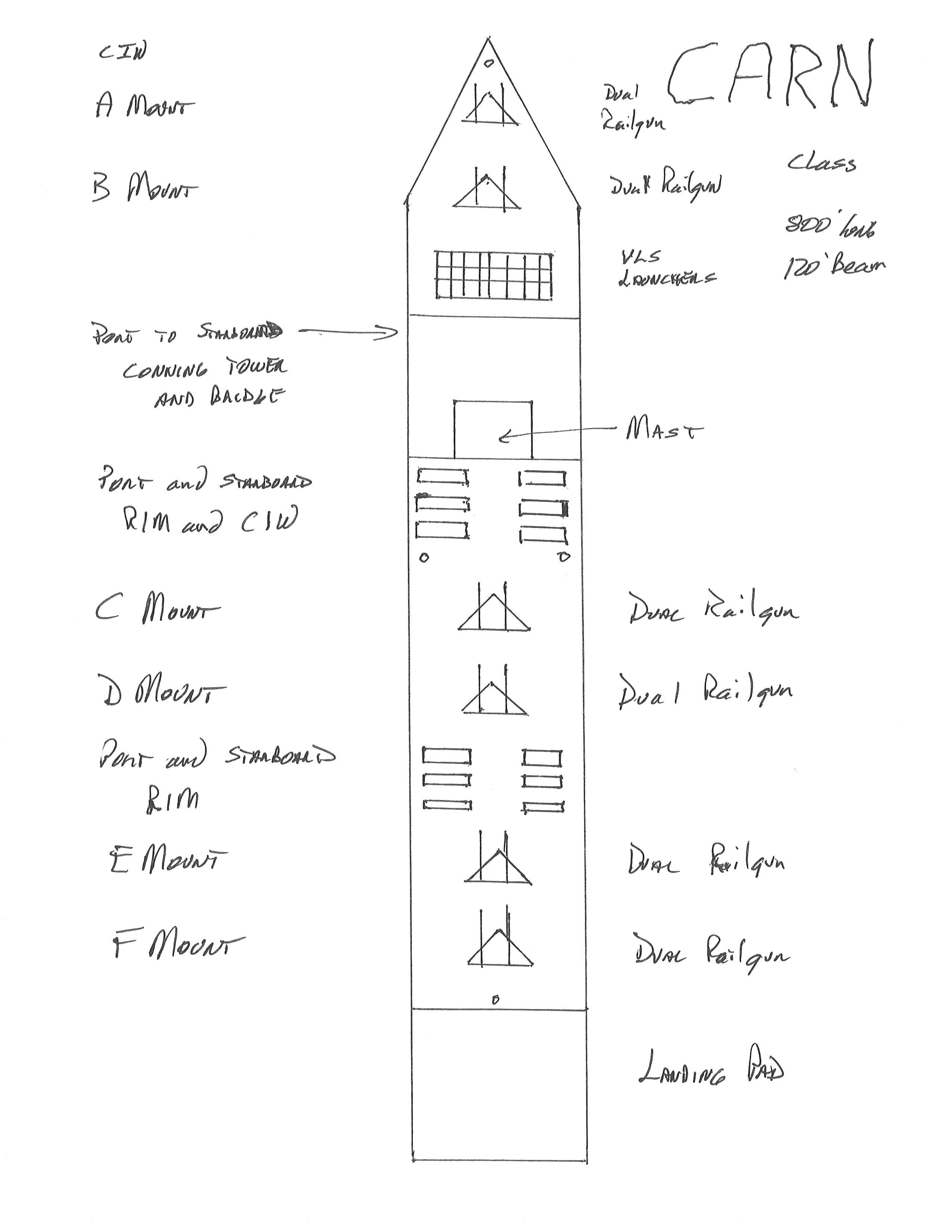
Sketch by Jan Musil. Hand drawn on quarter-inch graph paper. Each square equals twenty by twenty feet.

This article, the fifth of the series, examines how fitting lots of drones, of all types, and large numbers of railguns, aboard a CVLN and either one or two CARNs, can allow the U.S. Navy to confidently ride out the fabled thousand missile strike from the mainland of Eurasia. To do so let’s walk through a possible exercise involving Red, a Eurasian mainland power and Blue, essentially a typical Western Pacific carrier strike group. Read Part One, Part Two, Part Three, Part Four.

Red’s motivation might be ensuring that Blue cannot interfere with, or arrange for reinforcements to reverse, an offshore invasion. An alternative, somewhat more likely though, is that Red is intent on challenging one of Blue’s friends or allies and finds that it cannot achieve its objectives without removing Blue’s powerful naval forces from the area. When threats and warnings do not result in a satisfactory result, Red’s leader authorizes a massive missile strike on Blue’s carrier strike group at sea. This missile strike will be an attempted TOT (time-on-target) strike where all the missiles launched, regardless of distance to the carrier strike group or their speed, i.e. a combination of subsonic and hypersonic missiles, will arrive within a five minute window at the target location. The strike will primarily consist of land-based missiles, but some of Red’s numerous submarines will attempt to participate as well, for the purposes of this exercise it is assumed 29 missiles launched from three different submarines will arrive on target within the five minute TOT time period. Red’s commander has elected to hold his meaningful, though not massive, long-range aircraft striking power in reserve, hovering in a threatening position but not immediately participating. Thus a total of 1,029 missiles are launched.

This exercise assumes that Red can coordinate the command and control challenges involved in such a large undertaking. It also assumes that Red possesses adequate space based surveillance capabilities that real time targeting information down to the nearest kilometer, or better, is available on a timely basis to the relevant land, air and submarine commanders.

It should be emphasized here the importance of the compressed TOT portion of Red’s attack plan. Any incoming missiles, whether land or sub launched will be far easier for Blue to defend against if straggling in before or after the massed attack. This advantage of Blue’s is magnified by the presence of the railguns with their enormous magazine size and the ability to fire every five seconds.

It is assumed that Blue’s carrier strike group consists of:

1 CVN

1 CVLN

1 CG (Ticonderoga class)

1 CARN

4 DDG (Arleigh Burke)

4 FF (the new ASW frigate under development)

2 squadrons of F-18s

6 EA-18G Growlers

1 squadron of F35s

1 squadron of strike drones

15+ ISR drones

4 E-2D Hawkeyes

2 S-3 Vikings

6 refueling drones

15+ Fire Scouts

10+ Seahawks

75+ buoys with UUVs or a dipping sonar installed and a radar/infrared lure

Blue’s carrier strike group commander has taken full advantage of the ASW capabilities provided by all the Fire Scouts and buoys, spreading the strike group out over a thirty mile radius in a preplanned dispersal strategy. The commander has also been successful at maneuvering the strike group into a position where there are no Red submarines within at least 30 miles, and it is believed (or hoped) by Blue’s commander that the strike group is at least 50 miles from the nearest Red submarine.

Blue also possesses space based surveillance capabilities and is able to provide Blue’s carrier strike group a twenty minute warning of the incoming attack. Blue’s commander selects one of his preplanned spatial deployment plans, concentrating the majority of his surface assets in a compact zone with the CARN taking position and turning its broadside closest to the incoming missile strike, three of the four DDGs some distance behind it, then the CG and two of the frigates, then the CVLN and finally the CVN. One frigate is so far off on the periphery on ASW duty that it will fire chaff rounds repeatedly during the attack and hope the handful of aircraft overhead and many radar lures dropped in its vicinity will allow it to emerge unscathed. On the opposite side of the strike group one DDG and the fourth frigate will do the same, though with the added protection of the DDGs AAW missiles.

This dispersion plan means a large portion of the area where the strike group is located is simply empty ocean. The intent is to use the strike groups EEW and radar lures to effect and make thorough use of the fact that even a subsonic missile cannot maneuver quickly enough to search out targets if presented with enough empty ocean upon their initial arrival at the selected target location.

Blue’s commander has also chosen a specific plan for utilizing his air assets in a layered defense, intent on maximizing the effectiveness of the various weapon systems embarked. Let us follow the resolution of the attack, starting with the outermost layer, and work our way inwards as the strike progresses.

Cap Layer

2 E-2D Hawkeyes and 12 F-18 Super Hornets

Blue’s strike group commander has assigned these air assets to anti-aircraft duty, approximately 250 miles from the strike group’s location. Since Red’s long-range bombers are known to be airborne, but apparently are not immediately participating, the decision is taken for these Super Hornets to hold their fire, confident that the rest of the strike group can deal with the incoming missiles, and continue to guard against any enemy aircraft that might intrude later.

Shot Down/Eliminated/Missed/Decoyed This Layer: Zero

SD/E/M/D Cumulative: Zero           Of 1,029 incoming missiles

ISR Drones Layer

8 ISR Drones

These eight drones are individually scattered in an arc 150 miles out from the strike group’s location. They are there to provide accurate targeting information, primarily for the SM-2 and railgun equipped surface ships of the strike group. In particular the presence of this arc ensures timely targeting information so the railguns can effectively engage at their maximum range of 65 miles.

SD/E/M/D This Layer: Zero 

SD/E/M/D Cumulative: Zero           Of 1,029 incoming missiles

Railgun Layer

13 railguns (12 on the CARN and 1 on the CVLN)

With the targeting information provided initially by the ISR drones and later by the various aircraft and AAW radars of the strike group the railguns will steadily engage at their maximum rate of every five seconds. Since it is unlikely that any particular missile, even subsonic ones, will not close the remaining 65 miles to the strike group before a second shot can be taken this exercise assumes each railgun will only fire once at any given missile.

Each railgun can fire every seconds, 60 seconds/5 = 12 shots a minute. Therefore over a five minute time period each railgun will get off 5 x 12 = 60 carefully aimed shots. 13 railguns x 60 equals 780 opportunities to hit an incoming missile.

This exercise will assume a 50% success rate for the railguns. Therefore 390 incoming missiles are eliminated.

SD/E/M/D This Layer: 390  

SD/E/M/D Cumulative: 390           Of 1,029 incoming missiles

SM Family Missile Layer

420 surface ship launched SM-2 missiles and 2 E-2D Hawkeyes operating approximately fifty miles out from the strike group’s location.

The CG (100) and four DDGs (80 each) in the strike group are assumed to have 420 SM-2 missiles available to fire in their collective VLS cells.

This exercise will assume a 70% success rate for the missiles. Higher success rates can easily be argued for, though there will be some unavoidable overlap with the railguns resulting in double targeting by some missiles. 420 x .70 = 294. Therefore 294 incoming missiles are eliminated.

SD/E/M/D This Layer: 294  

SD/E/M/D Cumulative: 684           Of 1,029 incoming missiles

Air Wing Layer

12 F-35s, 12 Strike Drones, 12 F-18 Super Hornets, 6 EA18-G Growlers, and 2 S-3 Vikings carrying 4 air-to-air missiles each = 176 AAW missiles

Blue’s air commander has elected to concentrate the bulk of his air assets close to the strike group. This allows the air commander to attempt to concentrate this groups AAW missiles in defense of the three zones occupied by the surface ships below. This allows more of the incoming missiles that have survived to this point but appear to be targeted on empty ocean to be ignored.

This exercise will assume a 70% success rate for the AAW missiles. Again, higher success rates can easily be argued for, though given the tight time constraints on pilots decision making some double targeting will be unavoidable. 176 x .70 = 123.2 rounded down to 123. Therefore 123 incoming missiles are eliminated.

SD/E/M/D This Layer: 123   

SD/E/M/D Cumulative: 807           Of 1,029 incoming missiles

Eliminated Due to Malfunction Layer

If everything always worked perfectly the world would be a much happier place. But things inevitably go awry and the incoming missiles are not immune to this problem. This exercise assumes a standard 5% malfunction rate. 1,029 x .05 = 51.45, rounded down to 51.

SD/E/M/D This Layer: 51     

SD/E/M/D Cumulative: 858           Of 1,029 incoming missiles

Missed Due to Dispersal Layer

The high rate of speed of the incoming missiles will sharply limit their ability to effectively search for a target if they happen to encounter one of the areas of empty ocean Blue’s commander has contrived. This exercise assumes, rather arbitrarily, a 5% missed rate, but empty ocean will certainly greet some of Red’s missiles. 1,029 x .05 = 51.45, rounded down to 51.

SD/E/M/D This Layer: 51     

SD/E/M/D Cumulative: 909           Of 1,029 incoming missiles

Decoyed Layer

The strike groups EEW capabilities, including the Growlers, all the strike group helicopters, Fire Scouts and over 75 buoys with various types of lures aboard can be utilized to great effect. This exercise assumes, rather arbitrarily, a 5% decoyed rate. It is tempting to select a higher rate, but to be conservative the 5% rate is used. 1,029 x .05 = 51.45, rounded down to 51.

SD/E/M/D This Layer: 51     

SD/E/M/D Cumulative: 960           Of 1,029 incoming missiles

Internal Rolling-In-Frame Layer

The CARN has six rolling-in-frame close defense missile launchers installed on each side of the ship. As Red’s surviving missiles reach the LOS horizon, these missiles engage those missiles targeted on the primary layered group of surface ships, which includes the crucial CVN.

This exercise will assume a 70% success rate for these missiles. 48 x .7 = 33.6, rounded down to 33. Therefore 33 incoming missiles are eliminated.

SD/E/M/D This Layer: 33    

SD/E/M/D Cumulative: 993           Of 1,029 incoming missiles

Last Ditch Layer

At this point the last 36 missiles of the original 1,029 are assumed to acquire surface targets and close on them. At this point the targeted ships individual CIW and close range missile defense provide a last ditch defense layer.

To be consistent, this exercise will assume a 70% success rate for the CIW and close range defense missiles. 29 x .7 = 20.3, rounded down to 20. Therefore 20 incoming missiles are eliminated.

SD/E/M/D This Layer: 20    

SD/E/M/D Cumulative: 1,013           Of 1,029 incoming missiles

The hits the remaining 26 missiles inflict will do varying amounts of damage, with the highest variability being the size of the target. One hit can easily destroy one of the ASW frigates. Depending on where the hit occurs, damage to a DDG or the CG will merely damage some portion of its functionality but the combination of the damage and the resulting fires could easily incapacitate the ships fighting ability for quite some time. A hit or two on the CARN with its extensive armor are likely to incapacitate some of its weapon systems but not seriously impair the ships ability to fight. Obviously the more hits, the greater the collective damage. The CVLN and CVN, hopefully spared the worst by their placement at the far back of the layered spatial deployment chosen by Blue’s strike group commander, should be able to continue to function at close to normal capabilities, with the obvious proviso that any fires started do not prove difficult to bring under control.

So at the conclusion of the first round of the exercise, Red has achieved some significant, but not decisive damage with its massive 1,000 missile strike. So what does the Red Commander do next? If that is the sum of his assets, committing his modest long-range aircraft to anything other than continued harassing missions does not seem prudent. Blue’s obstructing carrier strike group has more or less survived and Red must now consider alternative means of achieving its objectives.

Unless Red, assumed to be a major East Asian land power, has utilized its substantial economic capability to construct a second wave of long-range missiles.

Red Force Commander

If so, then Red force commander, after a rapid but thorough review of the results of the first strike provided by his space-based reconnaissance assets decides to proceed with a pre-planned second strike. This time all of his available air assets will participate in the attack and Red Force commander does his best to coordinate another five minute time-on-target attack by hundreds of land based missiles and orders a much larger number of submarines to participate. Hopefully many of them will be able to evade Blue Forces SSNs and contribute at least some missiles from a multitude of different directions.

The intent here is to take advantage of the fact Blue Force will not have time to reload his ship borne missile tubes and in the intervening 30 minutes to an hour, only a few aircraft will have time to re-arm with AAW missiles. This will leave only the magazines of the railgun equipped ships with a significant amount of ammunition available for use.

Summation

At this point we will take leave of the exercise for with the results so far we are capable of making several conclusions.

1- Adding the various types of drones now available as well as the railgun, IN QUANTITY, to the fleet combined with appropriate doctrine adjustments, and flexible and carefully thought through battle plans means the fabled 1,000 missile strike can be survived by a typical carrier strike group.

2- This is particularly true of what most non-East Asian powers across the Eurasian landmass are likely to be able to field over the next few decades.

3- Adding a second CARN to the Western Pacific carrier strike group might well be a wise additional investment.

4- Several of the layers discussed above were deliberately provided with conservative success rates. The railgun itself may very well be able to operate, even at 65 miles, at much higher success rates. The ability to utilize our EEW and decoying assets could also provide significantly better results than estimated, as could the effects of dispersal.

5- Installing one or two railguns aboard the new CVNs as they are built looks to be an excellent idea. Consideration should also be given to installing one or two during refits, or during the refueling process, of our existing carrier assets.

In the next article we will discuss just why Congress and the American taxpayers should pay for all these additional UAVs, UUVs, Fire Scouts, buoys, railguns and the necessary ships to deploy them at sea.                                                                           

Jan Musil is a Vietnam era Navy veteran, disenchanted ex-corporate middle manager and long time entrepreneur currently working as an author of science fiction novels. He is also a long-standing student of navies in general, post-1930 ship construction thinking, design hopes versus actual results and fleet composition debates of the twentieth century.
CIMSEC content is and always will be free; consider a voluntary monthly donation to offset our operational costs. As always, it is your support and patronage that have allowed us to build this community – and we are incredibly grateful.

Select a Donation Option (USD)

Enter Donation Amount (USD)