Unmanned naval systems are rapidly reaching the limitations of physics with regard to their endurance. Current internal combustion and electrically powered systems have several drawbacks. In addition to range/weight issues, liquid fuel engines make for noisy UAVs which can compromise missions in some circumstances, such as intelligence, surveillance, and reconnaissance. Electrically-powered UAVs are quiet, but batteries do not approach the energy contained within a similar weight of fossil fuel. This article clearly explains the physical limitations of current battery technologies. Modern lithium-ion batteries are problematic due to their propensity to catch fire and explode. SOCOM’s billion dollar Advanced SEAL Delivery System (ASDS) fire illustrated why navies are not keen on carrying lithium-ion batteries at sea, especially undersea. Clearly, alternative power technologies are in high demand.
Previously, we highlighted the use of ship-based lasers to power future UAS. The video below discusses these tests, along with a propane-powered variant. Planned upcoming flight tests will demonstrate the ability to keep a Stalker Small Tactical UAS aloft using a laser for two to three days.
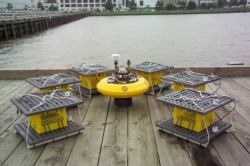
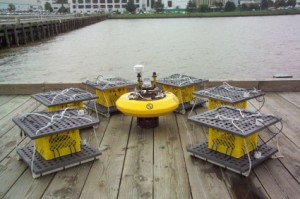
For long-endurance surface and underwater vehicles where speed is not a mission requirement, wave power and buoyancy-driven gliders are viable alternatives. Another possibility for powering future autonomous sea-floor crawlers or UUVs is the benthic microbial fuel cell. Naval drones will require continued innovations in power to allow performance necessary to meet future operational requirements.
Harnessing the power of the murky deep.
This article was re-posted by permission from NavalDrones.com.
Force development is much like agriculture. Seeds appear trifling things; but such small objects can engulf entire fields or grow to incredible height. Investing early in incubator programs can lead to huge changes in the future. When observed from a position of strength, the small changes garnered by others seem superficial rather than tectonic. The American defense establishment is missing those tectonic changes as China’s military begins the process of stealing a march in force development.
Whatever you do, don’t think “crash.”
China is pursuing a broad portfolio of revolutionizing technologies. We have discussed in detail the potential opportunities for drone warfare on this blog and elsewhere. However, those working to reap such opportunities are not here in the U.S. where ideas are shared freely, but in the People’s Republic of China. Scientists in China have developed a system by which, with thought alone, an operator can control an aerial drone. Rudimentary technology at best, it is nonetheless a leap we have yet to take. Even at the beginning stages, it shows smoother control with a mental operator rather than a manual one. Although the US does seem dedicated to drone saturation, we have not moved past our initial uses and operation of them. Drones still require legions of remote operators rather than partial automation and direct connections with the men in the field. While we have yet to integrate our many exciting advances in automation and bionics, the PRC has grabbed a great leap forward and changed the very way they interact with drones.
China is also marching past us in more mundane military technologies. We have discussed the practicality and pragmatism of theHoubei versus our misbegotten LCS. Far from the risky investment in an in-shore knife-fighter some desired, LCS was held back as a conventional, do-everything (aka: nothing) combatant without the relative advantage in speed, strength, or resilience to give it any sort of field advantage. We essentially attempted to build a Ford RS300, but halfway through decided to finish it as an Isuzu Elf. Meanwhile, with the PLAN following a disciplined strategy for blue-water modernization, a stream of solidly-constructed and capable warships are pouring into the Pacific, making the failures of our current investment ever more evident. Our attempts at modernization in the air are just as white-washed; worse than the do-everything design of LCS, the new Joint Strike Fighter attempts to stuff the needs of every branch into one frame that doesn’t quite make anyone happy. Even basic capabilities, like anti-ship missiles, lag embarrassingly behind. While the U.S. still uses a sub-sonic cold-war relic, the PRC rolls out DF-21Ds. Where technology does branch out, it seems unnecessary, like the laser-guided Griffen Missile system on PCs that already have far-more capable Mod 2 25mm cannons. China’s more reasonable and planned forays into future technology have made our past-ideas decorated with sweet rims look ridiculous.
We are also shrinking from the one area in which we could claim total dominance: space. Although our nation is now in the mini-euphoria from Curiosity’s landing on Mars, most have forgotten that this is an achievement of a program started 8 years ago. Our current manned space program is dead. NASA shifted the lion’s share of investment to “earth sciences,” a realm already well-manned by all the scientists ON earth. China not only retains a manned space program, but advertises a plan for both the Moon and Mars. Even if such a schedule is a dream, at least they still have one. While this is not directly a military issue, it is a strong force multiplier. Space is the ultimate high ground. To lose dominance there undermines a vast number of U.S. capabilities.
Has never attended mandatory “Improving Financial Management” training
Our mighty oak is rotting from within. Money is pouring into failed projects. Our Sailors are over-stretched and time is cut for the training/education necessary to add critical value to those personnel. Our priorities are skewed, millions of man-hours are lost to politically correct schools and rubbish ship-wide life-choices training. Meanwhile, the PLAN marches forward, steadily planting the seeds necessary to grow a modern blue-water navy supported by a far greater industrial base than anything the U.S. can muster. They are slowly reaching into the commons, as the face put forward by the U.S. becomes harder and harder to maintain. If we don’t get back into step soon, we may need that long-view of history to see just how far ahead of us the Chinese march has advanced.
Catching Up
The effort necessary to regain our momentum would be disruptive, but not impossible. First, stubborn pride and sunk costs are no way to direct procurement. LCS must be cancelled. In its place, begin a vetting process for contracting apre-existanthullto be built in the US, backed up by a low-mix of new coastal patrol crafts and the new MK VI’s. This would provide the desired coverage using fast, proven, and cheaper vessels that would save us billions in these tight times.
Where the LCS has many fine replacements, the JSF has crowded out the development of real alternatives. The diplomatic/trade capital invested also makes it an impossible program to cancel without painful follow-on consequences. However, the billions saved from LCS could fund a quicker turnover to automated and integrated ComBot technology, creating an “AEGIS in the sky” of super-fast autonomous aircraft and ComBots on the ground integrated with our fighting men and women. It’s a future closer than you may think. These new automated systems could lead to new systems to take on LCS’s failed missions, such as brown-water ASW and mine-sweeping.
With the US’s new technologies, we rely heavily on space. It is a commons commanding the ultimate high ground from which we guide our weapons, communications, and our intelligence infrastructure. Less concrete, but existentially more important, we must continue our investment in the development and exploration of space. The United States, at its very essence, doesn’t represent a set of borders, we survive as an idea. Being a nation undefined by a border, we must constantly strive beyond them. When the US landed on the Moon, we didn’t represent just ourselves, but all humanity. Such is a cause and driving force behind our constant success… a dream. To abandon that dream, even worse to cede it to the likes of the PRC, would be tantamount to ideological suicide. We must re-invest in our manned space program. This is not in defense of our physical commons, but in the commons of ideas, something to believe in. Much like the JSF and LCS programs, we don’t believe anymore. We’re going through the motions. We need to regroup and find a real direction towards the future, because the PRC marching past us.
Matt Hipple is a surface warfare officer in the U.S. Navy. The opinions and views expressed in this post are his alone and are presented in his personal capacity. They do not necessarily represent the views of U.S. Department of Defense or the U.S. Navy.
Last Spring, the guys at CIMSEC wrote a series on how 3-D printing would revolutionize naval logistics. Their vision is much closer to reality than science fiction. The nexus of on-demand fabrication and unmanned vehicles was recently demonstrated in small scale at a venue where one would least expect to see cutting edge military concepts tested. In another example of performance art-turned dual-use UAS military application, at the Burning Man Festival this year, a social entrepreneurship project called Blue Sky allowed visitors to scan an image of themselves, sculpt a miniature likeness of the person with a 3D printer, and deliver it to the consignee with an experimental octo-rotor UAV. Despite challenges with wind, dust, and safety, the proof of concept demonstration was a success.
The ability to print and deliver parts on demand locally and rapidly deliver them to forward operating forces will greatly streamline naval supply chains. Last December, the Marine Corps VMU-1 squadron began logistics deliveries to remote combat outposts in Afghanistan with an unmanned version of the K-Max dual rotor helicopter. A contracted manned K-Max variant had previously flown thousands of logistics missions for U.S. Navy ships during the 1990s. The Marines’ two unmanned K-Max vehicles delivered more than a million pounds of cargo between December and May and have were so successful the trials have been extended until 30 September.
Weaponizing individual drones is just the beginning…
By Chris Rawley
Last winter over at Information Dissemination, I made the observation that swarming robots will irreversibly transform warfare, and I hold to that argument. The discussion and progress in this area is developing quickly. Much of this conversation involves non-military uses for drone technology, but as with many tools, there are also applications for warfare. A host of militarily useful scenarios can be envisioned to employ very small unmanned naval platforms in a non-lethal fashion.
In the videos below, quadrotors are used to perform simple construction tasks. The technology that is today viewed as modern performance art could some day be utilized to build an expeditionary forward operating base remotely. A C-130 would fly over a likely FOB site and deploy hundreds of UAVs, which would quickly go to work filling Hesco Barriers and building fighting positions all night long based on a pre-programmed design, a scoop of sand at a time. Out of power, the drones could then land on the FOB and relay observations to the incoming troops. The site would be defensible as soon as the first Marines arrived, leaving Sea Bees for more valuable construction projects.
Researchers in the UK are developing autonomous vehicles which will replace the tedious role of scuba divers who painstakingly seed damaged coral reefs. The alternative being worked is to allow “multiple small autonomous robots following a simple set of rules and seeking out coral fragments and re-cementing them to the reef. But first the robot needs to be driven by a computer ‘trained’ to recognise coral fragments from other objects such as rocks, litter, sponges and other sea creatures… The swarm of autonomous underwater robots will operate according to a simple set of ‘micro-rules’ to seek out coral fragments and re-cement them to the reef.”
A swarm of nano-UUVs similarly equipped as the “coralbots” could quietly infiltrate an enemy naval port and use sensors and algorithms to recognize seawater intakes on ships. These intakes are indispensable on just about every vessel and are used for heat exchangers cooling engines and various pumps, to make fresh water for the crew, and to propel water-jet equipped ships like the LCS. The UUVs could inject a combination of mud or sand scooped up from the harbor with epoxy into these intakes, effectively rendering the fleet useless and unable to get underway. A similar attack could gunk up the intakes to power plants, refineries, and other coastal infrastructure.
The idea of drones mimicking insects might have other applications. Like bees or fire ants who can subdue a much larger predator, disposable micro-UAVs – too small to defeat with CIWS or other weapons systems – might swarm an Aegis combatant, each spraying a tiny amount of radar absorbent paint on the SPY array, achieving a mission kill of the most powerful air and missile defense system in the world.
Of course, these sorts of aerial swarms might be vulnerable to jamming, EMP, and the like, but here, LT Matt Hipple offers some recommendations to build resiliency into drone swarms. The rapid evolution of drone swarm technology can be expected to continue until concepts like these are deployed operationally; likely sometime in the next decade.
This article was re-posted by permission from NavalDrones.com