Tag Archives: Africa

Re-Post: Al Shabaab Is Only the Beginning

As Boko Haram declares its own caliphate, we re-post this article from 7 OCT 2013.

On the Run, or Running Somewhere New?

After the massacre at Westgate, many American media outlets acted as if they were only hearing Al-Shabaab’s name for the first time. This is only the tip of the US Medias Fifth-Estate-Failure iceberg. While incidents may be reported in part and parcel, the staggering scale of militant Islam goes disturbingly unreported. While many of these movements remain separate to a point, the geographic and communicative proximity provided by globalization serves as a catalyst for a horrifying potential collective even more monstrous than anything we could imagine in Afghanistan.

Globalization of De-development

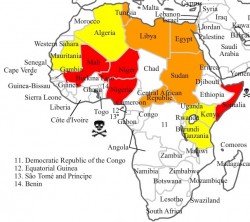
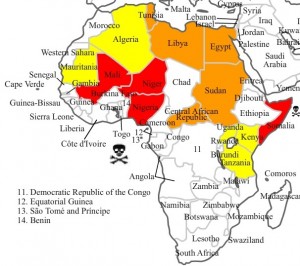
Yellow: Attacks Red: Open Extremist Conflict Orange: Getting Close Skull: Who do you Think?
Yellow: Attacks
Red: Open Extremist Conflict
Orange: Getting Close
Skull: Who do you Think?

ADM Stravridis pegged this problem squarely on the head when he brought up convergence, that globalization is merely a tool. What can be used to organize communities and build stable growing economies can also help coordinate civilization’s detractors. To spread our gaze further than the recent events in Libya and Somalia, Boko Haram fights a war against the Nigerian government; this is spreading into Niger, Camaroon, and Chad through a porous border. Its militants have also been found in in Mali, where they fought and trained with both Movement for Oneness and Jihad in West Africa (MOJWA) and Al-Qaeda in the Islamic Maghreb(AQIM) (MOJWA’s former parent organization). There, they fight an open war with the government. MOJWA meanwhile is also fighting in Niger. In one case, even more with al Mua’qi’oon Biddam in revenge for an AQIM leader killed by the French and Chadians in Mali. While the forces of globalization may allow nice things like the Star Alliance global airline network, it can also be harnessed to create this jihadist hydra.

With Somalia’s conflict spreading beyond its borders in the east and the coalition of chaos in the west, the center is not holding either. The Central Africa Republic sits in the middle, with potential militant Islamic rebels causing mayhem throughout the country after a successful coup… not that their neighbor is doing much better. Oh, did we mention Egypt too? No? Well… I’ll stop before I’ve totally crushed my own spirits. The tendrils of many different militant groups, often associated with, facilitated by, or directly franchised by Al Qaeda grow close together in a vast body of uncontrolled spaces.

Why the Navy?

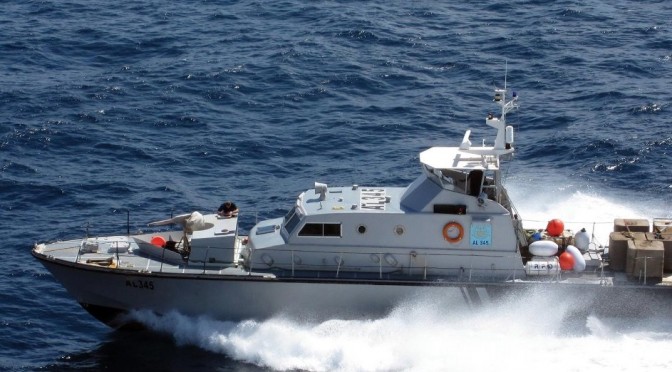
So, it’s African Navies week, and I’ve yet to get to maritime security. You’d be correct to assume that, as with Somalia, these problems don’t have primarily naval solutions… but effective maritime security will help prevent the growth of the power vacuum and encourage shore-side virtuous cycles.

The critical importance of maritime security is both pushing back the lawlessness and increasing entry costs for illicit actors. Lawlessness builds vacuums of civil order or undergrounds paths for militant Islam to enter either the money or idea markets. Islamic Militancy isn’t just sporadic and spontaneous violence; it’s also a massive logistics and patronage system that funds militants and creates in-roads into local communities. Where al-Shabaab can utilize the Ivory trade along with the LRA (wouldn’t that be a lovely marriage of convenience), who is to say Boko-haram couldn’t find in-roads into the multi-billion dollar oil-theft market, cocaine trade, or the full-on theft of motor vessels for movement of arms, persons, or stolen goods, let alone the Nigerian piracy enterprise which now even exceeds that of Somalia. Law enforcement needs a “last line of defense.” As stolen ships, goods, and persons leave the shore, the maritime presence is that final check of a state’s strength of institutions. This not only sweeps back this vast illegal enterprise, but also makes it harder later to re-enter the market.

That strength has a virtuous effect, since a rising tide lifts all boats. The improvement of civil society is not completed one institution at a time. Professional courts require professional police require professional elected officials, etc… etc… etc… Improvements to navies and coast guards help improve other portions of military and law enforcement infrastructure. Especially as such lucrative opportunities arise as crime’s payout and connections increase, closing such temptations through capabilities and professionalism is important.

Bottom Line

Africa is critically important to future global security. Despite its great economic growth, improving institutions, and growing innovation, the forces of terrorism so long reported “on the run” are growing and connecting at an alarming rate, even in places some thought secure. In such a vast countryside with at minimum half-dozen Afghanistan-sized poorly controlled areas, rolling back this development is of deadly importance. Maritime security, while not the primary arena, will help stay the spread of the lawless vacuum in which militancy thrives and help improve surrounding institutions to further minimize that vacuum ashore.

Matt Hipple is the Director of Online Content for the Center for International Maritime Security. The opinions and views expressed do not necessarily represent the views of U.S. Department of Defense or the U.S. Navy..

Private Anti-Piracy Navies: How Warships for Hire are Changing Maritime Security

This is an article in our first “Non Navies” Series.

By Emil Maine

I recently sat down with John-Clark Levin, coauthor of Private Anti-Piracy Navies: How Warships for Hire are Changing Maritime Security. For those of you interested in the subject of private maritime security, Levin’s book “is intended to provide a contextualized understanding of the historical origins, current state, and future prospects of this fast-changing sector.” Rather than simply rehash Joseph Hammond’s earlier interview of Levin, I decided to take the discussion in a slightly different direction.

EM: Some experts have argued that pirates off West Africa benefit from stable governments that provide easy access to corrupt officials and a steady stream of valuable targets. How does this complicate or undermine the effectiveness of private security contractors?

JCL: This undermines the effectiveness of private security contractors, because West African governments are generally quite hostile to foreign maritime security companies. Armed guards or escort vessels are prohibited from entering territorial waters, which introduces unnecessary hassle and danger. Merchant ships carrying armed security must stop at the twelve-mile limit and either lighter the guards off onto another vessel, or dispose of their arms. This has often forced shipping companies to hire local paramilitary groups for protection in territorial waters. This is a very bad thing, because it takes security out of the hands forces that are internationally accountable, and entrusts it to shadowy and unregulated entities. But because the arrangement is lining the pockets of a corrupt few, there’s political incentive to keep it going.

EM: Do you think that with the increasing number of prisons in Somalia, i.e. Puntland, housing together both convicted al-Shabaab militants and Somali pirates will create an even more complex system integrating terrorism and maritime piracy once they are released?

JCL: To my knowledge, that’s not something that analysts have considered much. Any time groups are housed together in prison, there is potential for links to form, and carry over outside the prison walls. But it doesn’t seem that that risk is acute enough to warrant alternative prison arrangements, given the difficulty in finding places to house pirates in the first place.

EM: Until recently one of the main prisons for pirates was in Somaliland, a relatively stable, semi-autonomous area in northern Somalia, the U.N. is now building facilities in Somalia proper because Seychelles no longer wants to imprison Somalis, how secure do you think these facilities are?  Are the proposed sites secure and stable enough to survive a jailbreak attack?

JCL: I know that there’s a facility in the works in Garowe, Puntland, but I have not seen any plans for it, so can’t comment on security. In order to weather a major jailbreak attack, it would certainly have to be strongly fortified, and have a large and well-armed guard force. But I’d be more worried about pirates escaping by bribery than by a frontal assault.  

EM: A single piracy case will often affect several nations. How does this complicate some of the legal issues private security contractors must face?

 JCL: Whenever pirates attack a vessel, several countries can potentially claim jurisdiction over them—the flag state of the victim ship, the shipowner’s country of origin, and the home states of the crew. If there are private security personnel aboard, that may add more states to the mix, and if there is a private escort vessel, that layers on an additional flag state and shipowner country. If any of those nations cannot protect the human rights of prisoners, that could arguably give the other nations an obligation to prevent the suspected pirates from falling into that country’s hands. In practice, though, the problem has almost always been the reverse: countries trying to avoid responsibility for prosecution. Prosecuting and imprisoning pirates is an inconvenient and expensive undertaking that can last decades. The burden naturally falls on a single country, but all nations share in the benefits. It has taken years to develop agreements within which stakeholder states can share the burdens fairly.

This unruly tangle of jurisdictions can also complicate private anti-piracy operations themselves. Although there are now international licensing and accreditation standards for private maritime security companies, none of those are legally binding. Rather, countries’ domestic law takes precedence. Similarly, although there are now widely accepted rules for the use of force by private security, domestic doctrines of self-defense prevail. Thus, private security companies must take great care to ensure that they are not breaking the laws of anyone who might prosecute them if something goes wrong.

For example, if personnel aboard a private escort vessel believe themselves to be under attack and shoot civilian fishermen in error, both the flag state of the escort and the flag state of the client merchant ship may apply their own laws on self-defense and come to opposite conclusions about whether the shooters acted criminally. Because there have been very few test cases in this area, it remains unclear how such an incident would be resolved.

Emil Maine is a National Security Research Assistant at the Heritage Foundation, where he conducts independent research on U.S. defense posture. The views and opinions expressed in this article are his own.

Disturbing the Pond: A Missing Tanker in the Gulf of Guinea

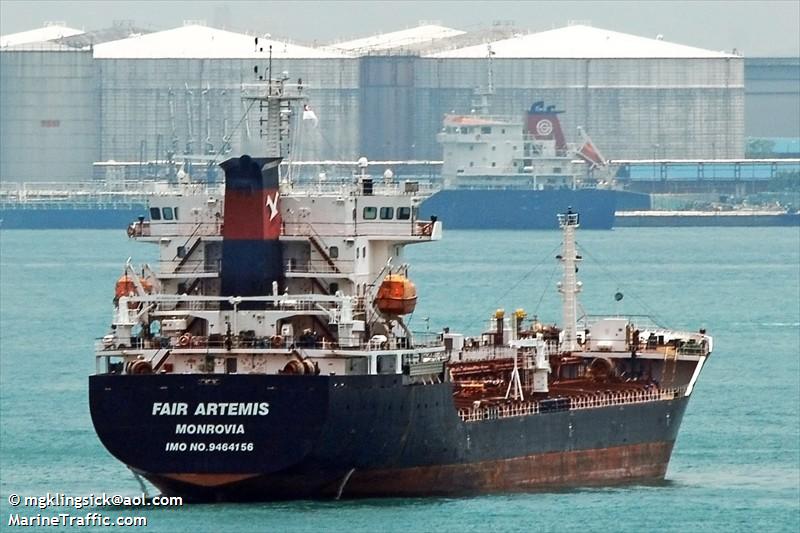
MT Fair Artemis. Image (c) MarineTraffic.com/Mgklingsick@aol.com

MT Fair Artemis. Image (c) MarineTraffic.com/Mgklingsick@aol.com

By James M. Bridger, Delex Systems Inc.

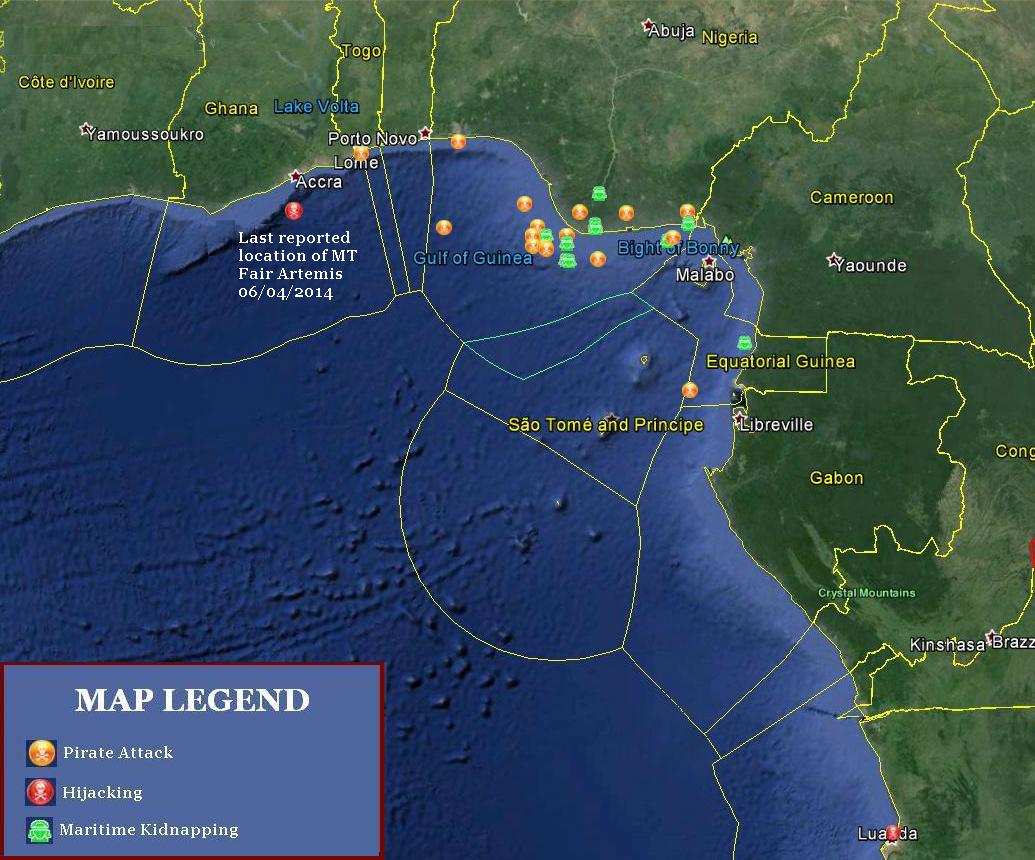
A Greek-owned oil tanker that lost contact with its owner after the evening of June 4 is still missing and presumed hijacked in the pirate-prone Gulf of Guinea. The MT Fair Artemis was last reported operating some 40 nautical miles SSE off Accra, Ghana and is laden with a cargo of gasoil. The International Maritime Bureau (IMB) is treating the vessel’s disappearance as a possible hijacking, while local naval forces have mobilized in a search.  

A senior port official in Tema, Ghana claims that the vessel’s master sent a distress call on June 6, saying that the ship had been hijacked and was being looted as it was forced to sail east through the waters of neighboring Togo. Naval forces from Ghana, Togo, and Nigeria have all engaged in a search for the Fair Artemis, with Ghanaian military officials noting, “We are looking within the whole sub-region.” 

The Fair Artemis’s cargo and sudden disappearance fit the profile of the well-organized tanker hijackings that have plagued the Gulf of Guinea in recent years. If the vessel is under pirate control, its attackers have likely disabled the ship’s communication equipment and painted over its identifying markers. The pirates’ objective would be to sail the Fair Artemisto a safe location, most commonly off the western coast of Nigeria, and transfer the vessel’s valuable cargo to secondary vessels for onward sale on the regional black market.  

Disturbing the Pond

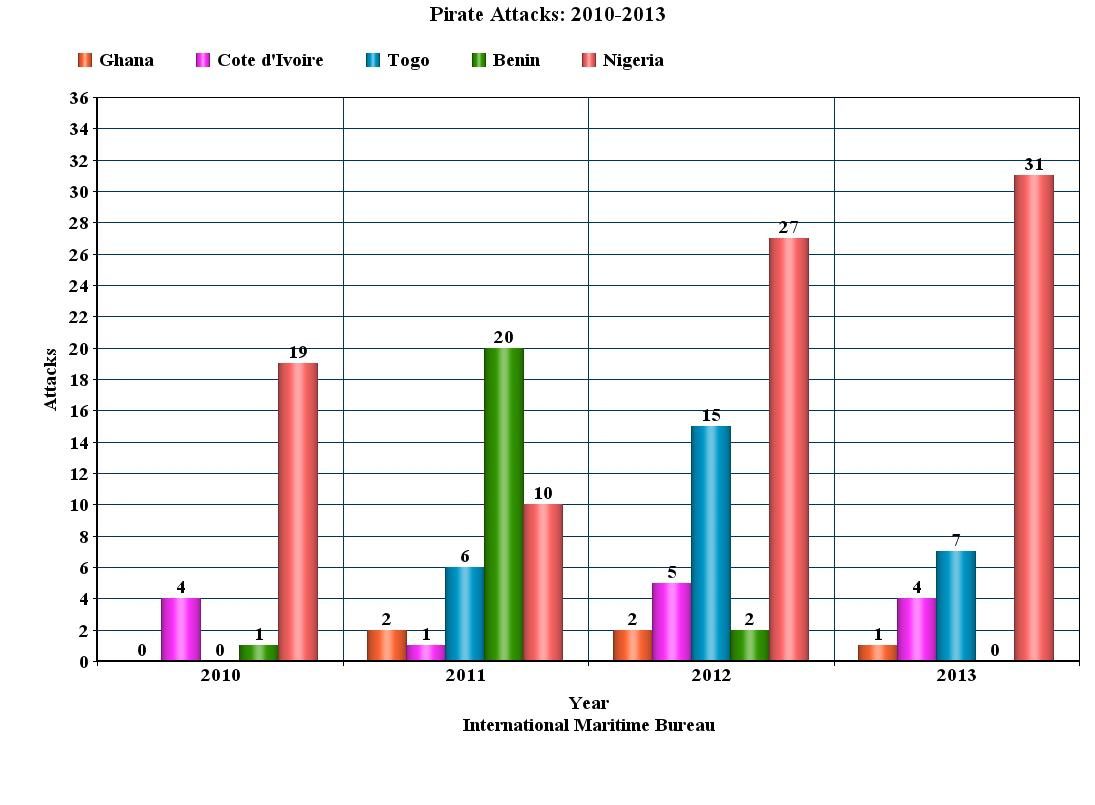
A tanker hijacking off Ghana would be particularly notable because the country’s waters have been a relative sea of calm compared with those of its neighbors. The anchorages of Lagos, Nigeria, Cotonou, Benin, Lome, Togo, and Abidjan, Cote d’Ivoire have all witnessed multiple tanker hijackings since 2010, while Ghana has seen only a handful of minor robberies at sea. Striking off Accra thus conforms to the pattern of the hijack gangs who have sought to shift their attacks to anchorages where they are not expected and where defenses are lowered.  Previous outlier hijackings have occurred as far west as Abidjan, Cote d’Ivoire and as southward as Luanda, Angola

Ghana Chart

The specter of Nigeria-based piracy expanding to its waters has weighed heavily on Ghanaian officials as the country continues to develop its offshore oil productioncapabilities.  Accra has acquired new patrol boats and surveillance aircraft in recent years and is in the process of launching a naval special forces unit. Ghana has also sought to improve its maritime situational awareness by implementing a Vessel Traffic Management and Information System to remotely monitor vessels and coordinate efforts among government and commercial stakeholders. A pirate hijacking off a Ghanaian port will damage the country’s reputation for maritime security and “reflect on the attitudes of the international shipping community towards our port,” notes Paul Asare Ansah, head of public relations at the Ghana Ports and Harbors Authority.

A Tough Neighborhood

Despite the progress the country has made towards securing its maritime domain, Ghana remains beholden to a neighborhood characterized by “sea blindness and mutual distrust.” Pirates, for example, have hijacked several tankers along the maritime border of Ghana and Togo and then fled across the sovereign boundary to avoid hot pursuit from national naval forces. The Fair Artemis’ prolonged disappearance and likely multi-national hijack route mirrors the January 2014 case of the MT Kerala, which pirates hijacked off the coast of Luanda, Angola and then sailed some 1,200 miles north to sell its stolen cargo in Nigerian waters.  

Pirate Attacks in the Gulf of Guinea: 2014 (OCEANUS)

Gulf of Guinea Piracy 2014 (Data and analysis from Oceanus and Delex)

Over 60 percent of pirate attacks go officially unreported in the Gulf of Guinea, as vessel masters weigh the costs of delays and inspections against the unlikely chance of a regional naval response. 

The Maritime Trade Information & Security Centre (MTISC) in Accra was established with international support in 2013 as a means to improve regional information sharing and response coordination. However, interagency information sharing and exchange of maritime domain awareness information was reportedly lacking during a recent international naval capacity building exercise, Operation Obangame Express.  

Regional maritime security cooperation is incrementally improving, and tanker hijackings have in fact declined from a 2011 high. The presumed pirating of the Fair Artemis, however, demonstrates that the hijack gangs remain regionally active and will continue to stalk assumedly safe anchorages.

James M. Bridger is a Maritime Security Consultant with Delex Systems Inc. and the Director of Publications for CIMSEC. His current areas of focus and expertise address piracy, terrorism, and other irregular threats to global maritime transportation. He can be reached at jbridger@delex.com

West Africa: More Dangerous Pirates, Less Adequete Security

West Africa is home to the world’s most violent pirates—who are now proving capable of overwhelming armed guards. Last month pirates killed a crewmember during an attack on German-owned oil tanker. Instead of fighting off the pirates, the embarked security team retreated to the ship’s citadel safe room.

For the shipping and insurance worlds, the widespread adoption of armed guards aboard vessels essentially ‘solved’ Somali piracy, as no vessel employing them has been hijacked by pirates. An attempt to transfer this panacea to the pirate-prone waters of West Africa, however, has proven inadequate and ill-suited to local conditions.

On the night of April 29, pirates attacked SP Brussles 35 nautical miles off the coast of Nigeria. Local security forces guarding the vessel were unable to prevent the pirates from boarding and retreated to ship’s citadel along with the crew. The guards did not emerge until the following morning, only to find that the ship’s chief engineer had been killed and another crewmember injured as they failed to reach the citadel.

This incident and others like it highlight three important issues that distinguish West African from maritime crime in other parts of the world.

First is the distinctive operating environment in which international naval patrols are absent, the response capacity of regional security forces is limited, and the use of foreign armed guards is prohibited.

Second, is the uniquely violent nature of Nigerian pirates and their propensity to engage in shootouts with security forces.

Finally, are the multiple shortcomings of using local armed guards aboard vessels and the inherent danger the shipping industry faces in being overly reliant on this measure.

Getting Around the Neighborhood

Piracy in the Gulf of Guinea is a Nigeria-centric problem that primarily occurs within 100 nautical miles of the coast and targets the ships plying the regional oil trade. Local naval forces have provided a modicum of security for transiting vessels, but their ability to respond to pirate attacks outside of territorial waters and secure anchorages is limited. The pirate’s proximity to shore coupled with local concerns over state sovereignty has prevented international naval operations from deploying as they have off Somalia.

These same confines have restricted Private Maritime Security Companies (PMSCs) from operating in the region as national laws prohibit foreign guards from carrying weapons within the 12nm limit of territorial waters. For embarked security, shipowners are forced to rely on armed guards contracted from littoral states. These guns on deck, drawn from national police and naval forces, are often poorly trained and undermanned, making them ill equipped to match the threat they face.

Ultraviolence

A recent UN report found that pirate attacks in West Africa from 2006 to 2013 have been proportionally more severe (involving vessel hijacking, hostage taking and violent acts towards crew members) than those in the Western Indian Ocean and South East Asia. West African pirate attacks have also become more violent over time, the report notes, particularly from 2011 onwards. International Maritime Bureau data records show more crewmembers were injured and killed off Nigeria than other country from 2012 to first quarter of 2014.

Regionally distinct pirate ‘business models’ partially explain this phenomenon. When Somali pirates hijack a vessel, they must ensure that the hostages are kept alive so that ransom negotiations for the return of the entire crew and ship can proceed smoothly.

West African hijackings, by comparison, are usually “extended duration robberies,” in which the crew and vessel are only held hostage until the ship can be pumped of its petroleum cargo. When maritime kidnappings occur, pirates take only the most valuable (usually Western or Asian) officers for ransom while leaving the rest of the crew and vessel behind. Under both scenarios, the majority of the crewmembers hold no value for the pirates and are thus considered disposable assets.

Armed to the Teeth

West African pirates are also better armed and trained than other maritime criminals, reportedly wielding heavy machines guns, such as M60s, and RPGs. Many of these weapons are ‘legacy firearms’ circulating from previous African conflicts, while others are sold or rented from corrupt security forces.

This heavy armament is a product of the pirate’s proximity to their onshore bases in the Niger Delta, which allows them to carry more weight in weapons and ammo and less in fuel and water than their Somali counterparts. Nigerian pirates also display military-grade tactics, explains Kevin Doherty, Owner of PMSC Nexus Consulting, “they know how to skillfully maintain and fire their weapons, they ambush security forces, and they board vessels with tactical precision.”

The weapons and tactics displayed by the pirates are often superior to those of the security personnel hired to protect vessels, notes a report from the counter-piracy think tank Oceans Beyond Piracy. As a result, local soldiers contracted to guard ships have reportedly hidden during pirate attacks. “They hide, just like that,” exclaimed a regional seafarer, “When we ask them why they hide, their answer is simple, ‘The weapons of rebels and pirates are stronger.’” An alternative, often anecdotally reported explanation is that naval guards have colluded with pirates in exchange for a share of profits.

Nigerian pirates are often undeterred by onboard security forces and willing to use deadly force to achieve their objectives. While shootouts between pirates and embarked security are exceedingly rare in the Indian Ocean, they are becoming increasingly common in the Gulf of Guinea, resulting in multiple casualties.


Fatal Nigerian Pirate Attacks 2012-2014*
Date & Location Incident Details Casualties
February 13, 2012100 nm South of Lagos, Nigeria Pirates fired on, boarded, and robbed a drifting bulk carrier, MV Fourseas, off the coast of Nigeria. The pirates killed the ship’s Master during the robbery, while Chief Engineer died from injuries sustained during an attempted escape. Master and Chief Engineer killed.
August 3, 201245nm SW of Bonny Island, Nigeria Pirates armed with AK 47s overpowered the Nigerian naval personnel guarding an oil barge, Jascon 33, and kidnapped four crewmembers for ransom. Two Nigerian guards killed, two guards injured, four crewmembers kidnapped.
December 13, 201225nm SW offshore, Bayelsa, Nigeria Pirates armed with machine guns attacked an offshore supply vessel, PM Salem, and engaged in a 20-minute firefight with onboard security guards before retreating. One Nigerian guard killed, one guard injured.
February 4, 2013Lagos Anchorage, Nigeria Pirates attacked and boarded an anchored chemical tanker, Pyxis Delta, conducting STS operations off Lagos. The onboard naval security returned fire and eventually repelled the attackers. One crewmember died from injuries sustained during the firefight. Two pirates were also killed.
February 5, 2013Near Angiama, Niger Delta waterway, Nigeria Gunmen ambushed an Indian-owned oil barge as a Nigerian military detachment escorted the ship through the Niger Delta. Two Nigerian soldiers killed, one crewmember killed, three crewmembers wounded.
April 29, 201435nm W offshore Bayelsa, Nigeria Armed pirates boarded a product tanker, SP Brussels, underway. The onboard security forces fired at the pirates before retreating to the citadel along with most of the crew. Chief Engineer killed, Third Officer wounded. Two pirates were also killed.


The Wrong Answer

Armed guards aboard ships in West Africa do not provide the silver bullet security solution that PMSCs have in the Indian Ocean.

A key differentiator in the latter theatre is that ship owners have a number of tools for vetting the quality and compliance of the armed security they hire.

For example, the GUARDCON contract developed by BIMCO, the largest international shipping association, provides a standard agreement between ship owners and PMSCs that covers guidance on Rules of Force and other security issues. In addition, there is the ISO/PAS 28007 accreditation that allows PMSCs to certify their compliance with appropriate regulations and best practices.

Vetting and compliance is much more problematic in West Africa as vessel owners and Masters have far less oversight over the armed guards they bring aboard. Owners can either hire security forces directly through a local agent, or engage a PMSC to act as an intermediary to employ local guards and provide unarmed logistical support and leadership. In either case, BIMCO notes, the local security forces will operate under their own rules of engagement and cannot be bound to the provisions of GUARDCON.

When a vessel contracts local security, it is the soldiers’ commander, not the shipowner, who usually controls the number of guards posted. An undermanned and poorly drilled guard team bears responsibility for the fatality aboard the SP Brussels, argues Rene Toomse, CEO of the PMSC Aburgus. “What was missing,” Toomse explains, “was a guard assisting all the crew into the citadel while others were fighting with the criminals.” The vessel had only two armed guards onboard at the time of the attack, rather than the BIMCO recommended staffing of four.

Maritime insurers and PMSC owners have privately expressed reservations that an overreliance on onboard guards is contributing to lax safety and security standards in West African waters. One source close to the London insurance market noted a particular problem of vessels with embarked security rejecting advisories to avoid prolonged exposure in high risk-areas close to the Niger Delta, opting instead to save time and fuel by using shorter routes and “shooting their way out” of any potential pirate attacks. The majority of these incidents, it was further noted, are never reported to authorities and thus contribute to a cycle of inaccurate threat perceptions and inadequate security measures.

Multiple Layers

It is very unlikely that the laws barring foreign armed guards from West African territorial waters will change, despite pressure from PMSCs and shipping organizations. Concerns over sovereignty and control understandably run deep, particular in Nigeria, and the current regime of renting local guards to foreign ships is too lucrative to give up. Unarmed PMSC advisors working with local guards offers an improved measure of security, but BIMCO still warns that the ability of PMSC leaders to effectively control their teams will be limited.

As no single defense against West African piracy is impenetrable, a multi-layered security system must be implemented. This begins with a pre-transit risk and security assessment and requires up-to-the-minute information on pirate activity and vessel vulnerabilities. Communication security is also essential, as pirates are known to select their targets by obtaining route and cargo information from open and private sources. Vessel hardening measures such as the use of citadel safe rooms are key, but it is also imperative that crews are regularly drilled for emergencies. Vessels also need a well-staffed 24-hour watch duty as West African pirates primarily attack at night.

Even with all these measures in place, the most important lesson to draw from the SP Brussels and other fatal pirate attacks is that no vessel should ever be lulled into a false sense of security.

James M. Bridger is a Maritime Security Consultant with Delex Systems Inc. in Herndon, VA. His current areas of focus and expertise address piracy, terrorism, and other irregular threats to global maritime transportation. He can be reached at jbridger@delex.com