Tag Archives: Africa

OBANGAME EXPRESS 2015: Two steps forward. One step back.

Between 19 and 27 March OBANGAME EXPRESS, African Partnership Station’s annual exercise since 2011 took place off the coasts of West African states between Côte d’Ivoire and Angola. It is the fifth iteration of this exercise that has grown from nine participating nations in 2011 to 23 this year, including 12 Gulf of Guinea countries. Crucially, the framework for OBANGAME EXPRESS has changed since the last exercise. On 25 June 2013, 22 West and Central African countries signed the Yaoundé Code of Conduct, a document that obliges the member states to co-operate on preventing and prosecuting all forms of maritime crime and illicit activities at sea and to share information between each other. OBANGAME EXPRESS 2015 was the first exercise in this series to rehearse and test the new structure and, where they existed, procedures.

Broadly speaking, the Yaoundé Code of Conduct (YCoC) provides for a hierarchical information sharing and co-ordination structure that includes all countries from the two regional economic communities – the Economic Community of West African States (ECOWAS) and the Economic Community of Central African States (ECCAS). The YCoC structure envisages an Inter-regional Co-ordination Centre (ICC) for the strategic level, regional reporting centres for both ECOWAS and ECCAS and below those, for operational co-ordination, Multinational Co-ordination Centres (CMC), grouping the Gulf of Guinea countries into five zones: A, D, E, F and G.
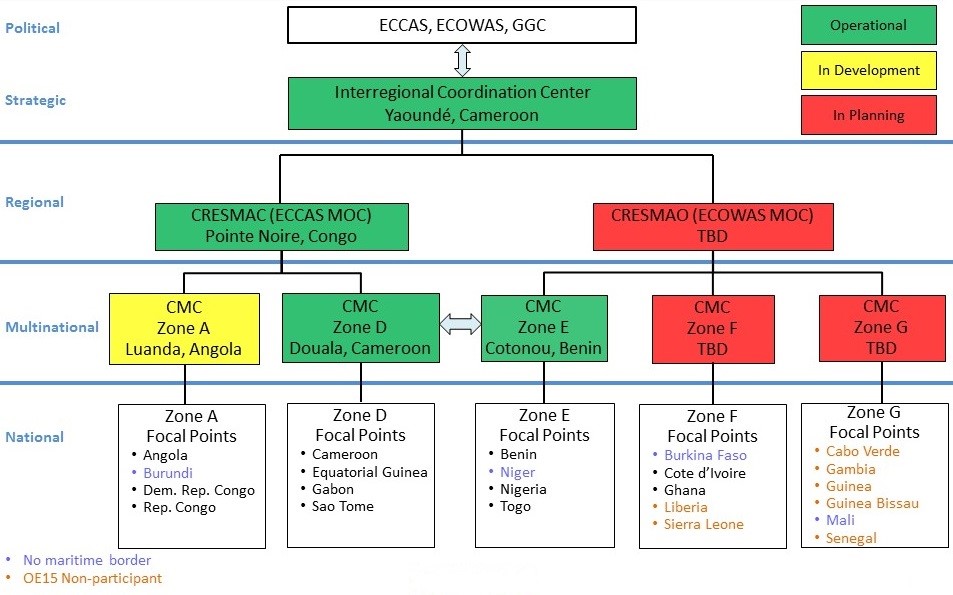
The information sharing and reporting structure as envisaged by the Yaoundé Code of Conduct and the degree of implementation (in green) during OBANGAME EXPRESS 2015. (AFRICOM)

One of the key differences of this year’s OBANGAME EXPRESS was that it took place off all the Gulf of Guinea states’ coasts rather than in a single exercise area. This made for a realistic setting regarding the command and control as well as logistical challenges for the region’s navies.  It also allowed the YCoC structures to be tested with realistic timeframes, as target vessels transited through the Gulf of Guinea nations’ waters. It also added another layer of complexity to the already very demanding schedule of OBANGAME EXPRESS 2014. Was it too much, given some of the modest outcomes of last year’s exercise? Was it an exercise in window dressing? Or is the Gulf of Guinea on a good path towards becoming part of the “global network of navies” as the exercise’s officer in tactical command, Commodore John Rinko (USN), predicted during the opening ceremony in Accra, Ghana? The truth, as always in this region, is probably somewhere in between.

The core functionality that this exercise tested was that of the 21 Maritime Operations Centres (MOCs) on national, sub-regional and regional levels and their ability to communicate, co-ordinate and direct maritime interdiction operations (MIO) represented on a tactical level by patrol boats, boarding teams and special forces teams.

It became clear during the exercise that the information flow functioned broadly as envisaged by the YCoC despite a lack of reporting standards and procedures, absence of a common interpretation of the situation picture, organisational and technical deficiencies (which affected some MOCs more than others). There is also still an overreliance of many MOCs on tracking vessels via their Automated Identification System (AIS) signals. Given that the majority of criminally active vessels in the Gulf do not broadcast this signal, in addition to an increasing number of merchant vessel switching off their AIS as a self-protection measure as per industry guidance, it effectively reduces any Maritime Domain Awareness (MDA) capability to near zero outside coastal radar range. This is a particular challenge also for tracking and combating illegal, unregulated and unreported (IUU) fishing activities, since many fishing vessels do not have AIS transponders or choose to switch them off while poaching.


Additionally very few Gulf of Guinea nations, such as Ghana, have integrated their coastal radar stations into their MDA systems. Farther south, in the Republic and Democratic Republic of Congo and in Angola there is no meaningful coastal radar coverage at all at the moment. On a positive note: the Nigerian Navy, as the first Sub-Saharan navy ever, transmitted a radar picture via data link from a vessel to the MOC. Given the recent acquisition of three more large Offshore Patrol Vessels (OPV), this at least opens the prospect for a better surveillance of the Nigerian Exclusive Economic Zone (EEZ).
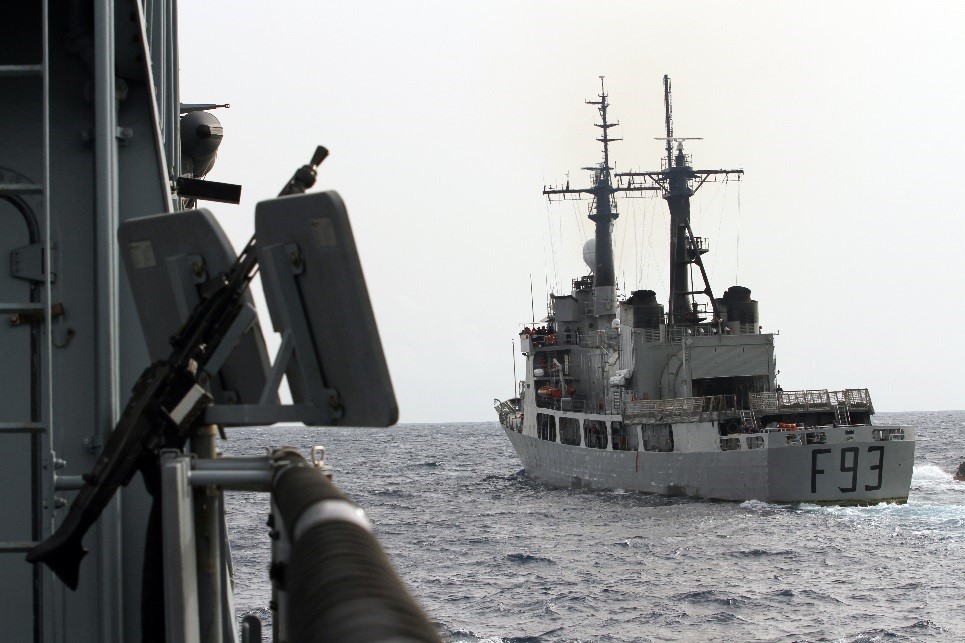
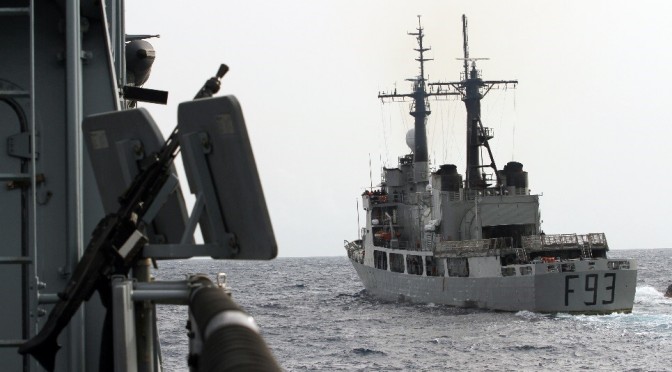
NNS OKPABANA intercepts the German frigate BRANDENBURG, which simulates a tanker carrying a cargo of stolen oil, on 24 March 2015. (Photo: German Navy/Steve Back)

Beyond the artificiality of the exercise, however, old suspicions and prejudices are hard to eradicate. While Nigeria and Cameroon played their part well in exercising tracking and intercepting suspect vessels at the border between Zone E and Zone D, Cameroon does not grant Nigeria the right of hot pursuit into her territorial waters in real life. Equally, the Ghanaian chief of naval staff, Admiral Biekro, casually announced the formation of an “information-sharing coalition” comprising Côte d’Ivoire, Ghana, Togo and Benin, conspicuously leaving out the elephant in the room. Circumspection in sharing information with Nigeria is widespread in the northern part of the Gulf of Guinea and, based on the performance of Nigerian criminal networks and their current relationship with the Nigerian political and military elites, certainly justified.

Nevertheless the Nigerian Navy was determined to contribute as best as it could in the face of political constraints. The detachment of one of the Nigerian Air Force’s precious ATR-42 Maritime Patrol Aircraft (MPA), which are used as reconnaissance planes in the campaign against Boko Haram in Nigeria’s northeast, was a signal that, whatever the shortcomings, Nigeria was willing to engage. Only a few days later, the same MPA flew out to south of Sao Tomé to assist in the real-world episode of the scuttled IUU fishing vessel THUNDER. This mission, too, reflects the spirit of the YCoC; Sao Tomé lacks air assets for Search and Rescue (SAR) – for the purpose of the exercise this had been simulated just a few days earlier by a Portuguese Air Force P-3 Orion flying out of Sao Tomé.

On the tactical level, results were also mixed, ranging from pleasant surprises to disappointments. All navies struggled with the absence of formalised and trained procedures for Maritime Interdiction Operations (MIO). The teams deployed by the African nations typically lacked consistent tactical skills for boat handling, boarding and close-quarter including room-clearing as well as command procedures. Poor communications equipment aggravated those shortcomings; usually only the team leader had a VHF radio to communicate with the mother ship. The dismal performance of the Nigerian SBS team was particularly disappointing after last year’s credible performance. However, this year’s team which boarded the German frigate BRANDENBURG in an opposed boarding scenario was actually a land-trained team that had seen combat in Nigeria’s northeast. The tactical deficiencies that this team displayed are a lesson for those (especially in the private sector) who believe that combat experience alone is sufficient qualification for succeeding in maritime security missions.

Togo’s embryonic MIO capability on the other hand made visible progress since last year. While tactics where still not near anywhere that would enable the Togo Navy to carry out anything else than compliant boardings, the team appeared more professional and self-assured than last year. Once on board, the team, which included specialists from other agencies, made a good job of securing the crime scene and preserving and collecting evidence.
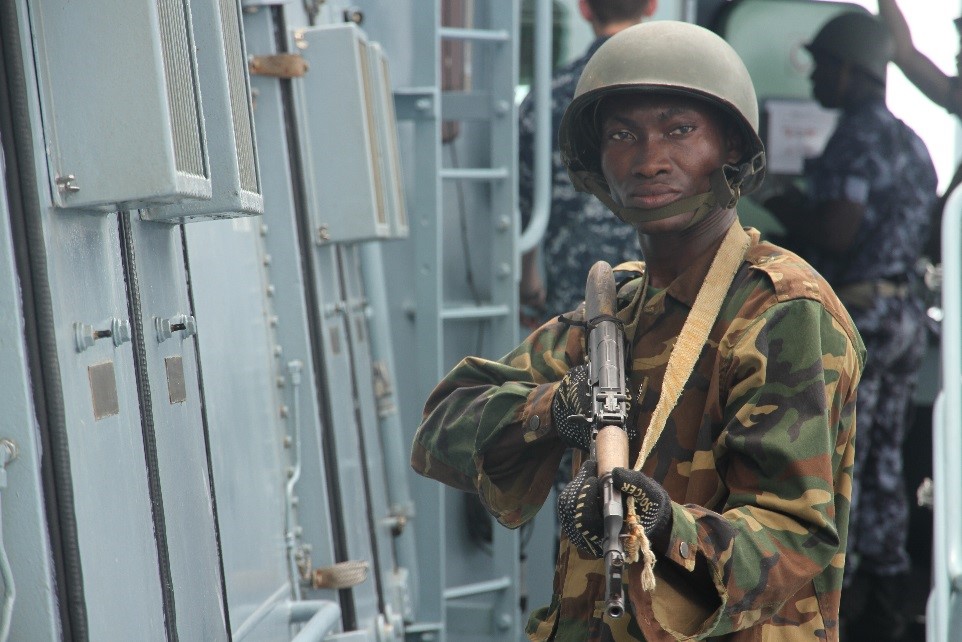
A Togolese soldier provides rearward security for the Togo boarding team on the bridge of the target vessel BRANDENBURG during OBANGAME EXPRESS 2015. (Photo: German Navy/Steve Back)

Ghana’s MIO teams for the exercise received a three-day pre-sail training by the German Navy’s naval infantry. It was also a useful lesson for the Ghana Navy that the exercise should really test real arrangements rather than such made specifically for the exercise. In this case Ghana had hand-picked four MIO-teams from different vessels for OBANGAME EXPRESS. Lack of familiarity of the boarding officers with their teams as well as the inclusion of non-naval specialists from the Police, Fisheries etc. made for very mixed results.

The risks of the lack of formalised procedures were apparent during the real world incidents of the MT MARIAM and FV LU RONG YUAN YU 917. Both vessels were hijacked by Nigerian criminals in January and February 2015 respectively and subsequently recovered by Ghana Navy boarding teams from the patrol boats BLIKA and CHEMLE, both of which took part in the exercise. In the case of the MT MARIAM luck and good improvisation played a great part in the success of the mission. The Ghana Navy boarded the tanker 26 nm outside the port of Tema (the BLIKA having unwittingly passed the tanker INVICTUS, which had siphoned off the MARIAM’s cargo, on the way) with a boarding team comprising a mere seven persons (in addition to the two-man crew of BLIKA’s sea boat). The fact that five of the eight suspected pirates on the MARIAM were hidden away in a water tank without guns only emerged after a while and after the initial team (of five persons) had almost given up the search. The remaining three suspects were holed up in the chain locker. One of the apprehended suspects from the water tank was used as a mixture of human shield and go-between when the Ghana Navy team had to approach the only entrance to the compartment through a narrow corridor. Fortunately, the three remaining suspects gave up and then, bizarrely, tried to hide themselves in the small compartment. In the end it was perhaps fortunate that, whether abetted by the MARIAM’s crew or not, the Nigerian criminals chose to place themselves into a position where the small Ghana Navy team could deal with it effectively. However, the vignette also holds a strong message that in the case of a non-compliant or opposed boarding this vessel recovery would not have gone ahead or if it had, could have ended in disaster due to the inadequacy of the boarding team.
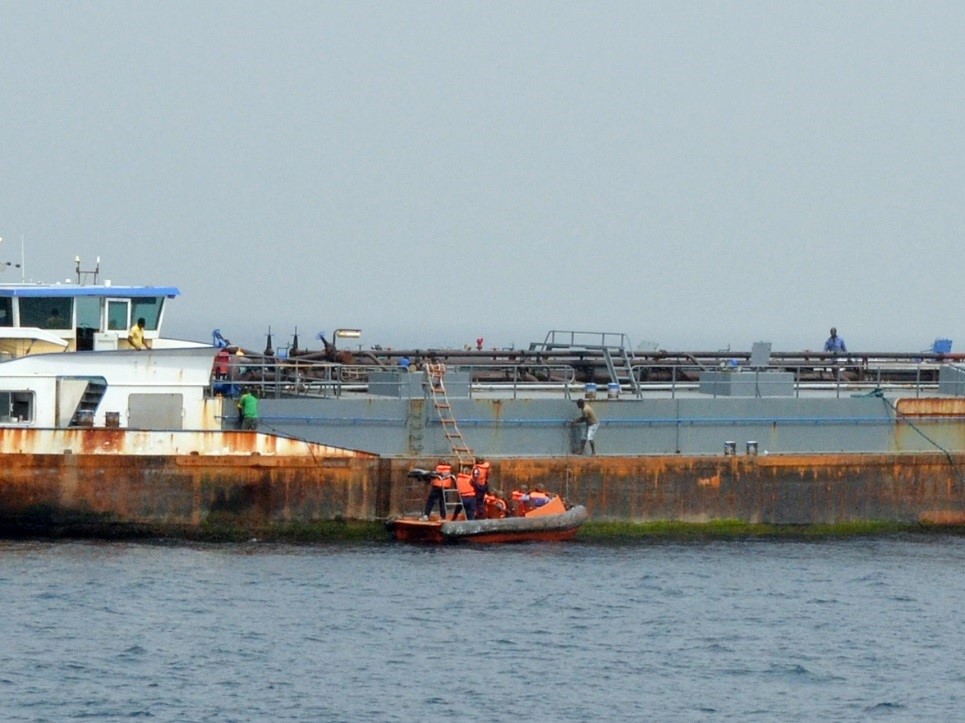
From exercise to reality: GNS BILIKA’s boarding team boards MT MARIAM, a tanker that had been hijacked under dubious circumstances off the Niger Delta on 11 January 2015. (Photo: Ghana Navy)

The Ghana Navy’s Flag Officer Fleet, Commodore Mark Yawson, and the Director of Operations, Commander Derrick Attachie saw this exercise as an opportunity to improve and to identify what should be the navy’s priorities in training and procurement. Clearly, this is what an exercise is designed to do, but in some cases there remains some doubt that even though there is a will to address deficiencies identified in the exercise capabilities may not be available. Low operational readiness of some navies, absence of reliable fuel supplies (even for the exercise), systematic communications infrastructure shortfalls (poor internet, a “gap” between VHF and HF coverage at sea) are not problems easily addressed without a significant increase in funding, which is unlikely to be forthcoming in the short-term. Some improvements, while noteworthy and laudable, are improvements from an extremely low level, such as those made by Côte d’Ivoire, Republic of Congo, Democratic Republic of Congo or Sao Tomé and Principe. In the latter case, in spite of great personal engagement by junior officers and NCOs, there appears to be very little top-level support. The evaluator for the Sao Tomé MOC pointed out that the centre did have a higher level of performance some years ago, but that it seemed the operation had been started from scratch again.

The true “success” of OBANGAME EXPRESS over the years is really in highlighting all these aspects and tracking progress – or absence thereof. The annual exercise also provides a benchmark and while the political message will always be one of continuous improvement, the analytic tools are actually fine-grained enough to register the nuances of change in either direction. As in 2014 the closer look at the individual results and how they came about raises the question of “sustainability” of the progress achieved so far. It is evident from this year’s results that gains made in the past can be lost in no time for as long as the effort does not become systemic.

There is a strong desire by the US to get other nations more involved in the maritime security effort. With the EU’s new Gulf of Guinea action plan the time may be auspicious to broaden the base of this capability-building effort with more permanent and long-term commitments by extra-regional powers (where this is desired), but with a view to “responsibility sharing”, rather than an open-ended engagement. This effort will be complex, given different priorities:  Europeans and Americans are worried about drug trafficking while most West African governments are more concerned with the smuggling of cigarettes and oil products. Piracy is another priority for the EU and the US while it is less important for many African politicians who have to fight against pirate fishing to be able to feed their growing populations. The road ahead is still long. And as this year’s exercise showed: it also is not straight.

Dirk Steffen is a Commander (senior grade) in the German Naval Reserve with 12 years of active service between 1988 and 2000. He took part in Exercise OBANGAME EXPRESS 2015 as an observer during the German Navy’s MIO-team training in Ghana before transferring to the Exercise Control Group as a Liaison Naval Officer. He is normally Director Maritime Security at Risk Intelligence when not on loan to the German Navy. He has been covering the Gulf of Guinea as a consultant and analyst since 2004. The opinions expressed here are his alone, and do not represent those of any German military or governmental institutions.
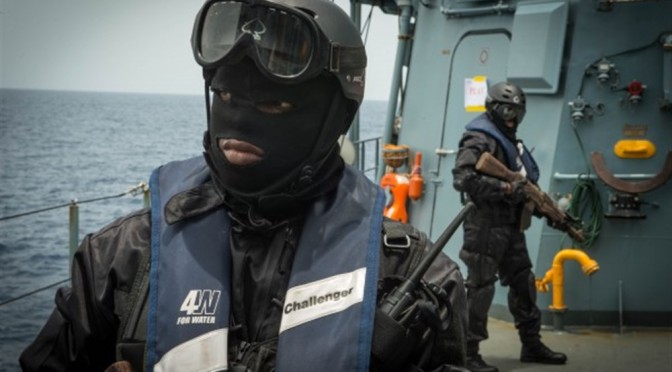
Sea Control 72 – Obangame Express, Gulf of Guinea

seacontrol2We interview CAPT Rinko, USN, and CDR Sune, Cameroon, about Obangame Express, the 23 Nation Gulf of Guinea Maritime Security exercise. We discuss the scope and purpose of the exercise, the challenges of building cross-organizational/ cultural/ national inter-operability, and lessons learned. For context on the ongoing expansion and conduct of Obangame Express,  CIMSEC Africa expert, Dirk Steffen assessed this exercise last year.
DOWNLOAD: Sea Control 72:
Obangame Express 2015

Remember, subscribe on iTunes or Stitcher Stream Radio. Leave a comment and rate five stars!

Host and Editing: Matthew Hipple
Music: Sam LaGrone

Publication Release: Africa Compendium

Africa CompAuthors:
Breuk Bass
Mark Hay
Matt Hipple
Timothy Baker
Dirk Steffen
James Bridger
Emil Maine
Charlotte Florance

Editors:
Matt Hipple
Chris Papas
Scott Cheney-Peters

     Download Here

Over the preceding decade Africa has faced a variety of maritime challenges. Unsurprisingly, many of our authors have focused on the scourge of piracy that has cycled through boom and bust near the Horn of Africa and is making its presence felt in the Gulf of Guinea. Other maritime challenges, from smuggling and terrorism to ecological disaster and mass migration, also face the nations and people on the continent and those across its seas. In this compendium our authors start to approach the varied problems and complicated growth of modern naval and maritime security forces.

Articles:
East Africa: More Than Just Pirates
– Breuk Bass
East Africa: A Historical Lack of Navies
– Mark Hay
Al-Shabaab is Only the Beginning
– Matt Hipple
Africa: “A Problem as Unique as its Constituent
Parts”
– Timothy Baker
Troubled Waters? The Use of the Nigerian Navy
and Police in Private Maritime Security Roles
– Dirk Steffen
Risks in Contracting Governement Security
Forces in the Gulf of Guinea
– Dirk Steffen
Disturbing the Pond: A Missing Tanker in the Gulf
of Guinea
– James Bridger
Balanced Public/Private Effort for West African
Maritime Security
– Emil Maine and Charlotte Florance

Follow-ons:
The Shifting Center of Gravity for Piracy in Africa
– Mark Munson
West Africa: An Ounce of Prevention
– Paul Pryce
The Legalities of Gulf of Guinea Maritime Crime with Suggested Solutions
– Herbert Anyiam

How To Make The ‘Ebola Bomb’: Why You Should Stop Worrying About Bioterrorism

By Sandra Ivanov

The Ebola outbreak in West Africa is the deadliest epidemic since the virus was discovered in 1976, crossing international borders, it has claimed over 2’600 lives (as of September 18, 2014). There is no vaccine and there is no cure. Aid and medical personnel are sought from all over the world, borders have been contained, and risks of rising violent conflict continue to develop out of the Ebola eruption. However, there have been other interesting analyses of this issue on the side – media and opinion pieces are claiming that terrorist groups could get a hold of the virus and spread it around their regions, and the world (see for example Rick Noack, “Why Ebola worries the Defense Department“, The Washington Post, 05.08.2014). Well, I wanted to test this claim for myself, so with a bit of research and optimism, I’ve created a recipe to examine what a potential terrorist group would need to do to make this so-called “Ebola Bomb” – how hard could it really be?

ebola-001

Many studies from a health, as well as a humanities perspective, assume that terrorists could successfully generate biological or chemical agents and weaponise them. Taking this initial premise, a lot of literature has been based around this looming threat, subsequently offering policy advice, public health recommendations, and technological investment to avoid such catastrophes. However it would be useful to deconstruct this claim entirely. So I’ll begin by offering a baking recipe, to explore at the very core, what a group would need to do to successfully create a biological weapon, in this case, utilising the Ebola virus.

Ingredients
Firstly, any terrorist group wanting to create and weaponise a biological or chemical agent will need to have an appropriate kitchen. In the case of the Ebola virus, a standard biosafety level 4 (BSL-4) scene will be required (Adeline M. Nyamathi et al., “Ebola Virus: Immune Mechanisms of Protection and Vaccine Development“, Biological Research For Nursing 4, No. 4, April 2003: 276-281). Some features of these laboratories include decontamination mechanisms, pest management systems, air filters, and special suits. Sometimes the kitchen will have to be in a separate building, or in an isolated area within a building to meet the safety requirements. Not only will the kitchen be under strict conditions, the baking process will need to be kept in total secrecy. The constant threat of law enforcements raiding facilities, and intelligence and secret services detecting activities will have to be avoided. Also, there are only some fifty of these laboratories successfully maintained worldwide.

Before starting, make sure there is a baking dish of ‘uncertainty’ readily available to just throw all of the following ingredients into:

  • 1 Tablespoon of Proper Agent

Initially, a terrorist group must decide what kind of agent they would like to use in a bioterror attack. This is one part of the recipe which can be modified, but the other ingredients will be standard for all types of attacks. The recent spread of the deadly Ebola virus will be the agent of choice for this bomb. Ebola is a virus which is passed to humans through contact with infected animals. The spread of the virus from person-to-person is brought about through blood and bodily fluids, as well as exposure to a contaminated environment. An infected live host with Ebola would need to be maintained in a human or animal – only a few animals are able to be used as hosts, such as primates, bats, and forest antelope. Although Ebola infection of animals through aerosol particles can be effective, it has not successfully been transferred with this method to humans (Manoj Karwa, Brian Currie and Vladimir Kvetan, “Bioterrorism: Preparing for the impossible or the improbable“, Critical Care Medicine 33, No. 1, January 2005: 75-95).

  • 1 Bucket of Resources and Money

In order to develop a biological weapon, a substantial amount of material and money is required. Investment is needed from the very outset – taking into account membership size and capabilities of a terrorist group, financial assets of a group, and making sure territory and proper infrastructure is available for the biological agent. For a successful bomb to be created, a group must think about the resources they will need for each stage of the baking process, such as weapons production, potential testing phases, and logistics, such as transportation and communications technologies (Victor H. Asal, Gary A. Ackerman and R. Karl Rethemeyer, “Connections Can Be Toxic: Terrorist Organizational Factors and the Pursuit of CBRN Terrorism“, National Consortium for the Study of Terrorism and Responses to Terrorism, 2006). Resources needed for an “Ebola Bomb” will most likely need to be imported from the outside, and a group must determine the feasibility of acquiring the materials and technologies needed for the bomb (Jean Pascal Zanders, “Assessing the risk of chemical and biological weapons proliferation to terrorists“, The Nonproliferation Review, Fall 1999: 17-34). A surplus of money would also be a smart idea in case technical difficulties arise.

  • 5 Cups of Expertise

With all the correct resources and necessary amount of monetary support, the recipe will require the right kind of know-how. For an operation like this, a terrorist group should have members with high levels of education and training in science, engineering, and technological development, to deal with highly virulent agents, and for successful weaponisation (Zanders). A group may need to be integrated into knowledge flows and institutions, or be able to recruit members to their cause with this specific expertise (Asal, Ackerman and Rethemeyer). Knowledge and expertise is required to create the correct strain, handling the agent, growing the agent with the desired characteristics, and maintaining the agent. Taking Ebola specifically requires synthesising proteins which make it infectious, and becomes a task that is difficult and unlikely to succeed (Amanda M. Teckma, “The Bioterrorist Threat of Ebola in East Africa and Implications for Global
Health and Security
“, Global Policy Essay, May 2013). If Ebola is successfully created in the kitchen, it is not itself a biological weapon – an expert will be required to transform the virus into a workable mechanism for dissemination.

  • A Teaspoon of Risk

The decision to use biological weapons for an attack is in itself extremely risky. There is a risk that bioterrorism could cause dissenting views among followers, and that public approval and opinion may channel the way a group operates. After all, terrorists are political communicators, wanting to bring attention to their grievances. If a group becomes polarised or resented by their actions, they will not see the benefits of pursuing certain methods. Terrorists want to send powerful messages, gain more members, in which these members assist to bring about certain plans and demands. Therefore, public opinion and political opportunism will be risked in a quest to create a bioweapon such as an “Ebola Bomb” (Zanders). Secondly, a terrorist group may be subject to more scrutiny or attention. This is why keeping activities covert will be a key to success. States will be more vigilant towards groups that are known to be seeking and acquiring biological and chemical capabilities (Asal, Ackerman and Rethemeyer). And finally, risk will always cling on to funding requirements, and potential technical difficulties in all stages of the bioweapon making process.

  • A Fist of Time

Now this recipe is going to take a while to prepare and bake in the oven, and there is no particular moment to determine when it should be removed from the baking dish. So, whatever group wants to make this bomb, will need to realise this is a long-term and complex effort. It will not work like most conventional weapons, which produce a high number of casualties with a single explosion, and that could be a reason why bioterrorism is not the most popular means for a violent attack – demanding time, effort, and resources without guarantees of a concrete result. A fist full of time may be needed so that knowledge, both tacit and explicit, can be acquired, as well as accounting for the various mistakes and learning curves to overcome (Asal, Ackerman and Rethemeyer). It can also refer to how long it will take to cook up, maintain and prepare a virus for an attack. It will take time to create a successful weapon with prior testing, and wait for the correct environmental conditions when it comes to dissemination. Time will have to be a group investment – it is not the kind of bomb that will detonate immediately.

  • A Pinch of Curiosity of the Unknown

The teaspoon of risk coincides with uncertainty, and there will need to be a commitment to potential unknown factors. It is unknown what will happen once a virus is disseminated. Will the weapon even work in the first place? Weather conditions are unpredictable and Ebola will not have a prominent effect in certain environments. What happens to the terrorist group if the attack fails? What happens to the reputation of the group and its membership, or will the group cease to exist? If the recipe is a success, it is impossible to control the biological agent which is released – not only can it affect the targeted population, but it may annihilate the terrorist group itself. There will be an unknown into potentially losing local and international support, and donors if this causes widespread catastrophe.

Scientists from the Southern African Development Community region, including a sponsored postdoctoral research fellow by the Southern African Centre for Infectious Disease Surveillance, working in the only biosafety level 4 (BSL-4) laboratory in Africa, which is located at the National Institute for Communicable Diseases, Johannesburg, South Africa.

Method: Weaponisation and Dissemination
Mix that up good in your baking dish of what is now “deep uncertainty” and pop it in the oven to bake. But as time passes, it seems as though the ingredients are not rising. The process of turning a biological agent into a weapon for attack is the phase with the most hurdles for terrorist groups. In order for a virus to inflict a lot of harm, it has to be disseminated through an effective delivery mechanism. As mentioned previously, the Ebola virus needs a live host. Weaponising a live host is more difficult than other agents which can be cultured on dishes of nutrients. The process has many stages which involve testing, refining, upgrading, and toughening. The methods to disseminate an agent are only known to few people, and rarely published – it is not a basement project (Teckman).

Let’s take Aum Shinrikyo as an example of conducting a bioterrorist attack (even it was “only” a chemical attack). This apocalyptic religious organisation in Japan managed to release sarin gas inside a Tokyo subway, killing a dozen people, and injuring 50. However, even with money and resources, they failed to effectively weaponise the chemical. Factors which led to their failure included internal secrecy and breakdown in communication; selecting members only solely dedicated to their cause to work on the weapons, ultimately employing unskilled people to operate and maintain the project, causing accidents and leaks (Zanders). Aum Shinrikyo’s attempt to disseminate botulinum toxin into Tokyo using a truck with a compressor and vents, did not work because they had not acquired an infectious strain (Sharon Begley, “Unmasking Bioterror“, Newsweek, 13.03.2010; “Chronology of Aum Shinrikyo’s CBW Activities“, Monterey Institute of International Studies, 2001). Finally, a major obstacle to successfully disseminating Ebola, is because this virus requires a specific environment in order to thrive. Weather conditions can be unpredictable, and Ebola particularly needs high temperatures and humidity to remain effective.

The emergency service tend to victims of the Aum Shinrikyo sarin attack on Tokyo's subway in 1995 (Photo: Rex Features).
The emergency service tend to victims of the Aum Shinrikyo sarin attack on Tokyo’s subway in 1995 (Photo: Rex Features).

Decoration: Results and Conclusions
Obviously, this “Ebola Bomb” has not come close to containing the right requirements needed to explode. Looking back historically, pathogens, and all kinds of toxins have been used as tools in sabotage and assassinations since the beginning of time. Now, it would be silly to say this recipe will never work – there will always be a possibility that Ebola or other viruses may be used as biological weapons in the future. However, the likelihood of its development and use by a terrorist group is quite improbable.

Mentioning Aum Shinrikyo again, they are an organisation which at the time, had a war chest of more than $300 million, with six laboratories and a handful of biologists, in the end having insurmountable difficulties with the weaponisation and dissemination processes, and killing a dozen people (Begley). There is a greater amount of knowledge and technology available in our day and age than in 1995 with the Aum Shinrikyo attacks, but it is still unlikely that this will be the weapon of choice. Examining state biological weapons programmes, Soviet Russia had almost 60,000 personnel employed in their weapons development, with only about 100 people that actually knew how to take an agent through the full production process. In the United States, at Fort Detrick, there were 250 buildings with 3,000 personnel, and it took them a while to weaponise a single agent, such as botulinum (Manoj Karwa, Brian Currie and Vladimir Kvetan).

Nowadays, the narrative has assumed a worst case scenario analysis, and subsequently narrowed down bioterrorism to a single threat prognosis. There is little distinction made between what is conceivable and possible, and what is likely in terms of bioterrorism. Anything can be conceived as a terrorist threat, but what is the reality? The “Ebola Bomb” is not a danger. The likelihood of a bioterrorist attack remains highly unlikely (Teckman). The focus should be on preventing natural pandemics of human disease, such as tuberculosis, SARS, AIDS and influenza – emphasis placed on how we can cure diseases, and how medical training could be improved to contain, and avoid viruses such as Ebola altogether. Resources are being pumped into biodefence in the security as well as the medical sector, but preparedness and investment in bioterrorism needs to be in proportion to actual threats, otherwise, funds are diverted away from much needed public health programmes:

Diversion of resources from public health in the United States include diversion of funds needed for protection against other chemical risks – spills, leaks and explosives – and infectious diseases. Each year in the United States there are 60,000 chemical spills, leaks and explosions, of which 8,000 are classified as ‘serious’, with over 300 deaths. There are 76 million episodes of food-borne illness, leading to 325,000 hospitalisations and 5,000 deaths, most of which could be prevented. There are 110,000 hospitalisations and 20,000 deaths from influenza, a largely preventable illness, and there are 40,000 new cases and 10,000 deaths from HIV/AIDS. Diversion of resources for public health outside the US reduce the resources that can help provide protection against diseases rooted in poverty, ignorance and absence of services. — Victor W Sidel, “Bioterrorism in the United States: A balanced assessment of risk and response“, Medicine, Conflict and Survival 19, No. 4, 2003: 318-325.

The effectiveness of biological weapons has never been clearly shown, the numbers of casualties have been small and it is likely that hoaxes and false alarms in the future will continue to outnumber real events and create disruptive hysteria (Manoj Karwa, Brian Currie and Vladimir Kvetan). Emphasis needs to be back on medical research, as well as social science investigations into the roots of why terrorist groups would even want to pursue biological weapons, and the lengths they would go to use them. Let this be an avenue for further pondering and exploring, the realities of bioterrorism.

Sandra Ivanov is from New Zealand with a postgraduate education in Peace and Conflict Studies. She is currently an editor of the blog “Conflict and Security“, and primarily works in the non-government sector. You can find her through Linkedin or follow her updates on Twitter.