There’s been a fair bit of reporting regarding U.S. Chief of Naval Operations Admiral Greenert’s supposed remarks that Malaysia was offering a base in East Malaysia for deploying US Navy P-8s. Despite the U.S. Navy clarifying his remarks and saying they’ve been taken out of a context, the “base offer” seems too good a story for the U.S. media to pass on. Unfortunately many of the reports miss the dynamics of how U.S.-Malaysia military cooperation actually works, as to anyone familiar with such the notion of Malaysia allowing the United States to regularly stage surveillance missions out of its airbases is fairly laughable.
The fact is, except under the ambit of the Five Power Defence Arrangement, every military cooperation activity by Malaysia with a foreign country is agreed to on a case-by-case basis. So the United States would have to ask for approval for, at a minimum, every deployment with no guarantee that Malaysia will approve. It might be hard for those outside the military-defence circle here to accept but military cooperation activities between Malaysia and other countries can often ad-hoc based on opportunities provided by a deployment that takes place close to or in the vicinity of Malaysia. For instance, last year when the U.S.S. Boxer was transiting through the Malacca Straits with no engagement activity or exercises with Malaysia planned, the United States then decided to offer to fly Malaysian military and defence officials via V-22 Ospreys to the ship to see U.S. Marines capabilities onboard and engage in briefings and discussions, an offer which was then accepted. Similarly in June last year, when the French LPD F.N.S. Tonnerre was on a deployment tour in the region, France put in a request to Malaysia’s Joint Force Headquarters (JFHQ) for an amphibious landing exercise but JFHQ declined, saying it was tied up with the ongoing CARAT 2013 exercise with the United States but referred the French to the Malaysian Army Headquarters who could accommodate the request.
These two examples illustrate that Malaysia’s military cooperation activities with other countries are often on an as-and-when basis, rather than occurring as part of a highly formalized arrangement. As Malaysia wishes to preserve its ambit of neutrality, any activity has to be offered in such a manner so that Malaysia can decide whether to allow it based on such criteria and whether the timing is suitable – requests to do something during the fasting month of Ramadan or the Eid Fitri celebration period for instance are typically going to be denied.
Indeed at the Asian Naval Warfare Conference in Kuala Lumpur on September 10, which was open to the media although very little media showed up, Vice Adm. Robert Thomas, Commander U.S. 7th Fleet, directly addressed the matter:
“There’s no formal treaty with respect to Malaysia as far as military operations. In fact, we conduct operations with the Malaysian military on a case-by-case basis, when permission is granted. We have a lot of subject matter exchanges including in the maritime patrol reconnaissance aircraft area so we’re doing more and more work in that regard, but that is not a formal policy document that says ‘hey, this is what we’re going to do and this is when we’re going to do it,’ this is really Admiral Kamarul [Vice Admiral Kamarulzaman, Deputy Royal Malaysian Navy (RMN) Chief who was the senior RMN officer at the conference] and Robert Thomas saying, ‘hey what about this,’ and ‘can we get diplomatic clearance and permission to go work these exercises and this training.’”
And it’s not as if P-8s, or for that matter P-3 Orions, have not flown in and out of RMAF bases in the past in East Malaysia. Check out any Malaysian planespotting forum and you’ll see plenty of evidence, all related to cooperation activity and exercises between Malaysia and the United States. Part of the reason the United States is keen to have the P-8 Poseidon go to Malaysia is to highlight its capabilities to the Malaysian military given that Malaysia has long had an outstanding requirement for a long-range maritime patrol aircraft, and the P-8 could fill it.
Which raises another point, the ready assumption that anything to do with U.S. surveillance aircraft in East Malaysia has to be in regard to China. The fact is that Malaysia also has concerns on the state of security on the east coast of the state of Sabah in East Malaysia, which since last year’s incursion by Sulu separatists has also been plagued by cross-border kidnappings by various groups from the Philippines so a P-8 or P-3 going to East Malaysia may not necessarily be doing surveillance in an area where China operates. It’s not surprising that when the United States offers a chance for Malaysian personnel to fly aboard and see the P-8’s capabilities, Malaysia would opt to use the familiarization flight to gauge how it performs in an area where the country expects to do the bulk of its maritime surveillance mission.
Still, for some in the media it makes a nice story to say that Malaysia is offering the United States a base to stage P-8 flights as an attempt to counterbalance China and in response to Chinese maneuvers near East Malaysia and its waters. But the reality is that the Malaysian government hasn’t very much changed its position that it can resolve issues diplomatically with China. The New York Times report quoting “a senior Asian diplomat” saying that Malaysia has been in discussion with the United States on such has to be considered in context. There are some Asian countries that might see it as advantageous to draw a wedge between Malaysia and China, and thus tell the media something that may not be true for such a purpose. It also illustrates the danger of relying on a single source to determine the truth.
The Malaysian government is very much aware of how stretched the Malaysian Armed Forces are to cover the area in question. Allowing the United States to set up in East Malaysia for the purpose of monitoring China would only provoke the Chinese to step up their activities in the area, further taxing the RMN and RMAF, which makes it counter-productive, without mentioning the (domestic) political infeasibility. Unfortunately this type of context is seldom visible to those writing from Washington or New York, leading to narrative displaced from reality.
Dzirhan Mahadzir is a freelance defence journalist based in Malaysia and a regular writer on the Malaysian military and defence developments in Malaysia for a number of international defence publications groups including IHS Janes, Shephard Media, Mönch Publishing Group and Ventura Media.
Using a television to watch TV is so 20th Century. Screens can do much more these days. The civilian sector is proving that and the Navy needs to take heed. Specifically, the Navy should use electronic displays in new and innovative ways to communicate among its deployed forces, confuse potential enemies, and even disguise its ships and shore facilities. It is not often that one talks about screens as innovative since the television has been commercially available for almost a century, but display technologies have advanced so dramatically since the early days of television that they can now be used cost-effectively for entirely new purposes. Considering the ever tightening budgets looming in the Navy’s future, it would do well to invest in proven technology, like the digital electronic display, and generate operational advantage through creative employment. What if an aircraft carrier could change its hull number at will? Or if a strike group could communicate at high data rates without transmitting a signal? Imagine a warship being able to sail right through an enemy fleet in broad daylight by simulating the appearance of a merchant vessel. These ideas may seem like science fiction, but they are all possible through the use of technologies that are used by millions every day.
Digital electronic display technologies, such as light emitting diode (LED), liquid crystal display (LCD), plasma, and digital projection, have advanced and proliferated rapidly in recent years. This has caused unit cost to decrease and quality and capability to increase. These technologies are no longer just for watching television or working on a computer. Massive LED screens are common on digital billboards, while nearly half of all Americans carry high resolution displays in their pockets in the form of smartphones. Displays are even beginning to break out of their traditional rectangular shape. LEDs can now be manufactured so that panels can be flexibly conformed to curved or irregular surfaces. Projection mapping techniques enable projectors to display images on three dimensional surfaces. All of these technologies have the potential to revolutionize the way the Navy operates for pennies on the dollar.
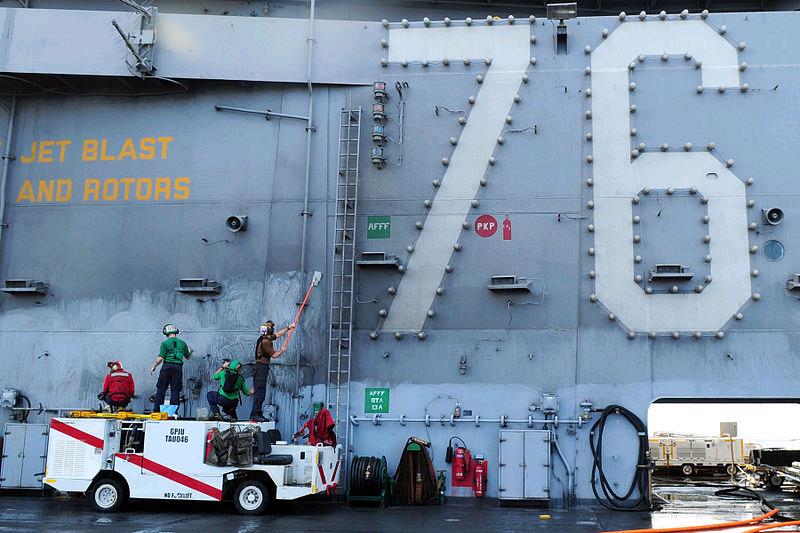
Consider the island superstructure on an aircraft carrier. Large white painted hull numbers take up about a quarter of the inboard and outboard faces of the island. They serve one purpose: identify the ship in order to comply with international regulations. The numbers are lined with dozens of light bulbs which can either be turned on or off. Aside from ceremonial ambience, it is difficult to see what value they provide.
Sailors scrub down the island superstructure on the flight deck of the aircraft carrier USS Ronald Reagan (CVN 76). They could be watching the latest episode of Game of Thrones. Image Courtesy: U.S. Navy photo by Mass Communication Specialist 3rd Class Shawnte Bryan/Released. Retrieved from: www.wikipedia.org.
If the lights and the painted numbers were replaced with digital displays, the Commanding Officer of the carrier would have several new options at his or her disposal. For one, the screens could be set to display any hull number or none at all. Obviously, removing or changing hull numbers would not hide the ship, but against a capable and professional enemy it might confuse their decision making process enough to delay or deter an attack. As an example, the US Navy today requires significant confirmation, often visual, to establish and maintain maritime domain awareness (MDA). If the same ship were to be reported in three different locations, mission effectiveness would suffer while watchstanders tried to sort out the discrepancy. Conflicting reports are like poison to a networked force. Even if the superstructure screens were blank, the CO may find advantage in denying the enemy useful intelligence. In World War II, the Pacific Fleet removed visible numbers from aircraft carriers and did not return them until the Japanese were no longer a threat.
An island superstructure screen could also be used as a visual aid for flight deck operations. The flight deck of an aircraft carrier is an extremely loud and dangerous work environment. It is often difficult for crews to hear anything but jet noise. Visual messages could supplement audible alarms to indicate emergencies, not only grabbing attention but also relaying critical information. Conversely, an outboard screen could aid in force protection efforts, particularly in precarious situations like anchoring in popular foreign ports. If a wayward sightseer saw his leisure craft on the screen with the word “STOP” written in several different languages, the message would be received loud and clear.
Digital displays can also be a cost-effective means of communicating messages over long distances. In an effort to move the Navy away from highly detectable radio communications, optical communication techniques are gaining attention, but they often rely on technologies such as laser, which require more research and development (R&D) investment. Digital displays offer the possibility of optical communications without any R&D required. For example, a popular manufacturing and advertising concept called a quick reaction (QR) code uses a matrix of black and white squares to store data, which can be read by a camera on a smartphone or other computing device. When large digital displays (such as the aforementioned “superstructure screen”) are coupled with high resolution digital cameras (another readily available technology), ships within sight of each other could communicate optically, much like age old flashing light or semaphore techniques, but with much higher data rates.
Since the interpretation of QR codes is automated, data rate is only limited by a computer’s ability to process each new code. Data rate, fidelity, and communications range will only increase as display and camera technologies improve. This concept could easily be applied to satellite communications, as shown above. Communication would depend heavily upon adequate visibility, but this “digital semaphore” technique could offer a cost-effective method of optical communication while recapitalizing some of the capabilities lost by the disestablishment of the Signalman rating in 2003.
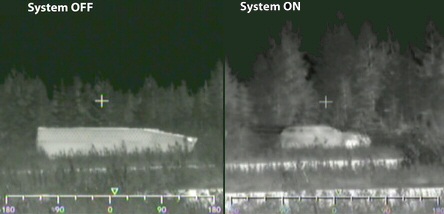
The visible version is not far off. In March 2012, Mercedes Benz made one of their new vehicles nearly invisible by covering it with flexible LED panels that displayed images from a camera on the other side of the vehicle. The aim of active camouflage in naval applications would not be to make a warship invisible, but rather to appear as a different kind of ship not worthy of the enemy’s attention. Displaying a false hull form instead of trying to make the ship invisible actually could reduce some technical challenges of active camouflage, such as the requirement to know the viewer’s look angle in advance. Furthermore, a warship has several other signatures, such as radar return and visible wake, which are impossible to eliminate completely.
To promote the environmental ‘invisibility’ of the zero-emission, hydrogen-fuelled Mercedes F-Cell, ad agency Jung von Matt covered the car in LED sheets which would display a live video image whatever was behind the car, as filmed by a camera attached to the other side. (Image Courtesy: Mercedes-Benz. Retrieved from: http://amazingstuff.co.uk/technology/invisible-car/)
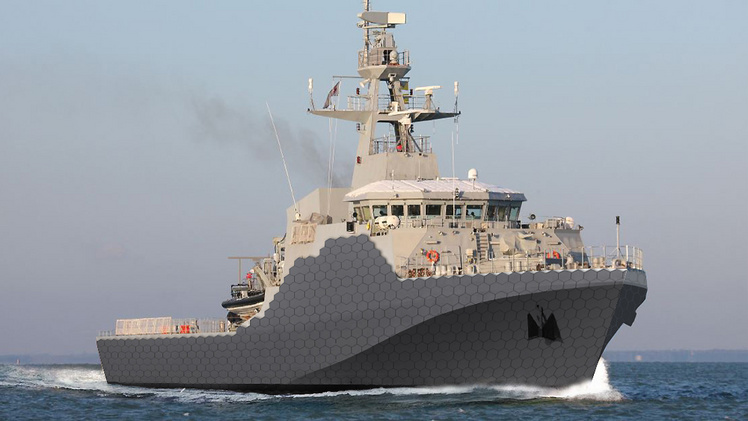
Although the technology still needs to mature in order to be feasible for use on ships at sea, the concept is simple (indeed BAE is already working hard to apply Adaptiv to warships at sea). A ship’s freeboard and superstructure could be covered in conformal LED paneling to display an image of a merchant or some other vessel, provided it is not protected by international treaties like a hospital ship.
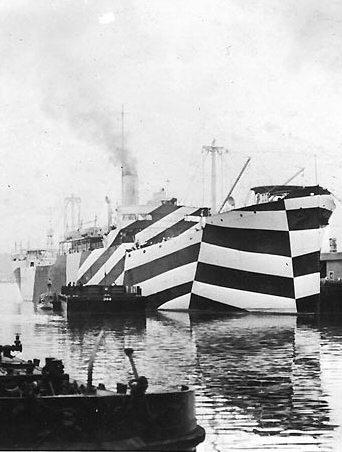
Naval active camouflage would be intended to fool routine enemy surveillance from near-horizon distance, not ships in close contact or aircraft conducting targeted search efforts. However, in combination with emissions control (EMCON) and careful maneuver (i.e. staying within shipping lanes and avoiding close approaches to enemy assets), the appearance of a merchant vessel on the horizon would fit the enemy’s expectations and cause him to focus his surveillance efforts elsewhere. Another potential use of naval active camouflage can be found in a historical example. In World Wars I and II, the Allies took inspiration from the art world and painted their ships with irregular patterns of contrasting geometric shapes, called dazzle camouflage, to confuse enemy rangefinders, particularly on submarines. Dazzle camouflage fell out of favor with the advent of radar, but today the digital version could prove valuable, particularly against low end threats. Without advanced fire control radars, terrorists and pirates rely on their vision to target or avoid naval warships, depending on their particular goals. Even without disguising identity, creative use of adaptive camouflage could make it nearly impossible for a threat to determine a warship’s true aspect, just like dazzle camouflage, and consequently, how to engage or maneuver effectively.
USS Mahomet (ID-3681) in port, circa November 1918. The ship has a “dazzle” camouflage scheme that distorts the appearance of her bow. Image Courtesy: Naval History and Heritage Command. Retrieved from: www.wikipedia.org.
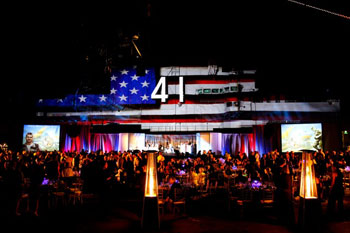
Using display technologies to make warships appear as something else is not a completely new concept for the modern US Navy. In September 2011 as part of the 5th Annual Midway American Patriot Awards gala, the island superstructure of the USS Midway was transformed into a waving American flag using a different kind of display technology called projection mapping. AV Concepts, Inc. used 3D projectors, advanced graphics software, and creative lighting techniques to virtually “paint” the flag onto the ship with stunning clarity and realism.
The American flag virtually draped over USS Midway using projecting mapping technology at the 5th Annual Midway American Patriot Awards. The projection of the flag onto the hull was so precise, some guests thought ship was covered with a flat projection screen. Image Courtesy: AV Concepts, Inc. Retrieved from: http://livedesignonline.com/excellenceawards/uss-midway-aircraft-carrier-projection
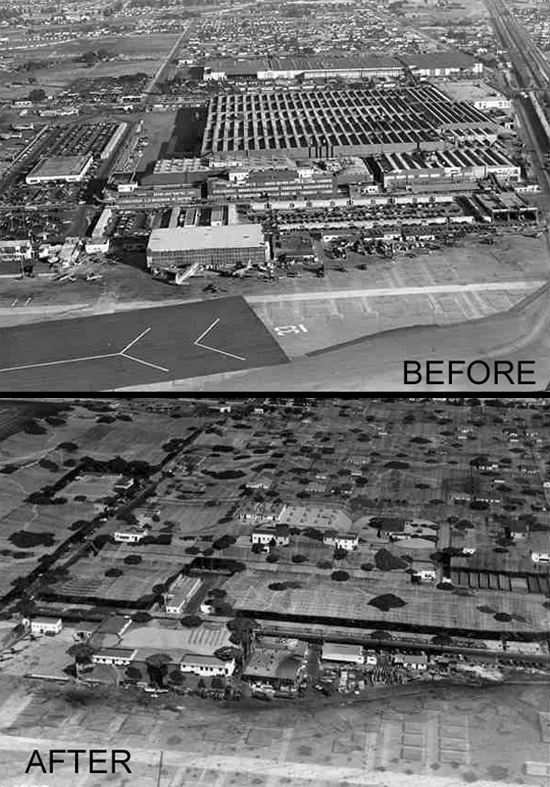
While not an ideal technology for afloat forces, projection mapping could be used to fool optical sensors by blending shore facilities into their surroundings. Again, history provides an intriguing parallel. After the 1941 raid on Pearl Harbor, Lockheed Martin desperately needed to hide its Burbank, CA aircraft plant from Japanese fighters. With the help of nearby Walt Disney Studios, they used canvas, paint, and chicken wire to cover the massive industrial facility with scenery of a quiet rural community. By employing a little artistic creativity, the Burbank plant was able to continue operations throughout the war. Blending this type of creativity with modern display technology could provide cover against today’s more advanced optical sensors.
An aircraft manufacturing plant disguised as a suburban Burbank neighborhood during World War II. With modern display and projection technology, the same concept could be applied to counter modern enemy surveillance efforts. Image Courtesy: Lockheed Martin Corporation. Retrieved from: http://www.themarysue.com/camouflage-aircraft-plant/#geekosystem.
The decreasing cost and increasing performance trends of proven display technologies offer the Navy a cost-effective way to generate revolutionary capabilities. Emerging technologies, such as electronic paper (e.g. E Ink® on Amazon’s Kindle®) and phased array optics[2] (think “the Holodeck from Star Trek”), promise to bring even more capabilities into the fold. Certainly, there will be challenges like increased maintenance requirements that must be considered to determine operational feasibility. Also, enemies will undoubtedly adapt to the capabilities described here, but simply affecting an enemy’s operations can have real value. Still, all of these capabilities are useless if the Navy does not have operational concepts for them. Without imagination and an innovative mix of art and science, the Navy will miss this opportunity to increase its combat power and, instead, give potential enemies a few more ways to bring parity to the world’s oceans.
[1] Unfortunately, the term “digital camouflage” is already in use to describe patterns on uniforms.
[2] The technology behind phased array optics is still several decades from reaching maturity.
This article investigates the effectiveness of various private arrangements with Nigerian security as well as some updates on the “usage” and liability implications for shipping companies utilizing such services.
Status of the use of Nigerian Navy and Police for private maritime security roles
Subsequent to my previous article, the Inspector General of the Police (IGP) has reiterated in writing to the Commissioners of Police (Maritime) in the relevant coastal states of Nigeria his policy that his personnel (the NMP) are not to be used outside their jurisdiction. Some agents and security providers have sought to side-step this restriction by alleging they had been granted permission to embark naval personnel. The Nigerian Navy’s position remains that any use of Nigerian Navy personnel without a Memorandum of Understanding (MoU) or in contravention to the terms therein is considered “unofficial allocation” and thus unauthorised. No evidence in writing, except the acknowledgement by various naval commands of receipt of enquiries, have been provided to back claims that the Nigerian Navy has reversed its previous stance that it has adopted since 2012.
[Photo: “Acknowledgement of receipt” provided by a security provider to a client as “evidence” of approval to embark naval personnel.]Embarked security teams vs patrol boats
Embarked security forces are a relatively new development in Nigeria. Traditionally, government security forces (in the Niger Delta) have utilized light craft for escort duties. Embarked teams were largely confined to platforms, which inside the EEZ constitute extensions of sovereign territory. Whether this approach was the result of a deliberate security planning process or not is now hard to establish, but it has had implications on how the navy’s light forces have evolved from their operational and tactical low point in 2006/7 until today and how the Nigerian Navy views its role in securing private assets in Nigerian waters.
Embarked security teams in Nigeria, where they exist, continue to share many attributes of the poorly trained and motivated forces that make up the bulk of Nigeria’s garrison army and land-based security forces. Adding this to the lack of aptitude (in terms of training, familiarization etc.) of those teams for the maritime environment, then it becomes clear that the question whether to use embarked security or escort vessels is more than a legal (or even financial) question; it is about the ability to deliver effective security and mitigate risks without creating (more than is necessary) new ones.
Embarked security teams
The record of embarked security forces on client vessels is in the Gulf of Guinea is mixed. Contrary to the Indian Ocean experience, vessel carrying embarked armed teams off Nigeria have been boarded and seized by attackers or crewmembers kidnapped, although this was most frequently the case in the context of the Niger Delta insurgency between 2006 and 2009 that targeted floating offshore installations, such as the FSO OLOIBIRI, the FPSO MYTRAS or the BERGE OKOLOBA TORU. However, the conditions and modus operandi that embarked teams continue to face in and off the Niger Delta remain similar and many target vessels today are in fact tankers that are stationary, drifting or engaged in ship-to-ship transfers and therefore tactically not more challenging to the attackers (who are for the most part ex-militants). If anything, the small product tankers are easier to board than the high-freeboard Floating Production Storage & Offloading units targeted by the militants during the insurgency.
The vulnerability of embarked security teams is even more pronounced for security vessels, especially those of an improvised nature with no mounted weapons, which are a requirement for those vessels approved by the Nigerian Navy under the current MoU. In the discussion on pirate violence in Nigeria it is often forgotten that almost half of the casualties to date in pirate incidents have been government security forces – usually embarked on vessels of oil & gas contractors. This has prompted the Nigerian inter-agency Joint Task Force in the Niger Delta to declare a ban on using such embarked teams from 19 November 2013 onwards in favour of river gun boats. Companies continue to ignore this at their own risk, as a recent example of an attack on a contractor vessel on the Sambreiro River on 17 June 2014 shows: one soldier and two crewmembers were injured before the attackers managed to snatch an employee of an oil company from the boat.
The embarked security forces’ shortfalls range from inability to detect and engage at night (when the bulk of attacks take place off Nigeria), inability to manoeuvre, and lack of co-ordination to poor weapons discipline. Poor motivation of the embarked soldiers and police officers in the face of aggressive and well-equipped attackers complement the picture. This pattern has not fundamentally changed since 2006/7.
Case Study 1: SP BRUSSELS
The fatality of one crewmember on board the PYXIS DELTA roads during a shoot-out between her embarked security detachment and attackers on Lagos roads the night of 4 February 2013 was brushed off as a tragic accident. The attack on the Marshall Island-flagged product tanker SP BRUSSELS off the Niger Delta on 29 April 2014, however, highlighted the risks associated with embarking armed teams in the Gulf of Guinea, especially off Nigeria. These risks are commonly misunderstood by people who believe that armed teams have the same effect in the region as they have in the Indian Ocean. This is not the case.
The SP BRUSSELS’s chief engineer paid for this misunderstanding with his life; the 3rd officer narrowly escaped when the ship’s bridge suddenly turned into a shooting gallery. While, arguably, the guards prevented the ship from being hijacked, they did so at a price. Given that none of the 38 successful tanker hijackings since the VALLE DI CORDOBA incident in December 2010 in the Gulf of Guinea had resulted in a fatality, this was an avoidable result.
From the confused crew accounts of the attack on the SP BRUSSELS and the Nigerian Navy’s investigation several things become clear:
The vessel was transiting in international waters with two embarked Nigerian policemen (NMP) as security guards. At the time of the attack (ca. 2015 hrs) by a single speedboat and a total of 8 attackers, the ship was idling at 6 kts approximately 35 nm from the Bayelsa coast, SW of Forcados (Delta State), a notoriously dangerous area off the Niger Delta at the time.
Of the 2-man team, one was on watch, smoking at the time of the attack in the starboard bridge wing (the attack unfolded on the port side, leading to the death of the chief engineer)
There was no general alert and the second guard had to be roused by a crewmember. By the time he arrived on deck it appeared some attackers had already boarded.
The guard team appears to have made their stand on the bridge, possibly killing two pirates in the process while the ship’s crew hid in the citadel (with the exception of the injured 3rd officer and the dead chief engineer).
The actual course of events until the next morning remains controversial, with the Nigerian Navy alleging that their intervention by NNS BENIN and NNS IKOT-ABASI had resulted in the defeat of the pirates and the subsequent arrest of the 6 surviving attackers.
The chief engineer’s exact circumstances of death are uncertain as is the injury of the 3rd officer, as he fled the bridge.
[Photo: Damage to the bridge of SP BRUSSELS from the firefight on the bridge. (Source: withheld)]The ship was eventually taken into custody by the Nigerian Navy on Lagos roads the following morning and detained for several weeks as a part of the investigation, which also extended to the question whether or not the ship had been permitted to carry NMP personnel outside their jurisdiction.
Case Study 2: SEA STERLING
The Nigerian-flagged product tanker SEA STERLING was attacked on 26 August 2014 west of the Pennington Loading Terminal, 45 nm SSE of the position in which the SP BRUSSELS had been attacked in an area, which to date in 2014 had experienced no less than 3 kidnappings, a hijacking and at least 7 attacks against product tankers – the majority in January-March 2014.
The SEA STERLING carried a team of three Nigerian Navy ratings, procured through a PMSC that had recently set up business in Nigeria and held the same MoU with the Navy like all 42 security companies, which, as mentioned above, only permits the use of navy personnel on “suitable” and “approved” vessels, i.e. patrol boats which are entered into the Nigerian Navy’s list of warships.
[Photo: The SEA STERLING on Lagos roads in April 2014. (Dirk Steffen)]Like other episodes, which have aroused the suspicion of Nigerian authorities, the contrasting versions of the incident do not quite add up. The ship allegedly spotted a bunker barge trailing her at 1810 hrs and then claimed to have been pursued until 2100 hrs at which point a speedboat was lowered and approached the tanker. The distress signal was sent at this point, although the ship’s AIS had been switched off at 1812 hrs, indicating a speed of 6.2 knots at the time and a destination port of Lomé, rather than Onne, which was claimed to be the vessel’s destination. There ensued an on-and-off engagement in which the attackers subjected the ship to suppression fire – allegedly with two belt-fed weapons – and at least two individuals boarded the tanker.
A privately contracted patrol vessel (name withheld) from an adjacent oil field responded to the distress call and arrived on the scene at 2345 hrs, firing several warning shots which prompted the boarders to disembark, return to the bunker barge and flee the scene of the crime. The ship was inspected by the naval craft, but lacking further authority could not prevent from SEA STERLING departing from the area in the early hours of 28 August with her AIS still switched off.
Patrol boats: opportunities and limitations
In a report of Gulf of Guinea tanker hijackings Risk intelligence identified at least 11 cases between December 2010 and August 2013 which involved a local or international naval response with warships, either as part of a patrol scheme or in response to an ongoing attack. This figure does not include incidents where local navies were called and did not respond or react. In six of the seven “prevention cases” the naval forces were successful in disrupting the attack; in one case two Beninese naval vessels were too late to intervene in order to prevent a hijacking. This was in part owed to the ship under attack – the RBD ANEMA E CORE (hijacked on 24 July 2011 off Cotonou) – waiting too long before sending out a distress call.
Once pirates have boarded a ship, the scope for any intervention is much reduced, as the “response cases” show. The unsuccessful sortie of the Togolese Navy in response to the attack on the ENERGY CENTURION on 28 August 2012 off Lomé stands out as an example of local navies’ inability to ensure security of the patrolled zones and to respond effectively at the same time. This argument has been made before, but since that very early stage of the (then very vaguely defined) Togolese secure anchorage, this type of failure has not been repeated.
The inability of local naval forces to provide a timely and effective response is a key argument for those promoting embarked security forces, even though dedicated escort is available both in the Secure Anchorage Area and the Bonny River Convoy. Neither of those two secured operations has so far experienced a successful pirate attack. Patrol boats can also be hired directly, but the cost is a multiple of the embarked team, which serves as a commercial deterrent and is more likely to be the key argument in favour of the embarked security forces.
[Photo: NNS IKOT-ABASI, pictured here on Lagos roads in April 2014, responded to the distress call made by the SP BRUSSELS. (Dirk Steffen)]On balance, however, experience of the past 2-3 years has shown that attackers usually desist or abandon their endeavours in the presence of patrol boats – be they actual navy vessels or privately contracted look-alikes. The drastic, most likely punitive, killings of 13 of the 16 pirates who boarded the Nigerian-owned tanker NORTE (with a cargo owned by the Nigerian National Petroleum Company) on 17 August 2013 is thought to have had an impact on the mindset and modus operandi of would-be tanker hijackers in terms of that it will become more likely that attackers will resort to using human shields while retreating to the safety of the creeks in the Niger Delta. Equally, restraint by the navies (as was the case in the hijacking of the ADOUR on 13 June 2013, although this was an intervention after the deed, not one that resulted from a failed protection mission) can ensure safety of the hostages in case of a successful boarding by pirates.
Liability
In terms of liability and externalisation of risk, the patrol boats have some advantages over the embarked navy teams. Since even the contracted patrol boats are under navy operational command, law suits for loss of life of navy personnel or damage to navy property will be unlikely, especially inside territorial waters. Conversely, a major European charterer is currently being sued by the Nigerian government over the death of a policeman who was killed while being part of an embarked team.
The possibility of the patrol boat directing its fire against the client vessel (for example to prevent a boarding) is a real risk and probably the gravest. So far, this has not occurred in the Gulf of Guinea. On the other hand, several casualties have occurred as a result of embarked security teams being involved in the defence of merchant vessels. While, it is unclear who actually shot the 3rd officer on the SP BRUSSEL’s bridge, the use of Nigerian Police Force personnel outside their jurisdiction and outside territorial waters had wider-ranging implications for the vessel’s insurance and potentially also opens up the way for a lawsuit by the deceased chief engineer’s relatives against the shipping company.
Many of these liability issues are at the moment only being superficially considered by shipowners and operators especially when arrangements for the provision of embarked security forces are made or implemented in breach of existing legislation or other “policies” promulgated by the security agencies – also referred to as “unofficial allocations” in Nigerian Navy parlance. In this regard, it must be noted that every marine insurance policy has an implied warranty that the voyage is lawful. Thus, having embarked armed guards (or a patrol boat escort as well for that matter) without an express provision in the insurance policy to cover such operations, and that such operations conform to applicable law, may render a lawful voyage potentially unlawful, which in turn may invalidate the policy and discharge the insurer(s) from the liability.
As far as claims by the Nigerian government are concerned, the Nigerian Navy and Police Force may be confronted with a situation in which they will not be indemnified for suffering losses for providing a service inside territorial waters which they would be obliged to render anyway (maritime security) even without pay. However, it is evident that the Nigerian government intends to pursue shipowners or charterers for compensation regardless.
Conclusion
In spite of both local and foreign (even if incorporated in Nigeria) security providers’ attempts to exploit the legal loopholes and lack of inter-agency co-ordination and enforcement of security agencies’ policies, the use of embarked Nigerian security forces in Nigerian waters or offshore Nigeria remains fraught with risks which appear to outweigh the benefits. The use of such teams is frequently an excuse for neglecting other security measures and, understandably, a product of cost and expedience.
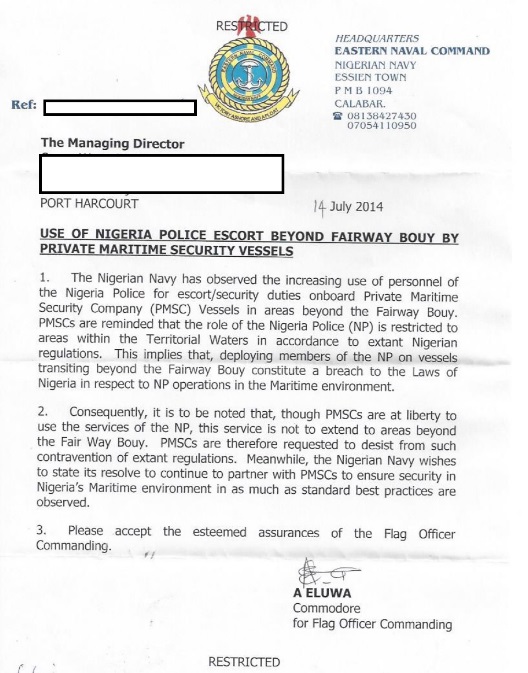
The Nigerian Navy remains committed to promoting its own vision of providing localised security through (often privately operated) patrol boats and secured areas and will continue to apply political leverage to that effect, therefore creating a tangible risk for all “unofficial allocations” of government security personnel. As evidenced by the IGP’s directive and the Flag Officer Commanding Central Naval Command’s written approval for the use of NMP inside their jurisdiction on contractors’ security vessels, the Nigerian Police Force’s policy is not as divergent from the Navy’s as it is frequently portrayed.
Photo: Letter by the Flag Officer Commanding Central Naval Command authorizing the use of Nigerian Police inside their jurisdiction on contractors’ security vessels.
The current lawsuit over the death of a Nigerian policeman also illustrates that the “official” Nigerian policy takes a dim view of what little regulation exists being undermined by foreign shipping companies and charterers through the use of what are effectively rogue security teams. Whether or not the security agencies’ policies are driven by particular (pecuniary) interests rather than by an overarching security strategy is immaterial with regards to the risks that parties run when ignoring these “official” policies, which are de facto enforced, in favour of “unofficial arrangements”.
Dirk Steffen is the Director Maritime Security for Denmark-based Risk Intelligence. He has been covering the Gulf of Guinea as a consultant and analyst since 2004.
Next week is our one-year birthday at Sea Control! Considering leaving a comment and five-star rating on Itunes, Stitcher Stream Radio, etc… Remember to subscribe and recommend us to your friends!

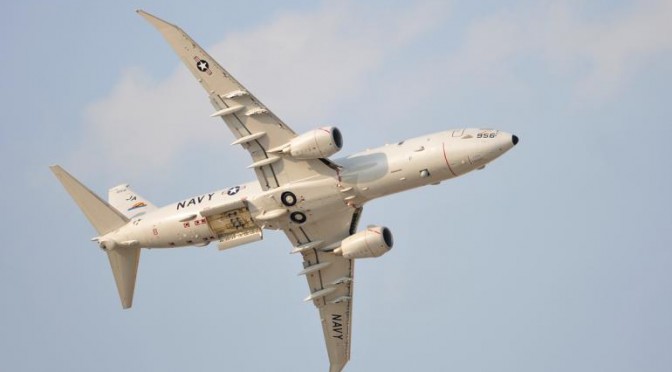
 These two examples illustrate that Malaysia’s military cooperation activities with other countries are often on an as-and-when basis, rather than occurring as part of a highly formalized arrangement. As Malaysia wishes to preserve its ambit of neutrality, any activity has to be offered in such a manner so that Malaysia can decide whether to allow it based on such criteria and whether the timing is suitable – requests to do something during the fasting month of Ramadan or the Eid Fitri celebration period for instance are typically going to be denied.
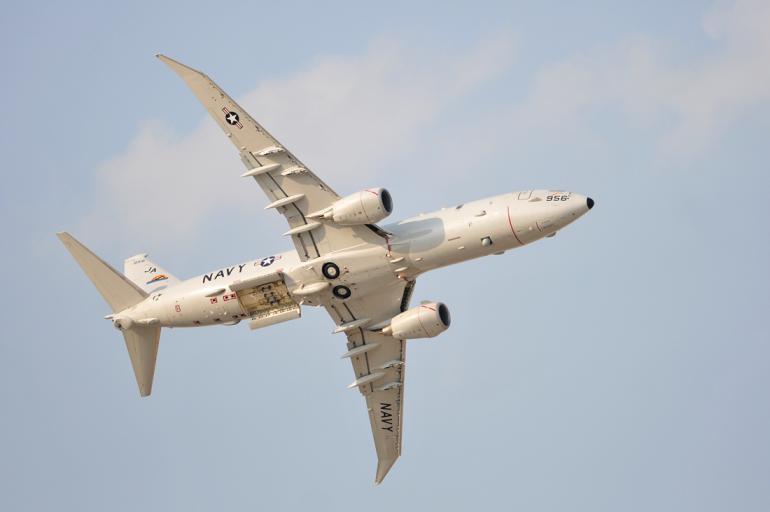 Still, for some in the media it makes a nice story to say that Malaysia is offering the United States a base to stage P-8 flights as an attempt to counterbalance China and in response to Chinese maneuvers near East Malaysia and its waters. But the reality is that the Malaysian government hasn’t very much changed its position that it can resolve issues diplomatically with China. The New York Times report quoting “a senior Asian diplomat” saying that Malaysia has been in discussion with the United States on such has to be considered in context. There are some Asian countries that might see it as advantageous to draw a wedge between Malaysia and China, and thus tell the media something that may not be true for such a purpose. It also illustrates the danger of relying on a single source to determine the truth.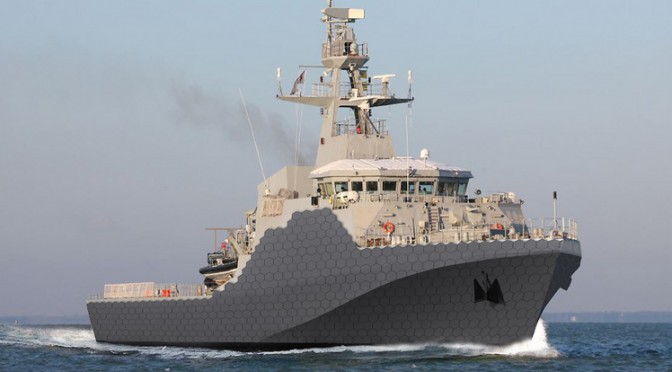


![[Photo: “Acknowledgement of receipt” provided by a security provider to a client as “evidence” of approval to embark naval personnel.]](https://cimsec.org/wp-content/uploads/2014/09/security-receipt.jpg)
![[Photo: Damage to the bridge of SP BRUSSELS from the firefight on the bridge. (Source: withheld)]](https://cimsec.org/wp-content/uploads/2014/09/Brussels-damage.jpg)
![[Photo: The SEA STERLING on Lagos roads in April 2014. (Dirk Steffen)]](https://cimsec.org/wp-content/uploads/2014/09/Sea-Sterline.jpg)
![[Photo: NNS IKOT-ABASI, pictured here on Lagos roads in April 2014, responded to the distress call made by the SP BRUSSELS. (Dirk Steffen)]](https://cimsec.org/wp-content/uploads/2014/09/IKOT-ABASI.jpg)
 James Bridger interviews Marko Hekkens on the EU project to build partner capacity in Africa and fight piracy-