Thoughts on Grand Strategy

This article originally featured on The Navalist and is republished with permission. Read it in its original form here

By LT Robert “Jake” Bebber USN and Professor Richard J. Harknett

The United States has been operating without a Grand Strategy for nearly 25 years. First, it was essentially on auto-pilot in the immediate aftermath of the collapse of the Soviet Union (the grand strategic endstate of containment) and then post-9/11 it became tactically oriented in reacting to global terrorism. Over the past 16 years, a flux in the distribution of power internationally has begun as the United States has relied on coercive force in an attempt to manage terrorist capacity and its gap in power is not guaranteed to be sustained without a strategy to do so. Great powers rise and fall because, over time, they tend to choose policies which accelerate the balancing dynamic of other competing states. Today, while the United States remains the leading state in an imbalanced global system, traditional realist theory suggests that international systems tend toward balance and we should expect a turn to a multipolar world. The National Intelligence Council’s January 9th released quadrennial Global Trends Report suggests a similar conclusion.

This is not preordained, however, if U.S. policymakers were to return to leveraging true American strength. The United States is still a relatively young Great Power and can choose policies that can stretch its advantages. Thus, while actors will balance against it, the United States can remain preponderant for some period of time. This is because it enjoys its position as a foundational power, rather than a coercive power. The majority of the world benefits from the foundations that have been laid in the aftermath of the Second World War and, therefore, there is significant incentive to buy-in and work within the current American-led incentive structure–most states are rewarded by the imbalance and thus it is not the driving force that traditional analysis suggests. This gap in power is tolerable to a majority of state and non-state actors because it is leveragable by them.

However, perpetuating an imbalanced system where the U.S. remains the foundational power will not sit well with actors like China, Russia, Iran and a few other revisionist actors. Indeed they are all working hard to challenge the current system to make their own rules and pursue their own interests. 

Yet the incoming administration may have an opportunity to fundamentally reorient the pieces on the grand strategic chessboard, and perhaps retain a position of strength that has been ebbing over the past few years. It appears that the President and his team are open to a different view of Russia as a great power. They seem amenable to Mr. Putin’s realist view of the world, and his naked pursuit of Russian interests.

At the same time, Mr. Trump’s comments about Communist China, and his apparent willingness to rethink America’s “one-China” policy seem to indicate that on some instinctual level, Mr. Trump considers the PRC to be a greater threat than Russia. On that matter, he is probably correct. Russia is essentially a vulnerable great power heading in the wrong direction. Communist China, on the other hand, while facing its own internal inconsistencies, has the capacity to challenge the United States in terms of economic, military and political power.

Quite simply then, the new Administration may be in a position to reverse the realignment of the Nixon era (but in Nixonian fashion) and enter into a tacit alignment with Russia as a geopolitical balance against Communist China, thereby sustaining the imbalanced system. There are a number of reasons why this might be advantageous to both the United States and Russia, but we should acknowledge up front that it will not come without significant cost. And this is not the mere “reset” that was recently attempted. In geopolitical terms, this is effectively bringing Russia into the western orbit.

The core unknown is whether Russia can be a satisfied great power in an imbalanced system? The answer is possibly yes, if its status is based on seats at the table of global governance, it is convinced that it is not susceptible to outside aggression or collapse, and that its particular form of domestic governance can persist.

Russia is a weakening great power on its current course demographically and economically. A new relationship would have to emphasize that there is a fundamental benefit to Russia of leveraging U.S. foundational power, rather than risking the cost of opposing U.S. coercive power. Russia should understand that challenging that coercive power would lead to its swifter demise. It lost the first Cold War and the U.S. can actively isolate it again and turn the energy (oil price) weapon against it if the Russians want to challenge the U.S. This is not a containment for containment sake argument, but rather an invitation to Russia to become a western power coupled with a hard power argument of the consequences that would follow from not accepting the invitation. What needs to be made clear is that the Russian hope of undermining western institutional legitimacy will not be tolerated anymore, but that there is an alternative to competition. This is a “tough love” message, but one in which Mr. Trump and his Secretary of State designee Rex Tillerson may be uniquely qualified to deliver.

In order for this to happen, Mr. Trump will have to convince Mr. Putin that Russia has a “losing hand” as it were, and that Communist China is a greater long term threat to Russia than the United States or the west. Russia is currently under severe economic sanctions from the west due to its invasion of Ukraine and seizure of Crimea, and while Mr. Putin remains popular for now, even he knows that the Russian people will not tolerate for long growing economic depravity. Mr. Trump can effectively say, “I can get you out of this mess.”

And indeed there is growing concern even within Russia of China’s overt interest in the sparsely populated, but resource rich Siberian expanse. The Russian people are intimately familiar with several thousand years of history, to include numerous invasions from the Asian steppe hordes. Of course in recent history, Communist China attacked the Soviet Union in 1969. Russia is beginning to note the frequency with which Communist China now talks of reclaiming the territory lost during its “Century of Humiliation” – much of that territory being taken by Imperial Russia. (This includes the city of Vladivostok which was ceded to Russia by Imperial China in 1858.)

Can a Trump Administration conduct a strategic realignment with Russia? While the West will be under pressure to “negotiate a deal” likely involving forswearing further NATO expansion or the integration of former Soviet states into the EU, it should resist this temptation. Remember, Russia has a losing hand in this relationship, and is contracting both demographically and economically. Rather, Mr. Trump has to convince Mr. Putin that any lifting of sanctions will be followed by American investment which would effectively “stop the bleeding” in Russia. However, there would be no rollback on NATO – the Baltics and Eastern Europe are not going to be discarded. One clear question is the motivations of Mr. Putin: does he want Russia to retain global recognition as a great power and will cut a deal to do so, or is he too much a product of his KGB legacy and sees the “West” as an unremitting enemy with which no deal is safe? He will recall promises of the 1990s that were not kept, so trust building will be essential. The choice of Mr. Tillerson as Secretary of State could be critical in establishing that trust. 

For the United States, bringing Russia into a Western orbit could provide significant advantages. First, it diverts the PRC’s attention back to its 2,600 mile long border with Russia. This will require the PRC to reconsider its reorganization of the People’s Liberation Army (PLA), perhaps away from building a power projection force back to a land-oriented border protection. And the PLA still relies largely upon Russian designed and supplied military equipment, which would hopefully be curtailed or stopped.

Second, it advances the goals of the United States relative to India and Vietnam, who also maintain a friendly relationship with Russia and heavily relies on Russia as a military supplier. India has historically been non-aligned, though friendly to the former Soviet Union/Russia. A rapprochement between the U.S. and Russia relieves a source of tension with Vietnam and India, and opens the door for an alignment between the world’s two most populous democracies and a former war enemy of China.

Third, it does permit the U.S. and Russia to resume and enhance counter-terrorism relationships. It may even open opportunities for the United States and Russia to conduct joint operations in the Middle East against ISIS. To be clear, Russian insistence that the Assad regime remain in power would have to be dropped. However, the U.S. and Russia can probably find a mutually acceptable third party to rule in Syria over time

As of yet, there is no evidence that the incoming Administration is thinking along these lines. It would require a deft bit of diplomacy and “deal making” to convince Russia to throw its lot in with the United States as opposed to remaining the junior partner to the PRC (whether or not Russia realizes it is the junior partner is an open question). However, the warm words exchanged between the incoming Trump team and the Kremlin may be an opportunity. How unsubstantiated reports of deeper campaign Trump-Kremlin ties will impact moving forward is unknown, but in a world in which perception is reality, a President Trump would now have to pursue such a realignment strategy more openly than Nixon did with China. If they could pull it off, future relations with Communist China could look very different than the current trajectory it is on right now.

To quote Star Trek VI, there is an old Vulcan proverb that “Only Nixon could go to China.” Well, perhaps “only Trump could go to Russia.” We shall see if he can seize this opportunity.

LT Robert “Jake” Bebber USN is a Cryptologic Warfare Officer assigned to the staff of U.S. Cyber Command. He holds a Ph.D. in public policy from the University of Central Florida and welcomes your comments at jbebber@gmail.com.

Professor Richard J. Harknett is the former Scholar-in-Residence at U.S. Cyber Command and currently an inaugural Fulbright Scholar in Cyber studies at University of Oxford, United Kingdom. He can be reached at richard.harknett@uc.edu.

The opinions expressed here do not reflect those of the Department of Defense or U.S. Cyber Command. The authors offer an academic-based explanation for possible policy change, rather than personal advocacy or rejection of any possible policies.
The Final Frontier – The Future of Defending Space as a Global Commons (Pt. 2)

By Tuan N. Pham

Part 1 of this two-part series outlined a conceptual framework for characterizing the dynamics that contribute to instability and stability in the space domain. It made the case that instability arises when there is a real or perceived lack of order and security with the worst possible outcome being the “Thucydides Trap” – a rising power opposes a dominant power leading to a great power competition for space preeminence. On the flip side, it also made the case that stability arises when there is a real or perceived sense of order and security with the best possible outcome being the universal acceptance that “space is big enough for everyone and it is in everyone’s best interest to keep it free for exploration and use by all.” With this backdrop, Part 2 will focus on the ways and means the United States can employ to reduce instability and reinforce stability in the space domain while maintaining space preeminence into the 21st century.          

U.S. Space Stability Challenges

Preeminence Puzzle. As the guarantor of the global economy and provider of security, stability, and leadership because of its powerful military and vast network of allies and partners, the United States delivers global public goods that others cannot. A case in point is the current volatility of the South China Sea. Without the stabilizing presence of the U.S. Navy operating on the high seas there, Chinese assertiveness and unilateralism could destabilize the region, damaging both regional and global commerce and possibly leading to an unwanted conflict. Thus, there is a strong need going forward for a comparable guarantor of the freedom of space (a net provider of space security) to ensure the free flow of space commerce, a leadership role that calls out to the United States, supported by allies and partners, to fill.

Just as maritime preeminence is necessary to guarantee the freedom of the seas, so too is space preeminence needed to guarantee the freedom of space. By committing to space preeminence, America will better protect its critical strengths in space; enhance its space deterrence posture by being able to impose larger costs, deny greater benefits, and encourage more restraint; prolong its terrestrial preeminence; and reverse the growing perception of American decline.

Decline is a deliberate choice, not an inevitable reality. Having complementary policies and strategies in contested domains fosters unity of effort, optimizes resource allocation, sends a strong deterrent message to potential adversaries, and reassures allies and partners. To do otherwise invites strategic misalignment and miscommunication and encourages potential competitors to further advance their counter-balancing efforts. Put simply, if the United States does not preserve its current strategic advantages in space, a rising power like China may gradually eclipse America as the preeminent power in space which will have cascading strategic ramifications on earth.

This greater role will demand more analysis and planning to address the anticipated challenges of domestic fiscal constraints; emerging and resurgent space powers; potentially destabilizing space competition; escalation control; and establishing and maintaining partnerships for collective space security through risk sharing and burden sharing – similar to the challenges now facing the U.S. rebalance to the Indo-Asia-Pacific. The puzzle for American policymakers is whether it may be more cost-effective to invest now and maintain the current strategic advantage in space or pay more later to make up for diminished space capabilities and capacities while accepting greater strategic risk in the interim.

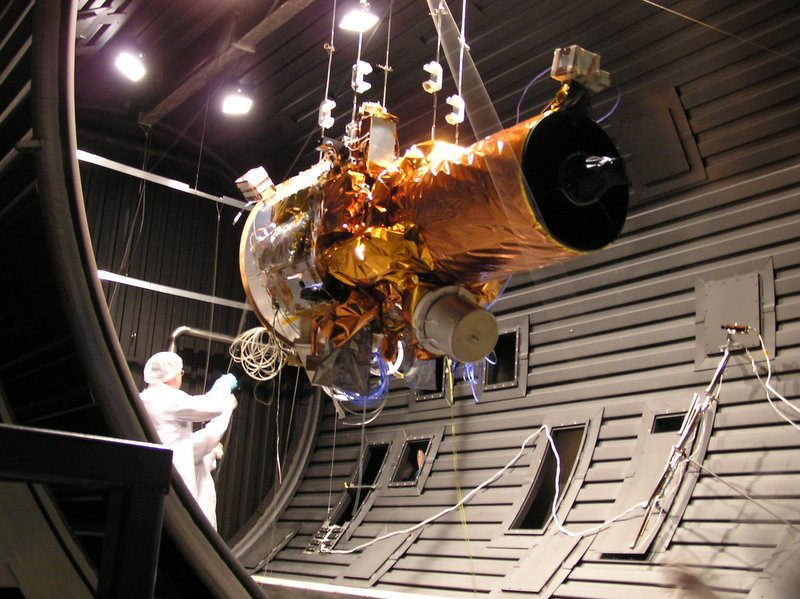
Workers prepare the TacSat-2 micro satellite for thermal vacuum testing at the Space Vehicles Directorate. (Air Force photo) 

Domain Dilemma. America fundamentally has two space deterrent and response options – (1) threaten to respond in the same domain; (2) threaten cross-domain retaliation to underwrite the deterrence of attacks on U.S. space capabilities. The former represents a vertical escalation if the response is disproportionate to the attack, and possibly “some” horizontal escalation depending on the target sets. This could result in large amounts of space debris and the resetting of international norms of behavior by legitimizing space attacks. The latter option represents a vertical escalation if the response is “perceived” as disproportionate to the attack, and horizontal escalation respective to the other domains. Nonetheless, the scope, nature, and degree of action must ultimately strike the delicate balance between the need to demonstrate the willingness to escalate and the imperative to not provoke further escalation in order to maintain space stability. The dilemma for the United States is where, when, and how best to deter; and if deterrence fails, where, when, and how best to respond.  

Reliance/Resilience Riddle. Enhancing and securing space-enabled information services (SEIS) is now essential to U.S. national security, a daunting task considering that space has become more and more “congested, contested, and competitive” and less permissive for the United States. Therefore, the current strategic guidance – 2010 National Space Policy (NSP), 2011 National Security Space Strategy (NSSS), and 2012 DoD Space Policy (DSP) – directs the U.S. government to reduce the nation’s disproportionate reliance on space capabilities and the vulnerability of its high-value space assets through partnerships and resiliency, respectively. The riddle for America is how best to manage the dichotomy between reliance and vulnerability through resilience.

Offensive Counter-Space (OCS) Conundrum. Space warfare is intrinsically offense-inclined due to the uncertainty, vulnerability, predictability, and fragility of space assets; and ever-increasing OCS capabilities to deceive, disrupt, deny, degrade, or destroy space systems. The latter can be destabilizing (warfighting capability) or stabilizing (deterrence) depending on one’s perspective. Hence, the conundrum for the United States is not whether or not to possess OCS capabilities – but how best to use them to deter and retaliate if deterrence fails; what type, how much, and to what extent should they be publicly disclosed; and how to leverage the existing international legal framework and accepted norms of behavior to manage them without constraining or hindering one’s own freedom of action.

Moreover, OCS capabilities continue to grow in number and sophistication driven by the “offense-offense” and “defense-offense” competition spirals influencing military space policies in Washington, Beijing, Moscow, and elsewhere. OCS developments to defeat defensive counter-space (DCS) measures drive further OCS developments for fear of falling behind in offensive capabilities and encouraging a first strike by an adversary, while DCS developments to mitigate OCS measures further drive OCS developments to remain viable as deterrent and offensive tools.     

Refining Military Space Capability  

Develop Cross-Domain Deterrence Options. Deterrence across the interconnected domains may offer the best opportunity to deter attacks on U.S. space capabilities, and if deterrence fails, retaliate across domains to deter further attacks. Prudence then suggests the need for some level of active planning prior to the onset of increased tensions and hostilities. American policymakers and defense planners should have on hand a broad set of potential cross-domain responses to the threats of space attack or the space attack itself. The responses should be organized by the levels of force application, provocation, and risk; dynamic enough to accommodate the ever-changing strategic, operational, and tactical conditions; and part of a larger menu of policy options to better manage tensions and escalation during pre-hostilities and identify off-ramps during hostilities. On balance, the decision on whether or not, when, and how to implement these responses should be viewed through the lens of cost and risk imposition, proportionality, strategic policy coherence, and desired outcome.        

Continue to Increase Resiliency. Strengthening the resiliency of the U.S. national security space architecture may offset the offensive inclination of space warfare by lessening the vulnerability and fragility of space assets, assuring retaliatory capabilities, and denying benefits of OCS operations.

Building up space protection capabilities will decrease the vulnerability and fragility of high-value space assets by presenting more targets (disaggregated space operations, micro-satellites), hiding targets (signature reduction), maneuvering targets (dynamic orbital profiles for unpredictability and threat avoidance), hardening targets (strengthened space assets and networks against kinetic and non-kinetic attacks), and complicating targets (hosted payloads on commercial, civil, and allied or partnered nations satellites).

Mission assurance can be sustained by responsive launch capabilities (launch-on-demand services for rapid reconstitution of degraded or lost space capabilities), Operationally Responsive Space (ORS) program (mass production of microsatellites in a short period of time), and “sleeper” orbiting satellites (standby spares that will activate when needed).

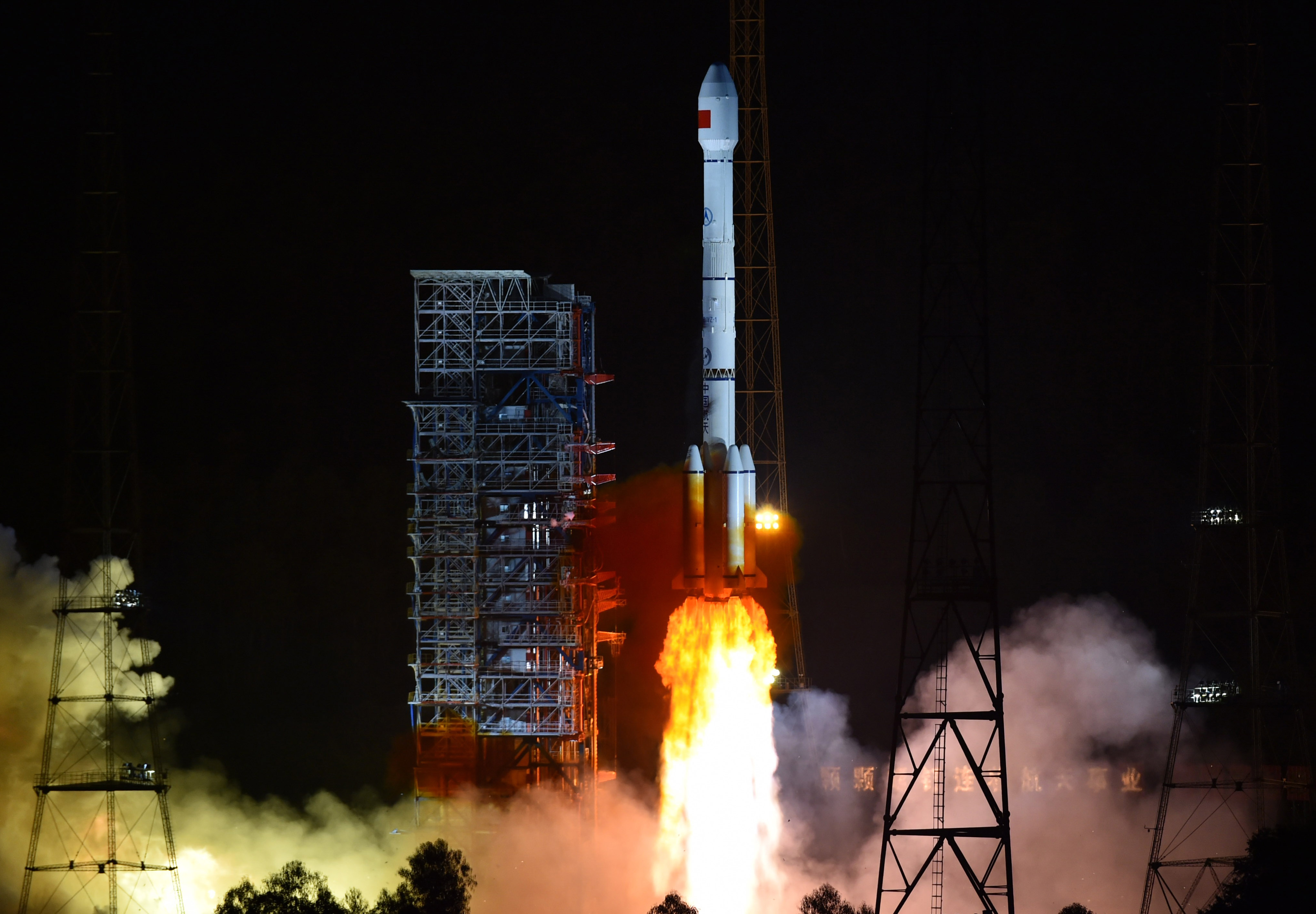
Launch of Chinese military communications satellite (Xinhua)

Mission continuity in a degraded, disrupted, or denied space environment can be ensured by the following measures: developing standard operating procedures for continuity of operations; hosting some SEIS in commercial, civil, and allied or partnered space systems as part of a surge in space capability and as a measure of redundancy; building and sustaining alternative terrestrial-based systems to reduce SEIS reliance – chip-scale combinatorial atomic navigator for precision, navigation, and timing services; high-altitude long-endurance unmanned aerial systems for persistent ISR; and fiber-optic cabling and terrestrial radio and microwave communications devices for secured C2.  

Continue to Invest in OCS Capabilities. The heart of the matter remains what type of OCS capabilities (reversible, irreversible, or both) and how much. Regarding the latter, some argue none or limited quantities are required while others call for robust OCS capabilities. Whatever the right answer may be, it is difficult to see how one can deter or retaliate if deterrence fails without “some” OCS capabilities, especially considering that potential competitors like China and Russia are actively developing their own OCS capabilities to challenge U.S. space preeminence, and by extension, terrestrial preeminence.

Strengthening Space Governance

Since the elimination of OCS capabilities is unlikely, attention and effort should be placed on managing them instead. The extant international legal framework and accepted norms of behavior offer some ways and means to reduce OCS capabilities to a manageable level, restrict their proliferation, and establish constraints and restraints on their employment. The space powers should review the existing international agreements and legal principles, and determine what additional conventions or provisions are needed. Goals can be to set acceptable limits of OCS capabilities; renounce the first-use of OCS; establish confidence-building measures; and limit the possession of OCS capabilities to select space powers and out of the hands of “pariah” states (North Korea and Iran) and undesirable non-state actors (terrorist, criminal, and business groups).  

Space powers should also review and update current treaties and legal principles to govern the changing strategic, operational, and tactical landscapes, particularly those overseeing activities in space, registration of space objects, and space sovereignty. States should negotiate new treaties to manage emerging space challenges like space debris, RF interference, and other space threats. Finally, parties must develop new capabilities and protocols for verifying treaty compliance and enforcement.               

The international community should seek to empower the United Nations (UN) governance of space and space activities, particularly in the areas of regulation, arbitration, and collaboration. The UN should consider further defining and codifying the rights and responsibilities of nation-states with respect to their activities in space through a UN Convention on the Law of Space (similar to the UN Convention on the Law of the Sea); establishing the International Space Authority (similar to the International Seabed Authority) for the regulation of space-based resources; and forming the International Tribunal for the Law of Space (similar to the International Tribunal for the Law of the Sea) for arbitration of space-related disputes. Transform the UN Office for Outer Space Affairs into an empowered World Space Council to promote international collaboration in space, manage emerging space challenges, and act as a forum for global contingency planning and preparedness for potential space threats.

Expand Partnerships. The 2010 NSP, 2011 NSSS, and 2012 DSP call for building enduring partnerships with other space-faring nations, civil space organizations, and commercial space entities to share benefits, costs, and risks; strengthen extant alliances through increased cooperation across the various space sectors; spread SEIS reliance to others; and provide greater space deterrence and stability through collective defense. That being said, partnerships also carry with them risks and concerns. Risks include the unpredictability of horizontal escalation (attack on U.S. space assets with hosted payloads involves other parties) and greater potential damages and unintended consequences (more interdependent players and things that can go wrong). Concerns center around autonomy (transparency, response, and responsiveness constrained by other parties), operational security (information sharing, technology transfer, and increased risk of insider threat), legality (intellectual property rights, loss compensation, and sovereignty), and the interoperability of disparate space systems (varying levels of sophistication amongst partners). All things considered, the benefits outweigh the risks, and concerns are manageable in varying degrees.

Partners should build on extant bilateral/multilateral partnerships to complement and supplement U.S. space capabilities. They must leverage emerging opportunities like the Memorandum of Understanding between the United States, Canada, United Kingdom, and Australia for joint space operations and Japan’s plans to develop a military space force by 2019. These partnerships may vary in nature, scope, and extent depending on the strategic and operational imperatives, costs, risks, and domestic legal constraints; and could involve capacity building, information sharing, technology transfer, interoperability, integration, and joint operations.   

Partners should promote international collaboration and foster shared reliance on space-enabled capabilities in the fields of scientific exploration (International Space Station, interplanetary probes, and manned space flights), commercial ventures (launch vehicles, micro-satellites, space tourism, and space mining), global positioning system or GPS interoperability (United States, Russia, European Union, and China), shared space situational awareness or SSA (Space Fence and Geosynchronous SSA Program), space-based observations (climate change, weather, and humanitarian assistance/disaster relief), space debris, and asteroid defense.

Conclusion

At the end of the day, space stability occurs when there is universal acceptance that “space is big enough for everyone and it is in everyone’s best interest to keep it free for exploration and use by all.” Moving forward, there is a common interest in safeguarding the collective need for guaranteed freedom of space under the imperative for all space-faring nations to support an international framework that encourages cooperation and manages competition in the space domain.  

Tuan N. Pham is widely published in national security affairs. The views expressed are his own and do not reflect the official policy or position of the U.S. Government

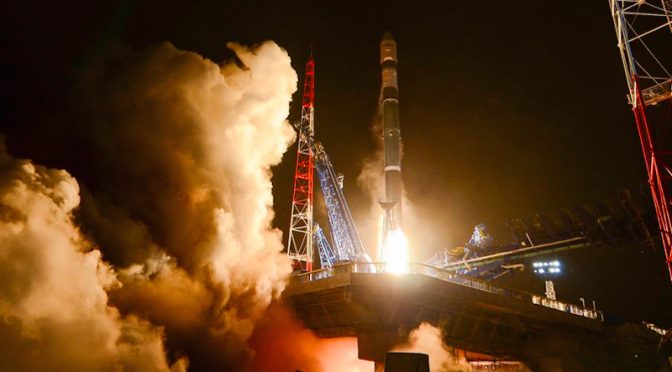
Featured Image: Launch of Russian military satellite (Russian Ministry of Defense)

The U.S.-Philippines Alliance in Context

By Usman Javed

“Alliance does not mean love, any more than war means hate.” The words of Francis Parker Yockey accurately suggest that states build relationships with other states to advance mutual interests. The U.S.-Philippines alliance is no exception. Though the very close relationship between the two countries has experienced some hiccups recently, this article suggests that the mutual interests of both states are substantial enough to sustain cooperation between the two countries.

Forging Alliances 

For the majority of American history, the lawmakers of the country were apt in following George Washington’s advice on foreign affairs: “It is our true policy to steer clear of permanent alliance with any portion of the foreign world.” As a result, for the first 165 years of its existence, the U.S. did not form any alliances with the exception of France during the revolutionary war. However, a completely different course has been taken since WWII, when the U.S. became heavily involved in global affairs. With the preeminence of transnational organizations and multi-party international treaties such as the United Nations and the North Atlantic Treaty Organization, Washington made numerous alliances. To this end, Washington’s isolationist policy was replaced by a highly inclusive and internationalist one.

However, there has been another noticeable episode in the United States’ relationships with its allies. From Europe to the Middle East and the Asia-Pacific, relationships with countries that at one point seemed politically untouchable have increasingly become vulnerable. The past few years have seen some uneasy episodes with Saudi Arabia, Israel, Turkey, the UK, and Japan. In that sense, the Philippines is only the latest chapter in the recent history of weakening partnerships.

Friend of the Philippines

The U.S.-Philippines relationship has been historically strong and is often categorized as a special relationship. It has seen its evolution from conflict to partnership to friction to re-emergence. Yet despite its unsettling history, the relationship between the two countries has been on the rise in recent years. The Enhanced Defense Cooperation Agreement between the Philippines and the United States signed on April 28, 2014 not only gave U.S. access to select Philippines bases, but also allowed the Philippines access to American ships and planes. In addition, the Philippines was set to gain invaluable training and assistance lessons to defend its sovereignty, which included more than $41 million – or almost 85 percent of the $49.72 million total amount this year of the Maritime Security Initiative funding for capacity-building initiatives in Southeast Asian states near the South China Sea. Philippines is also the largest recipient of U.S. assistance in Asia. The U.S. Agency for International Development (USAID) has facilitated more than $5 billion in infrastructure investments since 2013.

Though the relationship has been very close over the past few years, the election of Philippine President Rodrigo Duterte in June 2016 has instilled doubt in the future of the U.S.-Philippine alliance. In October 2016, Duterte announced a Philippines separation from the U.S. in favor of a closer relationship with China. The State Department, baffled by Duterte’s suggestion, said that it would seek an explanation of what the Philippines leader meant. This initial exchange was only the beginning of what became a series of episodes leading to an uneasy relationship between the two countries.

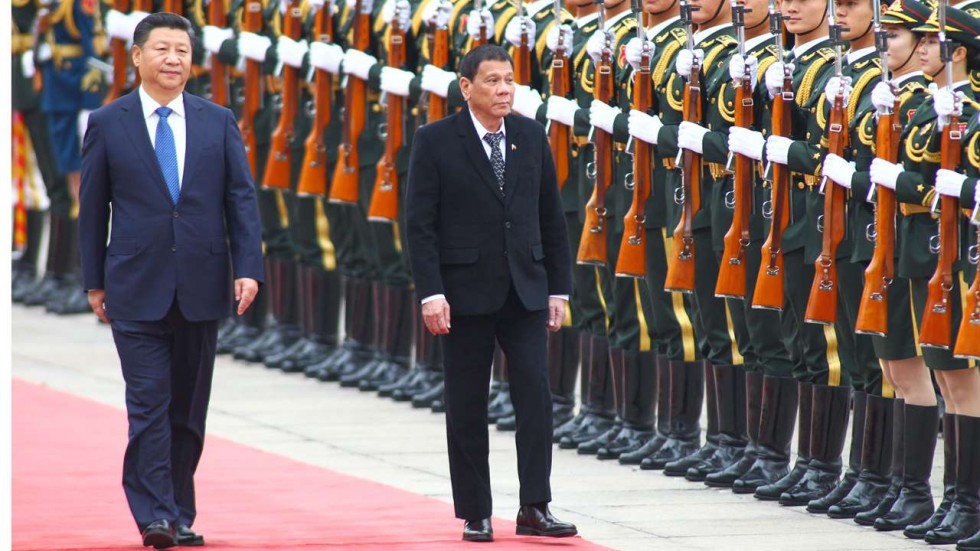
President Xi Jinping (left) pictured with Rodrigo Duterte as they inspect an honor guard in Beijing. (Photo: Simon Song)

However, despite heavy rhetoric and passionate speeches, it is unlikely that the world has seen an end to the decades-old alliance. The reason is simply that the practical advantage of such an arrangement is beneficial to both the U.S. and the Philippines, and both countries are better off in cooperation than in discord.

Enduring Interests and Ties

Though the President of the Philippines wants to exercise an “independent foreign policy,” the reality is that the country is still heavily dependent on the U.S., especially in the matter of defense. As one of the region’s weakest militaries, the Armed Forces of the Philippines (AFP) rely significantly on the U.S. to address its security challenges, including tension in the South China Sea, terrorism, and natural disasters. Even domestically, the AFP will not look too favorably upon an isolationist policy towards Washington. The military plays an instrumental role in the security of the country and is vital for peace processes with communist rebels and insurgent groups. Duterte would not go far in achieving his objectives unless the basic security condition is met. For that, he is much better off having the U.S. on his side.

A fundamental question remains unanswered by Duterte or his aides: which country would the Philippines turn to for help if it chooses to end its bond with Washington? Granted, there have been some talks with China and Russia, but it is unlikely either of the two countries will be able to fill a void as big as the U.S. Dependence on China would be problematic for the Philippines due to the disputed territorial claims, especially when China’s ambitions over the South China Sea have been described as the biggest threat to Philippines sovereignty. Moreover, the early proposals of buying equipment from China and Russia have already seen some pushback in the defense circles both privately and publicly.

Practically speaking, even if there is a genuine desire to escape any relations with the U.S., the wise policy would be to incrementally remove its dependence on Washington instead of revolutionary-style revisionism. This would allow the Philippines some time to become more self-sustaining as well as to forge alliances with other countries. However, such an arrangement may take several years for Manila and can certainly not be achieved in the six-year term of Duterte.  

There is already elite and bureaucratic resistance to Duterte. For instance, the Defense secretary, Delfin Lorenzana, has voiced clear support for the U.S. mutual defense treaty. Moreover, separation from the U.S. is also going against the local public, which has long been heavily in favor of the U.S. According to the Pew Research Center, 92 percent of respondents in the Philippines said they had a favorable view of the United States. In comparison, only 54 percent said they regarded China favorably.

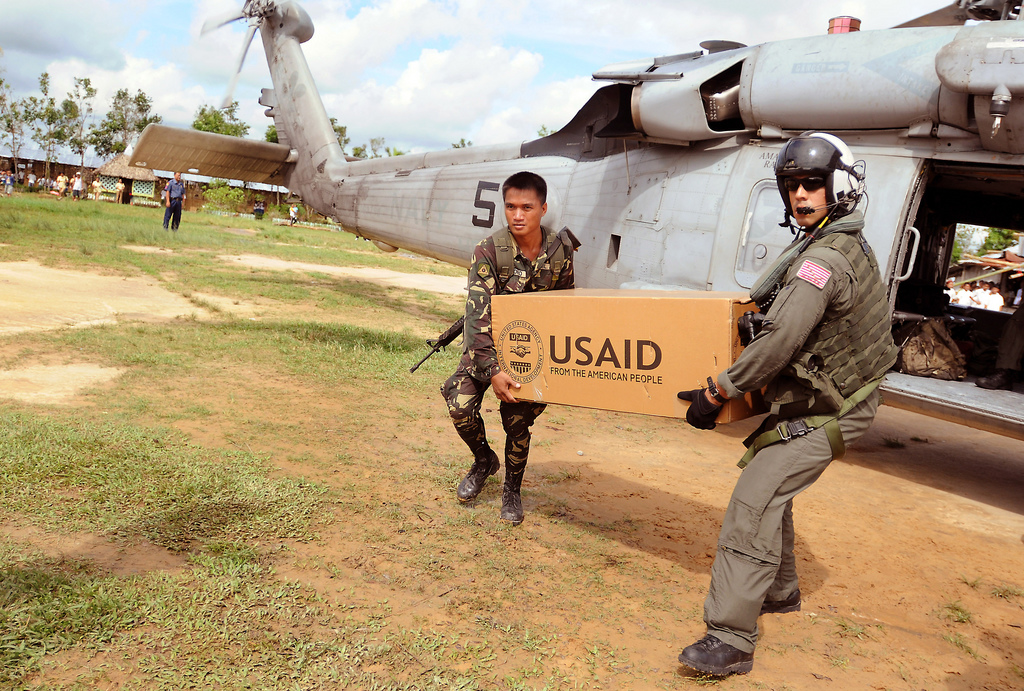
Petty Officer 2nd Class Anthony Chavez, a native of San Bernardino, Calif., works with a soldier from the Armed forces of the Philippines to move relief supplies to a school on the Panay Island in the wake of Typhoon Fengshen.  (U.S. Navy photo by Senior Chief Mass Communication Specialist Spike Call)

Economically, Japan, a strong American ally, is the largest trading partner of Philippines followed by China, the U.S., and Singapore. The Philippines exports 42.7 percent of all its exports to the U.S., Japan, and Singapore, compared to only 10.5 percent to China. The Philippines imports 16.1 percent of its total imports from China, while almost all the remaining imports are from the U.S. and its allies.  

These realities have at least in part been recognized by Duterte. For instance, though he initially called for the withdrawal of U.S. troops from the nation’s south, he later conceded that the country would need U.S. presence for the South China Sea. His aides have also accepted that the existing treaties would also remain enact.

Conclusion

The Philippines, Southeast Asia’s oldest democracy, is an important trade and security partner for the U.S. The Philippines has grown to become one of Southeast Asia’s strongest growing economies with GDP growth of about six percent a year and trade with the U.S. at $18 billion last year. If the Philippines aligns itself with China, Washington will struggle to hold the “first island chain” in the Western Pacific that encompasses “the Japanese archipelago, the Ryukyus, Taiwan, and the Philippine archipelago.” Defending the first island chain has been an important U.S. foreign policy objective since the Cold War and Washington is unlikely to change that policy given its significance for deterrence. Freedom of navigation in the South China Sea is a contentious issue where $5.3 trillion in goods is estimated to pass through the South China sea annually, including $1.2 trillion in U.S. trade. With the Philippines no longer on its side, the U.S. Navy would find it much harder to protect important sea lanes and sustain military operations.

The U.S.-Philippines alliance may have suffered but it is certainly not dead. Both countries gain a strategic advantage by being in such a relationship. Ups and downs are a natural course for alliances and the U.S.-Philippines relationship is no exception to the rule. It is possible that some change may occur in the conduct of the relationship, but sooner or later both countries will realize it is better to remain in such an arrangement, even if they do not see eye to eye, than to stray to a path unknown.

Usman Javed holds an MPhil from the Judge Business School from the University of Cambridge. As the author of several articles, editorials, reports and media publications, he has presented his research at a number of conferences. His work experience includes working for the World Bank, consulting for a number of start-ups in the UK, Asia-Pacific, and North America and co-founding an Ed-Tech start-up.

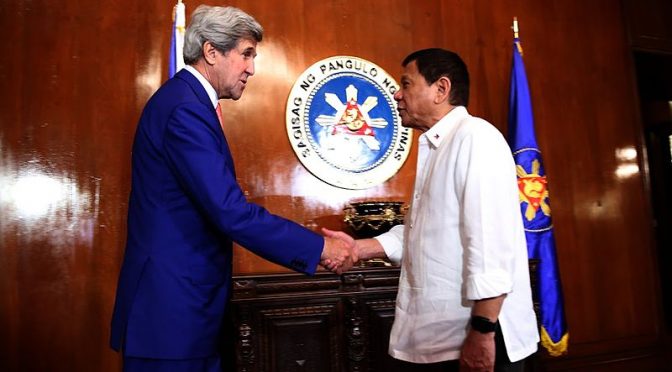
Featured Image: President Rodrigo R. Duterte meets with U.S. Secretary of State John F. Kerry during a courtesy call at Malacañan Palace on July 27, 2016. (Philippines Presidential Communications Operations Office)

Exponaval 2016 and Latin America’s Arms Fairs

The Southern Tide

Written by W. Alejandro Sanchez, The Southern Tide addresses maritime security issues throughout Latin America and the Caribbean. It discusses the challenges regional navies face including limited defense budgets, inter-state tensions, and transnational crimes. It also examines how these challenges influence current and future defense strategies, platform acquisitions, and relations with global powers.

“The security environment in Latin America and the Caribbean is characterized by complex, diverse, and non-traditional challenges to U.S. interests.” Admiral Kurt W. Tidd, Commander, U.S. Southern Command, before the 114th Congress Senate Armed Services Committee, 10 March 2016.

By W. Alejandro Sanchez

Chile organized the 10th Exponaval exhibition from 29 November – 2 December. The arms fair brought dozens of defense companies to northern Chile, where they showcased their latest maritime defense technology with the hope of securing new contracts. Arms fairs are a common event in the defense industry and they regularly take place in locations across the world, hence the success of Exponaval is particularly relevant as it will help Chile, and Latin America, cement its place in the global arms fair circuit.

Exponaval 2016

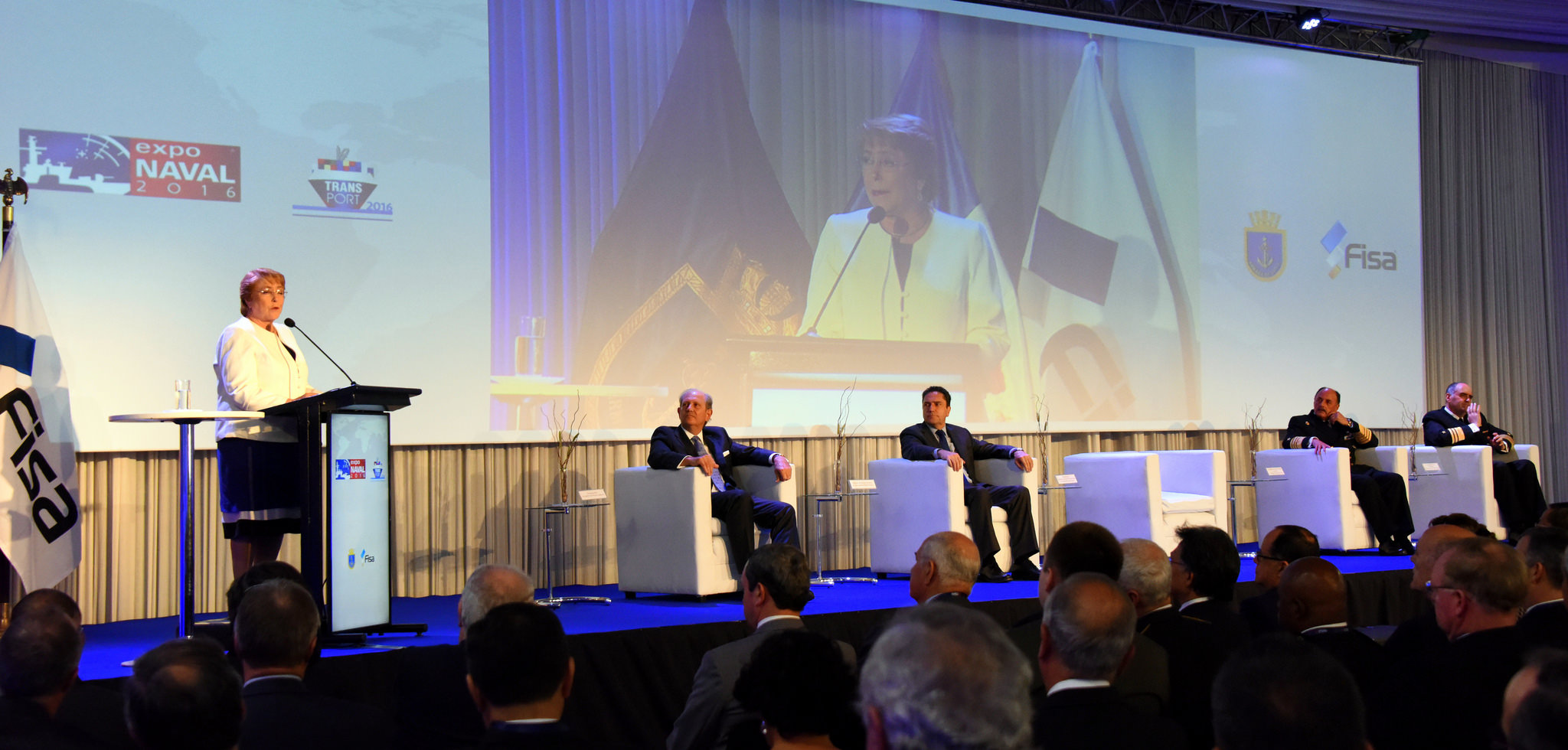
The Chilean government and Navy give great importance to Exponaval (full name Exhibición y Conferencia Internacional Naval y Marítima para Latinoamérica) as exemplified by the participation of President Michelle Bachelet, who gave a speech on 29 November to officially open the arms fair. The country’s defense minister and military authorities were also present. Unsurprisingly, during her speech, President Bachelet took a moment to praise her nation’s state-run shipyard Astilleros de la Marina (ASMAR) as it is constructing, with support from the Canadian company Vard, a new ice breaker for the Navy, which is scheduled to be completed in 2018. Exponaval 2016 was held at the at the Concon naval base in Viña del Mar, northern Chile. It is also important to note that the recent arms fair was actually a two in one event, as  the 10th Exponaval was also the 5th Trans-Port (full name, Exhibición de la Industria Marítima Portuaria para Latinoamérica), an exhibit of port industries in Latin America.

President of Chile, Michelle Bachelet, delivers remarks at Exponaval 2016 (Exponaval photo)

As for the type of technology that was exhibited, some examples include Russia’s Rosoboronexport, which displayed “Project 12150 Mangust fast patrol boats, the Varshavyanka-class (Project 636) submarines and Amur 1650 class submarines among other vehicles.” A number of British companies were also present, as Mercopress news agency explains that “companies exhibiting on the Department of Trade’s Defence and Security Organisation’s stand include: Leafield, SEA, MOD Disposals Agency and Ultra Electronics. Other UK companies exhibiting include BAE Systems, MBDA, Qinetiq, Kelvin Hughes, Lloyds Register and Thales.”

Additionally, there were also important developments among Latin American maritime defense industries. Case in point, a representative from Colombia’s Corporación de Ciencia y Tecnología para el Desarrollo de la Industria Naval Marítima y Fluvial (COTECMAR) told the defense news agency IHS Jane’s that “a joint programme between Brazil, Colombia, and Peru to develop a new river patrol ship is now under way, with design work expected to conclude in the second half of 2017.” The project dates back to 2015, but it is an important development that there is already a (still somewhat distant) deadline for the completion of the design.

Apart from the sales booths, there were several technical presentations via which experts shared their knowledge. According to Exponaval, the presentations included representatives from renowned defense companies like Navantia, MBDA Missile Systems, SAAB Group as well as Chile’s ASMAR.

Booth of Chilean state-owned shipyard ASMAR (Exponaval 2016 photo)

Even more, the Chilean Navy had  prominent participation in the fair, as it carried out exercises for the audience. This included a simulation in Valparaiso Bay of a vessel carrying radioactive material that is taken over by terrorists, where Chilean naval forces demonstrated how they would react to this hypothetical crisis.

Other Latin American Arms Fairs

It is worth noting that other Latin American countries also have arms fairs, though Exponaval stands out as it focuses on maritime defense technology. For example, Chile organizes another arms fair for aerial technology, the FIDAE-International Air & Space Fair (Feria Internacional del Aire y del Espacio). As for other regional states, Brazil organizes the LAAD Security–Feira Internacional de Segurança Pública e Corporativa (International Fair of Public and Corporate Security); Colombia has the Expodefensa International Fair of Defense and Security (Feria Internacional de Defensa y Seguridad); while Peru organizes the SITDEF–International Show for Defense Technology and Disaster Prevention (Salon Internacional de Tecnologia para la Defensa y Prevencion de Desastres).

Like with Exponaval, other governments and militaries provide support for these fairs in their respective nations. For example, while Exponaval 2016 took place at the Concon naval base, SITDEF 2017 will reportedly be held at the Peruvian Army’s headquarters in Lima.

Significance

What is the importance of Latin America organizing arms fairs? This author would argue that the main objective is to demonstrate that Latin America should not be regarded as a sole importer of military technology, but also a producer and a “showcase center” where deals can be made. President Bachelet voiced a similar idea in her welcome message as she stressed how this arms fair “allows a meeting between [suppliers] from the naval defense and maritime industry with official delegations from Latin American navies and the port agencies from other countries.”

In a 22 August commentary for CIMSEC entitled “The Rise of the Latin American Shipyard” the author discussed how various Latin American nations are constructing their own naval platforms and are even attempting to sell them to foreign customers. Since said commentary was published there have been new developments in the region: Colombia’s COTECMAR has signed a contract with Honduras and another one with Panama for logistic multipurpose vessels; Peru’s Servicios Industriales de la Marina (SIMA) has reached an agreement with Bolivia to sell its navy a riverine hospital ship; finally Ecuador’s shipyard Astilleros Navales Ecuatorianos (ASTINAVE) on 10 November “announced it is to construct three passenger boats for the Panama Canal Authority.”

Hence, regional arms fairs are particularly important for Latin American defense industries as they they allow for opportunity to showcase their products to regional navies and international firms in order to attract future sales. The aforementioned deals by ASTINAVE, COTECMAR and SIMA highlight that intra-regional naval platforms sales are already happening, and future arms fairs will benefit these companies in their eternal quest for new customers; hence it should not come as a surprise that SIMA and COTECMAR were present in Exponaval.

This brings us to the obvious question: to what extent do the exhibitions and meetings made during these arms fairs, such as Exponaval, result in actual contracts? Exponaval naturally summarized the recent fair as a success, explaining how over 140 company experts gave presentations, while putting the number of attendees at over nine thousand visits. Additionally, regional navies deployed some of their platforms, including Argentina’s corvette Robinson; Brazil’s Niteroi-class frigate Constitucion; Mexico’s patrol vessel Centenario de la Revolución; while the United Kingdom deployed the frigate HMS Portland and the tanker RFA Gold Rover.

As for contracts, Exponaval’s declared in a statement that deals were made for more than USD $800 million, but “this amount is related to the projects that the participating navies have in development for the next few years.” Hence, we will have to wait and see if in the coming months announcements are made about contracts between Latin American navies and maritime defense companies, and whether they can be traced back to Exponaval 2016.

Final Thoughts

The Exponaval 2016 arms fair which recently took place in northern Chile should be regarded as a success for local government and maritime forces. It was reportedly well-structured, with over a hundred companies showcasing their maritime defense products, it hosted thousands of visitors, and even featured visiting warships from friendly nations. Santiago also demonstrated the accomplishments of its state-run shipyard ASMAR as well as the professionalism of its naval forces. Ultimately, we will have to wait to see if, indeed, Exponaval (not to mention other Latin American defense fairs) can reliably serve as a place where suppliers and customers can meet and ultimately reach sales agreements.

W. Alejandro Sanchez is a researcher who focuses on geopolitical, military, and cyber security issues in the Western Hemisphere. Follow him on Twitter: @W_Alex_Sanchez.

The views presented in this essay are the sole responsibility of the author and do not necessarily reflect those of any institutions with which the author is associated.

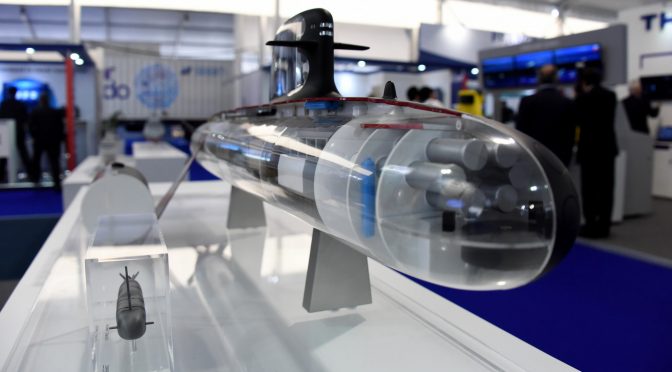
Featured Image: Model submarine at Exponaval 2016 (Exponaval 2016 photo)

Fostering the Discussion on Securing the Seas.