
It’s Time to Invite Taiwan to RIMPAC

By Jim Halsell

The Taiwan Strait remains one of the most volatile flashpoints in the world. With the People’s Republic of China (PRC) accelerating its coercive behavior aimed at “reunifying” Taiwan with the mainland, the United States must adopt a clearer, more deliberate strategy to bolster deterrence and reassure regional partners. One measure that should be taken is to include Taiwan in the world’s largest multinational maritime exercise – the Rim of the Pacific (RIMPAC). Doing so would be consistent with U.S. policy under the Taiwan Relations Act, align with the values of collective defense and democratic solidarity, and signal to Beijing that any use of military force against Taiwan will result in a unified, multinational response.

Taiwan’s Strategic Significance

Taiwan occupies a central position in the First Island Chain and plays a crucial role in the balance of power in East Asia. It is a thriving democratic society of 23.4 million people and a key node in global semiconductor supply chains. Beijing’s claim to the island is tenuous, supported by a campaign of intimidation and “gray zone” tactics that aim to coerce Taiwan into capitulation without war.

Though lacking official recognition as an independent country by the United States and many of its allies, Taiwan is not isolated. U.S. policy, as codified in the 1979 Taiwan Relations Act (TRA), commits the United States to make available “defense articles and defense services in such quantity as may be necessary to enable Taiwan to maintain a sufficient self-defense capability,” and to “maintain the capacity of the United States to resist any resort to force or other forms of coercion that would jeopardize the security” of the people of Taiwan. Inclusion in RIMPAC would help operationalize this policy while remaining consistent with the U.S. One China policy.

Why Include Taiwan?

Deterrence requires both capability and credibility. While Taiwan continues to acquire U.S. military hardware and reform its defense posture, the question of whether the United States and its allies would support Taiwan in a contingency remains deliberately ambiguous. Strategic ambiguity may help manage escalation risk, but it risks failing to deter if Beijing concludes that the costs of aggression are tolerable.

Involving Taiwan in RIMPAC would signal a broader multinational investment in regional peace. Beijing is pursuing two parallel lines of effort to pressure Taiwan: coercion without violence and the looming threat of military force. Both avenues can be countered through stronger integration with partners, transparent signaling, and public commitments to Taiwan’s survival as a free society.

A Republic of China Navy Tuo Chiang-class corvette. (Photo via Ann Wang/Reuters)

The inclusion of Taiwan in RIMPAC would not require diplomatic recognition of Taiwan as a sovereign state. RIMPAC has previously included diverse participants with some participating only as observers. Taiwan could be invited under a similar framework—e.g., “Taipei Navy—Observer”—that would align with RIMPAC precedent, and would not constitute formal U.S. recognition. It would, however, reinforce the deterrent message that a conflict in the Taiwan Strait would not remain a bilateral issue between Washington and Beijing.

Reinforcing the Taiwan Relations Act

The TRA provides a clear legislative foundation for actions that enhance Taiwan’s defense and deter coercion. The Act affirms that “the United States will consider any effort to determine the future of Taiwan by other than peaceful means…a threat to the peace and security of the Western Pacific area and of grave concern to the United States.”1 Participation in exercises like RIMPAC would help Taiwan prepare for defense without crossing the line into formal alliance, thereby avoiding a breach of the One China policy.

Congress continues to reaffirm bipartisan support for Taiwan’s self-defense. The FY2025 National Defense Authorization Act (NDAA) includes provisions to strengthen military cooperation and enhance deterrence through initiatives like the Taiwan Security Cooperation Initiative. Including Taiwan in exercises alongside Japan, Australia, and other regional partners would be a natural extension of these legislative efforts.

Operational and Symbolic Value

Beyond signaling, there are tangible military benefits. Taiwan’s military operates U.S.-made systems and is transitioning toward an asymmetric defense model, emphasizing survivability and denial. Interoperability with U.S. and allied forces, especially in joint maritime operations, will be essential in any scenario short of or including conflict.

As the Council on Foreign Relations notes, “Taiwan likely doesn’t have the capabilities to defend against a Chinese attack without external support,” despite pledging nearly $20 billion in defense spending for 2025.2 Enhancing operational coordination before a crisis emerges is not only prudent, but operationally essential.

Symbolically, inclusion in RIMPAC would acknowledge the democratic values that Taiwan shares with other regional partners. This is particularly important as Taiwan remains diplomatically isolated, with only eleven countries maintaining official relations. Participation in multinational military activities would help offset this isolation without provoking conflict, provided it is managed diplomatically and clearly communicated.

Would Other Nations Support Taiwan’s Inclusion in RIMPAC?

One of the central concerns surrounding Taiwan’s potential inclusion in RIMPAC is whether key U.S. allies and regional partners would support such a move or whether they would balk at the political risk of antagonizing the People’s Republic of China. However, recent geopolitical trends suggest that support for Taiwan’s participation in multinational defense activities is quietly growing, particularly among Indo-Pacific democracies that share an interest in preserving regional stability and resisting Chinese coercion.

Japan is perhaps the most likely partner to welcome Taiwan’s inclusion. Tokyo has become increasingly vocal about the importance of Taiwan to Japan’s national security, with senior officials, including former Prime Minister Shinzo Abe, stating that “a Taiwan contingency is a Japan contingency.” Japan’s Self-Defense Forces have increased coordination with the U.S. military and have participated in bilateral and trilateral exercises that implicitly prepare for scenarios involving Taiwan. Given Japan’s growing anxiety over China’s assertiveness and its own constitutional reinterpretation on collective self-defense, Tokyo would likely support Taiwan’s inclusion in a multilateral setting like RIMPAC, especially if coordinated in advance with careful diplomatic messaging.

Australia has also strengthened its strategic alignment with the United States and Japan, particularly through the AUKUS agreement. Canberra has voiced concerns about China’s regional behavior and recently joined Washington in emphasizing the importance of peace and stability in the Taiwan Strait. While Australia might be more cautious about formal diplomatic gestures, it is unlikely to oppose Taiwan’s participation in a non-sovereign capacity, especially if framed as a security-enhancing measure rather than a political endorsement.

Other Indo-Pacific states, such as India, Philippines, and Vietnam, have growing interests in counterbalancing Chinese maritime assertiveness. India has long advocated for a multipolar Asia and may view Taiwan’s inclusion as consistent with its own efforts to build regional coalitions. The Philippines, under President Ferdinand Marcos Jr., has deepened security ties with the United States and allowed expanded access to military bases in response to PRC aggression in the South China Sea. Vietnam, while traditionally wary of foreign alignments, has clashed with China over maritime claims and may be open to Taiwan’s inclusion in an observer or limited functional role.

European states that have participated in recent RIMPAC iterations such as France, Germany, and the United Kingdom have also increasingly signaled concern over Taiwan’s security. They conducted transits of the Taiwan Strait, and their defense white papers mention the Indo-Pacific as a zone of strategic interest. While these countries may not be vocal advocates for Taiwan’s inclusion, they would be unlikely to withdraw or protest if the decision were led by the United States with appropriate multilateral coordination.

Ultimately, the determining factor may be how the invitation is framed. If Taiwan’s participation is defined not as a sovereign equal to other states but rather as a security partner or “participant entity,” other nations could find it diplomatically palatable. This would mirror Taiwan’s existing participation in multilateral forums such as the Olympics, the World Trade Organization and the Asia-Pacific Economic Cooperation forum, where it joins under the name “Chinese Taipei.”

RIMPAC’s Flexible Participation Model

RIMPAC’s long history as a multinational exercise underscores its diplomatic flexibility. Since its inception in 1971, RIMPAC has included a diverse array of participants, including states with varying degrees of political alignment with the United States, non-ally partners, and even, at times, strategic competitors. This precedent offers a viable pathway for Taiwan’s inclusion without triggering a fundamental break in U.S. policy or alienating key participants.

A notable example is the People’s Republic of China, which was invited to participate in RIMPAC in both 2014 and 2016. Despite growing tensions in the South China Sea and concerns about Chinese military transparency, the Obama administration included the People’s Liberation Army Navy (PLAN) in an effort to promote professional military dialogue and reduce the risk of miscalculation. China sent surface combatants, auxiliary vessels, and observers to participate in non-combat aspects of the exercise. This inclusion was reversed in 2018 following the continued militarization of artificial features in the South China Sea, but the precedent remains: even states that do not share U.S. values or alliance structures have participated in RIMPAC under constrained formats.

Similarly, RIMPAC has welcomed non-allied or non-aligned states such as Vietnam, India, and Brunei, each of which participated in observer or limited operational capacities. These arrangements allowed for diplomatic inclusivity without compromising the exercise’s core focus on interoperability and security cooperation. India was first invited as an observer in the early 2000s before gradually expanding its participation, culminating in the deployment of naval assets by the 2010s. This incremental approach demonstrates RIMPAC’s capacity to accommodate partners with unique diplomatic statuses or sensitivities.

The American Institute in Taiwan (AIT), established under the Taiwan Relations Act as the vehicle for unofficial U.S.-Taiwan relations, could serve as the conduit for managing Taiwan’s RIMPAC participation. AIT-coordinated representation would allow the United States to maintain consistency with its One China policy while exercising its commitment to Taiwan’s self-defense.

Managing PRC Backlash

Inevitably, Beijing would likely respond harshly to Taiwan’s inclusion in RIMPAC, as it has to other perceived infringements on its sovereignty claims. Large-scale military drills, economic sanctions, diplomatic condemnation, and cyber operations are all part of the PRC’s well-established retaliation playbook. Yet the United States and its partners must resist the temptation to let their Taiwan policy be dictated by fears of PRC outrage. This reactive posture grants Beijing a de facto veto over democratic decision-making and emboldens further coercion.

China has escalated its pressure campaign on Taiwan even in the absence of provocations. Since the election of Democratic Progressive Party (DPP) President Tsai Ing-wen in 2016, Beijing has employed what Richard Bush calls “coercion without violence,” a deliberate campaign to wear down Taiwan psychologically, politically, and economically without firing a shot.3 This has included near-daily air and naval incursions into Taiwan’s air defense identification zone (ADIZ), cyberattacks on government agencies, diplomatic isolation, and targeted disinformation campaigns.

These actions have continued even as Taiwan’s leadership has treaded cautiously. President Tsai’s tenure was marked by efforts to maintain the cross-Strait status quo and avoid unilateral declarations of independence. Her successor, President Lai Ching-te, has pledged to do the same, calling for “dialogue instead of confrontation” in his 2024 inauguration address. Nevertheless, Beijing has continued to characterize Lai as a “separatist” and launched punitive military exercises following both his inauguration and Taiwan’s National Day celebrations.

This pattern reveals a key truth: Beijing’s escalatory behavior is not a response to specific actions by Taipei or Washington, but part of a long-term strategy to bring Taiwan under PRC control. As such, restraint has not yielded peace; resolve may. Integrating Taiwan into multinational military exercises like RIMPAC would impose reputational and strategic costs on Beijing’s aggression by signaling that Taiwan’s security is a shared interest among responsible stakeholders in the Indo-Pacific.

Conclusion

Ultimately, deterrence fails when adversaries perceive inaction as weakness. Taiwan’s participation in multinational exercises is not merely symbolic. It is a necessary step to ensure that coercion is met with collective resolve. The message to Beijing must be unmistakable: the democratic world will not stand by while one of its own is bullied into submission.

It is time for the United States and its Indo-Pacific allies to move from passive deterrence to active deterrence. The inclusion of Taiwan in RIMPAC would send an unmistakable message to Beijing: any aggression against Taiwan risks triggering a multilateral response from a network of regional powers united by shared values and interests. Including Taiwan in RIMPAC would fulfill the spirit of the Taiwan Relations Act, enhance deterrence, and stand as a visible affirmation of America’s commitment to a free and open Indo-Pacific.

Lieutenant Commander James Halsell is a submarine warfare officer. His most recent assignment at sea was engineer officer on board the USS Topeka (SSN-754). He is the Federal Executive Fellow at the U.S. Naval Institute, and a doctoral student at Johns Hopkins School of Advanced International Studies, researching the potential impact of deep-seabed mining on maritime sovereignty assertions.

References

1. Lawrence, Susan V. 2024. “Taiwan: Background and U.S. Relations.” Congressional Research Service, IF10275, updated December 26, 2024. https://crsreports.congress.gov/product/pdf/IF/IF10275.

2. Maizland, Lindsay, and Clara Fong. 2025. “Why China–Taiwan Relations Are So Tense.” Council on Foreign Relations, March 19, 2025. https://www.cfr.org/backgrounder/china-taiwan-relations-tension-us-policy-trump.

3. Bush, Richard C. 2024. “Why Does the U.S. Security Partnership with Taiwan Matter?” Brookings Institution, September 16, 2024.

Featured Image: Multinational ships sail in formation July 22, 2024, off the coast of Hawaii during Exercise Rim of the Pacific 2024. (U.S. Navy photo by Mass Communication Specialist 1st Class John Bellino)
Call for Notes to the New CNO

By Dmitry Filipoff

Submissions Due: September 12, 2025
Week Dates: September 22-26, 2025
Submission Length: 500 words
Submit to: Content@cimsec.org

In 500 words or less, what do you want the new Chief of Naval Operations to know? CIMSEC is launching a special series featuring short articles that look to convey pressing points to the U.S. Navy’s new top leadership.

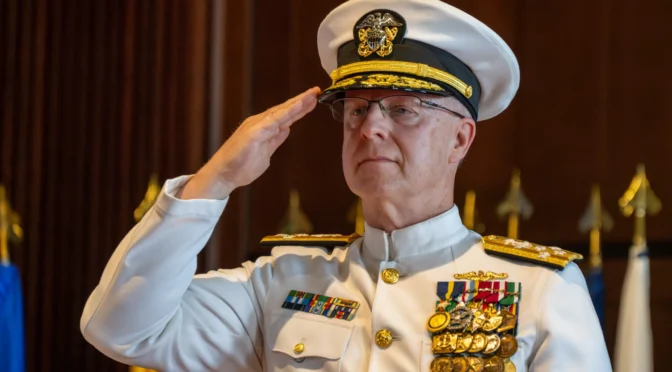
Admiral Daryl Caudle was sworn in as the U.S. Navy’s 34th Chief of Naval Operations on August 25, 2025. In his speech, Caudle articulated:

“The Sailor will be front and center in my vision throughout my tenure as CNO…To ensure that they are ready to fight and win decisively–today, tomorrow, and well into the future—we will view everything we do we through an operational lens focused on three priorities: the foundry, the fleet, and the way we fight.”

How can Admiral Caudle accomplish these priorities? What challenges are underappreciated by Navy leadership and deserve stronger priority? How can the new CNO make major reforms to better meet great power threats? Contributors can address these questions and more as they convey their message.

Given the broadly international nature of the U.S. Navy’s mandate and the numerous partners and allies that closely work with American naval forces, international contributors are highly encouraged to share their perspectives.

Send all contributions for consideration to Content@cimsec.org

This is an independent CIMSEC initiative and is not produced in cooperation with any U.S. Navy entity. Read previous editions of “Notes to the New CNO” for the 33rd and 32nd Chiefs of Naval Operations. 

Dmitry Filipoff is CIMSEC’s Director of Online Content. Contact him at Content@cimsec.org

Featured Image: Adm. Daryl Caudle assumes duties as the 34th chief of naval operations during an assumption of office ceremony at the Washington Navy Yard in Washington, D.C., on Aug. 25. (MCS Joe J. Cardona Gonzalez/U.S. Navy)

A System of Systems Analysis is Needed for Maritime Strike

By Dick Mosier

The US military is expanding its inventory of long-range maritime strike missiles such as the Precision Strike Missile (PrSM), Maritime Strike Tomahawk (MST), Standard Missile 6 (SM-6), Long-Range Anti-ship Missile (LRASM), and Naval Strike Missile (NSM). These capable weapons all have ranges well beyond the effective range of the sensor systems organic to their launch platforms – meaning their effective employment relies on third party targeting data. 

While these missiles all have terminal seekers for target acquisition and aim point selection, they require target location and identification information from deep-reach external sensor systems for mission planning, missile launch decisions, target location updates to in-flight missiles, and battle damage assessments (BDA).

The threat of long-range (400 km/160 nm), hypersonic, air-to-air missiles such as the PLAAF’s new PL-21 indicate that US conventional reconnaissance and targeting aircraft must now operate within protected airspace limiting their ability to target enemy ships out to the maximum ranges of US anti-ship missiles. As a result, targeting for US long-range anti-ship missiles is increasingly dependent on NRO and Space Force satellite reconnaissance and targeting systems.

A fundamental problem facing the US military is that the services have fielded capable, long-range missile systems, but only possesses limited deep-reach Intelligence, Surveillance, Reconnaissance and Targeting (ISRT) capabilities, limiting the effective employment of long-range missile systems. The National Reconnaissance Office (NRO) and Air Force/Space Force are developing satellite ISRT constellations to address the problem, but the services need to use a ‘Maritime Strike System of Systems’ approach to address the true functionality of US maritime strike capability.

A System of Systems Approach

The Office of the Under Secretary of Defense (Acquisition & Technology) Systems Engineering Guide for Systems of Systems defines a System of Systems (SOS) as: “a set or arrangement of systems that results when independent and useful systems are integrated into a larger system that delivers unique capabilities.” The “Maritime Strike SOS” is the set of systems and human processes integrated into a larger system of systems that provide engagement quality tracks on moving enemy ships within stringent time latency requirements for the successful engagement by the various long-range, anti-ship missiles fielded by the Air Force, Navy, Marine Corps and the Army.

A Maritime Strike SOS analysis would address the functionality of not only NRO and Air Force/Space Force space systems; but also, the other essential components and processes of the end-to-end architecture, such as requirements submission and adjudication, satellite/constellation tasking, satellite data relay, ground processing and exploitation, and information/data dissemination to tactical forces. The SOS analysis would ensure that the end-to-end architecture and its timeliness will provide the targeting required for effective anti-ship missile engagements.

Without guaranteed performance across this entire architecture—particularly its timeliness—these substantial space investments will fail to enable anti-ship missile engagements.

Maritime Strike SOS Analysis

Missile Range Velocity Service
Naval Strike Missile

 (NSM)

115 nm 450 kts Navy, USMC
Maritime Strike Tomahawk (MST) 1000 nm 450 kts Navy, USMC, Army  
Long Range Anti-Ship Missile (LRASM) 200 nm 450 kts Navy, USAF
Precision Strike Missile (PrSM) 350 nm 3334 kts Army
Standard Missile 6

(SM-6)

130 nm 2334 kts Navy, USMC, Army

The first step in a Maritime Strike SOS analysis is to determine the capability required of the SOS for each type of anti-ship missile and launch platform combination. The objective is to determine the sequence and timing of events from receipt of a mission task by a launch platform to the acquisition of the moving target ship by the missile seeker.

In the final analysis, the missile must arrive at the target ship location area of uncertainty and begin its search before the moving ship has time to exit the area of uncertainty. This analysis will determine the maximum usable time latency from satellite target sensing to entry of the target information into the missile by the launch platform.

The SOS performance requirements are derived from the performance attributes of these five existing missile systems fielded by the Services for use in the context of joint force operations.

Maritime Strike SOS Baseline

Once the SOS performance requirements are defined for each type of missile, the next step is to identify and evaluate the baseline and alternatives. The targeting timeline for the SOS analysis would begin with receipt of a Maritime Strike mission order, and include the following:

  • Processes for the submission of collection requirements
  • Adjudication of collection tasking priorities
  • Planning of satellite mission or constellation coverage
  • Tasking of satellites
  • Time for satellites to access the target area
  • Collection of data by the satellites
  • Dissemination of sensor data to ground/shipboard systems for data processing and image exploitation
  • Dissemination of target information to missile launch platforms

The combination of all these factors has to occur within the maximum allowable time latency for successful missile engagement. 

The SOS Satellite Baseline

Satellite communications, intelligence, surveillance, reconnaissance, and weapons targeting systems are well into the transition from a small number of operational systems to proliferated architectures that take advantage of lower launch costs, and cheaper satellites to form mega constellations of hundreds of satellites. The following satellite mega constellations designed for or capable of supporting anti-ship missile targeting should be included in the baseline SOS analysis.

NRO Proliferated Architecture

On 22 May 2024, the NRO launched the first set of 21 Star Shield imaging satellites into low earth orbit (LEO) in what the NRO calls the NRO Proliferated Architecture. As of 30 April 2025, 179 Star Shield satellites have been launched. According to the NRO, six more launches are scheduled in 2025. Assuming the previous pattern of 21 satellites per launch the constellation is projected to reach approximately 300 three hundred satellites in late 2025. The NRO also indicates that launches will continue through 2029 but has not disclosed specifics on schedule or the total number of launches. The SOS analysis would address the performance of the satellite sensors and the processes and timelines involved from submission of fleet requirements to delivery of the sensed information to the fleet.

Space Force Long-Range Kill Chains Program

In August 2024, the Space Force Long-Range Kill Chains Program was approved for Milestone B indicating that this satellite-based Moving Target Indicator (MTI) constellation designed to track ships and land targets can proceed to acquisition. Program cost, constellation size, and the technical details of the overall architecture and performance are classified. The schedule and performance parameters are established, and the program is funded for an Initial Operational Capability (IOC) in the early 2030s. The size of this mega-constellation, arrangement of the satellites in space, and the technical details of the overall architecture and performance remain classified.

Space Defense Agency Proliferated Warfighter Space Architecture (PWSA)

The Space Force/Space Development Agency (SDA) is fielding the Proliferated Warfighter Space Architecture (PWSA) that includes Link 16 and Integrated Broadcast Service (IBS) for the dissemination of information to tactical forces. In August 2024, SDA demonstrated the capability to make a PWSA Link 16 connection with a carrier and an aircraft on its deck.

In late summer 2025, the SDA is expected to begin launching its first set of PWSA satellites with limited operational capabilities. This will include 126 Transport Layer data relay satellites, and 28 Tracking Layer satellites, and 4 demonstration satellites for missile tracking. The SOS should determine the role of the PWSA in the overall SOS architecture for targeting anti-ship missiles.

Maritime Strike Command and Control Baseline

Maritime Strike is a mission that now involves platforms and missiles from the Army, Navy, Marine Corps, and USAF. The Maritime Strike SOS analysis must address the command and control relationships and processes among the components to ensure the arrangements are in place for the sharing of target information; and, for the planning, and execution of coordinated multiple component maritime strike operations.

The Services are fielding systems for the receipt and exploitation of targeting information. The Army is fielding Tactical Intelligence Targeting Access Node (TITAN) variants for Division and above, and a basic variant for division and below. The Navy and Marine Corps are developing and fielding Navy Maritime Targeting Cells (MTC) ashore and afloat; and, the Marine Corps is fielding a Family of Integrated Targeting Cells (MTC-X, MTC-Mobile, and Tactical Edge Node TEN-X). The details of Navy and Marine Corps MTC systems are classified, but they are expected to have capabilities similar to those of TITAN, e.g., direct satellite tasking, satellite sensor control, direct downlink of satellite data, data processing and analysis for the purpose of weapons targeting. The Maritime Strike SOS analysis would assure that these tactical terminal systems are fully integrated with the overall maritime strike SOS architecture.

Conclusion

The SOS analysis could consist of a relatively modest approach based on the integration of the detailed architectures of each of the components of the SOS as should be available from the NRO, NGA, Space Force, and the Services/Joint Force components. The investment in this analysis is justified given the looming conflict with China over Taiwan, one dominated by anti-ship missile operations. The SOS analysis would ensure that the anti-ship missiles operated by Army, Navy, Air Force, and Marine Corps will have the timely and comprehensive targeting support required for their effective use against moving ships.

Dick Mosier served as a Naval Flight Officer (VQ and VP); OPNAV N2 civilian intelligence analyst; OSD (Intelligence and Space Policy); SES 4 ASD(C3I) Director Tactical Intelligence Systems; and Deputy Director of a support activity leading OSD studies on space and unmanned airborne ISRT system alternatives. His career-long interest in improving the effectiveness of US Navy tactical operations, with a particular focus on the challenges of assuring the integration of national-tactical ISRT combat support capabilities. The article represents the author’s personal views and do not necessarily reflect the official views of any U.S. government department or agency.

Featured Image: RED SEA (Sept. 19, 2021) Fire Controlman (Aegis) 2nd Class Garrett Town stands watch in the combat information center aboard guided-missile destroyer USS O’Kane (DDG 77) in the Red Sea. (U.S. Navy photo by Mass Communication Specialist Seaman Elisha Smith)

Arsenal of Democracy: Myth or Model? Lessons for 21st-Century Industrial Mobilization Planning

By Tyler Hacker

The following article is adapted from a new report by Tyler Hacker at the Center for Strategic and Budgetary Assessments (CSBA), Arsenal of Democracy: Myth or Model? Lessons for 21st-Century Industrial Mobilization Planning.

As conflicts from Europe to the Middle East draw on U.S. munition stocks, many of which are already insufficient for great power conflict, leaders are calling on the U.S. military and defense industrial base to rapidly increase munitions production. In doing so, many reference the United States’ industrial mobilization during World War II, which transformed the nation into the indispensable “arsenal of democracy” and greatly contributed to Allied victory.

A protracted war between the United States and China would demand immense quantities of munitions and would require the industrial base to grow to meet these demands. This is industrial mobilization, a topic the nation has not seriously considered since the end of the Cold War. Given this lapse in focus, it is only natural to look to the nation’s last major mobilization for great power war, World War II, as a model for the future.

But World War II was over eighty years ago, and much has changed since the nation set out to expand war production to eventually supply two thirds of all weapons used by the Allied nations. What can contemporary policymakers learn about industrial mobilization from the arsenal of democracy?

Interwar Mobilization Planning and Its Continued Relevance

Examining the history of World War II industrial mobilization begins in the interwar period, a time when the U.S. military spent nearly two decades planning for industrial mobilization. The nation’s chaotic mobilization for World War I in 1917—an effort which proved too late to equip doughboys sent to Europe—spurred Army planners to develop a series of procurement and mobilization plans and actively engage with the nation’s industrial base during the 1920s and 30s. Although President Franklin Roosevelt did not implement these plans in their entirety when he began readying the nation for war in the late 1930s, many of the plans’ elements and the preparations they spurred left the nation in a much better position relative to 1917.

Although interwar mobilization plans proved integral to building the arsenal of democracy, America’s wartime industrial achievements were ultimately made possible by the circumstances of the era: a homeland sanctuary that provided the U.S. military several years to mobilize the world’s most powerful economy and manufacturing base toward war production. The United States confronts a drastically different set of strategic, economic, and industrial conditions today. Recent efforts to increase production of critical munitions have resulted in modest gains over several years and confronted numerous bottlenecks, revealing the inadequacy of America’s post-Cold War industrial base.

Nevertheless, the nation’s mobilization for World War II and interwar planning efforts hold many enduring lessons for contemporary policymakers as they consider industrial expansion in the modern era. The details of mobilization such as the military hardware that must be produced, essential industrial sectors, and critical materials and their sources may be very different today, but the enduring relationship between strategy and logistics, as well as the interactions between the U.S. government, the military services, and the industrial base, remain the same in many ways.

March 20, 1942: Launch of the U.S. Navy light cruiser USS Birmingham (CL-62) at the Newport News Shipbuilding and Dry Dock Company shipyard, Newport News, Virginia. (Naval History and Heritage Command photo)

If a war between the United States and China requires increased production of military hardware, then the history of World War II’s mobilization contains numerous insights into the fundamental planning considerations, tradeoffs, and risks inherent to industrial mobilization in the United States. Moreover, the period provides an opportunity to examine how prewar preparations and plans played out once mobilization began and how industrial output progressed alongside military demands and expenditures in campaigns from 1942 to 1945.

Other periods, such as the Cold War, may also hold relevant lessons on mobilization planning, but World War II remains a valuable case study and a significant touchpoint for American leaders and the public alike. These factors invite a reexamination of the period with an eye toward applying its lessons to today’s strategic environment and industrial base. This analysis highlights five lessons for today’s military planners as they consider industrial mobilization in the 21st century.

Lesson One: Establishing Requirements is Central to Mobilization Planning

A recurring theme in interwar mobilization planning is the central importance of determining military requirements for protracted war. Before mobilization can begin, the military must determine the types and quantities of materiel it requires to execute its strategy and, in turn, that industry must produce. Throughout World War II, these requirements were intimately linked to allied strategy, with changes in either often dictating modifications to the other.

President Roosevelt set expansive production goals in his December 1940 “arsenal of democracy” fireside chat, but the details of exactly which guns, planes, and ships to produce were left unanswered. Industrial expansion could not be completed until the military services developed firm, specific requirements. Amid these efforts, the president requested an assessment of “over-all production requirements” in August 1941, which tasked the military with estimating the total number of men it would put in uniform, how these men would be organized into fighting units, what equipment these units would field, and the rates at which they would expend consumable goods like ammunition and fuel. With this information, civilian mobilization agencies could coordinate production and material requirements into a scheme that became known as the Victory Program. Even so, the feasibility of fulfilling these requirements was hotly debated and ultimately forced the Army to modify its strategic approach, reduced its planned end strength, and modify the composition of fielded forces.

Determining military requirements remains an essential aspect of planning for protracted war and industrial mobilization. The Department of Defense must think deeply about what it might require over the duration of a conflict, from its initial troop basis to replacing hardware and materiel lost to attrition. These requirements should look past current budgetary constraints to consider potential national objectives, strategy, and limitations in a conflict requiring mobilization. The misestimations of interwar plans, such as outdated munition consumption rates, show the enduring challenge of gauging the demands of future war. Requirements must remain flexible enough to account for uncertainties surrounding a war’s specific aims, geography, and methods.

Still, some assessment of requirements remains a prerequisite to industrial mobilization planning and the implementation of effective industrial preparedness measures. Developing such requirements remains entirely within the purview of the Department of Defense. Interwar planners mistakenly assumed that production would rapidly adjust to strategic plans. Today’s Pentagon planners must not repeat this mistake and should begin assessing the military’s needs for a protracted war in order to drive industrial planning.

Lesson Two: Allies Must Be Factored into Mobilization Plans

In developing requirements, the Department should consider the potential needs and contributions of U.S. allies and partners. Throughout World War II, assessing and coordinating allied requirements was a consistent challenge and encouraged Roosevelt to establish civilian mobilization agencies such as the Office of Production Management. The president’s August 1941 request for total production requirements was driven by the German invasion of the Soviet Union and the addition of yet another nation to the list of allies supported via the Lend Lease program. Despite the reliance of U.S. forces on allied equipment during World War I, interwar mobilization plans did not adequately factor in allies. As a result, President Roosevelt’s drive to supply Great Britain, the Soviet Union, China, and other partners around the world threatened to seriously disrupt the military’s own procurement and mobilization plans.

Today, America’s multitude of allies and partners are often touted as one of the nation’s competitive advantages vis-à-vis China. Accordingly, contemporary mobilization plans must consider the materiel these nations might request, as well as their capacity to support industrial expansion. As recent events in Ukraine and Israel have shown, many partners in a U.S. coalition will draw on U.S. production of munitions and platforms. Policymakers are already facing the same dilemma Roosevelt faced in 1941: balancing the support of allies engaged in active conflict with U.S. military readiness. Contemporary mobilization plans must coordinate and deconflict U.S. and allied demands in order to provide the defense industrial base the combined demand signal necessary to expand production capacity.

In today’s globalized economy, U.S. allies may also play a larger role in defense supply chains. World War II mobilization officials were forced to balance limited domestic sources of critical materials with the transportation requirements and transit time inherent in foreign sources—a tradeoff that often led them to expand domestic capacity or establish domestic substitutes, such as synthetic rubber. Similarly, today’s military-industrial plans must fully consider the benefits and risks of relying on allies and partners in defense supply chains. An industrial coalition of the United States and its close allies in Europe and Asia is a formidable opponent to China’s massive industrial base, but military planners must understand how relying on foreign sources might impact production timelines and create vulnerable supply lines throughout the world. Effectively leveraging allied industrial capacity also calls for a rebuilding of the U.S. Merchant Marine to ensure the United States maintains the ability to keep manufacturing inputs flowing from its overseas allies and partners.

Lesson Three: Mobilization Plans Cannot Ignore Threats to the U.S. Homeland

World War II’s mobilization benefited from the relative invulnerability of the continental United States, which provided sanctuary for an extended industrial buildup before the nation committed its forces to large overseas campaigns. Even in this relative safety, military and industrial planners worried about the vulnerability of production facilities on the nation’s coasts and focused new plant construction in the American heartland. To mitigate the threat of sabotage, the government distributed war production over a broad geographic area and built redundant facilities to reduce the number of bottlenecks and single points of failure.

Partly completed Heinkel He-162 fighter jets sit on the assembly line in the underground Junkers factory at Tarthun, Germany, in early April 1945. The huge underground galleries, in a former salt mine, were discovered by the 1st U.S. Army during their advance on Magdeburg. (German Federal Archives photo)

Today’s potential adversaries possess numerous capabilities to disrupt or destroy U.S. defense production and critical infrastructure, from kinetic strikes to sabotage and cyberattacks. Indeed, Russia is already utilizing unconventional warfare to disrupt Western defense production in support of Ukraine. The destruction of the Nord Stream 2 pipeline and recent cutting of undersea cables foreshadow the sorts of asymmetric infrastructure attacks that could be employed to impede war production before or during a conflict.

Defending the industrial base will require numerous lines of effort across multiple domains. Within industry, additional force protection measures may be necessary to prevent physical sabotage alongside cyber and network defenses. Domestic air and missile defenses, such as those proposed in the Department’s Golden Dome project, may be necessary around critical industrial and logistical nodes. Of course, planners must consider how these requirements will draw on limited resources and low-density assets. All in all, the vulnerability of the U.S. defense industrial base calls for a renewed focus on homeland defense, the U.S. Northern Command, and various civil defense organizations. The Pentagon must work with its industrial partners to reduce vulnerabilities, disperse critical functions, and harden weak points in defense production facilities.

Lesson Four: Mobilization May Influence the Design of Military Hardware and U.S. Military Force Structure

Protracted war and industrial mobilization will shape the design of individual weapons in the American arsenal and have implications for the U.S. military’s broader force structure. Industrial and material limitations often forced the military to accept modified weapon designs during World War II’s mobilization. Many weapons developed in arsenals during the interwar period were complex and failed to leverage the latest mass production techniques of the period. The demands of mobilization pushed industrialists to modify designs to simplify production, increase efficiency, and maximize output. Military officials were often skeptical of these changes despite their centrality to achieving output objectives.

Likewise, today’s exquisite weapons may need to be modified to increase their manufacturability, and the military should consider reevaluating minimum performance requirements to assess the potential for material substitutions and process modernizations in weapon manufacturing. If today’s suite of military hardware proves unsuitable for scaled production, then entirely new classes of weapons must be designed with mobilization and producibility considered alongside other performance requirements.

These changes and the evolving demands of protracted war also have two significant implications for U.S. military force structure. First, the standing military must be capable of fighting until industry is mobilized to replace losses and support the campaigns required for victory. Planners should consider how attrition and materiel shortages will affect strategic requirements and concepts of operation. The force must be capable of adapting to unforeseen circumstances, new missions, and the losses that are typical in great power conflict.

Second, industrial planning must foster a production base flexible enough to design and produce new weapons in addition to existing systems. World War II saw the adoption of novel technologies and fleets of new aircraft, naval vessels, and ground vehicles. Industrialists could not settle for mass producing existing, proven designs, but instead had to produce systems under constant modification in response to battlefield feedback and evolving missions and requirements.

Lesson Five: Mobilization is a Competitive Activity

Finally, World War II shows how mobilizing a nation’s military-industrial complex for war is inherently a competitive endeavor in which both belligerents attempt to bring their national resources to bear and provide their forces with the firepower necessary to outmatch their opponent and accomplish military and political objectives. The arsenal of democracy was paired with political and military campaigns to degrade the production capacity and supply lines of the Axis powers, from diplomatic efforts to secure foreign sources of raw materials to strategic bombing against German aircraft production facilities.

Any future conflict requiring industrial mobilization could be accompanied by similar campaigns and efforts. The Department of Defense should consider how it might disrupt enemy supply chains, transportation networks, and military-industrial facilities via non-kinetic and kinetic means. Military planners should assess the value of industrial and economic targets and the forces and weapons optimal for attacking these targets, which may be different than those optimized for destroying military forces. In any case, imposing costs and impeding adversary war production should be a vital part of any military-industrial strategy for protracted great power war.

Applying the Lessons of World War II

As the U.S. military prepares to deter and, if necessary, fight a war with China, industrial mobilization planning and industrial preparedness take on a renewed significance not seen since at least the end of the Cold War. Chinese concepts such as military-civil fusion show how seriously America’s adversaries consider mobilization and the importance of industrial capacity in future warfare. In the nuclear age, mobilization planning and a healthy defense industrial base should be viewed as not only important for prevailing in great power war, but also as key elements in deterring such an outcome. The dangers of failing to prepare the U.S. industrial base for protracted war are grave, from leaving U.S. forces with empty magazines to pushing decision makers to abandon treaty commitments or over rely on nuclear threats.

Developing industrial mobilization plans and implementing long-term measures to strengthen the industrial base risk being discounted by military officials as overwhelming or unachievable tasks due to their scale, complexity, and the need to coordinate across government agencies and the private sector. But the Pentagon must start somewhere, and the interwar period and World War II hold valuable lessons as planners address this challenge. Many aspects of mobilization planning and aligning strategic ends with industrial means remain unchanged, and the U.S. military should look to this era for both instruction and inspiration. If interwar mobilization plans prove anything, it is that no plans will ever be perfect. But as Dwight Eisenhower, himself a key author of the 1930 industrial mobilization plan, noted: “Plans are worthless, but planning is everything.”

Tyler Hacker is a fellow at the Center for Strategic and Budgetary Assessments (CSBA), where his work focuses on long-range strike, the defense industrial base, and operational concepts for great power conflict.

Featured Image: The factory floor of a F-35 production facility in Fort Worth, Texas. (Lockheed Martin photo)

Fostering the Discussion on Securing the Seas.