We are at Risk of Forgetting the Lessons of the 2017 Collisions

Notes to the New CNO Series

By John Cordle

A common saying in safety organizations is to consider the “half-life of scared” as a measure of the decay of institutional urgency after an accident. In 2017 the U.S. Navy lost 17 sailors in two tragic collisions that prompted an assessment of how the Navy looked at fatigue, human-centered system design, and an overzealous “can-do” attitude. The United States Fleet Forces Comprehensive Review (CR) recommended 112 corrective actions. In the ensuing two to three years, the Navy checked off all those actions as complete and built a system to ensure that the changes were enduring – as recommended by the report. Recent events, however, specifically a series of Class “A” mishaps in the past year, call into question the effectiveness of those changes across the Navy enterprise.

It was my unique honor to take part in the investigations of two of these three events, where I interviewed over a dozen Sailors who came within a few feet or seconds of losing their lives in a violent manner. It was my job to analyze these situations for signs of stress and fatigue and decide if these contributed to the incidents. I will never forget their stories.

Unfortunately, the timing and classification of these reports are such that they are not all complete as of this writing. I cannot discuss the findings here, but I encourage the CNO to have his staff bring them to him – the complete reports, not just the summaries – and read the Human Factors sections closely. I would have done this as part of my job, but as of my retirement in May of this year, both Human Factors positions in the Surface Force are vacant and unlikely to be filled soon (if at all) due to the hiring freeze and other new government personnel policies.

This action essentially “unchecks” the block for one of the major CR recommendations, ironically titled Sustaining Change: “(8.3.4.1 – Establish Human Performance Expertise at all Type Commander Staffs).” This all comes at a time when our naval forces are engaged in sustained combat operations which can easily lead to the same challenges that manifested themselves in 2017 – fatigue, poor system design, manning shortages, and an overzealous “can-do” attitude.

In letters to the last two CNOs in this forum, one in 2019 and one in 2023, I recommended that the lessons of the CR, which was primarily focused on the Surface Fleet, be applied to the entire Navy. I recommend these two articles to the CNO for action as well – before it is too late. The red flags are there – fatigue, manning shortages, and the “can do” attitude – if we are willing to look and come to grips with them.

Last year, as I was enrolling a Sailor into a sleep study on the USS Ford Carrier Strike Group, he shared that he was sleeping in the berthing compartment on the USS Fitzgerald just above where seven of his shipmates perished in the collision. He helped save some of his friends and still lives with the trauma of that day.

He shared that he was thrilled to participate in a study whose origins lie in the events of 2017. We had a friendly conversation, and he closed by asking me to “Make sure that we are not forgotten.” I told him I would do my best,” hence this letter.

Organizational drift to failure is always a risk, and an important protection against it is constant, critical self-assessment. These three mishap reports – viewed holistically – are a perfect opportunity to do just that. The question should not be “have we completed all of the CR recommendations?” But “did they work?” Recent events indicate they might not have.

A peer recently said to me, “Near misses aren’t enough to drive real change – only more deaths will do that.” I hope that is not true. The other question should be, “Would the Navy response be different if one or more of those Sailors in the LCAC, the F/A-18, or onboard the USS Harry S Truman had lost their life?”

The CNO’s appointment comes at a critical time for shipbuilding, ship repair, and warfighting. But Admiral Caudle’s well-articulated commitment to focus on Sailors’ well-being and resilience will be critically important as we prepare for potential conflict in the future. It would be tragic for us to relearn the same lessons of 2017 less than a decade later, so this is my message to the new CNO Please consider a holistic examination of recent near misses to evaluate the effectiveness of the CR corrective actions and their application to the entire Navy.

Captain John Cordle, PhD, is a retired Surface Warfare Officer who served as a Type Commander Personnel Officer and Chief of Staff, and twice Commanding Officer of Navy warships, USS Oscar Austin (DDG-79) and USS San Jacinto (CG-56). He is the recipient of the U. S. Navy League John Paul Jones Award for Inspirational Leadership. He has been recognized as the Naval Institute and Surface Navy Association Author of the Year.

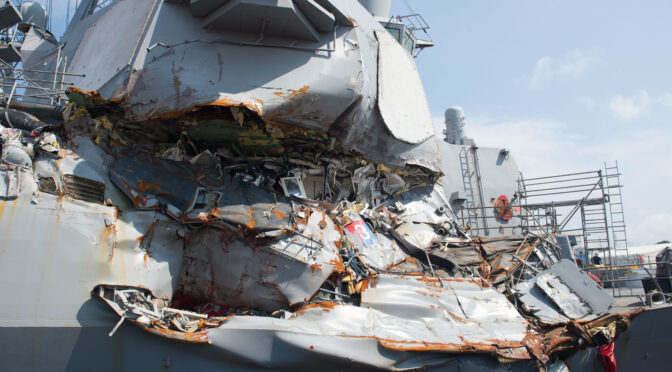
Featured Image: The guided missile destroyer USS Fitzgerald sits in Dry Dock 4 at Fleet Activities Yokosuka, Japan, for repairs and damage assessments, July 13, 2017. (U.S. Navy photo by Petty Officer 2nd Class Christian Senyk)
Train to Win Below the Threshold of War

Notes to the New CNO Series

By Vince Vanterpool

In support of developing a new Navy Deterrence Concept, the U.S. Navy needs to develop and train to new tactics and techniques in how to operate just below the threshold of armed conflict. The PRC and PLAN are very comfortable in this realm under the doctrine of their “Three Warfares” and have only grown bolder in their day-to-day operations in the Pacific. The recent collision between PLAN and CCG vessels provided the world a reminder of how dynamic and volatile the situation has become, but it will not dissuade the PLAN from further attempts to exert sea control and sea denial through non-lethal means.

In recent years, the strategy of Integrated Deterrence has taken the form of increased multilateral partnerships, exercises, and patrols to include ASEAN nations, Japan, Australia, and even European powers such as England and France. Additionally, the Pentagon has implemented VIPER (VI personnel) as a means to better broadcast accurate narratives for incidents and interactions at sea. The services have developed operational concepts for countering future maritime threats through Distributed Maritime Operations (DMO), Expeditionary Advanced Base Operations (EABO), and the Multi-Domain Task Force (MDTF). However, these initiatives are falling short of truly deterring the PLAN and are not providing tactical-level personnel with the training necessary to win in situations that remain just below hostile acts of war.

In training events and schoolhouses, students often find themselves stuck between the two extremes of routine peacetime operations and preparing for the high-end fight, neglecting the nuance of what comes between those stages. Commanding Officers, Officers in Charge, and Mission Commanders, as well as the personnel under their command, need to be better prepared to interact with a more aggressive and competent PRC that will exploit the seams in our current policies to either force our hand as the aggressor or erode our influence in peacetime. This preparation can only come from practice, but not always at the console or in the cockpit, but in discussions and forums, guided and mediated by JAGs, warfare commanders, and personnel familiar with PRC coercion tactics. The tactical and operational commanders need to have earnest discussions and wargames or tabletop discussions to experiment and refine policies, processes, and tactics.

The actions seen against the Filipinos by the PRC is only the beginning. There may be similar actions against U.S. assets in the future. In order to adequately deter and defeat these future attempts, the Navy Deterrence Concept needs robust tactics and techniques for naval units operating at the tactical level just below the threshold of armed conflict.

LT Vince Vanterpool is currently serving as Chief Engineer onboard USS Preble (DDG-88). Vince completed his Division Officer tours onboard USS McCampbell (DDG-85) and USS Shiloh (CG-67), and earned his Master’s in Operations Research from the Naval Postgraduate School during his shore tour.

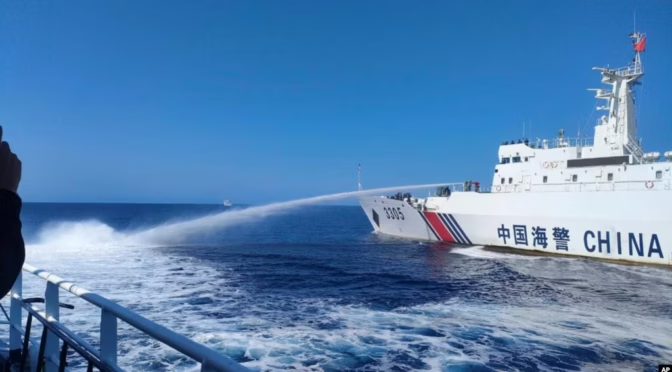
Featured Image: A Chinese Coast Guard ship, right, uses its water cannons on a Philippine vessel as it approaches Scarborough Shoal in the disputed South China Sea on Dec. 9, 2023. (Philippine Coast Guard photo)

Sink the Kill Chain: A Navy Space Guide to Protecting Ships and Sailors

Notes to the New CNO Series

By Alan Brechbill

Admiral Caudle’s first message to the fleet outlined three priorities: the Foundry; the Fleet and the way we Fight. These priorities cannot be realized without acknowledging the simple fact that the next war at sea will be decided first in space. Ships and Sailors operating inside lethal weapons engagement zones (WEZs) cannot survive against China’s massed, over-the-horizon precision fires unless the Navy treats space operations and Counter-C5ISRT (C-C5ISRT) as foundational, not auxiliary, to naval warfare.

China has already built an architecture designed to hold U.S. carrier strike groups and logistics convoys at risk from thousands of miles away. Their killchains depend on persistent surveillance, tracking and targeting multi-phenomenology satellites, long-range radars, and networked command systems. In other words, they will not win with their missiles, but with their ability to find us. Breaking that killchain is the Navy’s main line of defense.

The uncomfortable truth is that Navy leadership still underappreciates this vulnerability. Too much emphasis remains on adding incremental capability to surface combatants or fielding exquisite, but fragile platforms, while adversaries are scaling cheap, resilient sensor networks in space. A fleet that cannot hide cannot fight.

The prioritization of space must be ruthless. The CNO must make Navy space and C-C5ISRT operations the primary force enablers across the maritime domain, and should do this across five mutually supporting lines of effort. 

1. Space as a Warfighting Domain, Not a Support Function

The Navy cannot outsource its survival to the Space Force. Maritime space operations must be owned, integrated, and exercised by trained Sailors who understand fleet maneuver. Space control must be as natural to a strike group commander as air defense.

2. C-C5ISRT as the Navy’s First Layer of Defense

Before the first missile is fired, the battle is already underway in the electromagnetic spectrum and across all orbital regimes. We must blind, jam, spoof, or destroy red’s kill web faster than it can refresh. This requires investments in offensive space capabilities, maritime EW, and deception tools that are not “nice-to-have,” but existential to survival.

3. The Foundry Must Build for the Dark

New platforms and payloads must be designed to operate when space enablers are degraded, while simultaneously being able to deny space support to the adversary. Resilience is not redundancy, it is deception, mobility, and adaptability baked into the Fleet from day one.

4. The Fleet Must Train to Disappear

Fleet exercises must not assume persistent U.S. space superiority. Ships must practice emissions control, deception operations, and distributed maneuver under the assumption that they are being hunted from orbit. Only by learning to vanish can they fight to win.

5. Manpower as a Warfighting Weapon

The Navy cannot fight a space war with borrowed manpower and leased expertise. Space dominance demands Sailors who are trained and certified in the lethal art of disrupting red killchains. This is not an auxiliary skillset, but a warfighting specialty. If the Fleet expects to survive, it must invest in dedicated Navy Space operators with the same rigor given to aviators and submariners. Anything less will cost ships and lives.

Conclusion

The Navy’s heritage is about giving Sailors a fighting chance to prevail. In the age of great power competition, saving ships and Sailors’ lives means breaking the enemy’s killchain. Admiral Caudle’s vision will succeed only if the Navy ruthlessly prioritizes space dominance and C-C5ISRT as the bedrock of how we Fight. The Fleet’s survival depends on it.

Captain Alan Brechbill, a Maritime Space Officer, is the Director of Navy Space Command. The views expressed here are those of the author and do not necessarily reflect the official views of the United States Navy or the U.S. government.

Featured Image: The guided-missile destroyer USS Oscar Austin (DDG 79) transits the Atlantic Ocean Sept. 14, 2017. (U.S. Navy photo by Mass Communication Specialist 2nd Class Ryan Utah Kledzik)

Accelerate Human-Machine Teaming in the Maritime Operations Center

Notes to the New CNO Series

By Michael Posey

To maintain maritime superiority in this era of trans-regional, multi-domain warfare, the Navy must accelerate human-machine teaming within Maritime Operations Centers (MOCs). Our adversaries, including our pacing challenge, China, invest heavily in adopting AI technology, a consequential technology for command and control. MOCs serve as the decision hubs of numbered fleets, responsible for executing campaigns at sea and managing maritime task forces. As our Navy fights from the seabed to space and through the electromagnetic spectrum, the volume of data demands our watchstanders employ data-enhancing tools that augment, not replace, human judgment.

The Fleet: Command and Control at Scale

Numbered fleets are our Navy’s primary warfighting formations, and MOCs serve as the command and control hubs. NTTP 3-32.1 reminds us that MOCs must integrate intelligence, operations, and logistics at scale. AI offers a force-multiplying capability by enabling rapid data synthesis, which enhances the Fleet Commanders’ situational awareness and supports watchstanders under pressure. When properly integrated, AI can relieve watchstanders and their task forces of burdensome tasks, allowing them to communicate the most salient information to Fleet Commanders so they may focus on high-consequence decisions. For centuries, our watchstanders have been ready for the fight. Given the rapidly evolving character of war, especially with the advent of AI tools, we must optimize how we train and equip our Sailors.

The Fight: Maneuver and Fires Across Domains

In combat, human-machine teaming becomes even more critical. The Navy is transitioning to hybrid fleet operations, employing assets across multiple domains with expanding maneuver and converging fires. AI can assist warfighters in the MOC with threat detection, targeting, and resource allocation, but only if operators trust its outputs. Building that trust requires transparency, reliability, and comprehensive training.

The Foundry: Building the Future Force

The most important pillar, sir, is the Foundry—how we build our future force through education and training. AI is not a panacea. Bias, contextual failures, and misinterpretation remain as AI’s Achilles’ Heels. Watchstanders should employ AI while recognizing these limitations. Furthermore, our Navy must initiate the challenging task of standardizing data collection across commands to prevent silos and enable data-informed decisions. Watchstanders must arrive as AI-literate warfighters, prepared to operate in a vast, volatile, contested maritime domain that demands machine teaming. The Pentagon is already investing in digital learning platforms and executive education to build this literacy across the force. Let’s lead the way with education and training at Naval Postgraduate School, Maritime Warfighting Courses, and  Fleet Tactical Training Groups.

Human-machine teaming in MOCs is not merely aspirational but an immediate imperative. The Navy must invest in AI education in our Foundry to empower the Fleet for the coming Fight. By doing so, our Sailors will be ready when they stand the watch with the decision-making tools they need to prevail in tomorrow’s maritime fight.

CDR Michael Posey is a U.S. Naval Flight Officer assigned as an Assistant Professor in the Department of Military Strategy, Planning, and Operations at the U.S. Army War College in Carlisle, PA. The views expressed here are those of the author and do not necessarily reflect the official views of the United States Navy or U.S. government.

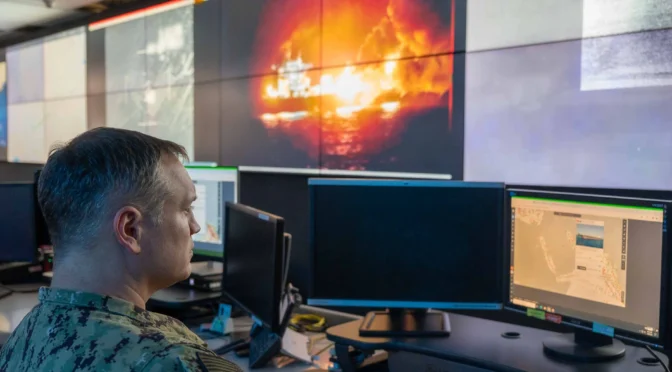
Featured Image: Sailors stand watch in U.S. Naval Forces Central Command’s (NAVCENT) maritime operations center in Manama, Bahrain, Jan. 29, 2024. (U.S. Navy Photo)

Fostering the Discussion on Securing the Seas.