
By Michael Posey
To maintain maritime superiority in this era of trans-regional, multi-domain warfare, the Navy must accelerate human-machine teaming within Maritime Operations Centers (MOCs). Our adversaries, including our pacing challenge, China, invest heavily in adopting AI technology, a consequential technology for command and control. MOCs serve as the decision hubs of numbered fleets, responsible for executing campaigns at sea and managing maritime task forces. As our Navy fights from the seabed to space and through the electromagnetic spectrum, the volume of data demands our watchstanders employ data-enhancing tools that augment, not replace, human judgment.
The Fleet: Command and Control at Scale
Numbered fleets are our Navy’s primary warfighting formations, and MOCs serve as the command and control hubs. NTTP 3-32.1 reminds us that MOCs must integrate intelligence, operations, and logistics at scale. AI offers a force-multiplying capability by enabling rapid data synthesis, which enhances the Fleet Commanders’ situational awareness and supports watchstanders under pressure. When properly integrated, AI can relieve watchstanders and their task forces of burdensome tasks, allowing them to communicate the most salient information to Fleet Commanders so they may focus on high-consequence decisions. For centuries, our watchstanders have been ready for the fight. Given the rapidly evolving character of war, especially with the advent of AI tools, we must optimize how we train and equip our Sailors.
The Fight: Maneuver and Fires Across Domains
In combat, human-machine teaming becomes even more critical. The Navy is transitioning to hybrid fleet operations, employing assets across multiple domains with expanding maneuver and converging fires. AI can assist warfighters in the MOC with threat detection, targeting, and resource allocation, but only if operators trust its outputs. Building that trust requires transparency, reliability, and comprehensive training.
The Foundry: Building the Future Force
The most important pillar, sir, is the Foundry—how we build our future force through education and training. AI is not a panacea. Bias, contextual failures, and misinterpretation remain as AI’s Achilles’ Heels. Watchstanders should employ AI while recognizing these limitations. Furthermore, our Navy must initiate the challenging task of standardizing data collection across commands to prevent silos and enable data-informed decisions. Watchstanders must arrive as AI-literate warfighters, prepared to operate in a vast, volatile, contested maritime domain that demands machine teaming. The Pentagon is already investing in digital learning platforms and executive education to build this literacy across the force. Let’s lead the way with education and training at Naval Postgraduate School, Maritime Warfighting Courses, and Fleet Tactical Training Groups.
Human-machine teaming in MOCs is not merely aspirational but an immediate imperative. The Navy must invest in AI education in our Foundry to empower the Fleet for the coming Fight. By doing so, our Sailors will be ready when they stand the watch with the decision-making tools they need to prevail in tomorrow’s maritime fight.
CDR Michael Posey is a U.S. Naval Flight Officer assigned as an Assistant Professor in the Department of Military Strategy, Planning, and Operations at the U.S. Army War College in Carlisle, PA. The views expressed here are those of the author and do not necessarily reflect the official views of the United States Navy or U.S. government.
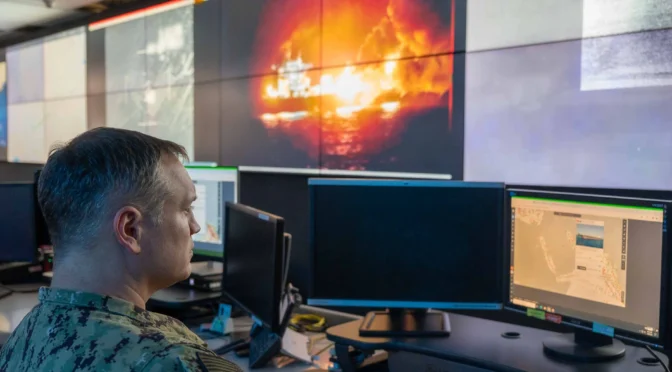
Featured Image: Sailors stand watch in U.S. Naval Forces Central Command’s (NAVCENT) maritime operations center in Manama, Bahrain, Jan. 29, 2024. (U.S. Navy Photo)