The Submarine Force Needs More Flexible Training Tools

Notes to the New CNO Series

By Andrew Pfau and Bridger Smith

Shore-based team trainers – attack centers – are critical for submarine crews preparing for deployment to exercise the full range of tactical skills in a challenging training environment. These trainers focus on modeling complex ocean environments, sensors, and warships, resulting in a high-cost trainer with only two to three attack centers at each shore facility. The limited number of trainers coupled with high demand means that submarine crews in shipyard availabilities are low priority for these trainers, often going weeks between opportunities to use them. If the Navy wants a more lethal submarine force, it requires more low-cost training options for Pre-Commissioning Units and those in long shipyard overhaul.

Only one submarine schoolhouse, in Pearl Harbor, is co-located on the same base as a shipyard. The Navy’s other public and private shipyards require sailors to travel to and from the schoolhouse, creating a time and financial burden on sailors. When attack centers are unavailable, shipyard units resort to studying manuals or discussing scenarios with whiteboard diagrams. These are clearly less than ideal training conditions, especially when shipyard sailors are considered the reserve surge force for deploying submarines.

A lower-fidelity, modular trainer, operated by one sailor in a classroom would provide a low-cost, high-density training asset for the submarine force. This “attack center in a box” would run on basic laptops, linking together four to five tactical watchstanders in the same training environment, utilizing off-the-shelf technology. It would not replace shore trainers but augment the higher-fidelity training they provide. Sailors could increase training “reps and sets,” execute a more consistent and higher density training schedule, and reduce qualification time. When watchteams train in the attack center, there would be greater training value with less time spent on basic skills and more time on the complex problems the higher-fidelity trainer provides.

Tabletop wargames also provide submariners with an opportunity to hone tactical decision-making skills at a low financial and readiness cost. Watchteams could wargame tactical decisions, exploring alternative paths and various tactical scenarios. The opportunity to pilot and test new technologies and tactics in low-risk environments would provide valuable user-centric feedback and would shift risk to the left of the more high-demand trainers. Wardrooms would be introduced to the principles of wargaming and practice integrating with surface and air units for theater anti-submarine warfare. A simple, flexible, wargame that uses knowledge sailors already possess and can be learned quickly provides countless repeatable training opportunities.

As shipyard availability delays continue to challenge the submarine force, sailors assigned to the these units require better and more consistent training tools. Sailors must be ready to support at-sea operations and units must quickly transition to a combat-ready state after shipyard periods. Low-cost, high-density training tools like wargames and an “attack center in a box” can provide opportunities for sailors to build and maintain perishable at-sea skills, leading to a more ready and lethal force.

Andrew Pfau is a submarine officer currently assigned as the Navigator aboard USS COLORADO (SSN 788) undergoing a CNO availability at Pearl Harbor Naval Shipyard. He is a graduate of the U.S. Naval Academy and the Naval Postgraduate School.

Bridger Smith is a submarine officer currently assigned to the INSURV Board of Inspection and Survey. He was Navigator aboard USS COLUMBUS (SSN 762) undergoing a CNO availability at Huntington Ingles Industry Shipyard in Newport News, VA. He is a graduate of the U.S. Naval Academy and the Naval Postgraduate School.

These opinions are expressed in a personal capacity and are not intended to reflect official views or policies of the Department of the Navy or the U.S. government.

Featured Image: Ohio-class ballistic missile submarine USS Nevada (SSBN 733) docked in Naval Base Kitsap’s Delta Pier’s dry dock, Dec. 28, 2023. (U.S. Navy Photo by Mass Communication Specialist 2nd Class Adora Okafor)
Revisiting A Modest Proposal for Improving Shipyard Production and Repair Capacity

Notes to the New CNO Series

By Ryan Walker

It came as a great surprise to me that, despite disliking being a submariner in a shipyard, I quite enjoyed working as a test engineer/technician at Electric Boat. Shipyards have defined my adult life, and despite my current career forcing me to move away from them, I greatly appreciate the experience. From both a yardbird on the deck plate and a shipyard historian, there were a few things to take into consideration.

In the short-term, existing shipyards are the only production environments on which we can reasonably depend. While funding is flowing to shipyards, the customer (Congress) is not always reliable, incredibly demanding (for good reason), and shipyard production is a diseconomy of scale that relies on a high level of capital investment with relatively low margins restricted by the customer. It is an unattractive prospect for a private company to decide to venture into. This assumption has thus far proven correct, as no new shipyard is projected to open by 2029, though there does appear to be diversification of the shipyard’s work and supply network.

The question shifts to how to accelerate production with facilities today without waiting for a miracle or new production facility. My experience standing midwatch at Portsmouth Naval Shipyard and being the Third-Shift “Operability” technician at Electric Boat taught me that fewer personnel are present outside of First Shift. Current shipyard operations concentrate too much work into first shift, creating bottlenecks in tight spaces and diminishing returns, oftentimes well past the point where returns are negative (and makes parking a nightmare).

The solution is a modified Dupont shift schedule, an 8-4-2-10 model, that could sustainably increase shipyard output without burning out the workforce. This schedule divides the labor pool into two ten-hour shifts across an eight-day cycle, with each crew working four days on, four days off. By spreading work across two balanced shifts, we reduce congestion, improve coordination, and extend productive hours from 60–76 per week to potentially 140.

The benefits go beyond productivity. A predictable four-day-off cycle improves morale, attracts new talent, and offers resilience in the face of illness, burnout, or future disruptions. It also creates a built-in training pipeline: experienced workers on staggered shifts can mentor new hires and build institutional knowledge while preparing for future expansion. The 8-4-2-10 is a modern adaptation of the Second World War-era production tempo, designed to meet today’s labor realities while maximizing throughput.

This proposal requires buy-in from labor unions, management, and policymakers. It challenges the cultural norm of the five-day workweek and demands investment in oversight, scheduling, and support infrastructure. But the alternative is continued stagnation or waiting for another miracle of production. We cannot afford to wait for new shipyards to come online while our current facilities operate below capacity.

I recommend the Chief of Naval Operations push the 8-4-2-10 as a potential realistic solution rooted in historical insight, operational experience, and a deep respect for the challenges facing the shipyard worker. If implemented thoughtfully, the 8-4-2-10 schedule could become a model for other defense programs, reinforcing readiness while preserving workforce well-being.

Ryan C. Walker served as a submariner in the USN from 2014-19. Ryan is currently a PhD researcher at the University of Portsmouth and an Adjunct Naval History Professor at the United States Naval Community College. His first book, The Silent Service’s First Hero and has published several articles and chapters in edited collections on American submariners, American Naval-Capital towns, and British Private-Men-of-War. The opinions expressed are those of the author alone.

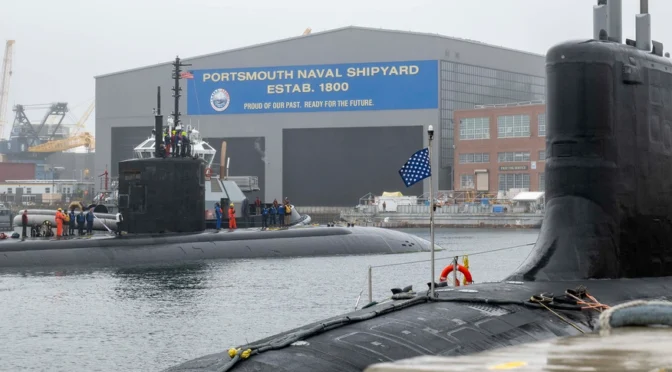
Featured Image: KITTERY, Maine (Nov. 21, 2024) — The Los Angeles-class attack submarine USS Hampton (SSN 767) arrives at Portsmouth Naval Shipyard, Kittery, Maine, for a scheduled maintenance period. (U.S. Navy photo by Mass Communication Specialist 1st Class Charlotte C. Oliver)

Fix the Navy’s Flawed System of Warfighting Development

Notes to the New CNO Series

By Dmitry Filipoff

“After their examination, the recruits should then receive the military mark, and be taught the use of their arms by constant and daily exercise. But this essential custom has been abolished by the relaxation introduced by a long peace. We cannot now expect to find a man to teach what he never learned.” –Vegetius, De re militari

For the U.S. Navy, the first 30 years of post-Cold War experience featured a major institutional reorientation toward the low-end spectrum of operations in a highly permissive threat environment. This facilitated widespread dysfunction across critical warfighting development functions that are crucial for preparing the Navy for war. The result has been one of the most pivotal eras of decay and atrophy of high-end warfighting skill in the modern history of the U.S. Navy.

A pointed example of the U.S. Navy’s atrophy in warfighting development can be seen in its combat training program and weak opposition forces. For decades, the U.S. Navy’s primary format for training carrier strike groups consisted of training only one warfare area at a time against opposition that was deliberately made to lose. No matter how poorly U.S. Navy forces perform in their pre-deployment exercises, they will still get certified as ready for war. This is because it is ultimately more important for the Pentagon to push naval forces out the door and meet demand signals on time, rather than to ensure its naval forces feature genuinely high readiness for great power war. This system has been normalized over decades and led to a deeply distorted understanding of what deploying naval forces are actually capable of.

This 30-year era of atrophy is some of the most fundamental background context for understanding the current state of the modern U.S. Navy. It is also the formative career experience of a full generation of naval officers and heavily shaped them. This experience has unfortunately contributed to major blindspots over first-order considerations of how a Navy prepares for great power war, as well as shortfalls in tactical literacy in high-end warfighting. This has made it difficult for the Navy to overcome the systemic dysfunction that resulted from its post-Cold War experience, and effectively pivot toward high-end warfighting to meet the rise of China’s superpower fleet.

The widespread problem in tactical literacy is especially consequential, and its impact is hard to overstate. Almost everything the Navy does boils down to its tactical warfighting implications, whether it is what force design it should have, how it should operate, or who it should promote. Almost everything is a function of tactics and has a direct tactical implication. But tactics are not minor details or actions – they are the governing logic of how fleets are destroyed in combat. And that logic infuses everything a Navy does.

If the Navy does not effectively understand that logic, then so much naval policymaking and administration will be seriously impaired when the warfighters do not have a good idea of what the combat is going to look like or how to prepare for it. It is extremely difficult to make good decisions about what force structure will be relevant, how to design warfighting concepts, or how to reform force generation, if the warfighters do not  understand how the fighting is going to work.

These issues are reflected in how the governance of the Navy’s warfighting development has a fundamental structural problem. The Navy is one of the U.S. military services that does not have a high-echelon warfighting development command for the whole service. There is no command in the Navy that is charged with acting as a true integrator of the warfighting development of its communities. Instead, those functions are heavily concentrated in community silos, who develop their forces with great independence. OPNAV N7 and NWDC have warfighting development in their names, but they do not have the actual core equities and authorities that are befitting of a true service-wide warfighting development command. They do not control combat training or tactical development, and they cannot compel the community warfighting development centers to make tradeoffs for the sake of integrating into an overarching warfighting concept.

But high-end warfighting is inherently combined arms warfighting and fleet-level warfighting. A fleet warfare doctrine must feature a combined arms doctrine that features deliberate tradeoffs and holistic integration across multiple types of forces, rather than a doctrine that is only a sum of parts that were separately grown by independent communities. This flawed architecture seriously impairs the Navy’s ability to generate and then implement service warfighting concepts, especially ones that yield real binding directives for how the Type Commands update their warfighting development.

The Navy should consider establishing a high-echelon warfighting development command that is empowered with the right authorities to truly integrate community tactics into fleet-level doctrine, and lead a broad range of warfighting development reforms. It should make reforms that ensure many warfighting development functions are better integrated and feature more responsive feedback loops that get quickly updated to pace the threat environment. SMWDC’s Red Sea combat lessons process is a positive example of sharpening these feedback loops, and there are many others that deserve similar updates.

The Navy should also systematically review and update its curriculum, qualifications, and administrative requirements to place greater emphasis on tactical warfighting and ensure the content is accurately pacing the high-end threat environment. It should also update career incentives and promotion precepts to ensure tactical warfighting skill and contributions to warfighting development are more heavily weighted in career progression. Lastly, the Navy should advocate for more service-retained deployments so it can resource its warfighting development agenda with more ready naval forces, rather than have almost all of them exclusively go toward combatant command demand signals.

Thankfully much of the system of warfighting development does not run through the Pentagon’s annual budgeting process. This should hopefully afford service leadership far more decision-space in making reforms, and making them quickly. Things like combat exercise regimes, tactical development agendas, certifications, qualifications, and curriculum can likely be changed far more quickly and substantively than a program of record in a POM submission. Updating a training syllabus can have a near-term, deckplate-level, fleet-wide impact on the Navy’s warfighting skill in a way few things can.

These efforts will be a concrete way to put warfighting first at an institutional level and elevate the importance of lethality. A reformed system of warfighting development will do far more than equip the Navy with better governance and readiness for great power war. It can set the stage for a fleet that dominates future high-end conflict, and help the U.S. Navy finally put a historic era of atrophy behind it. 

Dmitry Filipoff is CIMSEC’s Director of Online Content. He is the author of the Fighting DMO and How the Fleet Forgot to Fight series. He is the author of “Distributed Maritime Operations: Solving What Problems and Seizing Which Opportunities?,” and coauthor of “Learning to Win: Using Operational Innovation to Regain the Advantage at Sea against China.” Contact him at Content@cimsec.org

Featured Image: PORT HUENEME, Calif. (Feb 27, 2025) – The Arleigh Burke-class guided-missile destroyer USS Fitzgerald (DDG 62) conducts a port call onboard Naval Base Ventura County (NBVC) Port Hueneme. (U.S. Navy photo by Master-at-Arms 1st Class Jon Cason)

What Unifies the Foundry, Fleet, and Fighting Triad? Warfighting Focus

Notes to the New CNO Series

By CDR Paul Viscovich, USN (Ret.)

Which part of a spear makes it lethal? The shaft. Without its alignment of all vectors behind the tip, a spear is no more deadly than a stone. Likewise, unless the Foundry and Fleet behave like a shaft, focusing all their energy toward delivering ordnance on target, the warfighting leg of the triad is compromised. Fleet readiness consists of the manning, training, maintenance, and security programs that underpin it. But not only do these programs often fail to support one another, they are usually in direct competition for limited resources. Achieving effective balance and coordination will require an inexorable focus on warfighting that only the CNO can provide.

A model for this already exists in the Naval Special Warfare community. They recognize that to prioritize one thing – warfighting – it is necessary to reject all conflicting priorities. Whatever does not contribute directly to combat readiness they eliminate. Two things allow the SEALs to achieve this. First, their entire culture is dedicated exclusively to the mission. Second, the NAVSPECWAR chain of command is uncompromising in removing anything that distracts from this priority. It deliberately insulates the Teams from administrative interferences that bedevil the traditional warfighting communities.

By contrast, the warrior ethos of Naval Air, Submarine, and Surface leadership has been eroded by an eight-decade absence of deadly conflict with a peer adversary. It has been replaced by an administratively-obsessed culture that defines excellence in terms of passing rote inspections and scripted drills that often mask warfighting deficits but enable positive reporting. Our focus has shifted from “Rising Suns” along the cockpit to “Es” on the bridgewings.

Though individual commanding officers may strive mightily to create a warfighting focus within their units, the broader chain of command’s overriding insistence that they check all the administrative boxes will suffocate their efforts. At best, they can only put warfighting on the margins of an already thinly-stretched crew and demanding schedule. U.S. Navy flag officers are now mostly trained, groomed, and selected to perpetuate this bureaucracy which is top-heavy with administration.

Personnel is policy. If restoring a serious warfighting culture throughout the fleet is to be the CNO’s legacy, they will need like-minded subordinates now and successors in the future. The CNO must deliberately cultivate a critical mass of reformers that can sustain change at the working level and beyond the tenure of the CNO themself. Start by identifying promising, independent-thinking junior admirals and captains for promotion. A reputation for being “difficult” might be an attribute to look for, if it means they can be constructive change agents that are unafraid to challenge calcified orthodoxy. Then lobby influential Congressional leaders to champion the candidacies of these officers when they are poised to ascend to higher command.

An independent perspective that is not beholden to active-duty career influences and incentives could be useful. In guiding cultural overhaul, consider appointing a blue ribbon panel of retired officers to recommend programs and policies to cut for the non-essential time and financial burdens they place on the fleet. The composition of this board should include several SEALs, as they are the experts on eliminating bloat.

The CNO has inherited a fleet that has suffered creeping administrative overload for years. Unless the CNO can put an end to the suffocating administrative accretions from decades of poorly prioritized requirements, our next war may feature more “victory marks” on the enemy’s bridgewings and fighter cockpits than on ours.

Paul Viscovich is a retired Surface Warfare Officer with 20 years’ service, twelve of that on sea duty. He is a frequent contributor to CIMSEC.

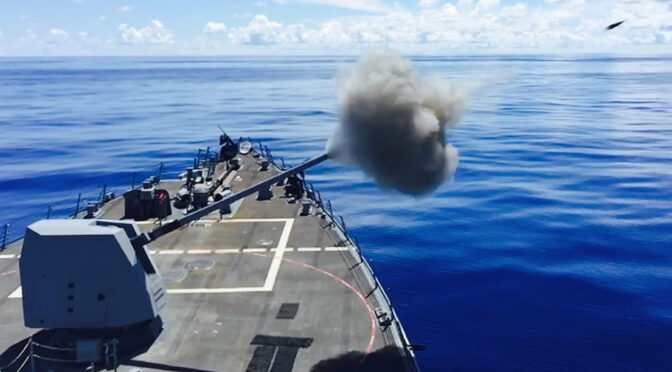
Featured Image: PACIFIC OCEAN (May 25, 2016) The guided-missile destroyer USS Spruance (DDG 111) fires its MK-45-inch gun during a self defense live fire exercise. (U.S. Navy photo by Boatswain’s Mate 3rd Class Daniel Erb/Released)

Fostering the Discussion on Securing the Seas.