To Win the Fight, We Must First Win the Mind: Create NDP-1.1 Naval Warfighting

Notes to the New CNO Series

By Paul Nickell

The new CNO’s vision to place the Sailor at the center of the Foundry, the Fleet, and the Way We Fight provides a powerful focus for the U.S. Navy. The enduring question is how we build the intellectual foundation to connect these pillars. While our service possesses an abundance of technical and procedural manuals, we lack a unifying warfighting philosophy that informs Sailors on not just what our forces do, but also how to think about the fundamental nature of combat at sea.

The central challenge of modern naval warfare is grappling with profound decision-making under uncertainty. Our current doctrine, NDP-1 Naval Warfare, is an essential description of our forces, but it is insufficient as a guide for thinking through the friction, fluidity, and ambiguity inherent in conflict. To truly equip our Sailors to fight and win for tomorrow, the CNO should supplement this document with a doctrine focused on the cognitive art of warfighting. The solution is to champion a new, companion publication – NDP-1.1 Naval Warfighting.

Modeled on the transformative success of the Marine Corps’ classic MCDP-1 Warfighting, this new, concise doctrine would provide the philosophical depth that NDP-1 currently lacks. It should serve as the intellectual framework for every Sailor, Marine, and Coast Guardsmen, fostering a common framework for understanding the challenges of combat. Drawing from the lessons that made MCDP-1 so effective, NDP-1.1 Naval Warfighting should be founded on the following three principles:

A Philosophy-Driven Approach. Doctrine should articulate a clear philosophy for action that values initiative, adaptation, and decentralized decision-making in the face of uncertainty. It should be a guide to thinking through the complexities of the maritime domain in joint operations, not a rigid playbook.

A Strong Conceptual Foundation. Doctrine should be supported by theoretical underpinnings of developing the foundry, and will describe the fundamental nature of naval warfighting to establish common ground among the sea services. This includes examining the unique challenges of the maritime domain, including the fluidity of the environment, the immense scale, and the complex interplay of technology, geography, and human factors that create friction.

An Elevation of Leadership and Decision-Making. Doctrine should place leadership and decision-making at its core. It is time to codify concepts like Mission Command and the Charge of Command, moving them from a standalone document into the fabric of our warfighting philosophy. By focusing on the human factors like experience, training, and critical thinking skills, this doctrine arms our leaders of all ranks to overcome uncertainty in the fog of war.

The publication of NDP-1.1 Naval Warfighting must be the capstone of a service-wide campaign of engagement, dialogue, and education, integrated into our Naval University System and schoolhouses from accession to flag. It deserves to be read and revisited in wardrooms and ready rooms across the fleet. Publication alone is not enough, it must be formally incorporated into curriculum and training, and deliberately socialized into the fleet.

To truly place the Sailor front and center, we must first invest in their mind. NDP-1.1 Naval Warfighting can provide the enduring intellectual framework to strengthen the Fleet, empower the Foundry’s purpose, and master the Way We Fight. It is a foundational reform and a legacy worthy of the CNO’s tenure.

Captain Paul Nickell recently completed his tour as a Military Professor at the College of Leadership and Ethics within the Naval War College. He is starting his training to take over as commanding officer of the Navy’s largest master jet base at Naval Air Station Lemoore in 2026. As part of the naval aviation community, he has commanded a squadron, facilitated learning at the Navy’s Leadership and Ethics Command for major commanders and commanding officers, and developed tomorrow’s joint force leaders. His graduate thesis at the Naval Postgraduate School focused on how the Navy can become a better learning organization.

Featured Image: NEWPORT, R.I.— Adm. Daryl Caudle, Commander, U.S. Fleet Forces Command (USFFC), delivers a lecture to students, staff and faculty at the U.S. Naval War College (NWC) onboard Naval Station Newport, RI, Apr. 30, 2025. (U.S. Navy photo by Mass Communication Specialist 2nd Class Connor Burns)

Expand the Navy’s Over-the Horizon Targeting Solutions

Notes to the New CNO Series

By Richard Mosier

Since the fielding of the Harpoon missile in the 1970s and the original Tomahawk Anti-ship Missile (TASM) in 1982, maritime over-the-horizon targeting has been an insufficient and largely unresolved ISR capability requirement for the U.S. Navy. The Navy has had limited long-range sensors for detection and tracking, an inability to sustain continuous tracking of targets of interest after detection, and few direct tactical network exchange capabilities to pertinent commands and shooting ships from satellites and primary processing commands. The advent of weapons like Naval Strike Missile (NSM), Prompt Conventional Strike, SM-6 in anti-ship mode, Long-Range Anti-ship Missiles (LRASM), and Maritime Strike Tomahawk (MST) cannot be fully employed without the supporting ISR-T.

The emergence of the Space Force’s fully funded, Long-Range Kill Chains (LRKC) satellite program for tracking moving land and maritime targets offers the Navy the opportunity to dramatically improve fleet tactical situational awareness and over-the-horizon targeting. The satellites’ continuous, near real-time tracking of moving surface ships will provide a track continuity foundation upon which to correlate other periodic sources of ship location and identification. For the Navy, the cost to take advantage of this satellite tracking capability will be in developing and installing modifications to fleet systems to receive this high new volume of moving target indicator (MTI) tracks, automatically correlate intermittent information from other sources, and disseminate updates on tracks of interest to command and battle forces in the area, as well as at the pertinent Maritime Operations Centers (MOCs).

To realize this potential, three actions are suggested:

1. Ensure fleet requirements and wartime architectural constraints are presented and accepted in the requirements forum for the Space Force LRKC constellation.

2. Modernize MOC, big deck, and major combatant capabilities for building and maintaining the common tactical picture with LRKC inputs, plus taking advantage of the near real-time MTI track updates.

3. Incorporate AI applications to support rapid command understanding of the defensive and offensive situation at operational (MOCs) and tactical (battle force commanders, big decks, and major combatants) levels.

ISR-T for sea control is also a joint capability matter. The deployment of the Marine Corps’ new Marine Littoral Regiments MLR), equipped with truck-launched NSMs, the Army’s developing Multi-Domain Task Force (MDTF) units with its next generation HIMARS-launched Precision Strike Missiles (PrSM), and the Air Force’s LRASM-equipped bombers, will need to be networked into regional anti-ship capabilities and networks alongside navy forces. Joint partners will need the same tactical pictures against moving seaborne targets, as well as a coordination network to integrate into regional sea control missions, probably led by local naval commanders.

With a projected full operational capability in 2030, the Long-Range Kill Chains (LRKC) program offers a solution to these requirements. While the first action step is to get maritime requirements inserted into LRKC capability factors, the Navy concurrently needs to equip the fleet to be ready to exploit this new over-the-horizon ISR-T capability when this constellation reaches full operational status. Doing so could help the Navy make the most of the latest long-range weapons entering the fleet and manifest a major evolution in firepower.

Richard Mosier is a retired defense contractor systems engineer, Naval Flight Officer, OPNAV N2 civilian analyst, and OSD SES 4 responsible for oversight of tactical intelligence systems and leadership of major defense analyses on UAVs, signals intelligence, and C4ISR.

Featured Image: The Arleigh Burke-class guided-missile destroyer USS Fitzgerald (DDG 62), while participating in Exercise Rim of the Pacific (RIMPAC) 2024, fires the first naval strike missile from a U.S. destroyer July 18, 2024. (U.S. Navy photo by Mass Communication Specialist 2nd Class Jordan Jennings)

Anchor Acquisition and Force Development on Targeting China’s C4ISR

Notes to the New CNO Series

By Nicholas Weising

Admiral Daryl Caudle’s tenure as CNO began on August 25th, 2025, meaning his four-year term includes the end of the Davidson window in 2027, when China will have reached its milestone of developing sufficient defense capability to forcefully annex Taiwan. The key to China succeeding is maintaining their anti-access/area denial (A2/AD) approach intended to keep adversary forces out of the first island chain. U.S. Navy operational concepts must make an explicit priority of targeting the C4ISR architecture that fundamentally enables China’s A2/AD approach and have it serve as a core organizing principle for Navy acquisition and force development.

The center of China’s A2/AD strategy involves long-range precision-strike (LRPS) missiles, encompassing anti-ship, anti-air, and anti-surface capabilities. The DF-21D is a road-mobile ballistic missile capable of targeting a moving carrier strike group at 1,450 kilometers away. The DF-26 is an intermediate-range ballistic missile capable of hitting Guam, Okinawa, and other American military installations in the region. The DF-17 is a road-mobile missile that delivers a hypersonic glide vehicle that can penetrate air and missile defenses. These are the primary long-range conventional weapons the PLA Rocket Force (PLARF) has at its disposal. The PLARF’s LRPS capabilities can attack carrier strike groups and military bases across the First Island Chain and up to the Second Island Chain on short notice.

The ability to establish and contest air control over Taiwan would be pivotal in any scenario, but the effects of China’s A2/AD posture are most acute in the air domain. Advanced sensors, integrated air defenses, and surface-to-air missile systems create a highly contested environment. Aircraft are limited by endurance and mission availability rates, meaning they cannot maintain presence indefinitely. Even the most capable U.S. jet fighter today has a combat radius of only about 600 nautical miles without aerial refueling. This constraint goes back to the origins of modern airpower. Fighter aircraft were first designed for the European theater, where dense networks of airfields exist. Meanwhile, the Indo-Pacific has vast stretches of water and land separated by hundreds or thousands of miles. In a Taiwan contingency, sorties from Japan or Korea would almost certainly require midair refueling and would struggle to maintain a consistent presence in the battlespace. This is why carriers remain indispensable. Yet the PLARF LRPS capabilities threaten to box carriers out of the region.

C4ISR capabilities enable A2/AD architecture. Admiral Caudle should treat C4ISR as the principal target in any campaign against the PLA and develop the Navy accordingly. The CNO must prioritize a layered approach that targets hostile sensing and command and control, while reinforcing friendly sensing and command links to create decision advantage. The CNO should scale up electronic warfare and cyber teams so they can effectively deny enemy ISR, disrupt missile targeting, and a play a more predominant role in wartime naval operations. The CNO should invest in communication architectures that can survive contested environments and accelerate investments in space-based sensors to create more distributed killchains. At the same time, the Navy should also invest in deception methods to complicate enemy targeting, and rehearse operations in degraded conditions so commanders and crews can operate confidently when links are contested.

Neutralizing Chinese C4ISR should be a top CNO priority, and serve as an organizing principle for guiding the investment of resources, the design of exercises, and the management of acquisition. Such an approach will maximize the competitiveness of the U.S. Navy.

Nicholas Weising is a Program Assistant at the Center for Maritime Strategy.

Featured Image: A KJ-500 airborne early warning (AEW) aircraft attached to an aviation regiment with the navy under the PLA Southern Theater Command prepares to take off for a real-combat flight training exercise on January 9, 2020. (eng.chinamil.com.cn/Photo by Qin Qianjiang and Zeng Qi)

A Navy for War in the Age of Intelligent Missiles

Notes to the New CNO Series

By Craig Koerner

The U.S. model of delivering firepower continues to predominantly take the form of short-range weapons delivered from smart and expensive tactical platforms, defined as platforms which primarily use organic sensors to find and engage targets. These are quickly becoming obsolete in modern warfare given the rise of long-range missiles coupled with long-range sensor architectures. In the age of modern microelectronics, missiles have increasingly capable seekers for independently and accurately targeting enemy ships and aircraft despite countermeasures. Compared to penetrating aircraft, missiles are cheaper, faster, and far more capable of penetrating defenses. Given targeting, long-range missiles often outperform platforms delivering short-range weapons.

The platform-weapon model long used by the U.S. creates a force that delivers warheads more cheaply and with greater magazine depth than a missile-centric force, but only if platform attrition rates are kept extremely low. This is unlikely when facing modern missiles from a great power, or from any country that can buy and target such missiles. Therefore, when fighting any competent military power, missiles should be launched from low-signature vehicles that never see the targets but shoot from over the horizon, including ground vehicles, submarines, stealthy surface combatants, inconspicuous and cheap surface ships, and cargo aircraft.

Reconnaissance for deploying missile-launching craft and providing targeting data to their missiles is vital to the killchain. Ships and aircraft conducting line-of-sight reconnaissance from the sea surface or the air are likely to be detected and destroyed by missiles. If using active radar, targeting and destruction becomes even more likely. Survivable terrestrial line-of-sight reconnaissance should only be provided by units hiding in clutter and using passive or LPI sensors.

Satellites will be critical for providing over-the-horizon targeting. The economy of orbiting smaller satellites in large multiples (such as 60 at a time via Starlink) gives satellites far greater resistance to anti-satellite weapons than was possible with the giant, exquisite previous generation of ISR satellites. Satellites can also provide coverage and targeting capabilities over contested areas that traditional battle management aircraft would struggle to penetrate. Expendable drones provide yet another avenue for providing over-the-horizon targeting by identifying targets and inducing the targets to defend themselves by radiating. Specialized reconnaissance forces should make up a greater part of our force structure to satisfy the information demands of modern long-range killchains and to defeat adversaries in the hider-finder competition.

Unable to hide, the future of conventional air and sea-surface platforms is grim. When fighting competent opponents, those few, valuable, and conspicuous legacy platforms are likely to be destroyed. Modern warfare is not boxing, it is hide-and-seek. We should redesign our forces accordingly.

Dr. Craig Koerner is a research professor in the Strategic and Operational Research Department within the Center for Naval Warfare Studies at the Naval War College. He is a faculty member and co-founder of Halsey Alfa. He specializes in the study of conventional warfare between high technology powers from World War One onwards. The views expressed here are the author’s own and not necessarily those of any organization with which he is affiliated.

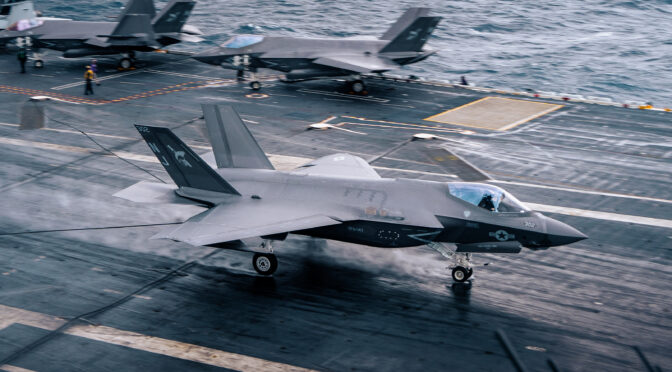
Featured Image: An F-35C Lightning II, from Strike Fighter Squadron (VFA) 147, lands on the flight deck of Nimitz-class aircraft carrier USS George Washington (CVN 73) while underway in the Atlantic Ocean, Dec. 6, 2023. (U.S. Navy photo by Mass Communication Specialist 2nd Class Nicholas A. Russell)

Fostering the Discussion on Securing the Seas.