
By Craig Koerner
The U.S. model of delivering firepower continues to predominantly take the form of short-range weapons delivered from smart and expensive tactical platforms, defined as platforms which primarily use organic sensors to find and engage targets. These are quickly becoming obsolete in modern warfare given the rise of long-range missiles coupled with long-range sensor architectures. In the age of modern microelectronics, missiles have increasingly capable seekers for independently and accurately targeting enemy ships and aircraft despite countermeasures. Compared to penetrating aircraft, missiles are cheaper, faster, and far more capable of penetrating defenses. Given targeting, long-range missiles often outperform platforms delivering short-range weapons.
The platform-weapon model long used by the U.S. creates a force that delivers warheads more cheaply and with greater magazine depth than a missile-centric force, but only if platform attrition rates are kept extremely low. This is unlikely when facing modern missiles from a great power, or from any country that can buy and target such missiles. Therefore, when fighting any competent military power, missiles should be launched from low-signature vehicles that never see the targets but shoot from over the horizon, including ground vehicles, submarines, stealthy surface combatants, inconspicuous and cheap surface ships, and cargo aircraft.
Reconnaissance for deploying missile-launching craft and providing targeting data to their missiles is vital to the killchain. Ships and aircraft conducting line-of-sight reconnaissance from the sea surface or the air are likely to be detected and destroyed by missiles. If using active radar, targeting and destruction becomes even more likely. Survivable terrestrial line-of-sight reconnaissance should only be provided by units hiding in clutter and using passive or LPI sensors.
Satellites will be critical for providing over-the-horizon targeting. The economy of orbiting smaller satellites in large multiples (such as 60 at a time via Starlink) gives satellites far greater resistance to anti-satellite weapons than was possible with the giant, exquisite previous generation of ISR satellites. Satellites can also provide coverage and targeting capabilities over contested areas that traditional battle management aircraft would struggle to penetrate. Expendable drones provide yet another avenue for providing over-the-horizon targeting by identifying targets and inducing the targets to defend themselves by radiating. Specialized reconnaissance forces should make up a greater part of our force structure to satisfy the information demands of modern long-range killchains and to defeat adversaries in the hider-finder competition.
Unable to hide, the future of conventional air and sea-surface platforms is grim. When fighting competent opponents, those few, valuable, and conspicuous legacy platforms are likely to be destroyed. Modern warfare is not boxing, it is hide-and-seek. We should redesign our forces accordingly.
Dr. Craig Koerner is a research professor in the Strategic and Operational Research Department within the Center for Naval Warfare Studies at the Naval War College. He is a faculty member and co-founder of Halsey Alfa. He specializes in the study of conventional warfare between high technology powers from World War One onwards. The views expressed here are the author’s own and not necessarily those of any organization with which he is affiliated.
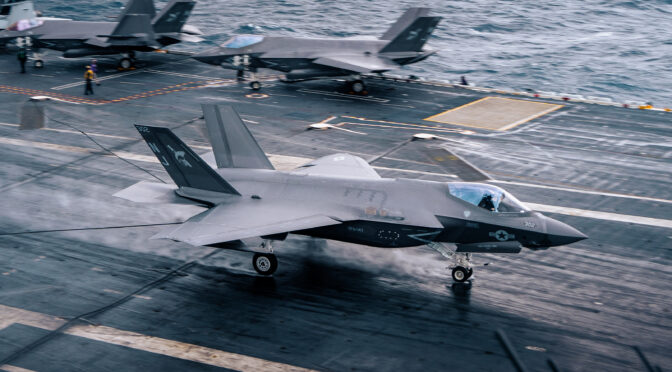
Featured Image: An F-35C Lightning II, from Strike Fighter Squadron (VFA) 147, lands on the flight deck of Nimitz-class aircraft carrier USS George Washington (CVN 73) while underway in the Atlantic Ocean, Dec. 6, 2023. (U.S. Navy photo by Mass Communication Specialist 2nd Class Nicholas A. Russell)
Discover more from Center for International Maritime Security
Subscribe to get the latest posts sent to your email.