
By Bruce Stubbs
In 2022, Congress established the independent National Commission on the Future of the Navy to conduct two overarching studies, one examining naval force structure and the other focused on shipbuilding and innovation.1 The former will recommend the size and composition of the Navy, while the latter will identify opportunities to better integrate advanced technologies into shipbuilding, new construction, and repair shipyards. China now possesses the world’s largest navy by ship count, and its shipbuilding capacity vastly exceeds that of the United States. Chinese shipyards are producing warships faster than American yards can repair them. China has spent a generation building a fleet capable of contesting sea control and converting industrial scale into military power, while the United States has allowed its shipbuilding capacity, naval industrial base, and force structure to deteriorate over the same period. The Commission is required to submit an unclassified report in 2027, and its recommendations could shape American naval power for years to come. To fulfill its mandate, the Commission must resolve five foundational issues.
Issue #1: A Navy Without a Strategy
The Commission cannot responsibly recommend a force structure until it answers a question that Congress, the administration, and the Navy have all failed to answer clearly to date: what is the Navy expected to do?2 Without a clear answer, every force structure recommendation lacks a coherent strategic foundation.
The current situation reflects an accumulation of partial answers. Title 10 provides a floor. The Navy shall be organized, trained, and equipped for the peacetime promotion of national security interests and for prompt and sustained combat at sea. But this is a generalized statutory minimum rather than a strategy.3 The 2025 National Security Strategy (NSS) and the 2026 National Defense Strategy (NDS) provide overarching direction, but they are administration-specific documents that will not survive the current presidency. The strategic objectives they reflect, preventing Chinese hegemony in the Indo Pacific, deterring Russian aggression in Europe, maintaining freedom of navigation, and protecting maritime commerce, have remained substantively consistent across recent administrations even as the terminology, emphasis, and policy frameworks surrounding them have changed. But consistent objectives alone do not constitute a strategy. For decades, the Navy has acknowledged operational strain, force structure pressure, and readiness shortfalls without clearly identifying which missions would receive priority, which risks would be accepted, and what strategic tradeoffs would follow from those choices.
CNO Caudle’s Navy Fighting Instructions is an unclassified public document, but the Navy Warfighting Concept and the developing Navy Deterrence Concept, the foundational guidance documents that the Fighting Instructions references and depends upon, remain classified. What is currently absent in unclassified form is not operational detail. Classified guidance is the appropriate place for theater-specific net assessments and force-sizing specifics. Missing instead is strategic direction concrete enough to shape force planning decisions. Effective strategy must do more than describe objectives. It must identify priorities, accepted risks, and strategic tradeoffs clearly enough to drive force structure decisions. Without that level of clarity, force planning becomes vulnerable to bureaucratic drift, budget pressures, and competing operational demands unsupported by a coherent strategic framework.
Without that conceptual foundation available in both classified and unclassified form, the public, Congress, and the defense community cannot evaluate whether the Commission’s force structure recommendations derive from realistic strategic guidance. Congress requires a classified version to conduct effective oversight and an unclassified version to communicate requirements and justification to the American public. No adequate unclassified naval strategy currently exists to anchor the Commission’s work. Indeed, three days after the President’s Golden Fleet announcement, a Wall Street Journal editorial observed that the larger problem was the apparent absence of clear direction for the Navy.4
The 1980s provide the relevant model for how this problem should be solved. Chief of Naval Operations Admiral James L. Holloway III established the correct analytical sequence in 1978. Force requirements depend on three factors: strategy, threat, and risk, in that order.5 As CNO, Admiral James D. Watkins declared the Maritime Strategy “the bedrock of planning, programming, and operations throughout today’s Navy,” providing “a clear framework against which all budget proposals are judged.”6 The Maritime Strategy existed in both classified and unclassified form. At least eight versions were produced at the secret level and above because Congress, the public, and allies all needed to understand the strategic logic supporting the 600 Ship Navy.7 Strategy defined the ends, and the 600 Ship Navy provided the means. That sequence and that transparency are what the Commission should require. This does not mean strategy alone determines force structure. Political and budgetary realities play an equally important role in shaping the size of the Navy. But strategy must come first and must provide the framework within which those realities are applied.8
The Commission must also look forward rather than remain anchored to current guidance. Ships built on the basis of its recommendations will still be operating in the 2050s. Force planning that ignores future threat environments across a service life extending more than thirty years risks producing forces optimized for today’s problems but poorly matched to tomorrow’s. Yet forecasting is genuinely difficult. Benjamin Jensen, a defense policy analyst at the Center for Strategic and International Studies, and former Marine Corps officer Michael Rountree observed that “there is no single future, but an endless unfolding of alternative pathways and timelines.”9 That difficulty is not a reason to avoid the effort. It is precisely why the Commission must undertake it seriously. It also argues for force designs that preserve room for adaptation. Ships operating in the 2050s must be capable of incorporating warfighting technologies and responding to threats that cannot yet be fully anticipated.
Issue #2: A Sea Control or Sea Denial Navy
The Commission must determine whether the Navy should be designed primarily to achieve sea control or to conduct sea denial. These are fundamentally different strategic objectives that require similar but not identical force structures. Sea control is the condition in which one has freedom of action to use the sea for one’s own purposes while denying that use to the enemy. It enables all other naval functions and historically has been the objective of the stronger naval power. Sea denial involves partially or completely denying the adversary use of the sea without necessarily securing it for one’s own purposes. It has generally been the objective of the weaker side.10
The current administration and the Navy have shifted toward sea denial as the primary organizing concept. The 2025 NSS directs the military to build a force “capable of denying aggression anywhere in the First Island Chain.”11 The 2026 NDS reaffirms this approach by directing a “strong denial defense along the First Island Chain” and declaring that making clear any attempt at aggression will fail “is the essence of deterrence by denial.”12 CNO Caudle’s December 2025 C-NOte stated explicitly that the Navy will “build an integrated, all domain Fleet capable of conducting sea denial and, when needed, sea control.”13 His Navy Fighting Instructions translated this concept into operational guidance through the Hedge Strategy, which he described as necessary because “building a Fleet to cover every possible threat is too expensive, unrealistic, and sub optimized.”14
This was an acknowledgment that the current fleet of roughly 295 ships cannot sustain sea control and therefore must prioritize sea denial supported by unmanned and tailored offset capabilities.15 The Navy’s own emerging small surface combatant concepts reinforce this reality. While senior leaders increasingly describe frigates and other lower-end platforms as necessary to relieve operational pressure on destroyers, those same platforms lack the area-air-defense capability required to replace large surface combatants in high-threat environments. The result is an implicit admission that the Navy is designing portions of the future fleet around the operational requirements of sea denial and presence missions rather than sustained sea control against peer adversaries. Throughout the Cold War and afterward, the Navy described its overarching purpose as sea control or power projection, and at times both, but never as sea denial. Naval Doctrine Publication-1 states explicitly that “Sea control enables all other naval functions.”16
The Commission cannot recommend a force structure without first determining whether that structure is designed to control the seas or merely to contest them. Nor can it make that determination without telling the nation plainly what each choice costs, what each choice risks, and what each choice forfeits.
Issue #3: The Navy’s High–Low Force Mix
The statute’s core mandate to recommend the size and force mixture of ships across four funding scenarios directly requires resolving the Navy’s high- low balance. CNO Caudle acknowledged the operational cost of failing to do so plainly at the Paris Naval Conference when he stated, “what I find now is I end up having to use CSGs [carrier strike groups] and amphibious strike groups in places where I believe I could tailor a force package and be more suited to the threat.”17
High-end forces such as aircraft carriers, nuclear powered submarines, and advanced multi mission surface combatants are designed to operate in contested environments against capable adversaries. They are essential for sea control, deterrence, and power projection. They are also expensive, finite in number, and poorly suited for missions that do not require their capabilities. Every high-end platform assigned to a mission below its capability threshold is a platform unavailable for the high-end fight it was designed and funded to win. The Navy’s operational problem is increasingly one of using sledgehammer solutions for missions that require only a tack hammer. Destroyers designed for high-end combat are routinely consumed by counter-drug patrols, maritime security missions, presence operations, and other low-threat requirements that steadily expend readiness, service life, and maintenance capacity without contributing meaningfully to preparation for major war.
The definition of low-end forces has evolved considerably beyond the crewed patrol ships and frigates of previous decades. Today it encompasses two distinct categories. The first consists of affordable crewed surface combatants. These are smaller and simpler ships optimized for presence, maritime security, and constabulary missions while still capable of contributing to wartime escort and force protection without the cost and complexity of a destroyer. The second and increasingly important category consists of robotic and autonomous systems. These include uncrewed surface vessels configured for scouting, screening, offensive mining, and containerized missile payloads; uncrewed underwater vehicles designed for area denial and counter mine missions; and attritable autonomous platforms capable of coordinated operations without continuous human control.18 CNO Caudle’s Hedge Strategy explicitly identifies these systems as “Tailored Offsets,” describing them as force multipliers that expand mass and complicate adversary targeting at a fraction of the cost of crewed platforms.19 The unifying characteristic of low-end forces, whether crewed or uncrewed, is mission specificity. They are optimized for defined tasks rather than the full multi mission spectrum expected of high-end combatants.
Not all adversaries operate high-end warships. China’s People’s Armed Forces Maritime Militia employs hundreds of nominally civilian fishing vessels to assert maritime claims and harass foreign ships in the South China Sea. Iranian Islamic Revolutionary Guard Corps fast attack craft have repeatedly threatened U.S. Navy ships in the Persian Gulf. Houthi forces have used anti-ship missiles, drone boats, and mines to disrupt Red Sea shipping, requiring sustained naval responses. None of these threats requires a carrier strike group. All require a capable, persistent, and affordable low-end presence that the current force structure cannot efficiently provide.
Six factors shape the Commission’s resolution of this question. The Navy is only infrequently engaged in high-consequence, low-probability conflicts such as war with China or Russia, but it must remain constantly prepared for them. That reality means high-end platforms cannot expend their readiness on lower tier missions. For most of this century, the Navy has instead been consumed by high-probability, lower-consequence maritime security and naval diplomacy missions that neither require nor should routinely employ its most sophisticated combatants. In a general war, low-end forces are essential for convoy escort and force protection. They cannot be absent from the wartime order of battle. Shipbuilding and weapons system costs continue to rise faster than defense budgets, making affordability a binding constraint. The sophisticated weapon systems that define high-end combatants are unnecessary for low-end missions and add cost and maintenance burdens without corresponding operational benefit. The Navy has also repeatedly demonstrated an institutional inability to define and maintain clear requirements for small combatants. The Constellation–class frigate, cancelled after its cost approached that of an Arleigh Burke-class destroyer, stands as the most recent and costly example. Persistent maritime security requirements cannot be sustained indefinitely through episodic deployment of scarce high-end combatants.
The Commission must resist two symmetrical errors in resolving the high-low question. The first is allowing the desire for low-end platforms to participate in high-end warfare to drive their cost and complexity toward that of the high-end platforms they are intended to supplement. Both the littoral combat ship and the Constellation–class guided missile frigate illustrate this problem clearly. The second error is designing low-end platforms so narrowly around peacetime security missions that they become wasted assets during conflict and cannot contribute to escort, force protection, or sea control operations when war comes. In a general war, every hull counts. Low-end ships must therefore be affordable enough to procure in quantity, simple enough to crew and maintain, and capable enough to contribute meaningfully to the wartime fleet.
The 2025 NSS and 2026 NDS sent strong demand signals for both ends of the spectrum simultaneously. High-end forces are needed to deny Chinese aggression in the First Island Chain. Low-end Navy and Coast Guard forces are needed to control sea lanes, counter narco-terrorists, and secure key terrain in the Western Hemisphere.20 The high-low force mix is ultimately not an acquisition question, but a strategic question. A fleet composed entirely of high-end platforms would be strategically capable but numerically insufficient and operationally inefficient. A fleet composed primarily of low-end platforms would be numerically adequate but strategically hollow. The Commission must define the proper balance, specify what low-end actually means in terms of capability and cost, and recommend a force structure capable of performing the full spectrum of naval missions, from maritime security in the Caribbean to sea control in the Western Pacific, without exhausting its high-end platforms on missions they were never intended to perform.
Issue #4: The Navy’s Shipbuilding Crisis and Its Legislative Fix
The Commission’s Study on Shipbuilding and Innovation should draw upon the Vinson-Trammell Act of 1934 as a model for correcting the shipbuilding crisis confronting the Navy today.21 That Act served as the charter that built the modern U.S. Navy.22 Its enduring principles for maintaining the fleet and sustaining the associated shipbuilding industrial base, if applied consistently, would have prevented most of the problems affecting the Navy’s industrial base today.
First, the United States must build and maintain a Navy composed of modern warships that remain on true parity with rival maritime powers. Achieving that goal requires determining on a long-range basis the numbers, types, and tonnages of warships to be laid down each year. Second, any surface ship more than twenty years old should be considered obsolete and of limited military value. Large numbers of aging hulls can mislead policymakers about actual naval strength, especially when a rival power is building rapidly. Third, sufficient warship replacement programs must be financed consistently from year to year in order to prevent mass obsolescence, maintain constant modern fleet strength, and reduce costs through repetitive construction. Finally, the sequence itself is nonnegotiable. National security requirements and sea power needs must be established first. Only afterward should cost considerations be applied. The purpose of that sequencing is to ensure budgets do not silently redefine national strategy through force erosion and deferred replacement.
The abandonment of these principles after the Cold War did not create an immediate crisis. It produced a slow-moving one whose consequences are now fully visible. When the peace dividend gutted shipbuilding budgets during the 1990s, the Navy retained aging ships in service rather than replacing them on schedule, violating the principle of systematic replacement. Without steady and predictable construction programs, private shipyards lacked any basis for investing in facilities or workforce development, violating the principle of repetitive construction. Public naval shipyards fell decades behind in infrastructure modernization. The skilled workforce contracted. When submarines required overhaul, there were too few dry docks, too few workers, and insufficient spare parts because the industrial base had not been sustained in the manner the Vinson-Trammell framework required.
The fate of USS Boise (SSN-764) illustrates the cumulative consequences of that failure. Commissioned in 1992 and docked a decade ago for what should have been a routine overhaul, Boise remained out of service for years while the Navy awarded a $1.2 billion repair contract in 2024.23 More than $800 million was spent. The overhaul was only 22 percent complete when CNO Caudle announced in April 2026 that Boise would be inactivated.24 Every dollar spent on her refurbishment was wasted. Senate Armed Services Committee Chairman Jack Reed called Boise the “poster child” for the Navy’s submarine maintenance backlog. From then, Bosie waited until the service awarded a $1.2 billion contract to HII for the work in 2024. Combined, the Navy has invested about $1.6 billion Boise, based on Pentagon contract announcements. 25 Boise was not simply a story about one submarine. It became a visible symbol of what happens when long-range shipbuilding discipline, maintenance capacity, and industrial sustainment are allowed to erode simultaneously.
The Commission, whose mandate explicitly includes recommending legislative changes, can present this case publicly and with full analytical authority. The Navy cannot resolve its shipbuilding and maintenance crisis through internal reform alone. The incentive structures, funding mechanisms, and oversight frameworks that produced the current crisis are embedded in law and congressional process, and correcting them requires Congress to act. Recent small surface combatant proposals also suggest the Navy is increasingly attempting to use force structure decisions to stabilize the shipbuilding industrial base itself. In practice, some future fleet programs appear driven as much by the need to sustain shipyard capacity and production continuity as by clearly defined warfighting requirements. That reality further reinforces the need for coherent long-range maritime planning linking strategy, force structure, and industrial capacity rather than allowing industrial weakness to shape fleet design indirectly through crisis management. A modern Vinson-Trammell Act, properly conceived and boldly recommended, could do for the twenty-first century Navy what the 1934 original Act did for the Navy that won the Second World War. It could establish the legislative foundation for sustained naval power adequate to the strategic competition the nation now faces.
Issue #5: American Sea Power and the Coast Guard
Any assessment of American sea power that excludes the Coast Guard is incomplete. The Commission’s governing statute requires it to ensure the Navy possesses sufficient capacity for current and anticipated homeland defense missions. That requirement cannot be fully addressed without considering the Coast Guard’s unique statutory authorities, capabilities, and role within the maritime domain, particularly given the 2025 NSS direction calling for “a more suitable Coast Guard and Navy presence” in the Western Hemisphere. The United States has always required constabulary power. It must possess the capability to uphold maritime sovereignty, prevent illegal and illicit use of its waters, protect maritime borders, ensure the safe passage of cargo and people, and preserve marine resources. These are maritime law enforcement missions that constitutional practice and historical precedent have assigned primarily to the Coast Guard rather than the Navy.
The case for including the Coast Guard in the Commission’s deliberations rests on six grounds. The Coast Guard possesses maritime law enforcement and counterterrorism authorities the Navy does not have, including statutory authority to arrest vessel operators and crews suspected of illegal activities on the high seas. That authority is essential for the constabulary missions the NSS and NDS now explicitly prioritize. The Coast Guard also operates the nation’s only icebreaking fleet, which is necessary to assert sovereignty and protect national security interests in the Arctic and Antarctic regions that the current administration has identified as priorities. The National Fleet Policy requires Navy and Coast Guard commonality and interoperability. Colin Gray observed in 2000 that the predictable shortage of frigate sized warships in the future Navy pointed toward closer integration with the Coast Guard because large cutters would increasingly need to function as warships.26 The 2025 NSS explicitly calls for a more suitable Coast Guard and Navy presence in the Western Hemisphere in order to control sea lanes, reduce human and drug trafficking, and secure key transit routes during crisis. This direction acknowledges that the Coast Guard is part of American maritime dominance rather than a peripheral service. The 2025 executive order on shipbuilding directs a government-wide review of production delays and cost overruns that specifically includes Coast Guard programs alongside those of the Army and Navy. Finally, the Coast Guard has served, fought, and died beside the Navy in every major American war and contingency, including its permanent patrol boat presence in the Persian Gulf, which in 2026 consisted of six Sentinel class cutters, a shore maintenance unit, and a maritime engagement team.
Recent operations have reinforced this argument. In March 2026, CNO Caudle identified maritime domain awareness and drug interdiction as the principal challenges facing U.S. Southern Command.27 He acknowledged that he wished the Navy had progressed further in developing alternatives so that when the Ford Carrier Strike Group departed the Caribbean, he could have offered something more appropriate for the mission. Historically, that mission set has belonged to the Coast Guard. The Coast Guard is also directly relevant to Issue #3. The low-end presence gap identified in the high-low force mix discussion, namely the need for persistent and affordable maritime security capacity below the threshold of high-end combat, is precisely the mission the Coast Guard was designed and statutorily authorized to perform. The Commission cannot responsibly address force structure without asking whether a properly resourced and integrated Coast Guard is the answer Caudle acknowledged the Navy could not yet provide. Force structure recommendations that fail to incorporate Coast Guard capabilities fully will remain incomplete.
Conclusion
Congress directed the Commission to examine force structure, readiness, shipbuilding capacity, naval aviation, personnel policy, and the force-generation model that sustains combat power at sea. Those problems are interconnected and their causes are well understood. Based on the Commission’s public statements, hearings, and commentaries, the recurring problem is that immediate operational demand, near-term political pressures, and annual budget cycles have repeatedly overpowered long-term maritime planning, industrial continuity, and strategically disciplined force planning. The consequences are now visible across the fleet. Readiness is consumed to meet current tasking. Maintenance is deferred to preserve near-term presence. Shipbuilding programs expand, contract, and change direction before industrial capacity can stabilize around them. Force structure drifts as priorities shift between administrations and budget cycles. Long-term strategic priorities blur because the Navy is continually forced to satisfy immediate operational requirements at the expense of sustained strategic coherence.
The underlying relationships are not conceptually complicated. During the Cold War, the United States understood that strategy had to establish priorities and accepted risks, force structure had to reflect those priorities, industrial capacity had to sustain that force structure over time, and readiness had to be preserved for the conflicts the nation considered most dangerous. The Commission’s statutory task is to provide Congress an unclassified report with findings, recommendations, and legislative proposals addressing those interconnected problems. In practice, however, the Commission is being asked to do something broader and more consequential. It must identify not only how to recover from the Navy’s present readiness, maintenance, force structure, and industrial base problems, but also how to prevent their recurrence. That requires more than shipbuilding targets or future fleet numbers. It requires a realistic framework for setting maritime priorities, defining accepted risks to the force and to the nation, aligning strategy with resources and industrial capacity over time, and sustaining American sea power across decades rather than budget cycles.
The Commission has the independence, the authority, and the mandate to confront these problems directly. Its report will have little value if it merely restates the Navy’s existing challenges or proposes force structure ambitions disconnected from industrial reality, operational sustainability, and accepted strategic risk. The Commission’s real task is to impose long-term strategic discipline on problems that have repeatedly been overwhelmed by short-term operational demand and political pressure. Whether it does so candidly and coherently is the measure by which its work should ultimately be judged.
1 James M. Inhofe National Defense Authorization Act for Fiscal Year 2023, Pub. L. No. 117-263, 136 Stat. 2395 (2022), § 1092.
2 Mackenzie Eaglen, Filemon Vela, and Benjamin Jensen, “How Congress Can Revitalize American Sea Power,” The National Interest, January 21, 2026.
3 10 U.S. Code § 8062, subparagraph (a).
4 The Editorial Board, “The Navy Needs Direction,” The Wall Street Journal, December 25, 2025.
5 CNO Admiral James L. Holloway III, Naval Warfare Publication 1: Strategic Concepts of the U.S. Navy, May 1978, in John B. Hattendorf, ed., U.S. Naval Strategy in the 1970s, Naval War College Press, 2007, p. 59.
6 CNO Admiral James D. Watkins, “The Maritime Strategy,” U.S. Naval Institute Proceedings, January 1986.
7 Peter M. Swartz with Karin Duggan, U.S. Navy Capstone Strategies and Concepts (1970–2010), Center for Naval Analyses, MISC D0026437.A1, December 2011, slide 21.
8 Anand Toprani, “Was the 600-Ship Navy a Chimera? Budgets, Force Structure, and the Political Realities Behind Reagan-Era Naval Strategy,” Journal of Strategic Studies, June 24, 2024, p. 3.
9 Benjamin Jensen and Michael Rountree, “Driving the Dark Road to the Future: A Guide to Revitalizing Defense Planning and Strategic Analysis,” War on the Rocks, July 1, 2022.
10 Naval Doctrine Publication-1 (NDP-1), April 2020, p. 22.
11Donald J. Trump, National Security Strategy, November 2025, p. 24.
12 Pete Hegseth, National Defense Strategy, January 2026, p. 4.
13 ADM Daryl L. Caudle, CNO C-Note #3, “World-Class Fleet,” December 1, 2025.
14 ADM Daryl L. Caudle, CNO C-Note #3, “World-Class Fleet,” December 1, 2025.
15 ADM Daryl L. Caudle, CNO C-Note #4, “The Way We Fight,” January 15, 2026; Breaking Defense, January 28, 2026.
16 NDP-1, April 2020, p. 22.
17 ADM Daryl L. Caudle, Speech, Paris Naval Conference, February 2026; Naval News, March 13, 2026.
18 ADM Daryl L. Caudle, CNO C-Note #4, “The Way We Fight,” January 15, 2026; Breaking Defense, January 15, 2026; NAVSEA Modular Surface Attack Craft contracting notice, 2025.
19 ADM Daryl L. Caudle, Remarks, Surface Navy Association. See also: Press Office, Department of the Navy, “Chief of Naval Operations Unveils ‘Fighting Instructions’ at U.S. Naval War College,” Press Release, 9 February 2026.
20 Trump, National Security Strategy, November 2025; Hegseth, National Defense Strategy, January 2026.
21 Matt Wright, “Just-in-Time Production,” U.S. Naval Institute Proceedings, January 2023.
22 Charles F. Elliott, “The Genesis of the Modern American Navy,” U.S. Naval Institute Proceedings, May 1966.
23 Justin Katz, “CNO Nominee Adm. Caudle Says He’ll Look ‘Hard’ at Whether to ‘Walk Away’ from Sub Boise,” Breaking Defense, July 24, 2025.
24 Sam LaGrone, “Navy to Inactivate Attack Boat USS Boise After $1.6B Repair Effort,” USNI News, April 10, 2026.
25 Justin Katz, “Navy Awards HII $1.2B Contract to Overhaul Long-Sidelined Sub Boise,” Breaking Defense, February 23, 2024.
26 Colin S. Gray, “Keeping the Coast Guard Afloat,” The National Interest, No. 60, Summer 2000.
27 Caitlyn Burchett, “SOUTHCOM Doesn’t Need a Carrier for Maritime Interdiction, CNO Says,” USNI News, April 6, 2026.
Prior to his full retirement as a member of the U.S. senior executive service, Bruce Stubbs had assignments on the staffs of the Secretary of the Navy and the Chief of Naval Operations from 2009 to 2022. He was a former director of Strategy and Strategic Concepts in the OPNAV N3N5 and N7 directorates. As a career U.S. Coast Guard officer, he had a posting as the Assistant Commandant for Capability (current title) in Headquarters, served on the staff of the National Security Council, taught at the Naval War College, commanded a major cutter, and served a combat tour with the U.S. Navy in Vietnam during the 1972 Easter Offensive.
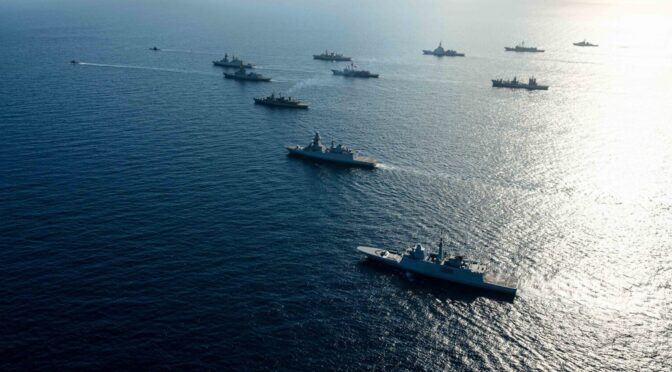
Featured Image: IONIAN SEA (Feb. 21, 2022) Standing NATO Maritime Group 2 ships and submarines sail in formation in the Ionian Sea off the coast of Sicily Feb. 21, 2022 during Exercise Dynamic Manta 22 (DYMA 22).
Discover more from Center for International Maritime Security
Subscribe to get the latest posts sent to your email.
Excellent discussion and consistent with Mr. Stubbs’ long standing position. There are opportunities for further exploration such as whether Navy is open to strategy as a foundational element; compatibility between how OPNAV currently formulates budgets vs a more strategy-driven approach; relationship between new surface combatant program issues and loss of design leadership expertise in NAVSEA; relationship between Navy and Coast Guard program issues.
Unfortunately, the most important study the National Commission on the Future of the Navy should have conducted was an examination of the leadership of the agency – NAVSEA – which is tasked to engineer, build, buy, and maintain the Navy’s ships and submarines.
As anyone with even a passing interest in US Navy ships can see clearly, NAVSEA has been and continues to be an abject failure. Never in the US Navy’s history has ANY enemy done as much damage to the US Navy as leadership at NAVSEA has. And that’s not hyperbole, that’s a fact.