
By Catherine Marie Abbott
A version of this article was originally published by the Center for Maritime Strategy, a non-profit, non-partisan think tank and research institution dedicated to studying maritime issues and their context within wider American national security policy. This article is republished with permission.
Reflexive Control in the Maritime Domain
Originating in 1960s Soviet strategic military doctrine, reflexive control (RC) allows the user to employ and orchestrate manipulative tactics, including disinformation, deception, overload, provocation, and distraction, to compel adversaries to voluntarily adopt courses of action favorable to the user’s interests. Since the intensification of the Ukrainian-Russo War and NATO’s extended support to Ukraine, Russia has attempted to reconfigure the environment’s balance of power and assess the limit of the alliance’s collective deterrence.
The Federation, using its fleet of shadow tankers as a tool for asymmetric coercion, has leveraged the vessel’s plausible deniability to enable drone incursions for reconnaissance against the Western alliance. Flyovers have reportedly occurred in proximity to civilian areas, airports, critical infrastructure, and military installations, with at least 39 drone-related incidents between September 2025 and October 2025, and a suspected incident as recent as June 2026. Despite being generally interpreted as surveillance operations, drone incursions launched from naval platforms have received limited attention as instruments of cognitive warfare designed to alter NATO’s decision-making and induce strategic miscalculations.
Cognitive Warfare: Leveraging Plausible Deniability in the Maritime Domain
Russia’s augmented strategy leverages grey-zone asymmetry to conduct cognitive warfare against allied states by exploiting maritime legal safeguards and persistent drone activities. Notably, cognitive warfare, according to NATO, is deliberate strategic synchronized use of military and non-military to influence human cognition, degrade rational decision making, and secure a cognitive advantage over an adversary. Within this context, cognitive warfare specifically targets allied rational processing, strategic beliefs, and threat perceptions under the cover of constant, exploitable intrusions. In recent years, drone technology has fundamentally altered the calculus of modern conflict, allowing comparatively weaker states to counteract the air superiority of major powers through inexpensive, adaptable, and deniable means. While the vast majority of drone incursions occur along NATO’s eastern flank, with Russian and Ukrainian assets encroaching on Estonia, Latvia, Poland, and Romania, these instances are widely recognized as spillovers from the adjacent conflict. Notably, these incursions require sustained and aggressive air policing operations, as well as increased investment in NATO anti-drone capabilities.
However, unlike these generally regarded accidental land-border spillovers, drone operations launched from maritime platforms represent deliberate psychological efforts to impose societal distress and sow distrust between citizens and state authorities. Russian-affiliated sanctioned vessels such as Astrol 1 and Pushpa have been observed launching and operating airborne assets into NATO airspace. Ukrainian President Volodymyr Zelenskyy has noted the use of these civilian-marked vessels for reconnaissance and potential sabotage coordination. Notably, when navigating in the Baltic Sea, shadow vessels operate exclusively within international waters and the exclusive economic zone (EEZ) of European littoral nations, using the United Nations Convention on the Law of the Sea (UNCLOS) as an international legal shield against allied interdiction and seizures, effectively weaponizing international law to conduct cognitive warfare with near impunity.
NATO continues to contend with shadow vessels, with varying solutions and effects, including increased sanctions and barring known sanctioned vessels from accessing allied ports. However, the primary nexus constraining interdiction and seizure efforts being the region’s strict adherence to international conventions. Accordingly, UNCLOS does not permit seizure or interdiction operations and obligates states to allow freedom of movement on the high seas, with vessel authority delegated to the designated flag state. Shadow vessels notoriously employ deceptive tactics to maintain plausible deniability on the international stage, including opaque and decentralized ownership structures, shell corporations, flags of convenience, and opportunistic flag registrations. By amalgamating the legally insulated fleet into a nearly impenetrable mothership for drones, Russia can maintain plausible deniability while leveraging drones as an exploitable means of regional coercion.
Altering NATO’s Decision Calculus
Viewing itself as diametrically opposed to the West, Russia has leveraged a cumulative cognitive warfare diaspora, including deniable offensive cyber campaigns, misinformation operations, and the weaponization of existing migration pressures, to destabilize Western states and diminish institutional trust. Ideologically, Europe has exhibited political fragmentation, with NATO member states such as Slovakia, Hungary, and the Czech Republic shifting toward illiberal democratic models. Through these targeted efforts, Russia seeks to influence and exploit the vulnerable domestic political environments of NATO member states in ways that weaken alliance cohesion and reduce sustained support for Ukraine.
Because Russia’s RC strategy operates just below NATO’s Article 5 threshold, the Kremlin can observe and evaluate NATO’s collective responses, operational timelines, and escalation thresholds. Since the onset of the Ukrainian-Russo War in 2022, and following the annexation of Crimea in 2014, NATO has dynamically increased its kinetic deterrence posture. In conjunction with initiatives such as Eastern Sentry, the NATO Force Model, and the Allied Reaction Force, NATO has adopted a deterrence-oriented defensive posture, increasing conventional presence along its eastern flank. While these efforts strengthen deterrence, this shift from crisis management toward sustained territorial defense increases the frequency of NATO-Russia interaction, raising the probability of strategic miscalculation within a persistently contested operational environment.
Notably, maritime-enabled drone incursions function as a key instrument of Russia’s RC strategy to diminish institutional trust and generate perceptions of insecurity among NATO allies. Russia’s maritime hybrid campaign has coincided with repeated damage to subsea infrastructure in the Baltic Sea domain, alongside sustained surveillance and mapping of NATO’s critical undersea infrastructure (CUI) as pre-crisis preparation. Repeated incursions conducted via shadow fleet vessels function as observable probes that evaluate NATO’s deterrence, attribution capacity, and response timelines within the gray-zone threshold. Despite increased defensive measures, the persistence of such incidents may erode perceptions of institutional reliability and alliance security guarantees.
If NATO responds to persistent gray-zone activities with kinetic measures, it risks reinforcing the central dilemma of RC: restraint is interpreted as strategic weakness and an inability to provide security guarantees, while escalation enables Russia to frame NATO as the aggressor, thereby reinforcing broader narratives of anti-Western sentiment, hostility, and escalation.
Strategic Considerations for NATO
While NATO has undertaken significant aggressive efforts to counter Russia’s shadow fleet activities, including initiatives such as Baltic Sentry and the Nordic Warden System, these mechanisms primarily focus on protecting CUI and monitoring suspicious maritime activities. Notably, these strategies do not address the vessels as drone-enabled platforms, requiring NATO to consider initiatives targeting maritime-enabled drone incursions.
Firstly, NATO cannot allow maritime-drone-enabled incursions to become a normalized non-kinetic activity. If left unchecked, Russia will perceive the passivity as permissive, emboldening the Federation to test alliance resolve through escalating behavior. Russia’s reflexive control strategy primarily relies on sustained ambiguity to reconfigure the decision-making calculus of a target; therefore, such incursions are likely to continue, if not exacerbate, over time to achieve its salami-slicing tactics to gradually reduce alliance credibility and security apparatus without invoking Article 5. Accordingly, NATO requires a comprehensive attribution mechanism addressing continual unauthorized drone activity, including a coordinated identification system linking vessels to drones, as well as non-kinetic interception strategies such as leveraging radio frequency jamming to diminish links between drones and pilots. Coastal states maintain sovereignty over their territorial sea and the above airspace, providing a legal basis for states to regulate unauthorized aerial activity within territorial waters.
Simultaneously, NATO must continue to expand legal efforts to address shadow vessels. Although, according to UNCLOS, surveillance conducted by vessels operating within a coastal state’s EEZ is not inherently prohibited, with its legality depending on the activity conducted and the status of the vessel permitting it. Shadow fleet vessels equipped with specialized surveillance systems, military-grade communication equipment, or drone launch capabilities may challenge their designation as ordinary commercial vessels, especially when operating in proximity to CUI. Given that civilian vessels under UNCLOS do not maintain equivalent sovereign protections afforded to military vessels, NATO member states should reassess whether vessels engaged in state-directed intelligence collection or military support activities can continue to benefit from the legal assumptions afforded to legitimate commercial actors.
Conclusion
Russia is leveraging multi-domain campaigns as part of its greater RC strategy. While not actively seeking conventional warfare with the Alliance, it is simultaneously defining the informational and operational environment in ways that preserve escalation optionality and strategic positioning in the event of a near-peer conflict. In this sense, Russia’s maritime-enabled RC has increasingly determined NATO’s decision-making environment through sustained uncertainty and ambiguity by leveraging regional vulnerabilities and international frameworks. Given the fragmented and expansive nature of the maritime domain, NATO is likely to contend with this challenge over an extended period, as efforts to constrain shadow vessel fleet activity are offset by Russian adaptation through vessel reconstitution. Currently, Russia is incorporating known sanctioned vessels, such as Pushpa, now Feniks, into its naval directory while continuing to acquire new tankers for shadow fleet activities, sustaining conditions that enable sanctions evasion, infrastructure disruption, and its maritime-enabled drone incursions as part of its larger RC strategy.
Catherine Marie Abbott holds a master’s degree in security policy studies from George Washington University and a bachelor’s degree in political science from the University of Missouri-Kansas City, specializing in maritime security, intelligence analysis, and counterintelligence. Her research primarily focuses on maritime logistics, emerging technology, and intelligence processing, with a distinct focus on analyzing overlooked variables and externalities that disrupt strategic decision-making.
The views and opinions are those of the author and do not reflect or represent those of her employer or any other organization with which she is affiliated.
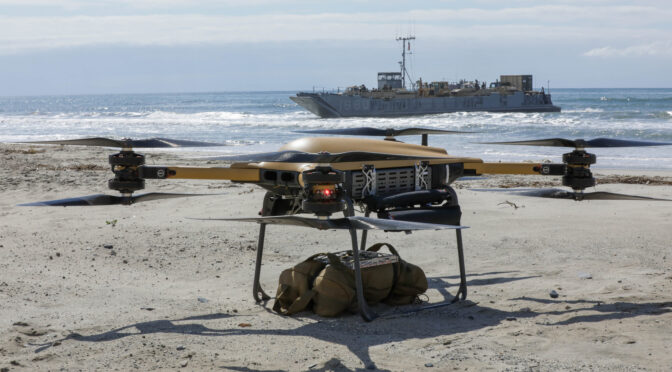
Featured image: The Tactical Resupply Vehicle-150 lands on the beach after a series of contested logistics experimentations from ship to shore as part of Project Convergence-Capstone 4 at Camp Pendleton, Calif., Feb. 29, 2024. (U.S. Army photo by Spc. Howard Lee)
Discover more from Center for International Maritime Security
Subscribe to get the latest posts sent to your email.
That’s a really interesting angle on how Russia is using drones. It seems like these tactics are designed to create a lot of uncertainty, which aligns with broader cognitive warfare strategies.