Category Archives: Strategic Outlook

Predictions and forecasting.

A Post-Chavez Maritime Order

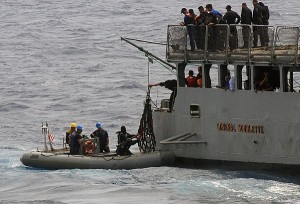
U.S. and Venezuelan Sailors work together during counter-drug operations in 2009.

In the next few days there will undoubtedly be a glut of post-mortems on the Chávez era and predictions for the future (not least because much of Washington’s “blogging class” is home for a snowstorm)1. Much of it will be by experts on the region or those armed with interesting facts. I’m not aiming to compete or replicate their work; what I want to look at is the implications for defense cooperation, specifically naval and maritime matters.

Danse Macabre Venezuelan
America’s tumultuous relationship with Venezuela under Chávez is well documented – from coups to theatrical UN speeches to declaiming Halloween’s frights as acts of “imperialist terror” – but it wasn’t always this way. Prior to Chávez’s inauguration in 1999, the U.S. enjoyed many fruitful defense ties with Venezuela including intelligence-sharing, counter-narcotics, military training, and defense exports.

Most of these ties continued during Chávez’s first term in office, although an initial indication of Chávez’s wariness of the American military may have arisen during floods and mudslides in December 1999-January 2000. After allowing in roughly 100 U.S. troops, he cancelled plans for additional U.S. military construction corps members to assist in the recovery efforts.

On the other hand, as late as 2002 Chávez still enjoyed interacting with the crews of visiting naval vessels, as this post by Chris Cavas, detailing a port call by the USS Yorktown (CG 48), and a declassified U.S. State Dept. Memo highlight. However, a mere 5 weeks later, the April 2002 coup would irreparably alter relations.

The U.S. military came under particular criticism from Chávez, both for allegedly – and without proof – directly aiding the coup attempt and subsequent espionage and coup-plotting efforts. Venezuela expelled a string of military attachés on these grounds, a tradition continuing to this day (see below). Chávez also followed up his words by severing most of the existing military ties between 2003-2005, including ending training-support missions and participation in the annual UNITAS naval exercise. It may have been his calculation that there was greater value in showcasing an external “imperialist” threat to shore up support, in the tradition of Vladimir Putin, than to maintain ties with the U.S. But whatever the reason, military relations after the coup were quickly curtailed.

In 2006, due to a lack of cooperation in anti-terrorism efforts, the U.S. followed suit by sanctioning arms exports to Venezuela. Despite these impediments, informal ties between the two militaries continued as the Venezuelan military backers of Chávez have reputedly been of a more pragmatic strain than their leftist civilian government counterparts.

One area of considerable focus has been counter-drug (CD) efforts. Despite the appearance of Chávez’s personal enmity, the U.S. Navy and Coast Guard have still managed in recent years to work with their counterparts, although this has reportedly been on a case-by-case rather than formalized basis. According to the GAO:

DOD allotted about $3 million for counternarcotics and related security assistance in Venezuela in fiscal years 2006 through 2011. Through 2009, this assistance was used in part to provide tactically actionable intelligence to both US and select Venezuelan law enforcement agencies.

CD efforts will continue to loom large as avenues for cooperation and potential sticking points if the next election returns a “Bolivarian” government. The Wall Street Journal reported this January that attempts to improve ties between the U.S. and Venezuela are hampered by

…allegations of high-level involvement by the Chávez government in drug trafficking. The U.S. has put seven top current and former Venezuelan officials on a Treasury blacklist for their alleged drug and arms dealing links to Colombian guerrillas based in Venezuela. Those links were exposed in 2008 after the Colombian military captured computers used by a guerrilla leader killed on a cross border raid in Ecuador.


Among the officials put on the Treasury list are Gen. Henry Rangel Silva, the former minister of defense who was recently elected governor of the state of Trujillo. Mr. Rangel Silva and the others say they are innocent.

Venezuela’s immediate future looks to be tumultuous and relations could in fact worsen. Vice President Nicholás Maduro moved to expel two American diplomats and claimed that Chávez had been poisoned with cancer by Venezuela’s “historical enemies.” This may have been mere posturing to aid power-consolidation for the immediate transition and new the elections that are constitutionally required to be held in 30 days – but it is a sign that things are far from certain to improve.

Despite today’s focus on Chávez’s death, however, the more meaningful impact on U.S.-Venezuelan naval and maritime efforts may have come from last week’s enactment of Sequestration. As Sam Lagrone describes, the forced budget cuts have dealt a blow to Operation Martillo’s CD efforts, suspending deployments to SOUTHCOM of U.S. Navy frigates USS Rentz (FFG-46) and USS Thach (FFG-43). Just as an opening may occur for increased cooperation in the next few months or years, the U.S. may not be able to take full advantage of it.

LT Scott Cheney-Peters is a surface warfare officer in the U.S. Navy Reserve and the former editor of Surface Warfare magazine. He is the founding director of the Center for International Maritime Security and holds a master’s degree in National Security and Strategic Studies from the U.S. Naval War College.
The opinions and views expressed in this post are his alone and are presented in his personal capacity. They do not necessarily represent the views of U.S. Department of Defense or the U.S. Navy. 

Polish Navy’s Small Steps Ahead

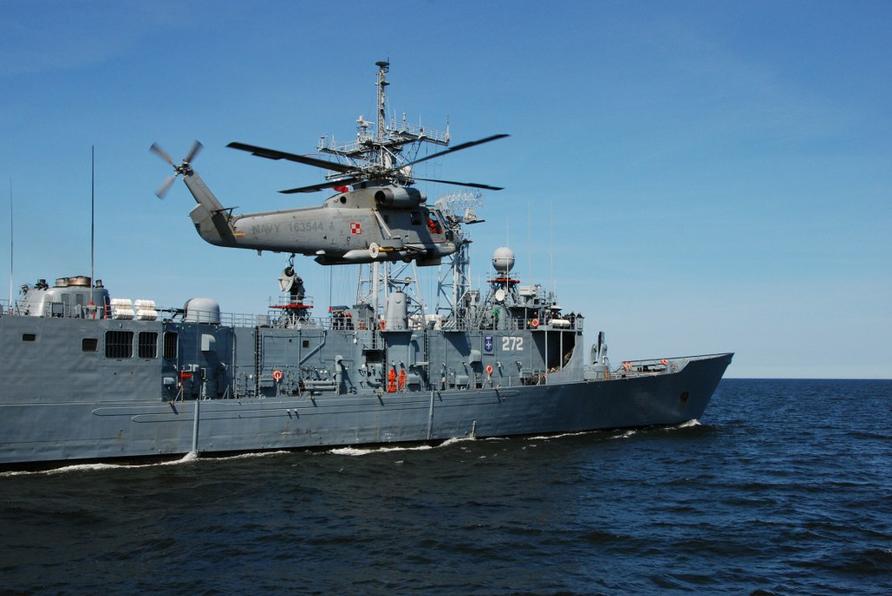
A competition is underway for the honor of landing on the Polish fleet's decks.
                    A competition is underway for the honor of landing on the Polish fleet’s decks.

The Polish Navy is expected to receive 6 Anti-Submarine Warfare (ASW) and 6 Search and Rescue (SAR) helicopters starting in 2014-2015 as part of a much bigger yet-to-be-awarded deal, totaling 70 helicopters and more than $2.5 billion. The new fleet will replace 10 aging Mi-17 and 4 Kaman SH-2 helos used for ASW and SAR. Poland’s Ministry of Defense announced its intention to purchase the helicopters as a result of National Security Review, which calls for higher mobility in the armed forces. Another 10 of the 70 helos will go to the Air Force in SAR configuration, but most of the fleet, 48 in the troop transport version, will be troop transport versions for the Army. The Polish military speaks (in Polish) about “common-base airframe,” but it is not clear if that refers to all versions, as requirements between services differs significantly. It is also expected that the helicopters will at least in part be produced in Poland.

Potential contenders for the contract are Sikorsky, Eurocopter, Agusta Westland, and AW’s Polish subsidiary, PZL Swidnik, bidding separately. A brief look at the actual range of aircraft makes it interesting to see what the sales strategies of the companies will be. Sikorsky and AW already have production lines in Poland. Sikorsky and Eurocopter (specifically NH Industries) could offer common-base airframes. The closest replacement to the Mi-17 in terms of size is the Super Cougar from Eurocopter, but the short lead time makes it difficult to integrate ASW gear into a new airframe.

New ASW helicopters, in contrast with the Mi-17, are more likely to operate from the decks of Coastal Defense Ships (CDS), for which specifications are being drafted and should be ready this year. Their rather enigmatic name, according to Commander in Chief means ships that differ from classic corvettes in mission priorities and equipment. The ship should also be able to operate as part of allied task groups beyond the Baltic. Such a definition will certainly will hangers with the necessary facilities to support air operations .

The first new assets in the modernization of the Polish Navy will not be ships, but helicopters. Additionally, the ill-fated Gawron corvette program seems to have come to a reasonable end as the MoD approved the final configuration for the unfinished Meko A-100 corvette as a patrol ship. Under the name Slazak she will join the fleet in first quarter 2016.

Przemek Krajewski alias Viribus Unitis is a blogger In Poland.  His area of interest is broad context of purpose and structure of Navy and promoting discussions on these subjects In his country

The Future Ashore

                                                                   Blurring the flavors of force.

Since contemplating Janus a month and a half ago we’ve seen a lot of ink spilled about national security affairs. The majority of it is driven by the fiscal challenges facing the U.S. government. There’s been hyperbole, exaggeration, as well as underestimation and ignorance.  Even here at NextWar we’ve seen some hysterics (yes Hipple, we’re looking at you).  The Firm believes that the U.S.’ Sequestration and the Continuing Resolution are bad.  They demonstrate terrible leadership and hint at a government bereft of the capacity for strategic thinking.  Discussing the politics of sequestration, however, isn’t going to help us at CIMSEC fill the void.

We said there is a “hint” that the government is incapable of strategic thinking, but we only say hint.  There has been some recent writing, publishing, and thinking about the future.  Specifically, about the future of American ground forces.  Buried in all the pages of frenzy about what happens March 1st, a pair of articles were published this month by leaders in the Army and Marine Corps meant to provide a vision for the future.

“Foreign Policy” (rapidly becoming a favorite of the Service Chiefs, we wonder what that says about their editorial policies) published General Odierno’s article “The Force of Tomorrow.”  The Army’s Chief of Staff laid out his vision for the post-OIF/OEF U.S. Army.  The article shouldn’t be a surprise to anyone, none of the ideas are new and the overall language is in line with both the Administration’s January 2012 Defense Strategic Guidance and the material the Joint Staff regularly puts out.  There are a couple of things that struck us, however, as we read it.  Despite the whitebread nature of the article, there was something about it that rubbed us the wrong way.  The Chief of Staff appears to be advocating for a force which sounds an awful lot like an Imperial Army.  His future Army is forward deployed all over the globe, working with our partners on their home turf.  That sounds good on the surface but makes three significant and problematic assumptions.

First it assumes that our partners want a large number of U.S. Soldiers in their country for an extended period of time.  We don’t see a lot of countries asking for that these days.  Second it assumes that we have the money in the national accounts for a land force that is both big enough to be good at large formation combined arms and small formation partnership and daily crisis response.  This requires units spread out in garrisons all over the globe like a modern day Roman Legion.  Besides the will, and the political/diplomatic problems with that kind of vision, there is no money for that.  The Chief of Staff doesn’t really even acknowledge the coming fiscal problem.  The third assumption it makes is that we need another part of the military that is globally deployed on a day-to-day basis focused on partnership, presence, and crisis response.  Just because the Defense Strategic Guidance says that the U.S. military should be doing those things, doesn’t mean that every Service should be doing every one of them in equal amounts.  It appears that money isn’t the only pie the Pentagon wants slice and serve in equal proportions, and the Chiefs want everyone eat their piece at the same time after dinner.  Here at The Firm we sometimes like pie for brunch, or Liner if we really sleep in.

This idea that the services should all be doing the same thing is ridiculous.  We need a U.S. Army that is optimized for large-formation combined-arms combat operations.  If the Army doesn’t do it, then who will?  There isn’t another service that does that.  We already have a service which is optimized for operations at roughly the battalion size and below, which historically has conducted partnership missions, crisis response, and small wars globally, and it’s call the U.S. Marine Corps.  The last twelve years of operations ashore appear to have convinced everyone that the Marine Corps is another land army, not just in terms of how we spend money, but also how we divide missions and responsibilities.

That brings us to the second article published this month.  Marine Corps Major General Kenneth McKenzie’s article “Naval Power and the Future of Assured Access” in “Armed Forces Journal.”  With General Odierno creating an obvious opening for debate, and an opportunity for the Marine Corps to reassert its historic role in our military, we had high hopes for this article.  Instead, we are treated to something written more for “The Rings” of the Pentagon than for a substantive discussion of roles and missions.  If we had a podcast of this article we would turn it into a drinking game – taking a shot for every cliché, piece of jargon, or doctrinal reference.  Each of the Marine Corps’ important acquisition programs gets a nod, the ground forces get to push back against AirSea Battle…or what they think AirSea Battle might be (since we’re not sure that anyone really knows), and we get to perpetuate the language of Jointness.  From the author of Revenge of the Melians we expected so much more.  Instead we’re treated to another staff-produced “article” that probably looks a lot better as the PowerPoint bullets where it started.  We feel sorry for the poor Major who actually wrote this article and didn’t appear to get any help from the chop chain (We do love the AFJ cover photo though).

We like the fact that the Marine Corps is talking about naval affairs.  This is a positive step and we don’t mean to belittle it.  However, we need clear thinking to move these discussions and debates forward.  If these two articles are indicative of what MGEN McKenzie called “the intellectual capital” that is being prepared for the coming Quadrennial Defense Review, we suspect that the 2014 QDR will be as useless as all the previous QDR’s.  It’s time to start talking about the strengths and weaknesses of each service, and being honest about who best fills the roles and missions required in today’s world.  Instead of playing games inside “The Rings” to increase prestige and funding, let’s talk about how to best defend our nation and our interests.

The Firm of Maynard, Cushing, & Ellis does not represent the opinions of anyone that matters.  Formed by Lieutenant Robert Maynard RN, Lieutenant William Cushing USN, and Captain Pete Ellis USMC, the firm doesn’t speak for the US Government, the Department of Defense, The Foreign Office, the Department of Housing and Urban Development, or the Department of Silly Walks.

Sequestration: America’s Great Harbor

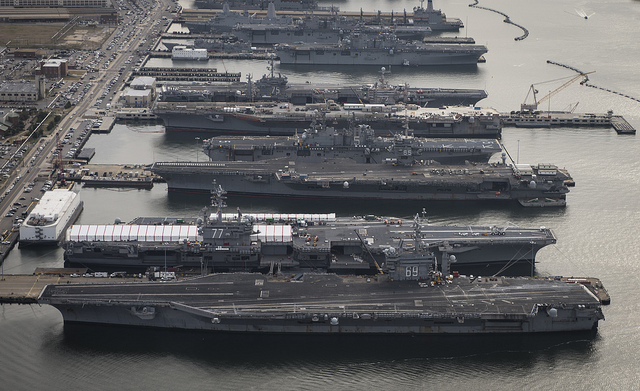
For the Athenians, the Great Harbor of Syracuse was anything but.  A monument to the Athenian tactic of bottle-necking of the “world’s” most powerful navy, the battle at the Great Harbor symbolizes the cost of trading mobility for convenience.  Today, the five carriers lined up in Norfolk like dominoes are reminiscent of that inflexibility, serving as a greater metaphor for constraints the fiscal crisis may impose on the U.S. Navy worldwide.

A good plan violently executed now is better than a perfect plan executed after the enemy has finished exterminating your entire naval task force and running you to ground in a quarry where you are executed or sold off as spoils of war." -General Patton
“A good plan violently executed now is better than a perfect plan executed after the enemy has finished exterminating your entire naval task force and running you to ground in a quarry where you are executed or sold off as spoils of war.”
– General Patton, sort of

During the siege of Syracuse, the Athenian expedition anchored its naval task force inside the protected Great Harbor of Syracuse.  Maintaining such a large force in a single place and at anchor decreased the costs of manning and command and control (C2).  The single entrance of the harbor and its copious defenses against wind and wave also simplified the fleet’s maintenance and logistics.  The convenience came at heavy cost.  The fleet’s great numerical advantage was lessened by lack of mobility.  Infrequent patrols allowed the Athenians to deploy navigational hazards and blockade runners.  Syracuse’s superficially low-cost, reactive approach lost to the proactivity of the enemy.  The harbor’s single entrance turned into a nightmare scenario as the massive fleet was locked into the harbor by a chain of ships strung across the entrance.  The fleet of the mightiest naval power in the world died in a Sicilian quarry without a single ship remaining.

One stone? Don't worry, we're way past two birds.
One stone? Don’t worry, we’re way past two birds.

America’s Great Harbor is not in a foreign land, but up Thimble Shoals Channel and through the gap in the Hampton Roads beltway.  Five carriers, the world’s most powerful collection of conventional naval power in one location, sit idle at harbor, one beside the other.  The United States maintains a massive naval center of gravity, within a single chokepoint that could be plugged at a moment’s notice in prelude to further enemy action.  The concentration not only lends itself to easy containment, but simplifies the potential for espionage and terrorism.  The fiscal noose tightening around the Navy’s neck is creating a prime target that goes against every lesson we’ve learned from Pearl Harbor to Yemen.

America’s Great Harbor is a vicarious manifestation of a more terrifying fleet-wide atrophy.  Sequestration will force the navy into a fiscal Great Harbor.  A 55% decrease in Middle Eastern operational flights, a 100% cut in South American deployments, a 100% cut in non-BMD Mediterranean deployments, cutting all exercises, cutting all non-deployed operations unassociated with pre-deployment workups, as well as a slew of major cuts to training – these further compound the losses from the Navy’s previous evisceration of the training regime.  Despite a growing trend of worries about fleet maintenance, a half year of aircraft maintenance and 23 ship availabilities will be cancelled.  The snowballing impact on already suffering training and maintenance will further exacerbate that diminishing return on size and quality created by the fiscal Great Harbor.  Nations like China and Iran continue to make great strides in countering a force that will recede in reach, proficiency, and awareness.  The mighty U.S. Navy is forced to sit at anchor while the forces arrayed against her build a wall across the harbor mouth.

What directionless security assistance program? All I see is dancing kids!

Military leadership has done a poor to terrible job advocating the true cost of defense cuts.  A series of actions by the brass has undermined their credibility and covered up the problem.  The blinders-on advocation for teetering problems like LCS and the F-35 have undermined the trust that military leadership either needs or can handle money for project development.  The Navy personnel cuts were pushed for hard by leadership, and when the Navy grossly overshot its target, the alarms were much quieter than the advocation; the ensuing problems were left unadvertised.  In general, military-wide leadership uses public affairs not to inform, but as a method to keep too positive a spin in a misguided attempt to keep the public faith.   That public faith has removed vital necessary support in a time when the military is rife with problems that absolutely require funding.  The PAO white-wash helps under-achieving programs and leadership get passed over by the critical eye.  Where Athenian leaders were frank with their supporters at home, stubbornness and inappropriate positivity have undercut military leadership’s ability break loose from the fiscal harbor.

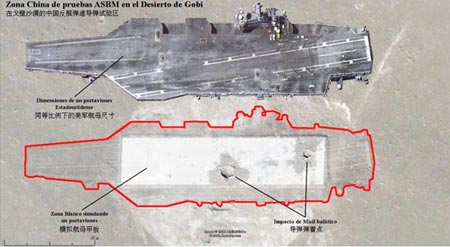
China's sequestration mostly involves disposing of excess DF-21D's into carrier-shaped holes in the desert.
China’s sequestration mostly involves disposing of excess DF-21D’s into carrier-shaped holes in the desert.

Those who dismiss the hazard of sequestration are wrong in the extreme.  When I was an NROTC midshipman, I remember a map on the wall of the supply building: a 1988 chart of all US Navy bases around the world.  Today’s relative paucity of reach leads some to believe that surviving one scaling back shows inoculation against another.  However, the law of diminishing returns has a dangerous inverse.  Each progressive cut becomes ever more damaging.  The U.S. Navy and sequestration apologists must realize what dangerous waters the Navy is being forced to anchor in.  The question is, how long can the navy safely stay in the Great Harbor before her enemies get the best of her?

Matt Hipple is a surface warfare officer in the U.S. Navy.  The opinions and views expressed in this post are his alone and are presented in his personal capacity.  They do not necessarily represent the views of U.S. Department of Defense or the U.S. Navy, although he wishes they did.