Category Archives: Strategic Outlook

Predictions and forecasting.

Europa Universalis at Sea – Strategizing Gibraltar

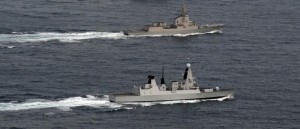
Royal Navy destroyer HMS Dauntless, the Spanish navy air defense frigate Almirante Juan de Borbon operate together
Royal Navy destroyer HMS Dauntless (D33) and Spanish navy air defense frigate Almirante Juan de Borbon (F102) operating together.

Following Kyle Mizokami’s own shot at war simulation, I apply the exercise to European waters by focusing on a potential clash over Gibraltar.

Much has been written about the so-called frozen conflicts of Eastern Europe but few pay attention to the crystallized conflicts of Western Europe.  There are border disputes between Portugal and Spain, Spain and Morocco, France and Italy, Ireland and the UK, Netherlands and Germany, Serbia and many of the post-Yugoslav republics, etc.  Perhaps the one that most often elicits media attention is Gibraltar – with rival claims by the UK and Spain unresolved to this day.

Periodically clashes occur between British and Spanish forces in the territorial waters (with 28 Spanish ‘incursions’ in Jan alone) – and more rarely in the land border crossing – of ‘the rock’.  This article addresses from a military perspective the potential for conflict as well as the likely outcome of one.

Imminent War?

Is there a threat of imminent war?  In short the answer is a resounding ‘no’.  Using the Falklands conflict as analogy one can conclude that Gibraltar is not as economically important as the Falklands – with its fishing banks, a large EEZ and potential oil and gas reserves – and Spain is not as politically populist as Argentina – whose politicians are ever-tempted to use the Falklands as a ‘rally to the flag’ instrument in times of economic downturn.  Nor is Gibraltar that far from Great-Britain and hence as strategically vulnerable.  Then there are the catastrophic diplomatic and political consequences of a conflict between two EU and NATO member-states, and the underlining fact that Madrid is much more militarily on par with London than Buenos Aires could ever hope to be in the foreseeable future – the UK spends around $60 billion ($17 billion goes to the Royal Navy) to Spain’s $14 billion ($2 billion goes to the Armada) in their respective militaries, but both spend far more than Argentina’s meager $3 billion in overall military expenditure.
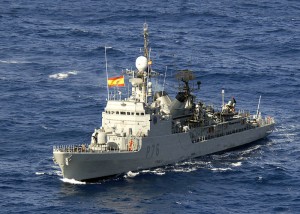
Descubierta-class frigate Elena (SPS
      Descubierta-class frigate Elena (P-76)

Strategically the case against belligerence grows even stronger if one considers the relative advantage Spain would enjoy fighting a war in its own turf.  The UK would be forced to fight this war – if one assumes the UK would want to fight in the Mediterranean – 2000 km away from its shores (if, of course, one does not include Gibraltar itself).  This means the Royal Air Force would be of little or no use, especially considering that neither air force enjoys advantages in aerial warfare – both Spain and Britain deploy the Eurofighter Typhoon as air superiority fighter – and that Britain no longer flies strategic bombers, which might have helped target Spanish installations with cruise missiles.  That said, Britain would still have a distinct advantage in numbers with its 5 destroyers, 13 frigates, 11 submarines, and 2 amphibious assault ships.  In operational terms, this means London could continuously deploy a task-force comprising 6 surface combatants, 3 submarines and probably 1 assault ship.  Madrid operates 5 destroyers, 6 frigates, 3 submarines and 3 assault ships but without the hindrance of force projection, it could probably operate half of them continuously.  This means in turn that together with the aid of the Spanish Air Force and with the Armada’s 10+ coastal patrol vessels, it could very possibly keep the Royal Navy away from its continental shores.  An important factor would be the gap that the Portuguese coast represents in separating Spain’s Atlantic fleet from its Mediterranean ones: no fighting would be tolerated in Portuguese territorial waters and EEZ which means that while Spain could theoretically move its ships through Portuguese waters, the British would also be able to shadow them, and this would imply a great risk.  More dubious would be its defense of the Canary Islands which would be vulnerable to British submarine warfare and thus tactical isolation.  The two nations’ maritime concerns throughout the world, from fishing fleets to oil tankers, would be equally vulnerable to interference from occasional minor naval sorties from either fleet – conceivably the British could capture Spanish trawlers in the Atlantic and the Spaniards could intercept British oil tankers out of the Middle East.  Spain would be able to prevent the British navy from crossing the strait of Gibraltar and could then deploy the occasional warship to the Red and Arabian seas while Britain could do the same but with much longer lines of supply.  The Royal Navy could also force Madrid’s Atlantic fleet into coastal defense, and pick off Spanish civilian vessels one at a time in the Atlantic Rim.

The result of a conventional conflict would thus be a draw, with no side able to win without spilling too much blood and treasury to prove the issue.  More likely than all-out war might be a single clash: one bad enough to bring both parties to a halt and later on to the negotiation table.

Single Engagement

Most clashes in the area of Gibraltar occur between Royal Gibraltar Police and the Royal Navy’s Gibraltar Squadron small craft on one side, and on the other small craft of Spain’s Guardia Civil – a paramilitary force which is also used as the Spanish Customs Surveillance Service – and most often, Spanish fishing vessels.  None of these is heavily armed and none could go beyond exchanging gunfire.

Among the reported incidents involving the Spanish Armada itself, the biggest vessels to date were the 27 crewed Anaga-class ship Tagomago and the 100+ crewed Descubierta-class corvette Vencedora. The Royal Navy in turn deploys periodically to Gibraltar, with warships transiting through the Mediterranean – generally frigates such as the 180+ crewed Duke-class HMS Argyll – in an attempt to deter the Spaniards from further incursions in what London calls “Gibraltar territorial waters”.

If a major exchange were to happen – be it carefully planned or as a result of hotheads – these would likely be the type of vessels involved.  Who then would get the upper hand?

Combat Tactics
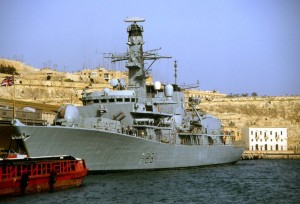
HMS Argyll (F231)
                                HMS Argyll (F231)

For the purpose of this scenario we’ll give only a cursory look at the Tagomago aside and go instead with the corvette Vencedora since the former would have no means of counter-attack due to its lack of heavy armament.  A Harpoon-missile attack from the Argyll on Tagomago would actually be overkill since one missile alone suffices to disable a frigate and to use it against a patrol boat would likely disintegrate the craft’s structure.  On the other hand, if the Argyll’s crew couldn’t obtain radar lock (the Harpoon needs a minimum firing range of 3km) or decided to switch to the frigate’s 114mm Mark 8 gun, the result would still be disproportionately bad for the Tagomagowhich would sustain the hits of heavier shells fired from a longer range and guided by an automatic targeting system; the Spanish ship would not be able to respond in kind with either of its 76 mm Mk22 or Oerlikon Mod. 5 TG 20 mm cannons and it would be facing a much bigger target.

The Vencedora would be a different proposition altogether as the Descubierta class can be deadly to a frigate in close proximity.  The good news for the British is that if Argyll fired first, the old corvette would likely not survive the impact, not least because it lacks a CIWS system.  On the other hand, what chance would the Vencedora have if it detected Argyll’s radar lock and preempted the missile attack with one of its own?  At a great distance Argyll’s air-defense Sea Wolf missiles and two 30mm DS30M Mark 2 Automated Small Caliber Guns should be able to intercept perhaps two incoming missiles, and lets optimistically discount another two lost to the British frigate’s electronic counter-measures.  However if the Spanish corvette fired a complete volley of its eight Harpoons the Argyll would surely not live to fight another day.  Yet a third possibility would be for Argyll’s helicopter to fire first on the Vencedora.  Every Duke-class vessel carries a helicopter, one usually intended for anti-submarine warfare, and HMS Argyll carries a Westland Lynx which can also be equipped with anti-ship missiles.  If the British wanted to sink the corvette, it might be preferable to risk a helicopter rather than a frigate.  If the British intended only to intimidate, the helicopter could also be a good option since it would send a message without exposing the lives of 180+ British sailors to a Spanish overreaction, even if the helicopter itself would become an easy target for the corvette’s Sea Sparrow air defense system.

A second possible type of engagement is the less dire possibility of the two ships exchanging cannon fire.  This would have the potential of avoiding de facto war by allowing both ships to attempt intimidation, save face, and avoid the complete destruction of ships and the death of hundreds.  Such an exchange would pit the Argyll’s 114 mm Mark 8 against the Vencedora’s Otobreda 76 mm.  The two guns have similar range and both fire High-Explosive shells; the difference is in the number of projectiles fired per minute which is higher in the 76mm and the size of the projectile which is bigger in the 114mm.  Another essential factor would be the top speed of each vessel which would give a competitive edge in maneuvering to the fastest ship, in this case the British frigate.  Because the British frigate would pack more of a punch and would be able to position itself better, the outcome of this encounter also leaves the British on top.

In addition, given the Spaniards task is essentially to provoke with their presence so as to deny acceptance of Britain’s local sovereignty fait accompli – it stands to reason that the British vessel would be the first one to fire.  The tactical advantage of initiative together with the British frigate’s superior weaponry would most likely punish the Spaniards for their trespass, even if at close distance the Spaniards would enjoy some equalizing edge.

Of course as previously mentioned the victory would be tactical rather than strategic.  Trading blows would be a media sensation and the electorates would almost certainly push for a real push for a permanent political settlement.

Miguel Silva is a Portuguese international relations analyst and regularly writes for the publications Eurasia Review, Small Wars Journal and the Atlantic Sentinel 
Will China’s Navy Soon Be Operating in the Atlantic?

An Important Stop

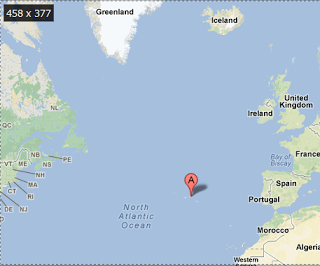
On his way back from a trip to South America in the summer of 2012 China’s Premier Wen Jiabao made the strangest possible stopover. He landed on an American-Portuguese air base on the Azores. The Lajes Field Air Force Base is one of many on the Pentagon’s list to be reduced or scrapped. In the National Review, anti-China hawk Gordon C. Chang speculated whether Wen Jiabao’s stop on the Azores island Terceaira could have a strategic-military context:

“Terceira, however, has one big attraction for Beijing: Air Base No. 4. Better known as Lajes Field, the facility where Premier Wen’s 747 landed in June is jointly operated by the U.S. Air Force and its Portuguese counterpart. If China controlled the base, the Atlantic would no longer be secure. From the 10,865-foot runway on the northeast edge of the island, Chinese planes could patrol the northern and central portions of the Atlantic and thereby cut air and sea traffic between the U.S. and Europe. Beijing would also be able to deny access to the nearby Mediterranean Sea.”

The Azores
                                       The Azores

However, terror-filled visions of Chinese aerial patrols over the Atlantic are out of place. How would the aircraft, including personnel and equipment, get there? And what types of aircraft could perform such feats? China’s military is not blessed with too many long-range bombers or maritime patrol aircraft. Even if they had such capabilities, why should China try to send men and material, strongly needed in the Indo-Pacific, to the other end of the world? From these current practical limitations it would be easy, but wrong, to stop the discussion about China’s role and potential operations in the Atlantic. 

In order to show its flag in the Atlantic, it would be sufficient for China at this point to use the airport and the ports for, let’s say, a “scientific research station.” It is in a similar manner that the British, French, and others pursue their interests in overseas territories. Incidentally, such a station would be an excellent opportunity for electronic espionage – signals intelligence (SIGINT). Furthermore, as a former emergency runway for the Space Shuttle, Lajes Field might also be of interest for China’s space program.

Into the Heart of NATO

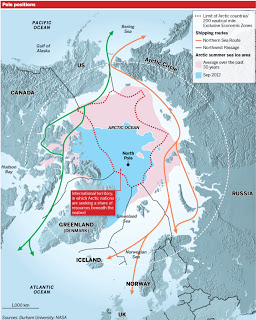
This new development in the territory of a NATO country must be seen in the context of China’s efforts in another NATO member, Iceland. China has heavily invested in the country’s ports and infrastructure because Beijing in the long-term expects an ice-free Arctic to open new shipping routes. Meanwhile in Greenland, whose foreign policy is administered by NATO member Denmark, vast quantities of important resources have also caught China’s eye and spurred development plans.

China is attempting to protect and project its strategic interests in the Atlantic and is doing so within NATO countries. This broader trend should not be dismissed without broader analysis. Such moves – note the plural – are something entirely new.

As stated above, the idea of an operational Chinese naval and aerial presence appears bizarre. Why should China try to station hardware, either civil or military or dual-use, on the other side of the world in the midst of a “hostile inland sea”? Viewed strategically, however, and it’s apparent that such a move would be a stab in NATO’s heart. In Iceland, China’s concerns (so far) are civilian and economic projects, but if the Portuguese government allowed the Chinese, in whatever form, a permanent presence on the Azores, it would be a strategic disaster.

What would happen if the U.S.’ Indo-Pacific antagonist settles into the home territory of the Alliance, in which the U.S. has since 1949 set the tone? The signaling effect within and outside NATO would be devastating. Obviously, NATO has never faced only friendly states, as members’ borders were often the literal front lines of the Cold War. But there are few parallels with the potentially hostile (a designation based on privately held beliefs of China’s intent and cyber efforts) power in the midst of the Alliance’s area. Would NATO Europe, as it is now termed in U.S. parlance, permit such a development by acquiescence or inaction, NATO Europe’s image in Washington would reach a new low.


Arctic Sea Routes
                       Arctic Sea Routes

Some of you may be thinking, but doesn’t the Malacca Strait, Gulf of Aden, Suez Canal, and Strait of Gibraltar separate China from the Atlantic? The answer again is due to the developments in the Arctic. In the long term, China’s shortest way into the Atlantic no longer leads through the bottlenecks of the Indian Ocean, but via the Arctic, once the Northeast Passage is ice-free. Regardless, it requires little to imagine Chinese ships, after a stop at the newly opened port in Pakistan’s Gwadar, sailing by the Horn of Africa and through the Mediterranean for a short visit further into the Atlantic. Due to the evacuation of Chinese nationals from Libya in 2011 we could see a recognized requirement for presence for the first (and not last) time.

Heading South

Pop Quiz: Where have Chinese pilots performed their first takeoffs from an aircraft carrier? In the Pacific? Wrong. In the South Atlantic? Right. It is on the Brazilian carrier Sao Paulo that Chinese pilots trained for takeoffs and landings. With the initiation of such military ties, it’s possible that the Chinese pilots and their Brazilian trainers will someday have the opportunity to meet again alongside their carriers during port visits and joint exercises.

Such a vision may or may not come to pass, but China’s interest in the South Atlantic is nothing new, due to Nigeria’s and Angola’s oil, construction projects across the continents, booming markets, and vast extractive industries. Potential sites for Chinese naval bases in the South Atlantic are already discussed openly. If somewhat of a new development for the North Atlantic, Chinese interest in the Azores fits into the picture of China’s pivot to Africa further to the south.

Despite all the speculation: Calm down

China is years or decades away from establishing military superiority in expeditionary operations. China’s military has more than enough work to do in the East and South China Sea working under the slogan “Learning by Doing“.  It remains to be seen if and how far the dispute with Japan about the Diaoyu/Senkaku Islands escalates, which could seriously alter China’s naval development trajectory. Further, the Chinese naval presence off the Horn of Africa since 2008 only exists, because it is welcomed by the U.S., India, and other countries in the fight against piracy.


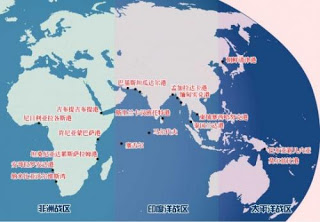
Potetential bases for Chinese naval operations outside China.

For the foreseeable future, what China does in the Atlantic will have zero operational military relevance. The strategic and political implications are what matters. In London, with its own not-inconsiderable South Atlantic interests, and in Paris, these geopolitical developments will be watched closely. Washington, London, and Paris are likely able to bring enough pressure to bear on Lisbon that China will not settle on an island in NATO’s heart. The unknown variable is debt. Will Beijing buy so many Portuguese bonds that Lisbon cannot say no? Or will Europe exploit Portugal’s dependence on Euro rescue funds for its geopolitical aims to eliminate any designs China has on the Azores? We will see.

What to do?

There is a lot to doubt about China’s intentions. The growing nationalism, the behavior in cyberspace, and the more aggressive stance in the East and South China Seas speak for themselves. Nevertheless NATO Europe must focus on cooperation rather than confrontation. The reality is that the U.S. and NATO have already developed templates for successful cooperation with China’s navy off the Horn of Africa. Such measures should be continued and expanded, for example with counter-piracy, humanitarian assistance, and counter-terrorism efforts. However, the reality is that China is also developing its navy as an instrument of Indo-Pacific power projection, which will have the side-effect of enabling it to pursue its interests in the Atlantic stronger than before.

But there is no reason for doom and gloom if today in the capitals of NATO Europe the right geostrategic agenda is set and pragmatic decisions are made. It is all on Paris and London.

Felix Seidler is a fellow at the Institute for Security Policy, University of Kiel, Germany and runs the site Seidlers-Sicherheitspolitik.net (Seidler’s Security Policy).

Follow on twitter: @SeidersSiPo

MFP: Navies for Archipelago Nations

The following is a guest post inspired by the questions in our Maritime Futures ProjectFor more information on the contributors, click here. Note: The opinions and views expressed in these posts are those of the authors alone and are presented in their personal capacity.  They do not necessarily represent the views of their parent institution U.S. Department of Defense, the U.S. Navy, any other agency, or any other foreign government.

Maritime Futures Project, Question 8: What advice would you give to a smaller nation on the maritime investments it should pursue, and why? 

Coming from the archipelagic nation of the Philippines with a 36,000 nautical mile coastline, 7,107 islands and islets, and a large population that depends on the sea as their lifeline, our maritime environment is a vital part of our strategic interests.

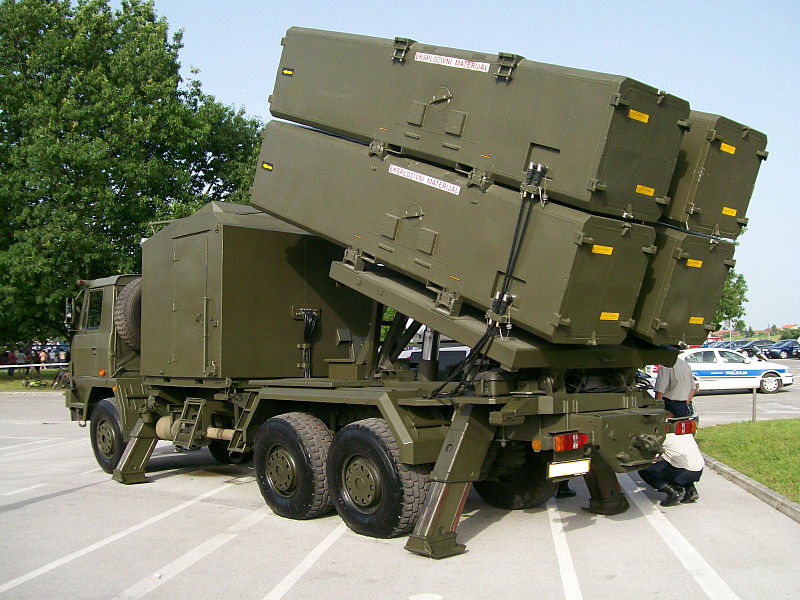
The Croation Mobilni Obalni Lanser system is an appropriate mobile ASM option for defending a multitude of coastlines.

As a result, air, surface, and subsurface assets are of prime importance. Guided-missile frigates and corvettes for offshore control, and a large number of fast-missile and patrol gunboats for the littorals would be appropriate. Long-range maritime patrol aircraft, ship-based multi-purpose helicopters, and naval light-attack aircraft along with a system of land-based radars in central chokepoints would also be an indispensable investment in the protection of an archipelagic nation’s maritime domain. Adding a flotilla of submarines (of the shallow-water attack type) and forming coastal anti-ship missile batteries would further extend a nation’s strategy of defense in depth. This could all be supported by pooling and developing manpower resources and skills.

For island nations with smaller EEZs, development may be limited to capable patrol gunboats and multi-purpose ships for its Coast Guard, supported by rotary, fixed wing, and amphibious aircraft.  The creation and training of coast-watchers from shore based villages would also be a positive development.

LCDR Mark Condeno is a member of the Philippines Naval Auxiliaries.

MFP: Tough Choices For Small Navies

The following is a guest post inspired by the questions in our Maritime Futures Project.  For more information on the contributors, click here.  Note: The opinions and views expressed in these posts are those of the authors alone and are presented in their personal capacity.  They do not necessarily represent the views of their parent institution U.S. Department of Defense, the U.S. Navy, any other agency, or any other foreign government.

Any attempt to answer question #8 from the MFP faces a problem at a very beginning: If we focus on what should be but isn’t, we eventually risk ending up with a dream fleet disconnected from reality. However, if we focus on what is possible, we risk to be stuck in real-life constraints, unable to conceptualize the next stages of naval development. Therefore, if there appears some fantasy within the my answer below, it means that the right balance is still ahead of me.

Today’s Polish Navy is at the beginning of a modernization process, which assumes construction of conventional submarines, corvettes, patrol ships, mine-hunters, and ASW (anti-submarine warfare) helicopters among others. The dilemma the Navy faces is block obsolescence of most of its assets, which means setting priorities for modernization within the context of a national security strategy based on two pillars — defense of the country and commitment to alliances/cooperation in the field of broader international security.

There is another critical issue to address: Poland’s geo-strategic position and history favors strongly national defense but the same history says that in any serious conflict, the navy will play a rather secondary role. Consequently in cases of significant budget cuts, the choice is as follows:

  • The Navy would invest in submarines as a potent anti-access weapon; surface forces, so useful in maritime security cooperation, will suffer badly, or
  • The focus would be on surface combatants, with a risk of loosing competencies in the operating submarine force, which will be very difficult to reconstruct.

Alternatives offered for consideration would be sacrificing capabilities of larger submarines (interesting to note how the meaning of “large” differs between navies) and instead investing in smaller coastal boats like U210-Mod or Andrasta. Resulting savings should be secured for surface vessel program. That would allow the Navy to maintain its proficiency in the operating submarine force surface vessels fulfilled international obligations. Both pillars of the strategy therefore could be followed, albeit in sub-optimal way.

The surface warship best suited for the Polish or any other smaller navy is linked

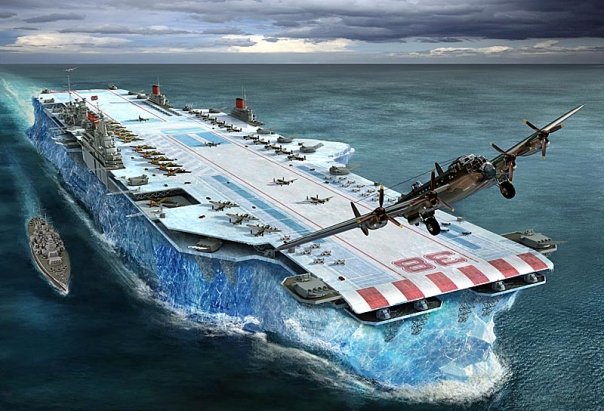
Churchill asks, "Why make a battleship when you can build a carrier out of a glacier?"
Churchill asks, “Why make a battleship when you can build a carrier out of a glacier?”

closely to strategy, geography, and advances in technology. Operating in narrow or coastal water puts a premium on small combatants, but if the navy wants to be an active participant in alliances far afield, then demand for seakeeping and self-deployment puts a premium on much bigger ships, unless we accept advanced hull forms. The compromise could be a ship in a range of 2,000 tons. What is possible to achieve in terms of capabilities within such a hull? British naval architect D. K. Brown in his book The British Future Surface Fleet: Options for medium-sized Navies makes a remark about ships’ “unstable designs”. These are ships which are already too costly to be defenseless. Proceeding toward two opposite extreme solutions, one either makes ships cheaper or better arms them: “Chinese junk” or “super battleship”. In a big navy, problems translate to discussions about force structure or “Hi-Lo mix.” In smaller navies the first is useless and the latter is often unaffordable. Just for reference – the Polish Navy projected shipbuilding budget, considered by many as rather too optimistic, is below $300M a year.

The issue is more complicated by the fact that experience and history teaches militaries that any conflict can easily escalate into full-blown war. Therefore, in the case of “unstable design,” they are inclined more towards “super-battleship”, while treasuries driven by other needs and perceived lack of threat would often oppose it. In the past, the solution was to arm a flotilla with asymmetric weapons and make it dangerous for any opponent. This, however doesn’t allow a smaller navy to support effectively allied forces far from its own bases. The modern equivalent of a flotilla could be a sort collection or hybrid of corvette and Offshore Patrol Vessels (OPVs). If a ship would be more corvette than OPV depends on the threat perception and compromise between the Navy and treasury, within constraints of political, financial, technical, and operational environments. It is also Important to consider if the given country has a Coast Guard as a separate service or solely a Navy. Technically, corvettes and OPVs are very different ships; corvettes offer survivability and armament while OPVs offers endurance and low cost. One proposal would be to trade armament for a low-cost which results in light corvette or up-armed OPV. Another is to enhance OPV survivability, increasing the cost.

Why would anybody be interested in hybrids if well-established solutions exist? Because a corvette is dangerously close to the unstable design. The wartime evolution of the Flower-class corvette, symbol of simplicity and low costs, ended with the Loch-class being the best ASW performer of Royal Navy during the WWII but for the cost of Tribal fleet destroyers. If we take a look on LCS from that point of view, for the full cost including modules we can probably purchase a FREMM frigate. As there are limits to cutting cost, the natural tendency will be to arm the ship better. It would be interesting to speculate what a small navy would make of LCS, in that for many of them LCS would be a capital ship!

When your name is HMS DEVASTATION, you can carry whatever propulsion you want!

Predicting which technology will have the biggest impact in the future is practically impossible. Steam power implementation was discouraged by Royal Navy Admiralty. It gave freedom of movement at the cost of logistical complexity, completely changing operational patterns. Not surprisingly, there was strong resistance to such a big change of the status quo. However, what usually makes the big change is a coincidence of many developments rather than a single technology. All-big-gun ships and the long-range fire of Adm. Jacky Fisher would be of no great value without advances in fire control systems. Equally, steam power without coaling stations around the globe would be disastrous for British Empire protection. My preferred mix would consist of the old and the new — robotics with related artificial intelligence, modularity (with some reservations), and artillery.

Autonomous vehicles have spread rapidly, changing old habits. Its story resembles that of naval aircraft — from reconnaissance and scouting to attack roles. Not long ago, Tomahawks paved the way for manned aircraft attacks. Maybe in the future manned craft would lead swarms of robotic weapons, the human role to assess situations and make decisions on spot?

I expect modularity to be helpful in easing conflicting demands for many roles and tasks expected to be performed by a dearth of platforms. The smaller the navy is, the bigger problems seem. The Polish Navy plan calls for 3 corvettes, 3 patrol ships and 3 mine-hunters. That is all for defending the country and forward deployments. Modularity used by coastal navies should generate much less logistical burden if load-out changes were required between deployments and in proximity to bases. Modularity, however should be implemented cautiously; keep in mind the old truth that you have to fight with what you have at hand, not with what is in the logistical pipeline or on drawing boards. It is an important decision to choose what sets of armament and sensors should be fixed and what could be exchangeable.

Choosing artillery (naval gunnery) may be surprising, but a versatility which some see as surpassed may be restored by advances like Volcano ammunition or by electromagnetic gun. With ranges of fire in the order of 100nm, operations in narrow seas means that there will be cases when major naval bases of opponents will be within range of naval artillery. This should incentive us to study cases like the Soviet Baltic Fleet operating from Kronstadt/Leningrad during WWII. Eventually, it should trigger one’s imagination to ask how Royal Navy would handle the problem of Channel convoys if confronted by German long range artillery installed on French coasts, assuming the latter possesses guided munitions? I believe that for a small navy operating in narrow waters, the paradigm of “stand-off weapon” needs to be applied after careful examination, which leads us again to nothing new, but rediscovery of historic battles.

Przemek Krajewski alias Viribus Unitis is a blogger In Poland.  His area of interest is broad context of purpose and structure of Navy and promoting discussions on these subjects In his country