Category Archives: Strategic Outlook

Predictions and forecasting.

The Vanishing Amphibious Fleet: Why Our Next Inchon May Begin off the Deck of a Container Ship

Christopher Barber is a Marine Corps Reserve Captain mobilized in the national capital region. While on active duty, he served in Helmand, Afghanistan as an Intelligence Officer and Scout Sniper Platoon Commander. He is a 2008 graduate of the United States Merchant Marine Academy and a USCG licensed deck officer.

A PIVOT, BUT WITH WHAT?

American strategic thought has been dominated by the recently self-proclaimed “pivot” to the Pacific and Asia. A student of history, or simple geography, can easily demonstrate that conflict in the Pacific has always, and will always, be a primarily naval endeavor. The same research will reveal that even with a naval focus, any future conflicts are likely to involve putting troops ashore in some fashion. However, seaborne basing, forcible entry, and general contingency planning for amphibious operations are at risk in our military’s current force structure.

Sheer numbers show that the capability to move and fight amphibiously is at a relative historical low point. The US Navy does not indicate in its ship building priorities that this unsettling fact is likely to change. Unorthodox options such as using Maritime Preposition Force ships, auxiliary ships (MSC), or contracted merchant ships are not desirable for operational planners at this time due to the legal and political problems of sending these ships into harm’s way. In light of our strategic desires and growing delta from our amphibious capabilities, the Navy/Marine Corps teams should reexamine these means to supplement capability until reason can guide (along with fiscal ability) necessary, capable amphibious forces.

WHAT HAPPENED TO THE GATOR NAVY?

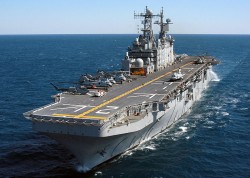
The US Navy possesses its lowest number in history of amphibious vessels. There is currently questionable accounting concerning the ability to put an entire MEB (Marine Expeditionary Brigade) to sea. Latest estimates place the required ships to conduct forcible entry options with a MEB, deemed necessary for major combat operations, at 33.  Realistically, that number leaves no real reserve and more worrying is the open secret that we will not maintain this force level past 2015. MEUs and ARGs are staying out longer, and being split in order to fulfill operational needs. The 15th MEU, which captured Somali pirates in September 2010, was split conducting counter piracy while simultaneously supporting Afghanistan combat operations and theater reserve.

While such split operations are within the kit bag of the MEU, such practices dilute the nature of the ready force that is forward and concentrated. Current naval planning does not indicate these trends will reverse. In the near term, FY13 budgeted shipbuilding plans for the procurement of 10 combatant vessels, none of which are designed as amphibious troop carrying vessels.

Longer-term outlooks are no more promising, with the 30-year shipbuilding plan designating amphibious ships to remain the smallest portion of the surface ship layout. These trends indicate that while we point to a pivot in the Pacific, a lack of focus on the real possibility of amphibious operations exists in the Navy.  Amphibious operations would only make up a portion of the large pie of commitments facing the Pacific Fleet. Within the large spectrum of possible kinetic or non-kinetic operations in the Pacific, it can be predicted that any amphibious operation would be a decisive moment strategically and the planning should be weighted accordingly.

IN THE LACK OF CLEAR ORDERS AND GUIDANCE, ACT ACCORDINGLY

Viewed through the lens of history (Normandy, Inchon, or Guadalcanal) it is difficult to find any amphibious operations that did not mark a dramatic turning point in a campaign or war.  If it is then self-evident that such an event would be so strategically critical, why does the current plan to build and maintain such a force seem akin to a family choosing to forgo insurance while deciding to move to earthquake prone area? The prime stakeholder in any amphibious operation, the Marine Corps, cannot dictate the procurement of other services, but it should consider alternative courses of action to ensure its capabilities remain viable.

It is important to remember that any alternatives to procuring and maintaining a robust combatant amphibious fleet should be only temporary. To rely on merchant shipping or other means that are not 100% dedicated to amphibious operations under fire would be a fool’s errand, but more dangerous would be to gap a crucial element of national power when the world is becoming more dangerous.

Numerous historical precedents counter the argument that only dedicated ships of war can be used under fire. Most apparent was the massive emergency nationalization of merchant shipping during World War II. Thousands of tons of civilian shipping, manned by civilian mariners, were mobilized and made a crucial contribution to winning the war. Losses were great, with 1,614 ships sunk from 1940 to 1947 (post conflict losses due to remnants of war) and 9,521 merchant seaman giving their lives in service to the country. Merchant seaman had a 1 in 26 chance of being killed in action, greater than that of any the four services. Clearly, our national history shows that civilian mariners are capable of risking all in service to their country.
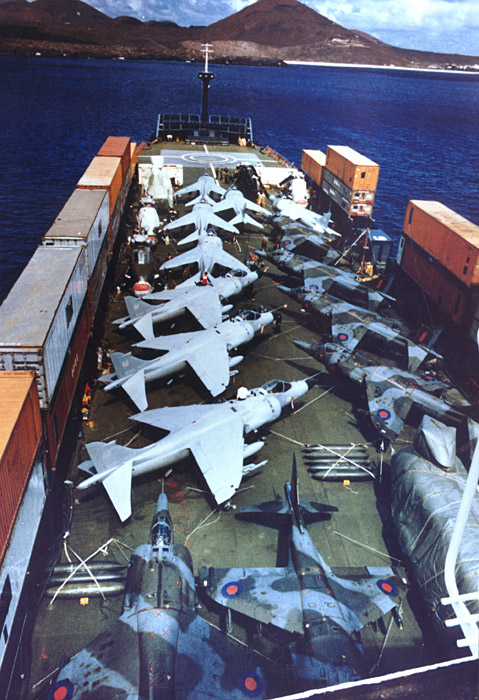
The SS Atlantic Conveyor became an unorthodox aircraft carrier during the Falklands War

Another useful example is that of Great Britain during the Falklands war of 1982. In an economic situation eerily similar to today, the British government had to make many choices of need rather than want during the 1970s. Economic malaise led to drastic defense cuts, and all strategic guidance pointed toward the threat of the Soviet Union and continental Europe.  History demonstrated that war rarely happens where governments want or plan for it to occur. Only a year after London mothballed several of its carriers and amphibious ships, Argentina invaded the Falklands and presented operational and strategic challenges of the highest order to the British Government.  In an amazing example of military mobalization, Great Britain took two civilian container/roll on-roll off (RO/RO) ships and converted them to ad hoc helicopters and VTOL carriers. They carried Harrier GR.1’s and Sea King Helicopters, and gave British commanders operational agility in the form of air cover and lift capacity. Tragically one of the ships was sunk along with several Royal Navy combatants.

The lesson to take away is that, while as much as we may want to envision a conflict of our choosing, it is more likely that we will end up faced with decisions we did not anticipate. If we have to create capability on the fly and mobilize merchant shipping after we are on the right sight of boom, our forces will face greater risks.

CAPABILITIES DO NOT APPEAR BY “JUST ADDING WATER”

Now is the time to begin planning for the worst. Using civilian shipping in amphibious operations is feasible and more cost-effective than waiting on billion dollar ships that have procurement cycles measured in decades. Training on the lower end of the conflict spectrum in operations such as humanitarian and disaster relief will increase civilian/ military amphibious force ability. Earlier integration into MEU and ARG structures to work out inevitable issues of interoperability will make the inclusion of merchant ships into higher spectrum operations a more risk tolerant option.

Most critically, planning for and using merchant shipping options now will keep our amphibious blade sharp, and capabilities will be less affected than if we remain on our current course of a letting them wither, and eventually die, on the vine. Few operations rival an amphibious movement in terms of complexity, and hoping for the best when marines and sailors conduct one under fire in the future is not only negligent, it is immoral. Utilizing the merchant shipping now and planning for its use until our amphibious force is stabilized is a viable strategy that deserves greater attention.
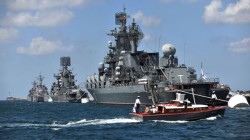

Maritime Warmongering: Russia’s Black Sea Military Exercise

Aaron Willschick on the tension over the recent Russian military exercise in the Black Sea and how Russian President Vladimir Putin should put an end to his persistent warmongering.

In what is becoming an almost daily occurrence, the Russian government has again stolen the front page news headlines with its recent military exercise involving more than thirty warships, 250 combat vehicles and up to 7, 000 troops. The exercise has been met with confusion and anxiety from the international community with regards to what in fact Russia’s intention was with ordering the surprise maritime exercise.

The country that has had the strongest reaction against the exercise is Georgia. Tensions have been high between the two countries ever since they went to war in 2008 over the separatist republics of Abkhazia and South Ossetia. In response to the exercise, the Georgian government said Russian military action in the Black Sea was “at odds with the interests of stability.” The official Russian statement on the drills from state-run news agency RIA Novosti was that they were meant to ensure regional stability ahead of next year’s Winter Olympics in Sochi on Russia’s Black Sea coast.

On April 1st, the Russian Foreign Ministry dismissed Georgia’s condemnation, stating that Tbilisi’s assertion was groundless and out of sync with its declared commitment to normalize its relationship with Russia. The Foreign Ministry also stated that Georgia’s claims that the military drills were destabilizing reflects its own regional aggressions. Russian Foreign Ministry spokesman Alexander Lukashevich said the Georgian reaction was “a public inflation of a Russian threat to cover its own confrontational policy.” NATO has not offered an official response to the exercise, but a NATO-member diplomat suggested that there was some unease over the surprise nature of the drill. There was no official objection from Ukraine either, but some members of the parliament chose to voice their displeasure.

Under international law, maritime exercises of this size do not need to be announced to other countries in advance, but as evidenced by some of the reaction, it has only added to the mounting international skepticism over Russia’s global intentions. Despite the rising tension, it is fairly clear that the Black Sea military exercise is yet more warmongering by the Kremlin and Putin and what we have come to expect during his lengthy tenure as either Russian President or Prime Minister. Putin himself even chose to attend the exercise in the Black Sea town of Anapa, along with Defense Minister Sergei Shoigu. During his time in office, Putin has used his role as commander-in-chief to cast himself as a strong leader for whom national security is foremost. Particularly since returning to the presidency last May, Putin has stressed the importance of a strong and agile military. He has often cited external threats in his thirteen years in power when discussing the need for reliable armed forces. It has been reported that spontaneous training missions resembling this one are apparently set to become routine in the Russian military.

Despite Russian denials, it is quite apparent that this exercise is part of some grand strategy of standing up to the West and asserting Russia’s regional dominance. Putin seems intent on projecting Russian power towards Europe as well as the Middle East. In late February, Putin ordered military leaders to make urgent improvements to the armed forces in the next few years, saying Russia must thwart Western attempts to tip the balance of power. He said that manoeuvres must be held with less advance warning to keep soldiers ready and prepared. Observers have commented that the drill is likely part of a wider attempt to reconfirm that the Russian navy and military are still able to play a political and geopolitical role in the south.

It is time for Putin to put an end to his regular attempts at flexing Russia’s geopolitical and military might. It has become all too regular an occurrence that it has now grown to be predictable and reminiscent of Soviet rhetoric during the Cold War. As a leader, Putin seems intent on making himself feared on the international stage which is unrealistic in this day and age. All the strength he is putting into trying to raise Russia’s geopolitical prominence could be spent on re-establishing and reinforcing relationships with Western powers. Unfortunately, it seems unlikely that this will happen until Putin has decided that his time in the Russian political spotlight has come to an end, a remote possibility unlikely to occur any time soon.

Aaron Willschick is a recent graduate from the MA program in European, Russian and Eurasian Studies at the University of Toronto’s Munk School of Global Affairs. He also holds an MA degree in political science from York University and a BaH from York University’s Glendon College. His research interests include the European Union, European security and defense policy, NATO enlargement to Eastern Europe and democratization. He has extensive experience in policy and research, having worked as a trade assistant at the U.S. Consulate in Toronto and a research assistant to well-known Canadian author Anna Porter and York University political science professor Heather MacRae.

Maritime Security and National Identity

A recent sign posted on the window of a Beijing restaurant refuses to serve certain nationalities due to current international maritime disputes between state actors. Sarah Danruo Wang analyzes how historic disputes on sea (and on land) shape national identity

Restaurant SignAs I near graduation at the University of Toronto, I keep thinking about vignettes of my incredibly awkward, enlightening, and unforgettable first year that really shaped some of my research interests today.  In one such episode, as I was researching a paper on the Franco-Prussian War I encountered an odd little anecdote about how, decades back, a group of people watched an opera so cathartic that when it concluded, Belgium was born. Since then I have researched what it means to be “German” through the ambitions of Bismarck; “Soviet Russian” during Lenin’s implementation of national language policies; “Greek” during the fall of Constantinople; “Czechoslovakian” amidst such an unstable geography; and “Azerbaijani” in a seemingly ethnically homogenous, enigmatic Iran. Personally, I was born in Beijing and I have lived for four to five years each in Ottawa, the San Francisco Bay Area, Vancouver, and now Toronto – a mobile life that renders me identity-less. If our characters are formed through our reactions to our struggles, is a national identity similarly (re)created through the interpretation of conflict?

A restaurant in Beijing has a faded sign on its window: This shop does not receive the Japanese, the Philippines (sic), the Vietnamese, and dog.” I admit that I am not shocked by this almost boastful racism from my hometown. Chinese signs were once the tangible symbols of losing something in translation, yet this one is succinctly clear. Why specifically these three countries? It turns out that each has a maritime dispute with China. China is obviously at odds with Japan over the Senkaku/Diaoyu Islands; and with Vietnam and the Philippines over islands in the South China Sea. Although the sign is an isolated incident, provoking nasty reactions from the nationalities in question, the state has not asked the owner to remove the sign as the owner indicates that “this is my own conduct.” What many news outlets did not mention is that this sign is eerily reminiscent of a well-told Chinese story of a sign reading, “Chinese and Dogs Not Admitted”, in Shanghai’s Huangpu Park in the 1920s. Although Chinese people were barred from entering local parks, the exact wording of any signs is disputed. Nevertheless, the restaurateur’s homage, grafted from previous experiences to today’s prejudices, exhibits the tension between perceived relative statuses.

When I was living in the United States, I recited the pledge of allegiance every day. When I returned to Canada, I did not remember the words to the national anthem, let alone the Royal Anthem that we had to sing on the way out of every assembly. I watched my social studies teacher be the only one in the auditorium refusing to stand for “God Save the Queen” because of an alternate stanza belittling the Scots. The nationalism in my Chinese peers and their parents was diluted at best – cultural detachment and youthful apathy. I want to blame the decreased interest in politics on the events and aftermath of 1989, but I now know better, that it was the decision to prioritize economic opportunity, and the spread of a material culture in my generation.

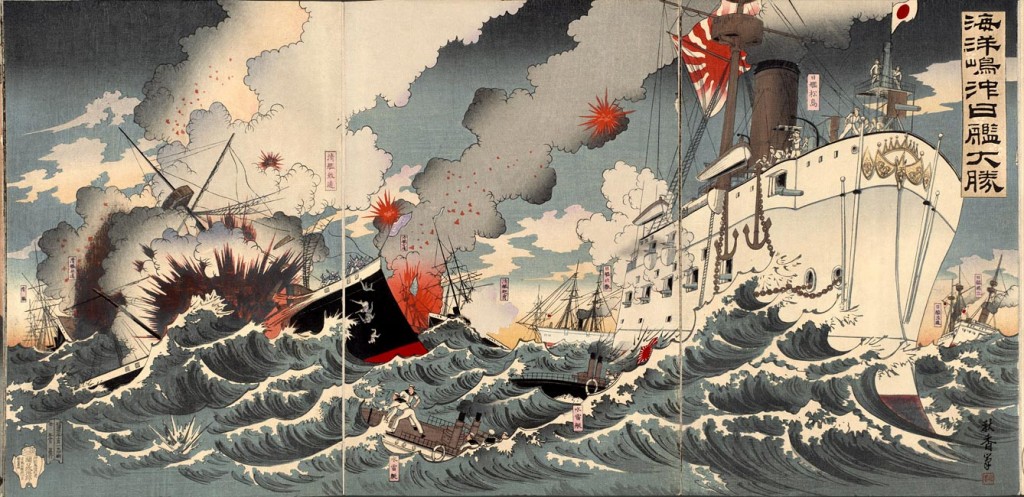
But with a foreign conflict, specifically one that makes the average Chinese feel cheated over our poignant, invaded past, the Chinese public do not disappoint. A traditional Chinese hero is Zheng He, whom we proudly claimed to have travelled the seas centuries before the Europeans. Yet we rarely note that Zheng is not ethnically Han but of Muslim Hui descent. More recent victories and defeats at sea during the Sino-Japanese conflicts of the late 19th century were captured primarily in the Japanese visual style (see image below).

Japanese Style

Since the 1990s, when the nation was once again challenged by non-governmental oversight and the retreat of ideology, China has faced and reacted mostly to land-based or conceptual conflicts. China Can Say No, published in 1996, rejected Americanization of culture. The bombing of the Chinese Embassy in Belgrade in 1999 by NATO produced protests that were verbally supported by Vice-president Hu Jintao. The 2008 Summer Olympics was a triumphant display of cohesion and unity. And now, the historical antagonism with Japan is suddenly reignited over rocks. Is this solidarity perhaps just a defense mechanism to perceived (cultural or national) insecurity, rooted in a historical perspective of either relative inferiority or regional supremacy? Or perhaps, it is just a bit more comforting to confront the other in the company of one’s peers?

As for Canada, the Rush-Bagot Treaty of 1818 demilitarized the Great Lakes region by permitting only one naval vessel each for Britain and the United States on Lake Ontario. This demilitarization was seen as a first step testing the precarious trust after the War of 1812. Furthermore, the Naval Service Act of 1910 created the Canadian Navy with second-hand British vessels, the HMCS Niobe and HMCS Rainbow, and established the Naval College in Halifax. Opponents derided the effort, calling the formation the “tin-pot Navy”.  Yet this was a clear assertion of Canada’s self-protection autonomy – separate from, but loyal to the Commonwealth.

Canada’s maritime security hasn’t always been life-or-death serious. In 2002, Denmark erected a flag and left some Danish vodka on Hans Island in a bizarre attempt to provoke a reaction over a rock that burdens Canadian-Danish relations. Five years later, Russia similarly planted a flag in the seabed of the Arctic to prove “the Arctic is Russian,” illustrating that Russian cooperation and aggression will perpetually be a mercurial cycle. Current maritime concerns in the Arctic revolve around Canada’s ability to react to potential oil spills and pollution through drilling and shipping, and Ottawa’s assistance to indigenous maritime development.

I do not want to poeticize maritime divides, but any fifth grade geography class reveals that the continents were once fitted together like a finished puzzle known as Pangaea. It is appropriate that with continental drift, distance produced distinct people. Only with the advances of maritime technology, ambition, and the lust for adventure led to the discovery of the New World. Shipping and maritime security determined wealth and relative power, which enabled the early flourishing of The Netherlands and divorced England from the European continent.

Before man conquered the skies, maritime passages were the medium for the arrival of the other. It is ironic that for all the efforts China used to build a wall to keep barbarians on horses out, it was defeated by other barbarians on ships at its ports.

The dividing seas also facilitated asymmetric development, ideological escape, and the spread of commerce. The Austro-Hungarian Empire’s lack of a navy exacerbated its economic stagnation as it steadily lost its maritime-efficient proxies through successions or independence. A century later, a Russian ambassador asked why the Czechs needed a navy when the country was obviously landlocked (the Czech representative replied that he did not understand why Russians needed a ministry of cultural affairs). Lastly, incidents like the Komagata Maru and Pearl Harbor shape our collective sense of how national and human security is simultaneously enhanced and endangered by the oceans, as trouble can be carried on the tides.

The racist sign in the Chinese restaurant, among the vast stimuli of a city like Beijing, indicates how disputes trickle down to even the obscurest of places. Conflict on the seas – both today’s and from times past – shapes who we are, what we fear, and how we react.

Sarah Danruo Wang is currently a third year undergraduate student at the University of Toronto studying international relations, philosophy, and fine art history. Her research interests from first year has steadily moved east from Germany to the former Czechoslovakia to Russia and include broader issues in identity politics, EU and NATO eastward enlargement, and education policy. She has previously researched for the Advocacy Project, the Department of History at the University of Toronto, and the G8 Research Group.

This article was re-published by permission and appeared in original form at The Atlantic Council of Canada.  

A Unified Chinese Coast Guard


Dragons of a feather stick together
                                                                      Dragons of a feather stick together

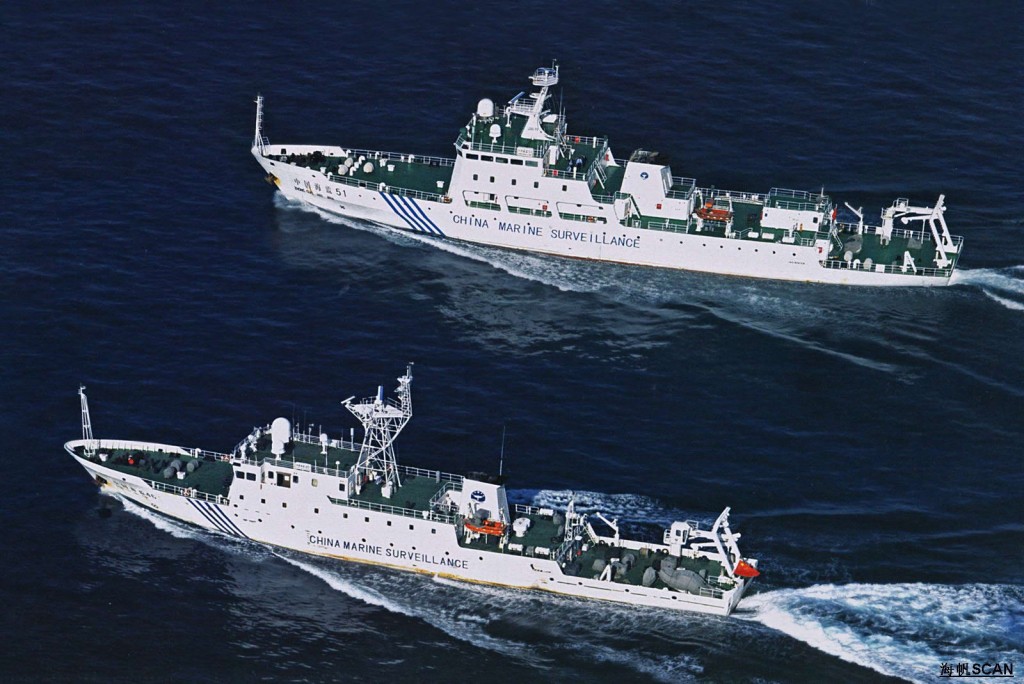
Our friend Chuck Hill, of Chuck Hill’s CG Blog fame, has a short synopsis of news that went mostly unremarked in the past few weeks – namely the consolidation of several of China’s various civilian maritime services (or “dragons”) – into something approaching a unified Coast Guard in the mold of a naval auxiliary:

The new agency will combine the China Maritime Surveillance (CMS) of the State Oceanic Administration (SOA), Fisheries Law Enforcement Command (FLEC), the anti-smuggling force of the General Administration of Customs, and their “Coast Guard” (aka Maritime Police in Chinese).


Ironically from the US point of view, SAR is not one of the agency’s responsibilities as the Maritime Safety Administration (MSA) of the Ministry of Transport will remain separate.

Read the full story here, including analysis on the potential impact on the region’s maritime stand-offs.