“History shows the navy which adapts, learns, and improves the fastest gains an enduring warfighting advantage. The essential element is fostering an ecosystem—a culture—that assesses, corrects, and innovates better than the opposition.”—Admiral Michael Gilday, Chief of Naval Operations, remarks at 2022 Surface Navy Association Symposium
Assembled and edited by notetakers Professor Mie Augier and Maj Gen (Ret.) William F. Mullen, USMC.
Learning is an important topic. The increasing pace of change in the operating environment, as well as the evolving requirements of leading each new generation that comes of age, makes both individual and organizational learning essential. At the same time, dedicated time for learning may be missing, or the desire for continued learning is lacking. But it can be reawakened through learning about learning itself, and discussing the need for both individual and organizational learning for warfighters.
The CNO’s recent initiative of “Get Real, Get Better” (GRGB) touches on the importance of learning on several levels. Learning is difficult and often painful as it involves transformation and change, and is not just something that one can put on “like a new suit,” as Mortimer Adler wrote in his classic piece, “Invitation to the Pain of Learning.” The emphasis in GRGB on taking hard honest looks at our performance and to have the courage to take the steps to improve have resonated well with the recent iteration of our Naval Postgraduate School course, “Maneuver Warfare for the Mind: The Art and Science of Interdisciplinary Learning for Innovation and Warfighting Leaders.” We sat down with a handful of students/learning leaders to listen to their reflections on the topic and how learning about learning itself can help us get real and get better as warfighters and warfighting organizations.1
The course starts with understanding the ‘why’ of learning, the need to exercise our minds, and embracing the pain along the way. It approaches learning as a manifestation of Marine General Al Gray’s approach to “maneuver warfare,” and as a mindset that is relevant across industries, organizations, services, and warfighter topics. We focus on different dimensions and elements of learning, such as the mechanisms for individual learning, organizational learning, learning organizations, and some of the key tradeoffs between refining existing competencies and exploring and experimenting for new ones.2 We use a broad set of interdisciplinary as well as warfighter-oriented readings ranging from Mortimer Adler’s ‘How to Read a Book,’ Herbert Simon, James March, General Gray, Secretary Mattis, Colonel John Boyd, and other articles on behavioral strategy, organizational learning, and counterfactuals.
We believe that active minds are best developed through active learning, and not lecturing and rote learning (no PowerPoints). That too was something emphasized in Gen Gray’s approach to learning and education, and we try to honor that by facilitating discussion through questions, small groups, and relating scholarly material to warfighter issues. As a result, we studied and learned from Gen Gray’s leadership and the maneuver warfare movement not just as an important episode in USMC institutional history, but also an approach to thinking, leading, and learning that can be useful to help evolve current initiatives (such as GRGB) into something that can have lasting impact on how our organizations think, learn, and fight.3
In the conversation below, our learning leaders reflected on aspects of what we studied and discussed in the course; such as different mechanisms and levels of learning, some links between individual and organization learning, the role of leaders in facilitating both, and how learning is essential to ‘get real, get better.’
What is your main takeaway about the importance of learning at the individual level and how it can help us become better learning leaders? How does that help us ‘get real’?
Individual learning becomes a building block for the organization. If learning is inculcated on an individual basis, it is more likely that the organization can become a learning organization. However, while individual learning is important, it is not the only thing needed. The organization has to provide the space, time, and opportunity for the individuals to be learners. And specific to Navy or military bureaucracies as a whole, there has to be a culture to allow for learning, innovation and innovative thinking, and the status quo needs to have less of a hold on progress. The status quo can be an inhibitor of innovation and of change in general.
Another takeaway is the role of the leader as a teacher. You cannot teach if you do not have a desire to learn, understand the mechanisms of how people learn, and more importantly for the sake of the organization, you need to understand how to help others be lifelong learners. That is really important because in organizations like the Navy and Marine Corps that are multi-tiered and stratified, the one thing you can find that will bind us all together as a learning organization is to cultivate this in future leaders/teachers. This is an example of something that links individual learners/leaders to building learning in others and a broader learning culture as well.
It is not enough to say you are a learning organization – you have to learn how to learn, and you have to learn to teach how to learn. That is a mechanism for how our approach to learning as individuals can help transmit and transform the organization into a learning organization.
We feel strongly that the role of the organization is essential. That is not specific to learning only – but to everything since the leader drives where the organization is going. We also saw that in some of the cases we discussed in class and some of the guest speakers. Boyd did that; Gen Zinni did that; Gen Gray too. All of those leaders offer examples of people in key positions deliberately driving change and learning in their own way.
There are important traits and skills that characterize learning leaders. It takes vulnerability to push folks beyond their comfort zone, to admit they may not know something, or to be willing to ask for another’s advice. It can also take vulnerability to stand up for learning efforts, especially when their takeaways challenge the norm. We discussed Gen Grays emphasis on “we,” not “me,” which is one manifestation of humility. How do you see the roles of humility, vulnerability, and courage in learning?
We better understood that through one of the readings, the Levinthal and March reading.4 In their article they are looking at learning at the individual level, and how that has implications for the organizational level. They are also looking at the cultural and social aspects for why learning fails or does not always succeed. That could be due to friction between people; people being too focused on themselves and not the organizations; and the myopias of learning.
It is also connected to the idea of satisficing – that we are often satisfied with the minimum solution, or what is good enough, to be effective. We also probably over-attribute success (or failure) to particular events or people. What if the success or failure was just by chance? What happened, and how much of that was attributed to things we were doing intentionally, and how much of that was influenced by chance? It involves self-awareness and comfort with uncertainty. Too often people and organizations attribute success or failure to efforts, mainly individual efforts, that may not have much to do with the actual causes. The “Myopia of Learning” article speaks to that in a great way. Admitting that you as a leader may not be the source of all great things involves some humility as well.
At a deeper level, it also relates to the idea of moral courage as a leader and that revolves around humility and vulnerability. Humility is difficult to teach, but it might be easier if you engage in a conversation about vulnerability as well. There have been leaders who lead with the statement, “I will confide in you something that I wouldn’t tell anyone else, and you do the same.” It is a challenge because it relies on trusting someone you may not know well. So vulnerability here builds trust. And that is part of the fuel that gets to learning.
Modeling learning behavior is critical, like with any other favorable leadership trait. To be a leader you need to be willing to be vulnerable, not only for accepting outside criticism, but also to be self-critical. As you embark on Senge’s concept or discipline of personal mastery, it is a journey that is ongoing and you never fully arrive at the destination. We can tie in a little bit of Boyd as well. A lot of folks naturally start the OODA loop with the first part, the observation. But once you delve into it you realize that you never take off on the OODA loop unless you get the orientation right, the part where you consider the implications of your observations. And orientation is itself its own OODA loop that is built on things like culture, norms, shared values, and others. But through observation from other parties and your own self-observation you are able to change that orientation. This then changes the nature of the OODA loop and how you perceive the environment, decide, and act.
As a leader, what we talked about regarding vulnerability, humility, and values, if you tie it back to Boyd, you are hitting the center of the orientation piece and the necessity of you as a leader to really understand yourself. A leader has to have the self-awareness to understand their strengths and shortcomings, while actively striving toward personal mastery so that they can make better decisions, and they can model better learning behaviors for those they lead.
How can learning help the Navy “get real, get better,” and what are the difficulties in creating learning organizations? Is there anything from the course that would be particularly useful to share? What would we do to help make it more like a movement, like MW/FMFM-1 Warfighting?
You can take a page out of General Dempsey’s “Mission Command,” and you have intent, trust, and communication. This helps with explaining the importance of learning, not just for learning’s sake, but for the mission and the organization, a point Gen Gray made in the maneuver warfare panel we discussed. This would ideally guide you as a leader and your colleagues to foster an environment where people have your intent and your trust. Trust is defined here as the absence of fear of humiliation, mocking, or ridicule, including for wanting to learn something new or pursue a novel idea. Once you have that environment, a leader can embrace those efforts, including those trying to understand what is wrong and develop solutions.
If you as a leader do not foster an environment where people can think outside the box – can think beyond the NAVADMINS and instructions and guidelines – then you are going to struggle to explain the orientation part of your thought process. You are going to struggle to think differently. If a leader does not foster trust, adequately communicate their intent, and foster an environment where people are not afraid to explore beyond the conventional boundaries, then they will struggle to develop creative solutions. It is not enough to say we need to harness constructive failures. We have to be able to create an environment where people are not afraid to explore beyond the boundaries of what they would normally do or think about. You will struggle to get to the creative solutions GRGB is aiming for without that organizational environment. GRGB is both about individual-level traits and approaches, but definitely organizational culture as well.
Boyd was able to use the bureaucracy against itself at times. The true secret is to reward the behavior you want and carefully manage the incentives. A perfect example for the U.S. Navy is this – I came across a NAVADMIN that completely rewrote the definitions for performance evaluations, and it put out exactly what should be ranked in terms of efforts to create and sustain a learning environment at both the individual level, in the workspace, at the organizational level, across the U.S. Navy. We saw this document come out – and be completely ignored – and then we had the perfect opportunity where the performance evaluation system was completely revised. Now we have gone from navfit98 to eNAVFIT online. Lo and behold, all of that wonderful criteria that was supposed to evaluate me on how good I am as a personal learner and how good I am at getting those under my charge to be learners – it evaporated overnight! How can we get better in building more lasting changes? It needs to be pushed within the bureaucracy itself, we need it to be sustained, unlike the implication of that NAVADMIN, unfortunately.
Another problem is leadership turnover. Leaders often want to put their mark on things and change things just for the sake of change. But they often rotate out of the position after so little time in the seat that things can rarely be sustained, or rarely do leaders have to live with the possible consequences of their initiatives, and the cycle repeats with turnover.5 So we need to help build a sustainable vision and change how the organization thinks, so it becomes embedded in our overall approach, much like the Marines and Gen Gray did with FMFM-1 Warfighting.6
What do you see as barriers to GRGB?
I think if you survey all members of the Navy, most would want the organization to become a learning organization where they can have time for personal learning, have the room and freedom to think, and they want to become deeper learners themselves. But it is hard. Learning is painful as we discussed in class, and it needs to be. On the organizational level, it is often everyone else’s fault for why it doesn’t happen. Because of the Navy mentality and what is valued, certainly in the officer corps it is often about FITREPs and promotion. No one is going to make the push that is needed when it may be seen as professionally risky. In other words, there can be a mentality of, ‘The system that promoted me can’t be wrong,’ but the GRGB initiative could change what the system values in people.
The Marines seem to have done a decent job at reversing some of these trends, both historically with the reforms Gen Gray lead, but also more recently. They seem to be at least trying to build an organization that embraces learning and exploration, with MCDP-1 Warfighting and the recent publication of MCDP-7 Learning really demonstrating that. Not having as much funding and having different challenges might have helped. We could learn something from how the Marine Corps institutionalized the emphasis on thinking and learning with FMFM-1 early on and the value of lifelong learning it embodied.7 It doesn’t cost money to think as Gen Gray reminds us.
Some of the recommendations in the Education for Seapower study can address these themes if we applied them. These include an organizational emphasis to developing learning and thinking as part of the culture and the ethos of the organization. It includes emphasizing this in the key documents which the organization derives guidance from over time, not just in a set of instructions that are changed tomorrow. The Navy hasn’t done that.
In the Navy we are so focused on our communities and too focused on depth, and unwilling to accept breadth in knowledge and proficiency, that we sort of get in our own way. We focus so much on operating our highly technical platforms that it signals to people that this is all we really care about. But what do you do in your free time, what do you do to educate your mind? What do you do officially, formally, organizationally to enhance learning for yourself and your command beyond the baseline standards?
What can we do to help GRGB become more of a movement and build it into our organizations?
We saw examples of the mentoring process in class and having a dialogue about the purpose, where to get more information, and how it can be implemented. Taking the time to discuss and share the ideas behind the GRGB initiative is essential and can help build excitement for it as well.
But it is really about renovating or transforming organizational culture and that is very difficult. The pamphlet and training package is good in providing some structure and training for how to deliver GRGB. But what they don’t really get at is where does it go from here, what is the follow-through? Who does this? What is the qualification? Where do we do this? There is nothing that says this is part of our organizational DNA now, as MCDP-1 is for the USMC. So as far as you can help make GRGB be part of the organization, you have to make it an agent of change, to make it something that is genuinely embraced by the organization, not just printed by the organization.
There are things happening at a high level now that supports making it a movement, such as mandatory GRGB training for flag officers, and the fact that it is a warfighting enabler is important. The Navy respects and acts upon what is written in ink. If it is not in ink then it is less likely to care. This spans from completing a travel voucher, to performance evaluations and other things. We need to have that hard document that I can wave and say, ‘This is why we are doing this, because this is directive, this is official.’ That is when it will really start to take hold.
The idea of publishing an FMFM-1/MCDP-1-type document for the Navy is key. It can become something the organization embraces as a sign of it becoming a deeper learning organization. It can be something that is foundational to new and experienced members of the organization, and part of who we all are and how we learn. An outline for an MCDP-1 type document might be a good start to at least start the conversation and discuss the benefits of a more structured organizational movement.
We look forward to you writing that!
Commander (Dr.) Art Valeri is an Operative Dentist stationed at NMRTC Great Lakes serving as the Department Head/Chief, Dental Service of the Veterans and Military Staff Hospital Dental Clinic, Captain James A. Lovell Federal Health Care Center, North Chicago, IL.
Commander Paul Nickell is a Naval Flight Officer currently stationed at the United States Naval War College as a student in the College of Naval Warfare in Newport Rhode Island and an MBA Candidate at the Naval Postgraduate School.
Captain Daniel G. Betancourt is a career Foreign Area Officer and Naval Aviator specializing in Latin America and the Indo-Pacific. He currently serves as Chief of the United States Naval Mission to Colombia.
Commander (Dr.) Jay Yelon is a US Navy Trauma Surgeon currently stationed at the military-civilian partnership at the Hospital of the University of Pennsylvania.
References
1. The course, inspired by Gen Gray’s approach to thinking and learning, utilizes organizational documents, scholarly articles as well as cases and examples relating to learning to study and understand different dimensions and levels of learning and how we can improve.
2. The classic tradeoff between exploration and exploitation and the difficulties balancing them and how both are essential for learning, is discussed in James March’s work (e.g. Exploration and Exploitation in Organizational Learning | Organization Science (informs.org)). A recent discussion and application of important parts of “Learning to Win” ( 060822_Learning_to_Win_Report FINAL.pdf)
3. During this iteration of the course, perhaps one of the most interesting aspects is the contribution from the students in the 865 program, which offers an innovative and very student centered graduate degree with a lot of flexibility and electives, in keeping with what navy leaders have emphasized as being essential for the ‘cognitive age’. Each of the students in this program were all taking the course (and in their program) despite working full time in responsible positions, thus already having important intrinsic motivation as learners. The 4 learning leaders in this conversion are all part of this program.
4. The myopia of learning – Levinthal – 1993 – Strategic Management Journal – Wiley Online Library
5. Gen Zinni talked during his visit to class about the problem of leadership ‘By temps’; the lack of continuing to vision. That is a problem both for our own organizations focus over time, and at the national level (General Anthony Zinni (ret.) on Staying Honest with the Troops and Translating Experience | Center for International Maritime Security (cimsec.org))
6. Gen Gray emphasizes the importance of thinking and learning embodied in FMFM-1 as a way of thinking that is applicable across organizations and industries. FMFM-1 later became renamed as MCDP-1; hence it is referred to both by students.
7. Gen Gray and Van Riper both mention the study groups and the informal efforts that helped inspire and facilitate learning beyond instructional learning Warfighting Panel – YouTube.
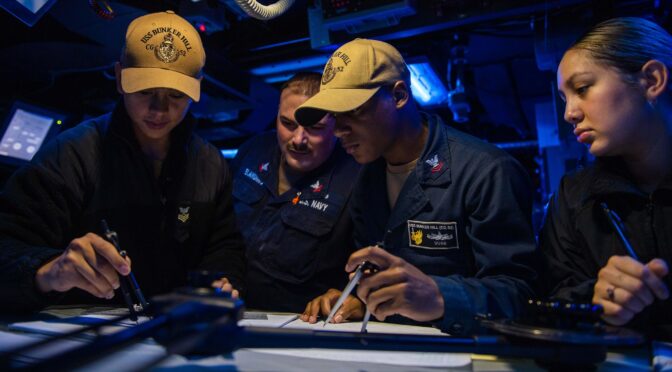
Featured Image: PACIFIC OCEAN (Oct. 14, 2022) Sailors conduct training in the combat information center aboard Ticonderoga-class guided-missile cruiser USS Bunker Hill (CG 52). (U.S. Navy photo by Mass Communication Specialist 3rd Class Jordan Jennings)