Category Archives: Global Analysis

A Geographical Breakdown of What’s Going on in the World

Book Review: “Saving South Sudan”

1403492_720053588040182_7172674623284646331_o

Disclosure: I have been following the evolution and progress of Robert Young Pelton‘s work on Sudan for several months. I am quite pleased with what came of this trip for Robert and his filmmaker / photographer cohort, Tim Freccia. Enjoy!

“Violence and bloodshed can never have morally good results” – The Tragedy of Julius Caesar, William Shakespeare

Saving South Sudan is an ambitious, multimedia event from World’s Most Dangerous Places, author Robert Young Pelton and master photographer/filmmaker Tim Freccia. VICE went big on Pelton’s quixotic journey with Nuer Lost Boy Machot Lap Thiep to “fix” South Sudan. The three enter the world’s newest nation, at a time of extreme crisis and bloodshed, creating a grand yarn with bold characters and high adventure set against sweeping, brutal savagery.

The story of South Sudan as viewed through a Western lens is unbelievably complex, but Pelton gives us an African perspective where the current crisis is demystified by those closest to it. South Sudan has plunged into another round of playground rivalry where the contested sandbox is the world’s newest country and the opponent’s bloody noses, busted lips and black eyes are dwarfed by the physical and emotional damage inflicted on its spectators.

Saving South Sudan gives us an intelligent summary of the history, religion, cultural anthropological aspects, militarism, oil economy and “baksheesh-ocracy” that makes South Sudan tick. Serious students of the subject are encouraged to consider all of these facets while reading / viewing this oeuvre: No actions are promoted, no outcomes are predicted- and this is how it should be. This is Africa.

Pelton’s 130 page print piece and 40 min documentary grants the viewer unparalleled access into an Africa where there are no orange sunsets framed by acacia trees. A place where war is irregular, ferocious and unpredictable. In THIS Africa even the “rebel leader” bristles at being identified as such. In an earnest conversation, ousted Vice President Dr Riek Machar relays his desire isn’t to incite violence but to have a seat at the table in order to discuss options and opportunities to end the conflict. Pelton takes the filter off: behind the rhetoric, the violence continues in real time and we know that securing a seat at the table and successful negotiations (see recent media reports) bear little impact on the battle for oil on the ground. If fighting has indeed ceased, most roving bands have yet to receive the memo.

I can’t exit this review without mentioning the main reason to take the time to get briefed on the region through Pelton’s Saving South Sudan. The human touch interviews with the rulers, rebels and raconteurs would be reason enough. So would Freccia’s breathtaking portraits of the people, landscape and conflict. But taking you along this expedition is Machot- an affable, handsome (still) young man and former lost boy. His story is one of sorrow, success, and optimism. His is perhaps the best lens of them all.

—————————————————-

Finding the print issue of the magazine can be a challenge but distribution sites are posted at the VICE website. The entire article can be found at: http://www.vice.com/read/theyre-all-coming-here-0000283-v21n4

The “Saving South Sudan” world premiere documentary can be found on-demand here: http://www.vice.com/en_us

Stephanie Chenault is the COO of Venio Inc, a service-disabled, veteran-owned small business which focus on plans, policy, architectures and problem-solving across the Department of Defense for multiple clients.

New Strategic Geography Ends “Long Army Century”

Some historians attempt to reframe the timeline of history in order to highlight trends that might otherwise remain submerged in more traditional categories. The British Marxist historian Eric Hobsbawn, for example, re-classified the long period from the French Revolution to the beginning of the First World War as the “long” 19th century. This change showcased a particular period of European ascendency through the Napoleonic, Revolutionary, Victorian and Edwardian periods. A similar effort might now be applied to the influence of the U.S. Army on United States strategic thinking. A “Long Army Century” is now drawing to a close due to new strategic geography and shrinking defense budgets.

ElihuRoot
Elihu Root

The “long Army century” arguably began in 1904 with the selection of New York corporate lawyer Elihu Root as the Secretary of the Army by President William McKinley in 1899. While the U.S. Army had been victorious in Cuba in the Spanish American War, its organization, operations, and logistics during that conflict revealed deep flaws that might circumscribe future success. Root undertook an aggressive program that created the modern Army General Staff, the Army War College, and the Joint Army Navy board for inter-service cooperation.
The Chief of Staff system, modeled on methods then used by American business, was a great success. Root’s reforms created the “modern” Army that was able to mobilize large numbers of volunteers for the First World War. This system eagerly embraced new technologies such as the tank and the airplane, and was successful in deploying millions of Americans to fight in France in a relatively short time. The Army also had great influence over large numbers of civilians for the first time since the Civil War, as high ranking Army leaders served in key roles on the War Industries Board that coordinated U.S. war production.

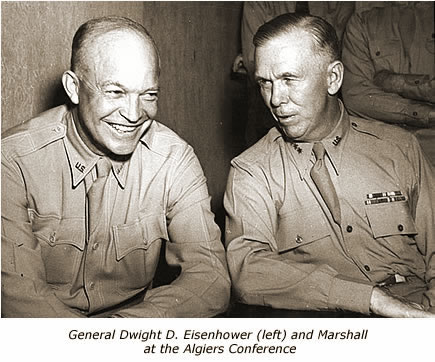
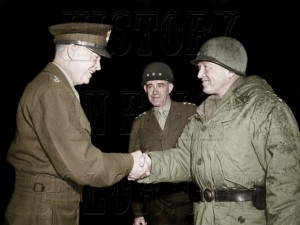
The end of the First World War brought a reduction in overall Army influence, but future influential leaders including George C. Marshall, Dwight D. Eisenhower, George Patton and many others were direct products of Root’s post-1903 reforms. These leaders fought the Second World War, and others again occupied significant roles in civilian government like General Leslie Groves who managed the Manhattan Project. The end of World War 2 should have brought about another reduction in Army strength and influence, but the emerging Cold War and the strong personalities of Marshall, Eisenhower, and other products of the Root Army War College had other ideas.

Eisenhower Patton
Eisenhower Patton Bradley

The Army targeted the Navy as unfairly hoarding resources in a “parochial” manner in order to gain its share of scarce financial resources at the beginning of the Cold War. One of the best ways to do this was to advocate for a unified “joint” military force with relatively co-equal branches under a supreme “generalissimo” of the U.S. armed forces. This is not surprising given the wartime experience of the post World War 2 U.S. Army leadership. Officers such as Marshall, Eisenhower, and Omar Bradley served primarily in the wartime European theater of operations where land and air warfare were the predominant modes of fighting. The “Battle of the Atlantic” against the German U-boat arm never fell under Eisenhower’s direct supervision. He and other Army officers respected the ability of naval forces to mount the Normandy invasion, but had little or no direct experience with naval combat. Postwar naval leaders such as Chester Nimitz, Forrest Sherman, and Arleigh Burke by contrast had experienced a relatively decentralized war in the Pacific. Nimitz and Army general Douglas MacArthur shared command authority and responsibility in a collaborative manner unlike the Army Chief of Staff system with one overall commander. As a result of this difference in leadership style and the fierce competition with the Navy and later the Air Force for funding, the Army enthusiastically adopted concepts of “joint” organization and control of the armed forces throughout the Cold War. Dwight Eisenhower as President tried to implement joint concepts of organization for the Department of Defense as a result of his war experience, but was thwarted in his efforts by key pro-Navy Congressional leaders.

Goldwater Jones
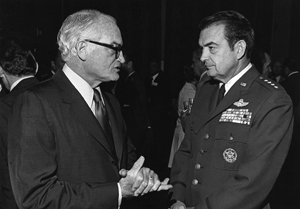
Senator Goldwater and CJCS General David Jones

The long and unsuccessful Vietnam War and end of the military draft in 1973 should have brought about a reduction in Army strength and influence, but the Army was again able to avoid large cuts by shifting to an all-volunteer force and refocusing on the European threat posed by the Soviet Union. Army leadership continued to advocate “joint” leadership of the U.S. Armed Forces in pursuit of desired force structure. The passage of the Goldwater Nichols Act of 1986 further cemented “joint” aspects of U.S. military strategy, policy and operations. The Gulf War of 1991 seemed to confirm that “joint” organization was crucial to U.S. military success. Building on triumph in that conflict, the Army was able to secure a significant force structure in the negotiations that produced the post-Cold War “base force” in 1994. The looming specter of a revanchist Russia, desire to enable a “New World Order”, as well as the continuing specter of Saddam Hussein’s armed forces convinced many decision-makers that there was continued value in a large expeditionary ground force. The Army found further relevance after the terrorist attacks of 9/11 and the subsequent ground invasions and counterinsurgency operations in Iraq and Afghanistan.

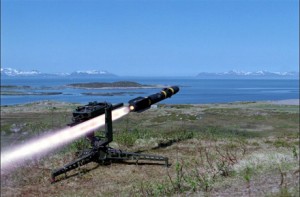
The Army’s success on the battlefield in the last 100 years, especially in more recent “joint” operations has been largely enabled by favorable geography. Combat in and around the Eurasian landmass in both World Wars, the Korean and Vietnam conflicts, and recent wars in the Persian Gulf and Southwest Asia all featured airfields within short range of hostile targets and an emphasis on the effects of land-based operations. The geography of future conflict however would seem to be shifting to largely maritime and air struggles in the Indo-Pacific basin. This region’s large maritime spaces offer few immediate venues for employment of land power as did the plains of Europe, the deserts of the Middle East and the highlands of the Hindu Kush in Afghanistan. The Air Force and Navy, rather than the Army, have the central role in Pacific strategy. The shrinking U.S. defense budget in response to national debt, trade deficits and massive new social welfare spending also works against the maintenance of continued Army force structure and influence. Without a defined mission in an essentially air and maritime battlespace, the Army has resorted to a kind of “me too” strategy advocating its ability to support the other services Pacific efforts through coastal defense, which ironically was one of the U.S. Army’s first missions in the new republic.

Hellfire-Missile-coastal-artillery

The Pacific Ocean, and the lands touched by its waves have always been of U.S. strategic interest. For the first time however since 1941 there is no comparable “land-based” strategic theater in competition with the Indo-Pacific region. The U.S. Army will likely have other expeditionary missions and conflicts in its future, and may again return to a level strategic influence like that it has possessed in the last 100 years. For the moment however, historians might be well served to give the present “Long Army Century” an endpoint in the early second decade of the 21st century.

Steve Wills is a retired surface warfare officer and a PhD student in military history at Ohio University. His focus areas are modern U.S. naval and military reorganization efforts and British naval strategy and policy from 1889-1941. He posts here at CIMSEC, sailorbob.com and at informationdissemination.org under the pen name of “Lazarus”.

Sea Control 34, Asia-Pacific: Game-Changers

seacontrol2This week, Sea Control Asia Pacific looks at ‘gamechangers’ in Asia. Natalie Sambhi, of the Australian Strategic Policy Institute, interviews her colleagues Dr Rod Lyon and Daniel Grant about the ways in which Asia Pacific states are engaged in strategic competition. We also offer an Australian perspective on domestic political changes and military modernization in Southeast Asia, China’s nine-dash line claims, Indonesia and non-alignment, and the US rebalanced.

DOWNLOAD – Sea Control 34: Asian Game Changers

Remember, subscribe on iTunes or Stitcher Stream Radio. Leave a comment and five stars!

Nordic NATO Nominees

Until recently, it was hard to imagine Sweden joining NATO. With long traditions of neutrality, Sweden and Finland had distanced themselves from the main military centers of Europe. The reason for neutrality is succinctly explained in the introduction to the book Navies in Northern Waters 1721-2000: “The present situation is a further illustration of the long-standing conflict between the legal and power-oriented approaches to disputes in the region,” with the Swedes and Finns aligned with the former. In 1994 Sweden joined Partnership for Peace (PfP) as a framework to cooperate with NATO. Still insisting on its place as a militarily non-aligned country, the Swedish Mission to NATO states that “by participating in PfP, Sweden wishes to contribute to the construction of a Euro-Atlantic structure for a safer and more secure Europe.”

Public Swedish support for joining NATO remained limited, with about 50% against as of mid-April, but supporters of this idea increased their share from 17% to 29% last year alone. In the same article we find important opinion of Finland’s Prime Minister Jyrki Katainen who said “that both Finland and Sweden should consider joining Nato when the time is right.” A small Finnish step in this direction is that this year the nation agreed to a Memorandum of Understanding with NATO, while Sweden and Finland are increasing military cooperation with each other under a landmark pact. So what caused both Nordic countries to begin reevaluate their positions? Prof. Mearsheimer in his book The Tragedy of Great Power Politics wrote:

When a state surveys its environment to determine which states pose a threat to its survival, it focuses mainly on the offensive capabilities of potential rival, not their intentions.

Living near mighty military power means that one lives in a state of permanent insecurity, so what one hopes for are benign intentions. The war in Georgia ignited doubt about one particular neighbor, but Ukraine has forced caution to give way to fear. If one can’t hide by flying “under the radar” of a big power, then what remains is to ally with another power. Appeasement doesn’t have a good track record during Europe’s last 100 years. But as Jan Joel Andersson explains in the Foreign Affairs article “Nordic NATO,” both countries need public buy-in for the solution before joining the Alliance. Although skeptical, Scandinavians seem to slowly appreciate this path and support for the idea is growing. The article lists good arguments, both political and military, for Sweden and Finland to join NATO from the Alliance’s perspective. In fact, this would be a geostrategic loss for Russia, greater probably than the gain of Crimea. From a purely military point of view, the following excerpt is critical for understanding the regional stability the additions would aid:

Even more important, Sweden and Finland’s formal inclusion in the alliance would finally allow NATO to treat the entire Arctic-Nordic-Baltic region as one integrated military-strategic area for defense planning and logistical purposes, which would make the alliance much more able to defend Estonia, Latvia, and Lithuania against Russia.

It’s worthwhile to take a look at a map, especially to highlight the maritime and naval aspects of this story.
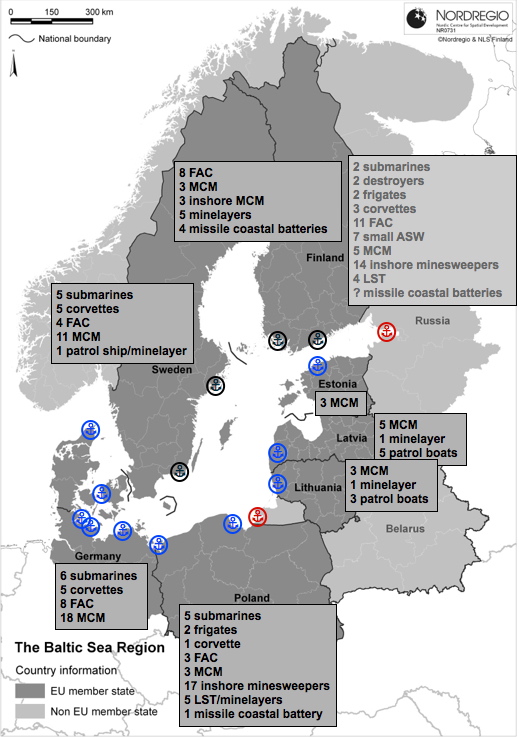
BalticInfographic_001

In the current situation, the Baltics represent a relatively narrow strip of land, lightly defended and not offering defense-in-depth. Any sustained reinforcements could come only from sea, which would require sea control. The main NATO naval forces would likely operate from bases in Germany and Swinoujscie in western Poland, as Gdynia and Klajpeda could be put at risk by ground operations. Although it would be possible to organize a successful blockade of any opposing naval forces using the Alliance advantage in submarines, light surface forces would have tough time overcoming land-based air forces and coastal batteries. Using Adm. J.C. Wylie’s terminology, the geography of the region strongly favors sequential warfare on land instead of cumulative naval warfare for which there would be no time assuming the desire to defend the Baltics.

Swedish access to NATO would alter these considerations significantly, bringing a few additional benefits to the more-realistic defense of the Baltics:

  • Norway would no longer be an “isolated” NATO member, as its depth of defense increases.
  • Baltic Sea control could be achieved and maintained by local navies with limited support from the United States.

There are two other aspects to consider, however. For Finland, Sweden’s joining NATO would only increase its isolation as the only neutral country in the region. The preference for a sequential land warfare strategy would expose Finland for greater risk. The situation would not be so different from that of the Black Sea. Therefore the best would be a common decision of both Sweden and Finland, even if it complicates matters.It is difficult to imagine synchronization of political willingness in such sensitive area, but growing cooperation between Nordic countries could be helpful. Nordic Defence Cooperation initiative, including Sweden, Finland, Norway, Denmark and Iceland, although mostly focused on military efficiency includes already mix of NATO and EU countries, and active participation of both Finland and Sweden with NATO lower technical barriers of access. The key point remains public support for such idea, but as it was mentioned already, such support and acceptance seems to slowly grow.
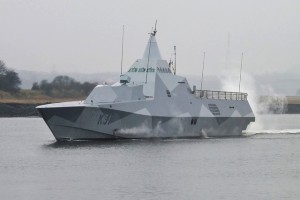
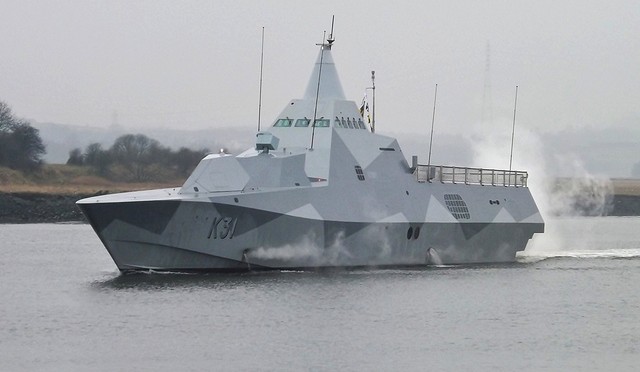
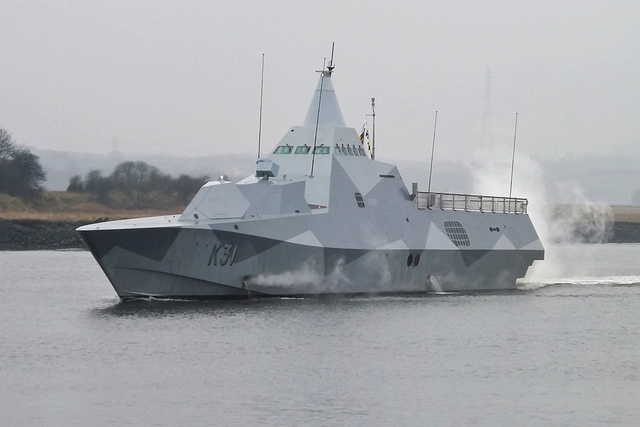
8643086211_cef286772e_zAnother issue is the opportunity to evaluate/reevaluate the concept of the U.S. Navy’s littoral combat ship (LCS) and/or its successor in the Baltic Sea security environment. Two different scenarios including Nordic countries offer very different operational possibilities. In today’s state of things, the LCS lacks offensive power of anti-ship cruise missile (ASCM). Meanwhile, pondering anti-air defense leads to the dilemma the best defined by Swedish designers of the Visby corvette – “invincible or invisible”. However, in the case of the Nordic countries belonging to NATO, LCS’s anti-submarine warfare (ASW) and mine counter-measure (MCM) capabilities would be very much appreciated. In the May issue of the U.S. Naval Institute’s Proceedings, Adm. Walter E. Carter offers some remarks on future forces in his article “Sea Power in the Precision-Missile Age:”

Based on the preceding analysis, it appears that the most significant forces for future warfare at sea include:

  • Platforms employing standoff ordinance that penetrate high-end defenses;
  • Platforms with an emphasis on offensive firepower to prevail at sea;
  • Mobile and low-observable platforms and logistics, readily dispersed, and heavily protected or hidden by decoys, obscurants, RF jammers, and signature control; and
  • Forces minimally reliant on RF networks to be employed against high-end opponents using pre-planned responses and low-data-rate, secure, and sporadic communications.

Conversely, less relevant forces of the future will include:

  • Those dependent on fixed bases;
  • Platforms within enemy missile ranges that have large signatures and are thus readily targetable;
  • Systems dependent upon long-distance, high-data-rate RF networks;
  • Platforms that must penetrate high-end defenses to deliver ordnance; and
  • Platforms whose primary means of survival rests on active defense (i.e. shooting missiles with missiles).

While this analysis seems to be a perfect description of Pacific scenarios, a narrow sea like the Baltic invites further elaboration as this environment offers little room for stand-off or escape from inference from shore based-capabilities. Striking an enemy’s shore would incentivize small, stealthy, and unmanned platforms, but keeping sea lines of communications open in the same area would be difficult without classic surface forces. So the question remains open as to how survivable these light surface forces would be in restricted waters. And in the case of submarines the weak point in narrow waters is still the naval base from which they operate.

Przemek Krajewski alias Viribus Unitis is a blogger In Poland. His area of interest is the context, purpose, and structure of navies – and promoting discussion on these subjects in his country.