Category Archives: Global Analysis

A Geographical Breakdown of What’s Going on in the World

Attrition, Maneuver, and Air Sea Battle

Since the development of the U.S. Department of Defense’s Air Sea Battle concept (ASB) became public knowledge, discussion of its merits has proliferated faster than you can say “multi-axis saturation attack by advanced precision-guided munitions.” (That’s still reasonably fast, I promise.) Many analysts have debated ASB’s implications for alliance politics, U.S. strategy, force structure, and crisis stability, among other topics. Several have proposed well-reasoned alternative concepts intended to address ASB’s limitations. Few, however, have asked whether or not ASB is likely to work at the operational level of war.

One tool available for addressing this question is military and naval theory. Though prominent in the debate surrounding doctrinal changes that led to AirLand Battle in the 1980s, theory has recently taken a back seat in discussion of Air Sea Battle. [1] Placing ASB in context in the realm of military thought enables us to examine the concept’s underlying logic. Theory isolates the key mechanisms of victory or defeat out of the mass of detail to be found in the history of warfare. In doing so, it provides a guide for how—not what—to think when developing operational concepts for application to specific present and future scenarios.

Good theory, grounded in history, is a point of reference. Where an operational concept or its key assumptions deviate from theory, developers should look to specific technological and tactical circumstances of the case to determine whether these deviations are appropriate. This permits informed decisions about departures made from what naval historian Julian S. Corbett termed the “beaten track” of successful precedent.

For example, any operational concept predicated on “dominant battlespace knowledge,” rather than Clausewitzian fog and friction, would receive special scrutiny from a theoretical perspective. Similarly, theory would cast doubt on concepts like Effects-Based Operations, which assume—contrary to historical evidence—that political will can be directly targeted by kinetic effects. In both cases, the validity of the concept would depend not whether it agreed with theory but on whether the unprecedented capabilities or causal relationships the concept required could be realized.

Two paradigms in military theory are attrition and maneuver. Like the wave and particle models of electromagnetic radiation, the applicability of each to a given situation depends on context. The context for ASB is the (re-)appearance of the anti-access/ area-denial (A2/AD) network (nee reconnaissance-strike complex) composed of a variety of weapons and sensors distributed over a wide geographic area, and linked together for mutual support. Specifically, ASB is intended to serve as a general guide to how a strike campaign against such an A2/AD network would be best conducted in order to secure U.S. maritime forces freedom to operate in the context of war.

Published accounts of ASB suggest the concept is all about attrition. That’s a good thing. This line of thinking emphasizes things that matter in maritime wars: minimizing operational risk and ensuring favorable combat-loss exchange ratios.

Open-source assessments of the capability of potential adversaries suggest that high-risk approaches associated with maneuver theory would be prohibitively costly. That ASB eschews this type of risk is grounds for confidence in the path the concept’s development is taking.

Attrition vs. Maneuver

Maneuver theory sees victory as the result of destroying the enemy’s cohesion. In this view, making decisions faster than the enemy allows friendly forces to seize and hold the initiative. Maneuver theory posits enemy dispositions composed of distinguishable strong and weak points. Separated from one another by time and space, these represent potential “non-cooperative centers of gravity.” Exploiting these weaknesses depends on “reconnaissance pull,” or the direction of attacks by organic reconnaissance assets, rather than higher command. Rapid, unpredictable attacks against enemy vulnerabilities produces psychological and organizational collapse, preventing effective cooperation between segments of the enemy force. [2] 

In contrast, attrition theory prescribes victory through the cumulative destruction of the enemy’s material strength. For attritionists, battle can further at least one of two ends—physically destroying the enemy’s fighting power, and breaking his will to resist. This school of thought emphasizes that one’s own military strength and political will are also at risk in battle. This produces a tactical focus, or a search for methods to maximize the adversary’s losses while minimizing one’s own.

Where maneuver looks to dispersion of forces to confuse and disorient the enemy, attrition tends to favor concentration for effectiveness. This view is reflected in the logic of the Lanchester Square Law: the more firepower massed against the enemy, the faster and cheaper the victory. 

At the heart of ASB is the “Networked, Integrated, Attack-In-Depth” to “Disrupt, Destroy, and Defeat” (NIA-D3) enemy A2/AD networks. NIA-D3 aims to win the “salvo competition” by attacking both the sensor and shooter components of A2/AD networks, reducing their effectiveness. On land, NIA-D3 targets integrated air defense systems (IADS), theater ballistic missile sites, command and control nodes, and long-range sensors. At sea, anti-submarine and anti-surface warfare efforts would destroy cruise missile-armed surface ships and submarines. In the air, tactical aircraft—initially operating from distant bases and aircraft carriers at standoff distance—would attack long-range airborne intelligence, surveillance and reconnaissance (ISR) platforms as well as enemy fighters and bombers.

What all these provisions have in common is a focus on maximizing tactical advantage in every battle, and ensuring U.S. forces take much less punishment than they deal out over an extended period of time. Although CSBA’s report identifies certain high-value targets—especially over-the-horizon targeting radar sites and command centers—neither the DoD or CSBA accounts of ASB envision causing the systemic collapse of a robust A2/AD network. ASB envisions the defeat of enemy A2/AD networks through cumulative erosion of their capabilities, not causing their sudden collapse by attacking their cohesion. 

Theory Meets Reality

Maneuver theory appears a poor guide to addressing A2/AD challenges. There are two reasons a maneuver-style campaign would be a poor choice. First, reconnaissance-strike complexes do not share the same vulnerabilities as adversaries organized along the lines of 20th-century conventional forces. Second, the decentralized command and control system required by maneuver theory would be unable to cope with the scale and interconnectedness of an advanced A2/AD network.

Central to maneuver theory is the proposition that rapid attacks against isolated points of weakness can disorient the enemy, causing the fragmentation and systemic breakdown of the ability to resist or counterattack. This assumption appears inapplicable to a sophisticated reconnaissance-strike complex like that visualized in open-source accounts of ASB.

The imperative of decision speed requires the decentralization of command authority through “mission-type” or “objective” orders. Maneuver advocates admit that this “inherently results in diffuse operations.” [3]

First, the inherent and self-imposed ISR limits of maneuver forces will require them to accept greater losses in searching for appropriate targets. Second, capable adversaries will concentrate defenses around key A2/AD network nodes. Third, the nature of a theater-sized reconnaissance-strike complex—a network characterized by the mutual support and redundancy of many components–suggests that its wholesale collapse would be difficult to achieve.

Decentralized control is integral to maneuver concepts, which require tactical commanders to discover enemy weaknesses by reconnaissance pull. The limited view provided by tactical ISR, however, will be insufficient for attacks on dispersed reconnaissance-strike complexes. Tactical ISR platforms would soon become priority targets for a capable adversary defending itself against a maneuver-style operation. Only higher echelons seem likely to have the resources to form and support the comprehensive “picture” of a theater-sized battlespace. Given the complexity and dispersal of integrated air defense systems (IADS), among other high-value military targets, such a picture seems necessary for adequate battle damage assessment.

In searching for weakness, a maneuver-inspired operational concept would run into strength. As amply demonstrated in the course of Operations ALLIED FORCE and DESERT STORM, IADS components and missile launchers can exploit terrain, mobility, and controlled emissions, making such searches time-consuming. [4] To minimize the risk advanced surface-to-air and anti-ship cruise missiles pose to the tactical aircraft and surface combatants that shoulder much of the strike mission, the time available for future Scud Hunts will be necessarily reduced.

Against continental adversaries with the ability to exploit buried fiber-optic communications, generating “non-cooperative centers of gravity” seems a tall order. It seems likely that capable adversaries will guard key nodes in reconnaissance-strike complexes—long-range sensors and C2 sites—reducing the possibility that surprise could compensate for dispersion in securing a favorable outcome in a given engagement.

Battle networks are designed for mutual support between their component systems. One example is the typical integrated air defense system (IADS). In such systems, the vulnerabilities of long-range tracking radar to low-altitude threats are mitigated by short-range radar and anti-air artillery systems placed to guard against such approaches. 

So if ASB is an attrition concept, and an attrition mindset is the right one to deal with A2/AD challenges, is ASB in keeping with the precedent of previously successful attrition campaigns? While no definitive answer is possible, there are reasons for confidence on this score. Successful attrition campaigns of the past, such as U.S. Army GEN Matthew Ridgway’s “limited objective attacks” in the Korean War, have consistently maintained a focus on minimizing losses as the best way to deliver the maximum damage over time.[5]  

In naval warfare, purely tactical advantages—tactical surprise and the concentration of firepower— have produced favorable loss-exchange ratios. [6] The cumulative destruction of Imperial Japan’s fleet played a central role in inducing that country’s surrender. It did so through the effects of defeat on Japan’s national leadership as well as indirectly through permitting the capture of the Marianas as forward air bases for a strategic bombing campaign. [7]

For generations of military leaders and analysts reared on tales of World War I’s Western Front and U.S. Army GEN William Westmoreland’s search-and-destroy operations in Vietnam, “attrition” may be something of a dirty word. Yet it appears an attrition mindset—that appearing in ASB—is the right one for tackling advanced A2/AD networks.

Critics argue that ASB is not a useful concept because it emphasizes the erosion of the enemy’s conventional forces and largely ignores questions of escalation and political will. [8]

Yet—unfashionable though it might be to say—killing people and breaking stuff can pay political dividends. The increased cost and length of time required to acquire major platforms and weapons systems suggests their importance as a source of strategic leverage has also grown. If potential adversaries cannot fight a conventional conflict without confronting the likelihood of losing, rather than gaining, military strength relative to the United States and its allies, a potential threat to stability will recede. ASB may yet play a role in bringing about this favorable scenario.

ENS Adam Humayun is a graduate of The George Washington University’s Elliott School of International Affairs and has completed coursework at Georgetown University’s Security Studies Program. The views and opinions expressed in this article are the author’s alone and do not represent those of the U.S. Navy, the Department of Defense, or the U.S. Government.

[1] Edward N. Luttwak, “The Operational Level of War,” International Security vol. 5 no. 3 (Winter 1980-1981): 61-79; Edward N. Luttwak, “Attrition, Relational Maneuver, and the Military Balance,” International Security vol. 8 no. 2 (Autumn 1983): 176-179; John J. Mearsheimer, “Maneuver, Mobile Defense, and the NATO Central Front,” International Security vol. 6 no. 3 (Winter 1981-1982): 104-122.

[2] William S. Lind, Maneuver Warfare Handbook (Boulder, CO: Westview Press, 1985 (5-6). See also Boyd’s Patterns of Conflict presentation (hyperlinked in paragraph).

[3] Robert R. Leonhard, “Maneuver Warfare and the U.S. Army,” in Richard D. Hooker, ed. Maneuver Warfare: An Anthology (Novato, CA: Presidio Press, 1993), 42-56 (45).

[4] Arend G. Westra, “Radar Versus Stealth: Passive Radar and the Future of U.S. Military Power,” Joint Force Quarterly no. 55 (October 2009): 136-143; Benjamin S. Lambeth, “Reflections on the Balkan Air Wars,” Air Power History, Spring 2010: 31-43.

[5] Carter Malkasian, “Towards a Better Understanding of Attrition: The Korean and Vietnam Wars,” Journal of Military History vol. 68 no. 3: 911-942 (918-928, 939).

[6] Wayne P. Hughes, Jr. Fleet Tactics and Coastal Combat (Annapolis, MD: Naval Institute Press, 2000) 40-44, 193-202.

[7] Robert A. Pape, “Why Japan Surrendered,” International Security vol. 18 no. 2 (Fall 1993): 154-201.

[8] See among others Thomas P.M. Barnett, “Big-War Thinking in a Small-War Era: The Rise of the Air-Sea Battle Concept,” China Security vol. 6 no. 3 (8-9).


Jokowi and the Defence Realm

This was first posted by our good friend Natalie Sambhi at “The Strategist” ASPI Blog.

No doubt by now most Australian readers would have heard that the popular Jakarta governor, Joko Widodo, also known as ‘Jokowi’, is the frontrunner for Indonesia’s upcoming presidential election. His meteoric rise from humble furniture entrepreneur in Solo to what could be the Presidential Palace is best explained simply by his genuine push for effective governance and a crackdown on corruption as well as his grassroots, ‘Mr Fix-it’ image. In short, he’s riding an Obama-like wave of hope and change in Indonesia—most importantly, hope that change is possible and that politics need not be dominated by stale and self-serving elites.

Nearly 32% of Indonesians recently polled by CSIS Jakarta have thrown their support behind Jokowi (Prabowo, the next preferred candidate, trails behind with 14.3%). While it’s not a fait accompli, it’s time to consider what a Jokowi administration might look like. How Indonesia views its strategic environment and how it chooses to manage its diplomatic relations is of great interest to Australia. As the past six months have shown, diplomatic disruptions to the relationship, for one, could harm our defence and security cooperation.

9013009998_a74da2e6ff_zWithout making predictions about who’ll fill a Jokowi cabinet, it’s fair to say there’ll be a period of settling in after the elections. As Gary Hogan points out, ‘If the new Indonesian president is allowed to form a cabinet of clean, capable, technocratic ministers, able to implement sensible fiscal and economic policy, the stake of Australian business in Indonesia’s future looks promising’. The same roughly applies to those who fill the roles of defence minister and coordinating minister for political, legal and security affairs. As always, people matter.

Looking to the bigger strategic picture, Jokowi will have to contend with challenges posed by the increasingly complex relationship between China and ASEAN states, exacerbated by a raft of territorial disputes. For its part, after years of maintaining its neutrality, Indonesia formally announced in early March its own dispute with China’s claim over parts of its territory in the South China Sea. As Ann Marie Murphy notes in today’s PacNet newsletter, this is ‘likely to heighten tensions on an issue that is already fraught with them’. Indonesia will have to work harder to maintain regional stability—and in an environment less conducive to the norms of peaceful settlement of disputes and non-interference from external actors. Jokowi has dipped his toe into ASEAN matters hosting a meeting with governors and mayors of ASEAN capital cities, but it’s not the same as strong Indonesian leadership of ASEAN in the face of a more provocative China.

And that’s where a good VP will help. An experienced hand will help bolster what Jokowi lacks in foreign policy street cred. So far, the serious talk has been of former Vice President to SBY, Jusuf Kalla (who also served in Megawati’s cabinet), running with Jokowi. Kalla’s proven credentials in conflict resolution would be of value: he helped solve inter-religious violence in Sulawesi in 2001 and steered Aceh’s rehabilitation after the 2004 tsunami. Of all potential VP candidates, Kalla can best ease Jokowi into the realm of international politics. The same goes for having a vibrant and experienced foreign minister.

In terms of defence policy, many of the current drivers for Indonesia’s military modernisation—including a focus on maintaining territorial sovereignty and protecting its EEZ—will continue to shape decision-making during a Jokowi term in office. Defence spending will largely depend on economic performance, so we’ll have to see how the Indonesian economy fares first under the new administration before we can expect announcements to increase the defence budget. TNI’s modernisation program aims to develop a ‘Minimum Essential Force’ (MEF) by 2024 which entails major upgrades of naval, land and air capabilities as well as the development of a local defence industry. While many of those developments were driven by SBY, some have made their way into legislation, which a new president might find hard to alter. Indonesia also has a number of capability development projects and acquisition deals on the go with partner countries. Defence officials recently announced that the first batch of F-16 Fighting Falcon fighter jets as part of a US grant are due to arrive in country in October.

Turning finally to how Jokowi will deal with the military itself, there’s been some chatter about current TNI chief General Moeldoko as Jokowi’s running mate. But most opinion polls suggest the public would oppose such a degree of military involvement in politics. Irrespective of historical preferences for a ‘strong man’, Indonesians have indicated that a civilian is up to the top job. At a time when anti-corruption and clean governance are the dominant political flavours, Moeldoko has made all the right noises about reform and professionalism. Hopefully this translates into a continuation of Indonesia’s reformasi project.

For Australia, a changing of the presidential guard is an opportunity to rebuild the defence and security relationship. It’s not possible that all military exercises suspended by SBY last year will automatically and immediately resume. But a few encouraging initiatives—both from Canberra and Jakarta—early in a new administration would provide positive signs for the future. In strategic terms, with growing ambiguity in Indonesia–China relations over territory, it’s timely and appropriate for Australia and other partners to warm the relationship with Jakarta.

Natalie Sambhi is an analyst at ASPI and editor of The Strategist. Image courtesy of Flickr user US Embassy, Jakarta.

NATO’s Pivot to Russia: Cold War 2.0 at Sea?

Putin’s annexation of the Crimea shifts NATO’s focus back to Europe. Therefrom, maritime security’s relevance for the Alliance will suffer. Nevertheless, Russia’s new assertiveness has massive impact on NATO’s maritime priorities. Other than expeditionary missions, European homewaters are now the theaters of concern.


All Opportunities Gone


After the Cold War, NATO was never threatening Russia, but rather sent dozens of cooperation offers to Moscow. Moreover, if Russia would sincerely have seeked NATO membership, Putin would fly to NATO’s September Summit. However, in NATO, Russia would never have been eye-on-eye with the US, but rather would have found itself on a level with Germany, France and the UK. Thus, Russia would never have found the global prestige and geopolitical influence it was looking for. That is the real reason why Russia never joined the Alliance. Since 1991, there were many opportunities for naval cooperation between NATO and Russia.

In Partnership for Peace (since 1994) and the NATO-Russia Council (since 2002), the Alliance reached out to Moscow, aiming to work closer together at sea. Positively, some of these opportunities turned into reality. NATO and Russia were working together in the Mediterranean (Med’) in Operation Active Endeavour to combat terrorism and in the Indian Ocean to combat piracy. Moreover, the planned, but cancelled joint naval mission to protect the destruction of Syria’s chemical weapons has shown the potential for increased cooperation. However, with the annexation of the Crimea, these opportunities ceased to exist.

Step up Black Sea Presence

Ukraine has no significant navy anymore. Instead, Ukraine’s warships were taken over by Russia, which makes Moscow’s navy, by numbers, larger than the US Navy. However, due to the warships’ poor quality, this increase in naval power does not present a game changer. Surely, a plus for Putin’s navy is that Sevastopol will remain a Russian naval base for decades.

Black Sea (Source: Wikipedia Commons)

After Sevastopol is lost, Ukraine’s only significant port left is Odessa. NATO’s response should be to support Ukraine in keeping at least a small navy. Moreover, NATO should give a guarantee that, in case of further Russian aggression, Ukrainian ships can find shelter in Romania, Bulgaria, Turkey or Greece. In addition, SNMGs and SNMCMGs should pay regular visits to Odessa; on the one hand for partnership with Ukraine and on the other hand as show of force to Russia. Trips to Georgia should go along.

Like it or not – The Bosporus has become a bargaining chip. NATO should make contingency plans how to close the Bosporus for Russian warships, should Russia invade Eastern Ukraine or Moldova. NATO must make clear to Russia that a price to pay for further annexation of territories would the loss of access through the Bosporus.France, Please Cancel the Mistral Deal

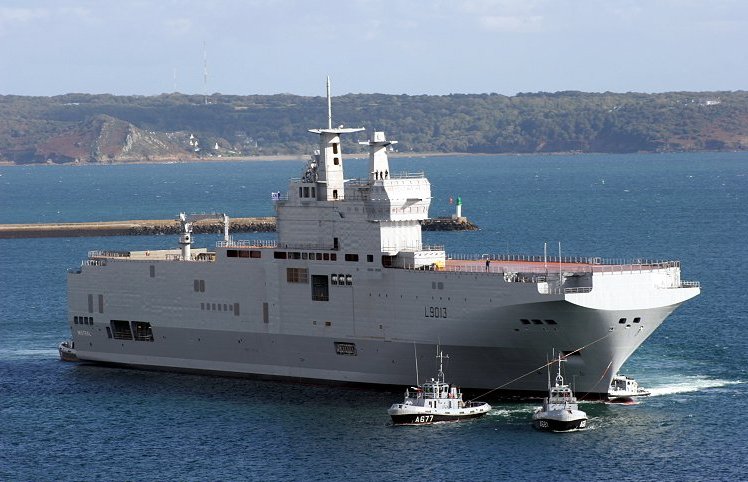
French Mistral LHD. (Source: Wikipedia Commons)

Russia could have done military campaigns like Georgia 2008 or Crimea 2014 much easier with one of the Mistrals. One of these LHD would also be useful for Russia’s navy in campaigns against Moldova, with regard to Gagauzia and Transnistria, or even against Estonia, because the Mistrals can serve as a platform for command and control, attack helicopters and landing troops.

That Russia announced to base its Mistrals in the Pacific does not mean that they will operate there. For its Syria show-of-force, Russia deployed warships from its Pacific Fleet to the Med’.

Regarding the military balance in Europe, France would do its allies a disservice, if it would deliver the Mistrals to Putin. Instead, these vessels should remain either in Europe or in a like-minded country. Options where to sell the ships could be South Korea, Japan, Singapore, Brazil, Turkey, South Africa or India; countries, which are looking for new LHD.


An even better idea comes from Jeff Lightfoot. He argues that “NATO should buy the Mistrals“. Like AWACS and AGS, the Mistrals could become a shared NATO asset. Although I fully support Lightfoot’s arguments for a NATO-nization of the Mistrals, I disagree with him about how to do that. After NRF and EU-Battlegroups failed, NATO’s Standing Maritime Groups are the only multinational units with combat capabilities, which ever really worked. Moreover, Europe was carrying most of the burdens in the SNMG, which face a serious of lack amphibious capabilities. Thus, the Mistral purchase should be mostly funded by the Europeans. Germany, Norway, the Netherlands, Denmark, Poland and Belgium could go for “NATO Mistral 1”, while the US, Canada, Spain, Italy, Portugal and Turkey could go for “NATO Mistral 2”. A NATO LHD in the Baltic or Black Sea would send clear message to Russia. Deployments to the Med’ or Indian Ocean would help to pursue Western maritime interests.
Sustain Superiority in the Baltic and the Med
Baltic Sea (Source: Wikipedia Commons)

With the entry of the Baltic Countries and Poland into NATO and EU, the Baltic Sea was a solely political issue, not worth military considerations. This has changed, too. However, this does not mean that we are on the brink of war. Nevertheless, NATO needs to make plans how to deter Russia from threatening the Baltic Countries from the sea. The Alliance must make sure that its naval superiority in Baltic remains clear. Deploying an SNMCMG to the Baltic and regular naval exercises, such as BALTOPS (non-NATO), are efforts worth doing. Moreover, Sweden and Finland should join NATO. Both countries would bring great contributions to NATO and their membership would even increase Russia’s isolation in the Baltic Sea.

Russia is no partner for cooperation in the Med’ anymore. Beside the consequences of Crimea, Russia’s show-of-force in the Eastern Med to cover Syria made clear that Putin is willing to use naval power in missions targeted against Western interests. In consequence, the Europeans have to prevent – politically – that Russia opens new naval bases in the Med’, for example in Cyprus or Egypt. EU member Cyprus must receive the clear message from Brussels that a Russian base on Cyrus is unacceptable. In addition, NATO should closely monitor all Russian naval activities in the Med’ and make plans about how to deal with them in case of further Russian aggression. Moreover, NATO states should close their ports for Russian ships to be replenished.
We Need Nuclear Deterrence
Ohio-Class SSBN, US Navy (Source: Wikipedia Commons)
Besides guaranteeing NATO’s future, Putin’s Crimea annexation also ends the American and British debates about the need for a sea-based nuclear deterrent. The argument for retiring the SSBN was that state-to-state conflict was unlikely and, therefore, nuclear deterrence was outdated. However, sea-based nuclear deterrence provides the minimum of global stability we need to prevent devastating state-to-state conflict. Where could the conflict with Russia go, if global zero was reality? What would prevent Putin from sending Russian tanks through Tallinn via Riga to Vilnius? Surely not statements from Berlin to keep the diplomatic hotlines open.

No matter about the massive unpopularity – Europe will need the nuclear umbrella provided by the US, UK and France. We are not yet back in the pre-1989 times. There is not yet a Cold War 2.0 at sea. However, if we forget the lessons learned of nuclear and conventional deterrence, we may find ourselves in exactly these situations much sooner than we think.

NATO-Building Starts at Home

NATO’s pivot to Russia will shift attention away from the maritime domain back to the continent. Armies and air forces will receive, once again, much more attention than navies. While Putin’s aggression increased the importance of NATO for its member states, maritime security’s relevance for member states and, therefore, for the Alliance will decrease. In consequence, theaters like the Persian Gulf and the Indian Ocean will become of much less concern for NATO.

In case the Crimea Crisis did not happen, NATO, to sustain its relevance, would probably have looked for new maritime tasks in the Med’, Gulf of Guinea and the Indian Ocean, maybe even in Southeast Asia. However, thanks to Putin, we will find NATO’s warships deployed back in the Baltic and the Black Sea. Given Operation Ocean Shield ends this year, we will not see NATO back in the Indian Ocean very soon; except maybe for a few friendly port visits. After Crimea and with Putin’s hands on Eastern Ukraine and Moldova, NATO’s debates about partners across the globe and global alliance are finally dead.

In response to Putin, NATO-building begins at home. We need NATO’s Public Diplomacy Division, fully focused on the Alliance’s core business, reaching out to the member states’ ordinary taxpayers. The changing European security environment requires an emphasis on the big messages: Defense, deterrence and security. Thus, zeitgeist-motivated campaigns should be stopped. In these times, NATO must tell the people what armies, air forces really are for and how our soldiers serve their countries and our Alliance.

Felix Seidler is a fellow at the Institute for Security Policy, University of Kiel, Germany, and runs the site Seidlers-Sicherheitspolitik.net (Seidler’s Security Policy).

Follow Felix on Twitter: @SeidersSiPo

100 Years Ago: Veracruz 1914 (Part 3)

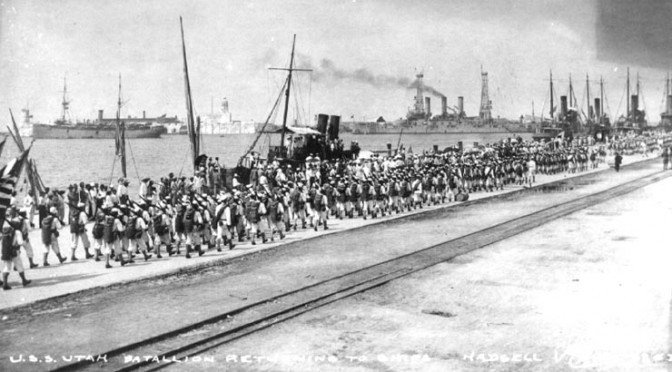
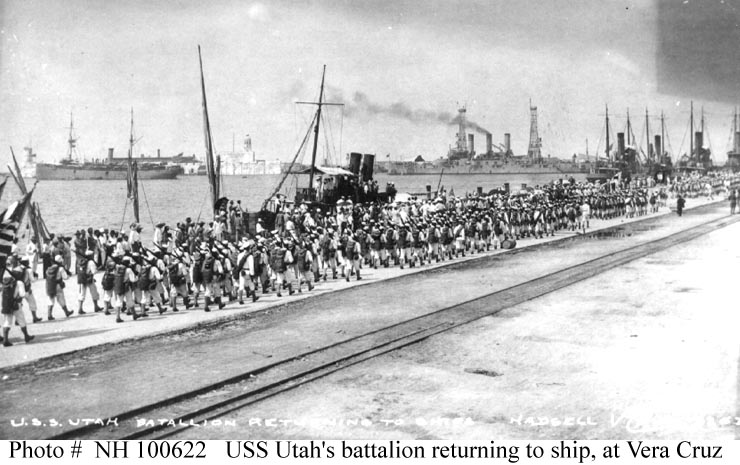
Sailors Returning to their Ships After Combat Ashore in Veracruz (Naval Historical and Heritage Command)

This is the third of a three part series on the American occupation of Veracuz in 1914. The first and second installments can be found here and here.

24 April marked the end of the combat phase of the U.S. invasion of Veracruz, with the “ABC Powers” of Argentina, Brazil, and Chile offering to mediate between the U.S. and Mexico.  President Wilson agreed to participate in these talks and ordered the troops ashore to refrain from offensive operations.

The negotiations proceeded to drag on even though one of Wilson’s original objectives behind the operation was was met in July when Mexican President Victoriano Huerta resigned.  However, negotiations with Venustiano Carranza, the head of the Constitutionalist opposition to Huerta who then took power, proved to be not particularly fruitful either, with the parties only coming to a satisfactory agreement for the withdrawal of American troops in November.

Of note, the other main reason for the invasion, preventing the delivery of the weapons onboard Ypiranga to Huerta’s army, was never achieved and did not matter regardless, as they were eventually delivered (the Americans let the ship leave Veracruz in early May and deliver its cargo at Puerto Mexico), but Huerta resigned before they could have any impact on helping the Army keep him in power. 

Probably the main reason why some history buffs know about Veracruz is the number of medals awarded to the participants, including men like Smedley Butler and John McCloy who each earned one of their two Medals of Honor there.  Members of the sea services earned fifty-five Medals of Honor for heroism or service during the four days of fighting.  One reason for that high number was that Veracruz was the first action in which Navy or Marine officers were eligible for the award.  Butler was embarrassed by his, stating in his biography that

“I received one, but I returned it to the Navy Department with the statement that I had done nothing which entitled me to this supreme decoration.  The correspondence was referred to Admiral Fletcher, who insisted that I certainly deserved the decoration.  The Navy Department sent the medal back to me with the order that I should not only keep it this time, but wear it also.”

Another frequently told anecdote has an admiral conducting an inspection in the 1920s, who upon seeing the medal on the chest of a man that had earned it in the First World War exclaimed “Holy smoke! Here’s a Medal of Honor that’s not for Veracruz!”

The U.S. Navy and Marine Corps both learned some lessons from Veracruz.  It marked Naval aviation’s first involvement in anything resembling combat.  It also marked one of the last instances that ship’s company sailors fought ashore as infantry, something that had been relatively common up to that time, with U.S. sailors having recently fought ashore in Latin America, Hawaii, Korea, Samoa, China, and the Philippines.  As for the Marine Corps, the 3,000 Marines eventually assembled and sent ashore was “the largest concentration of Marines in the history of the Corps, to date.”

While U.S. memories of Veracruz are almost non-existent today, it had a massive and lasting impact on Mexican attitudes towards its northern neighbor. In Jack Sweetman’s the Landing at Veracruz: 1914, he describes the occupation as “a kind of Caribbean Pearl Harbor.”  Even the Constitutionalists fighting against Huerta opposed U.S. military intervention in Mexican affairs, with Pancho Villa the only leading figure in Mexican politics who did not oppose the U.S. landing, ironic in light of him being the main target of another U.S. invasion a few years later.  Just as the niños heroiques of 1847 entered the pantheon of national heroes, martyred defenders of the Naval Academy like Cadet Virgilio Uribe and Lieutenant Luis Felipe José Azueta are remembered to this day.  A new adjective was added to the title of the Naval Academy, now known as the Heroica Escuela Naval Militar in honor of the cadets’ resistance to the norteamericano invasion.  This year the Mexican Navy is participating in a months-long series of events to mark the centenary of an event that the service actually played little part in.

Whether or not the Veracruz operation was a success is difficult to determine. Huerta was forced from office, but one would be hard pressed to prove that the American attack against Veracruz caused his removal.  It did not end the Civil War, with Mexico undergoing several more years (or decades, depending on when one believes that the Civil War actually ended) of chaos and violence.  A prominent event in Mexican history, it remains mostly a source of obscure service lore to Americans.

Lieutenant Commander Mark Munson is a Naval Intelligence officer currently serving on the OPNAV staff. He has previously served at Naval Special Warfare Group FOUR, the Office of Naval Intelligence, and onboard USS Essex (LHD 2).  The views expressed are solely those of the author and do not reflect the official viewpoints or policies of the Department of Defense or the US Government.