Category Archives: Current Operations

On-going Naval Ops or Maritime Current Events

Taming the East Asian Naval Race

Note: This article was originally published in its original form in the Naval Institute’s blog and was cross-posted by permission.

On August 6th,CIMSEC ran a feature on the latest Japanese helicopter destroyer, the Izumo (DDH-183). CIMSEC contributor Miha Hribernik observed that the Izumo, which is supposedly capable of carrying an aviation squadron and boasts a 814 feet-long (248 meters) STOBAR (short take-off but arrested recovery) flight deck, is “sure to cause concern in China…[since the launching of the ship] presents a potent addition to the operational capabilities and strategic reach of the JMSDF.”

22ddh-compAccording to Business Insider, the helicopter destroyer “came in” shortly after China’s recent statement that it is in “no rush [to sign the proposed Code of Conduct] since [Southeast Asian nations involved] harbor unrealistic expectations.” Japan’s territorial row involving Diaoyu/Senkaku coupled with threats emanating from the DPRK (Democratic Republic of Korea) might have triggered increased defense spending. However, the two aims of Japan’s burgeoning defense spending, pre-emptive strike capabilities and the creation of an amphibious assault unit similar to the United States Marine Corps, have made its East Asian neighbors uneasy. As for America’s reaction, Zachary Keck believes that while it is “unclear” how the Obama Administration will respond to Japan’s pre-emptive attack on its “adversary’s bases,” the Obama Administration could become “vocal” should Japan act upon its “threats to review [its] past apologies.”
Japan's Prime Minister Shinzo Abe poses inside the cockpit of a T-4 training jet plane of the Japan Air Self-Defense Force's (JASDF) Blue Impulse flight team at the JASDF base in Higashimatsushima, Miyagi prefecture, in this photo taken by Kyodo May 12, 2013 and released on May 16, 2013. Mandatory Credit REUTERS/Kyodo

In light of the fact that the ROK (Republic of Korea)China and Japan are seeking to boost their naval capabilities in recent years, some now fear that East Asian countries may have entered into a “regional naval competition.” One explanation for the naval race, as recent territorial rows and controversies over Japan’s wartime atrocities demonstrate, is that the ongoing tension in East Asia remains rooted in historical grievances. Osaka mayor Toru Hashimoto’s remark in May that wartime brothels were “necessary…to maintain military discipline” coupled with the photo of Shinzo Abe inside the cockpit of a T-4 trainer with thenumber 731 stenciled on its fuselage seemed to evoke among the Chinese and Koreans memories of  Japan’s imperial aggression during the Pacific War. Indeed, Japan’s seemingly strident militarist overtone may have worsenedthe extant historical enmity among the three major East Asian countries.

To the historical grievances must be added another dimension—the fierce competition for energy resources. According to the National Geographic, “how much oil and natural gas is at stake, in either the South China or the East China Sea, is unclear [since] territorial disputes have prevented any reliable survey.” Nonetheless, each country’s efforts to “guarantee access to resources” will indubitably enhance its ability to “to shape international events according to a new definition of self-interest, one matching [the country’s] status.” As regards the territorial row over Dokdo/Takeshima, some aver that contradictory claims are based on “sequence of centuries-old records and half-told versions of more recent history.” To the extent that natural resources may be concerned, the Dokdo/Takeshima islets, although “poor in fresh water necessary to sustain human life,” are “abundant in fish.” Furthermore, the island is said to “contain natural gas reserves estimated at 600 million tons.” It can be argued, therefore, that in the Dokdo/Takeshima dispute, as with that of Senkaku/Diaoyu, energy security will retain “great salience” in the years, if not decades, to come.

However, one major factor that may explain the exacerbating the East Asian arms race is the recent sequestration cuts within the Department of Defense which may make it more difficult for the United States to “manage its alliances and strategic partnerships in the region.”  Keck argues that a new geostrategic environment whereby the United States increasingly desires to see its East Asian allies “shoulder more of the burden for regional security” may the create the perception that the United States presence in the region has diminished despite its commitment to the “pivot to Asia” strategy.

Nevertheless, it is unlikely that peace in the region can be successfully maintained without the continued American presence in the region. While it may be true that “rational trust-building” diplomatic measures among East Asian states may somewhat temper the extant tension in East Asia, at present, the basis for mutual trust among East Asian states remains flimsy at best. For this reason, the United States must learn to “lead from behind” in East Asia by demonstrating its diplomatic prowess. To that end, the United States must seek cooperation with China in order to achieve stability on the Korean peninsula and to temper the tension over Senkaku/Diaoyu. With respect to Japan and the ROK, the United States can work to defuse tension over the competing claims to the Dokdo/Takeshima islets. One way in which the United States can defuse the naval race would be to help form a combined fleet whereby the United States Navy, together with its sister East Asian navies, “may share their unique resources and cultures to develop flexible responses against future threats.”

In short,  the ongoing naval race, as represented through the launching of the Izumo, is an outcome of deep-seated historical enmity and rivalries over increasingly scarce energy resources. While some may dismiss the possibility of a regional war, slight miscalculation among East Asian state actors may indeed spiral out of control and lead to a lethal war.

Notwithstanding the substantive defense budget cuts which could hamper flexible strategic responses, the United States nevertheless has a role to play to ensure peace in East Asia. “Leading from behind” to tame the ongoing East Asian naval race just may be the most cost effective way in which to exercise influence in the region.

Jeong Lee is a freelance writer and is also a Contributing Analyst for Wikistrat’s Asia-Pacific Desk. Lee’s writings on US defense and foreign policy issues and inter-Korean affairs have appeared on various online publications including East Asia Forum, the Georgetown Journal of International Affairs, the World Outline and CIMSEC’s NextWar blog.

______________

NOTE: In a follow-up article entitled “More Than Meets the Eye in Asian Naval Race” published at RealClearDefense, I argue that the naval competition among the three East Asian countries is driven by each country’s desire to look after its own self-interests and not necessarily by desire for imperial expansion.

A Post-Sequestration Blueprint for a Leaner and Smarter Military

Five months after the much-dreaded sequestration went into effect, many defense analysts and military officials alike are worried about the negative repercussions of the drastic budget cuts on military readiness. In his latest commentary, the rightwing commentator Alan Caruba declared that “The U.S. military is on life support.” Defense Secretary Chuck Hagel also argued in his Statement on Strategic Choices and Management Review (SCMR) that “sequester-level cuts would ‘break’ some parts of the strategy, no matter how the cuts were made [since] our military options and flexibility will be severely constrained.”

Secretary of Defense Chuck Hagel answers reporters' questions during a Pentagon press briefing on the recent Strategic Choices. Navy Adm. James A. Winnefeld Jr., right, vice chairman of the Joint Chiefs of Staff, joined Hagel for the briefing. (DOD photo by Glenn Fawcett)
Secretary of Defense Chuck Hagel answers reporters’ questions during a Pentagon press briefing on the recent Strategic Choices. Navy Adm. James A. Winnefeld Jr., right, vice chairman of the Joint Chiefs of Staff, joined Hagel for the briefing. (DOD photo by Glenn Fawcett)

To its credit, the SCMR seemed to hint at operational and structural adjustments underway by offering two options—trading “size for high-end capacity” versus trading modernization plans “for a larger force better able to project power.” Nevertheless, one important question which went unasked was whether or not the US Armed Forces alone should continue to play GloboCop.

The current geostrategic environment has become fluid and fraught with uncertainties. As Zhang Yunan avers, China as a “moderate revisionist” will not likely replace the United States as the undisputed global champion due to myriad factors. As for the United States, in the aftermath of a decade-long war on terror and the ongoing recession, we can no longer say with certainty that the United States will still retain its unipolar hegemony in the years or decades to come.

That said, Secretary Hagel is correct that the United States military may need to become leaner in the face of harsh fiscal realities. To this must be added another imperative: The US Armed Forces must fight smarter and must do so in ways that may further America’s strategic and commercial interests abroad.

So how can the United States military fight smarter and leaner?

COCOMs
Possible Combatant Command Realignments

First, given massive troop reductions whereby the Army personnel may be reduced to 380,000 and the Marine Corps “would bottom out at 150,000,” while at the same, the DoD is seriously considering restructuring existing Combatant Commands (COCOMs), it no longer makes sense to deploy or train troops for protracted counterinsurgency campaigns or foreign occupations. Instead, should another transnational terrorist group or a rogue state threaten homeland security, the United States could rely on SOF (Special Operations Forces) commandos and UAV (Unmanned Aerial Vehicles) to selectively target and neutralize potential threats. While the SOF and UAV surgical raids should not be viewed as substitutes for deft diplomacy, they can provide cheaper and selective power projection capabilities.

Second, since the United States Navy may be forced to “reduce the number of carrier strike groups from 11 to 8 or 9,” it can meet its power projection needs by encouraging cooperation among its sister navies and by bolstering their naval might. One example of such partnerships would be to form a combined fleet whereby America’s sister navies “may share their unique resources and cultures to develop flexible responses against future threats” posed by our adversaries.

Third, the United States may encounter more asymmetric threats in the form of cyber attacks, CBRN (Chemical, Biological, Radiation, Nuclear) attacks, and may also be subjected to attacks from within by homegrown terrorists and drug cartels—all of which may wreak havoc and may even cripple America’s domestic infrastructures. As retired Admiral James Stavridis argues, such asymmetric attacks may stem from convergence of the global community. Such threats require that the United States take the fight to its adversaries by cooperating with its allies to “upend threat financing” and by strengthening its cyber capabilities.

Fourth, where rogue states such as Iran, Syria and North Korea, are concerned, the United States could implement what General James Mattis refers to as the “proxy strategy.” Under this arrangement, while “America’s general visibility would decline,” its allies and proxies would police the trouble spots on its behalf.

Fifth, the United States must be prepared to defend homeland against potential missile attacks from afar. The United States may be vulnerable to hostile aggressions from afar following North Korea’s successful testing of its long-range rocket last December and Iran’s improved missile capabilities. Thus, improving its missile defense system will allow greater flexibility in America’s strategic responses both at home and abroad.

Last but not least, the United States Armed Forces needs to produce within its ranks officers who are quick to grasp and adapt to fluid geostrategic environments. One solution, as Thomas E. Ricks proposes, would be to resort to a wholesale firing of incompetent generals and admirals. However, it should be noted that rather than addressing the problem, such dismissals would ultimately breed resentment towards not only the senior brass but civilian overseers, which will no doubt exacerbate civil-military relations that has already soured to a considerable degree. Instead, a better alternative would be reform America’s officer training systems so that they may produce commanders who possess not only professional depth but breadth needed to adapt to fluid tactical, operational, and strategic tempos.

ohmanmarchjpg-4e06c3b3e4dd8566
“The US Military Establishment’s Greatest Foes” By Jack Ohman/Tribune Media Services

Despite the hysteric outcries from the service chiefs and many defense analysts, in the end, the sequestration may not be as dire as it sounds. In fact, Gordon Adams argues that after several years of reductions, “the defense budget…creeps upward about half a percentage point every year from FY (Fiscal Year) 2015 to FY 2021.” Simply stated, one way or the other, the US Armed Forces may eventually get what it asks for–as it always has been the case. Nonetheless, the sequestration “ordeal”—if we should call it as such—offers the US military object lessons on frugality and flexibility. Indeed, American generals and admirals would do well to listen to General Mattis who recently admonished them to “stop sucking their thumbs and whining about sequestration, telling the world we’re weak,” and get on with the program.

Note: This article was originally published in its original form in the Naval Institute’s blog and was cross-posted by permission.

Jeong Lee is a freelance writer and is also a Contributing Analyst for Wikistrat’s Asia-Pacific Desk. Lee’s writings on US defense and foreign policy issues and inter-Korean affairs have appeared on various online publications including East Asia Forum, the Georgetown Journal of International Affairs, the World Outline and CIMSEC’s NextWar blog.

Smashing Maritime Ratlines – A Team Sport

The following article is special to our International Maritime Shipping Week. While we often discuss the threats to maritime shipping, this week looks at dangers arising from such global trade, and possible mitigations.


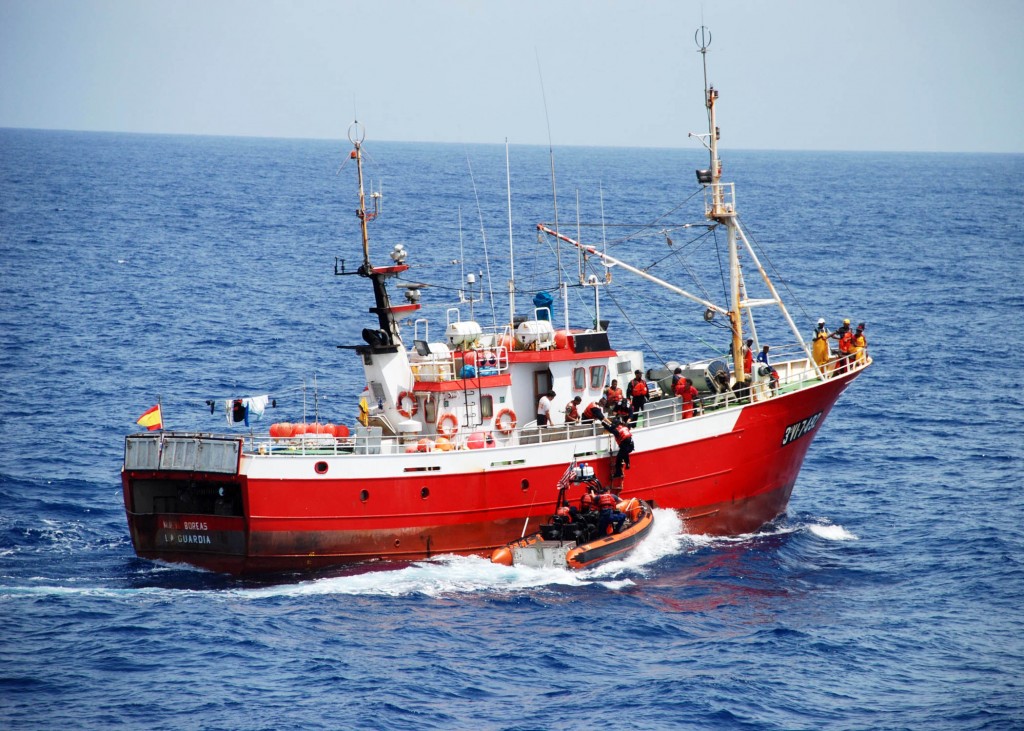
A boarding near Cape Verde

U.S. Navy publications often describe the sea as a global commons; the idea being that the oceans represent a resource to be shared for the benefit of all.  The reality, however, is that although the world’s oceans facilitate billions of dollars of legitimate commerce and trade every day, criminal networks, insurgent groups, and transnational terrorist organizations exploit sea lanes for more nefarious ends. The same ports and ocean routes used by sailors for thousands of years also provide today’s afloat highways, over which both legal and illicit cargoes move. These routes – or “ratlines”, when used for illicit traffic – exist amid a complex international patchwork of intertwined economies, diverse cultures, and varying legal authorities and levels of governance.

Disrupting these ratlines requires teamwork and a networked approach.  Accordingly, a number of U.S. government agencies have responsibility of some sort or another for stemming the flow of illegal shipments at sea. Obvious players are Department of Homeland Security organizations, including the U.S. Coast Guard, Immigrations and Customs Enforcement, U.S. Navy, and the U.S. Drug Enforcement Agency. The Human Smuggling and Trafficking Center is a relatively new agency charged by Congress to work against smuggling, illegal trafficking of people against their will, and terrorist travel. Many other agencies play an important role in supporting interdiction efforts with intelligence and law enforcement expertise.
 
Many readers are familiar with the efforts of the Joint Interagency Task Force South, at Naval Air Station Key West, Fla. This long-standing organization consists of several U.S. agencies working with numerous partner nations to counter narcotics trafficking moving through the Caribbean and Eastern Pacific into North America. In addition to this major drug transit zone, lesser-known maritime facilitation routes throughout the world move people, money, and materials illicitly for both financial profit and malign intent.

One example is Islamic foreign fighters who leave their home country and travel over sea, land, and air routes to train and take up arms in conflict zones. The foreign fighter pipeline has supported numerous jihadi battlefields, including Afghanistan, Iraq, Pakistan, Chechnya, Bosnia, Kashmir, Somalia, Yemen, Libya, and Syria. The relatively short ocean crossing connecting Yemen and Somalia, and their long coastlines, has resulted in significant foreign fighter flow between two countries, further destabilizing the region. Estimates of the number of foreigners who traveled in the late 2000s to train and fight with Somalia’s Al Shabaab militant Islamist group range from 200 to more than 1,000. Several of these foreign fighters were westerners from the United States and United Kingdom, including the first known U.S. suicide bomber. The problem garnered significant attention, such that the African Union’s commissioner for peace and security pressed the U.N. Security Council to authorize a naval blockade in order to prevent the entry of foreign fighters into Somalia. 

pic_03A more-obscure maritime ratline involves Afghani hashish and heroin smuggled from Pakistan’s Makran Coast to the Gulf States and East Africa. These smuggling routes reflect a nexus between criminal drug-trafficking and the funding of ongoing conflict and corruption in Afghanistan. In 2009, a U.S. Navy cruiser patrolling in the Gulf of Aden seized a skiff carrying 4 tons of hashish with a street value of $28 million. In all, international naval forces operating in the Indian Ocean seized 53 tons of drugs along the “hashish highway” in 2008 and more than 22 tons during 2009. This success notwithstanding, a lack of maritime patrol and reconnaissance assets combined with lax customs laws, and competing priorities of the various countries involved make narcotics interdiction along these sea routes a challenging proposition.

A different facet of illicit maritime networks is the transport of weapons and bomb-making materials into war zones. This usually involves a combination of legitimate businesses from source countries where electronics or other “dual-use” improvised explosive device (IED) components are produced and witting smugglers, who ship the goods sometimes hidden in legitimate cargoes.

In an operation a few years back (in which this author was personally involved), a non-DOD intelligence tipper on possible maritime facilitation of IED components was passed to a U.S. military special operations task force, which pushed the information to conventional naval forces. The Navy teams interdicted the vessel of interest, boarded it, and conducted an exhaustive search. Though they did not find the incriminating cargo, irregularities in the cargo manifest warranted further investigation. The ship was allowed to proceed to the next port of call where the host nation’s authorities, assisted by U.S. officials, conducted additional inspections. Through these searches the dual-use material was found and host nation authorities seized the cargo, with disruptive effects on the IED network. Moreover, because the effort required coordination between at least five U.S. government agencies, multiple DOD commands, and several countries, valuable lessons were learned that will pave the way for success in future counter-maritime facilitation actions. 

Above all, countering illicit maritime networks requires open and flat communications at multiple levels – both interagency and international. Traditional command-and-control structures that are comfortable to most military operators are not appropriate for an interdiction effort involving multiple agencies and countries. Rather, early and frequent meetings – such as secure teleconferences – will foster an environment of collaboration and coordination.  Because maritime targets are dynamic, rapid dissemination of intelligence and intent is necessary for a successful interdiction. In the above example, only about 12 hours passed between the initial intelligence tipper and the vessel’s identification, boarding, and interdiction. In some cases, the vessel of interest must be intercepted and boarded before it passes into territorial waters. At other times, coordinating for partner nation authorities at the next port of call to inspect the cargo ashore might be more feasible. 

Africa Partnership Station 2012Differing security classifications and communication systems between agencies and countries complicate the flow of information, but these obstacles can be overcome by persistent outreach and liaison. While advances in technology have certainly helped ease information-sharing blockages, it is often viewed as a panacea. Nothing beats the information flow that can be achieved from a closely tied liaison network working towards a common end state. Along these lines, countering illicit maritime facilitation requires a careful balance between various military, agency, and partner-nation equities. Sometimes these equities are competing; in other cases they are complementary. Law enforcement agencies often require that the chain of custody for any evidence seized during a maritime interdiction be carefully preserved in order to build a legal case against an individual facilitator. These efforts are sometimes at odds with the exploitation of a seizure for intelligence purposes and the need to maintain operational security. Meanwhile, a partner nation may see broadcasting the results of a successful interdiction effort through information operations as a way to gain legitimacy in the eyes of its population. Finally, internecine struggles and political friction between various institutions often stifle coordination despite the best efforts and intentions of those involved.

The maritime facilitation networks of criminals and terrorists present serious challenges to the security interests of the United States and friendly governments. Disrupting these ratlines requires a thoughtful and integrated approach by various organizations focusing on all aspects of the interdiction problem: intelligence, legal, diplomatic, and physical.

CDR Chris Rawley serves in the special operations community. He led boarding teams during maritime interception operations against oil smugglers in the Persian Gulf and coordinated operational level maritime interdiction efforts in the Middle East and the Horn of Africa. He is the author of Unconventional Warfare 2.0: A Better Path to Regime Change in the Twenty-First Century and blogs regularly at Information Dissemination. The above opinions are his own.

For more articles in our International Maritime Shipping Week, click here.

Post-OPCON Strategy for the US-ROK Alliance

(This article is cross-posted by permission of the United States Naval Institute Blog and appeared in its original form on July 25th here.)

According to the Yŏnhap News Agency last Thursday, ROK Defense Minister Kim Kwan-jin “confirmed…that he had requested the U.S. government” to postpone the OPCON (Operational Command) transfer slated for December, 2015. Citing from the same source, the National Journal elaborated further by saying Minister Kim believed that the United States was open to postponing the transfer because “a top U.S. government official leaked to journalists”  Minister Kim’s request for the delay.

Chuck Hagel and Kim Kwan-jin
Ministerial-level meeting
There may be several reasons for the ROK government’s desire to postpone the OPCON transfer. First, the critics of the OPCON transfer both in Washington and the ROK argue that this transition is “dangerously myopic” as it ignores “the asymmetric challenges that [North Korea] presents.” Second, given the shrinking budget, they argue that the ROK may not have enough time to improve its own C4I (Command, Control, Communications, Computer and Intelligence) capabilities, notwithstanding a vigorous procurement and acquisition of state-of-the-art weaponry and indigenous research and development programs for its local defense industries. Third, South Korea’s uneven defense spending, and operational and institutional handicaps within the conservative ROK officer corps have prevented South Korea from developing a coherent strategy and the necessary wherewithal to operate on its own. To the critics of the OPCON handover, all these may point to the fact that, over the years, the ROK’s “political will to allocate the required resources has been constrained by economic pressures and the imperative to sustain South Korea’s socio-economic stability and growth.” As if to underscore this point, the ROK’s defense budget grew fourfold “at a rate higher than conventional explanations would expect” due to fears that the United States may eventually withdraw from the Korean peninsula. It was perhaps for these reasons that retired GEN B. B. Bell, a former Commander of the United States Forces Korea, has advocated postponing the transfer “permanently.
 
However, the Obama Administration’s reversal of its decision to hand over the OPCON to the ROK military appears unlikely. First, in the face of the drastic sequestration cuts in the upcoming fiscal years, long-term commitment in the Korean peninsula may be unsustainable. Second, since both the United States Armed Forces and civilians suffer from war-weariness after having fought in Iraq and Afghanistan for over a decade, it is unlikely that they will accept long-term overseas commitment of this magnitude. Which leads to the third point that the United States will likely favor diplomatic solutions when dealing with Kim Jŏng-ŭn, since the DPRK has recently expressed its desires to engage in dialogues. Fourth, “[m]ost economic and military indicators show that South Korea has an edge over North Korea in almost all measures of power.” While many opponents of the transition point to the DPRK’s asymmetric threats to make their case, Suh Jae-jung contends that “quantitative advantage quickly fades when one takes account of the qualitative disadvantages of operating its 1950s-vintage weapons systems” which has led “serious analysts [to] conclude that ‘North Korea never had a lead over South Korea.’” Most importantly, arguments against the scheduled transition are weak because they tend to focus only on the military dimensions of the ongoing conflict.
 
There are several ways in which the US-ROK alliance  can enhance security dynamics on the peninsula in the aftermath of the OPCON transfer. One obvious approach would be to seek diplomatic solutions to proactively deter further provocations by Kim Jŏng-ŭn. Despite the deep-seated rancor and distrust between the two Korean states, both Korean states have nevertheless agreed to reopen the Kaesŏng Industrial Complex. The latest inter-Korean talk held at P’anmunjŏm demonstrates more than anything else the need to “cajole and flatter the young ruler…[by] allowing Kim Jŏng-ŭn to save face as sovereign ruler of his country.” As Miha Hribernik and I wrote in June, one way of doing this would be to “accept his offers to discuss arms reduction first.” In addition, the US-ROK alliance could defuse tension on the Korean peninsula by recognizing the DPRK as a sovereign state. Such measures would prevent miscommunication where parties involved are “not talking to each other but rather, past each other.”
 
Nevertheless, the US-ROK alliance must avoid appearing weak even as it seeks diplomatic solutions to guarantee peace and security for the Korean peninsula. As I wrote earlier, “in order for diplomatic endeavors to be sustainable in the long-run, they must be backed up by a credible threat of coercion.” With or without the OPCON, there are several ways in which the US-ROK alliance can effectively deter future DPRK aggressions. One such option, as I’ve written earlier, would be for the United States Pacific Fleet and the ROKN, along with the JMSDF, to form a combined fleet whereby the three navies “would may share their unique resources and cultures to develop flexible responses against future threats by Kim Jŏng-ŭn.” Second would be to allow the ROK JCS Chairman to assume command of the CFC with the top American general serving as his deputy as was proposed in June during a ministerial meeting held between Secretary of Defense Chuck Hagel and Defense Minister Kim Kwan-jin. However, at this juncture, according to the Washington Post, “the 28,500 U.S. troops here will not fall under the command of the South…[since] the United States and South Korea will have separate commands.” Third, to proactively deal with possible DPRK missile attacks, the US-ROK alliance, together with Japan, can develop a collective missile defense system.  Fourth, as retired Admiral James Stavridis argues, since the world has converged into smaller communities through globalization, we must take the fight to our adversary by “follow[ing] the money [to upend] threat financing” abroad and at home. Last but not least, since the DPRK’s  recent asymmetric attacks against the US-ROK alliance have been waged on cyberspace to cripple their infrastructures, the US-ROK alliance, in tandem with the international community, can work together to enhance their cyber security.
Despite unfounded fears among retired officers and conservative analysts that the OPCON transfer may considerably weaken South Korea’s security, it does not mean that the United States will completely withdraw from the Korean peninsula. Nor does the ROK resemble South Vietnam after the Paris Treaty of 1973. That is, the ROK remains an economically and politically stable nation. With new transition come new opportunities for innovative growth. For the ROK, OPCON transfer just may present such opportunities to protect itself from further aggression by Kim Jŏng-ŭn.

 Jeong Lee is a freelance international security blogger living in Pusan, South Korea and is also a Contributing Analyst for Wikistrat’s Asia-Pacific Desk. Lee’s writings have appeared on various online publications, including East Asia Forum, the Georgetown Journal of International Affairs and the USNI Blog.