Category Archives: Current Operations

On-going Naval Ops or Maritime Current Events

Russia’s Rusting Task Force

Much has been made in the media of the Russian naval presence in the eastern Mediterranean. With tensions rising over the Syrian conflict, the notion that Russian forces are staring down their American and British counterparts at sea fits the popular narrative of mutual antagonism. But is the Russian Navy’s Mediterranean task force all that unusual? Does it present a challenge or even a threat to the United States’ interests in the region, as some reports would suggest?

First of all, it is important to note that a Russian naval presence in the eastern Mediterranean is not unprecedented. From 1967 until its collapse, the Soviet Union maintained a task force of considerable size in the region, consisting of some 30 warships and an undetermined number of additional support vessels. Furthermore, Russia’s naval facility in Tartus, Syria was established in 1971, regularly providing repairs and maintenance for Soviet and later Russian ships.
Udaloy-class Russian Destroyer

In contrast, the Russian presence newly formed in the eastern Mediterranean is quite limited in its size and capabilities. The task force currently consists of twelve vessels: two destroyers, one frigate, two amphibious assault ships, three salvage tugs, a repair ship, and three re-fueling tankers. The long-term presence envisioned by the Russian defence ministry consists of no more than ten vessels. This is a dramatically reduced presence to the one put forward by the Soviet Union. The Priazovye, a reconnaissance ship deployed to the eastern Mediterranean by the Russian Navy in September 2013, will operate separately from the existing task force and is intended only for the short-term surveillance of the situation in Syria.

Despite the relatively small size of the Mediterranean task force, the Russian Navy reportedly struggled to find the resources to deploy a task force at all. When the United States Navy has deployed task forces on various operations, the vessels employed are usually drawn from the same fleet. But the Russian Navy’s Mediterranean task force is drawn from four of the country’s five fleets: Baltic, Northern, Black Sea, and Pacific. Only the Caspian Flotilla – a small contingent itself – did not contribute to the Mediterranean force. Had the Russian Navy followed the American practice of drawing from a single fleet, it would have left one of its fleets dangerously under-strength. This is a testament to how limited Russia’s naval capabilities have become in recent years.
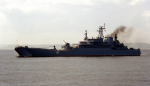
Ropucha Class large landing craft.

Another important point regarding the Mediterranean task force is how dated some of the vessels are. The two Ropucha-class landing ships provided by the Baltic Fleet were originally commissioned for the Soviet Navy in 1975. An ambitious procurement project, intended to replace some of the aging Ropucha-class vessels with several of France’s Mistral-class amphibious assault ships, had its launch recently postponed until 2016. If the project eventually comes to fruition, the Mistral-class ships will be deployed with the Pacific Fleet. In short, while the technology in the eastern Mediterranean task force is seriously behind the times, there are no substantive plans on the part of Russian policymakers to update the force.

Rather than seeking to intimidate ‘the West’, the deployment of the eastern Mediterranean task force seems to be more a gesture for domestic audiences in Russia. In 2011, the authorities released some highly optimistic plans for the expansion and modernization of the Russian Navy, envisioning almost a complete overhaul of this military branch by 2020. The implementation of these plans has been lacklustre thus far, as demonstrated by the aforementioned difficulties with only the partial replacement of the Ropucha-class landing ships. The formation of a new task force allows Russian policymakers to feign progress on this front and assert that Russia is reclaiming ‘past glories’, deflecting criticism from the government’s procurement problems. But this fresh coat of paint won’t long conceal all that rust. A more realistic plan for the development of the Russian Navy is desperately needed.

This was originally published 12 SEP 13 at the Atlantic Council of Canada.

Paul Pryce is a Junior Research Fellow at the Atlantic Council of Canada. With degrees in political science from universities in both Canada and Estonia, he has previously worked in conflict resolution as a Research Fellow with the OSCE Parliamentary Assembly. His research interests include African security issues and NATO-Russia relations.


Assad’s Deadman Switch

Russia has saved the world from loose WMD before; in the aftermath of the Soviet Union’s dissolution, Russia arranged the Lisbon Protocols with Ukraine, Kazakhstan, and Belarus to systematically destroy or return massive nuclear stockpiles. If only Syria had the stability of post-Soviet chaos. If the Syrian “Lisbon Protocol” fails and the regime collapses, the presence of WMD is a guarantor of intervention, most likely by the US.

Yeah, these are some nice WMD. It would be a shame if, let's say, my guards disappeared and someone stole them.
Yeah, these are some nice WMD. It would be a shame if, let’s say, my guards disappeared and someone stole them.

The Russian arrangement is not yet official and may be Assad’s play for time. The chemical weapons are potentially more powerful against the US than rebels. Likely, a reality causing Secretaries Kerry and Hagel to eschew the term “regime change” is that the danger of Syria’s chemical weapons (CW) to the US increases as Assad teeters. Though rightfully loathed, Assad and his men secure their CW and have so far resisted handing party favors to associates.

As the regime crumbles, CW facilities may find themselves overwhelmed or guards shifted to critical fronts, doors open to terrorists or unscrupulous brokers.  Though some argue we do not have a dog in Syria’s fight, a whole henhouse is under threat if those dogs break loose. There are only three likely solutions if a Russian deal fails:

  1. "Kill yourself" is my final offer.
    This can work for both of us. “Kill yourself,” is my final offer.
    Can you work with, "Go to hell"?
    We understand your position. Meet us halfway at, “die and go to hell.”

    Political Agreement: If only all parties could agree to a two-part plan to stop murdering one another and share power. Guards stay on post, conflict ends, and world moves on after the noble work of aiding refugees. The rump of Assad’s regime keeps its pulse and constant pressure to the switch. Unfortunately, with parties whose non-negotiable point is that the opponent “die”, and multiple Al-Qaeda (AQ) militias, this seems nigh impossible.

  2. Who needs norms, human rights, or excuses when you have machiavelli and a hand cannon?
    Who needs norms, human rights, or excuses when you have Machiavelli and a hand cannon?

    Russian Military Operations: Russia is a big fan of Syria. Russia has a naval presence in the country and a large portion legitimacy and energy policy invested in the management of the regime. Russia would like to keep Syria’s CW from groups connected to their own domestic extremistss. Most cynically, with very public domestic problems, military operations to save the world from CW seem a likely move for President Putin. In the words of Orwell, “War is Peace.”

    Russia has particular advantages in their contact with Assad’s regime. They likely could access exact locations for the regime’s CW in a pinch. The world has no high standard for Russian intervention, so a sting operation to grab or destroy the vast stores of CW without any follow-on reconstruction would not be shocking to the global community. This also serves as a guise for direct military support for regime survival.

    That said, Russia has managed the Syria narrative well and knows the US could not abide Assad’s weapons falling to extremists. Russia has enjoyed the umbrella of security provided by primarily US operations against extremists in the Middle East and likely has no desire to get bogged down or gain unwanted attentions. Russia is still just “a” rather than “the” “Great Satan.” It would likely leave the mess to the final and least pleasant option:

  1. It's getting very... VERY old.
    It’s getting very… VERY old.

    American Intervention: In a conflict with too many “thems” and not enough “us’s”, the fog of Syria’s war is thick. Unfortunately, nothing is unclear about the peril of loose CW or the peril of a necessary US military response.

    Boots: The number and location of all weapon sites remains a mystery, requiring resources spent in the search phase of “seek and destroy” operations. The time or scale necessary also removes the critical element of surprise. A lengthy chain of smaller operations warns enemies to secure weapons at un-sanitized sites while they still can. A massive simultaneous operation would strain an already creaking military budget and drop the US fully into the war, leaving the US in control of large swaths of territory and people it  could not just leave to extremists.

    Strikes: Dead suffocated civilians, lack of verification, and PR for terrorists lies at the end of an aerial campaign. Though the US has invested in weapons that can neutralize chemical weapon stockpiles, most leave a large margin of error or have almost as toxic byproducts. The explicit refusal to consider striking Assad’s chemical weapon stockpiles should be evidence enough of the unsavoriness of such an operation.

    Unfortunately, loose CW is not an option in a war-torn hellscape crawling with groups who have plotted against US interests and citizens for over two decades.

Ghost of Christmas Future! I fear you more than any spectre I have seen.

Though an embarrassing stolen march, the Russian deal is the US’s best chance is to avoid Syria. Nonetheless, US policymakers must plan for the worst while stumbling upon the best. The US must accept the real-world possibility of Assad’s collapse and subsequent unlocking of Pandora’s Chemical Box; many rightly desire to have nothing to do with the conflict, but while we may not be interested in Syria, Syria is very interested in us.

Matt Hipple is a surface warfare officer in the U.S. Navy.  The opinions and views expressed in this post are his alone and are presented in his personal capacity.  They do not necessarily represent the views of U.S. Department of Defense or the U.S. Navy.

Clash off Zamboanga

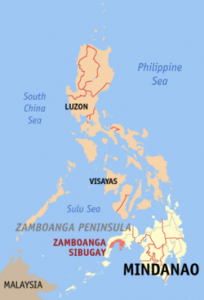
ZamboangaA naval engagement off the southern port city Zamboanga, Philippines, is once again showing the utility of maritime transport for non-state actors.

A navy patrol encountered and fought with “about 100 suspected Moro National Liberation Front (MNLF) rebels, who were on board a large motorboat and eight smaller vessels off Rio Hondo, a crowded Muslim community in the port city of Zamboanga, military spokesman Lt. Col. Ramon Zagala said.” The clash left 1 member of the navy special forces dead and 6 injured, while at least a further 5 died as the fight moved inland. Estimates of hostages taken by the MNLF number between 20 and 300 hundred.

As reported by the AP: “The 11,000-strong Moro Islamic Liberation Front has engaged the Philippine government in Malaysian-brokered peace talks, which have progressed recently toward a new Muslim autonomy deal. But a Moro National Liberation Front guerrilla faction led by Nur Misuari felt left out and has issued new threats.”

In February, followers of the nominal ‘Sultan of Sulu’ also took to the sea for an invasion of Malaysian Borneo in what was seen as an attempt to gain a stronger bargaining position in the peace talks.

Suez and Syria: Updated 9/5

A brief update on some of the fast-moving maritime issues:

Suez Canal Attack

Update 9/5: Footage from the attack is reportedly now available here.

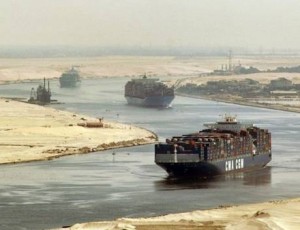
Suez TransitOn Saturday, assailants attacked the Panamanian-flagged container ship COSCO Asia with machine gun fire as it transited the Suez Canal near the el-Qantara area. Egypt reportedly arrested 3 involved in the attack.

Fellow CIMSECian James Bridger had an insightful post on the Suez Canal’s security situation earlier last month, warning that a range of actions could be taken with the aim of disrupting traffic through the canal, primarily as a result of islamist retaliation against Egypt’s military coup.

Syrian Storm Clouds

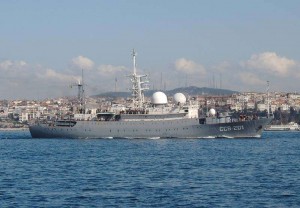
PriazovyeTo the north, Russia sent the surveillance ship Priazoye from Sevastopol on the Black Sea to monitor U.S. naval forces off Syria. The news came while the number of U.S. forces gathering in the region increased as the Nimitz carrier strike group (CSG) moved into the Red Sea to await further orders instead of returning home to Everett, Washington after its deployment. The CSG includes the Ticonderoga-class cruiser USS Princeton and three Arleigh Burke-class destroyers: the USS William P. Lawrence, USS Stockdale, and USS Shoup.

The strike aircraft aboard Nimitz and ships’ cruise missiles add to the seapower already assembled in the Mediterranean – the destroyers USS Stout, USS Mahan, USS Ramage, USS Barry, and USS Gravely. An unknown submarines are also in the area along with the amphibious ship USS San Antonio, a dock landing platform that earlier transited to the Eastern Mediterranean.