Written by W. Alejandro Sanchez, The Southern Tide addresses maritime security issues throughout Latin America and the Caribbean. It discusses the challenges regional navies face including limited defense budgets, inter-state tensions, and transnational crimes. It also examines how these challenges influence current and future defense strategies, platform acquisitions, and relations with global powers.
“My plain and simple message to our friends in the region is ‘the United States is a reliable and trustworthy security partner….Latin America and the Caribbean are not our backyard. It’s our shared neighborhood… And like the neighborhood … where I grew up, good neighbors respect each other’s sovereignty, treat each other as equal partners with respect, and commit to a strong neighborhood watch.” –Vice Admiral Craig Faller, USN, before the Senate Armed Forces Committee, Sep. 25, 2018.
By W. Alejandro Sanchez
The Argentine Coast Guard stopped a South Korean trawler that was allegedly operating without authorizationin its Exclusive Economic Zone (EEZ) in early February. The non-violent operation highlights how Asian fleets are willing to travel long distances in order to make a profit, and how Latin American navies and coast guards need to be more focused than ever before on combating unauthorized fishing.
The O Yang 77
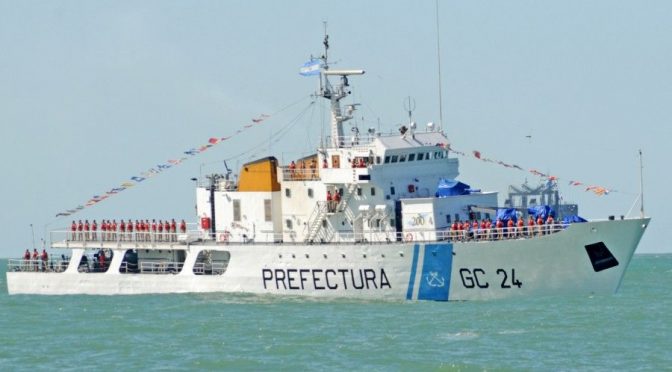
The latest international fishing incident in Argentine waters occurred when the South Korean trawler O Yang 77 was detected by Argentine authorities, which deployed PNA Doctor Manuel Matilla (GC-24), a Mantilla-class patrol boat, to stop said vessel. According to Infobae, the vessel was detected around Chubut province, in the Southern part of Argentina, with its nets down. Aboard the vessel, Argentine authorities found some 130 tonnes of fish. A 11 February video posted on the Argentine coast guard’s Twitter account shows the O Yang 77 docked in the South American country’s Comodoro Rivadavia port.
South Korean authorities argue that the vessel, which belongs to Sajo Oyang Corporation, did not violate Argentina’s EEZ.
Illegal Fishingand Incidents
The aforementioned incident highlights one obvious fact: illegal, unauthorized and unregulated (IUU) fishing does not occur simply because Latin American and Caribbean fishing vessels break the law, but extra-regional vessels, particularly large fleets from Asian nations, are willing to travel long distances in order to make a profit and satisfy their nation’s demands.
Previous commentaries by the author noted the problem of IUU fishing in Latin America (see CIMSEC’s “Latin American Navies Combat Illegal Fishing”), of which Chinese fleets are repeated offenders. For example, in 2016 the Argentine Coast Guard shot at and sank a Chinese fishing vessel,Lu Yan Yuan Yu, which was part of a larger fleet operating in Argentina’s EEZ. The following year, the Chinese vessel Fu Yuang Yu Leng 999 was spotted close to the Galapagos Islands and detained by Ecuadorian authorities. An inspection discovered over 300 tons of a variety of fishes, particularly hammerhead and silky sharks as well as other endangered species (see CIMSEC’s “A Growing Concern: Chinese Illegal Fishing in Latin America”). A year later, in late 2018, Peruvian authorities stopped the Chinese vessel Runda 608 for fishing without authorization in Peruvian waters.
Ironically, at the time of this writing, yet another incident regarding Asian fishing fleets occurred in the South Atlantic. In mid-February, the patrol boat Mantilla was once again called into action, this time to help the Zhongyuanyu 11, a Chinese fishing boat that collided with the Spanish fishing vessel Pesca Vaqueiro, some 16 km outside Argentina’s EEZ. The Argentine platform was deployed to rescue the crew of the sinking Chinese ship, while the Spanish vessel apparently did not suffer significant damage. These incidents highlight the constant presence of extra-regional fishing vessels in the South Atlantic.
How are Regional Governments and Navies Reacting?
Unsurprisingly, whenever a major illegal fishing incident occurs, there is an understandable public outcry and regional governments promise to protect a country’s maritime resources. For example, after the Lu Yan Yuan Yu incident in the Galapagos Islands, the Ecuadorian Navy deployed its submarine Huancavilca to help combat unauthorized fishing. Quito also reportedly sent a formal letter of protest to Chinese authorities about the incident, though it is unclear (and highly doubtful) if any measures have been implemented to avoid future violations of Ecuador’s maritime sovereignty by Chinese vessels.
However, it is also necessary to obtain aerial platforms that can help monitor and intercept suspicious vessels faster. Space programs can be additionally helpful to locate suspicious ships as well – the Chinese vessel Runda 608 was reportedly located via space-based capabilities. In other words, the answer is not just adding more ships to a fleet to successfully combat illegal fishing; aerial platforms and even space technology are also critically important.
Moreover, governments have a vital role to play. Robust legislation to combat IUU fishing is necessary, such as heavy fines or even prison time for offenders, but there also has to be action at the diplomatic level when illegal fishing is conducted across national borders. It will be important to monitor whether Buenos Aires confronts Seoul over the latest incident, though it is unlikely as Buenos Aires-Beijing relations remain the same after the Fu Yuang Yu Leng 999 incident.
As a corollary to this analysis there is an ironic detail worth highlighting: in late January the Argentine news service Ambito reported that South Korea is planning to donate an Ulsan-class frigate to Argentina. This report has been frequently cited in other media outlets. Such a move is not without precedent as Seoul donated a corvette to Perua few years ago as well. It will be interesting to see if Seoul does in fact donate a warship to Buenos Aires, which would likely be utilized for patrol operations to crack down on maritime crimes in Argentina’s EEZ, such as illegal fishing.
Final Thoughts
The O Yang 77 incident will not be the last time that Asian fleets fish without authorization in Latin American waters as these vessels constantly operate in the South Atlantic – this is best demonstrated by the collision between the Zhongyuanyu 11 and the Pesca Vaqueiro just days after the arrest of the O Yang 77. Demographic growth, the eternal quest for profit, and depleting maritime life in other bodies of water mean that extra-regional fleets will travel great distances for new sources of fish.
It is bad enough when illegal fishing occurs domestically (e.g. a Peruvian fishing vessel operating illegally in Peruvian waters) or across regional borders (e.g. a Ecuadorian vessel ilegally fishing in Peruvian waters). The scope of IUU fishing by Asian fishing fleets could help bring about the destruction of an already fragile Latin American maritime ecosystem.
Latin American navies and coast guards are the tip of the spear in combating IUU fishing, and they have a mighty opponent in front of them.
Wilder Alejandro Sanchez is an analyst who focuses on geopolitical, military, and cybersecurity issues. He tweets at @W_Alex_Sanchez.
The views expressed in this article are those of the author alone and do not necessarily reflect those of any institutions with which the author is associated.
Featured Image: Coast Guard patrol GC-24 Mantilla. (Mercopress)
“In the midst of chaos, there is also opportunity.” –Sun Tzu
Parts One and Two of the Bad Day Scenario series posited a worst case-style scenario for the U.S. Navy, discussed ways the Navy might respond with current capacity and capability, and introduced emerging concepts that could help the Navy address similar scenarios in the future as a more globally responsive force. Dynamic Force Employment (DFE), the U.S. military’s latest concept for employing the joint force with agility and unpredictability, will have a significant impact on how the Navy is used as an instrument of national power. Meanwhile, Distributed Maritime Operations (DMO) is the Navy’s emergent concept for force development and maritime operations that will be capable of generating combat power across a broad range of platforms, domains, geographical area, and potential adversaries. The rest of the Bad Day Scenario series aims to reconcile the DFE and DMO concepts into an overall model for developing a dynamic, distributed, and lethal global force by 2020.
There currently exists no satisfactory integration of DFE and DMO. Chief of Naval Operations Admiral John Richardson addresses both concepts independently in his Design for Maintaining Maritime Superiority 2.0. Essentially, he suggests the Navy will use DFE at the lower end of the range of military operations, and DMO at the high end. Design 2.0 recognizes the unsustainability of business-as-usual global maritime operations, but fails to acknowledge that DFE and DMO will simultaneously impact steady state operations and must account for each other to be effective. They are not two conceptual “buttons” which the Navy can press depending on the situation.
Proposing a new concept – Global Force 2020 – can provide the necessary integration of DFE and DMO to enable the Navy to operate efficiently on a daily basis, while remaining postured to respond to global crises and contingencies. Global Force 2020 is based on a six-factor model – Operational, Technological, Human, Partnership, Cultural, and Logistical – that highlights the unique challenges and opportunities that arise from the integration of DFE and DMO. The first three factors will be discussed in this part, and the remaining three will be discussed in Part Four.
Operational Factor
Global Force 2020 will fundamentally change naval operations, along with tactics and training, in a variety of ways. Most notably, the model will necessarily reduce the primacy of the Carrier Strike Group (CSG) as the Navy balances a variety of force organizational constructs. Admiral Richardson seemed to acknowledge this shift when he said “our fundamental force element right now in many instances is the carrier strike group. We’re going to scale up so our fundamental force element for fighting is at the fleet level, and the strike groups plug into those numbered fleets. And they will be, the strike groups and the fleet together, will be operating in a distributed maritime operations way.”
Upscaling to the fleet as the basic fighting unit, however, could unintentionally hamper distributed execution by centralizing C2 at the three-star level, and would not incentivize the Navy to evolve its default CSG deployment model. Under Global Force 2020, existing constructs, such as Amphibious Readiness Groups (ARG) and Surface Action Groups (SAG), would see more emphasis, while emerging constructs, such as influence squadrons, war-at-sea flotillas, littoral combat groups, and unmanned or autonomous swarm formations, would be incorporated.
For decades, operations, tactics, and training in the surface force have focused too heavily on supporting the aircraft carrier. CSGs became the default force element. In the era of the Global War on Terror, carrier-based tactical air sorties became the naval force du jour for projecting American military might onto enemies in Iraq, Afghanistan, and elsewhere. The Navy even re-designatedCarrier Battle Groups to CSGs in 2004 to reflect the emphasis on power projection ashore. The demand signal from operational commanders ashore was so immense that the Navy deployed CSGs constantly to generate sorties in an almost industrial fashion. On a typical radar screen in the North Arabian Sea, ingressing and egressing carrier aircraft resembled widgets on a conveyor belt. To support this pace of sorties, nearly all surface combatant deployments were as part of CSGs.
Even before the wars in Iraq and Afghanistan, the Navy was already structured to operate with the CSG as its basic building block. The modern CSG was conceived of during the Cold War to defeat Russian battle groups in blue water, force-on-force, high end conflict. The concept hinged on the CSG’s ability to defend the aircraft carrier and preserve its ability to generate combat sorties. The Aegis Combat System was designed for this purpose, specifically targeting sea-skimming anti-ship cruise missiles (ASCM). Eventually, “Aegis” became synonymous with “high end surface combatant.” Even the Command and Control (C2) concept, Composite Warfare Command (CWC), which was designed to enable CSGs to defend aircraft carriers against multi-domain threats, came to be applied almost universally in surface force operations.
CWC is based primarily upon two key principles: functional warfare commanders, and command-by-negation. Functional warfare commanders have command of the fighting function of CSG assets, not necessarily the assets themselves, within their individual warfare area or domain (i.e. Air and Missile Defense (AMD), surface warfare (SUW), anti-submarine warfare (ASW)). The warfare commanders are empowered to engage threats to the CSG without asking for permission. They are only required to notify the CSG Commander, who can then negate the order if he or she does not concur. This is the principle of command-by-negation.
Functionally arrayed warfare commanders and command-by-negation work well for the point defense of an aircraft carrier by her surrounding escorts. Multi-domain threats along multiple axes afford little reaction time, and decentralized C2 among concentrated forces offers the best chance for successful defense. As maritime operations become more distributed, however, the efficiency and efficacy of CWC diminish significantly. The individual ships of a CSG already operate disaggregated across entire theaters, well outside of organic weapons and high data-rate communications ranges. Ships can communicate via satellite relay but at a certain distance the ships will be part of different communication architectures which complicates tactical communication. Lower data-rate methods such as high frequency (HF) radio also do not support tactical communication. Functional warfare commanders cannot effectively defend assets when they cannot communicate rapidly, build shared awareness, or cover with their own armament. Global Force 2020 will not be able to rely on CWC as an effective method of tactical maritime C2. DFE and DMO are bringing about a sea change in naval C2 that will require commanders to operate effectively both independently, and as part of a larger networked force.
Future fights will require naval force elements to interface with joint and coalition constructs more frequently and more dynamically. Today, for example, a CSG or an ARG may be required to detach from a scheduled mission on short notice to join a Joint Task Force or multinational operation. In the future, this could become commonplace for ad hoc force elements to “plug in” to joint or international constructs. CWC, while highly effective for defending an aircraft carrier, does not translate well to the widely-used Prussian general staff structure, which is comprised of functional directorates (e.g. administration, intelligence, operations, logistics, plans, communications, etc.). The friction is evident even within Navy commands. Fleets are often broken into task forces, but task forces often employ CWC instead of further subdividing into task group and units. When a ship shifts from one task force to another, she sometimes retains her warfare commander duties to the former, creating a conflict for the fleet staff to manage.
Along with C2, the Navy must also adapt training to account for the reduced emphasis on CSG operations under Global Force 2020. Surface ships will no longer deploy with CSGs by default, and therefore will not be able to rely on a training curriculum tailor-made for CSG operations. Training should be geared toward each ship’s unique capabilities, not necessarily her expected role within a group, and should include practice integrating into joint and coalition force elements under a wide range of circumstances. Likewise, threat recognition and study of enemy tactics cannot be exclusive to a single geographic region. Ships may be asked to respond to any number of contingencies around the globe while potential adversaries are increasing their own out-of-area deployments.
Finally, an important element of Global Force 2020 operations will be deception. Inherent in the DFE concept is an element of unpredictability, which can be supported by military deception, both operational and tactical. As DFE seeks to keep potential adversaries on their heels by making the location and timing of naval deployments less routine, the Navy can further confuse their operational picture and frustrate efforts to understand U.S. intent through the use of information operations. Tactically, the Navy can employ Electromagnetic Maneuver Warfare to make the enemy think the fleet is concentrated where it is not, and vice versa.
Technological Factor
A variety of emerging technologies, and some long-established but neglected by the U.S. Navy, now enable the U.S. to deliver decisive effects without the need for concentrating forces on the objective. Naval warfare has come a long way since the Battle of the Coral Sea in 1942, the first naval engagement in which opposing warships did not sight each other. Today’s weapons, sensors, and communication systems enable friendly forces to coordinate fires outside visual range of each other and the enemy. In the future, some key technologies will enable naval forces to engage targets when not even in the same theater. Global Force 2020 will utilize long range hypersonic missiles and aircraft, next-generation cruise and ballistic missiles, next-generation unmanned systems, artificial intelligence, and cyber to name a few.
Much has been written on the advent of hypersonic weapons, airborne projectiles that travel faster than Mach 5. Some have even suggested a new hypersonic arms race is underway. On the other hand, some argue there is nothing transformational about these weapons, and they do not alter strategic fundamentals. This perspective fails to recognize the second and third order effects that the resultant force disposition and commander’s decision time will have on naval warfare. Hypersonic attacks, sometimes described as Conventional Prompt Global Strike (CPGS), would be a core maritime mission instead of just a strategic one. Hypersonic manned or unmanned aircraft could also transform naval operations in unforeseen ways, but the Navy should exercise caution in investing too heavily in them, potentially sacrificing lower cost, higher quantity missiles for an exquisite technological solution just to fit the current operational paradigm of naval aviation.
Anti-ship missile technology has advanced in a number of ways aside from velocity. Since the U.S. Navy first fielded the Harpoon missile in 1977, technology for propulsion, maneuver, and homing have all revolutionized the way in which missiles can be employed against ships. Anti-ship ballistic missiles (ASBM), such as China’s DF-26 with a range of 3400 miles, pose a significant challenge to legacy fleet air defense systems. Modern anti-ship cruise missiles (ASCM), such as Russia’s 3M22 Zircon, can perform terminal maneuvers even at hypersonic speeds and employ stealth technologies to significantly reduce their radar signature. Meanwhile, terminal homing technology is constantly improved to counter defensive electronic warfare systems. Today, the U.S. Navy still only employs four to eight Harpoon missiles on its surface combatants. While lagging far behind other naval powers in anti-ship missiles, the U.S. is now making significant gains in terms of funding, acquisition, and research and development.
Apart from missiles, the railgun is a popular weapon often discussed as the future of naval gunnery. China purportedly fielded a prototype on one of its warships in 2017; however, the U.S. Navy recently admitted the weapon’s limitations and signaled its intent to pursue alternatives. With a theoretical range of over 100 nautical miles, the railgun certainly would have a place in Global Force 2020, but the verdict is still out on its viability in naval warfare. Interestingly, in 2018 the U.S. Navy did test fire hypervelocity projectiles, the railgun’s munition, from a conventional 5” deck gun.
Meanwhile, unmanned systems are proliferating rapidly and giving the world’s navies the operational reach that was once reserved for superpowers. Unmanned aerial systems (UAS) can provide surveillance, extending the over-the-horizon targeting range of individual combatants, and communication relays, allowing force elements to operate disaggregated without relying on satellite networks or more conventional communications, which may be denied in future conflicts. Future UAS will also conduct strike and aerial refueling missions. On the surface, the U.S. Navy is also pursuing Medium Diameter Unmanned Surface Vessels (MDUSV) to hunt mines and submarines, and to serve as a communications node to network a larger force. Similarly, unmanned underwater vehicles (UUV) will become an integral part of advanced undersea warfare systems to detect, identify, and counter enemy ships and submarines.
Another emerging technology, artificial intelligence (AI), could make it possible for unmanned systems to operate autonomously when range or environment prohibit communication links for tactical control. Fielding autonomous weapons invokes substantial legal and ethical debate, but the technology can certainly benefit dynamic and distributed operations. Global Force 2020 will employ force elements comprising a mix of manned assets and autonomous systems. Beyond vehicles, AI will also be used in communication systems such as cognitive radio to dynamically access the electromagnetic spectrum and make it more difficult for adversaries to deny friendly use of the spectrum. In the cyber domain, payloads could be programmed with AI and deposited into enemy networks to conduct its mission autonomously without reach back.
A key aspect of cyber warfare as it relates to Global Force 2020 is that it permits engagement of the enemy irrespective of range. As long as friendly cyber forces can connect to adversary computer networks, cyber warfare can be conducted from anywhere in the world. By maintaining presence around the world, the Navy brings the capability of connecting to certain networks that would otherwise be inaccessible. A Littoral Combat Ship in the Caribbean Sea could connect to a local Wi-Fi network to deliver a cyber payload to an adversary’s power grid halfway around the world.
Human Factor
As technology inevitably increases in complexity and permeates every aspect of naval operations, the U.S. Navy will need to embrace the benefits of specialization in human capital management. In July 2018, Rear Admiral William Galinis, the Navy’s Program Executive Officer for Ships, remarked that the new Flight IIIs of the Arleigh Burke-class guided missile destroyer (DDG-51) have been maxed out with technological capabilities. This critical loading of the ship’s combat systems happened gradually, as the Navy rolled out new DDG Flights and Aegis baselines to accommodate ever more lethal, and complex, warfighting technology. While the Navy appears aware of the effect of this technological evolution on its ships, it may have underestimated its effect on the officers who lead and manage them. Global Force 2020 will give rise to a new level of complexity in the warfighting capabilities that Surface Warfare Officers (SWOs) will be expected to employ, and missions they will be expected to execute. It is prudent to ask whether the surface force has maxed out the cognitive capacity of generalists, and whether it is time for SWOs to be trained as specialists to become experts in a single mission or warfare domain.
The idea of dividing officers into subspecialties, such as engineering, operations, and combat systems, is not new to the world’s navies. The British Navy, and many others, employ this model. The U.S. Navy, however, develops ship and submarine officers as generalists, for the most part. They are trained and educated in all aspects of naval affairs, serving in assignments that cover as many subject areas as possible. Usually, this means they are not afforded the time or resources to gain subject matter expertise in any one area. The phrase “an inch deep and a mile wide” is commonly used to describe SWOs. Naval aviators, however, are treated as specialists for the aircraft that they fly, since the technical and tactical differences can be significant. The U.S. Navy needs surface tactical action officers who are as proficient with their ship’s combat systems as an aviator is with his or her aircraft.
The U.S. House Armed Services Committee approved language in the draft 2019 National Defense Authorization Act that would have required surface warfare officers commissioned after 2021 to specialize into either an engineering, operations, or combat systems career path. Ultimately, this language was stricken from the approved NDAA, but not before sparking much debate among navy pundits. Opponents argued this was an overreaction to the USS McCain and Fitzgerald collisions, as indicated by Rep. Rob Wittman’s comments in January 2019, and that it would degrade the quality of command at sea in the U.S. Navy. On the other hand, proponents argue that the Navy’s current way of managing officer careers contributed to the 2017 tragedies and should embrace specialization as a potential solution.
In any case, specialization for officer career progression should be considered not only in response to preventable tragedies at sea, but also as a necessary adaptation to technological trends. In addition to proliferation and increasing complexity, modern technology has largely removed ship maneuvering from the kill chain. Naval officers have always needed to be proficient shiphandlers because a ship’s ability to deliver combat power depended heavily on maneuver, from ramming triremes to naval gunnery to submarine prosecution in multi-ship formations. Today, much of the naval kill chain resides far beyond the immediate space around the ship. Naval weapons such as missiles travel so far and so fast that ship speed and maneuvering have become almost irrelevant tactical factors. Cyber and electronic warfare also have almost nothing to do with maneuvering. It is true that attack and countermeasure effectiveness are affected by the physical, acoustic, and electromagnetic environment, but these can all be accounted for in tactical aids. Any moderately proficient mariner can take advice from tacticians to steer into the wind or minimize light and sound signature. The U.S. Navy already contracts substantial maintenance activities onboard deployed ships. Similarly, all Navies employ harbor pilots to guide them in and out of ports and certain chokepoints. The time may come when the surface force is compelled to consider contracting its maneuvering function, which will be increasingly irrelevant to combat, while SWOs specialize in areas that contribute directly to lethality.
Part Four will address the Partnership, Cultural, and Logistical factors of Global Force 2020.
Jimmy Drennan is the President of CIMSEC. These views are the author’s alone and do not necessarily reflect the position of any government agency.
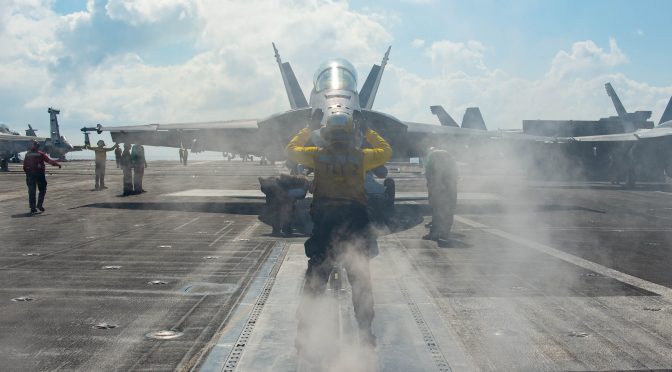
Featured Image: U.S. Navy Aviation Boatswain’s Mate (Handling) 3rd Class Chelsea Mortimer, center, from Kent, Washington, directs an F/A-18F Super Hornet, assigned to Strike Fighter Squadron (VFA) 41, toward a steam-powered catapult on the flight deck of the aircraft carrier USS John C. Stennis (CVN 74) in the Pacific Ocean, Feb. 8, 2019. (U.S. Navy photo by Mass Communication Specialist 3rd Class Skyler Okerman)
Erickson: In the last decade or so, China has dramatically expanded its control and influence over strategically important parts of maritime East Asia. It has done so despite opposition from regional states, including the United States, and without firing a shot. Others have examined this topic, but we found that much of the public analysis and discussion was not grounded in solid mastery of the available Chinese sources—even though China tends to be much more transparent in Chinese. We also recognized a general lack of understanding about the two organizations on the front lines of Beijing’s seaward expansion: the China Coast Guard (CCG) and the People’s Armed Forces Maritime Militia (PAFMM). This volume grew out of a conference we held in Newport in May 2017 to address some of these issues. It contains contributions from world-leading subject matter experts, with a wide range of commercial, technical, government, and scholarly experience and expertise. We’re honored to receive endorsements from top leaders in sea power, strategy, and policy: former Chief of Naval Operations Admiral Gary Roughead, former Secretary of the Navy J. William Middendorf, Harvard Professor Stephen Rosen, former Japan Maritime Self-Defense Force Fleet Commander-in-Chief Vice Admiral Yoji Koda, Dr. James Carafano of the Heritage Foundation, and former Pentagon Director of Net Assessment Andrew Marshall.
Q: The title of your book is China’s Maritime Gray Zone Operations. How does the term “gray zone” apply here?
Martinson: We usually prefer to use Chinese concepts when talking about Chinese behavior, and Chinese strategist do not generally use the term “gray zone.” But we think that the concept nicely captures the essence of the Chinese approach. We were inspired by the important work done by RAND analyst Michael Mazarr, who contributed a chapter to the volume. In his view, gray zone strategies have three primary characteristics. They seek to alter the status quo. They do so gradually. And they employ “unconventional” elements of state power. Today, a large proportion of Chinese-claimed maritime space is controlled or contested by other countries. This is the status quo that Beijing seeks to alter. Its campaign to assert control over these areas has progressed over a number of years. Clearly, then, Chinese leaders are in no rush to achieve their objectives. And while China’s Navy plays a very important role in this strategy, it is not the chief protagonist.
Q: Who, then, are the chief actors?
Martinson: The CCG and the PAFMM perform the vast majority of Chinese maritime gray zone operations. Chinese strategists and spokespeople frame their actions as righteous efforts to protect China’s “maritime rights and interests.” The CCG uses law enforcement as a pretext for activities to assert Beijing’s prerogatives in disputed maritime space. PAFMM personnel are often disguised as civilian mariners, especially fishermen. Most do fish, at least some of the time. But they can be activated to conduct rights protection operations. And a new elite subcomponent is paid handsomely to engage in sovereignty promotion missions fulltime without fishing at all. Meanwhile, the PLA Navy also plays a role in disputed waters, serving what Chinese strategists call a “backstop” function. It discourages foreign countries from pushing back too forcefully and stands ready over the horizon to come to the aid of China’s gray zone forces should the situation escalate.
Q: Most readers will have heard about the China Coast Guard, but fewer may be familiar with the PAFMM. How is the PAFMM organized?
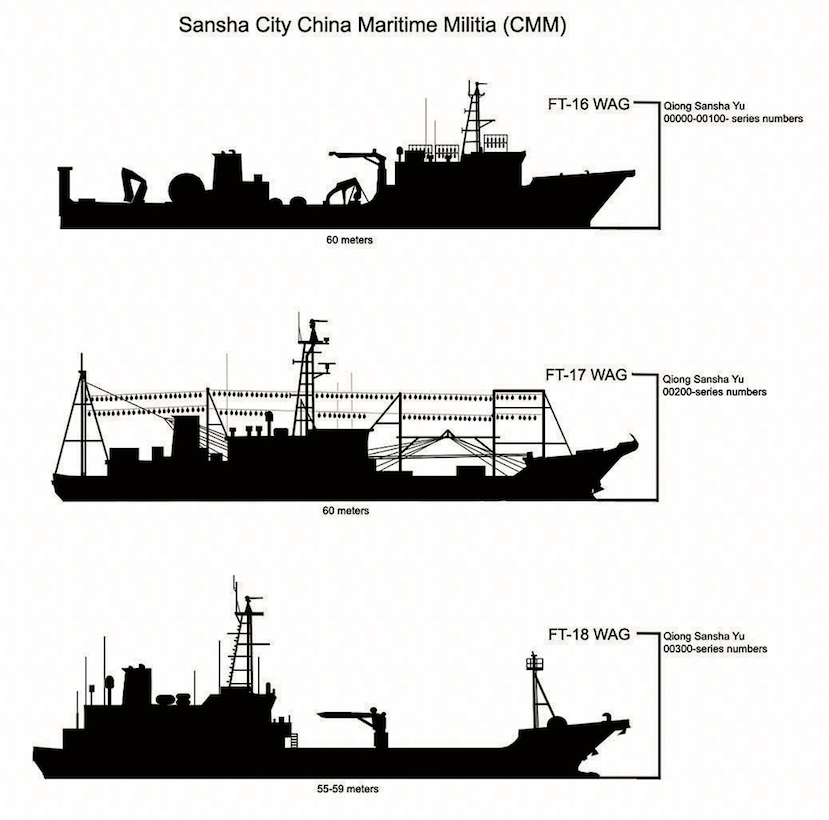
Erickson: The PAFMM is a state-organized, developed, and controlled force operating under a direct military chain of command. This component of China’s armed forces is locally supported, but answers to China’s centralized military bureaucracy, headed by Commander-in-Chief Xi Jinping himself. While most retain day jobs, militiamen are organized into military units and receive military training, sometimes from China’s Navy. In recent years, there has been a push to professionalize the PAFMM. The Sansha City Maritime Militia, headquartered on Woody Island in the Paracels, is the model for a professional militia force. It is outfitted with seven dozen large new ships that resemble fishing trawlers but are actually purpose-built for gray zone operations. Lacking fishing responsibilities, personnel train for manifold peacetime and wartime contingencies, including with light arms, and deploy regularly to disputed South China Sea areas, even during fishing moratoriums.
Three types of maritime militia vessels depicted in the Office of Naval Intelligence’s China’s People’s Liberation Army Navy (PLAN), Coast Guard, and Government Maritime Forces 2018 Recognition and Identification Guide. (Office of Naval Intelligence)
There are no solid numbers publicly available on the size of China’s maritime militia, but it is clearly the world’s largest. In fact, it is virtually the only one charged with involvement in sovereignty disputes: only Vietnam, one of the very last countries politically and bureaucratically similar to China, is known to have a similar force with a similar mission. China’s maritime militia draws on the world’s largest fishing fleet, incorporating through formal registration a portion of its thousands of fishing vessels, and the thousands of people who work aboard them as well as in other marine industries. The PAFMM thus recruits from the world’s largest fishing industry. According to China’s 2016 Fisheries Yearbook, China’s fishing industry employs 20,169,600 workers, mostly in traditional fishing practices, industry processing, and coastal aquaculture. Those who actually fish “on the water” number 1,753,618. They operate 187,200 “marine fishing vessels.” An unknown portion of these are militia boats. To give a sense of the size and distribution of PAFMM forces, our volume includes figures showing the location of leading militia units in two major maritime provinces: Hainan and Zhejiang.
Q: How is the CCG organized for gray zone operations?
Martinson: When we held the conference in 2017, the CCG was in the midst of a major organizational reform. It was only set up in 2013, the result of a decision to combine four different maritime law enforcement agencies. Before 2013, most rights protection operations were conducted by two civilian agencies: China Marine Surveillance and Fisheries Law Enforcement. They did not cooperate well with each other. Moreover, neither had any real policing powers. After the CCG was created, it became clear that Beijing intended to transform it into a military organization. In early 2018, Beijing announced a decision to transfer the CCG from the State Oceanic Administration to the People’s Armed Police. At about the same time, the People’s Armed Police was placed under the control of the Central Military Commission. So, like the PAFMM, it is now a component of China’s armed forces. Moreover, CCG officers now have the authority to detain and charge foreign mariners for criminal offenses simply for being present in disputed areas of the East China Sea and South China Sea (although they have yet to use this authority in practice).
Q: How is the CCG equipped to assert China’s maritime claims?
Martinson: When Beijing’s gray zone campaign began in earnest in 2006, China’s maritime law enforcement forces were fairly weak. They owned few oceangoing cutters, and many of those that they did own were elderly vessels handed down from the PLA Navy or the country’s oceanographic research fleet. They were not purpose-built for “rights protection” missions. In recent years, however, Beijing has invested heavily in new platforms for the CCG. Today, China has by far the world’s largest coast guard, operating more maritime law enforcement vessels than the coast guards of all its regional neighbors combined. As the chapter by Joshua Hickey, Andrew Erickson, and Henry Holst points out, the CCG owns more than 220 ships over 500 tons, far surpassing Japan (with around 80 coast guard hulls over 500 tons), the United States (with around 50), and South Korea (with around 45). At over 10,000 tons full load, the CCG’s two Zhaotou-class patrol ships are the world’s largest coast guard vessels. The authors project that in 2020 China’s coast guard could have 260 ships capable of operating offshore (i.e., larger than 500 tons). Drawing from lessons learned while operating in disputed areas in the East and South China Seas, recent classes of Chinese coast guard vessels have seen major qualitative improvements. They are larger, faster, more maneuverable, and have enhanced firepower. Many CCG vessels are now armed with 30 mm and 76 mm cannons.
Q: It appears that these gray zone forces and operations are heavily focused on sovereignty disputes such as in the East and South China Seas. Are they also pursuing other goals and lines of effort?
Erickson: That is correct. The vast majority of maritime gray zone activities involve efforts to assert Chinese control and influence over disputed maritime space in what Chinese strategists term the “Near Seas.” When conducting rights protection operations, these forces help Beijing enforce its policies regarding which kinds of activities can and cannot take place in Chinese-claimed areas. The CCG and PAFMM intimidate and harass foreign civilians attempting to use the ocean for economic purposes, such as fishing and oil/gas development. Since at least 2011, for instance, China’s coast guard and militia forces have been charged with preventing Vietnam from developing offshore hydrocarbon reserves in its own Exclusive Economic Zone (EEZ), part of which overlaps with China’s sweeping nine-dash line claim. China’s gray zone forces also protect Chinese civilians operating “legally” in Chinese-claimed maritime space. The 2014 defense of Chinese drilling rig HYSY-981, discussed in detail in our volume, is a classic case of this type of gray zone operation. By controlling maritime space, China’s gray zone forces can also determine who can and cannot access disputed features. Since 2012, for instance, Chinese coast guard and militia forces have upheld Chinese control over Scarborough Reef. Today, Filipino fishermen can only operate there with China’s permission.
Q: What are some of the tactics employed by China’s gray zone forces?
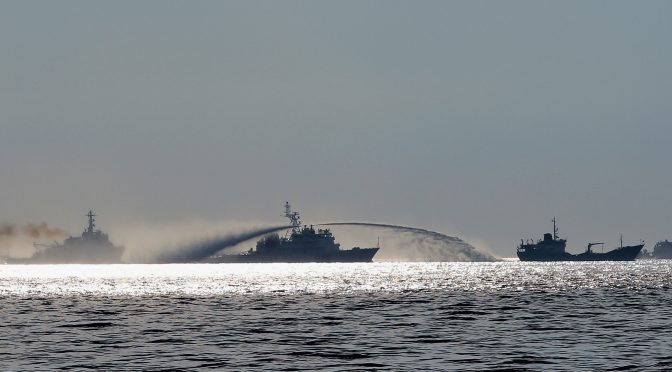
Erickson: Most CCG cutters are unarmed, and PAFMM vessels are minimally armed at most. They assert Chinese prerogatives through employment of a range of nonlethal tactics. In many cases, Chinese gray zone ships are themselves the weapon: they bump, ram, and physically obstruct the moments of other vessels. They also employ powerful water cannons to damage sensitive equipment aboard foreign ships and flood their power plants. Foreign states are often helpless to respond because China has the region’s most powerful navy, which gives it escalation dominance.
Q: How have regional states reacted to Chinese maritime gray zone operations? Have some had more effective responses than others?
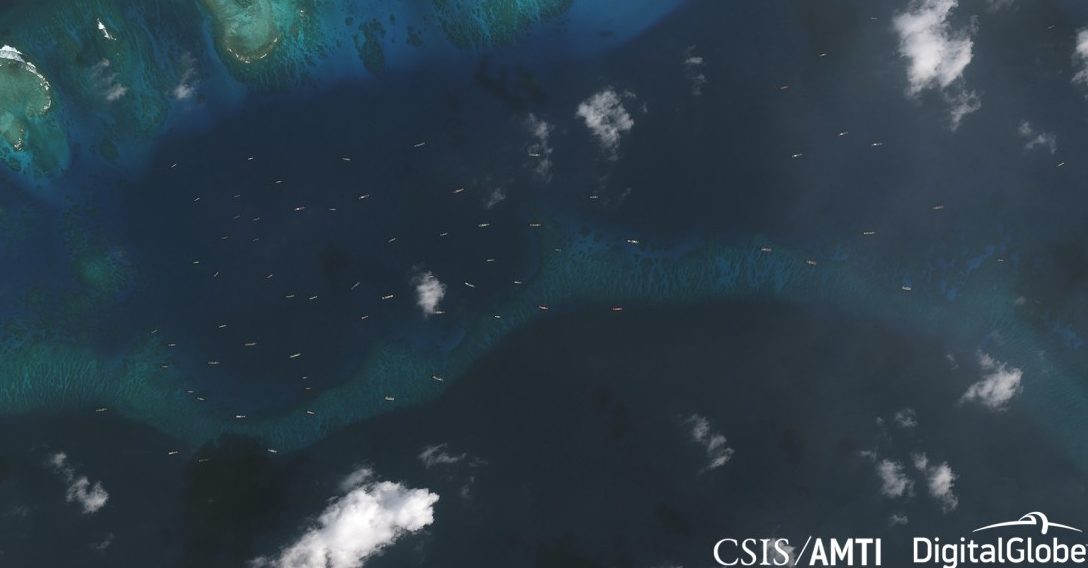
Martinson: Regional states have not presented China with a united front. They have each handled Chinese encroachments differently. China’s strongest neighboring sea power, Japan has taken the most vigorous actions. As Adam Liff outlines in his chapter, it has bolstered its naval and coast guard forces along its southern islands. It has also taken bold steps to publicize China’s gray zone actions. Vietnam has been a model of pushback against Beijing’s maritime expansion, as Bernard Moreland recounts in his chapter. But even its resistance has limits. In July 2017, Beijing likely used gray zone forces to compel Hanoi to cancel plans to develop oil and gas in its own EEZ, in cooperation with a Spanish company. Other states have taken a much more conciliatory approach to China’s incursions in the South China Sea. The Philippines, for example, is apparently acquiescing to Beijing’s desire to jointly developdisputed parts of the South China Sea—areas that a 2016 arbitration ruling clearly place under Philippine jurisdiction. Meanwhile, China continues to push Manila in other ways. Philippine supply shipments to Second Thomas Shoal are still subject to harassment. China has recently concentrated a fleet of gray zone forces just off the coast of Philippine-occupied Thitu Island, in an apparent effort to pressure Manila to discontinue long-planned repairs and updates to its facilities there.
Chinese fishing vessels massed off Philippine-occupied Thitu Island in January 2019. (CSIS/AMTI, DigitalGlobe)
At the same time, China itself continues to develop reclaimed land at Mischief Reef, a mostly submerged feature which because of its location clearly belongs to the Philippines. For its part, Malaysia has not publicly opposed Chinese incursions in its jurisdictional waters. But it is apparently proceeding with plans to develop seabed resources near the Chinese-claimed Luconia Shoals. Chinese coast guard vessels patrol the area, but have not forced a cessation of exploratory drilling operations—including those conducted by the Japanese-owned drilling rig Hakuryu 5in February 2018. This story will be worth following, as Malaysia makes decisions about next steps. In 2016, Indonesia took robust actions to crack down on Chinese fishing activities near the southern part of the nine-dash line, northeast of its Natuna Islands. Things have been fairly quiet in the years since, perhaps because CCG vessels are escorting the fishing fleetto the area.
Q: It seems like China’s gray zone strategy is more often directed at other countries. Why is this topic important for U.S. national security?
Erickson: The U.S. Navy has also been targeted by China’s gray zone forces. U.S. Navy special mission ships such as the USNS Bowditch, USNS Impeccable, USNS Effective, USNS Victorious, and USNS Howard O. Lorenzen have been shadowed and harassed, victims of China’s erratically-enforced opposition to foreign naval activities within its claimed EEZ. To be sure, China’s gray zone campaign is largely targeted at other territorial claimants, but two of these countries—Japan and the Philippines—are U.S. allies. Washington’s robust alliance with Tokyo, in particular, is critical to American presence and peace preservation in a vital but vulnerable region. Chinese bullying behavior threatens to undermine these alliances and could trigger direct American military intervention if China’s gray zone operations were to escalate into armed attack. Moreover, as Jonathan Odom points out in his chapter, China’s activities violate important international conventions and norms. This means they are weakening key pillars of the international maritime order, and with it the global system on which peace and prosperity depend. In many cases China’s gray zone forces are used to assert maritime claims that have no basis in international law.
Q: And how can the U.S. Navy, as a more high-end force, better handle these sorts of Chinese paramilitary forces without risking escalation?
Martinson: If the United States wants to be effectual, it must do more to expose China’s gray zone activities, and it must accept a degree of risk in opposing them more strongly. China’s gray zone activities cannot be easily deterred, because each individual act is calculated to fall below American red lines. If Washington wants to get serious about countering China’s gray zone expansion, it must do more than conduct “presence” and “freedom of navigation” operations—which appear to sit at the heart of the current approach. The former cannot deter Beijing from taking tactical actions in the gray zone. The latter does little to defend the interests of allies and partners. In our concluding chapter, we suggest ways that the U.S. Navy can do more to help them protect their legitimate interests and defend the legal norms and conventions that China’s behavior threatens to erode. In short, the United States should be out there with them, operating on the front lines of China’s seaward expansion. To that end, it must develop a range of nonlethal tactics that it can use to achieve local effects without resorting to use of force.
Dr. Andrew S. Erickson is a Professor of Strategy in the China Maritime Studies Institute and the recipient of the inauguralCivilian Faculty Research Excellence Awardat the Naval War College. He is an Associate in Research at Harvard University’s John King Fairbank Center for Chinese Studies and a member of the Council on Foreign Relations. In 2013, while deployed in the Pacific as a Regional Security Education Program scholar aboard USS Nimitz, he delivered twenty-five hours of presentations. Erickson is the author of Chinese Anti-Ship Ballistic Missile Development (Jamestown Foundation/Brookings Institution Press, 2013). He received his Ph.D. from Princeton University. Erickson blogs at www.andrewerickson.com.
Ryan D. Martinson is a researcher in the China Maritime Studies Institute at the U.S. Naval War College. He holds a master’s degree from the Fletcher School of Law and Diplomacy at Tufts University and a bachelor’s of science from Union College. Martinson has also studied at Fudan University, the Beijing Language and Culture University, and the Hopkins-Nanjing Center. The views expressed are those of the authors and do not reflect the official policy or position of the U.S. Navy, the Department of Defense, or the U.S. Government.
Dmitry Filipoff is CIMSEC’s Director of Online Content. Contact him at Content@cimsec.org.
Featured Image: A China Coast Guard ship uses a water cannon to harass a Vietnamese law enforcement vessel near the disputed Paracel Islands on May 27, 2014. (Photo by The Asahi Shimbun)
Every year, about this time, the leaders of the People’s Liberation Army Navy (PLAN) send their regards to Chinese sailors deployed overseas during the Lunar New Year. Every year these messages are covered by the Chinese press. Few in China pay attention to these reports. Fewer foreign observers even know of them, but they should. This annual ritual tells the story of China’s emergence as a global naval power.
A Tradition is Born
PLAN leaders made their first Lunar New Year’s call in the second year of China’s anti-piracy escort mission in the Gulf of Aden. On the afternoon of February 11, 2010 PLAN Commander Wu Shengli and Political Commissar Liu Xiaojiang met in the PLAN Operations Command Center. There they held a video teleconference (VTC) with the members of China’s 4th escort task force. According to Chinese press reports, the two leaders expressed their “holiday wishes” and “enthusiastic regards” to all Chinese sailors who were “fighting on the frontlines” in China’s anti-piracy mission.1
This VTC established the pattern for future lunar salutations. Admiral Wu praised the sailors for all that they had achieved while abroad. After 105 days, they had escorted 359 commercial ships, rescuing three from pirate attack. In doing their duty, they had portrayed an image of China as a responsible great power and “won wide acclaim both at home and abroad.” Wu entreated his sailors to faithfully implement the policies and instructions of the Central Military Commission and its Chairman, Hu Jintao. He warned them against complacence—they can and should strive to do better. Liu Xiaojiang followed with more praise, and orders for the task force commander to arrange fun activities so that sailors could have a safe, auspicious, and happy Spring Festival.2
During the two years that followed, only the anti-piracy mission kept Chinese sailors in the “far seas” (远海) during the Lunar New Year.3 From their station off the Horn of Africa, these forces helped protect Chinese commercial vessels and personnel transiting the Gulf of Aden. They also performed other non-combat operations, such as evacuating Chinese citizens from Yemen in 2015. Meanwhile, the Chinese Navy was developing another far seas mission set—high-intensity combat operationseast of the first island chain. In 2013, this objective brought Chinese sailors to sea on the most important holiday of the year.
Year of the Snake (2013)
On February 6, 2013, Wu Shengli and Liu Xiaojiang held two VTCs—a first in the history of New Year’s salutations. They called Task Force 570, which was conducting escort operations in the Gulf of Aden, China’s 13th escort task force to date. For their second call, they connected with Task Force 113, then doing far seas training in the Philippine Sea. It comprised three vessels from the North Sea Fleet: the destroyer Qingdao and two frigates, the Yantai and Yancheng.4
Deployments to the Philippine Sea were not unusual. The PLAN routinized operations east of the first island chain in 2007. Task Force 113 represented just one of six (or more) far seas deployments in 2013, and it was certainly not the biggest. Indeed, in October of that year elements of all three PLAN fleets—North, East, and South—congregated in the Philippine Sea for MANEUVER-5, the PLAN’s first large-scale confrontation exercise in the far seas. But Task Force 113 was the first to conduct far seas training during the Spring Festival. With this decision, Wu and Liu showed that China was serious about its plans to transform the PLAN into a force capable of conducting high-intensity operations east of the first island chain, against the only potential adversary that could conceivably be there—the U.S. Navy.5 The years since have seen a dramatic acceleration in the pace of this transformation.
Year of the Horse (2014)
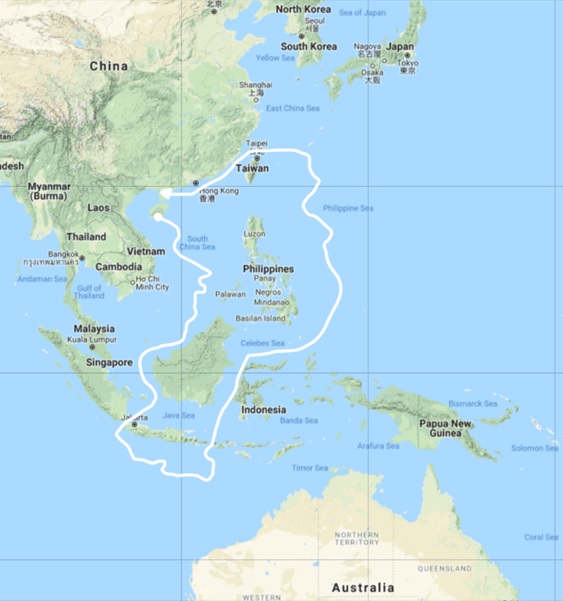
As Chinese citizens prepared to celebrate the year of the horse, hundreds of PLAN personnel were abroad. Wu and Liu made two calls on January 27, 2014. Aside from the 16th escort task force, they talked to Task Force 989, then pioneering a new model for far seas training.6 Up until then, PLAN far seas training mostly involved forays into the Philippine Sea. Task Force 989 conducted the PLAN’s first “two-ocean” (两洋) deployment. The task force—which comprised three surface combatants from the South Sea Fleet—departed Sanya, Hainan on January 20th.7 It sailed through the South China Sea, where it drilled with China’s submarine force, sharpening skills and tactics needed to break an enemy blockade. After that, the task force continued south, lingering at the James Shoal to hold a ceremonymarking the southernmost extent of claimed Chinese territory. It then sailed through the Sunda Strait, into the Indian Ocean. After training in waters south of Java, the three ships next proceeded north into the western Pacific via the Lombok Strait, Makassar Strait, and Celebes Sea. After operating in the Philippine Sea, Task Force 989 crossed the first island chain at the Miyako Strait, before heading home to Zhanjiang, Guangdong, where it arrived on February 11th. During its 23-day deployment, the task force conducted “realistic” (实战化) training along the strategically-important waterways connecting the Pacific Ocean and Indian Ocean.8
The “Two-Ocean” Deployment of Task Force 989 (January 20-February 11, 2014)
Year of the Goat (2015) and Year of the Monkey (2016)
The years 2015 and 2016 saw increased emphasis on noncombat operations in the far seas. In the past, anti-piracy escort task forces relieved before the Lunar New Year always arrived home before the holiday. This changed in the year of the goat. When Admiral Wu and the new PLAN Political Commissar, Miao Hua, called the navy’s overseas forces on February 15, 2014, Task force 547 was on its third month of escort operations in the Gulf of Aden.9 Meanwhile, the 18th escort task force was then in Piraeus, Greece, on a four-day port visit.10 It would not arrive home until March 19, 2015. Wu and Miao also connected with Task Force 138, led by the East Sea Fleet’s Sovremenny-class destroyer Taizhou, which spent the Lunar New Year training in the Philippine Sea.
The year of the monkey looked much the same. When Wu and Miao called on the afternoon of February 2nd, they spoke to three different PLAN task forces operating abroad. Task Force 57, the 21st escort task force, was then just pulling into India to participate in an international fleet review. Its relief, Task Force 576, was conducting anti-piracy operations off the Horn of Africa. Meanwhile, a task force led by the North Sea Fleet’s destroyer Harbin was deployed somewhere in the Western Pacific.11
Year of the Rooster (2017)
No PLAN surface forces operated east of the first island chain during the 2017 Lunar New Year—at least none that Beijing cared to admit.12 The PLAN’s new Commander, Vice Admiral Shen Jinlong, and Political Commissar Miao Hua made the annual New Year’s call on the morning of January 20, 2017. They spoke to two escort task forces: the 24th (then preparing to arrive in Qatar), and the 25th (on station off the Horn of Africa).13 Shen and Miao inaugurated a new tradition on this day. They held a VTC with PLAN personnel involved in the construction of China’s massive new military bases in the disputed Spratly Islands. In his remarks, Shen described them as operating “on the front lines of island/reef construction.” He praised the sailors for “resolutely implementing Chairman Xi’s policy” and achieving the “strategic aims” (战略目标) of the new construction, which he did not define.
Why did Shen and Miao conduct a VTC with sailors in the Spratly Islands in 2017, when PLAN personnel had been there since the 1980s? Why only the Spratlys, not the Paracel Islands, which were also in the midst of a construction boom, or naval forces operating along other parts of China’s maritime frontier? This decision suggests that PLAN leaders regarded the new Spratly bases as more than just installations with which to influence events in the South China Sea, but also as key components of the Navy’s far seas force structure.
Year of the Dog (2018)
On the afternoon of February 12, 2018, PLAN leaders held four VTCs—more than ever before.14 Vice Admiral Shen Jinlong and new Political Commissar Qin Shengxiang talked to the 28th escort task force, which had just completed an escort mission to Kenya. They also called Task Force 173, then in the eastern Indian Ocean conducting a “two ocean” deployment.15 This task force comprised four ships from the South Sea Fleet—the destroyer Changsha, frigate Hengyang, LPD Jinggangshan, and supply ship Luomahu. After the call, it would sail north into the Philippine Sea, disappointing widespread media speculation that it might head to the Maldives during the climax of that country’s political crisis. Task Force 173 arrived home on February 25, 2018.
Shen and Qin also called PLAN sailors stationed at China’s first overseas military base. According to Chinese reporting, Shen praised the sailors for “blazing the path for overseas base construction,” clearly indicating that while Djibouti may be the first, it would not be the last. Shen and Qin also called Chinese sailors stationed in the Spratly Islands, which they now called the “Spratly Garrison” (南沙守备部队). Shen thanked them for “their important contributions to guarding and constructing the Spratlys.”16
Shen and Qin made four calls on that day; but they should have made a fifth. Chinese reporting on the VTC excludes any mention of Task Force 171 (i.e., the 27th escort task force). It comprisedthree vessels—the destroyer Haikou, the frigate Yueyang, and the supply ship Qinghaihu. In the second half of January 2018, after making port visits to Tunisia and Algeria, Task Force 171 passed through the Strait of Gibraltar before navigating south along the west coast of Africa. On February 7th, the warships held anti-piracy exercises somewhere in the Gulf of Guinea.17 Reporting on Task Force 171 then went quiet for 12 days, until February 19, when the ships arrived in Cape Town, South Africa, for a two-day port visit. This timeline indicates that when Shen and Qin made their calls on February 12, Task Force 171 was somewhere in the South Atlantic.
Shen and Qin almost certainly called Task Force 171—why would they exclude them? But if so, why choose not to publicize the call? There is no clear answer. Was the mere presence of the task force in the Atlantic judged too sensitive? Unlikely, since this was not the first time that PLAN ships had been there. Just six months earlier, Task Force 174 took the long way home from the Baltic, where it had held exercises with the Russian Navy.18 In mid-August 2017, it conducted simulated “missile attack exercises” somewhere in the Atlantic.19 But its activities were only publicized in the PLAN press, not the wider media, as New Year’s salutations always are. Perhaps the problem was that allowing press coverage of the VTC would require that PLAN leaders publicly explain what the task force was doing in the Atlantic, and why.
Year of the Pig (2019)
February 2, 2019 was a very busy day at the PLAN Operations Command Center. On the eve of the lunar holiday, Shen Jinlong and Qin Shengxiang called five different Chinese task forces operating abroad. Only one anti-piracy escort task force was on their list—the 31st. The 30th escort task force had arrived in Qingdao on January 27, just in time to celebrate the Lunar New Year. As in 2018, Shen and Qin called the Spratly Garrison and the PLAN’s base in Djibouti. However, for the first time in PLAN history, two task forces conducted far seas training deployments during the Spring Festival. The first comprised a task force led by the East Sea Fleet destroyer Zhengzhou. Chinese press coverage did not indicate where Task Force 151 was, or what it was doing.
The Chinese media did cover the movements of the other far seas training task force then at sea. Task Force 174 left Zhanjiang, Guangdong on January 16. It comprised the destroyer Hefei, frigate Yuncheng, LPD Changbaishan, and supply ship Honghu. When Shen and Qin contacted them, they were not in the Philippine Sea, but somewhere in the Central Pacific—that is, somewhere in the vast expanse of ocean between Guam and Hawaii.
Also new, the Chinese press described Task Force 174 as a “far seas joint training task force” (远海联合训练编队). It was working in conjunction with other services under the Southern Theater Command—the PLA Air Force, PLA Rocket Force, and the PLA Strategic Support Force. Official Chinese media sources revealed that one of their aims was to “explore methods and approaches for building joint operations combat capabilities to win modern war at sea.”
Conclusion
The information shared in the PLAN’s annual New Year’s greetings does not account for everything the service is doing abroad. The case of Task Force 171 proves that. These short news reports tell us nothing about the expansion of Chinese submarine operations into the Indian Ocean. Nor do they acknowledge other naval activities best kept secret, such as intelligence collection and hydrographic surveys.
Still, the short history of China’s Lunar New Year’s deployments tells us much about the key events in China’s rise as a global naval power. This history shows a growing emphasis on both the combat and non-combat elements of China’s far seas naval strategy. It highlights the geographic expansion of China’s overseas deployments—where once Chinese ships were concentrated in the northwest Indian Ocean and the Philippine Sea, they now operate as far away as the Atlantic Ocean and the Central Pacific.
In the year of the snake, China’s far seas force structure comprised small task forces largely reliant on at-sea replenishment and the expensive hospitality of foreign ports. In the year of the pig, it included significant shore-based infrastructure, including the country’s first—but not last—overseas military base in Djibouti and colossal new installations in the Spratly Islands. This chronicle of the PLAN’s New Year’s deployments also shows how China’s growing emphasis on jointness is affecting naval operations abroad, and informing Beijing’s preparations for high-end conflict at sea. All of these things have happened in a single decade.
This history is far from over. By all accounts, the Chinese Navy has a long way to go before fully realizing its nautical ambitions. Xi Jinping has told the PLAN to set its sights on becoming a “world-class navy” by mid-century. What that means is impossible to tell. The PLAN has not shared its benchmarks for success. What is clear is that the decisions of PLAN commanders on the eve of each Lunar New Year will continue to serve as a useful gauge for progress in this journey, wherever it ends up.
Ryan D. Martinson is a researcher in the China Maritime Studies Institute at the U.S. Naval War College. The views expressed are those of the author and do not reflect the official policy or position of the U.S. Navy, Department of Defense or the U.S. Government.
References
1. 袁珍军 [Yuan Zhenjun] 海军首长视频慰问525编队全体官兵 [“Head of the Navy Holds a Video-Teleconference to Send Regards to All Officers and Enlisted of Task Force 525”] 人民海军 [People’s Navy] February 12, 2010, p. 1.
2. Ibid
3. In Chinese military discourse, the term “near seas” (近海) refers to the Bohai Gulf, Yellow Sea, East China Sea, and South China Sea. The term “far seas” refers to all waters beyond the near seas.
4. 蒲海洋 [Pu Haiyang] 海军首长视频慰问570,113 编队官兵 [“Head of Navy Holds Video-Teleconference to Send Regards to the Officers and Enlisted of Task Force 570 and Task Force 113”] 人民海军 [People’s Navy] February 8, 2013, p. 1.
5. During the VTC, Admiral Wu told the sailors that their sacrifice “held important significance for strengthening the concept of readiness embodied in the phrase ‘being able to fight and win’ exploring and putting into practice a mechanism for normalizing far seas training, exercising and improving the service’s ability to conduct far seas missions and tasks, and realizing a good start to the surface fleet’s annual far seas training.” See Pu Haiyang, “Head of Navy Holds Video-Teleconference,” op. cit.
6. 梁庆松 [Liang Qingsong] 海军首长视频慰问546,989编队官兵 [“Head of Navy Holds Video-Teleconference to Send Regards to the Officers and Enlisted of Task Force 546 and Task Force 989”] 人民海军 [People’s Navy] January 28, 2014, p. 1.
7. The task force included the LPD Changbaishan, the destroyer Haikou and the destroyer Wuhan.
8. 高毅 [Gao Yi], 南海舰队远海训练编队返港, 海军副政委王森泰到码头迎接并讲话 [“Far Seas Training Task Force from the South Sea Fleet Returns to Port, Deputy Political Commissar of the Navy Wang Sentai Meets Them Pier Side and Gives a Speech”], 人民海军 [People’s Navy], February 12, 2014, p. 1.
9. 王元元 [Wang Yuanyuan] 海军首长视频慰问547,138编队 [“Head of Navy Holds Video-Teleconference to Send Regards to the Officers and Enlisted of Task Force 547 and Task Force 138”] 人民海军 [People’s Navy] February 16, 2015, p. 1.
10. The task force was in Greece from February 16-20, 2015. Perhaps because the crew were too busy ashore, Wu and Miao sent their New Year’s salutations via written message. See Wang Yuayuan, “Head of Navy Holds Video-Teleconference,” op. cit.
11. 王元元 [Wang Yuanyuan] 海军首长视频慰问海上任务编队 [“Head of Navy Holds Video-Teleconference to Send Regards to Task Forces at Sea”] 人民海军 [People’s Navy] February 2, 2016, p. 1.
12. A task force departed Sanya, Hainan for a “two-ocean” training deployment on February 10, just after the holiday ended.
13. 梁庆松 [Liang Qingsong] 海军首长视频慰问112,568编队和岛礁建设部队官兵 [“Head of Navy Holds Video-Teleconference to Send Regards to Officers and Enlisted from Task Force 112, Task Force 568, and Island/Reef Construction Unit”] 人民海军 [People’s Navy] January 23, 2017, p. 1.
14. 王元元 [Wang Yuanyuan] 海军领导视频慰问海上任务编队,驻南沙岛礁和海外保障基地官兵 [“Navy Leaders Hold Video-Teleconference to Send Regards to Sailors from Task Forces at Sea, Located at Spratly Islands/Reefs, and Overseas Support Base”] 人民海军 [People’s Navy] February 13, 2018, p. 1.
15. The People’s Navy newspaper reports that on February 13, 2018 the task force was operating in the eastern part of the Indian Ocean, doing an anti-piracy exercise. See 周启青 [Zhou Qiqing] 大洋深处的”飓风营救” [“A ‘Hurricane Rescue’ in the Depths of the Ocean”] 人民海军 [People’s Navy] February 26, 2018, p. 1.
16. Wang Yuanyuan, “Navy Leaders Hold Video-Teleconference,” op. cit.
17. 刘鑫 [Liu Xin] 我护航编队几内亚湾组织机动巡航训练 [“Navy Escort Task Force Holds Maneuver Patrol Training in the Gulf of Guinea”] 人民海军 [People’s Navy] February 12, 2018, p. 1.
18. Task Force 174 comprised the Type 052D destroyer Hefei, Type 054A frigate Yuncheng, and supply ship Luomahu.
19. 梁庆松 [Liang Qingsong] 砺兵,万里航程真如铁—174舰艇编队远海大洋实战化练兵纪事 [“Grinding the Sailors, A Long Journey is Just Like Iron—A Chronicle of Task Force 174’s Realistic Far Seas Training”] 人民海军 [People’s Navy] September 27, 2017, p. 1.
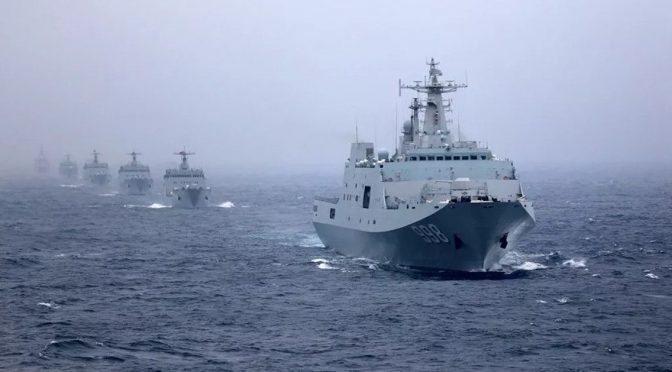
Featured Image: Leading by the amphibious dock landing ship Kunlunshan (Hull 998), vessels attached to a landing ship flotilla with the South China Sea Fleet under the PLA Navy steam in formation during the maritime live-fire training in waters of the South China Sea from January 17 to 19, 2018. (eng.chinamil.com.cn/Photo by Liu Jian)