Category Archives: Capability Analysis

Analyzing Specific Naval and Maritime Platforms

Piracy 2.0 : The Net-Centric Evolution

By Brian Evans

Network-Centric Warfare derives its power from the strong networking of a well-informed but geographically dispersed force. – VADM Arthur Cebrowski, Proceedings 1998

Almost twenty years ago the pages of Proceedings carried an article by RDML Cebrowski that introduced the concept of network-centric, or net-centric, warfare.[1] The concept transformed the manner in which the United States (U.S.) Navy operates and fights. The principles that defined net-centric warfare remain relevant as they support Navy’s current pillars of Information Dominance: Battlespace Awareness, Assured Command and Control (C2), and Integrated Fires. The success of net-centric warfare has not gone unnoticed. Navies around the world are working to develop their own net-centric solutions. As a result, the U.S. Navy should not be surprised when enterprising individuals around the world similarly take note and make the evolutionary leap from traditional piracy to net-centric piracy.

While piracy has been a scourge for the duration of human history, the technological advances of the 21st century provide potential pirates transformational means, methods and opportunities. While the world has yet to witness a case of net-centric piracy, the two scenarios below present possible piracy events leveraging today’s technology.

Basic Net-centric Piracy

Sixty-two nautical miles south east of Singapore – 17JUL15 1154C: An Indonesian pirate opens his laptop and logs onto the internet via satellite phone. His homepage is a commercial Automated Identification System (AIS) website providing real-time track data from coastal and satellite receivers.[2] The laptop, satellite phone and website subscription were all funded by his investors.[3] As he scans his homepage, he looks for AIS contacts that meet his desired vessel profile for cargo type, transportation firm, flag, and speed of advance. Today there are two AIS tracks of interest matching his profile and likely to pass through his preferred zone of operation, MV OCEAN HORIZONS and MW ORIENTAL DAWN. He then checks weather conditions and determining that they are favorable, he sends individual texts messages containing coordinate and track data for the AIS tracks of interest. The text recipients are two fishing boat captains, one located in Belawan, Indonesia and the other in Dungun, Malaysia.

Indonesian Pirates
From: The Maritime Executive – Indonesian Pirates

Forty-six nautical miles east of Belwan, Indonesia – 17JUL15 1646C: MV ORIENTAL DAWN passes a non-descript fishing boat 46 nautical miles off the coast of Indonesia. Unbeknownst to the crew of the MV ORIENTAL DAWN, this fishing boat is captained by the pirate’s associate from Belawan. The fishing boat’s captain discretely observes the passing vessel through a pair of high-powered binoculars. Seeing barbed wire along the railings and an individual on the ship’s deck that does not appear to be a member of the crew, the fishing boat captain utilizes a satellite phone to call and report his observations to his Indonesian pirate contact. Based on this information the Indonesian pirate determines that MV ORIENTAL DAWN is not a suitable target.

One-hundred seventeen nautical miles east of Singapore – 17JUL15 1707C: The Indonesian pirate receives a call. This time it is the fishing boat captain from Dungun. The captain reports that the MV OCEAN HORIZONS is loaded down creating a smaller freeboard and there does not appear to be any additional security measures present. Given this assessment, the Indonesian pirate decides that MV OCEAN HORIZONS is a target of opportunity. He immediately has the crew of his ship alter course.

Thirty-seven nautical miles east of Pekan, Malaysia – 18JUL15 0412C: The Indonesian pirate launches two high-speed skiffs from his ship, both carrying multiple armed personnel. The Indonesian pirate mothership remains over the horizon, but in radio contact while the skiffs conduct the remainder of the intercept.

Sixty-two nautical miles east of Pekan, Malaysia – 18JUL15 0642C: The armed personnel from the skiffs board MV OCEAN HORIZONS and catch the crew off guard. Once in control of the ship, they contact the Indonesian pirate via radio and report their success. The Indonesian pirate immediately opens his laptop and reports his success to his investors. He also lists the ship’s cargo for auction on a dark website and sends a ransom demand to the employer of the MV OCEAN HORIZON crew.

Sophisticated Net-centric Piracy     

Moscow, Russia – 17JUL15 0126D: After a series of all-nighters over the last week, a Russian hacker has gained access to a crewmember’s computer onboard the MV PACIFIC TREADER.[4] Using this access he maps the shipboard network. Discovering a diagnostic and maintenance laptop used for the ship’s automation and control system on the network, he quickly exploits the laptop’s outdated and unpatched operating system to install a tool on the automation and control system.[5] The tool enables a remote user to either trigger or disable a continual reboot condition. Once installed, the hacker posts the access information for the tool’s front end user interface in a private dark web chatroom.

Prague, Czech Republic – 16JUL15 2348A: Sitting in his Prague apartment, a pirate receives a message on his cellphone via a private dark web chatroom. The message is from one of several hackers he contracted to gain access to control or navigation systems onboard vessels operated by the TRANS-PACIFIC SHIPPING LINE. With the posted access information, he logs onto his laptop and tests his access into the MV PACIFIC TREADER automation and control system. After successfully establishing a connection he closes out of the tool and electronically transfers half of a contracted payment due to his hired hacker. Next using a commercial AIS website providing real-time track data from coastal and satellite receivers, he determines that MV PACIFIC TREADER is likely headed into port in Hong Kong.[6] Posting a message in a different private dark web chatroom, the pirate provides the identifying information for MV PACIFIC TREADER.

Hong Kong, China – 19JUL15 0306H: On a rooftop in Hong Kong, a young college student pulls an aerial drone out of her backpack. She bought it online and it is reportedly one of the quietest drones on the market. She also pulls three box-shaped objects out of her backpack. Hooking one of the objects to the drone, she launches it and flies it across Hong Kong harbor in the direction of a ship she identified during the day as the MV PACIFIC TREADER. Using the cover of darkness she lands the drone on the top of the pilot house and releases the object. Repeating this process twice more, she places the box shaped objects on other inconspicuous locations on the ship. After bagging up her drone, she posts a message to a dark web chatroom simply stating that her task is complete. Almost immediately afterwards she receives a notification that a deposit was made into her online bank account.

Prague, Czech Republic – 25JUL15 1732A: After eating a home-cooked meal, the pirate sits down at his laptop and checks the position of MV PACIFIC TREADER via the commercial AIS website he subscribes to. Observing that the MV PACIFIC TREADER is relatively isolated in the middle of the Pacific Ocean, he opens the remote tool that provides him access to the ship’s automation and control system. He sends a text message and then clicks to activate the tool.

Two-thousand ninety-three nautical miles north east of Hong Kong – 26JUL15 0332K: Onboard MV PACIFIC TREADER an explosion engulfs the bow of the ships sending flames into the dark air. Immediately, the ship’s engines roll to a stop as the navigation and ship’s control system computers go into a reboot cycle. The lone watchstander on the bridge is paralyzed to inaction by the surprise and violence of the events unfolding around him. The Master immediately comes to the bridge, completely confused by the events occurring onboard his ship.

Prague, Czech Republic – 25JUL15 1736A: The pirate confirms via his remote tool that the ship’s automation and control system is in a continuous reboot cycle, then he re-checks the commercial AIS website and confirms that MV PACIFIC TREADER is dead in the water. He immediately sends an email to the TRANS-PACIFIC SHIPPING LINE demanding a ransom, stating MV PACIFIC TREADER will remain dead in the water and more explosive devices will be activated until he is paid.

New Means – Same Motive

These scenarios illustrate how the evolution of technology and the increased connectivity of systems and people potentially enable a fundamental shift in the nature of piracy. Despite the change in means and geographic distribution of actors, net-centric and traditional piracy both utilize physical force or violence, or the threat thereof, by a non-state actor to seize or detain a vessel operating on the high seas. The key enabler of net-centric piracy is the Internet.
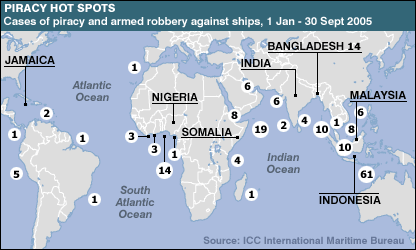
Piracy Hot Spots

The Internet is the net-centric pirate’s “high-performance information grid that provides a backplane for computing and communications.”[7] Admiral Cebrowski argued that this information grid was the entry fee for those seeking net-centric capabilities.[8] What Admiral Cebrowski did not know was how rapidly the Internet would evolve and enable near-instantaneous global communications at relatively low costs, allowing anyone who desires access to a high-performance information grid.

As the net-centric pirate’s high-performance information grid, the Internet serves as a command and control network as well as the means for disseminating intelligence information, such as vessel location or the presence of physical security measures. The intelligence that is disseminated may also have resulted from collections performed via the Internet. One collection means is to leverage the vast area of private and commercial data sources available for public consumption, again at little or no cost, such as shipping schedules and AIS data. A second means of collection uses the Internet to conduct intelligence, surveillance and reconnaissance (ISR) via cyber techniques; however, only the most sophisticated net-centric pirates will possess this capability. Similarly, highly sophisticated net-centric pirates may be able to achieve global weapons reach by producing physical effects via cyber means over the Internet, eliminating the need for the pirate to be physically present in order to seize or detain a vessel.
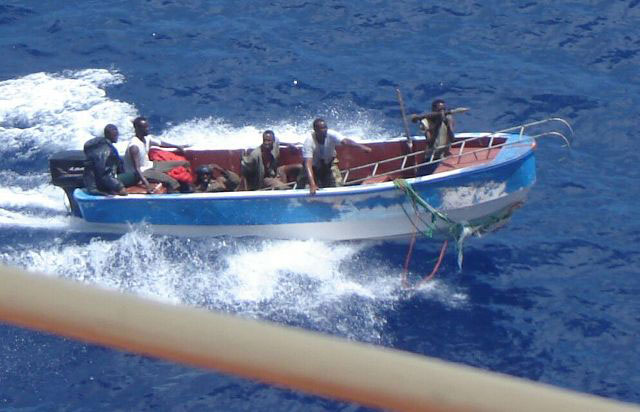
Somali Pirates
From: OCEANUSLive – Somali Pirates

The attractiveness of net-centric piracy is the low barrier to entry, both in risk and cost. Since the Internet is the key enabler of net-centric piracy, its low cost and ease of use vastly expand the potential pirate population. The anonymity of the Internet also allows potential net-centric pirates to meet, organize, coordinate and transfer monetary funds with a great degree of anonymity. As a result, the risks of arrest or capture are significantly reduced, especially since a net-centric pirate may not be able to identify any of their co-conspirators. Similarly, the ability of net-centric piracy to enable remote intelligence gathering or even produce physical effects via cyber techniques removes a significant element of physical risk associated with traditional piracy. The monetary gain from the successful capture of a vessel compared to the low cost and risk currently associated with net-centric piracy make it an attractive criminal enterprise.

Countering Net-centric Piracy

The United Nations Convention of the Law of the Sea (UNCLOS) Article 101 defines piracy as:

  1. any illegal acts of violence or detention, or any act of depredation, committed for private ends by the crew or the passengers of a private ship or a private aircraft, and directed:
    • on the high seas, against another ship or aircraft, or against persons or property on board such ship or aircraft;
    • against a ship, aircraft, persons or property in a place outside the jurisdiction of any State;
  2. any act of voluntary participation in the operation of a ship or of an aircraft with knowledge of facts making it a pirate ship or aircraft;
  3. any act of inciting or of intentionally facilitating an act described in subparagraph (1) or (2).[9]

Under this internationally recognized legal definition of piracy, net-centric piracy clearly results in violence against or detention of vessels on the high seas for private ends. It is also clear from this definition that any activities associated with facilitating a piracy event, such as intelligence collection or compromising a vessel’s computerized control systems, are also considered piracy under international law. International law also states that “All States shall cooperate to the fullest possible extent in the repression of piracy on the high seas or in any other place outside the jurisdiction of any State.”[10] As a result, the international community must resolve how it will counter net-centric piracy, where pirates need not operate on the high seas and may be located thousands of miles from the target vessel.

The challenge facing the international community from net-centric piracy is compounded by immaturity of international cyber law. Currently the authorities and responsibilities of international organizations, governments and law enforcement agencies with regards to the use of the Internet to commit piracy are undetermined. This challenge is further complicated by the fact that the Internet is a manmade domain where all potions are essentially within the territory of one state or another. As a result, disrupting net-centric piracy operations will require a significant degree of international coordination and information sharing. Extensive international cooperation will also be required to identify, locate, and apprehend individuals involved in net-centric piracy.
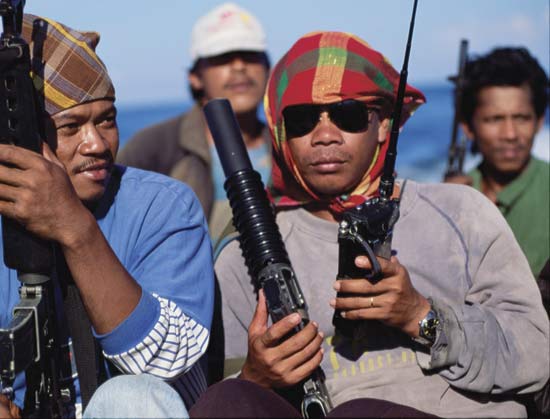
Pirates
From: Encyclopedia Britannica – Pirates utilize a range of weapons and technology

While an occurrence of net-centric piracy has yet to occur, the opportunity and capabilities required for such an event exist today. The U.S. Navy should not be caught off guard. Instead, the Navy should take the following actions:

  • Raise awareness within the international maritime community regarding the risks and realities of net-centric piracy
  • Provide best practice and limited cybersecurity threat information to transnational maritime shipping companies
  • Work with partner Navies to develop means and methods for disrupting net-centric piracy, including developing an appropriate framework for information sharing and coordination
  • Work with Coast Guard, law enforcement and international partners to develop a cooperative construct for identifying, locating and apprehending net-centric pirates
  • Engage with the State Department to advance international dialog on net-centric piracy, including the need for consensus on international law and processes for prosecution of net-centric pirates

An enduring lesson of human history is that opportunity for profit, regardless of difficulty or brevity, will be exploited by someone somewhere. Net-centric piracy represents an opportunity to generate revenue without requiring the physical risks of traditional piracy. The anonymity and distributed nature of the cyber domain also creates new counter-piracy challenges. Add to this the low cost and availability of unmanned system components coupled with the low barrier of entry for cyber, and the question becomes not whether net-centric piracy will occur but when. With a global interest in maintaining the international maritime order and ensuring the uninterrupted flow of commerce on the high seas, the U.S. Navy must be ready to meet the challenges of net-centric piracy.

LCDR Brian Evans is a U.S. Navy Information Dominance Warfare Officer, a member of the Information Professional community, and a former Submarine Officer. He is a graduate of the U.S. Naval Academy and holds advanced degrees from Johns Hopkins University, Carnegie Mellon University, and the Naval War College. 

The views expressed in this article are those of the author and do not reflect the official policy or position of the United States Navy, Department of Defense or Government.

[1] VADM Arthur K. Cebrowski and John H. Garstka, “Network-Centric Warfare – Its Origin and Future,” U.S. Naval Institute Proceedings, Volume 124/1/1,139 (January 1998).

[2]https://www.vesseltracker.com/en/ProductDetails.html

[3] “Somali Piracy: More sophisticated than you thought,” The Economist (November 2nd, 2013), http://www.economist.com/news/middle-east-and-africa/21588942-new-study-reveals-how-somali-piracy-financed-more-sophisticated-you

[4] Jeremy Wagstaff, “All at sea: global shipping fleet exposed to hacking threat,” Reuters (April 23rd, 2014), http://www.reuters.com/article/2014/04/24/us-cybersecurity-shipping-idUSBREA3M20820140424

[5] Mate J. Csorba, Nicolai Husteli and Stig O. Johnsen, “Securing Your Control Systems,” U.S. Coast Guard Journal of Safety & Security at Sea: Proceedings of the Marine Safety & Security Council, Volume 71 Number 4 (Winter 2014-2015).

[6]https://www.vesseltracker.com/en/ProductDetails.html

[7] VADM Arthur K. Cebrowski and John H. Garstka, “Network-Centric Warfare – Its Origin and Future,” U.S. Naval Institute Proceedings, Volume 124/1/1,139 (January 1998).

[8] Ibid.

[9] United Nations, United Nations Convention on the Law of the Sea (New York: United Nations, Article 101, 1994).

[10] United Nations, United Nations Convention on the Law of the Sea (New York: United Nations, Article 100, 1994).
 

Is There a Class of Armored Cruisers in the U.S. Navy’s Future? (Part Four)

Is There a Class of Armored Cruisers in the U.S. Navy’s Future?


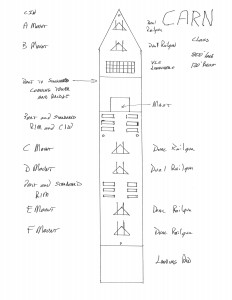
CARN class jpeg

Sketch by Jan Musil. Hand drawn on quarter-inch graph paper. Each square equals twenty by twenty feet.

This article, the fourth of the series, presents a suggestion on how to incorporate the new railgun technology into the fleet in an efficient and effective manner. Railguns, when used as a complement to the various UAVs, UUVs and Fire Scouts discussed earlier will provide the fleet with a potent AAW weapon. Read Part One, Part Two, Part Three.

Interestingly enough, the most important piece of information concerning the new railgun is a number. A single round of ammunition costs $10,000. Eighteen inches of railroad tie shaped steel (which costs less than $200) fitted with the wonders of modern microelectronics provides a startling contrast with the $1M+ cost of the missiles the Navy currently uses against incoming aircraft and missiles. A contrast that is even more in the Navy’s favor since any future opponent will be spending comparable sums for their attack missiles and substantially more for hypersonic cruise missiles.

There are no explosives purchased with the $10,000. This means hundreds of rounds of railroad ties and microelectronics can be safely stored in a ship’s magazine. This is a substantial advantage compared to the VLS missiles in current use by navies around the globe, most of which require specialized loading facilities to reload their missile tubes. In contrast, a railgun-equipped ship can take a much larger ammunition load to sea with it, and reload the magazine at sea if necessary.

The next relevant parameter of the new railgun is its range. At 65 miles this is far less than many long-range missiles, though still quite useful against incoming aircraft and missiles. Note that with an ISR drone or Hawkeye providing over-the-horizon targeting information, a surface ship equipped with a railgun can shoot down incoming aircraft such as the Russian Bear (Tu-95) reconnaissance aircraft before the intruder can lock in on the firing ship. The same is true for any attacking aircraft carrying long-range strike missiles.

This highlights the importance to both sides of providing accurate targeting information first. It also means, strategically, at its heart the railgun in the 21st century maritime environment is a defensive weapon: well positioned to provide defensive fire against incoming attacks, but with an offensive punch limited to sixty-five miles.

That said, with the ability to fire every five seconds the railgun can be very effective, particularly when utilized in quantity when escorting carrier strike groups or when placed between a hostile shore and an ARG.

So far we have noted the positive distinguishing capabilities of the railgun but there are three significant difficulties that come with fielding the weapon. Foremost is the enormous amount of electrical power discharged by the gun when firing. This means any ship equipped with a railgun needs substantial electric power generating capabilities, something certainly beyond the abilities of the DDGs and CCGs currently in the fleet.

Secondly, using these vast amounts of electricity means a large capacitor needs to be located on the deck below the railgun. Large does mean large in this application. No little white pieces of ceramic plugged into a circuit board will do here. The necessary equipment is physically massive and in need of protection from the elements. They will be taking up a substantial amount of space just below the main deck where the railgun has to be mounted, probably one per gun.

The third problem is that all the energy dissipated in launching a round generates heat. Lots and lots of it. Most, but not all, of the energy used to launch the eighteen inches of steel will be recovered back into the ships capacitor, but enough will be lost that the launching rails flexing as the railgun is fired simply must be exposed to the elements so the heat will dissipate in the air. No sailors or flammables nearby please.

The inevitable follow up conclusion means a railgun equipped ship is going to be impossible to hide from opponent’s infrared sensors. Regardless of how stealthy versus radar the ship is, all of that heat is going to stand out like the sun itself to incoming aircraft and missiles equipped with infrared targeting systems, which means it is almost a certainty the firing ship is going to get hit if subjected to a seriously prosecuted attack.

Armor

This ship is not going to be able to hide in a cloud of chaff, it will be heading into the incoming missile strike, placing its full broadside in a position to fire and it will be considered a high priority target.

Unlike almost all naval ships built across the globe since the end of WW2, this class needs to be built with the assumption that incoming missiles will hit it, the plural is intentional, and be able to survive the multiple collections of missile slag and burning fuel and the occasional warhead detonation. Just as we built the 44 gun class of frigates back in the 1780s to be thick hulled in order to survive the gunnery practices of the time, armored up the ironclads of the Civil War and multiple classes of ships intended for the main battle line of the last half of the 19th Century and first half of the 20th Century, we need to built this class to ‘take a licking and keep on ticking’.

Topside armor should cover most of the ship, but the prime purpose of this armor will be to shed missile slag, i.e. what is left of the incoming missile after being intercepted and its fuel. The impact of the metal missile parts is not the prime danger to be protected against here. It is the fuel, and the accompanying fires after impact that is the true danger. So the topside armor needs to keep the slag and fuel on the outside of the ship, hopefully allowing gravity to carry much of the burning fuel to the gunnels and overboard; in the process vastly easing the firefighting teams job in putting out any fires that have started.

Additional armor, probably using a combination of layered materials and empty space, is appropriate for selected topside compartments that need to be protected against a successful missile warhead detonation. Whether it is sailors or equipment that is being protected, only some compartments will need beefed up exterior armor.

After that the CARN (cruiser gun armor, nuclear powered) will need to adapt the principles of the ‘armored citadel’ concepts developed a century ago for battleships to the needs of securing the two, possibly three, nuclear reactors aboard and their associated pumps and other equipment. Whether this is best done with one internal armor layer or two will keep the engineers debating for quite a while as the CARN is designed.

CARN Equipment

So what should the new 25k+ ton armored cruiser have aboard? Nuclear propulsion is an unavoidable necessity given the enormous amounts of power each railgun requires; every five seconds when engaged. Since the primary use of the CARN will be to accompany the fleet’s carriers to provide defensive AAW capabilities, this is actually an advantage for both strategic and tactical reasons. Depending on the amount of power twelve railguns firing broadsides will require, two or three of the standardized nuclear plants being installed in the new carriers should work just fine.

Lots of armor and nuclear power are unavoidable. The following basic list of desired equipment should provide the reader with a good idea of what the CARN should go to sea with.

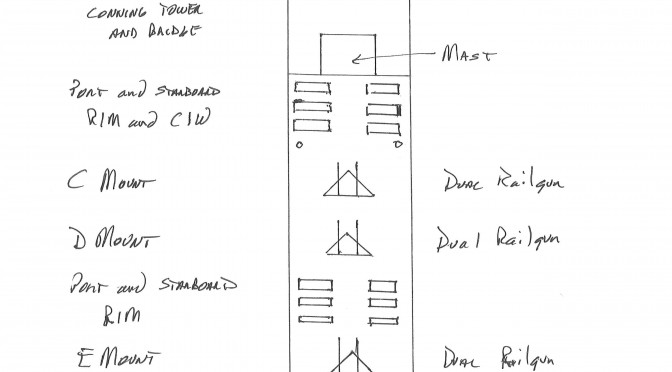
12 railguns mounted in six dual mounts. In the attached sketch A and B mounts are placed forward of the bridge while C, D, E and F mounts are located starting roughly amidships and extend back to the helicopter deck. Dual mounts are suggested since the large size of the capacitors that need to be located directly below each railgun will in practice utilize the full 120 feet of beam provided. Obviously if the capacitors are even larger than this, then single mounts will have to be employed. Let’s hope not as doubling up makes for a much more efficient ship class.

36 VLS tubes capable of a varying load out of ASW, SM-2, SM-6 and long-range strike missiles as the mission at hand calls for.

4 CIWS with one located in the bow, a pair port and starboard amidships and one aft, just behind F mount.

12 rolling missile launchers for close in defense. It will be no secret the CARN is in the task force so a substantial number of the incoming missiles will be using infrared targeting, either in place of, or as a supplement to radar. So adding half dozen rolling missile packs to port and another half a dozen to starboard will provide plenty of localized missile defenses for both the CARN and the task force as whole.

2 ISR drones if VTOL capable. None if VTOL capability is not available

2 Seahawk helicopters

This suggested list very deliberately reduces the VLS and ASW capabilities aboard to a bare minimum. Good ship design concentrates on the primary mission the class needs to accomplish. In the case of the CARN that is absolutely, positively AAW.

In the next article we will examine how adding UAVs, UUVs, Fire Scouts, buoys and railguns in quantity to the fleet can substantially enhance the Navy’s ability to survive in the increasingly hostile A2AD world of the 21st Century. Read Part Five here.

Jan Musil is a Vietnam era Navy veteran, disenchanted ex-corporate middle manager and long time entrepreneur currently working as an author of science fiction novels. He is also a long-standing student of navies in general, post-1930 ship construction thinking, design hopes versus actual results and fleet composition debates of the twentieth century.

CIMSEC content is and always will be free; consider a voluntary monthly donation to offset our operational costs. As always, it is your support and patronage that have allowed us to build this community – and we are incredibly grateful.

Select a Donation Option (USD)

Enter Donation Amount (USD)

Return of the Clandestine Merchant Raider?

By Chuck Hill

Since before recorded history, merchant vessels have been adapted for offensive purposes by navies, pirates, and privateers to destroy enemy commerce or to launch attacks ashore. Frequently they employed disguise and deception. The UK employed Ships Taken Up From Trade (STUFT) during the 1982 Falklands War, the Malaysian Navy has converted two container ships into pirate hunters, and the US Navy has leased ships to support special operations, but I think the last time they were used to attack commerce was WWII. By the end 1943, it appeared that technology, primarily in the form of reliable radios, plus robust challenge-and-reply procedures, a comprehensive naval control of shipping organization, and a seemingly impervious blockade of the German coast, had made this type of  warfare very dangerous, but new technology may now be working in favor of using converted merchant ships as clandestine warships.

The German Experience

During World Wars I and II, the German Navy achieved considerable success using armed merchant ships as clandestine merchant raiders. At small cost they sank or captured a large number of allied merchant vessels, tied down a number of warships searching for the raiders, and even managed to sink allied warships.

In World War I, three raiders, Wolf, Moewe, and Seeadler (a full rigged sailing ship), sank or captured 78 ships totaling 323,644 tons. In addition to the merchant ships they captured or sank directly, merchant raiders proved effective mine layers. One victim of a mine laid by the raider Moewe was the pre-dreadnought battleship EdwardVII, sunk on 6 January, 1915.

In World War II nine German Merchant raiders, Atlantis, Komet, Kormoran, Michel, Orion, Pinguin, Stier, Thor, and Widder, sank or captured 129 ships, totaling 800,661 tons. While this pales in comparison to the sinkings by U-boats, they were far more effective than the regular navy surface raiders, including the vaunted pocket battleships, heavy cruisers, and battleships Scharnhorst and Gneisenau, that managed to sink or captured only 59, totaling 232,633 tons. The merchant raider Kormoran even managed to torpedo and sink the light cruiser HMAS Sidney, before the Kormoran herself was also sunk.

Typically, the raiders of WWII were equipped with six obsolescent 5.9″ guns and large numbers of torpedoes to allow ships to be sunk rapidly. Most were also equipped with aircraft and some with torpedo boats.  They were also equipped to change their appearance while underway.

Several of their voyages were extraordinarily long. Michel’s first voyage was 346 days. Orion’s was 510 days. Thor was away 329 days and managed to sink HMS Voltaire, an armed merchant cruiser. Pinguin for 357 days. Komet for 512 days. Kormoran for 350 days before her fatal encounter with HMAS Sydney. The ships were refueled and rearmed by supporting vessels that also took their prisoners. Raiders were also used to resupply submarines.

Perhaps surprisingly, none of these WWII raiders were underway when the war began, when they might have been most effective. They were sortied in two waves in 1940 and 1942.

End of the Merchant Raider

Despite their successes, by the time the last German raider at sea was sunk on 7 September, 1943, by a US submarine shortly after it had sortied from Japan, it had become impossible for ships to sortie from Germany and make it to open sea. Komet and a tenth raider were both sunk attempting to do so.  Three of the nine, Atlantis, Pinguin, and Kormoran, were sunk in distant seas by British cruisers. One, Stier, was sunk by the Naval Armed Guard on the Liberty ship Stephen Hopkins. One was destroyed by a nearby explosion while moored in Yokohama. Two, Orion and Widder,  survived their career as raiders long enough to return to Germany and be repurposed.

Rebirth–Weapons and Sensors, Old and New

Technological changes in the form of containerized cruise missiles, satellites and UAVs and other Unmanned Vehicles may have made the merchant cruiser once again a viable option.

Cruise missiles mean that the raider no longer needs to come with visible range of the their victim. With sufficient range and use of way points, the shooter can be over 100 miles from its victim and the missile can come from any direction, not necessarily from the direction of the raider. Plus they can now attack land targets as well as ships. The US has begun to think seriously about the threat of a cruise missile attack on the US and innocent looking container ships are a possible source.

UAVs can provide over the horizon targeting and are likely to be undetected by the target.

Satellites may help or hurt potential raiders. If they have the support of satellites, it may help them find their pray. If the defenders are sufficiently sophisticated (and they are looking in the right place) they may be able to recognize a missile launch as the first step in finding, fixing and destroying the raider.

Similarly the Automatic Identification System may help the raider or the defender. It may help the raider find targets, but it may also help the defender react more swiftly to an attack or help him identify the raider from among all the other ships in the area. There is always the possibility the information may be bogus. Unmanned Surface Vessels might be used to create false targets. We might want to plan for a system of encrypted information for contingencies. Limiting use of the systems is an option that may require careful consideration.

Mines are still potentially effective. The large carrying capacity of cargo ships means they could potentially lay large mine fields. A raider could knowing a war will start soon might lay a large field to be activated when hostilities begin. If hostilities have already begun, the raider is unlikely approach a port closely enough to lay the mines itself, but mobile mines already exist, and Unmanned Underwater Vehicles or even simple semi-submersible unmanned vessels that can lay an minefield should be relatively easy technology.

China, Perpetrator or Target

From an American point of view, China with its huge merchant fleet and large inventory of cruise missile may appear a possible user of Merchant Raiders, but their large merchant fleet and need to import may also make them vulnerable to this this type of warfare if employed by weaker nations.

We know China has a Naval Militia. that will allow them to rapidly increase the size of their naval force. China has recently said it would require its ship builders to incorporate features that would make them usable for military purposes in wartime. These requirements are to be applied to five categories of vessels – container, roll-on/roll-off, multipurpose, bulk carrier and break bulk.  What these additional features are to be, is not clear. This could mean upgraded communications, either external or internal. It could mean improved survivability, greater speed, or foundations for weapons upgrades. They may only be thinking of using these ships to support amphibious operations, but these improvements may also make a large number of ships potential merchant raiders.

China’s large merchant fleet and need to import raw materials may make her vulnerable to Guerre d’Course. In the kind of low intensity conflict we have seen between China and her neighbors, it has seemed China has had all the advantages, but if they are pushed too far, China’s neighbors might see this form of warfare as a way to push back.

Non-State Actors

There is also the possibility of terrorist organizations attempting something similar, but they are more likely to attack highly visible targets of a symbolic nature, such as port facilities or major warships. Cruise missile could of course be used to attack major landmarks. They may also be less interested in living to fight another day.

Conclusion: I don’t think we have seen the end of offensive use of Merchant vessels.

Sources:

Addendum:

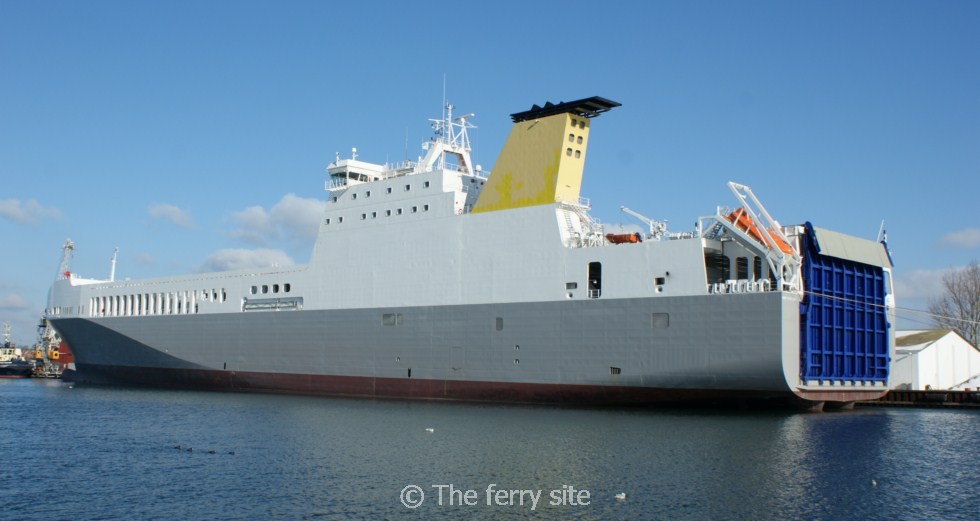
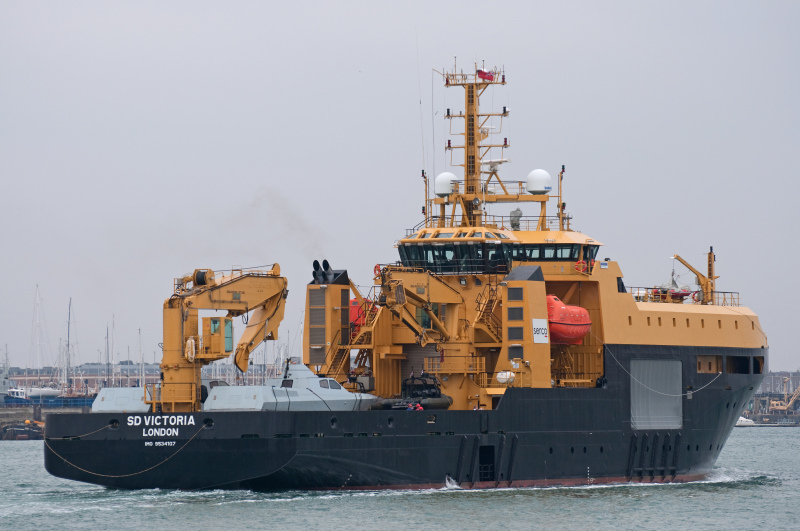
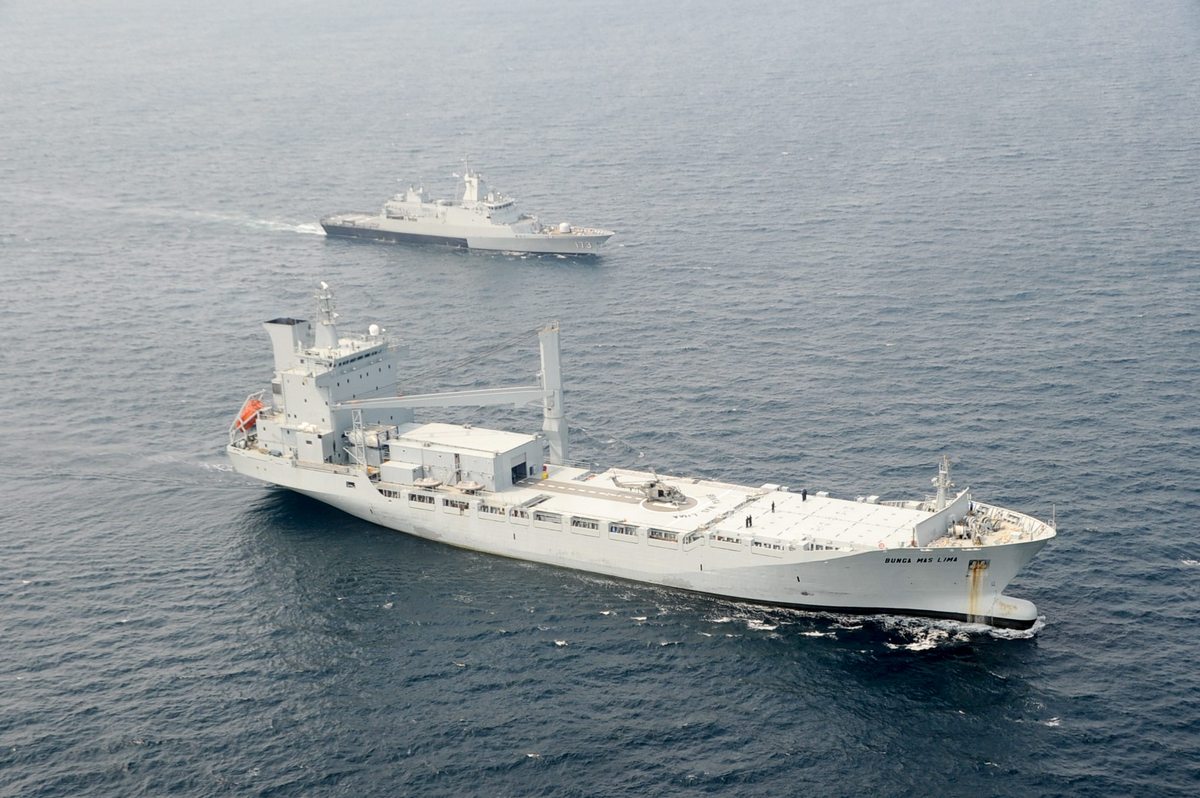
Some photos of vessels that are being used for military purposes:

MSC has chartered the MV Craigside to support SOCOM requirements. It is undergoing conversion in Mobile.

SD Victoria lifts boats and supports crews for UK Special Forces (SBS and SAS).

Malaysian auxiliary warship Bunga Mas Lima

Chuck retired from the Coast Guard after 22 years service. Assignments included four ships, Rescue Coordination Center New Orleans, CG HQ, Fleet Training Group San Diego, Naval War College, and Maritime Defense Zone Pacific/Pacific Area Ops/Readiness/Plans. Along the way he became the first Coast Guard officer to complete the Tactical Action Officer (TAO) course and also completed the Naval Control of Shipping course. He has had a life-long interest in naval ships and history.

Where is the U.S. Navy Going To Put Them All? (Part Three)

Where is the U.S. Navy Going To Put Them All?

Part 3: Two New Ship Classes.

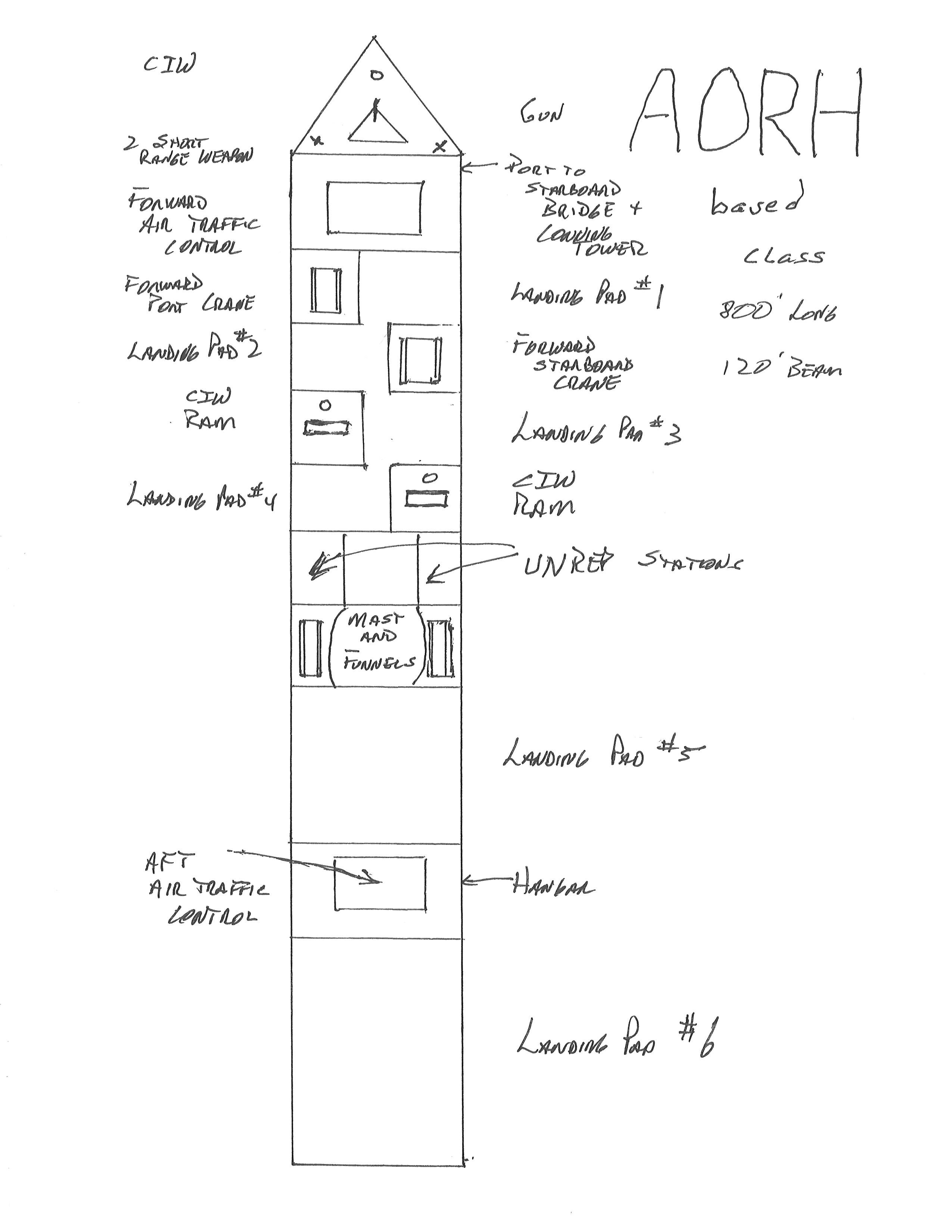
Sketch by Jan Musil. Hand drawn on quarter-inch graph paper. Each square equals twenty by twenty feet.

This article, the third of the series, presents two ship classes that can be used to take to sea the various UAVs, UUVs and buoys suggested in the previous two articles. These ships can provide the space needed to operate, maintain and hangar the equipment as well as house the necessary sailors. Read Part One, Part Two.

The first class, the CVLN (carrier aviation light, nuclear powered), is intended to operate with the two main carrier task forces, providing a home for the many ISR drones, UUVs, UAVs and buoys needed in the increasingly dangerous A2AD environment and to prosecute ASW. The second suggested class, the AORH (auxiliary oiler replenishment helicopter), is intentionally designed to routinely operate far from a CSG, frequently in association with either allied or local navies. The AORH is expressly designed to carry out a wide variety of missions with substantially lower initial construction costs and lower lifetime operating costs.

CVLN class

The intent of the CVLN class is to provide a deep blue sea platform that can operate, in fact come to be seen as needed to operate, with the two primary carrier task forces the U.S. Navy operates. Currently these task forces are almost always on station in the Western Pacific or the Gulf region. Adding a CVLN to the task force provides a home for the ISR drones, so useful in a contested A2AD environment as well as a home for the additional ASW assets the UUVs and Fire Scouts bring to the fleet.

By making the new platform nuclear powered the ship will be able to keep up with the CVNs, in both a strategic as well as a tactical sense. If the President suddenly needs a carrier strike group hundreds or thousands of miles away from their current position, the CVLN will be a fast complement to the CSG. A CVLN that can keep up with the CSGs affords the task force some very useful ASW protection both in transit and upon arrival. In addition, it will provide a permanent arc of ISR drones on the search, locate, transmit and target mission.

As for the tactical use of speed, in naval combat close almost always doesn’t count, and being able to accelerate over a 5-15 minute period at nuclear powered speeds can be just enough to survive an incoming strike. And once more, it allows the CVLN to keep up with the CVNs.

While building a nuclear powered CVLN is of course more expensive initially, once lifetime construction, operating and maintenance costs are considered, it should be notably less costly than an oil powered ship. Installing two of the existing nuclear reactors in use with the new CVNs aboard should provide plenty of power to move 45k tons around effectively and efficiently.

An obvious existing ship class to consider as a starting point for the new CVLN is the existing LHA/LHD design, but tweaked to accommodate nuclear power. If a canted flight deck and catapult were deemed necessary another alternative would be to revisit the old Midway class for design ideas.

CVLN Equipment

So how should the CVLN be equipped? A ski jump or canted flight deck should certainly be considered, although even if the ISR drone is fixed wing it should be small enough to launch off an LHD-style ship. If some of the modified S-3 Vikings or new refueling drones are going to be carried, then the extra expense of a canted flight deck will have to be incurred. Either way, the following, rather basic list of desired equipment should provide the reader with a good idea of what the CVLN will be accomplishing.

The navy should investigate whether it is practical to install one railgun, probably on the fight deck just before the island, aboard a CVLN. Obvious problems to be solved include insuring enough power is available, providing the space for the needed large capacitor just below the railgun and meeting the usual cost-to-benefit analysis applied to any new feature sent to sea.

2 CIWS mounted fore and aft and at least one RAM missile launcher for anti-missile defense are necessities.

15+ ISR drones with traditional jet engines or upgraded Osprey tilt-rotors are needed to execute the search, locate, network and target mission.

4+ UUVs plus the needed docking/launching buoys needed to get them in and out of the water.

15+ Fire Scouts and around 75 ASW oriented TIF Buoys.

4+ Seahawks

1 SAR team with associated equipment.

AORH class

The second suggested choice for the U.S. Navy to add is a ship class based on a modified AOR sized and double hulled design without a full flight deck, approximately 25k tons and oil powered. This class is intended to provide very substantial helicopter and VTOL launching and servicing capabilities, for ASW, amphibious, special-ops or other missions and then executing these missions over the years alongside a large variety of allied nation navies; hence the built in patrol boat capabilities as well as at least one UNREP station port and starboard.

The AORH is a solution to use, at a much lower cost than a CVLN in locations where a carrier task force is not present across the globe, especially in the Arctic, South China Sea, Gulf region and perhaps Northeastern Asia. These are obvious locations to homeport one of each of these ships permanently, but a standard rotation of three ships, perhaps only two ice-strengthened ones are needed for the Arctic, should be built for each requirement.

Reading the list of suggested equipment and capabilities below should provide a good grasp of the variety of missions, and not just ASW or amphibious, this class of ships will be capable of. The abilities this class will provide will substantially augment the small surface force combatants nations in the area already possess.

There has not been a great deal published on what the newly designated Arctic Command is going to deploy. Or do. As far as the U.S. Navy is concerned, my suggestion is to use ice-strengthened versions of what we already have and focus on the only realistic threat, submarines, that the fleet is likely to encounter up there. Let the Air Force provide air cover and if it comes to it, aerial strike capabilities out of Alaska or Greenland. As for ASW or ASuW capabilities, a task force composed of an AORH serving as flagship, 2-3 of the new ASW frigates, a Los Angeles class SSN and a Coast Guard icebreaker on an as needed basis should be ample to meet the nations needs up there.

As for more substantial portions of the fleet, there simply are not enough targets to justify the routine presence of a CCG or DDG. As for an amphibious ship, the American taxpayer as well as our Arctic neighbors should be asking just who we intend to invade up there. There simply is no need for these kinds of assets.

Operating in the Arctic is a new reality that the U.S. Navy has to add to its long list missions to accomplish. But a very limited list of ice-strengthened surface assets concentrating on the ASW mission, a SSN and Air Force provided top cover should handily do the job.

AORH equipment

Once more the following, rather basic list, of desired equipment should provide the reader with a good idea of what the double hulled, AORH should be equipped with.

A gun of some sort and since we have lots of 5-inch guns available one of these will probably be installed. One of the OTO-Melara 76mm family would also function well, possibly even be preferable over the 5-inch gun.

4 CIWS and at least 2 RAM missile launchers, and room for more should be considered if feasible. These are not going to be stealthy ships; they will be sailing in harm’s way, often in littoral waters and WILL be considered high value targets.

4+ ISR drones IF fitted with the new engine upgrade for the Osprey, allowing them to function as a VTOL capable airframe. Without VTOL capabilities the AORH will operate with the ScanEagle like the rest of the fleet.

4+ UUV drones plus the needed docking/launching buoys needed to get them in and out of the water.

15+ Fire Scouts and around 75 ASW oriented TIF Buoys.

4+ Seahawks

Flagship capable in the sense of having both working as well as berthing space aboard for a small task force commander’s team, which will occasionally be multinational.

1 SAR team with associated equipment.

This class will almost certainly be tasked from time to time with hosting Seals and Special Operations teams and their equipment as they come and go on their missions. Ample berthing, operating and maintenance spaces need to be designed into the class. In addition, room for the necessary crane capacity should be available to handle:

2 25’ Mark V.1 Patrol Boats and 2 Mark VI 85’ Patrol Boats

OR

4-6+ Mark V.1 Patrol Boats

The ability to berth and support a company of Marines.

The ability to support the operations of 2-4 of the Marines CH-53E/K helicopters.

Plus the ability to berth and operate on a add something, drop something off basis, whatever additional helicopters or small amphibs the Marine Corp might want to bring aboard.

Summation

The new abilities unmanned flight brings to the fleet are potentially very useful. But as discussed above, achieving the benefits frequently requires the use of the new drones in quantity. The suggested ship classes are two possible ways to get the needed UAVs, UUVs and buoys into the fleet. Another choice is certainly possible though and now is a good time to start discussing the topic.

In the next article we will examine how the Navy can add the railgun to the fleet in quantity and make use of its distinctive qualities in an effective manner. Read Part Four here.

Jan Musil is a Vietnam era Navy veteran, disenchanted ex-corporate middle manager and long time entrepreneur currently working as an author of science fiction novels. He is also a long-standing student of navies in general, post-1930 ship construction thinking, design hopes versus actual results and fleet composition debates of the twentieth century.

CIMSEC content is and always will be free; consider a voluntary monthly donation to offset our operational costs. As always, it is your support and patronage that have allowed us to build this community – and we are incredibly grateful.

Select a Donation Option (USD)

Enter Donation Amount (USD)