There are many ways of attempting to estimate the nature of naval surface warfare in the next quarter century or so. Some are based on systematic and relatively sophisticated extensions of perceived trends. Others are dependent upon a variety of projected scenarios of various types. All are just personal judgments or prejudices, if I may call them that. And all are highly suspect—as must be any projection into the future, the degree of uncertainty increasing with the length of the forecast.
The following thoughts are the product of my own prejudices, based on observations and exposures to the thoughts and arguments of many others. I shall therefore simply set them forth without trying to repeat the arguments that have led to them, other than noting that they contain the following basic assumptions:
There will be no major naval war within the period discussed.
There will be no major technological surprises during the period.
Prejudice No. 1: There will be a U. S. surface Navy in the year 2000 and beyond. This is based on the simple fact that we have a very substantial capital investment in our current fleet. Prudence is going to require that we protect this investment by whatever steps seem to be most cost-effective, whether this means retrofitting of new equipment, continued procurement of new versions of existing equipment, or the procurement of totally new systems. It is to be expected that any new element of the fleet—ship, plane, weapon, or equipment—will be introduced because it has some clearly apparent way of operating in concert with the existing elements to enhance their capability. If it has additional characteristics that permit it to perform new and unspecified missions, these characteristics will be developed in an evolutionary manner. The tendency to look at proposed systems as a total replacement for existing ones on an all-or-nothing basis has been the source of a lot of unrealistic projections in the past. Many of these projections have been associated with the Navy V/STOL (vertical and short takeoff and landing) aircraft program. The measure by which any system proposed for Navy use within the next 20-25 years will be judged, unless events demonstrate the wisdom of selecting some other criterion, is how capability of the current battle group built around the large carrier can be maintained or improved in the face of perceived threats.
“The Action Phase is the period from the arrival of the amphibious force in the operational area, through the accomplishment of the mission and the termination of the amphibious operation.” –JP 3-02
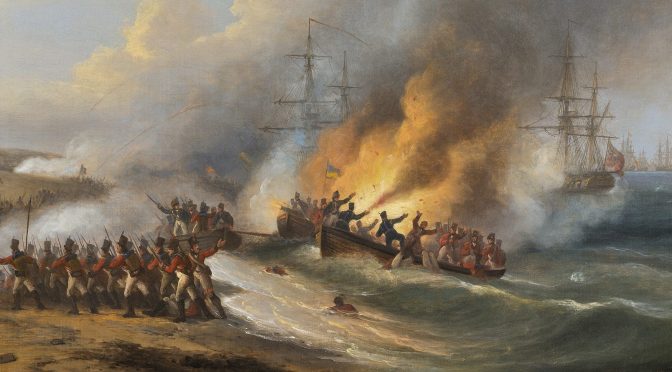
At 2 am, 5,500 troops climbed down into their boats to begin the assault on the French-held Aboukir Peninsula in 1801. Some of the boats had to row six miles to form up, delaying the assault from dawn until almost 9 am. As the boats approached the beach they could see the French troops and artillery in the sand dunes to their front, and artillery from the fort to their right started to fire. Embarked in one of the boats for the assault was Lieutenant Aeneas Anderson who stated, “Never was there a more trying moment.” As the troops crammed into the heavily loaded landing craft were vulnerable to fire the French managed to sink several craft. Some of the men in the boats were killed by round shot or drowning, while many were rescued from the water by boats tasked with SAR.1 Naval gunfire support was provided by Royal Navy bomb vessels Tartarus and Fury, two gunboats, and three armed launches.2 These vessels took station on the flanks and supported the landings by attacking Aboukir Castle on the right flank.
As the initial wave landed they formed up in the water. Soldiers of the 40th and 23rd Regiments charged ahead to capture the high sand dune in their front. On the left, 200 French cavalry charged the Coldstream Guard still forming up in knee-deep water, but the cavalry were repulsed by a well-timed volley fired by the 48th. The sharp action of twenty minutes secured a British beachhead at Aboukir. In a span of 5 minutes the British had landed 5,000 troops and formed for battle on a beach. After 15 minutes the British had driven off entrenched French forces and captured six cannons.3
British casualties had been heavy. Out of an initial landing force of 5,000, the Royal Navy had lost 97 officers and men killed or wounded, while the army had lost 625 killed, wounded, or missing and presumed drowned.4 Despite the heavy losses, British morale soared. General Menou had so doubted the ability of the British to establish a beachhead that he had only sent a detachment of 2,000 to defend against the landing instead of a larger force. French prisoners stated, “They had no fear that a landing could succeed.”5 General Menou expected the French army would have to fight on three fronts in Egypt. The army continued to fight a numerically superior yet qualitatively inferior Ottoman army east of Suez. The French expected this British force to land somewhere near Alexandria, and for another British force from India to land somewhere on the Red Sea coast. The British exploited Lake Aboukir and Aboukir Bay as a highway transporting water, supplies, and armed launches to provide naval gunfire support to the forward edge of battle. With the beachhead secured, General Abercromby’s forces advanced from Aboukir toward Alexandria.
On the 13th of March, the French attacked the British at Mandara, but well-positioned British troops repulsed the French. After two British victories, the local Arabs began to sell provisions to the army, reducing the reliance on provisions provided from the ships.6
On the 21st of March the French attacked again. General Abercrombie, leader of the British expeditionary force, was mortally wounded in the battle and died aboard the flagship instructing his staff to return the soldier’s blanket he was carried to the ship in. The French retired into the city of Alexandria. The British then left a force to besiege the city while another force pressed up the Nile to capture Cairo and link up with soldiers from India. On 16 August, Captain Cochrane and General Coote executed a second landing west of Alexandria to completely surround the city. On 29 August, 1801, General Menou’s besieged army surrendered.
Command and Control
Modern U.S. amphibious doctrine supports a Commander, Amphibious Task Force (CATF) and a Commander, Landing Force. Both commanders will draft an establishing directive to outline priorities and define who will be the supported and supporting commander throughout the phases of the operation. Throughout an amphibious operation the supported commander will change based on what is going on. For example, during an amphibious assault, the CATF will remain the supported commander until the CLF has established a defensible beachhead ashore.7 The CLF will then assume the role of supported commander and the CATF will continue to support, typically with logistics until relieved.
Throughout this campaign, there was less CATF/CLF coordination than desired. The first objective of the expedition was to capture the Spanish fleet at anchor in Cadiz. Despite both commanders’ amphibious experience the objective was not met. Lord Keith dithered over whether to support the landings or not, and he “could not be answerable for the winds.”8 If winds were from the southwest the fleet would be scattered. Unlike in modern doctrine where the CATF is the supported commander until the CLF has a defendable beachhead, Lord Keith felt his duty and responsibility done once the fleet was anchored in the correct operational area. This lack of interest meant that on the scheduled day of the landings there was both a shortage of landing craft and massive confusion when those craft did not go to the correct ships to pick up troops. Eventually, the decision was made to cancel those landings.9
The day after the landings were scheduled to happen, the southwest winds blew the fleet off Cadiz. If the landing force had been caught half ashore and half at sea, the landing force ashore would have been destroyed and the Egyptian campaign possibly never would have commenced. The lack of proper planning, of rehearsals, and Lord Keith’s continued unwillingness to make a decision about the landing created great tension between the army and the navy. Resentment among the army was so high that General Abercromby wrote to Secretary Dundas. Lord Keith received a letter from the First Sea Lord suggesting he remain in Gibraltar, and let another admiral oversee the Egyptian expedition.10 Good natured General Abercromby understood that part of his role as CLF was to calm the waters between the landing force and the naval force to ensure unity of effort. Today, the CATF and CLF embark aboard the same ship, however General Abercromby and Lord Keith were embarked on separate ships, and the First Sea Lord insinuated that this was the cause of tension between the two. Space aboard ship was the likely culprit in why the two commanders were embarked separately.
Lord Keith’s top priority was the location of the French fleet, and whether the French Navy would attempt to disrupt the landings. This question caused real problems for Lord Keith. The risk was real as Lord Nelson won the battle of Aboukir Bay in 1798 when a large portion of the French crews had been ashore. The army required over half the sailors in the fleet to support their operations ashore, and the transports would be so undermanned as to be unable to work the ships while the boat crews were away. 3,339 sailors served in Lord Keith’s fleet; 545 of those sailors were expected to serve ashore, and a further 820 were expected to serve in the boats ferrying supplies to the army.11 Aboukir Bay provided an anchorage, but it was no safe haven in a storm. Lack of sailors also increased the risk of shipwrecks in storms and defeat in battle if the French fleet appeared. With the ships half-manned, Lord Keith doubted that in a crisis those sailors could rejoin the fleet prior to an engagement with the French. Lord Keith wrote, “I am convinced that were I to withdraw a man, the troops would re-embark and charge the failure to me.” Despite Lord Keith’s misgivings, fleet support ashore enabled British victory.
Conclusion
This campaign provides an excellent study of the difficulties of planning an amphibious operation. One will never have all the intelligence desired and one will have to make decisions based off very incomplete or inaccurate data. In London, poor intelligence and an ill-defined mission risked the expedition before it even set sail. At sea and on land the British forces demonstrated their resolve and flexibility in overcoming adversity and the French to secure Egypt. The seven weeks spent training while waiting for Ottoman support demonstrated the importance of rehearsals in preparation for an amphibious assault. The confusion of the Cadiz expedition was replaced with calm, discipline, and order. The daily training in ship-to-shore movement and forming lines from landing craft enabled the landing force to conduct an opposed landing against entrenched infantry utilizing linear musket-age tactics.
Throughout the campaign the Royal Navy provided naval fire support and logistics support to the army. Fleet support enabled the execution of the campaign, but the most important asset the expedition had was General Abercromby. His attention to detail, emphasis on training, and tactful ability to work with Lord Keith, despite the Admiral’s foibles, ensured the successful execution of the campaign.
LT Jason Lancaster is a U.S. Navy Surface Warfare Officer. He is currently the Weapons Officer aboard USS STOUT (DDG 55). He holds a Masters degree in History from the University of Tulsa. His views are his alone and do not represent the stance of any U.S. government department or agency.
References
[1] Anderson, pg 222.
[2] Thomas Walsh andW.W. Knollys, The Cockade in the Sand,(Leonaur, 2014), pg 62.
Anderson, Aeneas. Journal of the Forces which sailed from the Downs on a Secret Expedition. London: Wilson and Co. of the Oriental Press, 1802.
Bartlett, Merrill L., ed. Assault From the Sea: Essays on the History of Amphibious Warfare. Annapolis, Maryland: Naval Institute Press, 1983.
Faden, William. “A detail of a plan of the Operations of the British Forces in Egypt from the landing in Aboukir Bay on th 8th of March to the Battle of Alexandria March 21st inclusive.” Wikimedia Commons. https://en.wikipedia.org/wiki/Battle_of_Mandora#/media/File:Faden_1801_alexandria_battle_detail.jpg. London, 1801.
Fortescue, J. W. A History of the British Army. Vol. IV. London: Macmillan and Co. Limited, 1915.
Glover, Richard. Peninsular Preparation 1795-1809. Cambridge: Cambridge University Press, 1963.
Joint Publication 3-02 Amphibious Operations. Washington DC: Office of the Secretary of Defense, 2014.
Life of Sir R. Abercromby. Liverpool: J. Fowler, Market Place, Ormskirk, 1806.
Loutherbourg, Philip James de. “The landing of British troops at Aboukir, 8 March 1801.” Wikimedia Commons. https://commons.wikimedia.org/wiki/File:The_landing_of_British_troops_at_Aboukir,_8_March_1801.jpg. London, n.d.
Lowry, James. Fiddlers and Whores: The Candid Memoirs of a Surgeon in Nelson’s Fleet. Edited by John Millyard. London: Chatham Publishing, 2006.
Mackesy, Piers. British Victory in Egypt The End of Napoleon’s Conquest. London: Tauris Parke, 2010.
Moiret, Joseph-Marie. Memoirs of Napoleon’s Egyptian Expedition 1798-1801. Edited by Rosemary Brindle. Translated by Rosemary Brindle. Mechanicsburg, PA: Stackpole Books, 2001.
Molyneaux, Thomas More. Conjunct expeditions: or expeditions that have been carried on jointly by the fleet and army. London: ECCO Print Editions, 1759.
Moore, John. The Diary of Sir John Moore. Edited by J.F. Maurice. II vols. London: Edward Arnold, 1904.
Porter, Robert Ker. A Correct Account of the Battle of Alexandria. New York: Southwick and Hardcastle, 1804.
Walsh, Thomas, and W. W. Knollys. The Cockade in the Sand: The Defeat of Napoleon’s Egyptian Campaign. Leonaur, 2014.
Wilson, Sir Robert Thomas. Narrative of the British Expedition to Egypt. Dublin: W. Corbett, 1803.
Featured Image: Brigade of Guards Landing at Aboukir, March 8, 1801. Thomas Luny, 1759-1837.
Written by W. Alejandro Sanchez, The Southern Tide addresses maritime security issues throughout Latin America and the Caribbean. It discusses the challenges regional navies face including limited defense budgets, inter-state tensions, and transnational crimes. It also examines how these challenges influence current and future defense strategies, platform acquisitions, and relations with global powers.
“The security environment in Latin America and the Caribbean is characterized by complex, diverse, and non-traditional challenges to U.S. interests.” –Admiral Kurt W. Tidd, Commander, U.S. Southern Command, before the 114th Congress Senate Armed Services Committee, 10 March 2016.
By Wilder Alejandro Sanchez
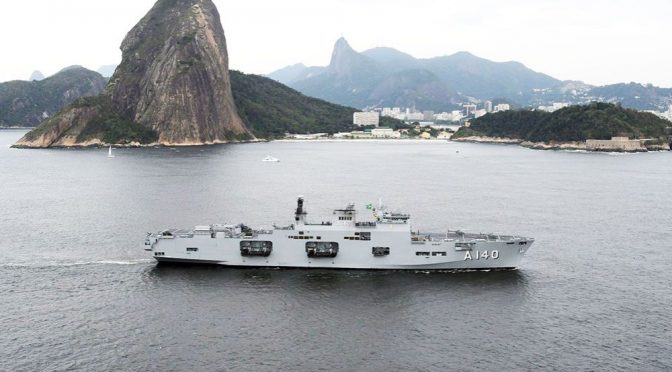
Brazil’s new helicopter carrier, PHM Atlantico (A 140), docked in Rio de Janeiro on 25 August 2018 after sailing across the Atlantic Ocean from Plymouth, United Kingdom, its former home. The vessel is the new pride and joy of the Brazilian Navy. However, apart from possessing an imposing appearance, how is this vessel useful to Brazil?
The New Ship
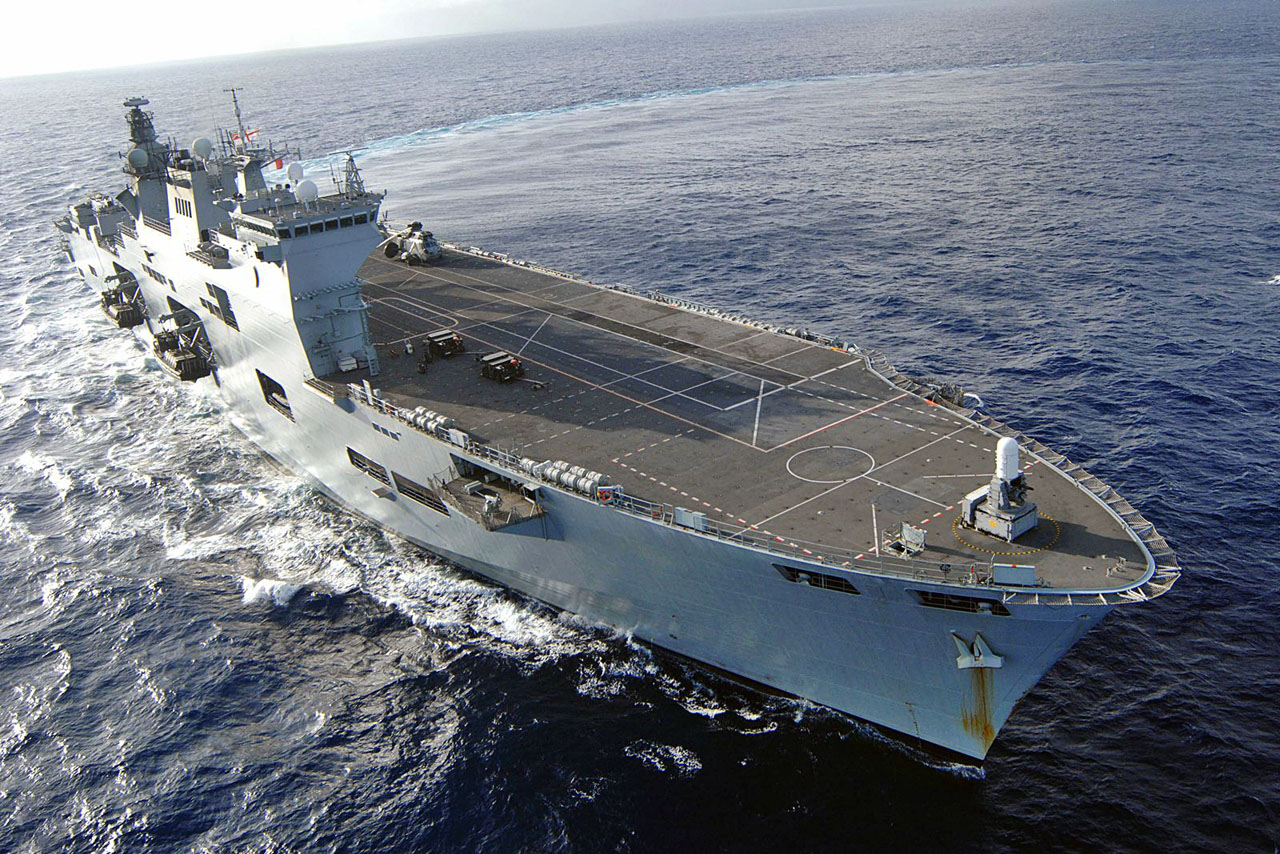
Atlantico was formerly known as HMS Ocean (L 12), an amphibious assault ship that belonged to the British Royal Navy. It was commissioned in 1998 and decommissioned earlier this year. The Brazilian government purchased it for 84 million British pounds. Among its characteristics the vessel displaces 21,000 tons, has a length of 203 meters, a max speed of 21 knots, and a range of up to 8,000 miles. According to the Brazilian Navy, the vessel is equipped with four 30mm DS30M Mk2 guns, two 1007 radars, one 1008 radar, and one Artisan 3D 997 radar. Atlantico transports a crew of 303 with only one female naval officer, Captain Márcia Freitas, chief of the vessel’s medical department. The ship can also transport as many as 800 marines. “It’s a new ship, in good condition. It can be operational for 20 to 30 years,” declared Brazilian Admiral Luiz Roberto Valicente to the Brazilian daily Estadao.
PHM Atlantico (Naval.com.br)
Atlantico can transport as many as 18 helicopters, but it is still unclear which type of aircraft the Brazilian Navy will deploy aboard its new vessel. On 5 September, the Brazilian aerospace company Helibras, a division of Airbus, tweeted a photo of H225M helicopters landing on the deck of Atlantico, hinting that these types of aircraft could be deployed on the new carrier. Additionally, the Estadao article declared that the carrier is compatible with all the models of helicopters currently operated by the Brazilian Navy.
It is worth noting that this is the third carrier that the Brazilian Navy has operated. Atlantico replaces the Clemencau-class carrier Sao Paulo (A 12), which was decommissioned in 2017. Previously, Brazil operated a Colossus-class aircraft carrier Minas Gerais (A 11), which was decommissioned in 2001.
Why Does Brazil Need a Carrier?
The standard explanation out of Brasilia for the purchase of the helicopter carrier is that it will help protect Brazil’s exclusive economic zone, which is rich with maritime resources such as fish and oil deposits. Moreover, in an interview with the Brazilian defense news website Defesanet, Capitan Giovani Corrêa, commander of Atlantico, explained that with the addition of the carrier, “the Navy will have a platform with dissuasive capabilities [which will help the] control of vast maritime areas…will help maintain security in the South Atlantic and…will protect Brazil at the international level.”
The statement about “dissuasive capabilities” raises the question of which nation could possibly attack Brazil in the first place. The country last fought an inter-state war when it deployed an expeditionary force to Europe to fight alongside the Allies during World War II. Even more, when it comes to conflicts with neighboring states, the last war that Brazil participated in was the Acre War (1899-1903) with Bolivia.
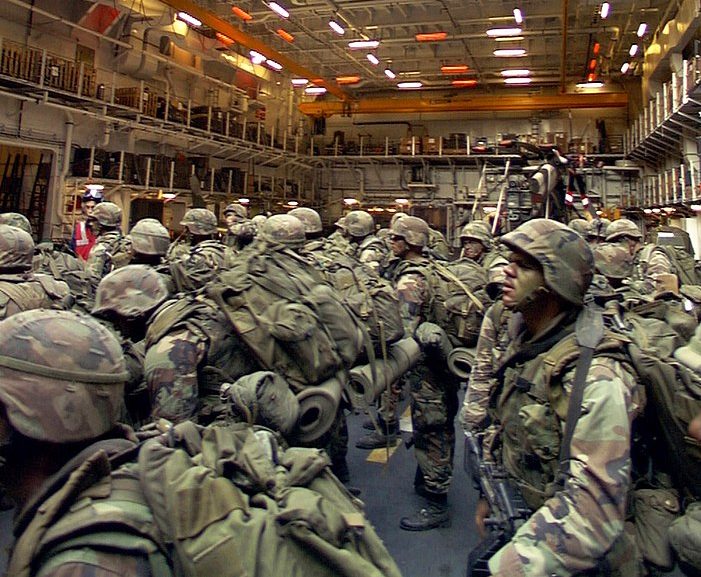
United States Marines from Lima Company, Battalion Landing Team 3/8, ride a lift into the vast hangar bay of the British amphibious assault ship HMS OCEAN (L12), during NORTHERN APPROACH, a NATO exercise in 1999. (Photo by CPL Jimmie Perkins, USMC)
Additionally, it is important to mention that Latin American geopolitics are fairly stable these days (the situation in Venezuela notwithstanding), which means that the rest of the region does not view Brazil’s recent acquisition, or its similarly ambitious submarine and corvette programs, with concern. In other words, there have been no apparent moves by regional navies to upgrade their own defenses in response to the acquisition of Atlantico. Latin America is not experiencing an arms race these days and Brasilia’s relations with its neighbors are fairly cordial, which effectively rules out the hypothesis of a regional state attempting to obtain control of Brazilian waters by force.
Thus, apart from patrolling Brazil’s territorial waters looking for non-traditional threats (such as illegal fishing, drug trafficking, or piracy), what other duties will Atlantico perform? In the aforementioned interview, Captain Corrêa suggested the carrier could be used to support humanitarian operations and as a command and control center for a task force. This raises the hypothesis that the ship could be deployed to United Nations peacekeeping operations. One likely candidate is the UN Interim Force in Lebanon, which has a naval component, the Maritime Task Force. Brazil regularly deploys a vessel to this naval force – the current ship there is the frigate Liberal(F 43). Hence, Atlantico could similarly be deployed to the Mediterranean to serve as a command center, should the task force attempt to carry out a major operation there.
Finally, and perhaps most importantly for Brasilia, Atlantico will give the Brazilian Navy true blue water capability. That was the main purpose of the previous carrier, Sao Paulo, but the vessel spent more time docked and undergoing repairs than at sea, so hopefully for Brazil, Atlantico will perform much better.
Final Thoughts
The acquisition of the helicopter carrier Atlantico, alongside the PROSUB submarine program and the Tamandare corvette program, are examples of the Brazilian Navy aiming to become a true blue water navy in the 21st century. Domestically speaking, Brazil has little to fear about a conflict with a neighboring state, but Atlantico, should it perform better than its predecessor Sao Paulo, will be of great help to project the image of the marinha do Brasil well past the South Atlantic.
Wilder Alejandro Sanchez is a researcher who focuses on geopolitical, military and cyber security issues in the Western Hemisphere. Follow him on Twitter: @W_Alex_Sanchez.
The views expressed in this article are those of the author alone and do not necessarily reflect those of any institutions with which the author is associated.
Featured Image: PHM Atlantico entering her home port of Rio do Janeiro (Merco Press)
The Navy’s tactical ignorance is built into its arsenal. Currently some of the Navy’s most important weapons development programs are not just evolutionary, but revolutionary in the possibilities they open up. This is not due to innovation, but instead many of these noteworthy and foundational capabilities are finally arriving decades after the technologies were first proven, many close to half a century ago. Many of these most crucial weapons are already in the hands of great power competitors such as Russia and China who have had decades of opportunity to train and refine tactics with them.
Offensive Firepower
“…no captain can do very wrong if he places his ship alongside that of the enemy.” –Horatio Nelson
One of U.S. Navy’s gravest errors in handicapping its own development was neglecting the development of long-range offensive firepower in the age of missile warfare. What made the anti-ship missile a revolution in naval warfare was its ability to deliver a powerful pulse of firepower comparable to that of an attacking wave of carrier aircraft through a combination of high speed, large warhead size, and salvo fires.
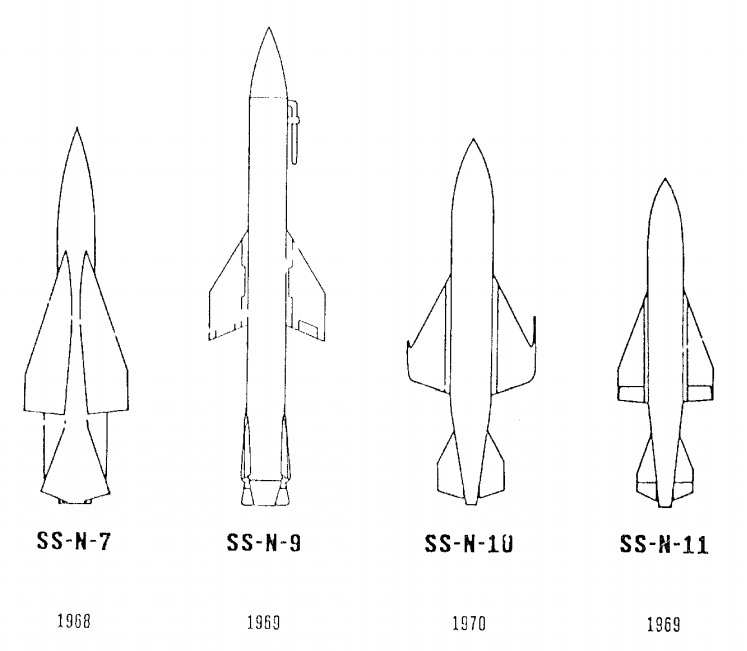
In spite of this by 1971 the Soviet Union managed to field 11 different types of anti-ship missiles before the U.S. had yet to field one.1 Today numerous surface ships, submarines, and heavy bombers in the Russian and Chinese navies carry long-range anti-ship missiles, many with supersonic speed and ranges as great as over 200 miles. It was not until 1977 that the U.S. Navy would field its first anti-ship missile, the Harpoon, which remains its primary anti-surface weapon to this day. Weapons with triple the range and speed of the Harpoon missile already existed in numbers 50 years ago.2
Select Soviet anti-ship missiles and their date of introduction, all preceding Harpoon. (Source: Declassified CIA Soviet Naval Cruise Missile Force: Development and Operational Employment, 1971)
The Harpoon is a slow, subsonic missile and extremely short-ranged at around 70 nautical miles.3 The Harpoon also isn’t equipped by most of the U.S. Navy’s destroyers. It is only found on less than half of the Navy’s destroyers despite there being little difference in the design of the ships that carry them and those that do not.4*
The submarine force took Harpoon out of its inventory entirely in 1997 which shaved tens of miles off its surface strike range and limited itself to only close-range torpedo engagements. Now the submarine force is thinking about bringing Harpoon back some 20 years later.5
Harpoon failed to take advantage of arguably the most important attributes large naval platforms bring to the fight – capacity and staying power. The surface fleet ships that do carry Harpoon only carry eight, a small sum. This is in spite of the fact that all U.S. Navy large surface warships have around 100 vertical launch cells for missiles and where Harpoon is much smaller than launch cell-compatible missiles like Tomahawk.
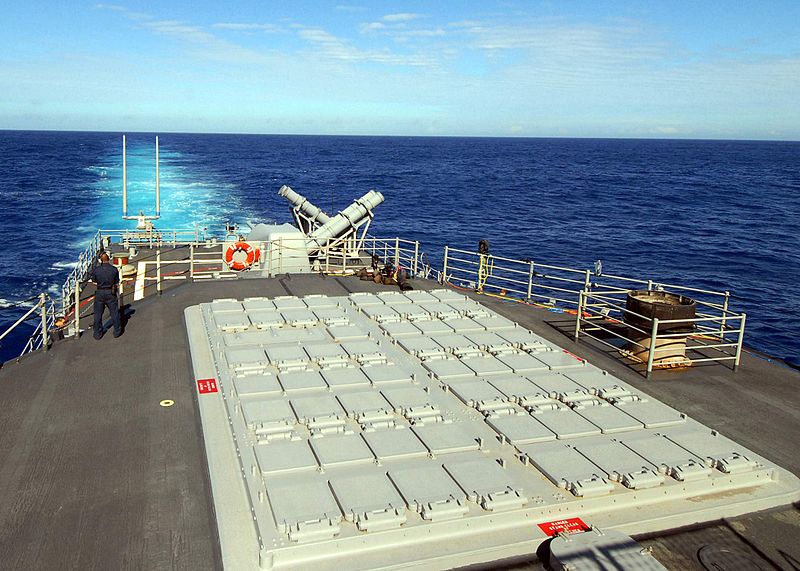
Because Harpoon is incompatible with its launch cells the Navy bolts the missiles on top of the deck in a most uneconomic fashion. This limits the maximum anti-ship salvo U.S. Navy surface warships can deliver to only an eight-missile salvo with extremely short range and subsonic speed. The Navy certainly expects its own ships to be able to easily swat down such a salvo. Harpoon must be fired via torpedo tubes for submarines, but shooting missiles through torpedo tubes can also only produce small salvos compared to a submarine’s launch cells.6
PACIFIC OCEAN (Feb. 18, 2008) Note the four Harpoon missile launchers in the background and the 64 vertical launch cells in the foreground. Original caption: Seaman Robert Paterson, of Norgo, Cal., stands watch next to the aft vertical launch missile platform on the fantail while underway on the guided-missile cruiser USS Lake Erie (CG 70). (U.S. Navy photo by Mass Communication Specialist 2nd Class Michael Hight)
The Navy did come close to effectively fielding a long-range anti-ship weapon. However, the Navy never truly integrated it by only procuring a small quantity and eventually taking it out of the inventory entirely.
At first the Tomahawk missile program pursued a weapon with two different capabilities. An anti-ship Tomahawk missile was first tested six months after the land attack version in 1976.7 The anti-ship Tomahawk incorporated the same active radar seeker and guidance technology from the Harpoon missile, but offered far better range and a larger payload.8 However, by 1995 it appears only about 600 anti-ship Tomahawks were produced, roughly a tenth of the size of the Harpoon inventory.9The only surface ships that could have carried more than a handful of deck-mounted anti-ship Tomahawks during the Cold War were cruisers that were exclusively focused on protecting capital ships via the defensive anti-air mission. Once the Cold War ended the U.S. Navy got rid of its only long-range anti-surface weapon by remaking the anti-ship Tomahawk missile inventory into the land-attack version.10
Ill-conceived arguments were put forward to justify taking these weapons out, such as how the Navy could not likely target the missile to the maximum extent of its range and the Navy’s current anti-ship missile seekers would be ill-suited to congested waters featuring a mixture of hostiles and non-combatants.11 However far the Navy could target Tomahawk was going to be far better than what it was getting with Harpoon. The Navy certainly accepted a 200-mile anti-ship missile threat from Soviet forces. And if NATO had gone to war against the Soviet Navy it still could have fought in congested waters such as the Mediterranean and Baltic Seas.
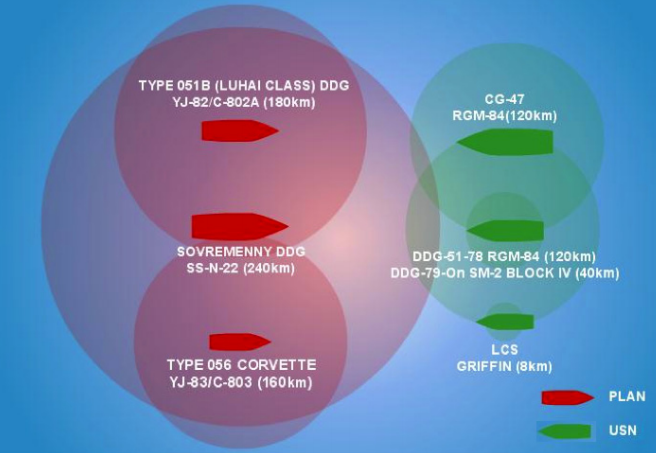
A comparison of U.S. and Chinese Navy (PLAN) warships and the range of their respective anti-ship firepower. (Via China’s Near Seas Combat Capabilities, China Maritime Studies Institute, Naval War College)
Still, the Tomahawk makes for a relatively poor anti-ship missile. It is subsonic and lacks aerodynamic features that allow for dynamic terminal maneuvering and where both drawbacks will lower its survivability. More missiles would have to be fired per salvo to achieve a similar effect offered by the more modern missiles coming to the fleet like the Long Range Anti-Ship Missile (LRASM) and Standard Missile (SM)-6.
Tomahawk’s best feature is its long range of hundreds of miles which would allow a dispersed force to aggregate their fires into concentrated salvos via networking.12 However, both slow speed and long range increase the dependence of the missile on in-flight retargeting updates and creates a more burdensome kill chain. It is also questionable to use such a large warhead when modern missile seekers using passive sensors can attempt to pinpoint their strikes on ships. If a missile can confidently choose to hit a ship in the magazine or in other spaces that guarantee a mission kill then missile design can more readily trade warhead size for extra range and speed.
The Navy is once again pursuing this capability. An anti-ship Tomahawk missile will be coming back to the fleet in 2022, 40 years after a Tomahawk first sunk a ship in testing.13
Defensive Firepower
“Anything can be saturated. Aegis can be saturated.”–Rear Admiral Wayne E. Meyer (ret.)
One of the most fundamental trends of military capability is that of reinforcing the kill chain, or the process by which targets are found by sensors and then fired upon with weapons. This process requires certain levels of information from simple detection to targeting-quality data. A key challenge is in keeping the kill chain resilient and freshly updated once the weapon is fired and travels a distance to its target. In response to being detected or coming under fire a target can change its behavior and launch decoys which can require new targeting inputs. Arguably one of the most information intensive fights among the warfare areas is the anti-air mission where sustained radar energy must steadily illuminate speedy aerial targets over great distances in order to guide a missile toward a hit.
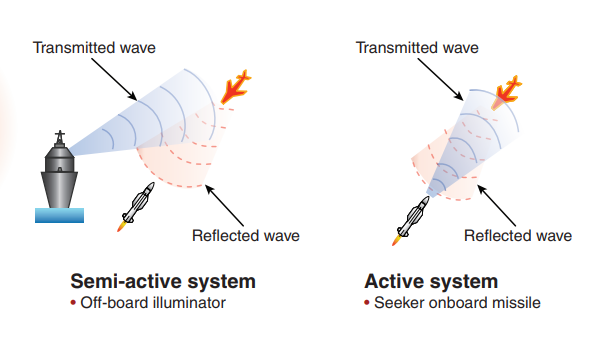
The difficulty of steadily illuminating a dynamic aerial target can be somewhat mitigated by putting a radar seeker into the missile itself, a capability known as active radar seeking. This adds resilience to the kill chain and gives the missile some degree of independence from external illumination sources such as the radar of a ship or aircraft. Usually active radar seeking is engaged in the terminal phase of the engagement given the relatively small size of the onboard seeker.
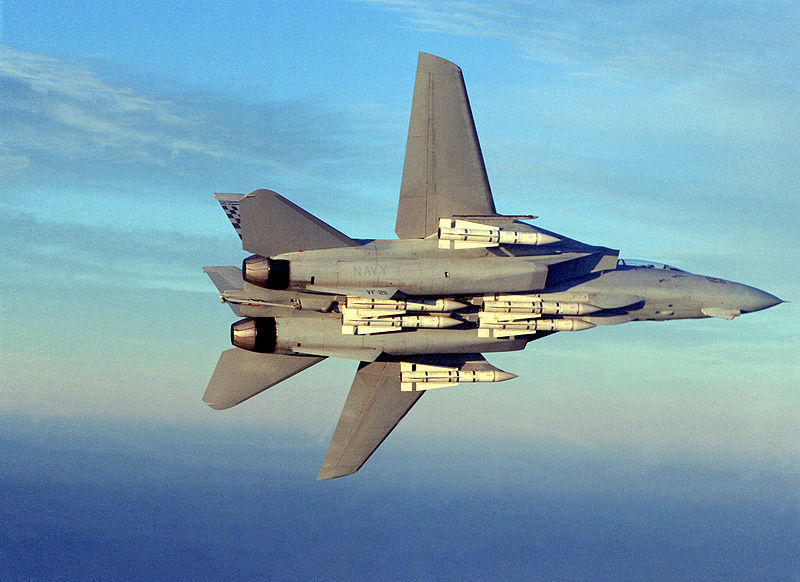
Missiles that are totally dependent on outside sources for illumination operate under semi-active homing. The Navy realized the potential of combining both semi-active and active radar homing when it fielded the Phoenix missile through the F-14 Tomcat that was the mainstay of the fleet’s air-to-air capability during its service life. The Phoenix missile could travel 100 miles and engage active radar seeking in the final moments to see the engagement through. The fundamental principle of building resilience into the kill chain by adding an active seeker into the payload itself is also reflected in the many torpedoes that have an active homing capability and in the Aster anti-air missile that is widely used by European navies today.
A Fighter Squadron 211 (VF-211) F-14B Tomcat aircraft banks into a turn during a flight out of Naval Air Station, Miramar, Calif. The aircraft is carrying six AIM-54 Phoenix missiles. (Wikimedia Commons)
Aircraft, through adjusting altitude and maneuver, are clearly not as inhibited as warships in illuminating their targets for anti-air engagements. If it made sense to put active radar seekers in anti-air missiles used by aircraft then it should make even more sense for a ship which must contend with the horizon and cannot maneuver in three dimensions like aviation. If an aerial target dives in reaction to being sensed and engaged then an attacking missile could use its active radar seeker to chase the target below the horizon limitation of its illuminating ship in a bid to independently finish the engagement. Such a capability adds extra depth to a ship’s ability to defend itself below the radar horizon and at altitude.
The Navy fielded active radar seekers over 40 years ago in the Phoenix air-to-air missile it procured by the thousands.14 The story is different for the surface fleet. In spite of this simple but important enhancement almost all of the Navy’s surface-to-air missiles do not have active radar seeking technology.
The missiles that are the mainstay of the fleet’s defensive arsenal such as Standard Missile (SM) and the Evolved SeaSparrow Missile (ESSM) are only equipped with semi-active radar homing, and where this form of homing has tactical handicaps. Semi-active homing works by having an external source illuminate a target with its radar. The radar reflections are picked up by the missile, which then finds its way to the target with the assistance of mid-course guidance from the external radar. Because a ship is limited by the horizon, if a target dives deep enough, the ship will no longer be able to illuminate it with its radar to see the engagement through.
Land-based surface-to-air missiles are not as inhibited by semi-active homing in spite of the same horizon limitation because they work in tandem with other anti-air systems. An aircraft diving low to avoid illumination over land places itself at risk of being engaged by shorter range anti-air weapons that do not reveal themselves through radar emissions. This tactic worked to great effect over Vietnam as radar-guided surface-to-air missile batteries forced American warplanes to drop altitude and fly within range of gun-based anti-air systems which ended up shooting down more aircraft than missiles.15 There is no similar effect at sea because capability is concentrated on warships.
To an extent Sailors already know the Standard Missile is handicapped by its guidance capability. The Standard Missile has an anti-surface mode, but of dubious effectiveness. Its range is less than 20 miles in this mode because that is only as far as the ship’s radar can target it close to the surface and to the limit of the horizon.16
An annual Defense Department report from 1975 highlighted this issue when it sought to develop an anti-ship version of the Standard Missile:
“The STANDARD SSM program was initiated in 1971 to provide an interim anti-ship missile capability until the HARPOON could be developed and deployed. The STANDARD SSM is operational in two versions, with a third now in development…The third version, Active STANDARD with a radar seeker…will have a range capability beyond the ship radar horizon. The range of the STANDARD semi-active missile is limited to the range of the ship’s radar, since the missile’s target must be illuminated by a ship radar. The STANDARD ARM and Active STANDARD, equipped with an anti-radiation homing capability and an active terminal seeker, respectively, eliminate the need for illumination of the target by a ship radar and thus permit engagement of targets beyond the ship radar horizon.”17
In the end the original Active Standard SSM never made it into the fleet though the same basic idea and capability would be replicated decades later. Despite many variants produced across nearly 50 years of service active radar seeking did not come to the Standard Missile family of weapons until SM-6 arrived in 2013. Even so, SM-6 does not have a unique seeker but takes its active radar seeker from the widely equipped AMRAAM air-to-air missile that entered service in 1991.18 SM-6 introduced an anti-ship capability in 2016, similar in concept to what was already deemed desirable many years ago in the form of the Active Standard SSM.19 SM-6 now bears the odd distinction of being both the Navy’s first long-range active radar seeking surface-to-air missile, and its first supersonic anti-ship missile.
In explaining the benefit of SM-6 the Navy once again described the value of similar technology 40 years later:
“The introduction (emphasis added) of active-seeker technology to air defense in the Surface Force reduces the Aegis Weapon System’s reliance on illuminators. It also provides improved performance against stream raids and targets employing advanced characteristics such as enhanced maneuverability, low-radar cross-section, improved kinematics, and advanced electronic countermeasures.”20
However, SM-6 will be fielded in relatively small numbers because it is extremely expensive and is not meant to replace the more widely equipped SM-2.21Active radar homing will also not come to the Evolved SeaSparrow Missile, the Navy’s main short-ranged defensive anti-air missile, until the Block 2 upgrade hits the fleet in 2020.22 The Navy is already pursuing a more common Standard Missile variant equipped with an active radar seeker, the SM-2 Block IIIC.23The missile is being pushed through the Navy’s Maritime Accelerated Capability Office in a bid to shorten the acquisition timeline and hopefully get it into the fleet within three years.24
However, according to the Navy’s 2017 program guide the Standard Missile variants that do not have active radar seekers “will be the heart of the SM-2 inventory for the next 20 years.”25
The Heavy Bomber
“We think we can destroy it; it is our business to attack it, and it is up to you to judge whether we can do it or not. Give the air a chance to develop and demonstrate what it can do!”–Billy Mitchell in 1921 urging Congress to support bombing warships with planes in testing.
When combat is joined between missile-armed fleets the maneuver of individual warships will matter little in the near term because of the large disparity between ship speed and missile speed. Upon engaging in fleet combat a commander’s most flexible means to respond to risk and opportunity in timely fashion will be through speedy aviation. Despite its single-minded focus on using aviation to sink ships at range the Navy never effectively incorporated the use of heavy bombers.
Heavy bombers can feature very long endurance and range, far superior to that of carrier aircraft. Bombers also have large carrying capacity that allows them to mount a level of offensive firepower comparable to that of a warship. Because long-range anti-ship firepower usually outranges anti-air firepower by a steep margin heavy bombers can have a powerful ability to fire effectively first against warships.
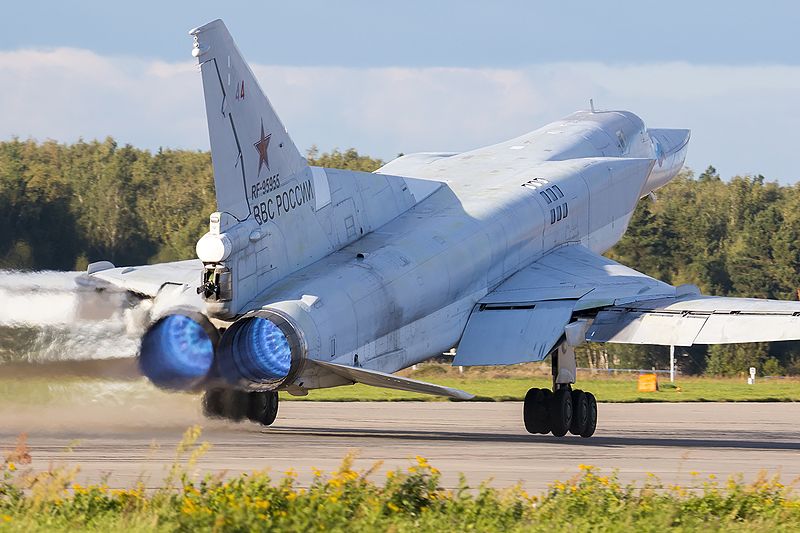
Both Russia and China field heavy bombers with long-range anti-ship firepower, and where heavy bombers were at the leading edge of Soviet anti-ship capabilities throughout most of the Cold War. Soviet-era Backfire bombers can travel over 1500 miles, are capable of supersonic speed, and can fire multiple Mach 3 missiles that have hundreds of miles of range. Large Backfire bomber raids have been expected to be a principle tactic for countering American carrier groups far from Russia for decades.26
Similar platforms exist within the U.S. military, but heavy bombers belong to the Air Force. It appears the Air Force bought very few Harpoon missiles with less than 100 in its inventory by the mid-90s.27 The full adoption of an anti-ship role for heavy bombers may have also been hindered by a combination of inter-service rivalry between the Navy and the Air Force as well as differing priorities in their contingency planning.
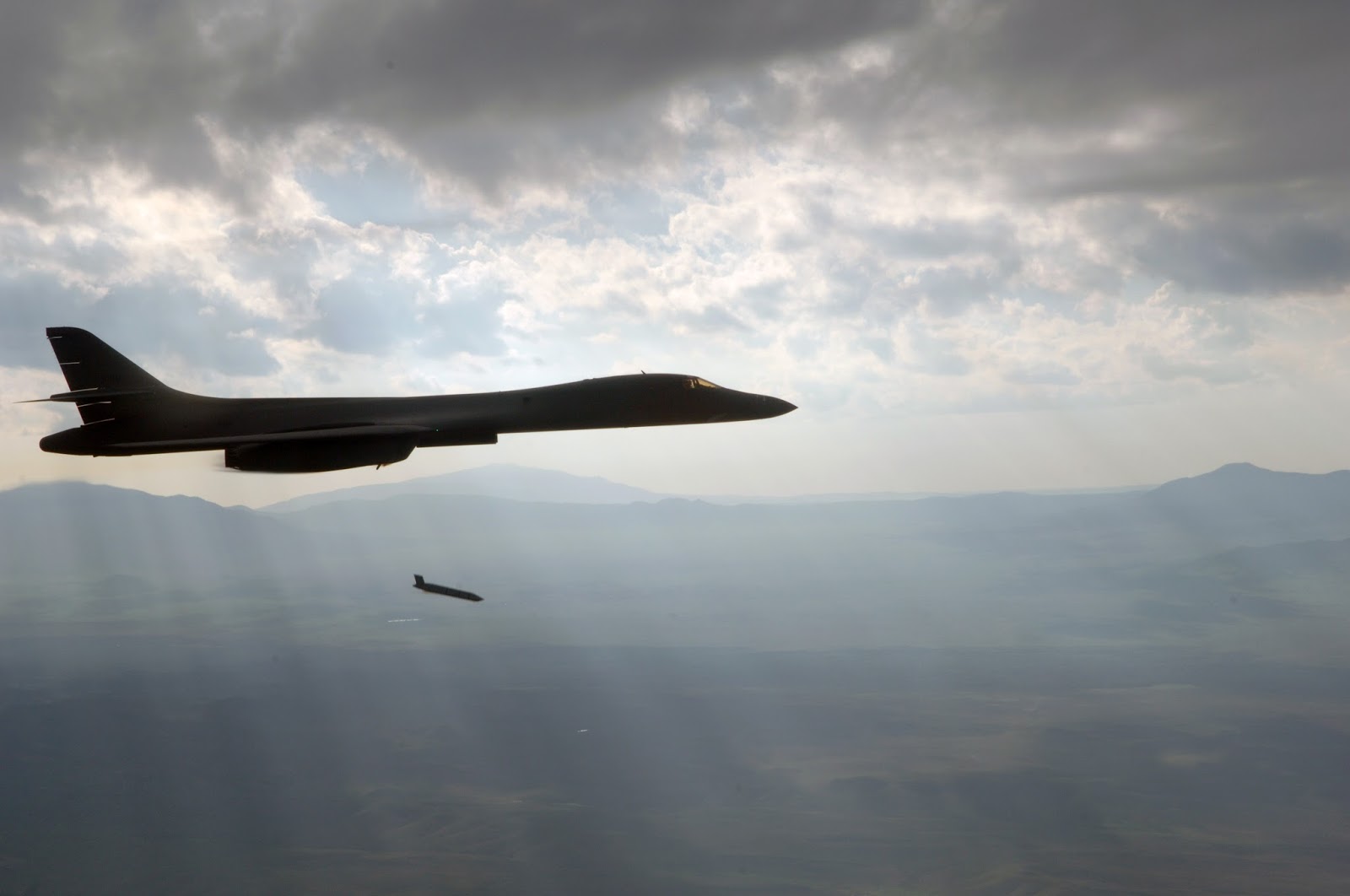
Soon one of the most powerful anti-ship platforms in the American arsenal will not even belong to the U.S. Navy. The platform that will first receive the first truly modern and widespread anti-ship missile of the U.S., LRASM, will not be a Navy asset but the Air Force’s B-1 bomber. These bombers will be able to carry 24 of these powerful weapons, packing over 15 times the anti-ship firepower of a Harpoon-equipped U.S. surface warship.28 These planes will make for an extremely powerful asset when combined with their thousands of miles of range.29 This year the U.S. will finally have a heavy bomber with credible long-range anti-ship firepower, but after the Soviets pioneered the same capability half a century ago.30
An Air Force B-1B Lancer drops a Long Range Anti-Ship Missile (LRASM) during a 2013 flight test from Dyess Air Force Base in Texas to Point Mugu Sea Test Range off the coast of southern California. (DARPA photo)
Shortchanged
Of the Navy’s errors in arming the fleet none can compare to failing to effectively bring its offensive firepower into the age of missile warfare. Only now is it on the verge of doing so with launch cell-compatible missiles like LRASM and the Maritime Strike Tomahawk that are just a couple years away from hitting the fleet. Finally the Navy will have widespread anti-ship firepower that can hit at over 100 miles. This wholesome introduction of long-range anti-ship missiles comes over half a century after the Soviets proved it was possible.31
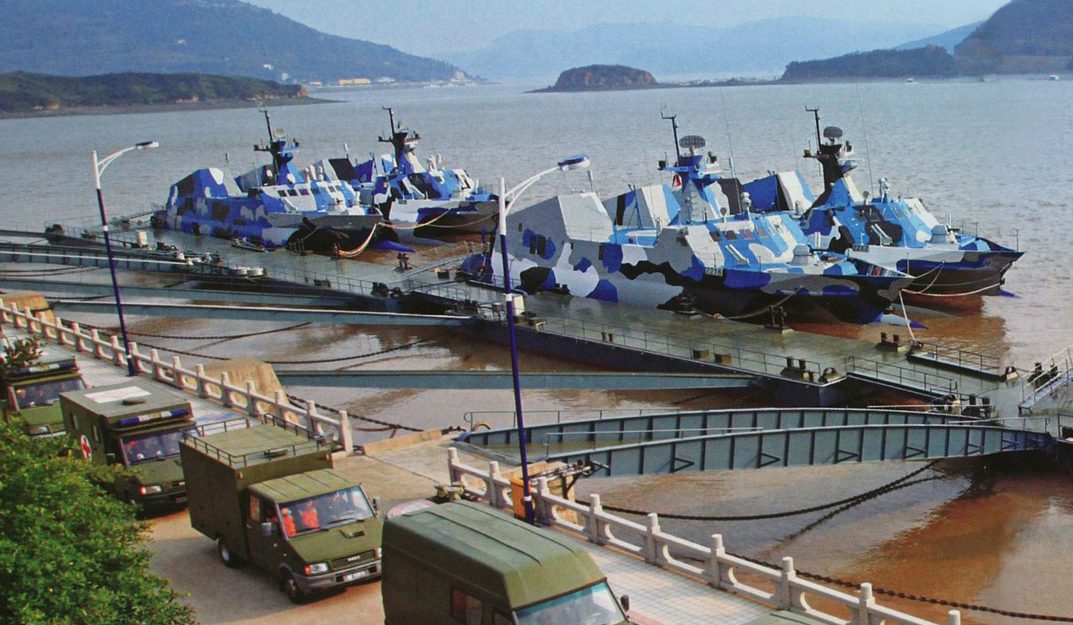
But this recent introduction of long-range anti-ship firepower will not be the Navy’s first attempt. Up until now much of the Navy’s story of fielding anti-ship missiles consists of developing weapons long after they were first possible, then not fielding them in effective numbers, subsequently removing them from the inventory, only to then try and reintroduce them decades later. The Navy lagged long enough to where today there are 400-ton Chinese missile boats that carry more long-range anti-ship firepower than 9,500-ton, billion-dollar American cruisers and destroyers that have around 100 launch cells.32
Chinese Navy Type 022 (Houbei Class) Fast Attack Missile Craft (China Military Review)
Why was the Navy stuck with only the short-ranged Harpoon for so long, and why were competitors able to design so many more anti-ship missiles with greater lethality in the meantime?
The answer may lie with doctrine. The aircraft carrier has remained the centerpiece of U.S. Navy anti-ship doctrine since WWII. Harpoon probably became the Navy’s first anti-ship missile and remained its primary anti-ship tool for over 40 years because it appears Harpoon was one of the first anti-ship missiles small enough to fit onto multirole aircraft, such as those flown from aircraft carriers.33 By comparison, airborne anti-ship firepower for the Soviets mostly took the form of enormous missiles that could only be carried by large bombers. The very short range of Harpoon was made up for by the long reach of aviation that could travel hundreds of miles and strike targets well before they could get within range to unleash their own anti-ship firepower.
The small size necessary to equip carrier aircraft with Harpoon was a major limiting factor for missile capability with respect to range, speed, and size. Ship-launched missiles can take on far greater proportions such as Tomahawk or the early-Cold War era Talos anti-air missile that weighed over four times as much as Harpoon.34 But by not bothering to effectively field an anti-ship missile that was compatible with the thousands of launch cells across the fleet the Navy was unable to capitalize on core advantages warships bring to the fight – staying power and deep capacity.
It is questionable to subscribe to a doctrine that deprives the surface fleet, the submarine force, and the heavy bomber arm of long-range anti-ship firepower. Russia and China have not made this mistake. With respect to anti-ship firepower in the age of missile warfare not only did the Navy bet the aircraft carrier would reign supreme, but that it could stand alone. While the reach and size of the carrier air wing could compensate for Harpoon’s shortcomings the rest of the fleet was stuck with a small, slow, short-ranged missile kept aboard in very low quantities. The U.S. Navy, so completely blinded by absolute faith in the supremacy of a single platform, failed to effectively field the premier offensive weapon of a new age of warfare.
Dmitry Filipoff is CIMSEC’s Director of Online Content. Contact him at Nextwar@cimsec.org.
*Correction: Harpoon is equipped by a majority of the U.S. Navy large surface combatants unlike as was originally worded. Harpoon is found on a minority of U.S. Navy destroyers.
Excerpt: “That shot marked the first time a Harpoon had been fired from a U.S. submarine in more than 20 years, and Commander of U.S. Pacific Fleet’s Submarine Force Rear Adm. Daryl Caudle said he expects that the cruise missile will be added back into the SSN’s regular armament.”
7. Captain Philip Signor, USNR, “Cruise Missiles for the U.S. Navy: An Exemplar of Innovation in a Military Organization,” Naval War College, June 1994. http://www.dtic.mil/dtic/tr/fulltext/u2/a283784.pdf
8. Joseph C. Schissler and John P. Gibson, “The Origin and History of the Global Engagement Department,” Johns Hopkins APL Technical Digest, Volume 29, Number 2 (2010) http://www.jhuapl.edu/techdigest/TD/td2902/Schissler.pdf
10. For anti-ship Tomahawk remove of service: Joseph C. Schissler and John P. Gibson, “The Origin and History of the Global Engagement Department,” Johns Hopkins APL Technical Digest, Volume 29, Number 2 (2010) http://www.jhuapl.edu/techdigest/TD/td2902/Schissler.pdf
Note: Vertical launch cells that could fire Tomahawk missiles were fairly rare in the U.S. Navy until only after the Cold War, and where Tomahawk was also kept in deck-mounted launchers for many ships. Vertical launch cells became more common when Spruance-class destroyers were modified to accomodate launch cells in the 90s, and the concurrent introduction of the Arleigh Burke-class destroyers.
13. For 1982 test date: E. H. Corirow, G. K. Smith, A. A. Barboux, “The Joint Cruise Missiles Project: An Acquisition History, Appendixes,” RAND, August 1982. http://www.dtic.mil/dtic/tr/fulltext/u2/a141082.pdf
Statement Of The Honorable James F. Geurts Assistant Secretary Of The Navy Research, Development And Acquisition Before The T Senate Armed Services Committee On Department Of Defense Acquisition Enterprise And Associated Reforms, December 7, 2017. https://www.armed-services.senate.gov/imo/media/doc/Geurts_12-07-17.pdf
33. Navy has an multi-role fighter-mounted weapon known as SLAM-ER that has superior range to Harpoon and is capable of engaging ships. However, it is much more rare than Harpoon. See inventory: Forecast International, AGM-84E SLAM, March 2011. https://www.forecastinternational.com/archive/disp_pdf.cfm?DACH_RECNO=850
Despite their enormous size the Navy had cruisers that could carry over 100 Talos missiles through highly advanced missile launch systems and magazines. These shields also carried dozens of shorter-ranged anti-air missiles. See: Elmer D. Robinson, “The Talos Ship System,” JHU APL Technical Digest, Volume 3, Number 2, 1982. http://www.jhuapl.edu/techdigest/views/pdfs/V03_N2_1982/V3_N2_1982_Robinson.pdf
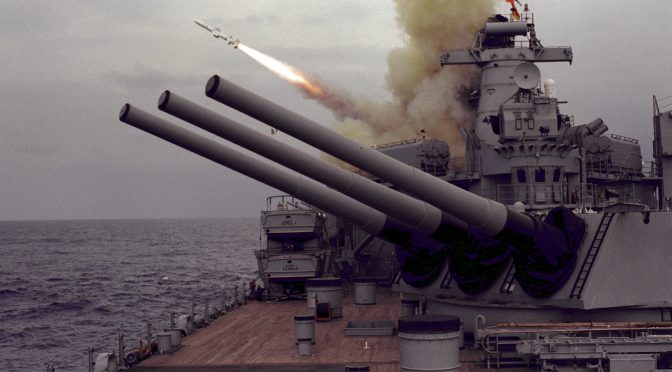
Featured Image: The battleship USS IOWA (BB-61) launches a Harpoon anti-ship cruise missile during Fleet Exercise 2-86 (National Archives Catalog)