Category Archives: Capability Analysis

Analyzing Specific Naval and Maritime Platforms

Print, Plug, and Play Robotics

William Selby is a Marine Officer who previously completed studies at the US Naval Academy and MIT researching robotics. The views and opinions expressed in this article are his own.

In September 1999, NASA lost a $125 million Mars orbiter because a contracted engineering team used English units of measurement while NASA’s team used the metric system for a key spacecraft operation.[i] In everyday life we are forced to choose between differing formats with the same function. What was once VHS vs. Betamax became Blu-ray vs. HD DVD. A lack of component standardization can reduce the operational effectiveness of a system as shown by the NASA orbiter. More commonly, the end user may waste resources purchasing multiple components that serve the same purpose, as was the case for DVD players in the late 2000s. These same issues are occurring in the development, procurement, and operation of our unmanned systems. Over the last decade, the US military has amassed large numbers of unmanned systems composed of highly proprietary hardware and software components. However, future unmanned systems designed with interoperable hardware and software and constructed utilizing advanced manufacturing techniques will operate more effectively and efficiently than today’s platforms.


Advances in manufacturing techniques as well as efforts to standardize software and hardware development are being pursued in order to diminish the negative effects caused by proprietary components in unmanned systems. These new technologies focus on speed and customization, creating a new and evolving research, development, and production methodology. Modular designs increase the rate of production and upgrades while new manufacturing techniques enable rapid prototyping and fabrication on the front lines. Replacement parts can be stored digitally, produced on demand, and swapped between unmanned systems, reducing the system’s logistical footprint. This organic production capability will enable units to tailor manufacturing needs to match operational requirements. The resulting unmanned systems will operate with interchangeable payloads making them quick to adapt to a dynamic environment while common software will enable easier control of the vehicles and wider data dissemination.


Complementary Technologies


The concept of interoperable hardware and software is more formally referred to as open architecture (OA). DOD Directive 5000.1, “The Defense Acquisition System,” outlines the DOD’s goal to acquire systems that can be easily swapped between unmanned systems similar to the way different types of USB devices can be swapped out on a personal computer. [ii] This ranges from swapping sensor payloads between platforms to entire unmanned systems between services and countries.[iii] Establishing standards and creating policy for OA are the responsibilities of multiple organizations. For unmanned aerial systems (UASs), the Interoperability Integrated Product Team (I-IPT) drafts UAS System Interoperability Profiles (USIPs). Similarly, the Robotic Systems Joint Program Office (RS JPO) creates Interoperability Profiles (IOPs) to identify and define interoperability standards for unmanned ground systems. Several of the IOP standards have been adopted for unmanned maritime systems by the Naval Undersea Warfare Center.[iv]


Advances in manufacturing techniques complement and leverage the OA concept. In general, these techniques focus on converting a digital blueprint of a component into its physical form. The advantages of additive manufacturing, commonly known as 3D printing, have been recently publicized as well as potential military applications.[v],[vi],[vii],[viii] 3D printing creates the desired object in metal or plastic by converting liquid or powdered raw materials into a thin solid layer, forming a single layer at a time until the piece is completed. Less mature technologies include Printed Circuit Microelectromechanical Systems (PC-MEMS) uses 3D printing to create a flat object of rigid and flexible materials with special joints that are later activated turning the flat object into a three-dimensional object much like a children’s pop up book. [ix],[x] A final technique inspired by origami involves etching crease patterns into flat sheets of metal allowing them to be quickly folded and assembled into complex components. [xi]


Lifecycle Impacts


Production of future unmanned systems will be altered by these technologies beginning with the initial system requirements.[xii] Standard capability descriptors minimize the need for a single, large business to create and entire unmanned system. This will allow small businesses to focus research and development on a single capability that can be integrated into multiple platforms requiring that capability thereby increasing competition and innovation while reducing initial procurement costs.[xiii],[xiv] These unmanned systems will be easily upgradeable since payloads, sensors, and software are anticipated to evolve much faster than the base platforms.[xv] Open hardware and software ensures that upgrades can be designed knowing the component will function successfully across multiple platforms. Advanced manufacturing techniques will enhance the development of these upgrades by allowing companies to rapidly prototype system components for immediate testing and modification. Companies can digitally simulate their component to verify their design before mass producing a final version with more cost effective traditional manufacturing techniques. The final version can then be digitally distributed enabling the end user to quickly load the most recent version before production.


These technologies also have the potential to significantly impact supply chain management and maintenance procedures required for unmanned systems. Since components can be swapped across multiple platforms, it will no longer be necessary to maintain independent stocks of proprietary components unique to each platform. If a component can be created using organic advanced manufacturing techniques, only the digital blueprint and raw materials need to be available. While the strength of components created using additive manufacturing may not be enough for a permanent replacement, temporary spare parts can be created in a remote area without quick access to supplies or depot repair facilities while permanent replacements are delivered. This reduces the logistical footprint and maintenance costs by limiting the number of parts and raw materials required to be physically stored for each system.


Most importantly, these technologies will produce unmanned systems with the operational flexibility necessary for the unknown conflicts of the future. Components ranging from power systems to sensor payloads can be quickly and easily swapped between platforms of varying vendors, selected to fit the mission requirements and replaced as the situation develops.[xvi]Standardizing the sensor’s data transmission format and metadata will generate timely and accurate data that is more easily accessed and navigated by all interested parties.[xvii] An early example of these advancements, the Army’s One System Remote Video Terminal, allows the user to receive real time video footage from multiple platform types as well as control the sensor payload.[xviii],[xix] Digital libraries will close the gap between developer and user ensuring the most recent component design is manufactured or the latest software capability is downloaded and transferred across platforms.[xx] Standardized communications protocols between the platform and the controller will enable a single controller to operate different platforms, as recently demonstrated by the Office of Naval Research.[xxi] Further into the future, the operator may be able to control multiple unmanned systems across various domain simultaneously.[xxii],[xxiii] The ability to create heterogeneous “swarms” of unmanned systems with varying sensor suites in different physical operating environments will give the commander the flexibility to quickly configure and re-configure the unmanned system support throughout the duration of the operation.


New Technologies Create New Vulnerabilities


As these technologies are implemented, it is important to keep in mind their unique limitations and vulnerabilities. The stringent qualification process for military components, especially those with the potential to harm someone, is often described a key limitation to the implementation of modular components.[xxiv] However, without people on board, unmanned systems have lower safety standards making it easier to implement modular components in final designs. Compared to traditional methods, additive manufacturing is slow and produces parts limited in size. The materials have limited strength and can be 50 to 100 times more expensive than materials used in traditional methods.[xxv] While future development will decrease prices and increase material strength, traditional manufacturing techniques will remain more cost effective means of producing high volume items into the near future. Additionally, open designs and digital storage can create vulnerabilities that may be exploited if not properly secured. Militants in Iraq purportedly viewed live video feeds from UASs using cheap commercial software while Chinese cyberspies allegedly gained access to many of the US’s advanced weapons systems designs.[xxvi],[xxvii] Further, digital blueprints of parts have the potential to be modified by nefarious actors to create counterfeit or falsified parts.[xxviii] As the price of manufacturing equipment quickly drops, anyone can create the products when given access to the digital copies.[xxix]


Future technological innovations have the ability to modify traditional supply methodologies allowing the end user to manufacture parts on demand for use in a variety of unmanned systems. Proprietary hardware and software can be minimized, resulting in unmanned systems with smaller logistical footprints condensing vulnerable supply chains while reducing overall system cost. These benefits are tempered by the unique vulnerabilities that arise when standardizing and digitizing unmanned system designs. Despite these potential vulnerabilities, the ability to equip a force with increased capability while reducing costs and logistical requirements is indispensable. While the locations of the next conflicts will remain hard to predict, unmanned systems able to complete a variety of missions in remote areas with limited logistical support will become an operational necessity.


[i] Lloyd, Robin, Metric mishap caused loss of NASA orbiter, accessed athttp://www.cnn.com/TECH/space/9909/30/mars.metric.02/index.html?_s=PM:TECH, 30 September 1999.

[ii] U.S. Department of Defense, DOD Directive 5000.1 – The Defense Acquisition System, Washington D.C., 12 May 2003.

[iii] U.S. Department of Defense, Unmanned Systems Integrated Roadmap FY2013-2038, Washington D.C., 2013.

[iv] U.S. Department of Defense, Unmanned Systems Integrated Roadmap FY2013-2038, Washington D.C., 2013.

[v] Llenza, Michael, “Print when ready, Gridley,” Armed Forces Journal, May 2013.

[vi] Beckhusen, Robert, Need Ships? Try a 3-D Printed Navy, accessed at http://www.wired.com/dangerroom/2013/04/3d-printed-navy/, 04 May 2013.

[vii] Cheney-Peters, Scott and Matthew Hipple, “Print Me a Cruiser!” USNI Proceedings, vol. 139, April 2013.

[viii] Beckhusen, Robert, In Tomorrow’s Wars, Battles Will Be Fought With a 3-D Printer, accessed at http://www.wired.com/dangerroom/2013/05/military-3d-printers/, 17 May 2013.

[ix] Leung, Isaac, All abuzz over small pop-up machines with Printed Circuit MEMS, accessed at http://www.electronicsnews.com.au/news/all-abuzz-over-small-pop-up-machines-with-printed-, 22 February 2012.

[x] Wood, R.J., “The First Takeoff of a Biologically Inspired At-Scale Robotic Insect,” Robotics, IEEE Transactions on , vol.24, no.2, pp.341,347, April 2008.

[xi] Soltero, D.E.; Julian, B.J.; Onal, C.D.; Rus, D., “A lightweight modular 12-DOF print-and-fold hexapod,” Intelligent Robots and Systems (IROS), 2013 IEEE/RSJ International Conference on , vol., no., pp.1465,1471, 3-7 Nov. 2013.

[xii] U.S. Department of Defense, Unmanned Systems Integrated Roadmap FY2011-2036, Washington D.C., 18 September 2012.

[xiii] Real-Time Innovations, Interoperable Open Architecture, accessed at

http://www.rti.com/industries/open-architecture.html, 2012.

[xiv] U.S. Department of Defense, Unmanned Systems Integrated Roadmap FY2013-2038, Washington D.C., 2013.

[xv] U.S. Department of Defense, Unmanned Systems Integrated Roadmap FY2013-2038, Washington D.C., 2013.

[xvi] Real-Time Innovations, Interoperable Open Architecture, accessed at

http://www.rti.com/industries/open-architecture.html, 2012.

[xvii] Crawford, Katherine, ONR Provides Blueprint for Controlling All Military Unmanned Systems, accessed at http://www.onr.navy.mil/Media-Center/Press-Releases/2013/ONR-Provides-Blueprint-for-Controlling-UAVs.aspx, 01 May 2013.

[xviii] Shelton, Marty, Manned Unmanned Systems Integration: Mission accomplished, accessed at http://www.army.mil/article/67838, 24 October 2011.

[xix] AAI Corporation, One System Remote Video Terminal, accessed at https://www.aaicorp.com/sites/default/files/datasheets/OSRVT_07-14-11u.pdf, 14 July 2011.

[xx] Lundquist, Edward, DoD’s Systems Control Services (UAS) developing standards, common control systems for UAVs, accessed at GSNMagazine.com, 06 January 2014.

[xxi] Crawford, Katherine, ONR Provides Blueprint for Controlling All Military Unmanned Systems, accessed at http://www.onr.navy.mil/Media-Center/Press-Releases/2013/ONR-Provides-Blueprint-for-Controlling-UAVs.aspx, 01 May 2013.

[xxii] DreamHammer goes Ballista for multi-vehicle control software, Unmanned Daily News, 15 August 2013.

[xxiii] SPAWAR Systems Center San Diego, Multi-robot Operator Control Unit (MOCU), accessed at http://www.public.navy.mil/spawar/Pacific/Robotics/Pages/MOCU.aspx.

[xxiv] Freedberg, Sydney J., Navy Warship Is Taking 3D Printer To Sea; Don’t Expect A Revolution, accessed at http://breakingdefense.com, April 2014.

[xxv] McKinsey Global Institute, Disruptive technologies: Advances that will transform life, business, and the global economy, accessed at http://www.mckinsey.com/insights/business_technology/disruptive_technologies, May 2013.

[xxvi] Gorman, Siobhan, Yochi Dreazen, and August Cole, Insurgents Hack U.S. Drones, The Wall Street Journal, 17 December 2009.

[xxvii] Nakashima, Ellen, Confidential report lists U.S. weapons system designs compromised by Chinese cyberspies, The Washington Post, 27 May 2013.

[xxviii] NexTech, Project Summary, NOETICGROUP.COM, April 2012.

[xxix] Llenza, Michael, “Print when ready, Grindley”, Armed Forces Journal, May 2013.


Sea Control 38: War Gaming with the CRIC Podcast (1 of 2)

seacontrol2From the entertainment of the risk board to the grand scale of international exercises… war games of varying types and scale inform and misinform us in learning about war and conflict. For the first in a two-part series on wargaming, CIMSEC jumped onboard with Jeff Anderson and the CNO Rapid Innovation Cell Podcast to discuss the CRIC’s Fleet Battle School game as well as a more general group discussion of the benefits, tripfalls, potential and limitations of wargaming. Chris Kona discusses the Fleet Battle School game and some larger wargaming programs. Jeff nerds out on Starcraft, and I talk a bit about the first world war.
Download: Sea Control 38:
War Games (1 of 2)

Speaking of wargames… remember, CIMSEC is running our “Sacking of Rome” series starting 16 June! Instead of talking about securing the commons, maintaining global security… using historic examples, modern-day developments, or predictions of the future, red-team the global system and develop constructive answers to your campaign. If you were an adversary, how would you seek to subvert or tear down the global system and how could we stop you? Paul Pryce is our editor for the week: (paul.l.pryce -at- gmail.com).

Remember, subscribe on iTunes or Stitcher Stream Radio. Leave a comment and rate five stars!

Sea Power: A Personal Theory of Power

This essay, is part of the Personal Theories of Powerseries, a joint Bridge-CIMSEC project which asked a group of national security professionals to provide their theory of power and its application. We hope this launches a long and insightful debate that may one day shape policy.

Air and land power leave monuments to teach us of their authority: from the House of Commons’ bomb-scorched archway to the nation-wide wreckage of the Syrian Civil War. Sea power’s traces are washed away by its namesake — no rubble marking the battle of USS Monitor vs. CSS Virginia nor shattered remains of the convoys from the Battle of the Atlantic. The power with which the sea consumes is the same power with which sea power is imbued. Sea power’s force, persistence, and fluidity –the vast opportunities afforded by the sea — create three properties: the gravitational, phantasmal, and kinetic manifestations of its power.

The Fundamental Nature of Sea Power

Sea power is the physical or influencing power projected by independent mobile platforms within a sea. Like the vast waters of the deep oceans, sea power does not “flow” from a source like air power would, nor does it need to “settle” as land power does. The sea is a large and open commons in which a platform can achieve mobile-and-independent semi-permanence. Being “mobile” gets to the core of sea power; it’s an ability to maneuver a semi-permanent threat at sea or anywhere near or touching the sea. Sea power provides a unique mid-point between persistence and mobility.

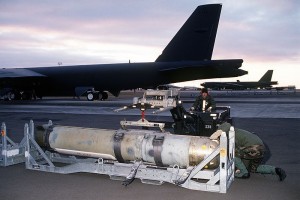
Airmen prepare to load a Mark 60 CAPTOR (encapsulated torpedo) anti-submarine mine onto a B-52G Stratofortress. US Navy
Airmen prepare to load a Mark 60 CAPTOR (encapsulated torpedo) anti-submarine mine onto a B-52G Stratofortress.
US Navy

Ordnance merely aimed or fired towards the sea is not sea power. Land-based aircraft dropping sea-mines is not sea power, just as naval gunnery on land targets is not land power, nor flying artillery shells air power. Land, sea, and air power can all be used to combat each other; their powers are not restricted to effects within or through their own medium. Our types of power are the spectrum of capability afforded by nature of one’s presence within a medium.

Sea Power’s Gravity: An Inescapable Weight

Adversarial resources are strongly drawn into defense against sea power’s mobility and potency; in this manner, sea power’s weight, or “gravity”, holds down adversarial actions. Even a weak fleet huddled in port can generate sea power, forcing the enemy to pull resources away from more productive tasks to hold down an adversary’s most mobile threat — it’s fleet.

Take the Spanish-American War, for instance. The Americans had an abiding fear of the mere existence of Spanish sea power and the possibility that it would descend without notice on their coastline, shelling cities and port facilities. Though the Spanish fleet was ultimately wasted in a force-on-force fight, strategists have historically referred to a standing fleet whose purpose is to leverage mere threat as “fleet in being”. Rather than winning through firepower, an in-port “fleet in being” has potent effect on even far-away nations by the potential of their sure potential.

Today it is easier to imagine a mobile “capability in being”, rather than a stationary “fleet in being”. This also leverages the advantages afforded by the sea. The might of this “capability in being” has been illustrated in the past by Allied sea power’s forcing the Nazi’s into building the failed “Atlantic Wall”.

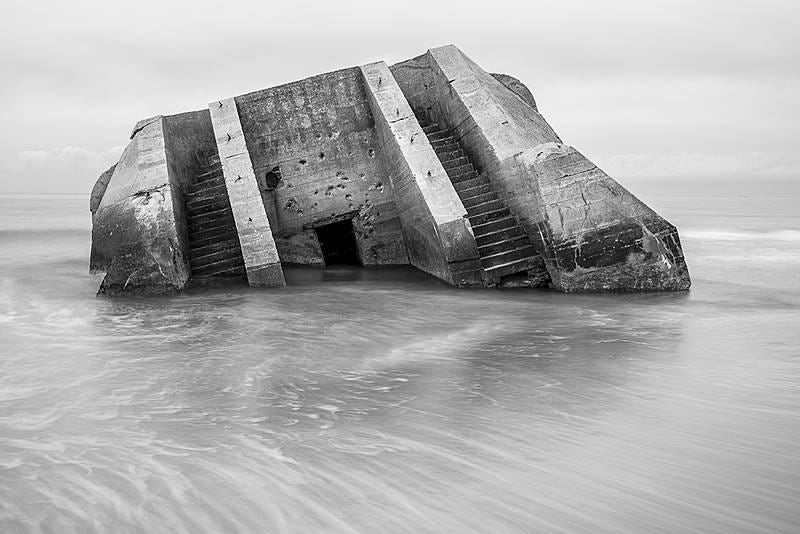
Joerg Karrenbauer Atlantic Wall — no. 3 http://www.karrenbauers.com/atlantic-wall/atlantic-wall-3-wissant-france/


In WWII, sea power afforded the Allies significant advantage, while the Reich’s land power was forced up against the coast to guard every inch of accessible shore of the Atlantic Wall. The Atlantic Wall stretched for hundreds of miles, covering every inch of Reich-held coastline. The scale of preparations and their drain on Nazi resources was enormous, but deemed necessary due to the threat of allied sea power’s mobile capability to penetrate of the continent.

The gravity weighs not only on an adversary’s defenses, but holds down an adversary’s desire to project power. Contrast the case of Taiwan to that of the South China Sea. American sea power has been a guarantor of unimpeded passage in the Pacific since the end of WWII. Taiwan’s existence reflects both the potential and the potency of American sea power, as was demonstrated in the 1996 crisis. However, China’s growing sea power creates space for it to unilaterally declare control of new areas in the South China Sea through ‘salami-slicing’, despite its neighbors’ protests.

Ultimately, sea power is tangible. Its destructive capability is only matched by its potential influence. Sufficient sea power, even hundreds of miles away, has enough gravity to hold down or absorb the resources of the mightiest land or air power. While the adversary of sea power must guard every crack in his armor, a sea power is at liberty to bide time and seek an asymmetry.

The Phantom of Sea Power: Pervasive Uncertainty

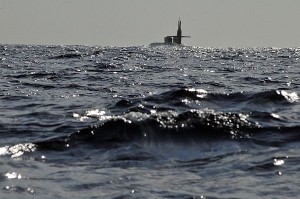
Ohio-class guided-missile submarine USS Florida (SSGN 728) US Navy
Ohio-class guided-missile submarine USS Florida (SSGN 728)
US Navy

Sea power’s gravity is complemented by the obfuscation and fluidity allowed by the sea. Armies leave a trail — they transit urban areas, gather supplies from the land, and generally reside where we do. The sea is far more secretive about its residents. Like silent undercurrents, sea power can be hidden from observers, summoning fearful phantoms.

The best modern example of the sea power phantom is the submarine at the 1916 Battle of Jutland. The mightiest fleet on earth could not bring itself to destroy the German fleet for fear of lurking U-boats. This example of sea-denial highlights a greater return than the expenditure of any ordnance.

Today, submarines have become greater tools for generating uncertainty. The submarine’s invisible presence places an adversary under threat of destruction by Tomahawk missile or direct action by inserted special operations forces. Further threat might be generated by the uncertainty of an un-located fleet or the aircraft that could come from anywhere deep enough for a carrier. Sea power has the unique ability to veil-and-move large amounts of force, leveraging fear of devastating capability hidden by the surface or the horizon.

Sea Power’s Kinetics: When Opportunity Knocks

The gravity and phantom of Sea Power is summoned by a credible threat. History speaks for sea power: the British Empire, the Napoleonic Wars, the Russo-Japanese War, Pearl Harbor, German unrestricted warfare, British logistics in WWII, island hopping, D-Day, and modern South China Sea bumper boats. In the interest of brevity, we will split sea power’s kinetic abilities into two categories: logistics and violence.


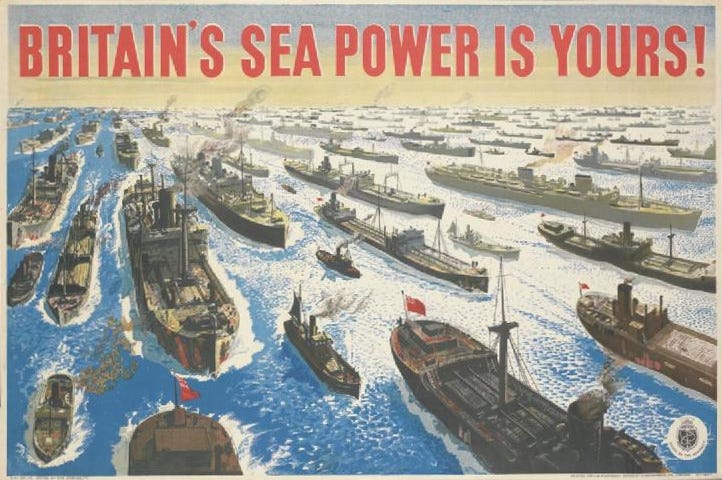
Sea Power’s logistical ability is often the forgotten part of sea power. A British WWI poster highlights this best. “Britain’s Sea Power is Yours” consists not only of a fleet of warships, but an entire horizon of commercial and military supply vessels. The ability to execute and secure seaborne logistics and to use and defend access to the global commons is potent power indeed. The effects of sea power on Malta, from its seizure by Britain during the Napoleonic Wars to its stubborn survival against the mightiest air force in Europe during WWII, serves as a testament to the subtle potency of the physical and logistical components of sea power. This flexible logistics train can either build an offensive opportunity or sustain a force until such opportunity arises.

The purely destructive capacity of sea power has indirectly already been described. Gravity becomes matter, the Allied fleet putting the wedge’s thin edge to the Atlantic Wall. The force feared by the Nazis came to fruition on D-Day. The phantom materializes, as experienced by Allied convoys facing wolf packs in WWII. It starts with the ability to find the point at which the thin end of the massive wedge can be applied; mobile forces deploying their feelers across the open commons. The American dance-and-smash across the Pacific is the best example, as Nimitz “island hopped” around Japanese defenses and two fleets fought for the first time without even seeing one another. Sea power allows forces a degree of sustainability of land forces to wait out an enemy while carrying along the independent payload with a degree of mobility of air power to respond in time to the development of that opportunity.

Sea Power: The Power of Opportunity

When we say “sea” we are using a placeholder for the large-and-open commons in which a platform can achieve mobile-and-independent semi-permanence. We discuss space power, but ships in space could eventually meld into a future sea power narrative. In WWI, one could argue that Zeppelins carrying aircraft could have joined a sea power concept. Rather than limiting oneself to the conventional “sea”, consider where humans have instinctively decided they can put “ships” from the type of freedom and opportunity the medium affords.

Sea power may have neither the total enduring strength of land power nor the mobility of air power — but it has a strategically potent degree of both. This affords it a unique gravity, an ability to generate fear, and a physical footprint unique from other powers. It finds, creates, and exploits opportunities better than any other type. It creates opportunity and suppresses those of adversaries by virtue of its physical capability or its influence upon enemy action. Sea power is the power of opportunity.

Matthew Hipple is an active duty officer in the United States Navy. He is the Director for Online Content at the Center for International Maritime Security, host of the Sea Control podcast, and a writer for USNI’s Proceedings, War on the Rocks, and other forums. While his opinions may not reflect those of the United States Navy, Department of Defense, or US Government, he wishes they did.

Increasing Lethality in Anti-Surface Warfare (ASuW)

Minor (and Less Minor) Course Corrections

Change in the force structure of any military service is a reality we should all expect and in fact insist upon; one may only hope the factors that drive these changes are planned and controlled, but the threat gets a vote, and the end result is never exactly as desired.  The reality in the Navy’s surface force is that we have delivered an extremely capable fleet of cruisers and destroyers, all of which met the threat for the time in which they were designed, and all of which share one distinct trait today:  they all need to realize an increase in their offensive lethality if we are going to win a SAG vs SAG War At Sea scenario.

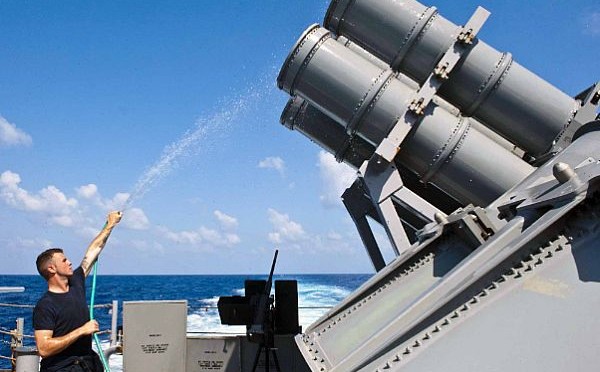
In the CRUDES world, our longest range and more capable anti-surface weapon remains the Harpoon missile; aside from a few software upgrades, the surface-launched version is largely the same weapon I saw on my first ship when I reported aboard in 1986.  The five-inch gun battery has more reliable and effective ammunition – and nearly the same range and rate of fire as its predecessor 30 years ago.  The Standard Missile, even with its anti-surface capability, is almost wholly and properly dedicated to the IAMD fight. And in perhaps our most glaring deficiency, we have not yet answered the demand signal from the COCOM in the Pacific, our most challenging maritime environment, to deliver a longer range, surface ship maritime strike weapon.

Today’s threat includes everything from pirates lobbing RPGs to the traditional blue water threat from adversary frigates, cruisers, and destroyers.  During a decade of war in and about the Arabian Gulf we focused on fast attack craft (FAC) and fast inland attack craft (FIAC) swarms designed to limit the freedom of navigation in the littorals; while we have already turned our attention to the competing blue water navies of the world, we must ensure our own ships pack the punch necessary to defeat that modernized adversary in the future.

Returning to our Offensive-minded Roots

The confluence among concluding the Afghanistan and Iraqi wars, rebalancing presence and control in the Asia-Pacific basin, and resizing the defense budget has culminated in a “Blue Water Renaissance” for the Surface Navy.  In many instances, the past is prologue for the challenges facing today’s (and tomorrow’s) fleet. Our leadership properly states in myriad forum, including testimony before congress, that Sea Power – specifically offensive capability and capacity – remains a critical strategic component in fulfilling rebalancing efforts and meeting international requirements.

120718-N-VY256-261To this extent, the Surface Force is positioned to serve as an enabling characteristic in virtually every scenario, yet we must become more lethal and more offensively postured – and deliver increased capacity and capability sooner rather than later.  No ship was ever designed with the thought that it would meet and defeat every threat in every scenario; I would submit that notion would be both fiscally and realistically impossible. There are several areas, however, in which the surface warfare community is engaged to increase its lethality, and to do so without having to rely on the presence of the CVN and its air wing; as clearly capable as the Carrier is, against the prolific threat today and tomorrow, the prudent warrior will plan on having to start and finish a maritime engagement without the CVN.

Increased lethality in our ships brings the idea of “sea control” back into the realm of our surface action groups – allowing flexibility in our operational plans and forcing  potential aggressors to pause, even when the CVN is days away. In light of the defense budget’s multiple competing requirements, programming the future Surface Force to maintain Blue Water primacy and offensive capability remains our most pressing challenge, but it is a challenge we are addressing on multiple fronts. As is fitting for multi-purpose ships like DDGs and CGs, this increased lethality will come in different mission areas and allow for greater capacity across the spectrum of operations.

Near to Far … Advanced Naval Surface Fires

From the perspective of Naval Surface Fires, N96 is currently spearheading a comprehensive re-fresh of major caliber gun requirements, aptly named “Advanced Naval Surface Fires”.  Already begun, this effort will re-evaluate the spectrum of requirements from close-in self-defense to offensive fires.  Advanced Naval Surface Fires will focus on increasing surface Navy offensive and defensive lethal capacity and decreasing cost per kill by broadening traditional gunfire requirements to include emerging technologies ranging from precision munitions to the Electro-Magnetic Railgun and laser weapons.

Over the next five years we will complete the fielding of the automated 25mm Mk38 gun system to all of our combatants and upgrade its EO/IR sensor for better threat identification and recognition.  The CIWS Block 1B upgrade continues apace, and by the end of FY15 every ship is scheduled to have this gun’s expanded defense against asymmetric threats such as small, fast surface craft, slow-flying aircraft, and unmanned aerial vehicles. In the 5″ gun lane, we are fielding a new “MOF-N” (Multi-Option Fuse, Navy) ammunition that replaces six older ammunition types and has improved performance against shore and sea targets, while continuing to evaluate the performance of MFF (Multi-Function Fuse) versus FAC/FIAC threats.

But those are all already-existing, albeit significant investments – as part of the focus on increasing lethality, N96 is also investing in new industry initiatives to increase the capability of today’s 5″ gun – improving our surface fleet’s ability to provide precision, high rate fires at extended ranges. Increased lethality also extends beyond the CRUDES community – by the end of FY15, we will complete installation of the laser-guided Griffin missiles in the PC class, which recently completed a perfect 4-for-4 demonstration in theater, and we will soon follow with a new missile system in the LCS which will significantly improve our small vessel engagement capability for the fleet.

Although the STANDARD Missile-2 (SM-2) remains our primary anti-air warfare missile system on all US Navy destroyers and cruisers, and is deployed by eight international Navies, the surface community is sustaining our inventory and pacing the threat by exploring cost effective ways to leverage the existing inventory by integrating an active seeker/guidance section into the SM-2.  As we continue to investigate this path, we are encouraged by the notion we could provide the Warfighter with a more robust and cost effective area defense weapon.  An active seeker could enable OTH engagements and improve SM-2 performance against stream raids and in ECM environments, while also enhancing our ASuW surface targeting.

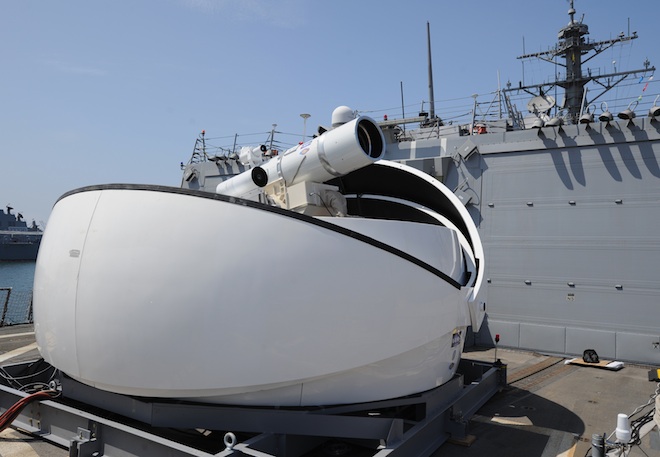
LaWS
LaWS

Longer term investments in directed energy – both in weaponized lasers and the electro-magnetic railgun – are expected to bring an offensive punch to several mission areas while also significantly reducing the cost curve of a surface engagement. Railgun will provide greatly enhanced range and accuracy against anticipated ASuW target sets in the Pacific Rim and Southwest Asia. Industry is already deep into prototype development of shipboard lasers – high energy, solid state weapons that will provide sustained counter UAV, counter boat swarm and greatly enhanced combat ID.  Both of these efforts continue at a pace commensurate with the developing technology; if you’re a SWO finishing your Department Head ride now, you can expect to see them reach culmination and being fielded at sea before your command tour.

Surface Ships and Maritime Strike

Ever since the demise of the Tomahawk Anti-Ship Missile (TASM), Navy has wrestled with the question of whether, and when, such a capability would again be necessary. What circumstances would dictate that our ships need to engage an enemy SAG at ranges greater than our current Harpoon missile?

Not a simple question, but perhaps there is a simple answer: our ships need to be able to engage that enemy SAG at ranges greater than they can engage us. Sea control really isn’t more complicated than that – possessing more lethality than the threat does, and being able to execute that lethality in a given scenario. Refer back to the earlier statement – we will not always operate with the CSG and its striking force in the Air Wing – and we owe it to our nation and our Sailors to be able to win that fight when it presents itself.

The Navy’s roadmap to fielding a surface launched maritime strike weapon (OASuW) includes competing a future solution that would follow the first increment of OASuW, the LRASM missile, which is an aviation-only weapon. In the interim, the surface community has invested significantly in the existing Tomahawk Block IV weapon system, including the All Up Round (AUR), to not only establish a recertification line and enable the weapon’s remaining fifteen-year service life, but also make the AUR relevant into and beyond the coming decade. The capabilities being built into the current Blk IV – including upgraded communications and electronics, with potential future inclusion of an advanced warhead and seeker – will bear some close similarity to those needed for the surface launched OASuW weapon. The Tomahawk missile, amongst others, will be well positioned to compete for that program.

Finally, since possessing this weapon will serve no purpose unless our ships can actually employ it with the confidence we should demand, we cannot forget the kill chain in the course of increasing lethality. Having myriad methods that rely on consistent communications or the presence of the air wing are not sufficient – we must develop an organic kill chain that enables a SAG to find/fix/target the enemy at ranges commensurate with the weapon system being employed. This is not an easy challenge to overcome, and its discussion is best reserved for another forum; suffice to say that solving this challenge is a primary focus in the surface community.

Another Planning Factor – Fiscal Constraints

Amidst all the intent and desire to increase lethality, and thereby enable sea control, we cannot ignore the fiscal reality that our nation and our military face. Sea Control is defined by offensive lethality; so how does a force with a declining resource base continue to meet the demands of forward presence and persistent readiness, and also not only maintain but increase its lethality?

The short answer is by making some difficult choices, and then maintaining the course to see initiatives survive from original design to actual fielding. No branch of our military, including the Navy and its surface community, can make that happen on its own. The first step, however, can be achieved thru the innovative application of developing technology as it enters the acquisition system. Toward that end, we partner with the many military industries to develop new systems, or refine existing ones, to address current and future requirements.

In this era of flat or declining defense budgets, we simply do not live in a fiscally unconstrained environment. New initiatives need to address capability gaps, and they need to be affordable.

Message to Industry: What would be more helpful than a $500M program designed to counter a $50K threat? A program that builds upon already existing technology, doesn’t require hundreds of millions of dollars of R&D, and can be fielded in an affordable and efficient manner.

Conclusion – Remember, Minor Course Corrections

Like most of the fleet, when I reported to the N96 staff I had never served in OPNAV in any capacity, much less in the role of a resource sponsor. I had little to no appreciation for the opportunities that would present to make a difference in the future of our surface navy. While I recognize that gratification in one’s efforts in the world of resourcing is measured in 5-year budget cycles, I am indeed gratified to know that the community’s focus and investment is in the right place. If we manage to make the minor course corrections described herein, instead of shifting our rudder 30 degrees right to left, we will most certainly realize the increased lethality we need in that future SAG vs SAG scenario.

Captain Charlie Williams is the Deputy for Weapons and Sensors, Surface Warfare Directorate (N96). He commanded USS FIREBOLT (PC 10), USS STETHEM (DDG 63) and Destroyer Squadron FIFTEEN (CDS-15). As the Commodore in CDS-15, he served as the GEORGE WASHINGTON Strike Group Sea Combat Commander and Strike Force ASW Commander, and subsequently served as the Seventh Fleet Chief of Staff.

For other material by OPNAV 96, Surface Warfare Division, staff:
Anti-Submarine Warfare (ASW) – the Heart of Surface Warfare by CAPT Charlie Williams, USN
Surface Warfare: Lynchpin of Naval Integrated Air/Missile Defense by CAPT Jim Kilby, USN
Operate Forward: LCS Brings It by RADM Thomas Rowden, USN