Tag Archives: US Navy

Management and Process Improvement: The Navy of the 1990s and Today

By Jason Chuma

On December 25, 1991, following a year and a half breakup of Soviet states, the flag of the Soviet Union was lowered at the Kremlin for the last time and the flag of the Russian Federation was raised. The next day, the Supreme Soviet voted the Soviet Union out of existence. It was a great victory for the United States and what was dubbed the “First World.” They were victorious in the Cold War, a different kind of war, but a war nonetheless. A war between east and west; a war between communism and capitalism; a war fought using all elements of national power – diplomatic, intelligence, military, and economic – which never erupted into combat between the major powers of NATO and the Warsaw Pact.

The End of an Era
(Oleg Nikishin/Getty Images)

Though the war did not involve combat, discussions of conflicts such as Korea and Vietnam aside, the U.S. military was in a near constant state of preparing for the Soviets to push through the Fulda Gap and for a great naval battle in the Norwegian Sea.

But suddenly, the adversary was gone. For nearly five decades the Soviet Union provided focus and direction for what to buy, how to train, and what to study. What now? In 1991, China was not the military power of today and the idea of a Global War on Terrorism couldn’t have been further from mainstream military thought. A look at the 1991 U.S. National Military Strategy makes only generic mentioning of terrorism and shows an isolationist view of China:

“China, like the Soviet Union, poses a complex challenge as it proceeds inexorably toward major systemic change. China’s inward focus and struggle to achieve stability will not preclude increasing interaction with its neighbors as trade and technology advance. Consultations and contact with China will be central features of our policy, lest we intensify the isolation that shields repression.”

The potential threat of China and the actual threat of terrorism did not reveal themselves in force until the early 2000s. The 1990s were a sort of rudderless decade for the U.S. military. With no major perceived enemy to fight, budget cuts commenced. Military spending in the 1990s quickly dropped by a third of its Cold War levels. Intervention in failing or failed states was the name of the game, and American technological superiority, specifically airpower, was the weapon of choice in places such as Iraq, Bosnia, and Serbia.

The Navy found itself without an enemy to confront at sea and with a rapidly shrinking budget. Control of sea lines of communication became assumed and the Navy gradually disarmed itself for fighting a major sea battle in the 1990s through decisions like discontinuing the UGM-84A submarine launched Harpoon anti-ship missile and converting remaining R/UGM-109B Tomahawk anti-ship missiles (TASM) into the Tomahawk land-attack missile (TLAM) R/UGM-109C. The last combatant commissioned equipped with anti-ship missiles was the USS PORTER (DDG 78) in1999.

Idle hands may be the devil’s workshop, but an idle Navy surely is the bureaucrat’s and the administrator’s. Without war or the real risk of war, Navy culture shifted. Instead of warriors patrolling the oceans and maintaining freedom of the seas from the Soviet Navy, it became about management and process improvement. The MBA became the graduate degree of choice and process improvement models such as Deming’s Total Quality Management – rebranded as Total Quality Leadership of course – became the norm.

Admiral James Stavridis had command of the USS BARRY (DDG 52) from 1993 to 1995. He maintained a diary while in command which was published as Destroyer Captain: Lessons of a First Command. Within it he makes some very astute observations of the Navy of the 1990s:

“[W]e have become a navy that specializes in safety, communicating, inspecting, engineering, administering, retaining, and counseling. There is too little emphasis on shiphandling, warfighting, battle repairing, and leading…As an example of how we are a bit out of whack is that if I charted my personal time, I suspect I spend virtually my entire day working the first list and precious little devoted to the latter…If I completely reversed my priorities – and focused exclusively on shiphandling and warfighting, I would be in some danger of being relieved for cause within ninety days…But in some not-too-far-distant decade, I think ships will be hit by cruise missiles, they will sink, men and women will die bad deaths. And hard questions will be asked about the Navy of the 1990s and its priorities and beliefs.”

Admiral Stavridis tells a grim but honest tale of the culture of the Navy in the 1990s, but is it a really a story of the past or is it a story of what has continued to this day? If you compared the Navy of 1995 and the one of today, what cultural differences would you see? Have we turned the tide and placed a focus back on mastering our trade of warfighting? The recent establishment of the Naval Surface and Mine Warfighting Development Center (NWMWDC) and Undersea Warfighting Development Center (UWDC) in 2015 is a positive start. Is attending the War College viewed as career enhancing? Recent discussions with officers indicate it may be currently viewed as not career hindering at the least. What is truly viewed as more important today: understanding tactical employment of a ship, fleet, or nation, or efficiently managing a major maintenance availability and developing and executing a shipboard training plan?

Yes, management of programs is a skill needed in any organization, especially in one as complex as the Navy and as unforgiving as life onboard a ship. But does it define that organization, is it what that organization’s culture is centered around, and can someone survive and even succeed in that organization simply being a manager and administrator instead of a leader and a warfighter? These are simple yet hard questions which must be asked in order to heed Admiral Stavridis’s warning of the Navy’s priorities and beliefs from the 1990s which have continued to today.

Harkening back to another famous admiral, Arleigh Burke, may help with some simple guidance from his Destroyer Squadron 23 Doctrine in World War II. These tenets (paraphrased for modernity) were the most basic guidance to his Commanding Officers while he was Commodore:

“If it will help kill [the enemy] it’s important. If it will not help kill [the enemy] it’s not important. Keep your ship trained for battle! Keep your material ready for battle! Keep your boss informed concerning your readiness for battle!”

Simple yet powerful tenets which serve to maintain the focus where it belongs, ensuring our ships and sailors are ready to sail into harm’s way to take the fight to the enemy. It becomes easy to be distracted by inspections, paperwork, and watchbill management. Items which are easier to audit and assess tend to get the energy and attention over warfighting effectiveness and combat readiness. Potentially at great peril during the next war at sea.

LT Jason H. Chuma is a U.S. Navy submarine officer currently serving as Navigator and Operations Officer onboard USS SPRINGFIELD (SSN 761). He is a graduate of the Citadel, holds a master’s degree from Old Dominion University, and has completed the Intermediate Command and Staff Course from the U.S. Naval War College. He can be followed on Twitter @Jason_Chuma.

The opinions and views expressed in this post are his alone and are presented in his personal capacity. They do not necessarily represent the views of U.S. Department of Defense or the U.S. Navy.

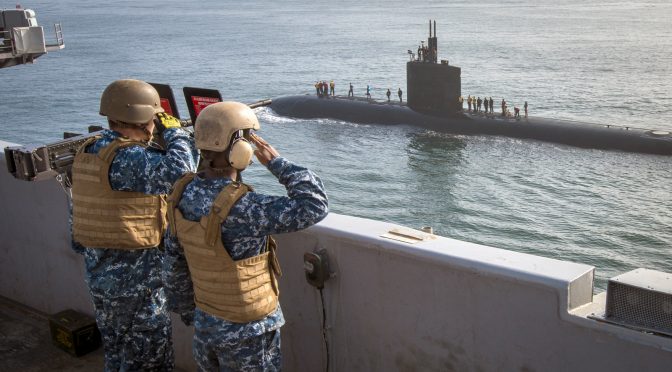
Featured Image: PACIFIC OCEAN (Aug. 30, 2016) Sailors on board the aircraft carrier USS Carl Vinson (CVN 70) render passing honors to the fast-attack submarine USS Pasadena (SSN 752) as it transits the San Diego Bay. Carl Vinson is currently underway in preparation for an upcoming deployment. (U.S. Navy photo by Mass Communication Specialist 3rd Class Sean M. Castellano/Released)
Members’ Roundup: July 2016 Part Two

By Sam Cohen

Welcome to Part Two of the July 2016 members’ roundup. Throughout the second part of July, CIMSEC members examined several international maritime security issues including joint Russian and Chinese military exercises in the South China Sea, the Royal Canadian Air Force’s procurement options for a new search-and-rescue aircraft, the relationship between free trade and security dynamics in the South China Sea, Russia’s offer to fulfill India’s tender for a multirole nuclear aircraft carrier, and Germany’s evolving military and strategic priorities. Read Part One here.

Kyle Mizokami, for Popular Mechanics, reviews the U.S. Navy’s failed Harpoon anti-ship missile test during a sinking drill at the RIMPAC 2016 multinational naval exercises. During the sinking operation, the littoral combat ship USS Coronado launched a Harpoon 1C missile at the retired frigate USS Crommelin, which was 20 miles away. He explains that that the Navy is investigating why the missile was lost from radar contact and never impacted the target ship. The missile exercise reflects the Navy’s continued testing of various missile systems in an attempt to update and improve the fleets’ surface-to-surface warfare capability. He notes that the Navy will likely adopt the Long Range Anti-Ship Missile (LRASM), Norwegian Naval Strike Missile or the Harpoon Block II+ as the next-generation surface-to-surface combat missile for the fleet’s surface ships.

Sam LaGrone, for U.S. Naval Institute News, discusses the upcoming joint Russian and Chinese military exercises set be conducted near the South China Sea in September. Joint Sea 2016 follows last years joint exercise – Joint Sea 2015 II – held off of Russia’s Pacific coast in August, where over 20 ships from the two navies conducted joint training that included anti-submarine warfare, live fire drills, air defense training, and a 400 marine amphibious landing. He adds that in addition to last year’s Pacific drills, joint exercises were also conducted in the Mediterranean Sea, while cooperation in the Black Sea region was also apparent with two Chinese frigates visiting the Russian Novorossiysk naval base stationed near Crimea.

Harry Kazianis, at The National Interest, discusses China’s imminent response to the South China Sea arbitration ruling in relation to the upcoming G-20 Summit Beijing is set to host on September 4-5 in the city of Hangzhou. He suggests that leading up to the summit Beijing will limit contentious actions in the South China Sea as to not risk any drama at the gathering of world leaders or risk positioning themselves where losing face during the summit’s proceedings is a possibility. He adds that China may be timing their next major South China Sea move for the post-summit months when the soon-to-leave Obama administration will be uninterested in jumping into an Asia-Pacific crisis in addition to the U.S. public being preoccupied with developments in the American election cycle. He notes that if China were to declare a South China Sea Air Defense Identification Zone (ADIZ) or start reclamation work at Scarborough Shoal, the U.S. will be unlikely to have the political unity or willpower to respond effectively to Beijing’s actions.

Paul Pryce, for the NATO Association of Canada, provides an analysis on the three aircraft the Canadian government is considering for procurement as the country’s new Fixed-Wing Search and Rescue (FWSAR) aircraft – the C295W from Airbus Defence, the C-27J Spartan from Alenia, and the KC-390 from Embraer. The search for a new SAR aircraft to replace the country’s aging CC-115 Buffalo fleet has been ongoing since a Request for Proposal (RFP) was released by Public Services and Procurement Canada in 2002. He explains that each of the aircraft being considered are similar enough in size and design to the CC-115 Buffalo that it would not be difficult for Royal Canadian aircrews to adapt to operating them and that each plane has significantly greater range and payload capacity than the Buffalos. He adds that these capability improvements will be especially beneficial for search-and-rescue operations in the remote northern regions of Canada.

Robert Farley, for The Diplomat, examines India’s pending decision of whether to accept or not to accept Russia’s offer to construct a multirole nuclear aircraft carrier for the country’s Navy. He explains that very few countries have the capacity to build a modern, nuclear aircraft carrier, and that there are few countries willing to export such technology. He also adds that Russia has played a major role in India’s naval aviation program having modernized the INS Vikramaditya, and having supplied the Indian Navy with carrier aircraft. Russian shipbuilders and military planners are likely familiar with Indian Navy carrier needs and specifications. From the opposite perspective, he argues that Russia’s lack of recent nuclear propelled surface vessel construction should deter India from awarding Russia the contract. He adds that if India were to rely on an export option for its next carrier (INS Vishal), it risks losing the shipbuilding expertise and capacity that it has begun to develop with the construction of the carrier INS Vikrant – a capacity that is critical for India’s long-term maritime interests.

Members at CIMSEC were active elsewhere during the second part of July:

At CIMSEC we encourage members to continue writing either here on CIMSEC or through other means. You can assist us by emailing your works to dmp@cimsec.org.

Sam Cohen is currently studying Honors Specialization Political Science at Western University in Canada. His interests are in the fields of strategic studies, international law and defense policy.

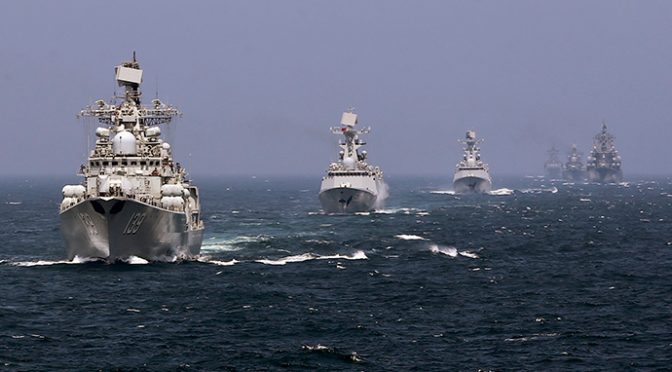
Featured Image: Chinese and Russian naval vessels participate in the Joint Sea-2014 naval drill outside Shanghai on the East China Sea, May 24, 2014 (Reuters / China Daily) 

Members’ Roundup: July 2016 Part One

By Sam Cohen

Welcome to Part One of the July 2016 members’ roundup. Through the first half of July, CIMSEC members examined several international maritime security issues, including the Permanent Court of Arbitration ruling in the South China Sea, Russia’s continued air campaign against ISIS, the U.S. Navy’s procurement objectives for the Virginia-class submarine successor, and the United States’ position on the United Nations Convention on the Law of the Sea (UNCLOS). Here is a roundup of their writings. 

Mira Rapp-Hooper and Patrick Cronin, at War on the Rocks, provide an analysis on the long-anticipated Permanent Court of Arbitration ruling in the Philippines vs. China case over the South China Sea. Using a ‘Choose Your Own Adventure’ format, the authors breaks down the different geopolitical and legal implications of the ruling, including potential Chinese responses, political fallout for China–Philippines relations, and the future of maritime and sovereignty claims in the South China Sea. The authors explain that for China to comply with the Court’s ruling it must not claim any water or airspace from the reefs it occupies or make a 12 nautical mile assertion from any claimed land features. With the ruling being highly unfavorable to China’s maritime objectives, the authors highlight that if Beijing begins to prioritize territorial claims while easing off claims to water and air, it would likely reflect a China looking to move beyond its defeat while saving face.

Armando J. Heredia at U.S. Naval Institute News, examines the tribunal’s decision from the perspective of Manila and how the recent election of Rodrigo Duterte as President of the Philippines will impact regional relations. He explains how the previous administration chose to accelerate the modernization process of the country’s military in response to increased hostility from China while opening the way for American forces to return to the Philippines through the Enhanced Defense Cooperation Agreement (EDCA). He notes that even under the modernization program the Philippines remain weak in terms of kinetic responses to a Chinese incursion. He also notes that any engagement by the Philippines would have to leverage the country’s poorly equipped Coast Guard, which lacks sufficient hulls to establish presence operations near disputed maritime regions and land features.

Jake Bebber, at the U.S. Naval Institute Blog, discusses the centrality of cyberspace operations in the People’s Liberation Army’s (PLA) strategy for long-term competition with the United States. He discusses aspects of informationized warfare and how the PLA is seeking to position its sources of information power to enable it to win a short, overwhelming victory for Chinese forces in a notional conflict. He notes that in response to China investing large amounts of time, energy, people and resources towards achieving the country’s cyberspace and information warfare objectives, the DoD must ensure that U.S. Cyber Strategy supports the force planning, training, and equipping of cyber forces while integrating advanced technology into information planning and acquisition.

Kyle Mizokami, at Popular Mechanics, provides an overview of Moscow’s decision to deploy the country’s only aircraft carrier to the Mediterranean to carry out airstrikes against the Islamic State until next year. Discussing some of the ship’s features, he explains that the ship’s propulsion system is unreliable and is so prone to breaking down that an oceangoing tugboat always accompanies it on long distance voyages. He also discusses the capabilities the carrier will deploy, including Su-33 air superiority fighters, Su-25UTG ground attack aircraft, and MiG-29KUB two-seater multi-role fighters.

Dave Majumdar, at The National Interest, discusses the U.S. Navy’s procurement objectives for the next-generation SSN(X) successor to the Virginia-class attack submarines. His article argues that one priority, permitting the Navy will have the technological know-how to do so, is to effectively turn the future attack submarine into an underwater platform for unmanned underwater vehicles (UUV). Another objective would be to eliminate noise-generating moving parts such as a propulsor or driveshaft in the propulsion system to decrease the possibility of detection in an increasingly competitive undersea environment.

Members at CIMSEC were also active elsewhere during the first part of July:

At CIMSEC we encourage members to continue writing, either here on CIMSEC or through other means. You can assist us by emailing your works to dmp@cimsec.org.

Sam Cohen is currently studying Honors Specialization Political Science at Western University in Canada. His interests are in the fields of strategic studies, international law and defense policy.

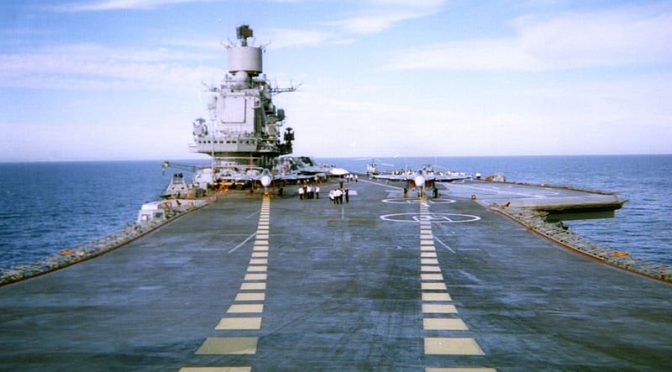
Featured Image: A view from the deck of the Russian carrier  Admiral Kuznetsov (Wikimedia commons)

Members’ Roundup: June 2016

By Sam Cohen

Welcome to the June 2016 members’ roundup. Throughout June, CIMSEC members examined several international maritime security issues, including increased competition in the undersea environment, the Taiwanese Navy’s pursuit of an enhanced air defense capability, Russia’s modernization of the Black Sea Fleet, developments in unmanned aerial vehicle (UAV) technology and carrier based operations, and finally, growing piracy threats off the coast of Libya. 

Beginning the roundup at the Bulletin of the Atomic Scientists, Bryan Clark discusses undersea cables and the future of submarine competition. Mr. Clark explains how at least 95% of voice and internet traffic in addition to more than $4 trillion per year in financial transactions travels through about 300 transoceanic fiber-optic cables along the seabed. Due to the likely economic and military impacts a cable break or sabotage would induce on international security and economic dynamics, the ability to threaten or protect undersea cables and their shore landings will become an increasingly important aspect of future conflict – with procurement of advanced submarine and unmanned underwater vehicle (UUV) technology being critical for  addressing this evolving threat. Mr. Clark highlights several of these technologies, including the rise of a new predominant sensing technology characterized by low-frequency active sonar, the use of undersea ‘battle networks’ and the deployment of fixed seabed-based sensors and outposts to augment UUV and submarine operations.

Harry Kazianis, for The National Interest, provides an analysis on the proliferation of anti-ship ballistic and cruise missiles around the globe and the implications the spread of these weapon systems will have on future U.S. aircraft carrier operations in peace and in conflict. Mr. Kazianis notes that the carrier has been at the forefront of every major U.S. combat operation since World War II, but the short ranges of current carrier based fighter aircraft relative to the longer ranges of certain anti-ship missiles – such as China’s DF-21D, or DF-26 ASBM – may limit the usefulness of the carrier as both an effective deterrent and a reliable platform for power projection in contested areas of operation. The article highlights additional variables affecting the relevance of the flattop in A2/AD environments, including the likelihood of successfully targeting a moving carrier at sea deploying an array of countermeasures.

Ankit Panda, for The Diplomatprovides an overview of a Chinese Naval vessel entering Japanese territorial waters and the incident’s reflection of growing tensions between the two countries. Mr. Panda explains that a Type 815 Dongdiao-class spy ship entered Japanese territorial waters on June 15, a move Beijing has not repeated since 2004, when a Chinese nuclear submarine entered Japan’s 12 nautical mile territorial sea near the Sakishima Islands. The article examines whether the Chinese spy ship was abiding by international law, particularly the provisions governing ‘innocent passage’ under the United Nations Convention on the Law of the Sea. Considering the Chinese vessel was a spy ship and sailed within Japanese waters for several hours, Mr. Panda explains that the Japanese Defense Ministry is investigating whether the PLAN vessel was operating in accordance with international law and if follow-up legal action should be taken.

Michal Thim and his colleague Liao Yen-fan, for Taiwan in Perspective, discuss the restructuring of the Taiwanese Navy, and the goal to acquire enhanced air defense capabilities for the fleet. The authors explain that modernization plans have identified interchangeable Aegis-like integrated combat systems (ACS) that pair powerful radars with advanced anti-air and anti-ship weapons as priority procurement targets. However, the recent breakdown in negotiations between Lockheed Martin and Taiwan’s National Chung-Shan Institute of Science and Technology (NCSIST) over the acquisition and technology transfer of the Mk.41 vertical launch system may limit the Navy’s ability to deploy ACS. They add that this breakdown and the resulting procurement limitations represent inherent challenges associated with Taiwan’s arms indigenization objectives.

To conclude the June members’ roundup, Sam LaGrone for U.S. Naval Institute News provides an overview of Russia’s first deployment of a new frigate to the Black Sea Fleet since the end of the Cold War. The Project 11356-class Admiral Grigorovich was sent to a Russian naval base in Crimea, which Mr. LaGrone explains is the first of many new surface ships the Russian Navy intends to base in the Black Sea. He adds that the delivery of the multi-mission surface combatant, capable of engaging submarine, air and surface threats, is part of a $2.43 billion Black Sea Fleet expansion program that will allow for increased power projection capabilities throughout the Fleet’s area of operation.

Members at CIMSEC were also active elsewhere during the month of June:

  • Bryan McGrath, for The War on the Rocks, explains how the lack of naval competition in the post-Cold War period has resulted in a U.S. fleet posture with limited offensive power. He explains how the Navy has prioritized a defensive mindset for too long, with survivability and defensive capabilities outcompeting offensive capabilities for platform space, budgetary resources and strategic inquiry. Mr. McGrath emphasizes that by adopting and implementing the distributed lethality concept across the fleet – that is increasing the unit-level lethality of virtually every ship in the Navy – U.S. naval forces will increase their capacity to successfully deter and challenge nations opposing U.S. interests and international law at sea.
  • Jerry Hendrix, for Defense One, advocates that the X-47B should be reinserted into carrier operations before the U.S. Navy begins to spend more time and fiscal resources on a new, expensive carrier-based UAV. Mr. Hendrix identifies that the Navy needs a long-range strike asset similar to the X-47B design, while it does not need a long-range surveillance platform – an asset the Navy seems to be leaning towards even though 68 unmanned MQ-4C Triton broad area maritime surveillance vehicles have recently been acquired. He also notes the possibility of evolving the X-47B into a joint strike-refueling platform, which would provide two useful, additional capabilities aboard the carrier that are more appropriate and necessary than a surveillance UAV.
  • Michael McDevitt, for The National Interest, discusses China’s ambitions as a maritime power by contextualizing the maritime environment from Beijing’s perspective. The article examines how China seeks to position itself in the maritime environment both regionally and globally, with the Coast Guard, PLA Navy, shipbuilding capacity, merchant fleet, distant-water fishing challenges, territorial disputes and both strategic and tactical level operations taken into consideration.
  • Paul Pryce, at Offiziere, provides an analysis on the current state of the Libyan Navy and the growing threat of piracy operations off of the country’s coastline. Mr. Pryce explains that the Navy’s one active ship, a Koni-class frigate, in addition to the lack of command and control governing the Navy – the same issue facing all Libyan security forces – is contributing to the refugee problem in the Mediterranean and the rising volume in piracy incidents throughout the region.
  • Robert Farley, for The National Interest, discusses Canada’s late 1950’s CF-105 Avro Arrow high-performance interceptor and the aircraft’s unsung potential as a dominating platform in early Cold War airspace, if only the program had not been cancelled due to shifts in Canadian technology, policy and security priorities. In a second article at The National Interest, Farley examines Russia’s Type 705 Lyra Cold War submarine that was regarded by the West as a profound threat to NATO’s undersea dominance.
  • Christian Davenport, for The Washington Post, highlights new technological advancements that may be transforming the way the pentagon outlines its defense strategy, particularly developments within the fields of robotics, drone swarms, and artificial intelligence. The article highlights emerging communication channels between the technology industry in Silicon Valley and the Pentagon, with Defense Secretary Ashton B. Carter recently meeting with executives at SpaceX and Google.
  • Kyle Mizokami, for Popular Mechanics, discusses the deployment of two U.S. carrier battle groups to the Philippine Sea to conduct exercises following the UN court ruling on China and its claims in the South China Sea. Mr. Mizokami explains that the carrier strike groups (CSGs) consist of two nuclear-powered aircraft carriers, two guided-missile cruisers, six guided-missile destroyers and likely two nuclear attack submarines – although their presence was not confirmed by the Navy. He adds that this is the first two-carrier exercise in the Western Pacific in two years.
  • Dave Majumdar, for The National Interest, examines the Russian submarine threat to NATO’s maritime forces and U.S. naval forces stationed throughout EuropeThe article explains how Russia has successfully incorporated highly agile, technologically advanced and lethal submarines into their overall A2/AD bubble strategy throughout European waters and the significant threat this poses to U.S. and allied undersea posture in the region.  

At CIMSEC we encourage members to continue writing, either here on CIMSEC or through other means. You can assist us by emailing your works to dmp@cimsec.org.

Sam Cohen is currently studying Honors Specialization Political Science at Western University in Canada. His interests are in the fields of strategic studies, international law and defense policy.

Featured Image: Naval vessels of Russia’s Black Sea Fleet (RT)