Tag Archives: Russia

The Russian Navy: Strategies and Missions of a Force in Transition

Russia Resurgent Topic Week

By Michael Kofman

On October 7th, Russia’s Caspian Flotilla launched land attack cruise missiles into Syria, bringing into relief the steady modernization of the Russian Navy (RFN), and its recently added strike capabilities. Dominating the Caspian is not a difficult challenge for the Russian flotilla of Gepard-class frigates and Buyan-M corvettes, but the ability to launch cruise missiles at targets in Europe or the Middle East potentially over two thousand kilometers away is emblematic of the future Russian Navy. Together with the Northern, Pacific, Baltic, and Black Sea Fleets, the RFN is a force in transition. Russia’s surface and submarine force today is quantitatively a fraction of the size of its Soviet ancestor, but it is undergoing revival, investment, and reconfiguration to become a qualitatively different force. Today’s Russian Navy is intended to pursue both traditional missions such as strategic deterrence and status projection, along with sea denial, sea control, and coastal defense.

[otw_shortcode_button href=”https://cimsec.org/buying-cimsec-war-bonds/18115″ size=”medium” icon_position=”right” shape=”round” color_class=”otw-blue”]Donate to CIMSEC![/otw_shortcode_button]

Russia’s latest maritime doctrine, released in July, is an incredibly ambitious document with visions of carriers, multirole landing ships, new destroyers, and a host of platforms indicating parity with the U.S. and power projection across blue waters in the maritime domain. However, these dreams, reaching out into 2050, are unlikely to be realized for a slew of reasons, including budget constraints, defense industry capacity, inefficiencies, and technological shortcomings. Russia’s defense budget this year, at 3.3 trillion roubles or 4.2% of GDP, is the largest it has ever been since the Soviet Union, but given prevailing economic conditions, it is unlikely to be seen at these levels for years to come. Financial constraints aside, Russia also lacks a vision for the missions these carriers or amphibious ships would perform. They are political aspirations on paper at best, while much of the actual maritime strategy and thinking on the future of Russian naval power is unlikely to reside in this document.

Instead of unattainable, and unrealistic, dreams of power projection with a large blue water navy, the RFN seems set to become primarily a green water force. Increasingly based around smaller and more advanced ship classes, with capable long range anti-ship and land attack missiles, this fleet will be designed to project conventional deterrence. In practice, Moscow is investing in the achievable, while paying lip service to the unnecessary. Hence, in the coming years, Russia will remain primarily a regional naval power. One area where the maritime doctrine rings true is the concentration of effort and assets facing NATO forces in Europe and along the Arctic, best embodied in modernization of the Northern and Black Sea Fleets.

The desire to establish “non-nuclear deterrence,” voiced in the Military Doctrine released in December 2014, is a more important driver behind Russian thinking. This strategy is based around long range precision weapons, multiple vectors of attack, and the ability to inflict high costs to NATO in select regions such as the Baltic, Black, and Barents Seas. In this respect, Russia’s naval developments should be viewed in conjunction with spending on additional maritime aviation and coastal defenses, such as the Su-30SM and the Bastion-P. However, Russia’s maritime aviation is a small force and organizationally in the hands of its air force. The more important trend in the Russian navy is that a small missile boat, or a frigate, armed with the new line of Kalibr missiles (SS-N-27A and SS-N-30A), can pose a similar threat to a Tu-22M3 bomber at a better stand-off range and have excellent land attack options.

In the Russian submarine force, strategic deterrence remains the paramount mission, particularly with the new Borey-class of SSBNs steadily replacing older Delta IVs and IIIs. Power projection seems mostly a mission for the submarine force, especially given the troubled shipbuilding program. In the coming years, older Soviet platforms will be steadily phased out. However, with delays in production of new multi-role ships, the Russian navy looks increasingly better underwater. The best example is a new squadron of six improved-Kilo diesel submarines being added to the Black Sea Fleet, armed with the same family of land attack and anti-ship missiles. The new Yasen-class multirole submarine, along with modernization projects for older SSNs and SSGNs, will restore some of the Russia’s sea power in the underwater domain.There is a marked increase in Russian submarine activity and patrols, up by fifty percent according to Russian Navy chief Admiral Viktor Chirkov, along with a newfound interest in underwater cable and oceanographic mapping.

Status projection via naval power remains an important national priority, as it arguably has been since the time of Peter the Great. While differences abound in Russian defense circles over the amount of spending on the navy, given the country is primarily a land power, Moscow remains committed to the notion that it cannot be considered a great power without visible hallmarks of naval power. Hence Russia is investing in the modernization and refit of the Kirov-class battlecruisers, at great expense to other priorities, with perhaps 1.7 billion roubles for Admiral Nakhimov and over 2 billion roubles for Peter the Great. The goal is to maintain a unique set of capital ships to conduct flag waving, strategic messaging, and a host of other status projection missions. While the Kirovs may be anachronistic, status projection is held at an even higher premium today because it is tied to the public perception of Vladimir Putin’s personal brand of leadership, which in Moscow is as important as the objective results of foreign policy.

The most prominent mission for the Russian Navy today is supporting the military intervention in Syria, including provision of air defense using the Slava-class missile cruiser Moskva and sustaining the force via sea lines of communication from the Black Sea, dubbed the “Syrian Express.” The Black Sea Fleet (BSF) is in charge of this operation in the Eastern Mediterranean, managing a rotating squadron of roughly ten ships, largely composed of Soviet era landing ships and the BSF anti-submarine warfare group. Originally stood up to support the Syrian regime in 2013, the Mediterranean squadron will become a more permanent fixture according to official statements, independent of the conflict’s trajectory.

The intervention in Syria is a useful study on the state of Russian sea lift and capacity for expeditionary warfare. Russia compensated for the lack of available sea lift, an expensive asset to have lying about for a country that has not done expeditionary warfare since the Afghanistan War, by simply re-designating commercial carriers (ironically purchased from Turkey). The RFN trains provision of mobility and sea lift for ground forces during annual strategic exercises, but even for a relatively close operation such as Syria, clearly lacks the requisite assets.  With limited platforms available for expeditionary warfare, the RFN is focused instead on being able to move forces around the country’s vast regions. This is an especially challenging mission in the Arctic and Pacific, largely uninhabited expanses of terrain where exerting sea control is taxing. Traditional expeditionary warfare is not something the Russian navy is geared for, plans for, or expects to be doing much of in the future.

The RFN will remain strongest facing NATO in the European theater, effecting sea denial and conventional deterrence, with smaller and more modern platforms. While Russian ships may venture out into the North Atlantic, most such forays will be limited to strategic communication, training, or flag waving missions. The submarine force will form an important element in a strategy of nuclear and conventional deterrence, maintaining the ability to strike the U.S. homeland. Around Russia’s periphery, a host of sea patrol ships and cutters for the FSB border guard will work to improve sea control along the coastline. The Arctic is an area of particular anxiety for Moscow, despite little traffic through the Northern Sea Route. Russian leaders envision long term economic competition over Arctic resources. They are seeking to invest in military and rescue infrastructure today in order to establish firm control over access to the region in the future. When it comes to sea control and sea lift the Russian strategy is mindful of cost constraints and structured around surging capacity when needed.

As envisioned today, the Russian Navy is not likely to become a global peer competitor to the U.S. but represent a more potent regional challenge, particularly to NATO allies. NATO will have to deal with a resurgent Russian presence in the Mediterranean and the ability of Russian ships to conduct long range strikes from within the comfort of established A2/AD zones close to their bases of operation. While the net sum of Russia’s naval strategy could be characterized as regional and largely defensive in nature, the practical results are not simply negative from a security standpoint for NATO, but present new challenges for a stretched U.S. Navy. Russia’s shipbuilding program will proceed fitfully at best, but the changes already in progress within the RFN are yielding results that will require adjustment and adaptation on the part of the U.S. and its allies.

Mr. Michael Kofman is a Research Scientist at CNA Corporation and a Fellow at the Kennan Institute, Woodrow Wilson International Center in Washington, D.C. Mr. Kofman holds a M.A. in International Security from the Edmund A. Walsh School of Foreign Service, Georgetown University and a B.A. in Political Science from Northeastern University.

Read other contributions to Russia Resurgent Topic Week.

Russia Resurgent Week Kicks Off on CIMSEC

By Matt McLaughlin

Welcome to Russia Resurgent Week at CIMSEC, where we attempt to shed some light on Russia’s objectives, capabilities and constraints. Russia has occupied the headlines for a variety of reasons in recent weeks, but this is not the place to visit for the latest updates. Rather, this week investigates the broad phenomenon of post-Soviet Russia’s rise. What are its tools? What will it do with them, and where? How do recent events fit into a broader strategic framework?

An impressive stable of international writers has contributed on a variety of Russia-related subjects. Interspersed are some pieces published earlier on CIMSEC that complement the latest work. We hope that by the end of the week Russia will be slightly less of a mystery, if still an enigma.

1 – The Russian Navy: Strategies and Missions of a Force in Transition By Michael Kofman
2 – The New Russian Naval Doctrine By Sean MacCormac
3 – The Development of Russian Naval Capabilities after the Cold War By Patrick Truffer
4 – Shipbuilding Constraints Drive Downsized but Potent Russian Navy By Dmitry Gorenburg
5 – Russian Navy Reads Sun Tzu’s Art of War By Vidya Sagar Reddy
6 – Cutting Through the Fog: Reflexive Control and Russian STRATCOM in Ukraine By Robert C. Rasmussen

7 – Is Russia’s Maritime Strategy Adrift? By Ben Hernandez
8 – Russia in the Arctic: Aggressive or Cooperative? By Laguerre Corentin
9 – Yours, Mine and Moscow’s: Breaking Down Russia’s Latest Arctic Claims By Sally DeBoer
10 – Russian & Soviet Fleets, 25 Years Apart  By Louis Martin-Vezian

Matt McLaughlin is a U.S. Navy Surface Warfare Officer. His opinions do not represent the Department of the Navy.

[otw_shortcode_button href=”https://cimsec.org/buying-cimsec-war-bonds/18115″ size=”medium” icon_position=”right” shape=”round” color_class=”otw-blue”]Donate to CIMSEC![/otw_shortcode_button]

From Russia With Love…To Ceuta

This post originally appeared on Common Sense. You may read it in its original form here
By Fernando Betancor
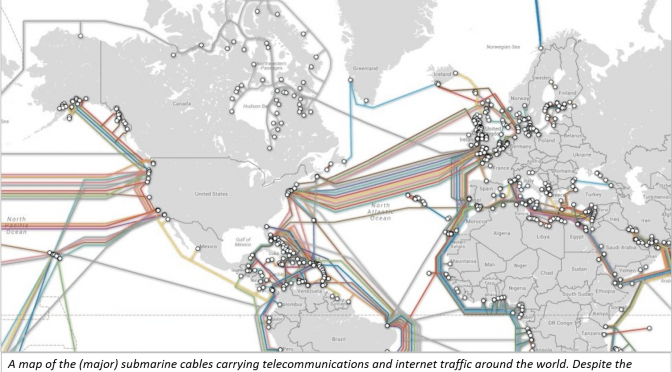
Defense experts on both sides of the Atlantic have expressed concern about the increase in Russian submarine activity in the Atlantic Ocean[1]. Russian patrols have risen by 50% to what one unnamed European diplomat described as “Cold War levels”. Not only the frequency of excursions has increased: the submarines are approaching the United States and Europe in areas with undersea cable routes. The cables are used for communications and internet data transmission; along with the fleet of satellites in low earth orbit, they are the spine of our digital world. The United States and NATO allies still rely on these cables for vital military traffic.
So far, the Russians have not been observed doing anything to the cables. But because of their importance, the presence of the submarines is alarming. The Russian Navy could be identifying the best places to cut the cables in the event of hostilities with the West; it could also be making efforts to tap them as a source of intelligence. Or they may have a different, unguessed purpose that is unrelated to the communications cables. What is certain is that the Russians are not simply passing the time of day; the Russian Navy is executing a mission and that mission somehow involves NATO.
ceuta 1
ntelligence gathering and signals interception remains the most probable activity. It has a long and distinguished history in warfare; the capture of a lost set of Confederate orders allowed General McClellan to bring General Lee’s Army of Northern Virginia to battle in unfavorable circumstances in Sharpsburg, Maryland, leading to an important Union victory in the Civil War. It has become critically important since the widespread adoption of wireless and radio communications during the First and Second World War. Everyone knows that the British built the world’s first computer at Bletchley Park in order to crack the German ENIGMA codes, though the incredible Polish contributions to that effort remain overlooked. The United States had successfully broken Imperial Japanese diplomatic codes prior to Pearl Harbor, and were used to prepare the US Navy for the critical Battle of Midway. The US Navy also pioneered the use of submarines and deep-sea submersibles for intelligence gathering, tapping the unencrypted military communications between the mainland and facilities along the Kurile Islands. We continue to deploy these assets, such as the USS Impeccable.
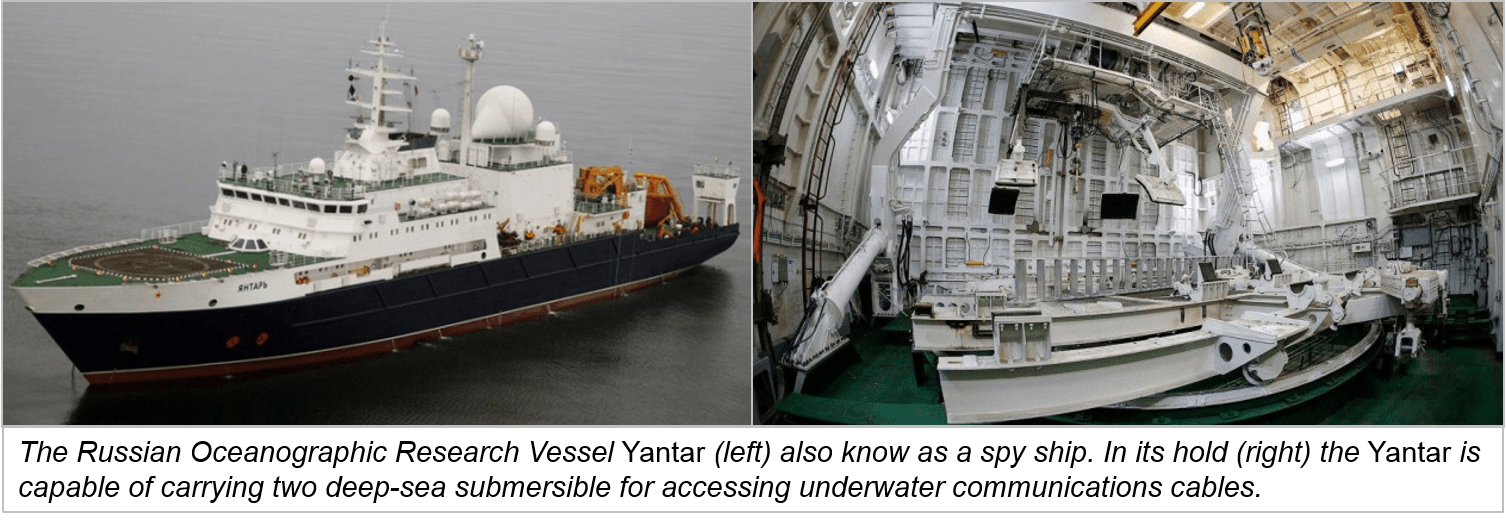
Assisting the submarines is the Russian Navy’s Oceanographic Research VesselYantar[2]. The Yantar is newly commissioned, having come off the Kaliningrad slips early this year, and has nothing in common with Jacques Cousteau and the Calypso despite its scientific-sounding designation. It is an intelligence platform, operated by the Russian Navy for the Glavnoje Razvedyvatel’noje Upravlenije, or Main Intelligence Directorate. Although less infamous than its sister organization, the KGB (now FSB), the GRU is the larger of the two organizations with six times more foreign agents deployed that the Foreign Directorate of the FSB[3]. The Yantar was tracked by the Department of Defense as it approached and followed the North American coast from Canada down to the Caribbean. The Yantar carries deep-sea submersibles of the same kind the US Navy uses for a similar purpose: finding, tapping and potentially cutting undersea communications cables.
ceuta 2
After its leisurely voyage, including passing the US nuclear submarine base in Kings Bay, Georgia, the Yantar made its way across the Atlantic back towards Europe. On the 19th of October, the spy ship arrived at its destination: the Spanish port of Ceuta[4]. There it received a warm welcome, with a protected berth and round-the-clock security provided by the port authorities. It took on fuel and consumables while its sailors stuffed their gobs with paella and vino tinto while also engaging in the other profligate activities typical of sailors ashore. As comradely a reception as Ivan could have received in Kaliningrad.
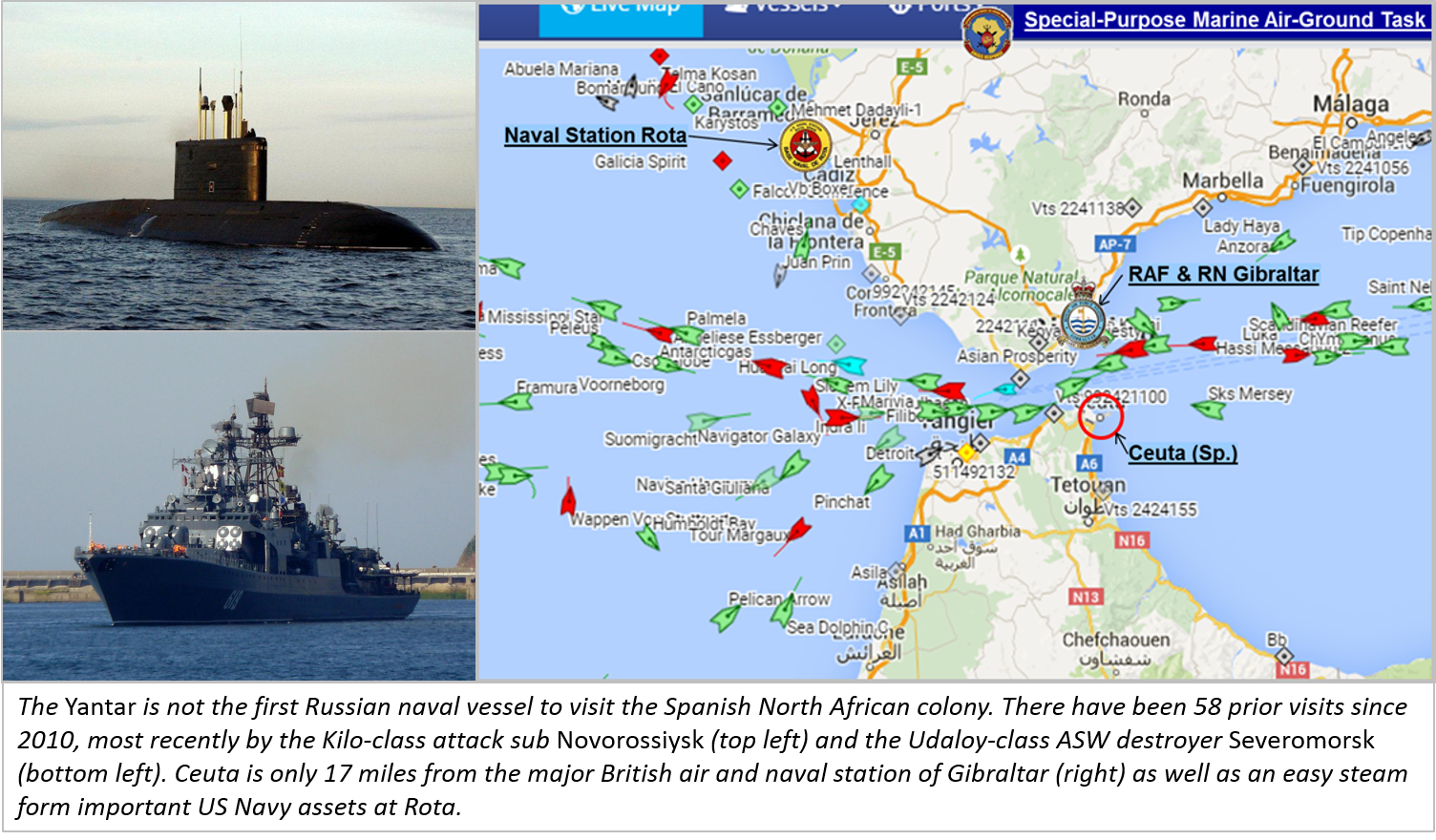
But Ceuta is not Kaliningrad. It is a port belonging to a NATO ally. It is strategically located on the North African coast next to the Straits of Gibraltar, one of the busiest maritime transit points in the world. And it is an easy day’s steaming from RN Gibraltar, a port that Royal Navy vessels often visit, as well as the naval station of Rota, a base leased by the US Navy from Spain. That is where the US is basing four Aegis-equipped destroyers as part of the European Phased Adaptive Approach to ballistic missile defense. What in God’s name is a Russian intelligence vessel doing there?
The Yantar visit is not an isolated incident: this year alone there have been 14 port calls by Russian naval vessels to Ceuta and 58 in total since 2010. In August, the diesel attack submarine, RFS Novorossiysk passed three days in the Spanish colony, with Gibraltar well within range of its SS-N-27 “Sizzler” anti-ship missiles. In April, it was the Udaloy-class ASW destroyerSeveromorsk; and in February another ASW frigate, the Yaroslav Mudry. The city fathers are happy to have 2,000 lonely sailors spending their rubles on “shore leave” and local businesses benefit too. Nothing to comment on in normal times; except that we’re not living in normal times. Russian troops are still in Ukraine; NATO aircraft are intercepting Russian bombers over allied airspace; Turkey is reporting violations of its airspace by Russian drones and jets; and we are not sending troops and equipment to Eastern Europe because relations are warm and fuzzy.
ceuta 3
It is long past time the United States took a firmer line with Spain. Spain may be an important ally for us and NATO, with a strategic location and shared interest in the stability of North Africa and the Sahel. It is not a question of gratuitously humiliating or infuriating them. But the US must make it crystal clear to Spain that they must choose their side and stick with their friends. They cannot play both sides: they cannot take American dollars for the use of Rota and Russian rubles for the use of Ceuta. Our concern and extreme displeasure at having half the Russian fleet pass the time of day within a hundred miles of our ballistic missile defense assets must be communicated to the Spanish in no uncertain terms. And the consequences of this perfidious attitude should also be made known – discretely.
Intelligence sharing between the two nations might begin to suffer. The notable successes of Spanish police in intercepting and arresting ETA operatives and potential jihadists in recent years is not due entirely to the keen sense of the beat cops, but to good intelligence and timely cooperation between the Spanish, French and American agencies. If Spain still refuses, the US should consider a relocation of US assets to the Port of Lisbon (USN) and to Beja for the Marine Crisis Response Force – Africa. Both are almost as well situated as the current locations and the Portuguese are not hosting Russian warships.
Unless the US and NATO take firm measure, Spanish will remain indifferent and their “business-as-usual” attitude will continue. It is not only avaricious and in bad faith, it is dangerous to Spain’s own interests. They may come to find, like the Crimeans, Moldovans and others, that once Ivan gets comfortable, he is not an easy houseguest to get rid of. And neither Ceuta nor Melilla are covered by NATO’s Article 5 provision for mutual defense.
Sources and Notes
[1] David E. Sanger and Eric Schmitt, “Russian Ships Near Data Cables Are Too Close for U.S. Comfort,” The New York Times, 25 October 2015
[3] The SVR, Sluzhba vneshney razvedki.

Call for Articles – Russia Resurgent Week

Week Dates:  Nov 23-29 2015
Articles Due:  Nov 20 2015
Article Length: 500-1500 Words
Submit to: nextwar(at)cimsec(dot)org

Amidst headline-grabbing activities on land in Ukraine and Syria, Russia is steadily pursuing new strategies at sea. From assuring Black Sea access with the annexation of Crimea to joint Pacific exercises with China, recent Russian activities represent a level of commitment to sea power unseen since the dissolution of the Soviet Union.

During the first week of November, CIMSEC will host a series exploring the maritime implications of Russia’s strategic goals, Russia’s capacity to execute its strategy at sea, and the implications of Russian strategy and policy for its neighbors, partners and adversaries. Potential topics, in order of broadest to most focused, could include: Is Russia a natural sea power, land power, or somehow both? What ends does Russia hope to achieve through sea power? What relationships is Russia looking to enhance or destabilize through stepped-up maritime activity? What asymmetries with the maritime strategies of NATO, the U.S., China, and others does Russian strategy hope to exploit? What policies should Russia pursue in the Arctic, and why? Does Russia have the economic and industrial strength to recapitalize its seagoing fleet? How much does the Russian economy depend on seaborne trade, legal and illicit? Does Russia possess an expeditionary capability? How does the concept of hybrid war, as practiced in Ukraine, extend to the maritime sphere? What role, if any, does or should Russia have in the humanitarian crisis in the Mediterranean? And, to all of these questions, how should other countries adjust their strategies to react?

Contributions should be between 500 and 1500 words in length and submitted no later than 20 November 2015. Publication reviews will also be accepted. CIMSEC will re-post selected older entries about Russian maritime activity, as well.

Matt McLaughlin is a U.S. Navy Surface Warfare Officer. His opinions do not represent the Department of the Navy.