Tag Archives: Leadership

Specialize or Not? Former RAN CO’s Reflections on Surface Warfare Officer Development

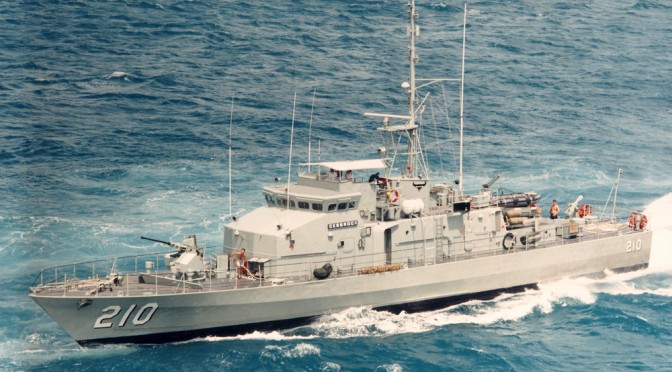
Rear Admiral (ret) James Vincent Purcell Goldrick AO, CSC, RANR, served three times as a the Commanding Officer of a ship at sea. He is a fellow at the Seapower Centre and a Naval Historian.
(editor’s note) He is also served with the Patrol Boat navy, which means he is one of the best.

The recent discussion about the different approaches to surface warfare officer training in the British and American navies has been of great interest to me, if only because the Royal Australian Navy, my own service, has largely combined British training methods and career paths with the use of American designed ships and equipment.

I have had first-hand experience with both British and American methods, as well as the Australian approach, having served at sea on two exchange postings with the Royal Navy, been both XO and CO of RAN ships, small and big (by Australian standards) and sea ridden USN units, including in command time in tactical control of MIO operations in the northern Arabian Gulf. If I could sum up my view with a one liner it is that the British system is better for individual ships, the American for a navy as a whole.

Here I need to make an important distinction – the USN’s operational requirements are not those of the British, still less are they the same as those of Canada or Australia, so its personnel solutions should not necessarily be identical. Another, associated aspect of the comparison is that the USN system works better in major units because these can have enough experts onboard – with their associated rank and seniority – to provide the necessary leadership to all the specialisations involved. This is very difficult to achieve in smaller ships. Actually, it’s practically impossible.

The unit of power in the surface forces of the smaller navies, particularly in recent years, has been the frigate or destroyer. Within the USN, although times are changing – as recent deployment patterns not only in the Caribbean but even the South China Sea suggest – it has remained that of the carrier battle or expeditionary strike group. This requires a very different approach. A USN destroyer or frigate has been judged largely by how it fits into the whole, while a Canadian or Australian and even a British ship has in the past to manage both task group operations and independent activity to a much greater degree. In other words, the smaller navies have had to wring much more out of their limited capabilities and doing so successfully requires a higher level of expertise at more junior ranks than has generally been the case for the USN.

The reality is that deep expertise is found in the O5s and O6s of the American Navy that the other naval services can only envy. But, contrary to some of the declarations in earlier contributions to this discussion, I’d take a British or Australian O3 or O4 in their specialisation over the average (but not the best) USN surface warfare officer with the equivalent qualified sea service any day. This may seem a hard judgement, but it is not one based on intellect, morals or individual quality, it is simply a matter of experience – a USN officer has to cover so many more bases that there is an inevitable element – somewhere in it all – of ‘once over lightly’. My belief is that the USN maintains the standards it does by sheer hard work and a great deal of sea time.

But there is more to it than that. It seems to me that the argument has been confused by the inclusion of platform and propulsion engineering into the wider question of the requirement of warfare officers for technological understanding and technical mastery in addition to what could be described as operator skills. Because of the ‘once over lightly’ problem, my judgement is that, in general terms, propulsion engineers provide a more effective service and ship commanders are more expert in their essential skills if there is no attempt for platform engineers to proceed down the path of combatant command. I believe very firmly, in so far as frigates and destroyers which may have to operate as autonomous units are concerned, that it is practically impossible to accumulate the expertise necessary to cover all the bases associated if the officer complement are to have an ‘unrestricted line’ background. All that time in the machinery spaces has to come at the expense of the combat system and tactical knowledge as well as the associated ship driving skills which are vital to the effective direction of a warship’s operations. One sees certain resonances of this argument in the American submarine community and it is notable, although they have had their challenges in their nuclear force, that the British have never chosen to risk their tactical expertise in meeting their nuclear power demands. Royal Navy submarine captains get some nuclear power training, but they do not serve as engineers. I think that the British are right. My own experience is that I was very hard pressed to ensure that I was sufficiently expert as a surface warfare officer with the minimum mastery of combat systems and tactics necessary to fight the ship. I was also always acutely aware that my captains – and the ships’ companies with whom I served – demanded nothing less.

I do not have an engineering degree and I have also always had to work hard to ensure that I have had what I think is sufficient mastery of all aspects of ship design and propulsion to be an effective sea officer and, later, sea commander. Yet this was always in support of my primary functions, not such a function itself and this is the real point. Could I have known more about engineering? Yes, but at what cost to my warfare expertise? Did I end up knowing enough? I once had an exchange with my – extremely efficient and truly expert- platform (or what we call ‘marine’) engineer officer ashore over a beer one night. ‘Sir,’ he said, ‘I know that both your undergraduate and postgraduate degrees are in history. How is it that you always know the question to ask me that I don’t want you to ask me?’ ‘Simon,’ I replied, ‘I’m the captain, it’s my job.’ I still treasure that as one of the greatest professional compliments I have ever been paid – but I think it is one that, at least in part, I had earned. I will say here that the training system through which I passed allocated more time to engineering theory and practical engineering training for surface warfare officers than does the ‘objective focused’ system of the present day. There is a minimum required and I am not convinced that it is being met in either the RAN or the Royal Navy.

The point, however, is that my job as a captain was not to be the engineering officer, nor attempt to do his or her job. Mine was to be as expert as possible in driving and fighting my ship to achieve its military purposes. I am deliberate in suggesting that the platform engineering specialisation is not the ideal preparation for combatant command – although I have no objection to such officers commanding auxiliaries and non-combatant units, provided that they have had sufficient time on the bridge. Let me emphasise that I am not suggesting that officers with a platform engineering background are necessarily ineffective as combatant captains. What I am saying is that the individuals concerned would be much better off – and much better war fighters if they were differently prepared. There just isn’t enough time to do otherwise.

Let me return to explain one point – my view that the USN system can be better for a navy. If one is to accept that platform engineers as a group must be ‘Engineering Duty Only’, this must not result in their exclusion from the highest levels of decision making and influence. The USN has achieved as much as it has in the last seventy and more years because it got its platform engineering right so many times. And where it did not, it soon knew what to do to fix the problem. This must continue.

However, I do believe that the USN has evolved a generally more effective approach to combat systems management than the RN or the RAN both at sea and ashore. This is another area in which there could be more theory and practical training for warfare officers within our organisations. While I assess that there is a vital space for the specialists that the British describe as ‘Weapon Engineers’, I do not think that the British (and Australian) system has allowed surface warfare officers to develop sufficient understanding of their technology and the operation of their weapon and sensor systems since the old warfare sub-specialisations such as gunnery and ASW were replaced by the Principal Warfare Officer concept in the 1970s. The PWO possessed a much improved ability to make a correct, no-notice response to an immediate threat, no matter whether it was from over, on or under the sea, but it was partly at the expense of the much deeper system knowledge of his predecessors and to the detriment of a much more equal relationship with the Weapon Engineers who were and are responsible for the preparation, maintenance and readiness of the weapons, sensors, computers and communications concerned. Our navies have a lot to do in this area.

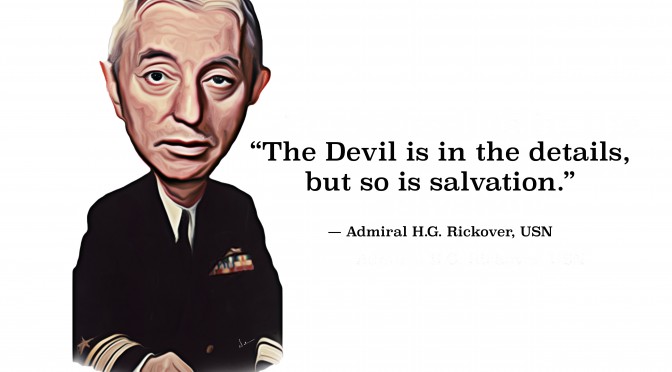
I don’t have any simple solutions for all this, but I will finish with one point. Whatever career system is adopted, it will only work if a truly professional attitude is adopted by all concerned. This includes, above all, a welcoming and inclusive approach to the new joiners that makes it clear that high standards are essential, but provides every opportunity to them to achieve their professional goals. Command at sea remains one of the most worthwhile experiences it is possible to have, but central to its value is encouraging and developing the young. None of our navies have always been as consistently focused on this as we should have been, but it is vital. As a very distinguished admiral once said, “You spend your first command proving yourself to yourself. You should spend your second and subsequent commands proving other people to themselves.”

He was – and is – right, but it also applies to every step in the surface warfare officer ladder. We all need to remember that we are there, amongst other things, to train our relief

Leading Where? Reflection on “Saltwater Leadership”

By Erik Sand

In his book Saltwater Leadership, Rear Admiral Robert O. Wray admits that he is not trying to add to the body of leadership knowledge. He seeks to provide a condensed, tailored, leadership primer for junior sea service officers. He includes tidbits from 35 books and stories and advice from hundreds of seagoing leaders. Wray limits his explicit advice but implicitly portrays his vision of successful leadership through the excerpts and anecdotes he includes. While the leaders he envisions would succeed as junior officers, I am left wondering if they would have the skills needed to guide an organization in to the future.

Wray begins by asking, “What is leadership?” He determines that “leadership is the process of getting people to do things.”[1] This simple idea encapsulates the daily tasks of a junior officer. Whether on watch or working with a division, new junior officers must ensure the completion of tasks for which they lack the training to complete themselves. They can complete few of their responsibilities without the work of others.

Yet, Wray quickly muddies the water in answering his next question: “What is the difference between leadership and management?” He provides his own answer along with answers from various scholars and practitioners. In several cases, Wray’s definition of leadership sounds more like what these experts consider management. Wray writes, “Some say that leadership is deciding what to do, and why, while management focuses on how.”[2] The “how” of management seems more like the “process” of his leadership definition than what or why. Similarly, he quotes a leadership expert who states, “A leader knows what’s best to do; a manager knows how best to do it.”[3]

Wray’s original definition of leadership is not wrong. Indeed, it reflects exactly the qualities that earn promotion in today’s Navy. Rather, the contradiction between Wray’s original definition of leadership and his discussion of leadership and management demonstrates that eventually leaders must do more than get things done. Leaders must choose the right things to do.

Wray would likely agree. Leadership is prone to lists, he explains, because many traits and skills are required for success. The exclusion of certain traits from his core definition should not mean those traits are unimportant. The omission of “what and why,” however, continues through the book. Wray surveyed 380 naval leaders from senior enlisted to admirals asking what traits were most important for junior officer success. Integrity, character, and trustworthiness topped the list. Summarizing the overall result, he describes successful junior officers as “ honest, hardworking teammates.”[4] No one should downplay these virtues. They are essential for successful leadership, but they tend toward “how.” The respondents deemed traits needed to make determinations about “what and why” less important. Analytical thinking came in at 18 of 76, and inspiration, vision, scholarship, insight, inquisitiveness, and conviction fell in the bottom third.

The book may emphasize “how” over “what and why” because it targets junior officers. Junior officers spend more effort on the process of doing than on deciding what to do and why to do it. If, however, the skills needed for successful leadership change as a career progresses, the book does not mention it. At some points, it suggests the opposite. Wray writes that “leadership lessons and concepts can be universal.” [5] When he provides caveats, he compares the boardroom and the battlefield not the deckplates and the Captain’s chair. Moreover, several of the stories he includes, such an aircraft carrier captain facing an unconfirmed report of a man-overboard, describe situations a junior officer would almost never face. These stories teach valuable lessons about leadership and life at sea, but their inclusion reinforces the sense that the while the book is tailored for junior officers its view of leadership is not.


The Navy has used checklists and written procedures for decades. Today, however, units receive more direction from headquarters than ever before. Type commanders not only direct what training evolutions ships must complete and when, but they also provide detailed grading rubrics specifying exactly how those evolutions must be accomplished. Time dedicated to growing administrative requirements distracts officers from core competencies. Just as Saltwater Leadership seems to focus on the undoubtedly important “how” at the expense of the equally important “what and why,” so too does our Navy.

Admiral Wray has produced a useful compilation of leadership advice for junior officers learning how to lead and how to get things done, but unless those new leaders also learn to make decisions about what must done and why, our future Navy will find itself underway but adrift.

Erik Sand is an active duty U.S. Navy Surface Warfare Officer stationed at the Pentagon. His views do not reflect those of the Department of Defense or the U.S. Navy. He is indebted to the contributions of Midshipman Amanda Assenmarcher for providing a perspective from this book’s intended audience.


[1] Wray, Robert O., Saltwater Leadership: A Primer on Leadership for the Junior Sea-Service Officer (Annapolis, MD: Naval Institute Press, 2013), 5.

[2] Wray, Saltwater Leadership, 6.

[3] Wray, Saltwater Leadership, 6.

[4] Wray, Saltwater Leadership, 85.

[5] Wray, Saltwater Leadership, 11.

Forging Leadership Worthy of Warriors

Men and women volunteering to serve their country during a time of war have a right to be taken seriously. They deserve a leadership capable of serving them as they serve the nation, throughout all phases of their career and current conflicts.

Three articles written in two separate military thought forums have put leadership on notice of late:

In “Millennials Bring a New Mentality: Does it Fit?” by CDR Darcie Cunningham, USCG, published in USNI’s Proceedings Magazine, the author argues that the most recent generation of military warfighters is lacking in adherence to the author’s view of military traditions, customs, and courtesies. She argues that millennials should recognize their place as subordinates and refrain from questioning senior leaders or asking “Why?” Cunningham writes, “We take pride in the missions we perform, serving as humble servants to the public. If millennials are more focused on what’s in it for them, they may not be the right fit.”

In “Fireproof Commanding Officers” by LT Lawrence Heyworth IV, USN, published in USNI’s Proceedings Magazine, the author discusses recent high-profile firings of commanding officers. He argues that “a career built on solid ethics and character development is the best way to safeguard naval leaders from relief due to personal misconduct.” He debunks the myths that ethically weak COs are either “bad apples” or “of weak moral character.” Rather, Heyworth concludes that commanding officers are predisposed to ethical failures due to their access to power, resources, an inflated sense of self-worth, and a loss of focus.

Unlike Cunningham’s analysis, Heyworth does not argue that senior leaders are “more equipped to take on increased levels of responsibility” based solely on their time in service. Rather, he argues that “deep and consistent introspection,” reading philosophy, and applying moral lessons each day can help leaders avoid ethical shortcomings and set the example.

Finally, in “Wasting the Warrior Culture: The Story of Frank” by Baz Khan, published in The Havok Journal, the author centers his discussion on a quote attributed to the Greek philosopher Heraclitus:

“For every one hundred men you send us, ten should not even be here. Eighty are nothing but targets. Nine of them are real fighters; we are lucky to have them, they the battle make. Ah, but the one. One of them is a warrior. And he will bring the others back.”

In his article, Khan argues that “Frank” is “the one;” “exactly the kind of knuckle dragging gunslinger that you want at your side when everything goes to shit, you’re surrounded and you need someone to help you carve an emergency exit out of lead, broken bones and charred human flesh.” But, as with most true warriors, Frank is “pretty rough on the edges;” he struggles with alcohol to cope with the Post-Traumatic Stress Disorder that comes from numerous, highly kinetic deployments in Iraq and Afghanistan.

Khan’s analysis is of the Marine Corps, but it is spot-on for the naval service as well:

“We were willing to overlook some cosmetic defects while we were fighting a war on two fronts but now it appears that these violent and coarse warriors are unacceptable in our post-war, garrison focused military.  It seems that guys like Frank do not have a place in our modern Marine Corps.  We are putting down our scarred and battle weary war dogs and promoting porcelain dolls in their place.  Haircuts, close order drill and trouser creases now hold greater appeal to promotion boards than Purple Hearts, valor awards and combat experience.”

Sailors, soldiers, airmen, and Marines swear an oath to “uphold the Constitution of the United States.” These men and women dedicate their lives–regardless of their service or proximity to combat–to that end. (And contrary to what CDR Cunningham writes, they do not need to be “reminded of the current economy and associated unemployment rate.” That sentiment cheapens the service of thousands of young people.) And while I sympathize with the points brought out by LT Heyworth and agree that reflection and a strong moral compass is essential, our focus on the actions of commanding officers is misplaced.

Chief of Naval Operations Admiral Jonathan Greenert takes as his motto: “Warfighting First. Operate Forward. Be Ready.” If we are to regard his priorities seriously, it reasons that the warriors doing our warfighting should be first and foremost.

But in today’s Navy, they are an afterthought. Washington leadership passes down the law via Navy Knowledge Online (NKO) and mandatory trainings with pre-recorded speeches from the CNO and MCPON. The message of this training insinuates that the Navy has problems, and the leadership is here to fix them. Sexual assault, alcohol abuse, and other issues are lectured ad nauseum to sailors in computer programs and Page 13 forms, often at the expense of a commanding officer, division officer, of Chief Petty Officer addressing these concerns and setting the tone within the unit.

An American president once said, “There is nothing wrong with America that cannot be cured by what is right with America.” So it is with our Navy. When 99% of our sailors are doing the right thing, punishing the group for the misdeeds of a few is leadership that takes the easy way out. It is not worthy of the warriors that it serves.

In his seminal essay “The Institution as Servant,” Robert Greenleaf maintains that “caring for persons, the more able and the less able serving each other, is the rock upon which a good society is built.” The concept of servant leadership, inspired by Greenleaf, has only been around for about four decades, but those grasping its tenets have been some of the most successful military leaders of our time.

Above all, servant leadership is about putting the needs of the ship or sailor above the petty wants or needs of the leader. Servant leaders inspire a vision, develop their people, and maintain trust. They are loyal to each individual as much as possible; they are tenacious advocates for their people.

A return to servant leadership is imperative to the vitality and future of our service. The question leaders should ask is not, as CDR Cunningham suggests, “Will [sailors] truly be able to adapt to the service?” but rather, “How can I set my sailors up for success?”

Deeper still, a sense of servant leadership must permeate down from the top of our service. When we more easily promote people who look good on paper and have the blessing of bureaucracy, we are not serving our sailors as we should. When we perpetuate a “zero defect” mentality that banishes a sailor to the darkest corner of our service for any transgression, we are not serving our sailors as we should. When we look around every corner for “signs of insubordination or disrespect” instead of using our efforts to help our people excel, we are not serving our sailors as we should.

LT Heyworth makes an excellent point: “The failure to lead by personal example and the impact of a CO’s relief can have far-reaching and long-lasting consequences for a crew of more than 250 sailors.” When leaders systematically fail to inspire vision, establish trust, and recognize excellence in their sailors, the effects are even farther-reaching and longer-lasting. This is the current troubling state of retention and advancement throughout both the officer and enlisted corps.

CDR Cunningham’s exhortations–“They should be reminded that there’s a long line of people outside the door waiting for a Coast Guard spot”–are not the leadership answer for the generation she writes about. Khan comes closer to the truth:

“There will come a time in the future when our nation will once again find itself in a time of great darkness and evil. Young men, yet untested in battle, will look to their leaders for guidance and find instead hollow vessels without the steel or stones necessary to lead men into battle. The painted soldiers on the parade fields will shake in terror and search desperately for the rough men like Frank who shepherded them through the last conflict for guidance only to find that they have all been weeded out of service. This is unacceptable.”

By serving those under our care as leaders, by advocating for them–even against a stubborn naval bureaucracy built up over years of legislating and obfuscating–and by delivering vision, honesty, and empathy, we can begin to “course-correct” the troubling leadership issues of this century. The men and women volunteering for selfless service deserve this effort, every day.

Roger Misso is a Naval Flight Officer in the E-2C Hawkeye and former director of the Naval Academy Foreign Affairs Conference. The views expressed here are his own and in no way represent the views of the US government, US Navy, or his unit.

Is There A Military Millennial Problem? Twelve Responses to CDR Darcie Cunningham

By Matt Hipple

In the most recent edition of Proceedings, CDR Darcie Cunningham, USCG, describes what she sees as the strategic challenge of cultural friction between millennial expectations and the rigors of professional military duties in an article titled, “Millennials Bring a New Mentality: Does It Fit?

Now, mind you, I can be pretty dismissive of my own Millennial generation at times, but the reality is that our newest generation of Sailors are professional, courteous and – based on the fact we are the most kick-ass navy on the planet – doing a damn fine job. For the USCG, the service of the author, I’m often jealous of the exotic, far-afield deployments of their Mobile Training Teams and the challenging mission they do with our partners. As a Patrol Coastal guy the Gulf, I was glad to have the WP’s there to carry some of the load. Here at home? The response during Hurricane season is always a testament to the Sailors of the Coast Guard.  Is there REALLY a strategic “millennial culture” problem or are we using the idea to run away from our REAL problems?

To answer the first part of that question, I will endeavor to respond to 12 major points posed by CDR Darcie Cunningham. I hope this better frames the reality of the “millennial issue.”

Iron Dome is an advanced defense system, designed for quick detection, discrimination and interception of rockets & mortar threats with ranges of up to and over 70 km and against aircraft, helicopters, UAVs and PGMs.

1. “This generation has me questioning how they can acclimate to the highly traditional, structured U.S. military.”

To the cognitive bias about “traditional (&) structured” – let’s talk about a generation in “general” terms being able to acclimate to those traditions and structures. The article is right – the millennial generation cannot row for days on end and do not like the sound of leather drums. I also find the horned helmet a bit heavy and the hamlets we burn down a bit boring. I also do not feel it necessary to fire cannon salutes upon the departure of the CO’s dinghy – I would note that getting Non-Combat Expenditure Allocation (NCEA) can be a pain, and I’d like to maximize the ammunition I have for training. I would also likely die if subjected to liberal use of lashings. Barring that, I would then likely chafe at the idea of paying for my commission or being rejected due to my family’s social standing. I also do not have the disdain for my steam plant engineers that other Union Officers have. Finally, I do not, in fact, know how to splice a mainbrace.  That said, we do power some of our ships by rending apart the very base material of the universe. The ships that burn boring ol’ dead dinosaurs can shoot a bullet down with another bullet in space. You take what you can get, I guess.

Iron Dome is effective in all weather conditions, including low clouds, rain, dust storms or fog.

2. “The younger generation postures to work only the bare minimum number of hours required. Additionally, they continuously request more time off in the form of early liberty, shorter workdays, the ability to go home after an office luncheon, and so on.

With greatly decreased crew sizes and 8-10 month deployments, can we REALLY complain when people try to get some extra leave in? Can we even claim they “work less”? Long-gone are the times of a 300+ DDG crew and a rope-yarn day. Is this “extra” time off, or just normal requests that are now a bigger deal due to the normal workload.  Now, that said, if there is time for an “office luncheon”, likely there is nothing critical going on and no reason to stay around the office for tradition.

Srlsy bro? Passed over AGAIN?

3. Upon hearing they would not be in-zone for promotion or advancement in a given year, these younger members declare they are fed up with the service and wish to resign. They have an expectation of accelerated advancement through the organization, without regard for the value that experience provides to those in leadership positions. 

People complaining about being looked over for promotion would seem completely in-line with reactions since the time some random Athenian strategos was looked over for command during the Peloponnesian War.

Iron Dome uses a unique interceptor with a special warhead that detonates the targets in the air within seconds. The system can handle multiple threats simultaneously and efficiently.

4. There are an increased number of negative confrontations between very junior members and senior leadership. Rather than saying “Yes Sir” or “Yes Chief” when tasked with a project or simple task, our newer members frequently question why they have to do it.

First, we now have different mechanisms of enforcement. Before my time, there was the threat of getting roughed up – that no longer exists. Naturally – mechanisms  exist in NJP, counseling, discussion where appropriate, etc… but threats & violence were damn scary, and likely without it there will be naturally more friction than before – and a good thing too BECAUSE…

Alfred Thayer Mahan, first great strategist of the Modern US Navy.

Our systems are increasingly based on technical knowledge that decision makers will not have without prior in-depth training. There will be no more Da Vinci-like experts of all things. Where once it was possible to master the knowledge of a ship in 10 years – it can now be a challenge to truly master the nature of some single systems in 20. While belligerence is not excusable, is all this actually belligerence from the subordinate or sensitivity from the superior? I’ve seen some Petty Officers forced to get pretty bellicose in order to avert a  stubborn lurch towards disaster.  Once in awhile, I was the one lurching – and thank God for their candidness! These are motivated, intelligent, and dedicated folks. Maybe part of leadership is to know when that “why” or “what” comes from a place of honesty – I find it is not for the purpose of avoidance or excuse, but a desire to understand or improve. It’s an opportunity.

If I may, I would also quote Alex Smith’s lovely post at the USNI Blog, the “Call of the Deep.” In it, he notes, “Mahan’s diary as a junior officer is a fascinating read. Many of his entries lament about his fear of drinking too much and his abhorrence of superior officers. ‘The Captain has annoyed me, and I have felt and spoken angrily and sullenly.'” Oh, that rascal millennial and his complaints – and a diary? Pshaw!

The Iron Dome provides robust, yet selective defense. Its ability to discriminate between threats headed towards the defended area and those that will fall into the sea or open fields reduces costs and limits unnecessary interceptor launches.

5. Customs and courtesies are eroding. Juniors are no longer smartly saluting seniors or verbally acknowledging higher ranks. On an almost daily basis, I hear, “Hi, how’s it going?” 

There is some truth here. Perhaps we can be a bit more informal at times. It’s not a deadly sin, if a sin at all, but I suppose there are places where we could shore things up a bit. I, for one, do find more use in candid superior-subordinate engagements that usually lead to a bit more informality. That said, once I leave my office for lunch, I am pretty much saluting until I get back indoors if there is heavy foot traffic.  I don’t see any slack in the saluting department and, personally, I like it. It allows me to salute back- which is the part I like. Call me a romantic.

6. Texting is becoming the primary mode of communication. It has already become a means of jumping the chain of command as a condoned communication tool.

Before we start, let us be clear about the problems here – “Jumping the chain of command” is not a “texting” problem. That is like saying a negligent discharge is a “bullet” problem. We shall touch on both.

To jumping the chain of command: Do we really see that much? I would say no. Let’s not stop there, however. When we do, is it always so bad? Is the problem one of people being sneaky or people trying to get things done in a timely manner. We all read the message-to-Garcia story as MIDN – is an hour of work-stoppage waiting for approval acceptable in an already daunting pile of PMS and repair issues? Of course, we do have an increasingly large number of supervisors and mangers running in parallel… perhaps an up-tick in “jumping the chain of command” is a natural side-effect of the increased number of bosses and not a symptom of generational issues?

To texting: there was a time when Sailors crossed the brow and didn’t come back until the next day – or Monday. There was no command expectation to have a cellphone leash at all times. In fact, many commands now require Sailors to have cellphones so they can be recalled. Texting is a short, to-the-point communication that can be sent to the entire command’s pocket – the ability to “leave a text” so someone comes in after a major casualty or maybe just a quick tool for finding people in one’s work-center. Sounds like a success for readiness.

Unveiled at the 2014 Singapore Air Show and expected to enter service in 2015, the Iron Beam is designed to destroy short-range rockets, artillery, and mortars too small for the Iron Dome system to intercept effectively.

7. We must educate them on the importance of patience in our systems.. If this doesn’t sit well with a young member, he or she should be subtly reminded of the current economy and associated unemployment rate. 

A subtle reminder that if many of our management methods were used in a competitive market, our company would be exterminated within months. Anyone who clung to these systems because they were “what we had”, advocating for them merely because they were what they knew, would be quickly fired. Anyone who could think critically about these issues would be well on their way to success (though, granted, those who just complained about them endlessly would ALSO probably be fired). Must we automatically ascribe selfishness to the folks who think we can do better? If our service members expect our world-class military to function on a world-class level, good on them! If we say we’re the best, we should want to be the best.

8. They need to be “course-corrected” immediately if they show signs of insubordination or disrespect.

This happens every day – I have seen it, done it, and had it done to me. It is correct and appropriate. However, we must be careful to realize that, while the line may be fuzzy, informality is not “disrespect” and disagreement is not “insubordination” – the latter especially.

9. We must get back to basics. Customs and courtesies are the foundation of our military traditions.
(later)
While I embrace the fact that we have a new generation that’s better educated, technologically astute, and poised to preserve our nation’s liberties, I also hope we can find a middle ground that will capitalize on their strengths and preserve our proud traditions.

We defend the constitution; we fight and win our nations wars – THAT is our “basic”. THAT is our foundation. THAT is our #1 priority. In Norfolk, there is a stand that claims to hold the lovely wooden helm from the USS MAINE – replaced for metal as our relationship with Spain began to strain. The customs and courtesies that change with time and tide as we pursue the mission are for us to decide and are of secondary importance.

As for where that tradition comes from, from E-1 to O-9, we all take part in creating a service-wide culture that merges tomorrow’s yesterday with ours. This gets at the subtle problem with the turn of phrase used here. Customs and Courtesies are not the foundation of our military tradition. Our military tradition is defined by our customs and courtesies.  The article is right – things have changed. They always have. Harness that and use it – many of these things have changed for a reason. Tradition is not something we keep preserved in a jar passed to us in perfect form from the first Sailor. From our youngest SN with his iPad to our flush-faced comrades in the Continental Navy after a night of grog – each of Sailor in their own time is creating tradition for the next generation.

10. They also need positive feedback early and often. Little gestures such as going to their offices and offering accolades for jobs well done gives encouraging reinforcement and the feedback for which they hunger….

I’ll be the first to admit there are many things about my generation I cannot stand, though I reject that this characterization is correct for our warfighters – but, let’s entertain a small kernel of truth here. Why DO millennials sometimes engage in such childish shenanigans?

It’s this very perspective that enables nonsense. No, don’t treat your grown-up, educated subordinates like children; they are not gentle flowers. Do not create the self-fulfilling prophecy by choosing the easy, comfortable route of leadership by coddling and participation trophies. What they’re looking for is constructive input – good and bad- not blind accolades.

11. And finally . . . this needs to be said: We must be prepared for the tough conversation. Will they truly be able to adapt to the service?

Truly realize who we are talking about. These are uniformed service members who joined up in wartime to make a difference – what they’re looking for is knowledge and relevance, not a fight with their boss or some empty accolade. It is a mature desire, one informed by a drive to defend our way of life, in the best way they can, at potentially shattering cost.

12. “If millennials are more focused on what’s in it for them, they may not be the right fit.”

130424-n-tr469-014
24 APR 2012 – USS FIREBOLT, in the Northern Gulf, honors the ultimate sacrifice of Navy Petty Officer 1st Class Michael Pernaselli; Navy Petty Officer 2nd Class Christopher Watts and Coast Guard Petty Officer 3rd Class Nathan Bruckenthal: killed in a terrorist attack during operations to defend ABOT and KAAOT.

I may have neither risked nor sacrificed as much as many of my friends who served on the front lines of the Global War on Terror, but I did serve on the USS FIREBOLT and refurbished the 3 stars embedded in the floor of the mess decks. From the 2004 terrorist attack on ABOT and KAAOT, one of those stars belongs to DC3 Nathan Bruckenthal, first USCG wartime casualty since Vietnam. He didn’t ask what was in it for him.

Millions have gone out to the front lines of our global war against terror and not asked what was in it for them. Thousands have not come back – they did it for what was in it for us, the ones that live. They are all Americans, but one could throw a superficial label like “millennial” on many.  Remember, when we write these kinds of articles, we are talking about leading people who, in the course of war, will have to kill – and some may have to die – in the service of their country. This kind of “millennial this” and “millennial that” talk doesn’t match that reality. This kind of talk is NOT what -we- should have “in it for them.”

I by no means think the purpose of this article was to ignore the great work of our shipmates, the ultimate sacrifice of our comrades, or the potential of so many others to bear that burden as well – but nevertheless, this kind of sentiment ultimately ignores it.

Matthew Hipple is a naval officer by choice and millennial by cruel twist of fate.