
Tag Archives: Korea

The Royal Thai Navy: Where to Post-Coup?

Guest Post by Paul Pryce 

With a coup d’état in May 2014 and the appointment of General Prayut Chan-o-cha as Prime Minister, 2014 proved to be a tumultuous year in Thai politics. Still faced with a deeply divided society, it is difficult for the Thai authorities to articulate foreign policy priorities or a grand strategy for the country. Even so, the Royal Thai Navy may soon have important tools available with which Thailand can make its presence felt internationally

Although often overlooked by most reports in favor of the contributions made by the Chinese and the Russians in years since, Thailand was an important player in counter-piracy efforts in the Gulf of Aden. In response to an increase in Somali-based piracy, Combined Task Force (CTF) 151 was established in January 2009 to secure freedom of navigation along international shipping routes in the Gulf of Aden and Indian Ocean. Although comprised largely of vessels and crews from NATO member states, Thailand deployed a Pattani-class off-shore patrol vessel and a supply ship to join the force in 2010-2011.

This was an unprecedented move. For the first time, Thailand deployed military assets abroad to defend its interests. HTMS Pattani and HTMS Similan, the supply ship, did not simply serve in token roles: Thai forces engaged in combat against pirates in two separate incidents on October 23rd, 2010. Beyond hosting ASEAN-related events, such as the 8th ASEAN Navy Chiefs’ Meeting in 2014, the Royal Thai Navy has since adopted a much more subdued posture, however. This can in part be attributed to the political dominance of the Royal Thai Army through last year’s coup.

Were there to be need for Thai participation in a similar multinational operation in Southeast Asia or elsewhere in the world, it is doubtful that the Thai authorities would find the political will to deploy any assets in the near future. But the Royal Thai Navy will soon see its capabilities bolstered. If national unity can be preserved in some way, Thailand could see its international image raised considerably. It has commissioned two stealth-capable corvettes based on the design of the Republic of Korea Navy (ROKN) Gwanggaeto the Great-class destroyers. With a displacement of approximately 3,900 tons, these would be among the largest vessels in Thailand’s arsenal, second only in size to the Royal Thai Navy’s two American-made Knox-class frigates.

Although it is currently unclear when Thailand expects delivery of its two Gawnggaeto the Great variants, the eventual addition of these vessels to the fleet will greatly enhance its capacity to project power in the Gulf of Thailand, South China Sea, and beyond. Thailand has no maritime disputes with China; tensions over territory exist only in relation to the land borders with Cambodia and Laos. As such, it is a reasonable assumption that the previous government intended to employ the new vessels not to exert Thai sovereignty, but to appease military elites and to attain international prestige through contributions to future multinational maritime operations. That the current junta has not cancelled this procurement suggests that it too shares these goals.

Of course, achieving the political stability necessary to engage in expeditionary missions will be a tall order, especially as legal action against Yingluck Shinawatra, Thailand’s former Prime Minister who was ousted in the May 2014 coup, is ongoing. Until such issues can be resolved and civilian oversight of the military is adequately restored, HTMS Chakri Naruebet, pictured below, may represent the future of the Royal Thai Navy.
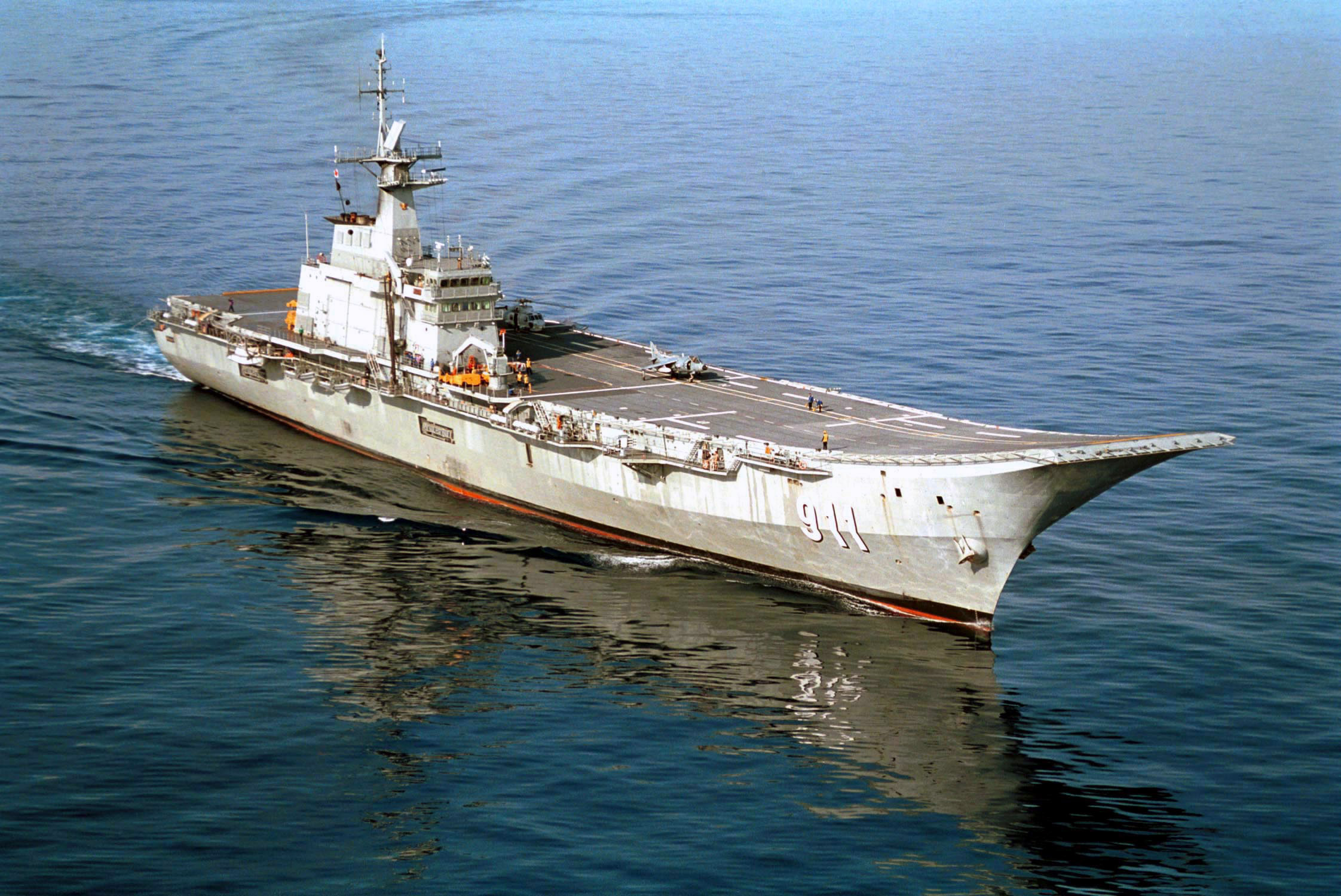
The Royal Thai Naval vessel HTMS CHAKRINARUEBET (CVH 911) in the South China Sea.
HTMS CHAKRINARUEBET  in the South China Sea.

This vessel, which serves as Thailand’s flagship and is based on the design of the Spanish aircraft carrier Principe de Asturias, spends much of its time docked at Sattahip naval base. No longer able to accommodate Harrier airframes, the Chakri Naruebet can now carry a small complement of helicopters and occasionally serves as a royal yacht. The two stealth corvettes may suffer a similar fate if Bangkok’s palace politics persist.

Paul Pryce is a Research Analyst at the Atlantic Council of Canada. With degrees in political science from universities in both Canada and Estonia, he has previously worked as a Research Fellow at the OSCE Parliamentary Assembly and an Associate Fellow at the Latvian Institute of International Affairs. His research interests are diverse and include maritime security, NATO affairs, and African regional integration.
No South EU Sea


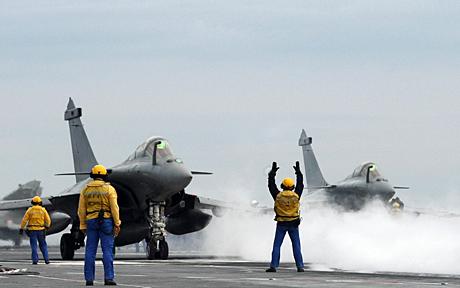
Rafale fighters launch from the deck of the French aircraft carrier Charles de Gaulle

By Peter Solomon

The South China Sea contains the second busiest trading route in the world: the Straight of Malacca. Vital to meeting the energy demand of China, Japan, Taiwan, and South Korea, the supply flow through this region is comprised mainly of crude oil, liquefied natural gas, coal, and iron ore. On account of the territorial claim disputes that afflict the South China Sea, several militaries have been busy modernizing, namely China, the Philippines, and Malaysia. Overall, six nations claim partial or entire territorial rights over the South China Sea: China, the Philippines, Malaysia, Vietnam, Taiwan, and Brunei. What’s at stake in the region is more than trade routes – a 2006 estimate by the United States Energy Information Administration revealed proven reserves of 26.7 billion barrels of oil in the South China Sea (about the same quantity as Oman, Qatar, Syria, and Yemen’s oil reserves combined), and proven reserves of natural gas amounting to 7.9 trillion cubic meters (about the same quantity as Saudi Arabia or the United States’ reserves). Due to the considerable value of the oil and natural gas, the potential for disagreement is exceptionally high and, therefore, the possibility of conflict over territory in the South China Sea cannot be understated.


Due to the magnitude of trade and investment conducts the European Union (EU) with Japan and South Korea, and the great prospects for enhancing economic relations, the EU has a great stake in the security of East Asia. About 18.1% (251.5 bn. Euros) of the EU’s exports are destined for East Asia, while a mere 3.3% go to other destinations in Asia. Additionally, the EU imports about 30.1% (452 bn. Euros) of its goods from East Asia compared to just 4.2% for the rest of Asia. It is easy to see that a good deal of the EU’s economic health depends upon trade with East Asia. Therefore, a key EU foreign policy security goal is to promote peace and stability in East Asia.


China is in the process of modernizing its People’s Liberation Army Navy (PLAN) to exert Chinese influence in the region. It is no secret that China is building up its power projection capabilities to counter-balance the presence of the United States defense forces in the Western Pacific. Due to Japan and South Korea’s geographic location and security ties, any conflict or disruption to stability in the South China Sea could have major impacts on East Asia. The EU’s concern, however, is in regards to Europe’s economic stake in the region and the EU’s identity as a normative power. Despite the EU’s promotion of peace and stability in East Asia, the institution’s lack of credible power projection capabilities in the region belie the EU’s ability to intervene in security issues in the region. 


Although an EU-led military operation would be unlikely in the Western Pacific, the importance of the region would compel individual nations to act to maintain law and order, or to preserve maritime safety, safeguarding their commercial interests in the region. In the event of a conflict it is entirely possible that EU member states would engage the region through the North Atlantic Treaty Alliance (NATO). Recent counter-piracy operations off the coast of Africa have set a precedent for maritime military action far from the traditional European area of operations. Additionally, Great Britain and France can still act on their own if it is in their best interests as both maintain competent navies with power projection capabilities, including the ability to deploy their own aircraft carriers.


In the case of a South China Sea conflict, Japan would be most certainly directly involved as its tankers transport 70% of Japan’s oil through this region. A confrontation would force Japan’s oil tankers to circumvent a conflict in the South China Sea by navigating around Indonesia into the Pacific Ocean. However, this option would be both expensive and laborious. Additionally, two-thirds of South Korean natural gas is shipped through the South China Sea on its way to the Korean peninsula. In regards to the European Union’s economic interests in East Asia, maritime security is crucial for Europe.


Currently, EU military capabilities consist of 13 battlegroups, which are “rapid response units” that consist of 1,500 troops each. EU member states rotate the responsibility of provisioning these units, two of which have always been on stand by since 2007. However, this force has never been deployed and it is difficult to say how the debt crisis will affect the EU’s research and development into new military capabilities. Given the budget cuts and focus on internal issues, the EU will likely continue to place the burden on the United States to maintain the status quo in the Western Pacific region. In the event of a crisis in the South China Sea, it would be the effects on the EU’s East Asian trading partners that would create the most potential to draw in the maritime forces of individual EU member states.


Whether or not the EU will cooperate in joint military expeditions with Japan or South Korea in the future is unknown. With regard to economics, EU-Japan and EU-South Korea economic ties are substantial, and significant cooperation in both relationships has led to the emergence of global economic partnerships via Free Trade Agreements with both nations. Through Japan and South Korea, the EU has established a gateway into East Asia’s vast markets and developed a role as a player in security issues, albeit a minimal role for the time being. Despite the EU’s current internal focus it cannot forget about its strategic partnership with Japan and South Korea.


This post is from our British partners at TheRiskyShift.com and can be found in its original form here.

Peter Solomon is a Master of Arts in International Political Economy candidate at King’s College London. Peter earned a bachelors degree from the University of Connecticut in English and Political Science.