Tag Archives: India

Strategic Maritime Balancing in Sino-Indian Foreign Policy

India’s Role in the Asia-Pacific Topic Week

By Ryan Kuhns

The notion that China and India have fought only one war with each other in their civilizations’ long histories has sometimes been used to preface or bookend conversations about Sino-Indian strategic rivalry. It would seem that this narrative would require a sort of continuous geopolitics, the consistent orientation of collective interests and power and their relationship with geography. In fact, the geopolitical facts of the past do not fully link up with the realities of the 21st century. Not only have the mountain passes and peaks of the Himalayas become zones for potential conflict, where in the past they served as natural buffers, but the shared space of the Indo-Pacific also links the interests and security concerns of present day India and China.

Despite the potential for friction, a perspective that is overly obsessed with the potential for strategic rivalry between India and China can obscure where their interests meet. It also fails to fully contend with the very real and powerful aspects of economic and political globalization, as well as Asian perspectives on how the current iteration of the global system should change in order to accommodate the rise of its most accomplished and promising states. This may be why security narratives that hone in on the potential for direct strategic rivalry in the Sino-Indian relationship are so often thwarted by rebuttals which simply point to India and China’s regional and international cooperation on infrastructure projects, trade, and in multi-lateral forums. In order to more fully understand potential or actual strategic rivalry dynamics between China and India, it may be necessary to widen one’s view to the regional and super-regional periphery, to India and China’s potential partners in the maritime realm. The maritime domain provides the most room for realistic maneuver between the two countries in that it eschews an overt continental buildup along their contested border while taking advantage of the Indo-Pacific’s political and economic complexity.

The potential for strategic maritime competition generally lies in maintaining the ability to carry out sea control / sea denial missions and the maintenance of a nuclear second strike capability. India and China both consider sea control to be a crucial element of their national security. China’s colonial experience and its wars with the Japanese Empire both highlighted the importance of a capable navy. India’s recent experiences with seaborne terrorism and its memory of American carrier diplomacy in its 1971 war with Pakistan have also served a similar purpose. Outside of their continental and near seas interests, both countries’ economies rely on the safe passage of goods and energy. India’s overseas trade contributes to 90 percent of its foreign trade by volume and around 70-77 percent of its trade value. 80 percent of India’s demand for oil is met by imports from overseas. Similarly, China’s economy relies heavily on imported energy, with over 85 percent of its oil demand met by overseas imports, two-thirds of which pass through the Indian Ocean Region (IOR) and the Straits of Malacca. 90 percent of China’s trade volume and 65 percent of its foreign trade value come via the sea, much of which also passes through the IOR. For growing Asian economies with the means to project power, these figures have justified the expansion of naval capabilities and greater operational distances.
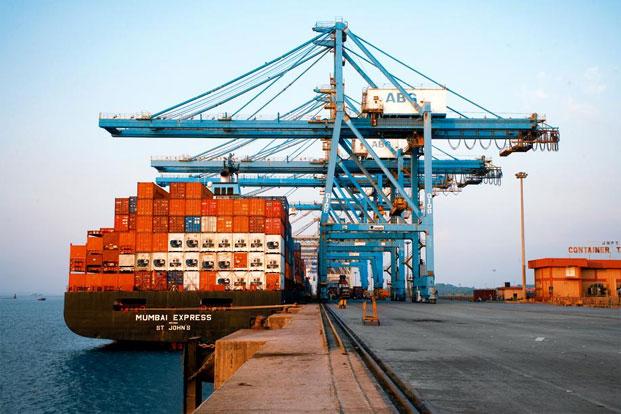
An Indian cargo ship at the Jawaharlal Nehru Port in Mumbai.

At the same time, India and China’s simultaneous pursuit of a more robust maritime presence has spooked each country in turn. As a more confident Chinese maritime strategy has driven an expansion of sorts into the IOR, some Indian analysts have become increasingly alarmed by the so-called “string of pearls” and/or Maritime Silk Road initiative, both of which may serve to further entrench Chinese interests in the IOR. While Chinese submarines had been sighted before in the IOR, many Indian defense experts were particularly worried by the appearance of a Chinese submarine at the Sri Lankan Colombo International Container Terminal (CICT) in 2014, which is a transit point for 48 percent of shipping bound for India. India has replied in turn by reemphasizing its desire to bolster its naval capabilities through indigenously produced, modern craft and through its own economic and geopolitical maneuvering. India is preparing to relax its cabotage laws in order to decrease its reliance on shipping from ports like the CICT. It is also working towards the construction of deep water ports of its own near major international shipping lanes. India has also expanded its cooperation with Japan and Vietnam. Japan and India plan to “deepen” their “bi-lateral defense relationship” and work together on infrastructure projects on the Andaman and Nicobar Islands, northwest of the Strait of Malacca. India‘s growing cooperation with Vietnam has included a line of credit from India to Vietnam for Ocean Patrol Vessels, an Indian commitment to the training of 500 Vietnamese submariners, Indian support for Vietnam’s possible access to the BrahMos supersonic cruise missile, and plans for the Indian construction of a satellite tracking station in Vietnam.

The expansion of the Sino-Indian action-reaction cycles to their respective strategic peripheries may be illustrative of what Chietigj Bajpaee refers to as a “nested security dilemma.” While there are certainly dangers to broadening the points of potential conflict between two powers, India and China’s moves to shore up their own economic and physical security through approaching potential partners in the region has also afforded the two powers a certain level of flexibility when it comes to strategic competition; providing opportunities for balancing each other with potential strategic competitors in an effort to sap the other’s efforts at expanding  their operational and strategic reach while maintaining the productive aspects of their bi-lateral relationship. The most important relationships to India and China in this regard may be with the United States and Pakistan respectively.

The PRC’s relationship with Pakistan goes back to shortly after the emergence of both nations. Pakistan has served as a crucial element of China’s effort to reduce India’s threat of revanchism. Pakistan also helped partially balance India’s close relationship with the Soviet Union during the Sino-Soviet split, and served as the diplomatic bridge to the United States, producing perhaps the most pivotal re-alignment of the Cold War. Today, Pakistan serves as a potential corridor for China’s efforts to circumvent its “Malacca dilemma.” It also looks as if Pakistan’s maritime capabilities will become increasingly important for augmenting China’s strategic interests in South Asia and the IOR. Last year’s agreement between China and Pakistan for eight Type 41 Yuan-class diesel-electric submarines, the largest of China’s arms deals to date, provides the means for Pakistan to complicate not only India’s ability to operate in Pakistan’s littorals, but may serve as the genesis of Pakistan’s future submarine-based nuclear deterrent.
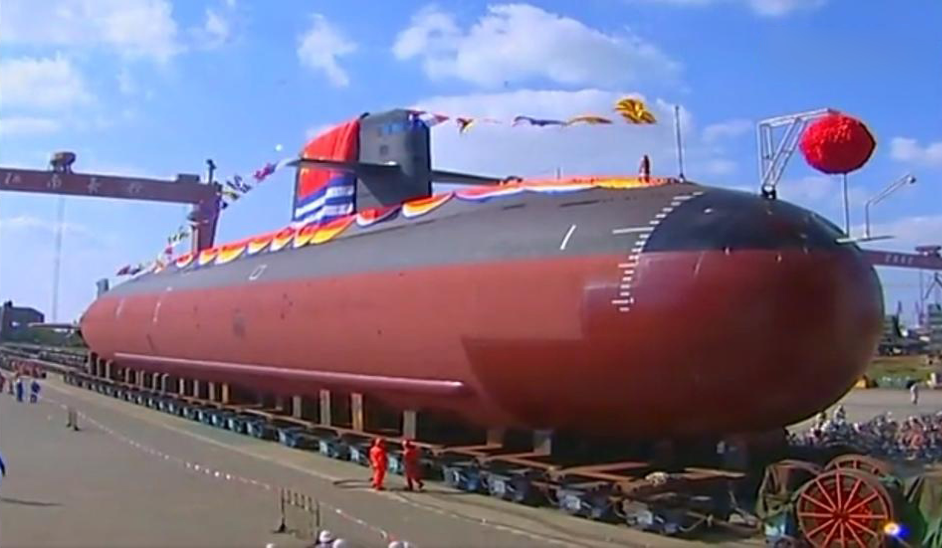
Type 039B Yuan-class submarine during rollout at the Jiangnan Shipyard on Changxing Island.

US-India détente has been slow coming and cyclical in nature but the end of the Cold War moved things along. As China’s assertive posture in the South China Sea began to rile the United States, India’s position as a core partner in the US’s “Asia-Pacific Rebalance” has been highlighted by high level visits from the United States and grand pronouncements regarding the potential of US-Indian partnership. US Secretary of Defense Ash Carter’s efforts seem to have yielded an agreement “in principle” on the Logistics Exchange Memorandum of Agreement. The US ambassador to India has also publicly expressed the desire, on the part of the US, to supply India with American aircraft and defense technology, highlighting that there “is no other country in the world that we are supporting as an emerging global defense leader” and that “[n]ever [has the US] actively supported the indigenous development of an aircraft carrier program in another country.”
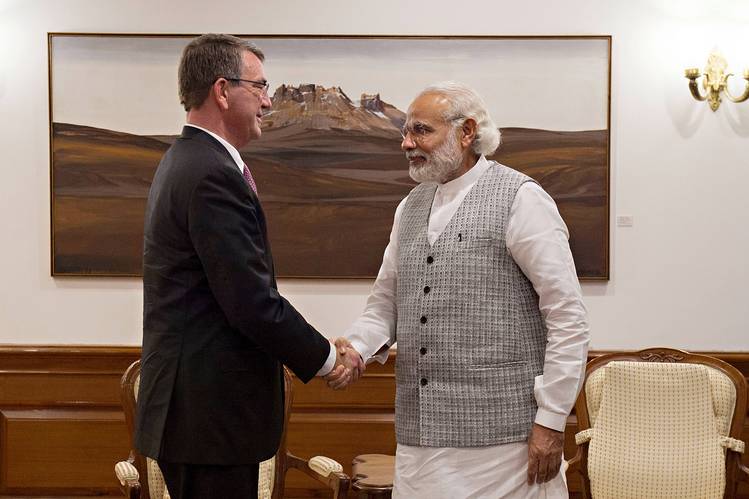
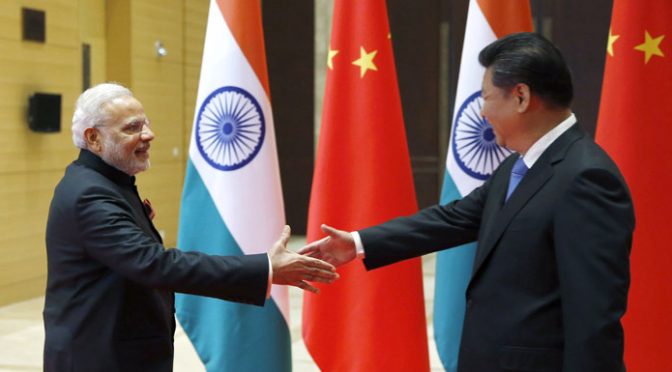
U.S Secretary of Defense Ash Carter meets with Indian Prime Minister Narendra Modi on April 12 in New Dehli, India. Source: Zuma Press.
U.S Secretary of Defense Ash Carter meets with Indian Prime Minister Narendra Modi on April 12, 2016, in New Dehli, India. Source: Zuma Press.

Even though the Chinese relationship with Pakistan appears, at least publicly, less ambivalent than burgeoning US-Indian ties, the Indian relationship with the United States could be extremely important for India as it attempts to build a navy that may cope with the enormous task of controlling the IOR while maintaining its commitment to continental defense. While the US may continue to push for direct Indian participation in meeting China’s increasingly assertive stance in the South China Sea, it is in India’s interest to build its capabilities for affecting influence in its regional seas first, and relieving and supporting the US in the IOR so that it may put pressure on China in the South and East China seas. Also, up until a certain point, this creates the conditions for India’s plausible deniability in China’s security woes with the United States and China’s possible subsequent difficulty in pulling its navy away from its immediate maritime periphery. China, through providing a great deal of military equipment to Pakistan and developing its submarine capabilities, thus attempts to complicate India’s regional maritime security calculations in such a way that it works to obstruct its larger regional and international goals.

While one can observe patterns, the true nature of these developing strategic maritime relationships never appears totally clear. While China professes itself as an “all-weather friend” to Pakistan, it has also been cautious about looking too close to its number one arms customer and India’s main rival. The United States, on the other hand, driven by the imperatives of its Global War on Terror and its legacy of defense cooperation with Islamabad, continues to sell military equipment and platforms to Pakistan. Of course, the US-China relations is more often defined by their mutual interest than by where they clash. Finally, India and China maintain meaningful and productive contacts. With regards to security issues, Beijing and New Delhi have institutionalized a “Maritime Affairs Dialogue”, are working towards a military hotline, and meet in multi-lateral forums with other major powers, such as Russia, to present unified visions on regional and global issues.

This lack of solid commitment to overt balancing does not reflect a level of uncertainty about each country’s respective national interests in regards to the strategic orientation of the other. It is in China and India’s best interests to not concretely and directly align themselves with Pakistan and the United States due to the fact that the actions of their allies could reduce their strategic flexibility. China has long been concerned with internal unrest in Pakistan and with how Pakistan’s issues with terror have affected both Chinese citizens in Pakistan and bled over into its own restive regions. Pakistan’s tense relationship with India also adds a level of unpredictability to the strategic situation in South Asia, a cauldron that China would do well to avoid if it wants to protect its maritime and continental assets. India’s approach to its growing relationship with the United States also exhibits some anxieties about becoming involved in the growing clashes between Beijing and Washington. As one of India’s leading intellectuals said in his analysis of the Modi boom in US-Indian relations, “Do we really think we will challenge the Chinese [in the South China Sea] with the Americans, when all that the Chinese have to do is take a little walk across our vast borders to make us feel vulnerable?”

While an ostensibly positive bilateral relationship seems to define Sino-Indian relations for now, undercurrents of competition remain and appear to have the potential to proliferate. Both their respective strategic maritime orientations and the nature of their relations with regional and international powers may lead to a point where the curtain on Sino-Indian strategic machinations is raised. The illusory aspects of a diplomatic relationship built on political theatre serve as poor mechanisms for deescalating real conflicts which may seriously threaten both of their interests. At the same time, overt strategic competition could fuel naval arms racing between the two powers in a way that could be wasteful, make clashes even more likely, and further complicate the delicate diplomatic architecture of a highly dynamic Asia. Only a cautious and healthy mutual respect for each other’s power potential and the possible disastrous outcomes of unchecked strategic competition may add some degree of certainty to Asian diplomacy in the 21st century. Simultaneously, unclear policies masquerading as caution could lead to uncertainty that shapes miscalculation in times of conflict. Currently, trends in Sino-Indian relations appear to be quite positive. Although, derivations from the strategic status quo in the Indo-Pacific can force recalculations.

Ryan Kuhns is a Research Associate at PAXsims and holds an MA from the Patterson School of Diplomacy and International Commerce. His research interests include defense economics, strategy, and the social/political organization of war. The opinions expressed in this article are the author’s alone.
Sino-India Strategic Rivalry: Misperception or Reality

India’s Role in the Asia-Pacific Topic Week

By Ching Chang

Defining Strategic Rivalry

As we examine the issue of the Sino-India strategic rivalry, we should start from the fundamental definition of the strategic rivalry. As previous research already indicates, the strategic rivalry is concerning territorial disagreement, i.e. competing for space, or alternatively, concerning status and influence, i.e. contesting for position on the political stage. Nonetheless, the author would like to argue that three factors should be also put into consideration. There are mutually exclusive interests, explicitly stated objectives, and insignificant third-party effects. Of course, we may also interpret the third-party effects more broadly to cover any other political, economic, social, or cultural elements capable of constraining the escalation of antagonism.

Adopting the basic definition to measure the relationship between the People’s Republic of China and the Republic of India, we may clearly identify that they do have territorial disagreement along their borders. On the other hand, they also have certain degrees of competition of status as well as influence in various aspects on the world stage. Particularly, the influence within the maritime space is a key issue frequently noted by strategic commentators and political observers. Yet, how real can the general perception be? Whether the maritime competition between China and India is in the Indian Ocean or the South China Sea may prove to be only an elusive speculation though seemingly plausible.

The Myth of the Maritime Majesty

The concerns raised by the Indians accompanying the expansion of Chinese maritime presence in the Indian Ocean since early 2009 is an understandable indication of the perception of a Sino-Indian strategic rivalry in the maritime space. The excuse for Beijing to justify the People’s Liberation Army Navy’s presence in the Indian Ocean is based on the four United Nations Security Council Resolutions, Number 1816, 1838, 1846 and 1851, passed in 2008 to request and to authorize all the member states to deploy maritime forces for anti-piracy escort missions in the associated waters of the Indian Ocean. Apart from this reason, there is no other excuse ever adopted by the Chinese government to justify their routine maritime presence in the Indian Ocean though naval port visits serve diplomatic functions and joint maritime exercises do occur. 

A Chinese Navy soldier observes from a helicopter during an escort mission in the Gulf of Aden, Aug 26, 2014. This is the 18th convoy fleet sent by the Chinese People's Liberation Army Navy for these missions since 2008. [Photo/ Xinhua]
A Chinese Navy soldier observes from a helicopter during an escort mission in the Gulf of Aden, Aug 26, 2014. [Photo/ Xinhua]
Many political commentators from time to time advocate that Indian maritime forces could project their presence into the South China Sea to reciprocate the uneasy sentiment caused by the Chinese maritime presence in the Indian Ocean. Nonetheless, mature strategic calculation should be a reasoning process free from passion. Is there any substantial Indian maritime interest that has been excluded by the Chinese presence in the Indian Ocean except the self-exaggerated pride of the “India should have the maritime majesty in the Indian Ocean” argument? Wouldn’t the efforts paid by the Chinese naval presence in the Indian Ocean promoting the security of maritime commercial transportation also serve the interests of India?

Indian strategic thinkers should consider whether the Indian position of maritime dominance in the Indian Ocean would have already been challenged or even excluded by the People’s Liberation Army Navy’s anti-piracy deployment in the region. Further, if Indian maritime forces would have the capacity to maintain the maritime majesty in the surrounding waters by assuring the safety and security of the maritime transportation as well as the peace, stability and order around the maritime theater of the Indian Ocean alone, how could the United Nations possibly passed aforementioned resolutions in 2008? Of course, the willingness to deploy People’s Liberation Army Navy forces to the Indian Ocean for committing to the United Nations resolutions is undeniably originated from the calculation of the PRC’s national interests. Nonetheless, the original aim was not intentionally to challenge or to antagonize the India’s stated supremacy of maritime dominance in the Indian Ocean.

The essence of seapower is nothing else but to support the national needs of exercising maritime activities. Among all the maritime activities generally conducted by states in the world, the utmost element is maritime transportation serving the commercial trade with other nations through various sea lanes of communication. Most states have no naval capacity of global reach to secure the security and safety of their merchant fleet, and must take a cooperative approach to support the freedom of navigation generally assured by the global maritime powers. To well control or to dominate the surrounding waters near their own territories is not practicing seapower but only conducting the defense function in the maritime domain. Conducting maritime defense function is never the core element of exercising seapower.

China needs the Indian Ocean to proceed its maritime commercial transportation. This is exactly the reason why Beijing would like to contribute to the anti-piracy escort missions defined by the United Nations Security Council resolutions. Likewise, India also needs the South China Sea to support its commercial exchanges in the East Asian region. Nonetheless, because India still needs other states to contribute their maritime forces to share the burden of maintaining the stability and security in the Indian Ocean, how can New Delhi justify its decision to send maritime forces to the waters in the East Asian region and form an atmosphere of maritime strategic rivalry with China in the South China Sea? Particularly, it is hard to get any resolution from the United Nations Security Council whilst the freedom of navigation for maritime commercial transportation is never substantially affected so far, no matter how loud anyone ever decries the maneuvers in the South China Sea.

For any Indian strategist who would like to advocate the unnecessary aspiration of expanding the Indian naval presence to the South China Sea, they should ask how such a decision may serve Indian strategic interests. They should scrutinize whether there is any mutually exclusive interests between China and India in the maritime space, either in the Indian Ocean or in the South China Sea. Further, if Indian strategists insist a strategic rivalry in the maritime theater is inevitable between Beijing and New Delhi, at least, these strategists should list those explicitly existed objectives as the basis for their advocacy. The same rule may also apply to over-enthusiastic strategic thinkers in Beijing. If both sides cannot clearly identify what exactly they may fight for, then how can a strategic rivalry in the maritime space be a realistic assumption? The key of solving the strategic challenge requires finesse. Fighting with a nonexistent strategic rivalry in mind like Don Quixote may only propagate foolhardiness.

Defusing the Land Territory Antagonism

Comparing abstract and elusive maritime contention, there are concrete and substantial territorial disputes along the borders between India and China. Could the territorial disagreement be a good reason to justify the strategic rivalry between these two traditional land powers separately existed in East Asia and South Asia? The territorial dispute does satisfy the three aforementioned criteria. It involves mutually exclusive interests and the territories themselves involve explicitly stated objectives. Given there is no other comparatively powerful states involved in their border disputes, the third-party effect is insignificant. Nonetheless, the possibility of finding a key for solving the seemingly rivalry still exists.

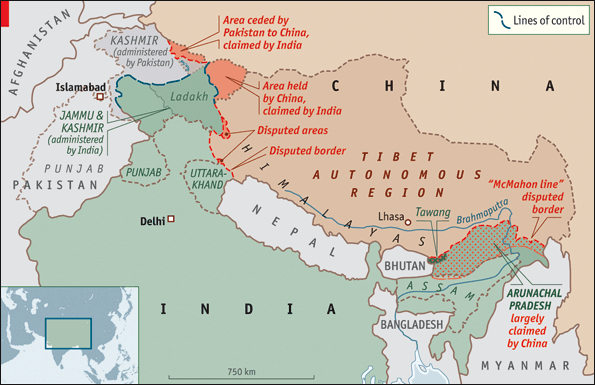
If we review all the factors involved in the territorial disputes between Beijing and New Delhi, the most irrelevant and misleading element that should be taken away from strategic calculation is the argument originating from the McMahon Line. The McMahon Line is unilaterally regarded by India as the border-should-be with China. Nonetheless, the McMahon Line and the Simla Accord may not survive an inspection of criterion existing in international judiciary practices.

The Chinese civilization engaged with the Indian civilization for thousands of years prior to the western presence in the sub-continent. Many cultural features introduced from India are still actively practiced in China today and have been openly admitted by the Chinese. The legacy of Indian influence is clearly indicated in many Chinese historical sites. However, the insistence of the McMahon Line is in essence an insult. It is a legacy left by the colonists in India never recognized by the Chinese. Insisting the order defined by the western colonists along the border of these two ancient civilization, is indeed a confession of no confidence.

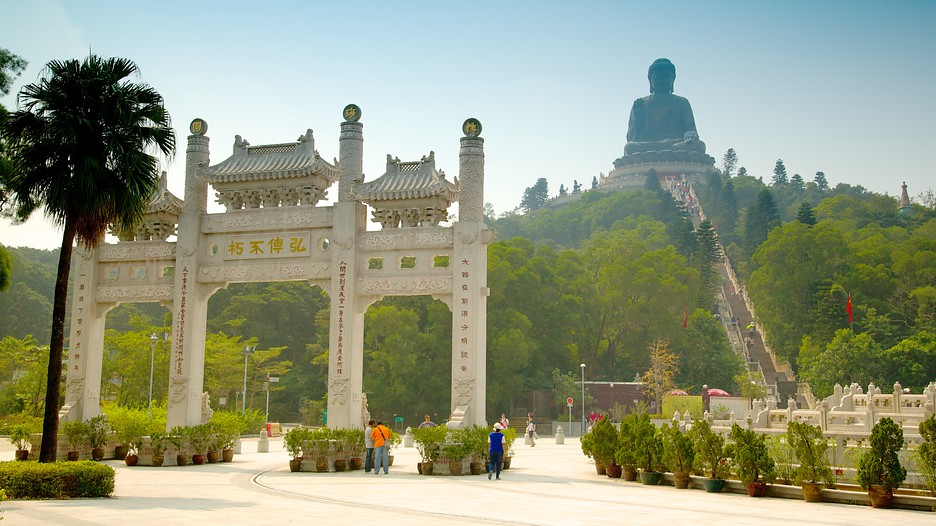
The "Big Budda" statue in Lantau Island, Hong Kong.
The “Big Budda” statue in Lantau Island, Hong Kong.

The McMahon Line is an indication that two ancient civilizations failed to set the order by themselves but need to rely on western civilization to define it for them. The possibility of the Chinese accepting an arrangement with such significance is extremely slim. To insist the McMahon Line as the basis for demarcation only proves that western civilization still effectively colonizes the strategic thinking in the Indian security professional community. Especially since the heritage left by the British colonists is fundamentally controversial. If India has no intention to let their strategic calculation be released from such a misleading shackle, then what is the value of getting independence in the late 1940s?

The author would like to recommend that Indian strategic thinkers conduct a survey on those successful cases of demarcation on land borders between Beijing and all its neighboring states except India in the past few decades. The most important lesson to be concluded from these cases is that any compromise on demarcation should be a decision made by the people actually involved now, not by a former colonial master. In many cases of these demarcation negotiations, Chinese negotiators have reasonably accepted the realities such as when former PRC Prime Minister Zhou Enlai pragmatically recognize the Line of Actual Control in a 1959 diplomatic note. To understand the modus operandi of Beijing is the essential element for defusing the disputes along their borders.

disputed-areas
A map indicating disputed territories between India and China.

Indian strategic thinkers should consider establishing a demarcation line between these two civilizations with an Indian or a Chinese name but not from a British official once colonized India. Unless keeping the territorial disputes unsettled may still serve the Indian interests, otherwise, it is about the time the Indian strategic community set itself free from the myth of the McMahon Line. By adopting the yardsticks of “cui bono” and “cui malo” the strategic thinkers of these two great civilizations should be able to draw a demarcation line between them with a name they may agree to choose for glorifying their cultural wisdoms.

Chang Ching is a Research Fellow with the Society for Strategic Studies, Republic of China. The views expressed in this article are his own.

India-China Competition Across the Indo-Pacific

India’s Role in the Asia-Pacific Topic Week

By David Scott

India and the People’s Republic of China are encountering each other across the Indo-Pacific, the predominantly maritime region spanning the Indian and Pacific Oceans. Harsh Pant’s prognosis in March 2016 is persuasive that “the turf war between the two navies, as both nations seek greater roles in regional [Indo-Pacific] dynamics, is set to grow.” Both countries are developing blue water long distance naval capabilities, and adopting Mahanian-style seapower strategies for power projection. Implicit competition in what has been dubbed “a new great game for influence in the Indo-Pacific” between these two rising powers is the order of the day in the Indian Ocean, the South China Sea, the West Pacific, and the South Pacific.

Indian Ocean

India has long held an implicit view of natural regional preeminence, based on its central geographical location in the Indian Ocean, whereby the Indian Ocean should somehow be India’s Ocean, which was the title of David Brewster’s book, complete with the subtitle The Story of India’s Bid for Regional Leadership. The challenge, or “wake up call” (Kapila), for India is China’s increasing Indian Ocean presence on the military, diplomatic, and economic fronts. Militarily this is shown through the deployment of the Chinese navy into the Indian Ocean. Diplomatically this is shown through China’s pursuit of littoral states and its “cheque book diplomacy” among the micro-island states of the Indian Ocean basin. Economically this is shown through China’s recent Maritime Silk Road (MSR) initiative which it has pushed since November 2014.

These events have generated widespread fears for India of a so-called string of pearls drive by China, denied of course by Beijing, to establish staging posts across the Indian Ocean. Pakistan’s port of Gwadar, now being run by the China Overseas Ports Holding Company Ltd (COPHCL), is one key irritant for India, as it provides a potential deep water berth for the Chinese navy. This growing Chinese presence across the Indian Ocean feeds into that other India strategic fear of encirclement, by a hostile China along its disputed northern border, ensconced in an equally hostile proxy state to its West in Pakistan, penetrating neighbours like Nepal, (previously) Myanmar, Bangladesh and Sri Lanka, and deploying naval forces to its South. India’s counter has been multi-pronged: building up the Iranian port of Chabahar as a “checkmate” (Sakhuja) to China building up Gwadar, strengthening its own outreach to South Asian neighbours, strengthening its own outreach to Indian Ocean island states, pushing its own naval presence, and keeping China out of the Indian Ocean Naval Symposium (IONS). Of further significance are India’s bilateral MALABAR exercises with the US operating in the Indian Ocean since the mid-1990s, which also included Australia and Japan in 2007, and which again also involved Japan in 2015 and 2016. These are indeed “aimed at countering growing Chinese military presence in the Indian Ocean (Singh 2015), with China denouncing them as dangerous (Global Times). What can be called India’s maritime-led “counter-containment” (Rehman) of China can be seen elsewhere in the Indo-Pacific, through what has been dubbed India’s own necklace of diamonds network of maritime-centred security partnerships.

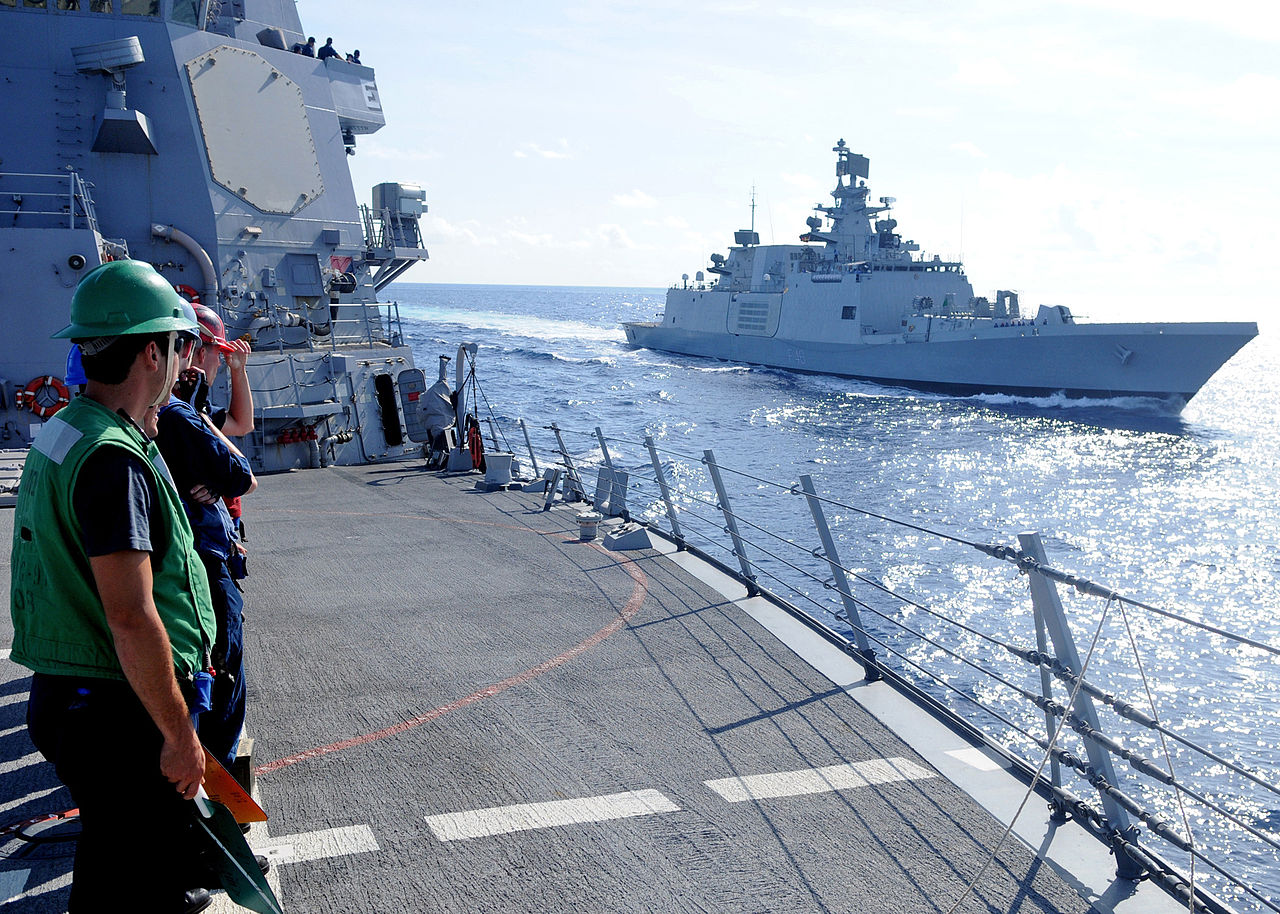
Sailors assigned to the guided-missile destroyer USS Halsey (DDG 97) stand in ranks as the Indian navy destroyer Sapura (F-48) pulls alongside Halsey during a Malabar 2012 exercise.
Sailors assigned to the guided-missile destroyer USS Halsey (DDG 97) stand in ranks as the Indian navy destroyer Sapura (F-48) pulls alongside Halsey during a Malabar 2012 exercise. U.S. Navy photo by Mass Communication Specialist 3rd Class Christopher Farrington.

South China Sea

The next part of the Indo-Pacific where India and China come up against each other is in the South China Sea, where India’s Act East policy “meets” (Chang) China’s southern drive. Whereas the Indian Ocean is India’s strategic backyard into which China is coming, the situation is reversed in the South China Sea which is China’s strategic backyard into which India is coming. The key feature here is that most of the sea is claimed as Chinese, supposedly from “time immemorial,”under China’s 9-dash line which encloses around 80% of the waters and includes the two groups of the Paracels and Spratly islands. The Paracels remain in dispute between China and Vietnam. The Spratlys (which mostly consist of atolls, rocks and reefs rather than proper “islands” as defined under UNCLOS criteria) remain in dispute between China (Beijing and Taiwan), Vietnam, the Philippines, Malaysia, Brunei (waters) and Indonesia (waters).

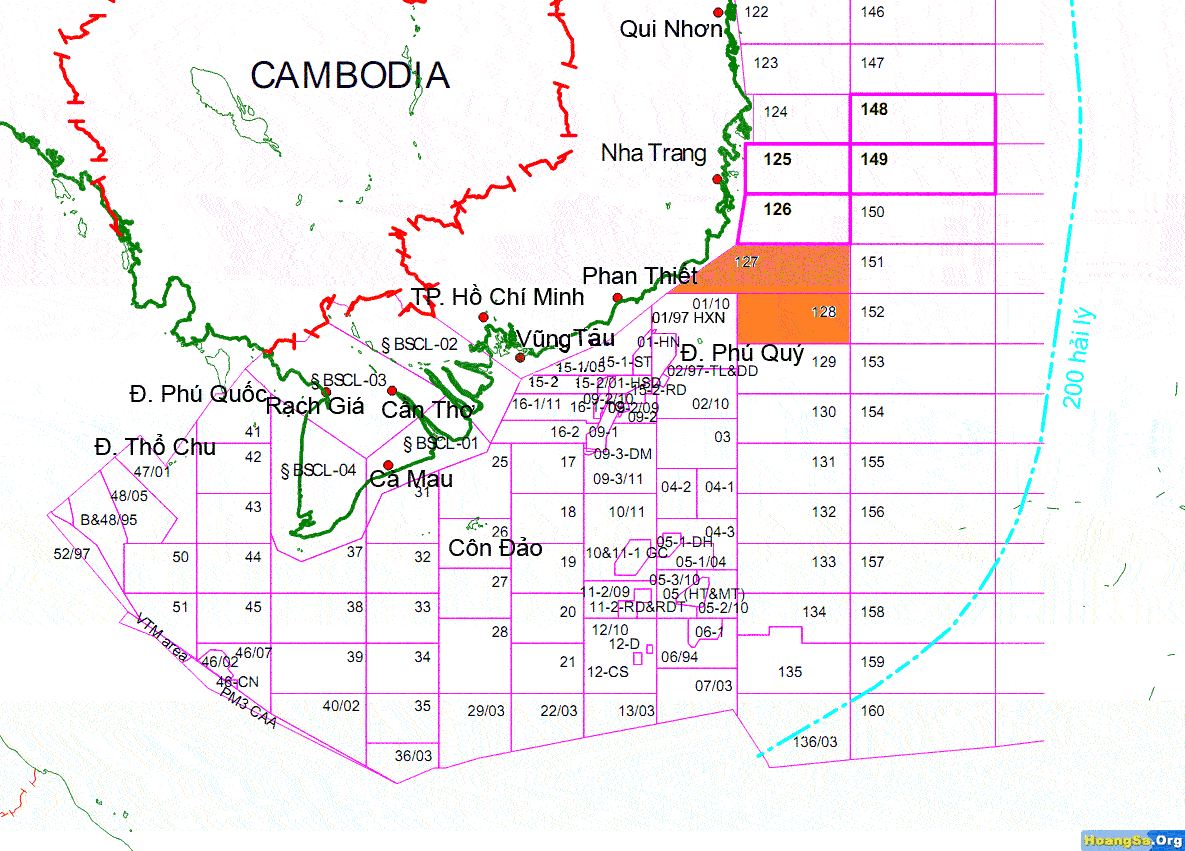
The South China Sea serves as India’s “maritime gateway to the Pacific” (Chaturvedy). While it has avoided taking any stance on sovereignty issues, India’s response to China’s increasingly assertive push in these waters has been six-fold. Firstly India continues to reiterate its support for adherence to international law and to open transit in regional forums like the ASEAN Regional Forum and East Asia Summit (EAS). This has been an implicit criticism of China. Secondly, India has pushed this line on the South China Sea in bilateral security discussions with the US, Japan, and Australia, and also in the India-US-Japan and the India-Japan-Australia trilateral mechanisms set up in 2011 and 2016 respectively. China has rejected all such discussions as outside interference. Thirdly, India has reinforced security ties with the Philippines and above all with Vietnam. Although there is official denial by India that such security strengthening is related to China, in reality it represents a degree of tacit balancing by India and these partners with China in mind. India’s strengthening security links with Vietnam continue to have a strong maritime flavour as India has provided supplies to the Vietnamese navy and Vietnam has provided berthing facilities for India at Cam Ranh Bay. The logic here is a Vietnam card being played against China by India to match the Pakistan card playable against India by China. Fourthly, since 2011, India has signed agreements with Vietnam whereby India’s national state company Oil and Natural Gas Corporation (ONGC) has conducted explorations in various waters within the South China Sea controlled by Vietnam as well as waters such as Block 128 that are also claimed by China. This has attracted vociferous Chinese denunciations. Fifthly, India has carried out joint SIMBEX exercises in the South China Sea with Singapore on a biannual basis since 2005. Sixthly, the Indian navy has been deploying regularly into the South China Sea since 2000. All of these aspects of growing Indian presence in the South China Sea can be seen as a response to growing Chinese presence in the Indian Ocean. India may not be able to stop this growing Chinese presence in the Indian Ocean, but it can apply countervailing pressure through going into China’s own backyard.

Blocks 127 and 128 in the South China Sea, where the India’s Oil and Natural Gas Corporation is looking to explore for oil.
Blocks 127 and 128 in the South China Sea, where the India’s Oil and Natural Gas Corporation is looking to explore for oil. Block 128 measures 7,058 square kilometers.

West Pacific

China views the West Pacific through the prism of what it calls the “first island chain” (diyi daolian) running from Japan, the Ryukyu chain, Taiwan and the Philippines; and the “second island chain” (dier daolian) running down from Japan, the Bonin islands, the Mariana islands, and the US stronghold of Guam. Chinese maritime doctrine aims to achieve penetration of the first island chain and ultimately the second island chain. Deployment of the Chinese navy beyond the first island chain into the West Pacific has become an increasingly common occurrence since 2004, and is of rising concern to Japan and the US, who have sought out India as a fellow security partner.

With regard to India, a key feature is that the Indian navy has also been deploying into the West Pacific since 2007, “to counter China” (Joseph). Particularly significant have been bilateral naval exercises carried out in the Western Pacific by India with the US in 2007 and 2011, the bilateral naval exercise with Japan in JIMEX 2014, and the trilateral naval exercises with the US and Japan in 2009, 2014, and 2016. It is officially denied that such exercises are aimed at China, but in reality they represent another tacit degree of balancing.

South Pacific

Beijing’s initial interest in the South Pacific is competition with Taiwan for  diplomatic recognition as the legitimate government of China, in which a “cheque book diplomacy” war has been in operation for the past few decades. The Pacific islands’ vast Exclusive Economic Zones (EEZs) also offer lucrative fishing grounds for deep sea fishing and seabed mineral resources. These waters are very distant for regular Chinese naval operations, although headlines were made when two Chinese warships visited Papua New Guinea, Vanuatu, and Tonga in September 2010.

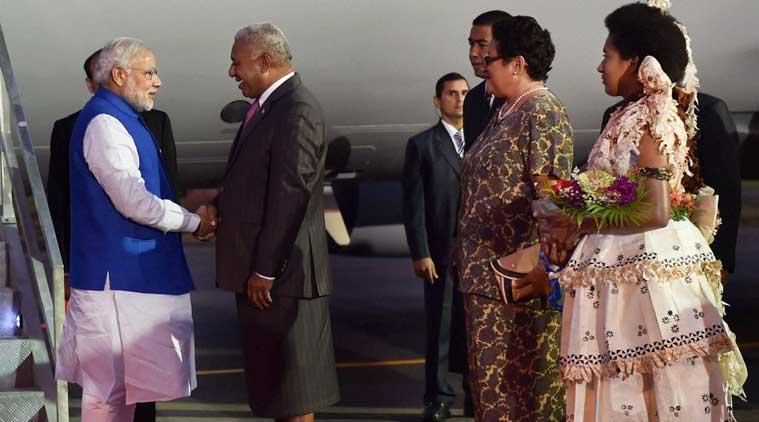
India is involved in a catch-up operation in the South Pacific, in part to “counter” (Ganapathy) China’s earlier established presence. China has been a Dialogue Partner with the Pacific Islands Forum (PIF) since 1989, while India has been one since 2003. China set up the China-Pacific Islands Countries Economic Development and Cooperation Forum (CPICEDCF) in 2006, while India set up its Forum for India-Pacific Islands Cooperation (FIPIC) in 2014. Narendra Modi’s visit to Fiji in November 2014 was not only predated by Wen Jiabao’s visit in 2006, but was also immediately followed by President Xi Jinping’s own visit three days later. China enjoyed satellite tracking facilities at Kiribati from 1997-2008, which served a dual purpose of enabling spying on the American missile range at Kwajalein atoll in the Marshall Islands, some 600 miles away, while India more recently announced in 2015 that it was setting up a space research and satellite monitoring station in Fiji.

Prime Minister Narendra Modi being welcomed by his Fijian counterpart Josaia Voreqe Bainimarama at Nausori International Airport as he arrives in Fiji on Wednesday. (PTI Photo)
Prime Minister Narendra Modi being welcomed by his Fijian counterpart Josaia Voreqe Bainimarama at Nausori International Airport as he arrives in Fiji in November, 2014. (PTI Photo)

Conclusions

So far the China-India picture is one of competition, rather on the lines of the 2012 book by Raja Mohan entitled Samudra Manthan: Sino-Indian Rivalry in the IndoPacific. Are there any signs of cooperation? Not very much it would seem in the Indo-Pacific. India and China are both members of de facto Indo-Pacific bodies like the ASEAN Regional Forum and the East Asia Summit. However, in these venues India had generally expressed similar, though more obliquely expressed, concerns about Chinese policies in the South China Sea alongside Japan, Australia, and the United States.

There are some signs of China-India cooperation at the global level. Both states seek a multipolar international order, both powers seek reform of hitherto Western-dominated international institutions like the World Bank and International Monetary Fund, and both states have a similar environmental stance, of “differentiated responsibilities” on international obligations. However, competition is more evident at the regional level. Admittedly there is some convergence in the anti-piracy operations that both countries, along with others, have been carrying out in the Gulf of Aden since 2011. However, India is generally more concerned about Chinese intentions across the Indo-Pacific and about being encircled by China. In turn, China’s own continuinganti-encirclement struggle” (Garver) remains fraught in light of ever strengthening Indian security links across the Indo-Pacific with Australia, Vietnam, Japan, and the US in particular.

It is true that direct bilateral maritime discussions started between India and China in the shape of their Maritime Dialogue mechanism, which met for the first time in February 2016. However, with little recorded about the actual discussions there, let alone absence of tangible agreements on anything, this remains a mechanism still to prove itself in the long term as anything more than a diplomatic sop. Meanwhile ongoing Indo-Pacific maritime friction between China and India remains more probable in the short to medium term.

David Scott is an ongoing consultant-analyst and prolific writer on India and China foreign policy, having retired from teaching at Brunel University in 2015. He can be contacted at davidscott366@outlook.com.

How The Indian Ocean Remains Central to India’s Emerging Aspirations

India’s Role in the Asia-Pacific Topic Week

By Vidya Sagar Reddy

The visit of United States (US) Secretary of Defence Ashton Carter to India has provided grounds for once again debating the facts and history of bilateral relations between these two countries and the implications on relations with China and the emerging world order. The convergence between the two parties to sign the Logistics Exchange Memorandum of Agreement (LEMOA) in the near future was the primary instrument of play in this debate. This visit has broader maritime relevance amid similar developments this month emphasizing India’s vision and attitude towards the Indian Ocean.

Sustaining present or higher growth trends for the coming three decades is the central economic strategy of New Delhi if India were to become an economic superpower. Maritime trade and connectivity is perhaps the critical enabler of this strategy, as it was historically when the subcontinent maintained one of the highest GDPs in the world. Enumerating this, India organised the first Maritime India Summit in Mumbai recently which featured about 240 projects with investment potential of $66 billion in the next five years. 

The National Perspective Plan for Sagaramala programme, a model of port-led development, has also been released. The Indian ports are undergoing modernisation along with their feeder transportation links – road, rail and inland waterways. These corridors will enable seamless transportation of goods and services from Indian hinterlands to overseas destinations.

Safe maritime connectivity, external trading, and overseas investments require India develop political confidence in its neighborhood and a dedicated navy to ensure secure seas. China is a key factor influencing India’s decisions regarding these domains of development.

India, Iran, and Afghanistan finalised the text for agreement on developing the port of Chabahar this month. This gateway port will boost regional trade and connectivity, and will allow India to secure access to Afghanistan where it is setting up basic infrastructure and shares Kabul’s security concerns.

On the other hand, the development of the Gwadar port by China in Pakistan has raised objections from the local people of Balochistan. India is concerned about the setting up of transportation links in the sensitive Pakistan occupied Kashmir (PoK) to China, who is worried about the safety of its workers. The probability of Gwadar functioning as a naval base, forming a node in China’s String of Pearls, has negative implications to regional stability.

In a separate development, the Maldivian President declared on his visit to India an ‘India first’ foreign policy in an attempt to revive the souring relationship caused by internal political turmoil as well as the passing of a controversial law that would grant China rights to land reclamation.

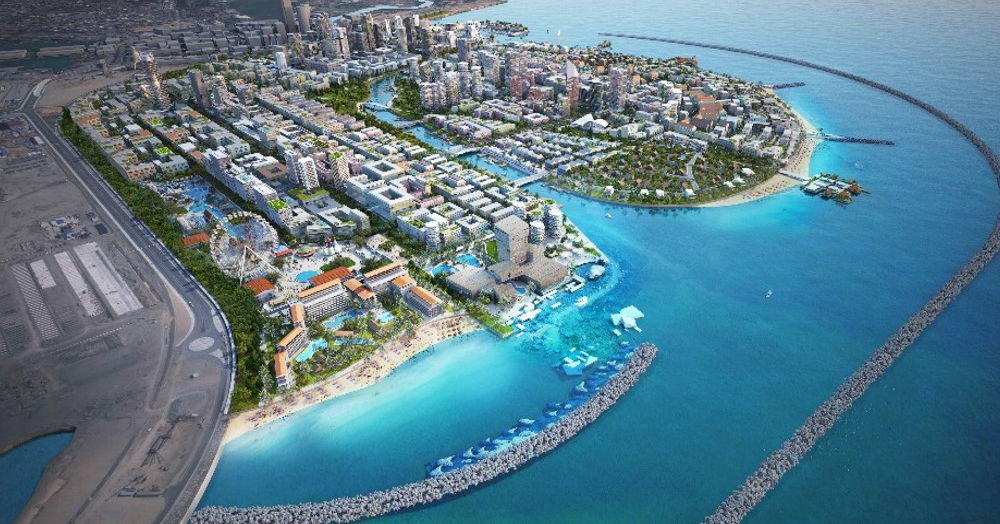
In Sri Lanka, the Colombo Port City Project has now morphed into a financial, business, and logistics hub welcoming large scale Indian investments. The ratio of investments from Sri Lanka and China were clarified and the entities that will be in charge of operations were named. Clarifications on this project were aimed at addressing India’s security concerns due to increased presence of China’s economic and naval assets in the country and aimed to welcome India as a partner in the project.

Concept image of the Colombo Port City Project.

The primary concern about China’s projects in the Indian Ocean under the Maritime Silk Road initiative is the possibility for turning these ports into strategic assets countering India’s natural advantages in the region. China could increase its naval presence in the Indian Ocean while citing protection of investments, anti-piracy operations, and humanitarian assistance to its citizens while rejecting international cooperation.

China’s provocative actions in the South China Sea disregarding international norms and calls for peaceful settlement of boundary disputes go against India’s quest for maintaining the status quo and consenting to international adjudications on maritime boundary disputes, such as those peacefully resolved with Bangladesh. China continues to disregard India’s sensitivities with respect to Pakistan and PoK. It has yet to settle land border disputes with India despite concluding similar agreements with 12 other neighboring countries.

The Indian Navy (IN), the principal guarantor of India’s maritime security, has encountered threatening postures from China’s warships. Two Chinese destroyers and an anti-submarine helicopter allegedly forced an Indian submarine to surface near Somalia. There were 22 “contacts” with Chinese submarines in the Indian Ocean through 2013, according to data provided by the US military.

In 2011, a Chinese fishing trawler was intercepted and pushed into international waters by the IN when it tried to monitor telemetry signals off Balasore, India’s missile testing range. India is also deeply aware of China’s unprofessional treatment of INS Airavat as it trasited the South China Sea (SCS) near Vietnam. China’s declarations like the “Indian Ocean is not India’s Ocean” certainly do not help build a positive environment.

These developments are factored into India’s decision to build a blue water navy with the Indian Ocean designated as its primary area of responsibility. Indian and American interests converge on protecting sea lines of communication in the Indian Ocean and upholding peace and stability in its littoral while adhering to international norms. As the US is in need of such a partner like India, India needs technological assistance that the US can provide for building an advanced network-centric navy capable of executing these objectives.

A maritime security dialogue will be initiated between the two countries. Regular discussions will be held on submarine safety and anti-submarine warfare techniques. India could acquire the Electromagnetic Aircraft Launch System (EMALS) from the US in ongoing discussions on aircraft carrier technology transfers. EMALS can launch a variety of manned and unmanned aircraft far more efficiently than the catapult system. India and the US will also exchange data on commercial shipping.

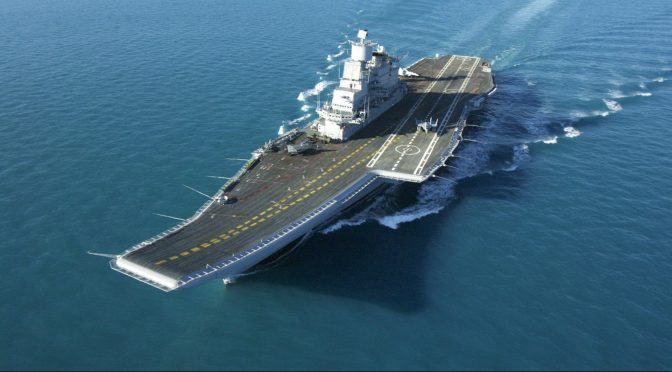
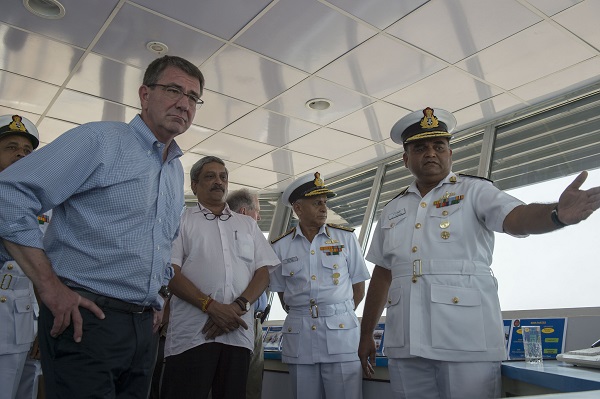
Secretary of Defense Ash Carter speaks with Indian Naval Officers as he tours Indian Naval Station Karwar as part of a visit to the Indian aircraft carrier INS Vikramaditya, April 11, 2016. Carter is visiting India to solidify the rebalance to the Asia-Pacific region.(Photo by Senior Master Sgt. Adrian Cadiz)(Released)
Secretary of Defense Ash Carter speaks with Indian Naval Officers as he tours Indian Naval Station Karwar as part of a visit to the Indian aircraft carrier INS Vikramaditya, April 11, 2016. (Photo by Senior Master Sgt. Adrian Cadiz)(Released)

The LEMOA will simplify replenishment requests by either military at one another’s bases. It would help the American and Indian navies to respond swiftly to non-traditional threats like piracy and terrorism on high seas; humanitarian assistance and disaster relief operations across the Indian Ocean, especially West Asia; and enhance compatibility of personnel and systems. India’s concerns will be taken into consideration to include provisions that deny supply of armament as well as absolve it from supporting US military operations against friendly countries.

This multi-vectored maritime relationship aims to enhance India’s capacity for fulfilling its role as the net security provider in the Indian Ocean. This is the primary objective and therefore the rebuttal to considering joint patrols with the US in the SCS. India will assume its responsibility for upholding wider regional peace and stability after a careful assessment of its political priorities and relevant capacity commensurate with the dynamics of an emerging multipolar Asia within a multipolar world order.

Vidya Sagar Reddy is a researcher at the Observer Research Foundation, New Delhi.

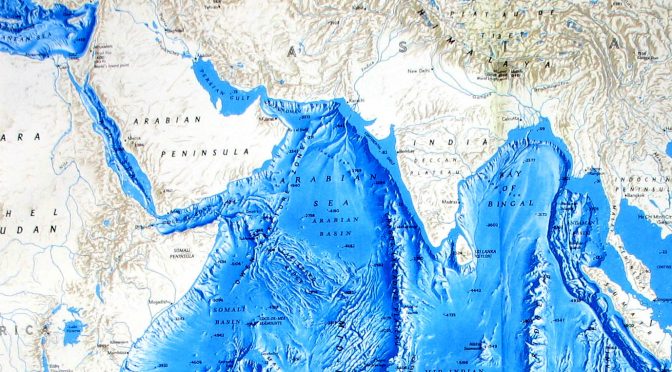
Featured Image: Indian Ocean by National Geographic.