The distributed lethality concept represents a distinct change in Surface Navy operations, one that emphasizes the offense, and one that requires the freedom of action only possible under mission orders. Both place heavy reliance on the Surface Action Group (SAG) having information superior to that of the enemy in order to be hard to find and thus avoid attack and achieve the offensive advantage of surprise. This is enabled in large measure by situational awareness: the warfare commanders’ perception of the tactical situation. It is achieved by the continuous collection, correlation, fusion, assimilation and interpretation of information from force organic systems, and nonorganic national, theater, and Navy systems.
Deconflicting Doctrine
A core element of the distributed lethality concept is that SAG commanders operate under mission orders that allow them the freedom to make tactical decisions, a major change away from the long-standing convention of detailed direction from higher headquarters located ashore or on a CVN with its substantial tactical intelligence decision support capabilities. Consequently, the surface navy has had no driving requirement for the sophisticated Common Tactical Picture (CTP)1 or “plot” capabilities that are now required onboard surface combatants for the situational awareness required for the planning/re-planning, and tactical execution of distributed missions.
Current doctrine regarding the allocation of responsibilities for maintaining the Common Tactical Picture CTP or “plot” is fragmented. In accordance with NWP 3-56, Composite Warfare Doctrine, the Surface Warfare Commander (SUWC), ASW Commander (ASWC), and Air Defense Commander (ADC) are responsible for using all available information to maintain a complete geographic plot for their respective warfare areas. NWP 3-56 also assigns to the Information Operations Warfare Commander (IWC2) responsibility for integrating real time Electronic Surveillance (ES) contact reports with indications,3 and warning4 information. NWP 3-13, Information Operations, assigns the IWC responsibility for achieving and maintaining information superiority; establishing and maintaining the CTP through spectrum awareness; and, for integrating real-time ES contact reports with indications and warning information. Further, NWP 3-56 assigns a Common Tactical Picture Manager (CTPM) responsibility for establishing, maintaining, assuring quality of, and disseminating the fused all-source GENSER CTP. NWP 2-01, Intelligence Support to Naval Operations, describes a concept in which the principal role of intelligence in support of warfare commanders is to characterize the threat and classify all threat targets that may enter the detection range of U.S. or coalition naval forces. It states: “Intelligence correlates and fuses all source data, including intentions, to determine the threat, threat direction, and operational characteristics of the threat platform before the threat platform is detected by own forces.” It further states: “Operational and tactical intelligence support is designed to detect, classify, target, and engage all hostile subsurface threats before they reach maximum effective weapons release range.”
When viewed together, NWP 3-56, NWP 3-13, and NWP 2-01 suggest that the Navy needs a concept and coherent allocation of responsibilities for developing and maintaining the CTP, especially as it applies to a SAG operating in EMCON while executing mission orders.
Impetus for Change
Changes to current Navy doctrine to accommodate the concept of distributed lethality will be driven by at least two factors. First, to achieve the surprise that is essential for distributed lethality mission success, the SAG will have to operate in RF silence to deny the enemy the opportunity to detect the force with passive RF sensors, one of the primary methods for surveillance of large areas to gain initial location and classification of detected units. All communications to the SAG from supporting entities will have to be routed to and disseminated via narrow and wideband satellite broadcasts such as CIBS-M and GBS. In effect, the SAG gets all the shore support while remaining hard to find thereby minimizing risk of attack.
Second, the surface navy will have to develop and field intra-SAG communications that are sufficient to command and control the force and maintain the CTP but covert enough to minimize the probability of detection and location by the enemy.
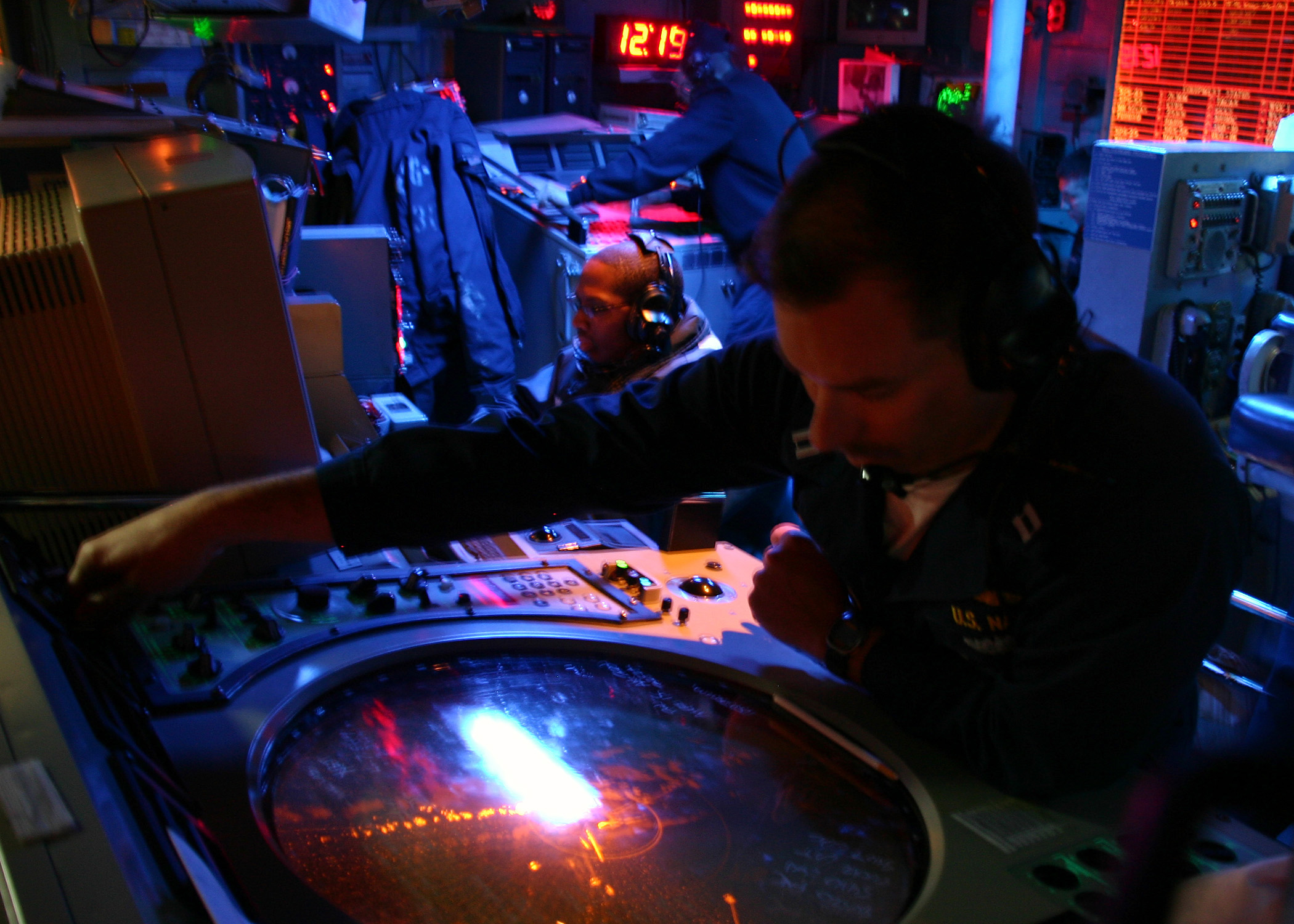
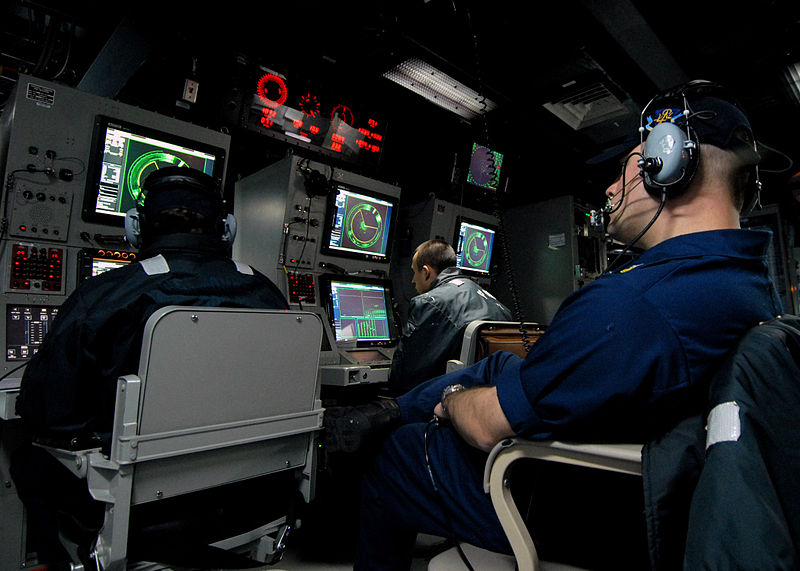
PACIFIC OCEAN (June 5, 2008) Chief Engineer, Lt. Dave Ryan, evaluates a tactical image in the combat information center of the guided-missile frigate USS Kauffman (FFG 59) during an anti-submarine warfare (ASW) exercise with the Chilean navy. (U.S. Navy photo by Mass Communication Specialist 2nd Class J.T. Bolestridge)
Third, surface combatants have neither the space nor the systems to support the large intelligence presence such as that found on a CVN or other big deck. This suggests that when in EMCON, the SAG will be more heavily dependent on tactical intelligence provided from shore. Some sensor information such as combat information5 cannot be processed ashore into tactical intelligence in time to meet SAG requirements. Therefore, SAG combatants will require dramatically improved capabilities for automatically integrating tactical intelligence, combat information, and organic force sensor information. Given the criticality of time in tactical decision making, automated information correlation and fusion capabilities are essential. However, their output is never perfect or complete so the crew will have to have the skills, knowledge, and abilities to analyze and resolve ambiguities and conflicts.
Conclusion
Distributed lethality depends on being hard to find and securing the element of surprise enabled by superior situational awareness. With the adoption of the distributed lethality concept, it is essential that the concept and doctrine for establishing and maintaining the CTP be reviewed and optimized to assure warfare commanders enjoy the tactical advantage of decision superiority over an adversary. The clear assignment to the shore intelligence structure of responsibility for the accuracy, completeness, and timeliness of tactical intelligence support to the SAG would result in renewed focus on tactical requirements and renewed appreciation of the critical importance of the clock at the tactical level. Moreover, it would drive a new hard- edged fleet focus on the ability of shore-based tactical intelligence support elements to provide this mission-essential support. The clarification of responsibilities onboard ship for maintaining the CTP would serve to focus attention on the ability of those responsible to maintain situation awareness that comports with the realities of the operating environment. As shortfalls and opportunities are identified, the fleet would refine its requirements for the manning, training, and equipping of surface combatants to achieve the information superiority that is the key to mission success.
As stated by VADM Rowden in the January 2017 Proceedings: “The force we send forward to control the seas must be powerful, hard to find, hard to kill, and lethal. These are the bedrock tenets of distributed lethality…” The concept has gained wide support in the surface navy and is being adopted as a broader Navy operating concept. Rapid progress is being made by the surface navy under the leadership of the surface warfare Type Commands and OPNAV N96. Changes to doctrine to accommodate command control of operations on mission orders are being investigated. Surface forces are being up-gunned to be more lethal. Surface Warfare Officers are being trained and developed as warfare experts for air, surface, and ASW at the Naval Surface and Mine Warfighting Development Center. This beehive of activity is resulting in rapid progress in all warfare areas except for Information Operations.
Progress in this fourth foundational warfare area remains in limbo, owed in large measure to unaddressed OPNAV and Type Command organizational relationships and responsibilities for manning, training, readiness, equipping and modernization of the fleet for the planning and conduct of Information Operations. In the absence of progress in this warfare area the success of the distributed lethality is at risk against any near-peer nation with a sophisticated ISR capability.
Richard Mosier is a former naval aviator, intelligence analyst at ONI, OSD/DIA SES 4, and systems engineer specializing in Information Warfare. The views express herein are solely those of the author.
Endnotes
1. Common Tactical Picture — An accurate and complete display of relevant tactical data that integrates tactical information from the multi-tactical data link network, ground network, intelligence network, and sensor networks. Also called CTP. (JP 3-01)
2. IWC in NWP 3-56, NWP 3-13, and as used in this article is the Navy’s abbreviation for Information Operations Warfare Commander. It shouldn’t be confused with the Navy’s use of the same abbreviation to denote the Navy’s Information Warfare Community.
3. Indications — In intelligence usage, information in various degrees of evaluation, all of which bear on the intention of a potential enemy to adopt or reject a course of action. (JP 1-02)
4. Warning intelligence — Those intelligence activities intended to detect and report time sensitive intelligence information on foreign developments that forewarn of hostile actions or intention against United States entities, partners, or interests (JP 1-02)
5. Combat Information — Unevaluated data, gathered by or provided directly to the tactical commander which, due to its highly perishable nature or the criticality of the situation, cannot be processed into tactical intelligence in time to satisfy the user’s tactical intelligence requirements. (JP 2-01)
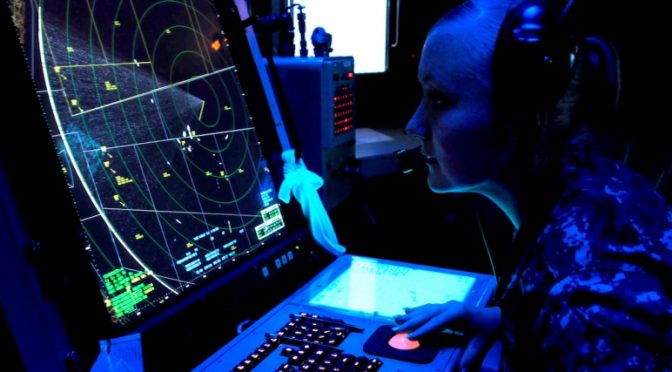
Featured Image: ATLANTIC OCEAN (June 27, 2012) Air-Traffic Controller 2nd Class Karina Reid operates the SPN-43 air search radar system while standing approach control aboard the amphibious assault ship USS Wasp (LHD 1). (U.S. Navy photo by Mass Communication Specialist Petty Officer 2nd Class Gretchen M. Albrecht/Released)
The Littoral Combat Ship (LCS) program has been subjected to heavy scrutiny, and much of it is justified. What is getting lost in the discourse is the real capability that LCS provides to the fleet. From my perspective as an active duty service member who may be stationed on an LCS in the future, I’m more interested in exploring how we can employ LCS to utilize its strengths, even as we seek to improve them. Regardless of the program’s setbacks, LCS is in the Fleet today, getting underway, and deploying overseas. Under the operational concept of distributed lethality, LCS both fills a void and serves as an asset to a distributed and lethal surface force in terms of capacity and capability.
Capacity, Flexibility, Lethality
The original Concept of Operations written by Naval Warfare Development Command in February 2003 described LCS as a forward-deployed, theater-based component of a distributed force that can execute missions in anti-submarine warfare, surface warfare, and mine warfare in the littorals. This concept still reflects the Navy’s needs today. We urgently need small surface combatants to replace the aging Avenger-class mine countermeasure ships and Cyclone-class patrol craft, as well as the decommissioned Oliver Hazard Perry-class frigates. Capacity matters, and “sometimes, capacity is a capability” in its own right. We need gray hulls to fulfill the missions of the old frigates, minesweepers and patrol craft, and until a plan is introduced for the next small surface combatant, LCS will fill these widening gaps.
LCS was also envisioned as a platform for “mobility” related missions like support for Special Operations Forces, maritime interception operations, force protection, humanitarian assistance, logistics, medical support, and non-combatant evacuation operations. Assigning these missions to LCS frees up multimission destroyers and cruisers for high-end combat operations. We’ve already seen how LCS can support fleet objectives during the deployments of USS FREEDOM (LCS 1) and USS FORT WORTH (LCS 3). Both ships supported theater security operations and international partnerships with Pacific nations through participation in the Cooperation Afloat Readiness and Training (CARAT) exercise series. USS FREEDOM conducted humanitarian and disaster response operations following the typhoon in the Philippines, and USS FORT WORTH conducted search and rescue operations for AirAsia flight QZ8501.The forward deployment of the ships to Singapore allowed for rapid response to real-world events, while allowing large surface combatants in the region to remain on station for their own tasking. With an 11-meter rigid hull inflatable boat onboard, LCS is well-suited to conduct visit, board, search, and seizure missions in Southeast Asia to combat piracy and protect sea lanes.
The presence of more ships on station doesn’t just allow us to fulfill more mission objectives; capacity also enables us to execute distributed lethality for offensive sea control. One of the goals of distributed lethality is to distribute offensive capability geographically. When there are physically more targets to worry about, that complicates an enemy’s ability to target our force. It also allows us to hold the enemy’s assets at risk from more attack angles.
The other goals of distributed lethality are to increase offensive lethality and enhance defensive capability. The Fleet can make the LCS a greater offensive threat by adding an over-the-horizon missile that can use targeting data transmitted to the ship from other combatants or unmanned systems. In terms of defensive capability, LCS wasn’t designed to stand and fight through a protracted battle. Instead, the Navy can increase the survivability of LCS by reducing its vulnerability through enhancements to its electronic warfare suite and countermeasure systems.
LCS may not be as survivable as a guided missile destroyer in terms of its ability to take a missile hit and keep fighting, but it has more defensive capability than the platforms it is designed to replace. With a maximum speed of over 40 knots, LCS is more maneuverable than the mine countermeasure ships (max speed 14 kts), patrol craft (max speed 35 kts), and the frigates (30 kts) it is replacing in the fleet, as well as more protective firepower with the installation of Rolling Airframe Missile for surface-to-air point defense. Until a plan has been established for future surface combatants, we need to continue building LCS as “the original warfighting role envisioned for the LCS remains both valid and vital.”
New Possibilities
LCS already has the capability to serve as a launch platform for MH-60R helicopters and MQ-8B FireScout drones to add air assets to the fight for antisubmarine warfare and surface warfare operations. LCS even exceeds the capability of some DDGs in this regard, since the original LCS design was modified to accommodate a permanent air detachment and Flight I DDGs can only launch and recover air assets.
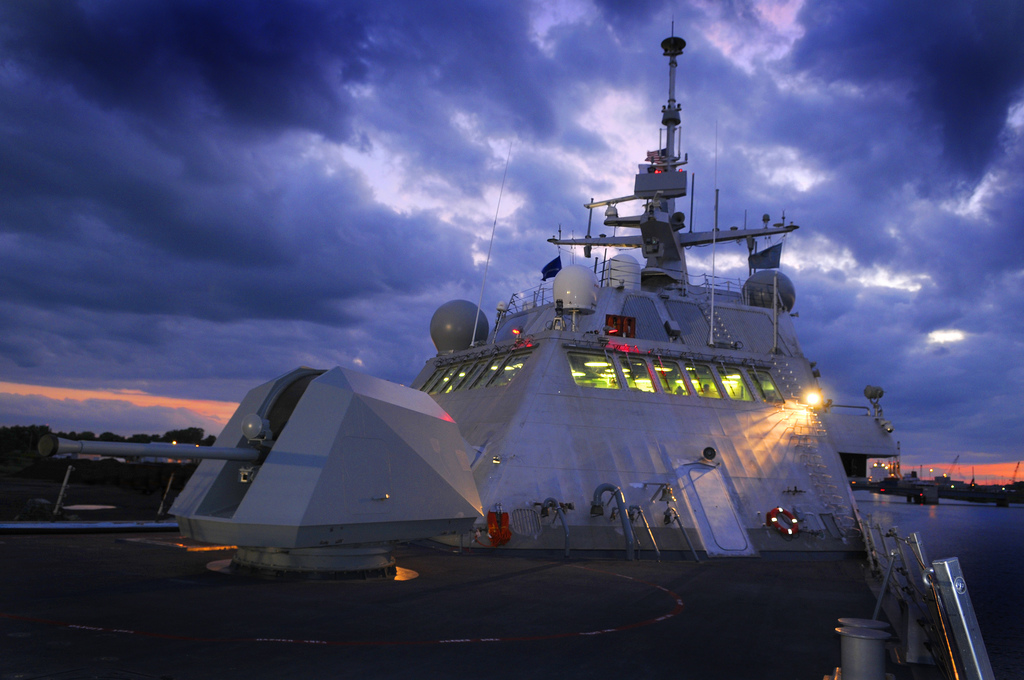
USS Freedom (Lockheed Martin photo)
We have a few more years to wait before the rest of the undersea warfare capabilities of LCS will be operational, but the potential for surface ship antisubmarine warfare is substantial. A sonar suite comprised of a multifunction towed array and variable depth sonar will greatly expand the ability of the surface force to strategically employ sensors in a way that exploits the acoustic environment of the undersea domain. LCS ships with the surface module installed will soon have the capability to launch Longbow Hellfire surface-to-surface missiles. The mine warfare module, when complete, will provide LCS with full spectrum mine warfare capabilities so that they can replace the Avenger class MCMs, which are approaching the end of their service life. Through LCS, we will be adding a depth to our surface ship antisubmarine warfare capability, adding offensive surface weapons to enable sea control, and enhancing our minehunting and minesweeping suite. In 2019, construction will begin on the modified-LCS frigates, which will have even more robust changes to the original LCS design to make the platform more lethal and survivable.
The light weight and small size of LCS also has tactical application in specific geographic regions that limit the presence of foreign warships by tonnage. Where Arleigh Burke-class destroyers weigh 8,230 to 9,700 tons, the variants of LCS weigh in from 3,200 to 3,450 tons. This gives us a lot more flexibility to project power in areas like the Black Sea, where aggregate tonnage for warships from foreign countries is limited to 30,000 tons. True to its name, LCS can operate much more easily in the littorals with a draft of about 14-15 feet, compared to roughly 31 feet for DDGs. These characteristics will also aid LCS’s performance in the Arabian Gulf and in the Pacific.
Of course, any LCS critic might say that all this capability and potential can only be realized if the ships’ engineering plants are sound. My objective here is not to deny the engineering issues—they get plenty of press attention on their own—but to highlight why we’ll lose more as a Navy in cutting the program than by taking action to resolve program issues. It’s worth mentioning that the spotlight on LCS is particularly bright. LCS is not the only ship class that experiences engineering casualties, but LCS casualties are much more heavily reported in the news than casualties that occur on more established ship classes.
Conclusion
LCS was designed as one part of a “dispersed, netted, and operationally agile fleet,”and that’s exactly what we need in the fleet today to build operational distributed lethality to enable sea control. Certainly, we need to address the current engineering concerns with LCS in order to project these capabilities. To fully realize the potential of the LCS program, Congress must continue to fund LCS, and Navy leaders must continue to support the program with appropriate manning, training and equipment.
LT Nicole Uchida contributed to this article.
LT Kaitlin Smith is a Surface Warfare Officer stationed on the OPNAV Staff. The opinions and views expressed in this post are hers alone and are presented in her personal capacity. They do not necessarily represent the views of the Navy or the Department of Defense.
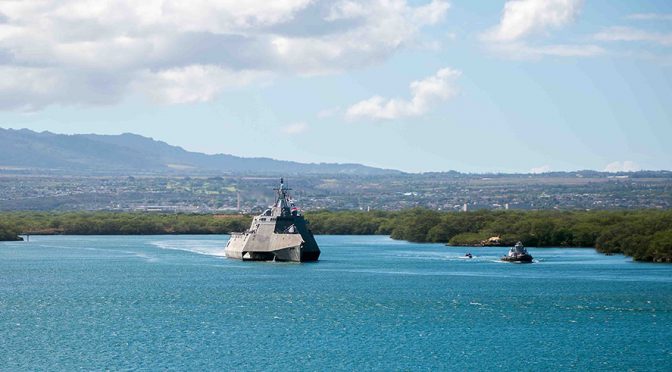
Featured Image: PEARL HARBOR (July 12, 2016) – The littoral combat ship USS Coronado (LCS 4) transits the waters of Pearl Harbor during RIMPAC 2016. (U.S. Navy photo by MC2 Ryan J. Batchelder/Released)
The ushering in of a new administration on January 20th has many wondering what campaign promises will materialize and meaningfully affect the U.S. Navy. Is it reasonable to expect movement toward a “350-ship Navy” and, if so, what might such a Navy look like? Where can increased military spending be focused to have the most immediate impact on the United States’ readiness to address near peer competitors?
To answer these questions, we invited one of the United States’ foremost experts on American Seapower, the Hudson Institute’s Bryan McGrath, on this episode of Sea Control. Hosts Sally DeBoer and Mike also talk with Mr. McGrath about measures to increase force lethality, the newly established N50Z office and efforts to let strategy inform the budget, and burgeoning threats in the 21st Century.
Listeners interested in attending Mr. McGrath’s American Seapower Speaking Tour can find more information here.
Read on, or listen to the audio below. This interview has been edited for clarity and length.
SD: The first topic we’d like to discuss with you is fleet design. The forthcoming Trump Administration has, as part of its campaign promise, vowed to increase military spending and indeed establish a 350-ship Navy (as discussed by Steve Wills in his fantastic recent CIMSEC Article: A New Administration, A New Maritime Strategy). Due to sequestration and decreased funding for platforms in general over the past decade or so, as well as the Reagan-era platforms reaching the end of their service life, we are coming from behind. Where should money be spent to have the most immediate impact?
BM: With respect to the 350-ship Navy, I think the thing to keep in mind is that they have wisely not established a timeline for when they want to reach 350 ships. I’ve done a lot of work over the last few years looking at how the industrial base could flex to meet a larger navy and it seems to me that getting to 350 would be beyond anything but an emergency shipbuilding plan during two terms. What they ought to do is concentrate on getting us on a path to 350, articulate what 350 ships looks like, and create a sense of trust in the congress that the Navy can build ships cheaply and efficiently.
One way to get started on this, and obviously Steve Wills is one of the most articulate defenders of the LCS, is to build more LCSs relatively quickly. I have written an article on this for the Hudson Institute Center for American Seapower where I recommend building two ships per yard in ‘17 and ‘18, and then moving to the frigate design and conducting a competition where the winning yard would build the frigate starting in ‘19 and the losing yard would continue to build LCS through 25. These would be the LCS-plus that the Navy is going to bid on in ‘17 that will have surface-to-surface missiles and air search radar, from what I can tell. This would be one way to produce 12-15 small surface combatants between now and ‘25. That keeps those two shipyards in business.
I think industrial base concerns are important and I recently listened to a hearing on LCS where people were making fun of or dismissing industrial base concerns. I think that’s strategically inept. If we are going to build and maintain the world’s finest navy we have to have a strong maritime industrial base. Plus, the fact is that Wisconsin, where one of the ships is built, was part of breaking down that blue wall and helped elect Mr. Trump. Alabama, where the other ships are built, is the home state of his attorney general. There are political realities here.
The other political reality is Sen. McCain and his desire to move away from the LCS ASAP. I think the Navy could go a long way toward meeting Sen. McCain’s concerns if they articulate within the next year or so what the follow-on frigate is going to be and that it will acquire it at the latest by FY26. There’s a hole in the small surface combatant biplane right now during 4 years in the late 20s that we need to fill and keep building ships.
You asked how to get started – hot production lines can build LCS, and build more oilers. We need oilers and need to rebuild the logistics fleet which is far smaller than it should be. We should also consider ship-to-shore connectors, ocean-going tugs, and understand there are a bunch of ships that can be built quickly, on budget, and show that we’re going forward.
Importantly, in ’17 and ’18, and even more important than building ships, is plugging the holes in the maintenance and modernization of the entire fleet, and not just ships but depot level maintenance on aircraft as well. We are at the ragged edge of hollowness right now and if we decide to start building ships willy-nilly on a base of shifting sands when we haven’t addressed modernization issues then we are making a mistake. I think we can build ships and accomplish this, and plus-up personnel accounts so that we can move and train people. If we’re going to build the Navy 30% bigger then costs are going to be incurred that aren’t bound up in shipbuilding.
SD: To expand on this, what are the major obstacles you see to the 350-ship Navy and to building toward a bigger navy or putting a nation on that road?
BM: I think the biggest issue is that the president-elect made a 350-ship Navy an article of his campaign, he won the election, and navies never grow unless the president is behind them. The first thing is the president has to stay behind that goal. If indeed he does, it is likely to happen. It’s not guaranteed because his bankers on Capitol Hill have to write the checks. The one thing that I haven’t heard yet, but I imagine they’re hard at work on a story to articulate why we need 350 ships, where, why, how will they operate, to what extent, against whom and what threats? The thing that many people don’t realize about the 600-ship Navy in the Reagan era is that that number was rattling around for a while in the late 70s and it was an article of the election in 1980, but it wasn’t until Reagan came into office and John Lehman was able to tie the emerging thinking of some really visionary admirals in the pacific fleet to that number. You need to have a story. Congress won’t appropriate money until they know what the plan is and why. That’s the biggest problem.
SD: Speaking of a narrative, it seems to me as a non-expert, that the Republican party has moved toward the idea of non-intervention and Mr. Trump said yesterday (and I know there’s a difference between things said in promotion and things that actually happen) that there would be focus on non-intervention and just defeating ISIS as far as U.S. military policy goes. Does that indicate to you anything about his commitment to the Navy?
BM: I’m not sure I would say the Republican party has gone in that direction, but the president-elect of the U.S. and his support base have moved in that direction. I think there is a serious tension within the GOP. I am one of the other guys, I think about American exceptionalism and think the world is better with more America in it. The road to perdition is paved by trade wars and moving away from a global trade posture. So, the problem or the difficulty that I see in making the case for a 350-ship Navy is in the “to do what?” question. If you are going to lean on allies to pick up more slack and if Russia is not seen as a major threat, then a 308-ship Navy is probably sufficient, the one that is there now. In order to justify 350 ships you have to have a more global internationalist outlook, so there is some tension there. I think they can thread the needle, but it is going to be hard.
MK: I would like to bring up the decline in attack submarine numbers throughout the early 2020s. There are ways to figure that out, like building 2 Virginia-class SSNs and one Columbia-class SSBN-X a year, but that is going to have to get done and paid for or we won’t have that capability. The attack submarine force will sharply decline right about the time the Chinese undersea threat becomes more pronounced. Right now, having dry-dock space to maintain the fleet that exists is at a sheer premium if we’re going to talk about plussing up the fleet and there will need to be an increase in shipyard capacity for maintaining that fleet.
BM: This is a national strategic issue. The Navy and the U.S. military should defend free markets but we don’t have to practice them. There are sound military reasons for excess capacity – excess capacity that you would never maintain if you were running a business – you don’t want excess stock on the shelves. That’s not the way the military works, we need excess capacity so that we can ramp up and have a workforce that can do what you need it to do.
MK: The other thing I would add to that is we sort of, based on some dubious lessons from WWII, think that we can build ourselves out of any deficit at the beginning of a major war. That isn’t the history of WW2, most of the naval conflict was fought with platforms that existed at or programs that were underway in December of 1941. Second, the shipbuilding excess capacity that existed in the country at the time does not exist today. I am not saying that we’re headed for world war, but it’s a worthy intellectual exercise to think about how you would plus that up and recognize the time that it would take to make a massive change in fleet size inside of a strategic challenge would be prohibitive at this point with the complexity of ships that are being built.
BM: It isn’t going to happen. In those days American shipyards were building merchant ships, you could take that commercial capacity and turn it into cannibalized excess shipbuilding, tank, plane capacity, etc. It just doesn’t exist now.
MK: But it certainly does exist in China though!
SD:That’s a great point, and we talked about in an interview with Dr. Andrew Erickson of the Naval War College, who is the editor of the new book Chinese Naval Shipbuilding. Could you speak to the CNO’s recent OPNAV staff reform co-locating the assessment division with the strategy folks in the new N50 office. Reactions have been positive – people like the idea of strategy informing budget. What kinds of substantive changes do you think we can expect from this arrangement and are you generally in favor of it?
BM: Who could not be in favor of it? It’s like ice cream or air. It’s what we have all always wanted in theory, right? Every strategist or would-be strategist wants resources to follow strategy. I think the CNO is making all the right moves and saying all the right things but resources following strategy is hard, really hard. It’s challenging enough to have resources follow strategy when you are utterly in charge of all of the variables – like if you’re running a company and can put internal investments where you want them to go and enter new markets as you want to. The CNO and SECNAV don’t have those luxuries. They have to respond to national tasking and to national strategy, so I think there is great value in the exercise and in the attempt. I look forward to its success – I might not bet on it. I’m going to meet with the N50 people to talk about some of these things and maybe my opinion will change. I am looking forward to it. I do like that some of the folks from N81 are being dragged over there and that there will be a way to assign them or have some folks who are in charge of thinking about how the fight will happen and what will be the desired strategic outcomes pushing them rather than N81 making it up itself, which kind of appears the way it has been done for a long time.
MK: I am also in the wait and see category. I think no matter how good your intentions may be there’s a tendency in large organizations to sort of know the answer going in. I think there’s the potential there that we assign the answer before the answer is given. If we’re told to program to 350 ships we will find something to do with them, rather than try to take a top down approach, which may take longer, given our needs.
BM: I think the CNO is doing something even more intelligent and even more potentially beneficial to the navy than this N81/N50 alignment thing. And that is taking a more architectural look at fleet design and dividing up or thinking about that architecture through domains rather than platforms, and assigning a honcho to each domain who then works with the resource sponsors within that domain to create a program that serves the domain’s ends – threats, networking, weapons, sensors, platforms – in a more holistic and integral way so that you’re able to allocate functionality more efficiently in a domain without thinking about air, surface, and subsurface and other things separately. Think about fighting in that domain in the most efficient way and allocate functionality that makes the most sense. That could be truly revolutionary if it works.
SD: Let’s switch gears. Characterize the fleet’s current effort to increase lethality in terms of conflict with proto-peer competitors. Specifically, we talk about distributed lethality – which we know you’re an expert on – and would like you to speak to the command and control construct that would accompany DL and the kinds of training and experimentation the fleet will undergo to implement it.
BM: So I just gave a talk at the OPNAV staff/CNA Future Strategy Forum at the Navy Memorial. I was on a panel that was called “beyond distributed lethality” and one of the things I said was that it was gratifying to think that DL had become so integrated into thinking that we could now move beyond it. Some of that was tongue in cheek but not all of it.
The subject of my talk was split into two halves. The first was command and control and the second was combat systems. With respect to distributing lethality in the fleet, this includes things like maritime-strike tomahawk missiles, SM-6’s surface mode, OTH missile for LCS and SSC, and also SEWIP bloc 2 and 3. The Virginia Payload Module (VPM) in the submarine force is the granddaddy of DL in my view. Those guys were on that a long time ago and it really affected my thinking. The Navy’s doing a good job of spreading its weapons and that is important because it makes you harder to find, harder to attack, you get to attack the other guy from multiple angles, and you get to hold more of what he values at risk and through more ways.
SINGAPORE (November 30, 2016) USS Coronado (LCS 4) departs Changi Naval Base to conduct sea trials after a maintenance period. Currently on a rotational deployment in support of the Asia-Pacific Rebalance. (U.S. Navy photo by Petty Officer 2nd Class Michaela Garrison/Released)
The command and control of a distributed force is something that bears a lot of thought. The way I look at this is that there is a slider, a continuum, that describes an exquisite peacetime network and comms environment that I refer to as the pre-first shot state of the war environment. This involves very centralized control, very strict ROE – the kind of thing we exist in so we don’t get some guy popping off a shot at the ragged edge of the network starting a war. That requires a very sophisticated network with high confidence in communications. For peacetime operations that’s probably the appropriate manner of Command and Control whether concentrated or distributed. You’re still going to want to have centralized control over weapons employment in that environment.
You move that slider to wartime, “the knife fight in a dark closet,” where you’ve lost a good bit of your SATCOM, probably on HL, LPI/LPD kinds of comms, radio silence. Commanding and controlling those forces is a real challenge but it is something we have to think about in the bright light of peace while we aren’t fighting someone in that kind of environment. We have to be able to maintain as much war fighting capability as we possibly can as you move down the sliding scale toward dark and quiet from light and loud. We have to back up aerial layer networks, tactical receiving of satellites, and aerostats potentially. There’s all kinds of ways to set up networks and temporary networks. But we have to be investing money and thinking about it and imbue our commanders with a very honed sense of mission command and that is – go execute your last orders and oh, by the way, if we lose comms, use your initiative. Go kill people and wreck things.
MK: There’s sort of two ways to solve that. The first is by increasing your sensor payload on whatever you think your smallest unit of action is going to be. There’s a lot of inventive ways to look a little further over the horizon, and in the “knife fight in the dark closet,” the potential of mistakes is going to go up. In my view, I don’t think enough effort is being applied to trying to figure out how we’re going to integrate air assets into DL. I have a couple concerns with that, particularly because in a similar place the reason that Vincennes shot down that Iranian airliner in 1988, a part of it was because she was in the dark and couldn’t get her aviation support fast enough. The alert package launched off of the Forrestal and they burned to get there but they couldn’t get there in time. I think there could be a similar mistake, and in a modern 24-hour news cycle, this would look even more poorly. Look at what the Russians are going through having shot down an airliner. There is a lot of blowback from mistakes like that and so I am a little concerned. I would like to see an increase in sensor payload of those sorts of ships to give them a better look without national-level assets.
BM: There’s an interesting DARPA/Office of Naval Research joint program called TERN. It’s a medium-altitude long endurance UAV that would take off and land on LCS, future FF, DDG, and cruisers. I think that it’s a couple hundred pound payload, 14 hours in the air. It’s just a truck and then you decide what package goes on (comms, IR/ER, radar), so that’s one way to get around that problem. The other thing to think about though is – if we’re in the real knife fight, I should hope that mistakes will be tolerated. If we are in an environment where we’ve lost SATCOM and we’re fighting a first world power –mistakes are going to happen and you have to minimize them but I would hope that there would be some understanding.
MK: The Lusitania sinking by a German U-boat in a war zone, potentially carrying war material, had huge strategic impact. So no I don’t think so and the idea that the entire rest of the world while we and China go at it is probably not reality. So you know, to say nothing of some potential attempt to egg us on to do something. I don’t think that’s the case at all.
BM: Don’t get me wrong, you bring up good points, and your point about the rest of the world is well taken. If the U.S. and the PRC get into a scrap the pressure to end it quickly is going to be immense which has in my view, huge fleet architecture implications. You damn sure better have what’s out there in the fleet be a force that can deny or deter their aggression. If you can’t, their aggression becomes more likely because the probability of success becomes higher. I’m not trying to say we would willy-nilly shoot down airliners, what I am trying to say is that there will be mistakes, incredible mistakes when command and control is taken away, but I don’t know that we necessarily want to use the fear of such a thing to help design our force.
MK: I would generally agree. I am just arguing that the likelihood of mistakes will be lessened and the lethality of your basic unit of combat will be higher with some set of fast moving fixed wing aircraft that can look at OTH targets.
BM: Keep in mind one of the reasons DL is attractive is because you don’t need CAW, or you would need one less, because they’re finite and there’s a finite supply. They can’t be everywhere at once. This is the thing that I tell my aviator friends: in a first-world scrape, that air wing is going to be very busy not just doing strike but doing ASUW, hopefully someday ASW again, certainly doing ISR. I think the CAW is going to be incredibly busy, maybe too busy to provide air cover for a SAG out there alone and unafraid.
MK: I think that’s probably true and possible.
SD: With respect to increasing lethality, are there any initiatives you feel that don’t get enough attention from fleet leadership that could lead to increased lethality?
BM: Everyone gets all excited about lasers. Lasers have been just around the corner for 30 years and I think there are applications, they are coming, they are out there, but it’s not like I think, ‘If we just paid attention we could move it along.’ The technology is moving along at the rate that it can. Railgun? I like the railgun as a concept; I like it quite a bit. I think I like it more than anything in its ASMD role, if you could throw a high energy projectile that blows up and creates a lot of FOD in front of a missile that is a wonderful way to take it out and it’s cheaper than trying to do so with a missile. Again, railgun is moving along, someday we will solve the energy storage problem. Storing the power is the issue, not generating it. I would like to see a supersonic long-range ASM that could be fired from a surface ship or sub, I would like to see that in the inventory, and I am talking 500 miles or so. I’m relatively satisfied with the weapons, weapons programs, and sensors. What I am not satisfied with is the networking, the ISR, and the connective tissue among all the elements. What we don’t have is all the interstitial stuff that helps tie it all together.
MK: I think we’ve made some really good progress toward EW but I am not quite sure we’re there yet or have thought about what it’s going to take to fight in a heavy EW environment, both in EA or some sort of electronic defense and providing the frequency agility that we might need in a very complex EW environment. I agree and I think that the increase in lethality of surface ship ASW systems has really changed a lot of things with the way that you can do ASW. AN/SQQ-89(V)15 is really a change in model for the surface navy and it is a very impressive system.
BM: Great point, the surface fleet needs a weapon that can exploit the detection range of the V15. We need to get something headed out quickly toward that submarine in the 4th or 5th CZ to put it on the defense. Killing subs is hard, scaring them is easy. Bryan Clark has done great work at CSBA that showed we were much more effective in WWII at scaring subs away than killing them.
Speaking of EW, the second half of my discussion at the Future Strategy Forum was about combat systems and I made the case – I didn’t command a ship that long ago (2006), that ship is still in the fleet (USS Bulkley) – the combat system is essentially the same, but the kinetic combat system and the EW combat system were not the same system. They were integrated to some degree, but not fully.
PACIFIC OCEAN (Jan. 26, 2008) Sonar Technician (Surface) 1st Class Mark Osborne supervises Sonar Technician (Surface) 2nd Class Randy Loewen, left, and Sonar Technician (Surface) 3rd Class Roland Stout, right, as they monitor contacts on an AN/SQQ-89V15 Surface Anti Submarine Combat System, aboard the guided missile destroyer USS Momsen (DDG 92). (U.S. Navy photo by Mass Communication Specialist 2nd Class James R. Evans)
We need, at the unit level, to have a single combat system that provides decision makers with automated battle management aids, provide strategies that help you conserve weapons, that tell you the better thing to do here is to jam this missile with this technique rather than shoot it with this missile or this gun – that kind of full integration of hard and soft kill EW with kinetics at the unit level is required. But then we have to take it to the next level and have networked combat systems in a SAG so the SAG can husband its efforts in the most efficient way, which leads you up to the strike group. You can get to a point where you have almost a web-based combat system that degrades gracefully down to the combat system that is in the ship providing end-to-end functionality within the ship – hard kill and soft kill – that can be networked among other units in order to conserve assets. We have to find a way where we are not going Winchester on the first salvo.
BM: First, I have always considered A2/AD to be redundant. A2 and AD are the same thing. It is sea denial – its keeping someone from doing something they wish to do in a chunk of the ocean. So the term itself is redundant. I don’t have any problem with what the CNO did. I think it is reasonable from the standpoint of trying to get people off their fainting couches. People overestimate the “kill zone” that is the Pacific Ocean. It is just not the case, it is looney to think that, but what I think he’s trying to do by eliminating that term is to make sure people understand that we have some tricks up our sleeves and can absorb some of this risk and fight our way in, fight our way out.
MK: I totally agree. He is saying that A2/AD presents it as a fait accompli rather than an aspirational goal is very well taken.
BM: Let’s face it; dealing with OTH radar – OTH radar has different characteristics at night and day. Sun spots, weather comes into play. What’s really needed is the ability in real time to heat map adversary ISR. We have to be able to see where the weaknesses and seams are and that’s where you go project power and do strike, then get the hell out and go do the next one. We can do that, we just have to think our way though it.
SD: I wanted to mention your American Seapower speaking tour. Can you tell our audience what that means, what you’re doing, and how they can attend?
BM: I think we haven’t been doing a good job of telling the American people the value of investing in their Navy and what the payoff is. My speaking tour is targeted to 23 different Rotary Clubs around Maryland. I have done 12 so far and I talk for 20 minutes and answer questions with a bunch of people who don’t ‘get’ the Navy. I am going to the far western edge of Maryland next week, a town called Oakland, and I’m going to talk to people about seapower. It’s a result of my frustration and my effort to try to do some good.
SD: I want to thank you for your time today, it was a true honor to have you on the show. Any last comments before we sign off?
BM: I love what you guys do, keep it up!
SD: Thank you very much, sir. Thank you also to our listeners and have a great holiday season.
Sally DeBoer is the President of CIMSEC for 2016-2017. The views of the guests are theirs alone and do not represent the stance of any U.S. government department or agency.
Vice Admiral Tom Rowden, Commander, Naval Surface Forces, spoke with CIMSEC about the future of surface warfare and how the surface fleet is supporting the Chief of Naval Operations’ Design for Maintaining Maritime Superiority. In particular, he discussed the ongoing development of the distributed lethality concept, how the surface warfare enterprise is evolving, and what the recently commissioned USS Zumwalt means for the future of the surface navy. This interview has been edited for length and clarity.
You are leading an effort to turn the surface navy into a more distributed force. What efforts have to be synchronized across the surface warfare enterprise to foment this transformation?
As we focus on distributed lethality I think the Distributed Lethality Task Force (DLTF) has done a phenomenal job of directing us in four areas. The first is tactics, and those tactics are focused on winning and sustaining sea control. The second is talent, and I think that is all about attracting and retaining our very best and raising the quality of performance across the force. The third is training. That’s really advanced tactical training and the development of this warrior ethos through a number of centers of excellence that we have in integrated air and missile defense, antisurface warfare, antisubmarine warfare, and antimine warfare. Finally, there’s tools, which entails offensive lethality across the board in the ships that we operate and defensive resiliency in those same ships. Tactics, talent, training, and tools, that’s really what we are focused on.
This year, three destroyers deployed as a Pacific Surface Action Group as a part of the distributed lethality concept’s development. What was learned from this deployment and what further plans do you have for refining and testing the concept?
The deployment is ongoing and we are still assessing the lessons learned. We certainly are in the process of learning about operations in the western pacific and what it means for distributed lethality and sea control. The thing I keep in mind is that when you have the opportunity to combine the lethality of three ships operating in a surface action group, the whole becomes much greater than the sum of the parts. As we look to send a PACSAG across the ocean, how do we think differently about the command and control of those ships and the utilization of their capabilities? What do we project for future surface action groups?
One of the things we are looking into is what we refer to as an upgunned ESG, which is taking a surface action group and putting it under the tactical control of an Expeditionary Strike Group that is operating forward, perhaps one with joint strike fighters. How does that tool look in the commander’s toolbox and how can we utilize that? There are a lot of opportunities to learn from the PACSAG. But as we deploy our forces, can we think differently about our independent deployers and moving them into surface action groups, providing them with a command element, and then issuing specific tasking or things to learn about how to operate those ships in a group. I think this holds great promise for the future.
What institutions are playing a key role in the development of distributed lethality and how are they contributing?
There’s a lot going on across the force. It comes back to Tactics, Talent, Training, and Tools. The Naval Surface and Mine Warfare Development Center (SMWDC) plays a big role in a lot of things we are working on. They are singled up on not only our tactics, but our training and talent as well with some influence in our tools piece, but really those three areas. On the training side of the house, I would also say the numbered fleets and certainly the Afloat Training Groups are helping with their ability to get the ships trained up.
Other folks that are contributing significantly to the development of our tactics are the numbered fleets with the large exercises we are executing such as RIMPAC. On the talent side of the house, in addition to SMWDC and the warfare tactics instructors they are developing, we are working closely with PERS41 in order to make sure from a leadership perspective that we are taking care of and properly progressing the young men and women that are coming into the surface force.
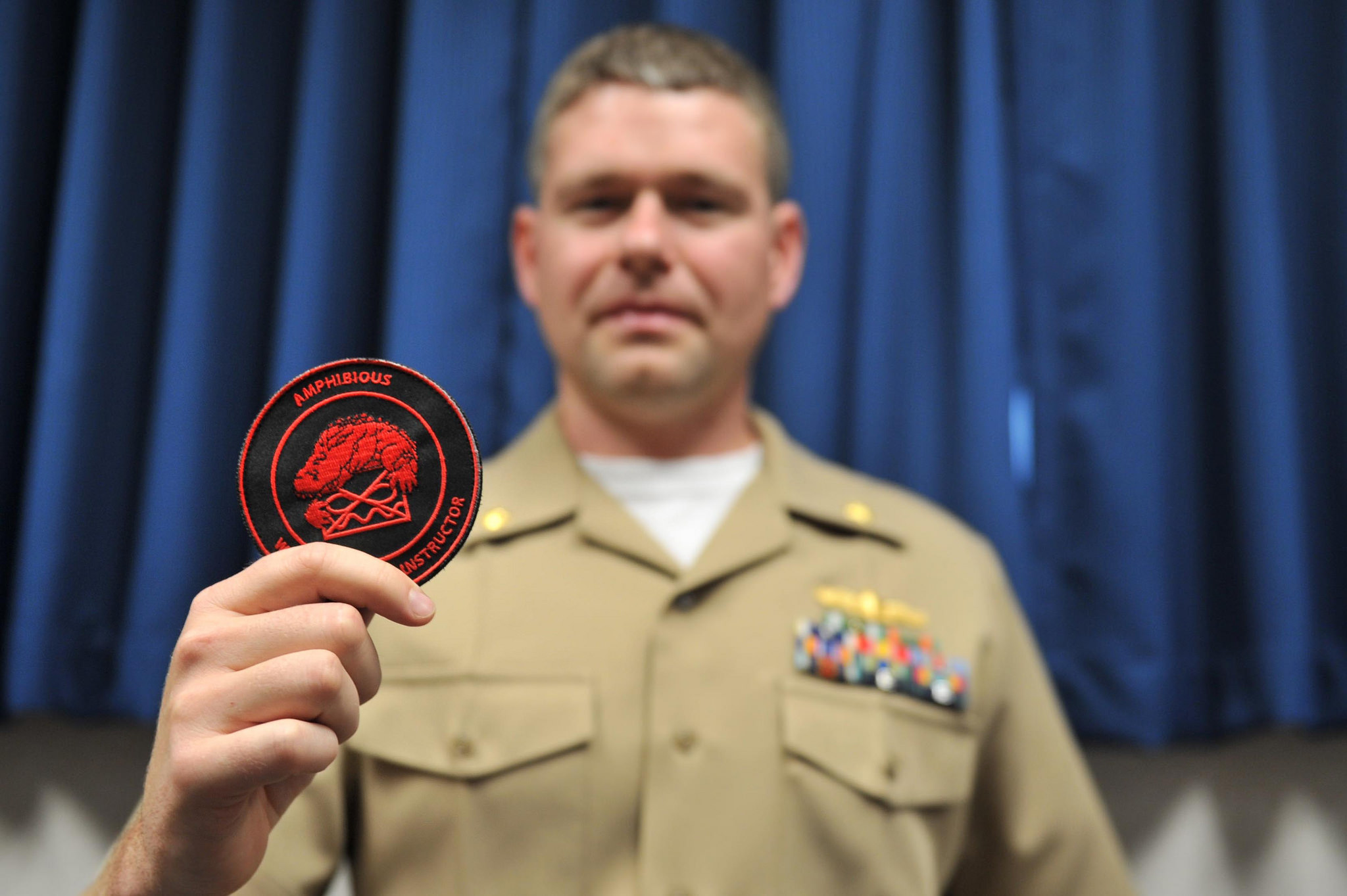
VIRGINIA BEACH, Va. (May 26, 2016) Lt. Cmdr. Dirk Sonnenberg, a graduate of Naval Surface and Mine Warfighting Development Center’s (SMWDC) Amphibious Warfare Tactics Instructor (WTI) course and winner of the course’s Iwo Jima Leadership Award, showcases the patch he and his classmates received upon graduating from the 14-week course. (U.S. Navy photo by Mass Communication Specialist 2nd Class Jamie V)
Finally, the OPNAV staff N96 and the requirements and resource folks working for RADM Boxall, Naval Research Labs, NAVSEA, and NAVAIR are contributing greatly to the “tools” concept.
With respect to the analysis we are executing, there are several significant organizations within the Naval Postgraduate School and the Naval War College that are helping us.
How do communities outside of the surface warfare enterprise such as submarines, aviation, information warfare, and others fit into distributed lethality?
The term was kind of born with the surface force and in some of the conversations we were having back in Washington D.C. when I was working the resource side for the CNO. The concepts applied not only to other communities but across the naval force and the joint force.
Truth be told we are already moving in this direction. The retirement of the SSGNs led the submariners to develop the Virginia payload module, and I think it is going to be a significant asset as we bring it online. The networking capabilities of the F35 creates airborne distributed target networks, and with the F35B coming to our bigdeck amphibs, that’s a tremendous asset we can leverage for sea control and also bring the Marine Corps in on executing the sea control mission.
We certainly are hearing more and more about operating in a more distributed manner with it being referred to as “distributed maritime operations,” which I think is an offshoot of the concept and organizing principle of distributed lethality. I think it stretches across the fleet and the joint force as well.
CIMSEC has launched several topic weeks on distributed lethality, and two in partnership with the Distributed Lethality Task Force. How have these writings contributed to the concept’s development?
We really appreciate all of CIMSEC’s efforts to raise awareness on distributed lethality and to encourage a broad spectrum of people to think about how best to improve our Navy. I think that’s critically important. It is also important to think about how we advance the distributed lethality concept from the conceptual phase into the operational phase. I think the intellectual opportunities CIMSEC provides for a larger group of thinkers is vital, and especially for our junior officers. The JOs I get to interact with on the waterfront– what a talented and excited group of young folks. Any opportunity that we can take to leverage their thoughts, enthusiasm, and professionalism seriously raises the level of discourse and can only add to the discussion.
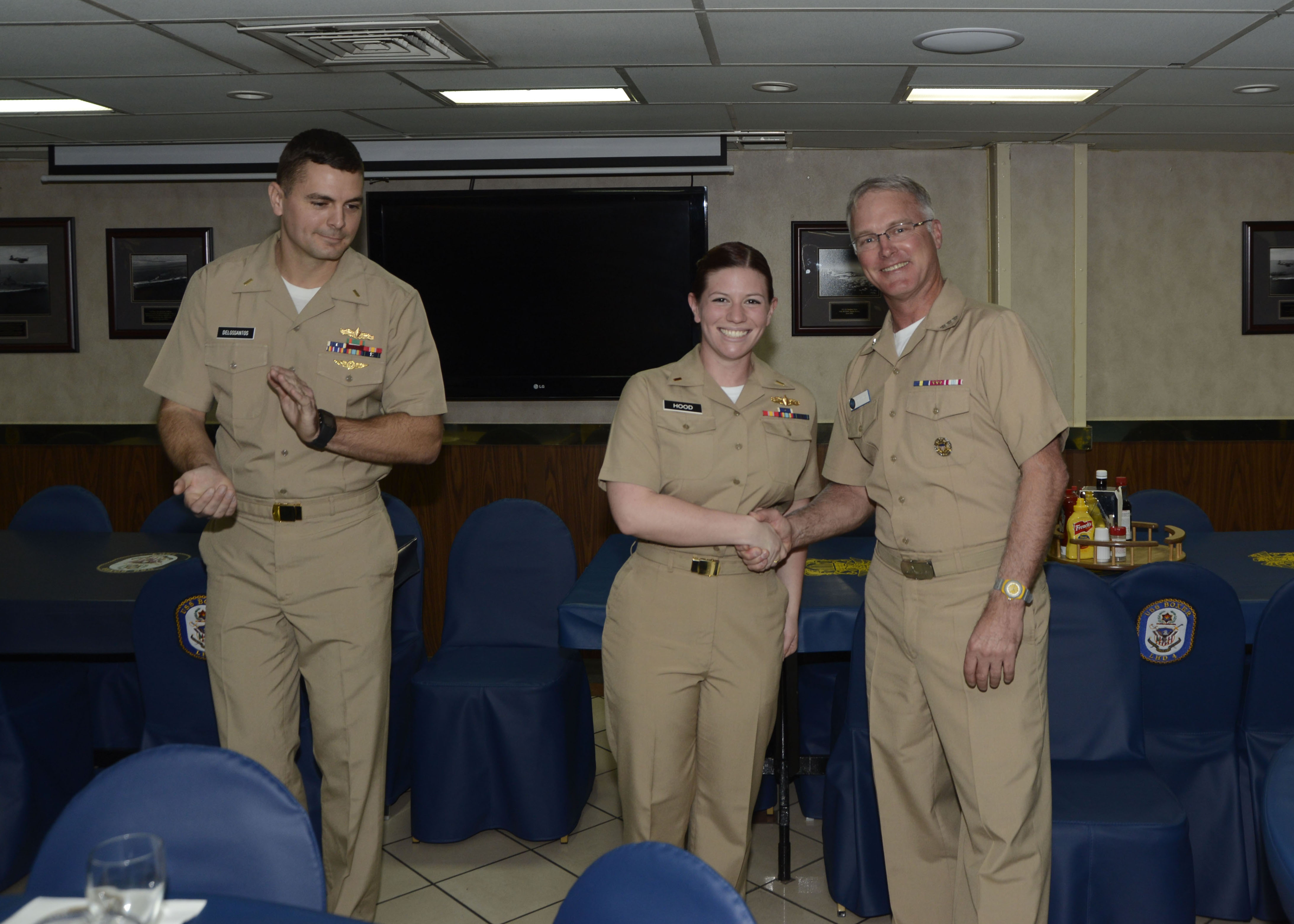
SAN DIEGO (Feb. 9, 2015) – Ens. Lauren Hood, Operations Intelligence Division Officer for the amphibious assault ship USS Boxer (LHD 4) is awarded her Surface Warfare Officer pin by Vice Adm. Thomas S. Rowden, Commander, Naval Surface Forces, in Boxer’s wardroom. (U.S. Navy photo by Mass Communication Specialist 2nd Class Briana Taylor/Released)
Where we are deriving a ton of benefit is from thinking about some of the enablers for distributed lethality. Command and Control, electronic warfare, cryptologic operations, and unmanned vehicle integration are things that are not necessarily touched by surface warfare, but we have the opportunity to reach across a broader spectrum and bring them in. I think that’s vital, and I appreciate CIMSEC’s efforts there.
Distributed lethality is not just about offensive weapons. It is about presenting an adversary with a difficult set of operational problems. Our robust C2, the facets of electronic maneuver warfare, distributed agile logistics, all of that is necessary. All of that has been featured in your forums, and that’s really important for us.
Glad to hear it, sir, thank you. Many have raised the point that more authority should be delegated to more junior commanders in order to truly enable distributed lethality. What is your vision for the command and control of a distributed force?
I envision a scalable C2 structure, and starting with a theoretical limit of perfect sensing and perfect networking. A fleet maritime operations center is capable of centralized planning and decentralized executing of fleet operations, which certainly we’ve seen before. On the other end of the scale, I see distributed operations in a mission command, comms-denied environment. One in which our commanding officers have already practiced, and where they feel confident in the employment of their weapons systems in the pursuit of the last order they received from their commander, all the while exercising the initiative required to exploit the tactical advantage wherever it is presented. That’s really what it is all about.
A week and a half ago you spoke at the USS Zumwalt commissioning ceremony, and in your remarks you stated “She builds upon more than two centuries of fighting spirit and innovation.” What will be your immediate priorities for the Zumwalt when she arrives in San Diego, and what does the Zumwalt tell us about the future of the surface navy?
I often think about what an exciting time it is not only to be a part of our Navy, but especially a part of our surface navy. We’ve got new ships, new classes of ships, and new concepts. We are working hard to recruit and retain the most talented men and women this nation has to offer, and we are working hard to improve our tactics, our training, and our procedures.
With that as a backdrop, we are really looking forward to getting her out here. We’ve got to get her through post delivery availability, through combat systems activation and testing, and to an initial operational capability. The priority is to do everything I can to give Captain Kirk the time to train his crew across the broad spectrum with which we will be able to apply this ship.
For the future of our Navy, I think Zumwalt points to some very meaningful directions. The first I think of is stealth. We specifically designed that ship to significantly reduce its radar cross-section. How can we utilize that in future operations, how we can think differently about the utility of the ship in those operations, and how might we take that knowledge and leverage that into future ship classes that we build?
On size, she is certainly larger than a DDG, but with that increased size comes increased opportunity. Just look at the vertical launch system alone. She has the ability to take much larger missiles into her MK57 VLS than we have in the MK41 VLS. Her computing power, firepower, that huge flight deck, the new undersea warfare systems, we are going to leverage all of that. The power that ship generates — 78 megawatts of power — is more power than we have generated on any other surface ship. How do we utilize and leverage that power for future weapons systems, perhaps directed energy or railguns?
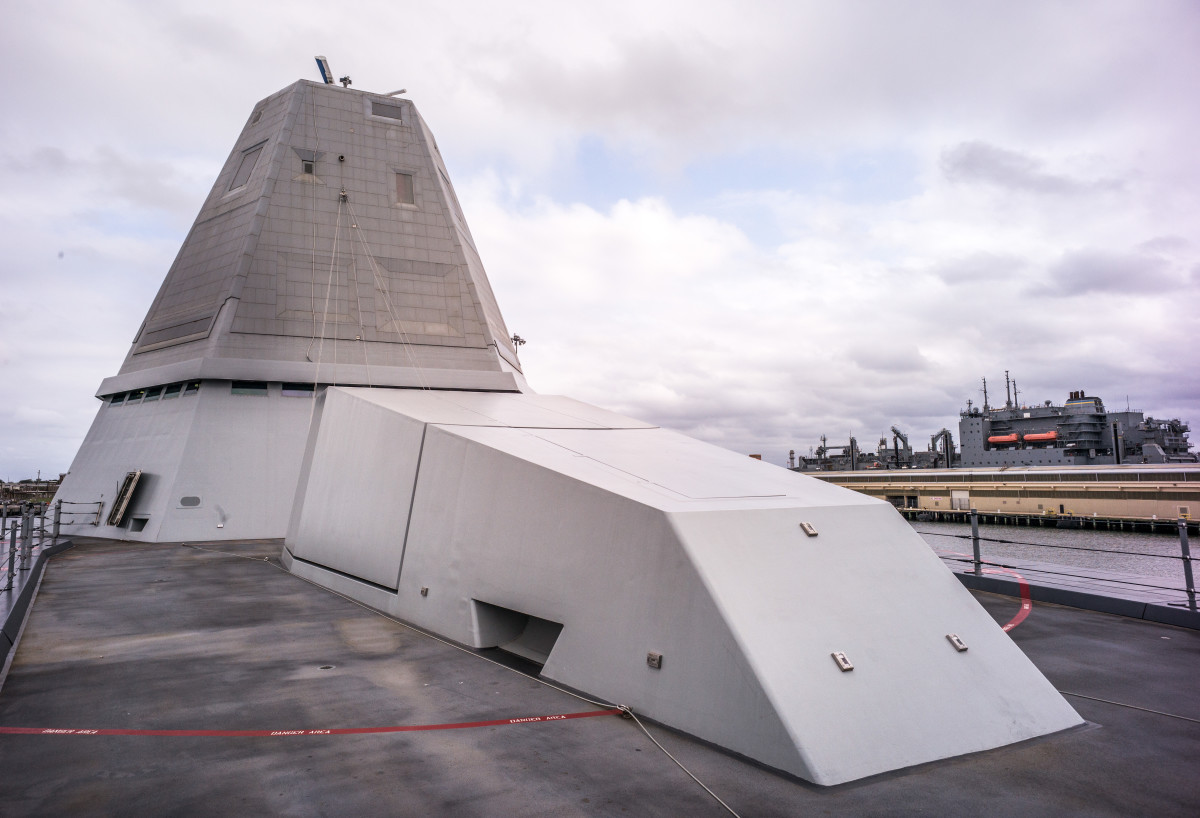
Norfolk Naval Station, VA. (Sept. 16, 2016) The land attack capabilities for Zumwalt comes from the ship’s two 155m m Advanced Gun System that can toss the lethal Long Range Land Attack Projectile nearly 60 miles at a rate of 10 per minute. (Mark D. Faram/Navy Times staff)
From the computing perspective we are looking to understand the ship’s total computing environment and how that impacts our ability to fight the ship. On the survivability piece, she has something called integrated fight-through power, which allows the ship to stay up and operational even if she sustains battle damage.
Those are some of the things that we have put on the ship, and we are gonna get her out, get her operating, get her in the hands of the sailors and Captain Kirk, and have them come back and tell us how we can leverage all of these capabilities to the maximum benefit of the fleet going forward.
Any closing thoughts?
I see excitement in the fleet on a daily basis. I have the great privilege of being able to go out and spend time on our ships and spend time with our sailors. I was recently on the Makin Island for the penning of the new Chief Petty Officers. There’s a lot of excitement, professionalism, and enthusiasm out there. Not that we haven’t had all of those in the past, but I’ve got to tell you, when I go on board the ships today it is palpable.
I think it is a great time to be serving our country and a great time to be serving on our surface ships. I could not be prouder of all the young men and women that are serving on our ships and all the great folks on the acquisition side, requirements side, and support side that are making these ships great. We will continue to do the best we can for them, and I know they will continue to do their best for us back here at home.
Vice Admiral Thomas S. Rowden is Commander, Naval Surface Forces. A native of Washington, D.C., and a 1982 graduate of the United States Naval Academy, VADM Rowden has served in a diverse range of sea and shore assignments.
Dmitry Filipoff is CIMSEC’s Director of Online Content. Contact him at Nextwar@cimsec.org.
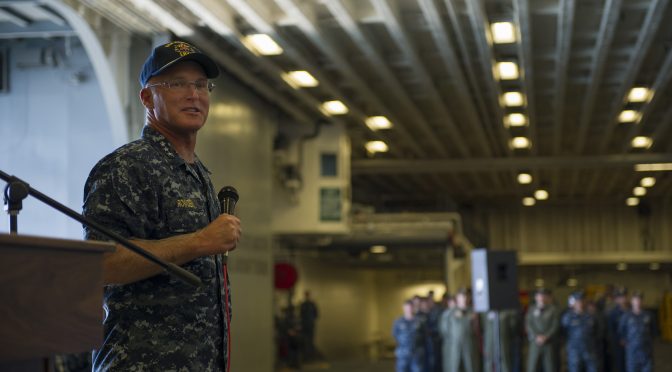
Featured Image: (November 6, 2014) Vice Adm. Thomas S. Rowden, commander, Naval Surface Forces and Naval Surface Force, U.S. Pacific Fleet, speaks to the crew on board amphibious assault ship USS America (LHA 6) during an all-hands call. (U.S. Navy photo by Mass Communication Specialist 1st Class Demetrius Kennon/Released)