CIMSEC is reintroducing PDF Compendiums to bolster its digital library. These compilations bring together the best articles CIMSEC has to offer on specific issue areas, all in an easy-to-read format. Our first release this year is Distributed Lethality, our topic week from July 2015. It can be found under the “Publications” tab.
In the future, CIMSEC will release compendiums for other topic weeks and issues. If you have compendium suggestions, please email Publications@cimsec.org.
Sincerely,
The CIMSEC Publications Team
Matthew Merighi & John Stryker
Matthew Merighi is a Master of Arts candidate at the Fletcher School of Law and Diplomacy at Tufts University, and CIMSEC’s Director of Publications. John Stryker is a International Relations and Hispanic Studies undergraduate student at the College of William and Mary, and is a CIMSEC Intern.
[otw_shortcode_button href=”https://cimsec.org/buying-cimsec-war-bonds/18115″ size=”medium” icon_position=”right” shape=”round” color_class=”otw-blue”]Donate to CIMSEC![/otw_shortcode_button]
“One must be ready to change his line sharply and suddenly, with no concern for the prejudices and memories of what was yesterday. To rest upon formula is a slumber that, prolonged, means death.”-Admiral Hyman G. Rickover.1
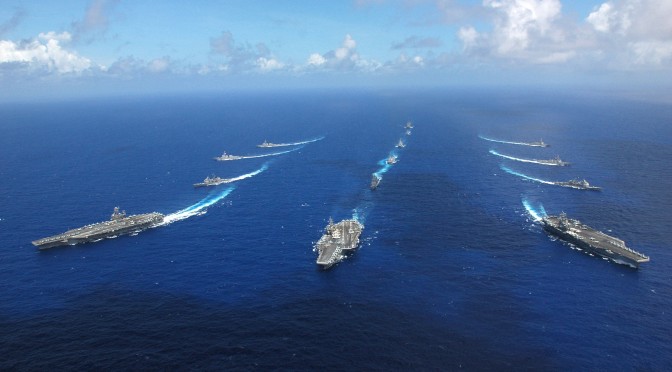
Distributed lethality is a concept that was officially launched a year ago by Navy leadership to explore how dispersing forces would enhance warfighting. Traditionally, dispersion has been a cardinal sin in the highly decisive nature of naval warfare, but new threats and capabilities may have changed this principle that has long guided the employment of warships. This analysis aims to show how distributed lethality can offer versatile means for achieving political and military objectives in an era of lean budgets and evolving threats.
Navy leaders assert that distributed lethality will “add battlespace complexity”3 and “complicate the calculus” of an adversary. How will dispersed surface action groups (SAG) accomplish this compared to traditional carrier strike groups (CSG), and how will dispersion affect operations in the electromagnetic (EM) domain?
Distributed lethality attacks left on the kill chain, meaning it intends to influence the earlier phases of the process by which targets are located, identified, targeted, engaged, and effects are assessed. Aside from increasing search volume, dispersion challenges intelligence, surveillance, and reconnaissance (ISR) through modularity. In a CSG centric navy,the detection of a large surface combatant increases the probability of learning the disposition of other warships, including valuable capital ships, and of knowing the operational unit they are arrayed in. The modularity offered by dispersed SAGs exacerbates the ISR challenge by reducing the certainty of what kinds of forces may be acting in concert with a potential contact, and what their capabilities and missions are. This will complicate prioritization of ISR and firepower, and increase the probability of expending precision guided munitions (PGM) due to forced error.4
However, distributed lethality will induce friction on the dispersed force. It is presumed that naval forces will employ emissions control (EMCON) techniques to frustrate the adversary in the EM domain. But EMCON exacerbates the challenges inherent to coordinating a dispersed force. Prior Navy experimentation discovered these challenges. Operations Haystack and Uptiderevealed thatdispersed operations under EMCON dramatically increase carrier survivability against submarines and land based bombers but at the expense of lengthened decision cycles.5 Under electromagnetic opposition, the degradation of confidence in the networking of a distributed force is easier because of additional variables to be accounted for and that can be influenced by enemy action. Aggregated forces can also more easily employ alternative means of communication compared to distributed forces.
Lengthened decision cycles for dispersed forces causes handicaps and presents dilemmas. Operations whose success is contingent upon careful coordination are less likely to succeed. The ability to mass capability on short notice amidst determined opposition is impaired. Planners must consider the extent that a SAG may be tied down by enemy action and its own tasking, and the resulting impact on total force flexibility. Operations must have built in flexibility and consider myriad contingencies. Scenarios where SAGs may be called upon to support one another will pose a challenge given how the Navy’s offensive firepower may soon outstick its defensive firepower. These realities will place a premium on inclusive planning and the Navy’s command by negation tradition.
Dispersion will complicate the enemy’s ISR at the expense of reducing one’s own C2 agility. It is important to note that C2 is not just further left in the kill chain than ISR and targeting, but threads the entire process together. These realities may make distributed lethality inflexible under certain circumstances, and result in a higher echelon commander’s intent being articulated in broader terms and with more modest aims. Vice Adm. Ted N. Branch, Deputy Chief of Naval Operations for Information Dominance, pointedly reminded that “the assured C2 pillar touches almost everything we do.”6 The nature of modern conventional warfare has made the EM domain the battleground for superior decision making, and distributed lethality affects the kill chain of all parties.
Distributed Lethality versus Anti-Access/Area Denial
“As they seek greater influence, we confront states that seek to compromise freedom of the seas, where conflict and coercion are increasingly common.“–Chief of Naval Operations Adm. John. M Richardson.7
The Anti-Access/Area Denial (A2/AD) environment is the threat environment dominating the thinking of senior Navy leaders. What advantages does distributed lethality offer in meeting the A2/AD challenge?
Combating an A2/AD adversary could involve operations spanning multiple areas including blue water sea control, power projection into the littoral and across land. While the CSG is a formidable asset against the warships of a near peer adversary, a salvo competition between a CSG and A2/AD forces, especially land based forces, would be suicidal. The A2/AD model is attrition based. Its predominant advantage over expeditionary forces is the logistical sustainment of PGM, ensuring victory in a salvo competition if accurate targeting is sustained. By denying commons, A2/AD reduces freedom of maneuver and raises the probability of attrition based operations, forcing expeditionary forces into the A2/AD’s strength.
Distributed lethality counters A2/AD’s attrition model through maneuver warfare’s intent to probe for weakness and influence psychology. Dispersion facilitates multiple points of entry into theater, allowing for more sea control and maneuver. This in turn strains the anti-access mission and forces the adversary into executing area denial simultaneously. Distributed forces can probe more areas of the A2/AD envelope to gain intelligence on the opponent’s ISR capabilities and discover the true extent of their maritime domain awareness (MDA), setting the stage for follow on operations. Complicating ISR and targeting offsets logistical superiority by injecting uncertainty.
Distributed lethality will benefit from the numerous capabilities the Navy is developing to maintain its edge. The concept seeks to employ platforms in different ways, and promote versatility to make the most of limited resources. How could the Navy employ its warships differently and which capabilities should be prioritized?
In a 2014 CIMSEC article Admiral Tom Rowden, then director of Surface Warfare Directorate OPNAV N96, articulated a concept of dispersed lethality andasserted a distributed force will not be dependent on the air wing.9 While distributed lethality deemphasizes carrier strike missions, the air wing will be a critical enabler for the distributed force. A distributed air wing can provide rapid response anti-submarine warfare capability and function as communications relays for maintaining a responsive decision cycle while the dispersed force operates under EMCON. The air wing’s screening and early warning functionswill be indispensable for enabling commanders on the scene to exercise initiative and engage on their own terms. The air wing will refocus from the right side to the left on the kill chain.
Much has been made of a recent memo issued by Secretary of Defense Ash Carter to Secretary of the Navy Ray Mabus on the Navy’s programs. The most significant directives include cutting procurement of the littoral combat ship (LCS) from 52 hulls to 40, and procuring 31 additional F-35C aircraft.10 It is important to note that distributed lethality was born from a wargame at the Naval War College where a LCS equipped with a long range surface to surface missile “added stress and complexity to the red force commander, who had to spend precious ISR resources trying to find these upgunned ships.”11 If aircraft and fast frigates/LCS are mutually exclusive investments in the near term, the Navy should explore whether it needs more shooters in the form of additional warships or air wing enablers performing the aforementioned missions.
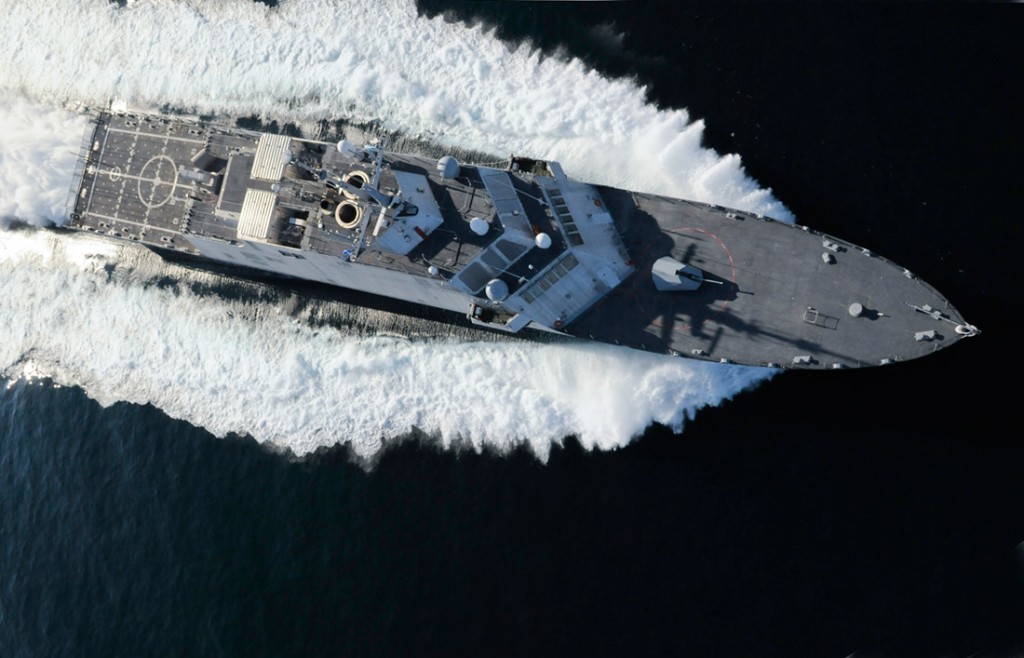
USS Fort Worth. (Rolls-Royce Photo)
A payload that has been wisely distributed across the Navy’s warships is the AN/SLQ-32 electronic warfare (EW) system. The Block III increment of the Surface Electronic Warfare Improvement Program (SEWIP) will provide common electronic attack capability to surface combatants.12 Not only does the CSG focus large surface combatants on the defensive application of anti-air warfare (AAW), it does the same for EW. A distributed force equipped with an offensive EW capability could cause great disruption to an adversary’s ISR picture, reinforcing distributed lethality’s intent to attack left on the kill chain. As a part of a proposed acquisition fastlane, Chief of Naval Operations Adm. John Richardson has singled out EW capabilities as “candidates for this kind of rapid acquisition, rapid prototyping”13 which will benefit distributed lethality enormously.
Distributed lethality aims to add more firepower to the fleet, potentially even equipping logistics vessels with missiles as a part of the maxim “if it floats, it fights” issued by OPNAV N96 chief Rear Adm. Peter Fanta.14 However, the Navy should reexamine prioritizing anti-surface warfare (ASuW) capability and consider focusing on land attack. While putting modern anti-ship missiles on more surface combatants would reinvigorate the Navy’s ASuW capability, enhanced power projection across land holds greater deterrence value. The Navy’s land attack proficiency is well honed and proven through recent experience. Thankfully the versatility of the tomahawk missile can enhance both mission sets, but presents the technical challenge of installing vertical launch cells on ships that may have little space and weight to spare.
Arguably no set of capabilities stand to enhance distributed lethality more so than Cooperative Engagement Capability (CEC) and Naval Integrated Fire Control-Counter Air (NIFC-CA). These capabilities allow one platform’s sensors to provide a targeting solution to another platform’s weapons. This will multiply the lethality of a distributed force across vast areas of influence by allowing for the massing of payloads but not platforms. Distributed forces will be able to mitigate risk by mixing and matching whatever combination of sensors and shooters best fits an engagement while ensuring survivability.
Strategic Merit
“…it’s primarily about changing our ways and means right now and the operational concepts we use to achieve our objectives…”-Deputy Secretary of Defense Robert O. Work.15
An operational concept’s warfighting advantages are linked to its deterrence value. How does distributed lethality contribute to deterrence, and what options does it provide policymakers confronting crisis?
Distributed lethality enhances deterrence by influencing psychology through more than just kinetic means. It aims to degrade an adversary’s confidence in their weapons rather than through the threat of overwhelming force, a threat that is not as credible against an A2/AD adversary. Dispersion better allows for demonstrations within the EM domain, which may prove a less escalatory form of conveying resolve than deploying a CSG to a hotspot. The enormous creativity allowed by electromagnetic maritime deception allows for a more nuanced and flexible escalatory dynamic. Demonstration options range from temporarily confusing sensors tosimulating strikes against strategic forces with impunity as the Navy did in NORPAC 82.16 Not only does threatening the destruction of networks constitute escalation, it attacks the channels by which deception conveys deterrence.17 During crisis, distributed lethality’s modularity allows for more options in terms of what and how many assets are committed to posturing, giving policymakers a more flexible means for adjusting the “temperature.” Distributed lethality not only has more to offer for maneuver in the military sense, but also politically.
As the threat environment evolves, reassessing the CSG’s deterrence value should occur in tandem with reevaluating its warfighting applications. Captain Robert C. Rubel (ret.) makes the excellent point that “If a lucrative target loaded with potent geopolitical symbolism is on scene, with more on the way, it could precipitate a dangerous “window-of-opportunity” mindset in the opposing government.”18 Sending a CSG to a hotspot could “catalyze as deter” and threaten nightmarish devastation or monumental loss of face as carriers are hurriedly withdrawn for the sake of preservation at the outbreak of war. During the initial phases of conflict, failing to deceive ISR through nonkinetic means could quickly escalate into attempting their physical destruction, up to and including strikes on mainland installations, which is more likely if a carrier’s survival is at stake.
Distributing forces will lower a first strike’s potential for success, which is especially important for deterring an adversary employing A2/AD. Jon Solomon points out an adversary’s maritime domain awareness “will never be as accurate and comprehensive at any later point in a conflict as it is during peacetime’s waning moments.”19 A patrolling, dispersed force would provide a more complex targeting picture, and would reveal more indicators and warning of an impending attack across a larger geographical area. These advantages would be realized by having forward deployed forces already operating in a dispersed manner at Phase 0, or otherwise face the uncomfortable process of transitioning into a dispersed force in the midst of crisis or at the onset of conflict.
Final Thoughts
“It will be orange and it may look kind of odd put together and won’t have the nice slick red/gray paint and it won’t be totally tested and it might fail, but we’ve got to get it out there and see what we can do with that.”-Chief of Naval Operations Adm. Jon Greenert.20
There are additional lines of inquiry that must be explored in order to flesh out distributed lethality. For example, what does it entail for amphibious forces? These forces are more likely to face the littoral arena, and their objectives are set upon fixed geography which limits their freedom of maneuver. The history of naval warfare has shown time and time again that key naval engagements precipitated in relation to developments and objectives on land. Scenarios commonly envisioned today such as a Taiwan contingency or a defense of the Strait of Hormuz demand that the Navy examine distributed lethality in a fixed geographical context. The concept will also challenge the ability to wage coalition warfare, as the careful planning and execution demanded by dispersed operations under EMCON will require ample cooperation and true interoperability.
Nonetheless, distributed lethality offers numerous benefits. It will make the most of what the Navy has today, while maximizing the value of investments that will achieve fruition both in the short and long term. It provides means for confronting the A2/AD challenge, and fulfills Air-Sea Battle’s intent to ensure U.S. forces can “assure access, maintain freedom of action, conduct a show of force, or conduct limited strikes.”21 Ultimately, it provides political and military leadership more flexibility to maneuver within crisis and conflict. The Navy must call upon its rich history of innovation and experimentation to turn distributed lethality into a credible warfighting construct that will deter foes, reassure allies, and make the greatest Navy the world has yet seen greater still.
Dmitry Filipoff is CIMSEC’s Director of Online Content. He can be contacted at Nextwar@cimsec.org.
[1] Admiral Hyman G. Rickover. US Naval Postgraduate School address (16 March 1954).
[6] Vice Adm. Ted N. Branch. “A New Era in Naval Warfare,” U.S. Naval Institute Proceedings (July 2014).
[7] Chief of Naval Operations Adm. John M. Richardson. “The Growing Importance of the Maritime,”10th Regional Seapower Symposium, Venice, Italy (October 22, 2015).
To close out Distributed Lethality Week, VADM Rowden, Commander, Surface Forces, was kind enough to add his own piece to the milieu.
Once again, I am really pleased to see CIMSEC out front and leading with respect to providing a timely forum for information exchange and professional learning. That you’ve chosen to focus on Distributed Lethality this week is an exciting development, and I look forward to checking in on the dialogue and getting a sense of how well the idea is catching on and where we might need to do a little more work in addressing concerns and criticisms.
Since we debuted Distributed Lethality six months ago at the Surface Navy Association Symposium, a team of superstars in DC, at my headquarters in San Diego, and from around the fleet have been doing the really hard work of putting the meat on the bones of what was admittedly an aspirational concept when I introduced it. Don’t get me wrong—the basic concept of increasing individual warship lethality and then combining surface warships in innovative ways makes straightforward sense to virtually anyone who will listen. But as with anything that will likely cause generational change in an enterprise as large as Surface Warfare, there are tough analytical questions that have to be answered, there are important questions of priority and timing, and there are critical questions of “how much?” and “how widely distributed?” the force can be. This is what the Distributed Lethality team is working on, and we’ll convene in Newport in two weeks for our second series of wargames designed to get at some of the things I just mentioned.
The subject I really want to focus on with this piece however, is the human side of Distributed Lethality, represented by the Naval Surface and Mine Warfighting Development Center that we stood up last month in San Diego under the command of Rear Admiral Jim Kilby. A lot of folks are likening NSMWDC to naval aviation’s Top Gun program, and I think there is something to that comparison. For decades Top Gun has produced finely-honed tactical experts in the LT/LCDR grades — experts who then go back to their parent squadrons or wings and raise the tactical proficiency of those organizations.
Like a drop of dye in a glass of water, we look for a new generation of Surface Warfighting experts—Warfare Tactics Instructors (WTI)—to change the very character of our profession. NSMWDC is part of the solution and will oversee the selection and training of those WTI’s – the ship’s CO’s are another part, integral in the selection of our WTI’s. In essence, we are “distributing” the human factor in Surface Warfare. We are investing in our junior officers in order to ensure that our crews are able to get the most out of training and the investments we are making in weapons and sensors.
We are looking to increase the warfighting professionalism of the force; to bring a new emphasis on tactics, tactical thinking, and tactical training, and we are going to do so one staff and one ship at a time.
Let’s face it, it is high-time we did this. Our ships are powerful and sophisticated, and the future upgrades we’ll field will demand a higher level of tactical acumen to wring the most out of them. While the mechanics are classified, I’m here to tell you that Navy Integrated Fire Control-Counter Air (NIFC-CA) engagements are not a trivial undertaking. They will require considerable training and coordination across battle force components, but it all starts right in our Combat Information Centers.
We need to get more proficient in Mine Warfare. But a different kind of Mine Warfare, one where we don’t steam into the middle of the minefield and then sweep. Rather, we’ll stand-off and position a variety of surface, subsurface, and air deployed sensors that make up the LCS MIW mission module.
With respect to Anti-Submarine Warfare, the AN/SQR-89V(15) processing system presents operators with information at ranges that were — up to now — virtually impossible to gather. We need to get back into serious passive localization techniques that enable us to exploit the detectable sound-sources of even the quietest energy submarines. We need to move more quickly with less information to “good enough” targeting solutions. Solutions that allow either a surface-based weapon system or an air-deployed weapon to put the submarine on the defensive so he no longer is capable of targeting us with HIS anti-ship weapons.
In Anti-Surface Warfare we’ll be right back in the War at Sea game. First with a medium-range weapon we’ll field on the FF’s, and then on a longer range—and potentially supersonic—weapon that we’ll field on larger combatants. We’ll be able to hold a greater number of things that adversaries value at risk while making every one of us a more interesting target for their ISR systems.
NSMWDC will eventually graduate more than 100 WTI’s a year; these officers will then go on to be XO’s and CO’s, and Strike Group Commanders. Distributing the power of human talent more broadly across our fleet makes a lot of sense as we distribute lethality within our ships. I look forward to providing CIMSEC readers (and anyone else who attends) with a full update on the progress of the analytical effort involved with Distributed Lethality at January 2016’s SNA. An additional part of that update will be a continued emphasis on the demanding tactical training that our force must continue to pursue in order to get the most out of this exciting new concept. Distributed Lethality is MUCH more than just putting more missiles on ships—it is about investing in warfighting expertise. Let’s get to work.
Vice Admiral Thomas S. Rowden is Commander, Naval Surface Forces. A native of Washington, D.C., and a 1982 graduate of the United States Naval Academy, VADM Rowden has served in a diverse range of sea and shore assignments.
This article was submitted by guest author Marjorie Greene for CIMSEC’s Distributed Lethality week. Ms. Greene is a Research Analyst with CNA. Views expressed are her own.
What will distributed lethality command and control look like? This article introduces a self-organizing approach that addresses this question. The increasing vulnerability of centralized command and control systems in network warfare suggests it may be time to take an entirely new approach that builds on the human capacity to interact locally and collectively with one another. Building on the concept of swarm intelligence, the approach suggests that information could be “shared” in a decentralized control system, much as insect colonies share information by constructing paths that represent the evolution of their collective knowledge.
This article builds on a self-organizing system that was developed for military analyses aimed at finding out “who talks to whom, about what, and how effectively” in a wide range of operational situations featuring the involvement of naval forces and commands. In an effort to describe the content of message traffic throughout the chain of command during a crisis, a technique was used to associate messages with each other through their formal references. “Reference-connected sets” were constructed that required no interpretation of the subject matter of the messages and, when further analyzed, were found to uniquely identify events during the crisis. For example, one set that was constructed from crisis-related message traffic found in files at three command headquarters contained 105 messages that dealt with preparation for landing airborne troops. Other sets of messages represented communications related to other events such as providing medical supplies and preparing evacuation lists. The technique therefore provided a “filter” of all messages during the crisis into events that could be analyzed – by computers or humans – without predetermined subject categories. It simply provided a way of quickly locating a message that had the information (as it was expressed in natural language) that was necessary to make a decision [1].
As the leaders of the Surface Navy continue to lay the intellectual groundwork for Distributed Lethality, this may be a good time to re-introduce the concept of creating “paths” to represent the “collective behavior” of decentralized self-organized systems” for control of hunter-killer surface action groups. Technologies could still be developed to centralize the control of multiple SAGs designed to counter adversaries in an A2/AD environment. But swarm intelligence techniques could also be used in which small surface combatants would each act locally on local information, with global control “emerging” from their collective dynamics. Such intelligence has been used in animal cultures to detect and respond to unanticipated environmental changes, including predator presence, resource challenges, and other adverse conditions without a centralized communication and control system. Perhaps a similar approach could be used for decentralized control of Distributed Lethality.
Swarm intelligence builds on behavioral models of animal cultures. For example, the ant routing algorithm tells us that when an ant forages for food, it lays pheromones on a trail from source to destination. When it arrives at its destination, it returns to its source following the same path it came from. If other ants have travelled along the same path, pheromone level is higher. Similarly, if other ants have not travelled along the path, the pheromone level is lower. If every ant tries to choose a trail that has higher pheromone concentration, eventually the pheromones accumulate when multiple ants use the same path and evaporate when no ant passes.
Just as an ant leaves a chemical trace of its movement along a path, an individual surface combatant could send messages to other surface ships that include traces of previous messages by means of “digital pheromones.” One way to do this would be through a simple rule that ensures that all surface ships are kept informed of all previous communications related to the same subject. This is a way to proactively create a reference-connected message set that relates to an event across all surface ships during an offense operation.
In his book, Cybernetics, Norbert Wiener discusses the ant routing algorithm and the concept of self-organizing systems. He does not explicitly define “self-organization” except to suggest it is a process which machines – and, by analogy, humans – learn by adapting to their environment. Now considered to be a fundamental characteristic of complex systems, self-organization refers to the emergence of higher-level properties and behaviors of a system that originate from the collective dynamics of that system’s components but are not found in nor are directly deducible from the lower-level properties of the system. Emergent properties are properties of the whole that are not possessed by any of the individual parts making up that whole. The parts act locally on local information and global order emerges without any need for external control.
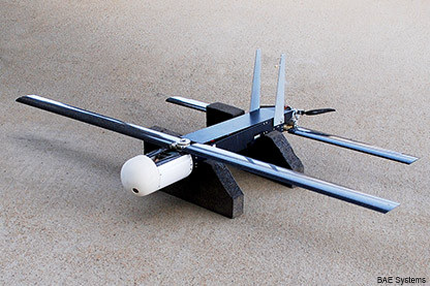
The Office of Naval Research has recently demonstrated a new era in autonomy and unmanned systems for naval operations that has great promise for Distributed Lethality. The LOCUST (Low-Cost UAV Swarming Technology) program utilizes information-sharing
The Coyote UAV, developed by BAE, used by the LOCUST program
between UAVs to enable autonomous collaborative behavior in either defensive or offensive scenarios. In the opinion of this author, this program should be analyzed for its potential application to Distributed Lethality.
Professor Vannevar Bush at MIT was perhaps the first person to come up with a new way of thinking about constructing paths for information-sharing. He suggested that an individual’s personal information storage and selection system could be based on direct connections between documents instead of the usual connections between index terms and documents. These direct connections were to be stored in the form of trails through the literature. Then at any future time the individual himself or one of his friends could retrieve this trail from document to document without the necessity of describing each document with a set of descriptors or tracing it down through a classification tree [2].
The current response to the dilemmas associated with command and control in any distributed operation has led this author to embrace the concept of swarm intelligence. Rather than attempting to interpret the subject matter of information exchanged by entities in confronting an adversary, why not build control systems that simply track information “flows”? Such flows would define the subject matter contained in a naval message without having to classify the information at all.
Any discussion of command and control would be incomplete without including the concept of fuzzy sets, introduced by Professor Lotfi Zadeh at the University of California, Berkeley in 1965. The concept addresses the vagueness that is inherent in most natural language and provides a basis for a qualitative approach to the analysis of command and control in Distributed Lethality. It is currently used in a wide range of domains in which information is incomplete or imprecise and has been extended into many, largely mathematical, constructions and theorems treating inexactness, ambiguity, and uncertainty. This approach to the study of information systems has gained a significant following and now includes major research areas such as pattern recognition, data mining, machine learning algorithms, and visualization, which all build on the theoretical foundations established in information systems theory [3].
Ultimately, the information paths constructed for the control of Distributed Lethality will be a function of organizational relationships and the distribution of information between them. Since a message in a path cannot reference a previous message unless its originator is cognizant of the previous message, the paths in a “reference-connected set” of messages will often reflect the information flows within a Surface Action Group. When paths are joined with other paths, the resulting path often reflects communications across Surface Action Groups. It remains to be determined whether the Surface Navy can use these concepts as it continues to explore the intellectual groundwork for Distributed Lethality. Nevertheless, it is very tempting to speculate that swarm intelligence will play an important role in the future. The most important consideration is that this approach concentrates on the evolution of an event, rather than upon a description of the event. Even if a satisfactory classification scheme could be found for control of hunter-killer Surface Action Groups, the dynamic nature of their operations suggests that predetermined categories would not suffice to describe the complex developments inherent in evolving and potentially changing situations.
Many organizations have supported research and development designed to explore the full benefits of shared information in an environment in which users will be linked through interconnected communications networks. However, in the view of this author, the model of “trails of messages” should be explored again. “Network warfare” will force an increased emphasis on human collaborative networks. Dynamic command and control will be based on communications paths and direct connections between human commanders of distributed surface ships rather than upon technologies that mechanically or electronically select information from a central store. Such an approach would not only prepare for Distributed Lethality, but may improve command and control altogether.
Ms. Greene is a Research Analyst with CNA. Views expressed are her own.
REFERENCES:
Greene, , “A Reference-Connecting Technique for Automatic Information Classification and Retrieval”, OEG Research Contribution No. 77, Center for Naval Analyses, 1967
Bush, V., “As We May Think”, Atlantic Monthly 176 (1):101-108, 1945
Zadeh, L.,” Fuzzy sets”, Information Control 8, 338-353, 1965
CIMSEC content is and always will be free; consider a voluntary monthly donation to offset our operational costs. As always, it is your support and patronage that have allowed us to build this community – and we are incredibly grateful.