Tag Archives: China

Distributed Lethality: China is Doing it Right

Distributed Lethality Topic Week

By Alan Cummings

Distributed lethality is about “increasing individual warship lethality and then combining surface warships in innovative ways.” We can add some 21st Century flair to the details, but the premise remains the essence of warships since time immemorial: go to sea and kill your enemy. Frankly, the U.S. Navy’s (USN’s) surface fleet is playing catch-up after the post-Cold War/ low-naval-threats era of the 1990s and 2000s. The fact that we needed to verify the value of capable warships with “a rigorous program of analytics” and numerous war games seems a poignant expression of the tactical and bureaucratic disconnect in the past decades. So for now, check out China and the People’s Liberation Army (Navy) (PLA(N)) if you want an example of Distributed Lethality in action.

The PLA(N) began building modern warships in the 1990s when they laid the keels for their first Luhu, Luhai, and Jiangwei-class vessels. Those vessels and every class of surface combatant since have counted anti-ship cruise missiles (ASCMs) as their primary armament. Which is to say they were each deadly in the anti-surface warfare (ASuW) arena from day one. Ironically, as China was ramping up production of lethal surface combatants, the U.S. was ramping down. The last Arleigh Burke to incorporate the RGM-84 HARPOON (USS Porter, DDG 78) slid off the blocks in 1997 and every U.S. destroyer built since has been oriented around air defense. What little ASuW capability these later destroyers have is reliant on firing an SM-2 missile designed for air warfare in a secondary ASuW mode.

Fast forward to 2015, and you have two comparisons of the USN and PLA(N)- first by tonnage, then by strike-mile lethality.
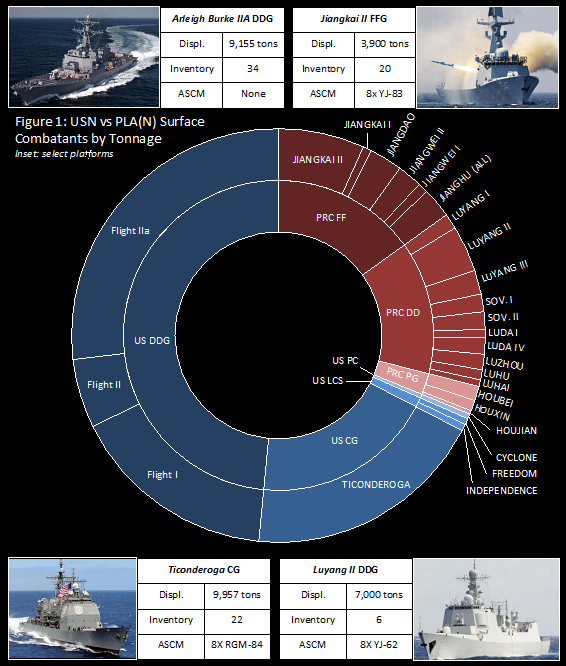
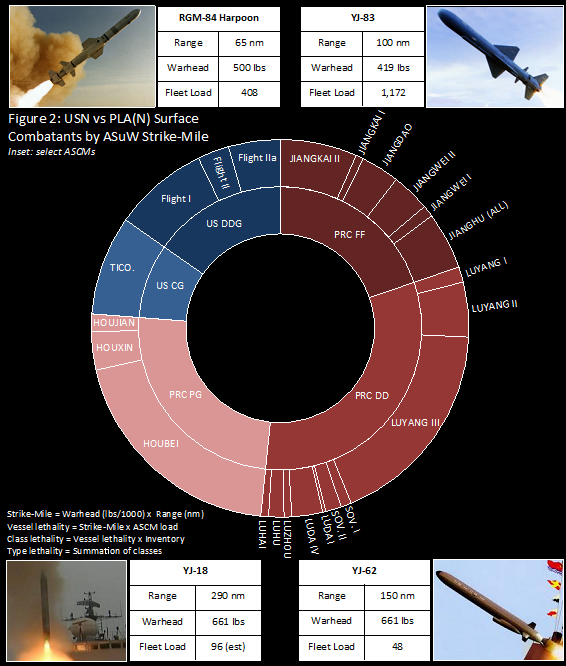
Chart 1
USN vs PLA(N) Surface Combatants by Tonnage
chae
USN vs PLA(N) Surface Combatants by ASuW Strike-Mile

As you can see, the USN may have the edge in tonnage but the PLA(N) takes the prize for lethality. It turns out the PLA(N) also has more hulls- which means their tonnage and armament are more, wait for it, distributed.  Granted, a lot of that distribution resides in their Houbei PTGs. But if you’re focused on regional sea control, say like the South China Sea and Western Pacific, then those low-cost/high-lethality combatants are the perfect thing to disperse across contested locations, key transit areas, and chokepoints.

Today’s bottom line is that the PLA(N) can field more ASCMs and a wider variety of platforms than the USN. For most of the PLA(N), that lethality comes in the form of a warship with at least four YJ-83s, each delivering a 419-lbs warhead up to 100NM (some vessels have ASCMs with even longer ranges, like the YJ-18 and YJ-62). This means combatants with YJ-83s can hold a 200NM-diameter circle (or 31,400NM2) at risk of lethal effects. The Spratly Islands for example claim 120,000NM2; strategic distribution of a four-ship PLA(N) surface action group (SAG) gives ASCM coverage to 125,600NM2.  Raising the hull count or employing multiple SAGs makes the situation all the more frightening. Cue these vessels with rough targeting data (a.k.a. maritime domain awareness) from a Fiery Cross-based patrol aircraft and the PLA(N) has a full-blown system of distributed lethality.

Holding short of a war at sea, PLA(N) combatants are the muscle behind China’s maritime presence and influence operations. PLA General Zhang Zhaozhong implied this in early 2013, calling it a “cabbage strategy” to surround contested maritime claims (like Second Thomas Shoal) with layers of civilian, government, and military vessels. Then in 2014, PLA(N) vessels helped escort the Haiyang Shiyou 981 drilling rig in 2014 despite Chinese statements to the contrary. Talk about “combining surface warships in innovative ways,” China is using them as part of a layered politico-military offense to advance their maritime claims, one that easily transitions to combat operations if things deteriorate.

Implementing distributed lethality requires sound doctrine and a practiced C2 structure. That’s where the USN carries the advantage (for now) while we implement expedients like the modified TLAM and SM-6. However, much of our doctrine is either available via open source research or may have been compromised by cyber warfare. For example, the majority of our own textbook on “Surface Tactics 101” is available via a quick Google search for MTP-1D (the Multinational Maritime Tactical Signal and Maneuvering Book). Paired with the equally available NWP 3-56 Composite Warfare Doctrine, and five minutes of Google research has provided the fundamentals of distributed tactics.

Whether the PLA(N) has incorporated U.S. C2 doctrine or developed a native system is likely hidden in classified reporting. However, we can look at broader open source examples to evaluate how practiced they are at operating warships together. For instance, rehearsals of combat resupply demonstrate coordination amongst combatants and the entire logistics train. Recent exercises with Russia, Australia, and the U.S.  illustrate that the PLA(N) has become a capable partner for live fire exercises, amphibious landings, and maneuvering drills amongst other evolutions. I was once told that the key to combat at sea is showing up to the right location, on time, with weapons and radios that work (which may have been borrowed from someone else). I believe that is a valid definition, particularly in the context of distributed lethality, and one that the PLA(N) appears to be meeting.

If one is inclined to dismiss exercises and drills as liable to heavy scripting, then the PLA(N)’s blue water deployments show their C2 abilities are no fluke. These complicated operations (and the C2 required for them) are one snapshot in an evolution of PLA(N) doctrine that runs concurrent with their progress in warship technology. Even the larger Chinese defense organization is adapting to facilitate coordinated operations. Two of the five newly inaugurated theater commands will likely be tasked with maritime-centric missions in the East and South China Seas. More important than today’s snapshot, these trends indicate where China wants to take their C2 ability tomorrow. So what do these strategic moves mean for distributed tactics? If China has the C2 infrastructure, logistics support, and trust in its commanders to operate independently around the world then it stands to reason they can operate together in China’s near abroad.

Which brings up my last point on distributed lethality in the PLA(N): they win by implementing it locally. Warships from China’s East Sea Fleet at Ningbo need to cover 400NM to be in the disputed Senkaku Islands, while South Sea Fleet ships from Zhanjiang are 700NM from the Spratly Islands. PLA(N) vessels can cycle through combat patrols, maintenance periods, training evolutions, and resupply hops in 1/3 the distance a U.S. destroyer covers transiting from San Diego to Hawaii. Meanwhile, the USN still needs the missiles, variety of hulls (small, medium, and large combatants), and regional partners to make distributed lethality work in the Asia Pacific. China need only cast off lines.

Tactics come down to your ability to shoot, move, and communicate. Most of the USN surface fleet can move and communicate around the world, but can’t authoritatively prosecute a surface engagement. The PLA(N) is working on the skills to communicate in a coordinated attack, but they can move with ease in their near seas and they designed their surface combatants as shooters from the beginning. Both sides have identified where they are and where they want to go as far as tactical capability (which, for good or ill, seems to be similar places). So which challenge is easier- learning C2, or refitting and retraining a fleet? I guess the race is on.

Alan Cummings commissioned from Jacksonville University in 2007 and served as a Surface Warfare Officer in the USN until 2013. The opinions here are his own and do not represent the position of the U.S. government. Some material used here is drawn from research being considered for publication elsewhere. Original data is available via valid requests submitted to nextwar@cimsec.org.
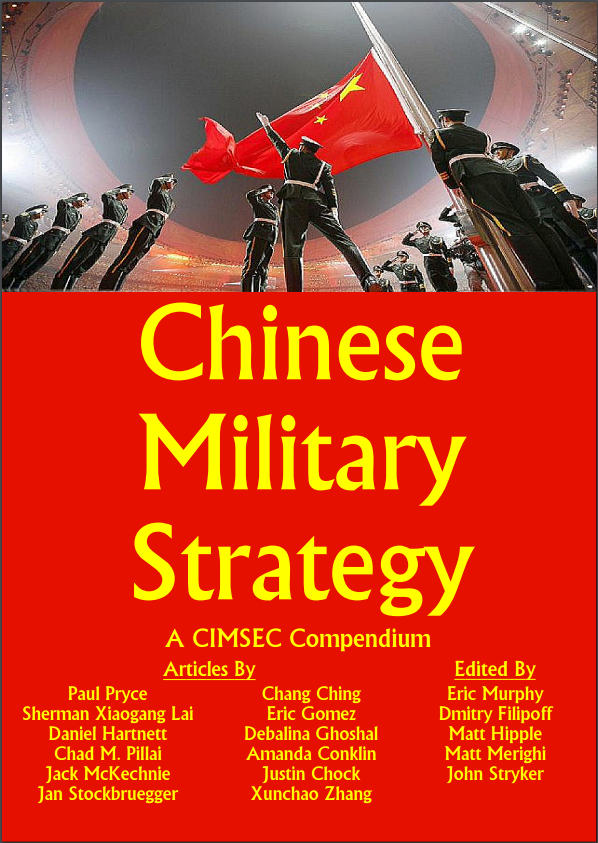
Publication Release: Chinese Military Strategy Week

Released: February 2016

The CIMSEC Chinese Military Strategy topic week ran from August 3-7, 2015 and featured shortly after a new Chinese Military Strategy white paper was released in May 2015, and after a new U.S. National Military Strategy was released in July 2015. Authors sought to identify key takeaways from the new Chinese white paper, establish historical context, and several compared the new Chinese document to the American strategy. 

Authors:Screenshot_1
Paul Pryce
Sherman Xiaogang Lai
Chad M. Pillai 
Jack McKechnie
Jan Stockbruegger
Chang Ching
Eric Gomez
Debalina Ghoshal
Amanda Conklin
Justin Chock
Xunchao Zhang

Editors:
Eric Murphy

Dmitry Filipoff
Matt Hipple
Matt Merighi
John Stryker

Download Here

Articles:
The Influence of Han Feizi on  China’s Defence Policy By Paul Pryce

From Expediency to the Strategic Chinese Dream? By Sherman Xiaogang Lai
Where You Stand Depends on Where You Sit: U.S. & Chinese Strategic Views By Daniel Hartnett
Bear, Dragon & Eagle: Russian, Chinese & U.S. Military Strategies By Chad M. Pillai
Avoiding Conditions for an Asia-Pacific Cold War By Jack McKechnie
Beyond the Security Dilemma? De-Escalating Tension in the South China Sea By Jan Stockbruegger
A Grain of Contextual Salt in the Chinese Military Strategy By Chang Ching
Deep Accomodation: The Best Option for Preventing War in the Taiwan Strait By Eric Gomez
Assessing China’s Nuclear Ambitions By Debalina Ghoshal
The Unnamed Protagonist in China’s Maritime Objectives By Amanda Conklin
A Pacific Rebalance with Chinese Characteristics By Justin Chock
Becoming a Maritime Power? The First Chinese base in the Indian Ocean? By Xunchao Zhang

Be sure to browse other compendiums in the publications tab, and feel free send compendium ideas to Publications@cimsec.org.

[otw_shortcode_button href=”https://cimsec.org/buying-cimsec-war-bonds/18115″ size=”medium” icon_position=”right” shape=”round” color_class=”otw-blue”]Donate to CIMSEC![/otw_shortcode_button]

US Department of State Seeks to Clarify Meaning of China’s 9-Dash Line: Finale

By Alex Calvo

This is the fifth installment in a five-part series summarizing and commenting the 5 December 2014 US Department of State “Limits in the Seas” issue explaining the different ways in which one may interpret Chinese maritime claims in the South China Sea. It is a long-standing US policy to try to get China to frame her maritime claims in terms of UNCLOS. Read part one, part two, part three, part four

[otw_shortcode_button href=”https://cimsec.org/buying-cimsec-war-bonds/18115″ size=”medium” icon_position=”right” shape=”round” color_class=”otw-blue”]Donate to CIMSEC![/otw_shortcode_button]

Whereas the assertion that China has not actually made a claim may not be shared by everybody, in particular given the language flowing from Beijing which the DOS report itself cites, the reference to the “high seas” between mainland China and some islands seems stronger proof that Beijing was not making a historic claim. However, we must again stress that this would be the case if we followed the prevailing interpretation of the law of the sea, but there is no reason why China should adhere strictly to it, and even less that Beijing should not have changed her mind since 1958, when she had little more than a coastal navy and her economy was closed and in tatters. It may be true, as the report notes, that the 1958 Declaration only made a historic claim to the Bohai (Pohai) gulf in northeastern China, but again this should perhaps be judged from a wider historical perspective. After 1949 the PRC took a much more uncompromising stance concerning its North-East than its South-East (and wider maritime) borders. With a pragmatic arrangement in place with the United Kingdom concerning Hong Kong, and a strong economic and political relation with the Soviet Union, it was at the other end of the country where, in 1950, Beijing (not without an intense internal debate given the state of the country), decided to resort to force to prevent the presence of hostile forces close to her border, intervening in the Korean War, pushing back the advancing Allied forces and reversing the impact of the Inchon landing, ultimately forcing a stalemate on the ground. In 1958, just five years after the Korean armistice, nearby waters may have thus been much more present in Chinese leaders’ minds. In addition, these were also the waters directly leading to Tianjin and Beijing, the venue for foreign interventions in both the Opium Wars and the Taiping Rebellion. It would not be until the late 1970s that China’s South-Eastern flank would begin to receive more attention, in part thanks to the rapprochement with the United States and in particular once economic growth and the country’s move to become a net energy and commodity importer turned the waters of the South China Sea into a vital venue and potential choke point. It is true that in December 1941 the loss of HMS Prince of Wales and HMS Repulse in the South China Sea had enabled the Japanese to land in Malaya and ultimately conquer Burma, closing the last land route to besieged Nationalist China, but this did not result in a comparable imprint on China’s historical consciousness, among other reasons because the episode did not involve Chinese naval forces and was subsumed into a much larger, dramatic, and quickly-developing picture.

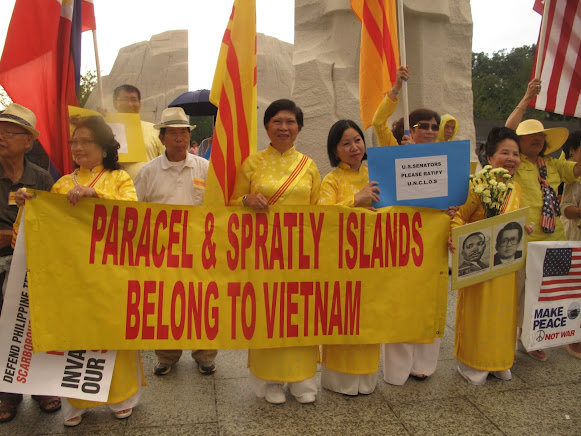
Vietnamese-Americans demonstrating against Chinese claims in the South China Sea. Note the banner in favor of US ratification of UNCLOS.

Rejecting the validity of a possible historic claim by China. Concerning whether, if China “Made a Historic Claim”, it would “have Validity”, the DOS paper insists that “such a claim would be contrary to international law”, stressing the limited degree to which UNCLOS recognizes this category of claims, as evidenced by its “text and drafting history”. The text argues that “apart from a narrow category of near-shore ‘historic’ bays” in Article 10, and “historic title” concerning “territorial sea boundary delimitation (Article 15)”, “modern international law of the sea does not recognize history as the basis for maritime jurisdiction”, citing the Gulf of Maine ICJ case. It also underlines the fact that UNCLOS provisions concerning the EEZ, continental shelf, and the high seas “do not contain any exceptions for historic claims” to the detriment of coastal states and all estates enjoying certain freedoms. Concerning fisheries, the report acknowledges that UNCLOS refers to “the need to minimize economic dislocation in States whose nationals have habitually fished” in the EEZ (Article 62(3)) and to “traditional fishing rights and other legitimate activities” (Article 51), but restricts the impact to the possible granting by one state to another of fisheries resources “based on prior usage”. The text stresses that no such traditional fishing practices can “provide a basis for sovereignty, sovereignty rights, or jurisdiction,” adding that UNCLOS rules on oil and gas development contain no “exception for historic rights in any context.” Again we note how a purely legal report like this may be missing part of the picture, given the great importance that fishing vessels have in the ongoing conflict over the South China Sea, where they are one of the pillars of asymmetric naval warfare.

Chinese scholars Gao and Jia have argued that UNCLOS does not regulate “historic title” and “historic rights,” which fall instead under the purview of general international law. In their view, UNCLOS “was never intended, even at the time of its adoption, to exhaust international law. On the contrary, it has provided ample room for customary law to develop and to fill in the gaps that the Convention itself was unable to fill in 1982” as clear from its preamble, which reads “matters not regulated by this Convention continue to be governed by the rules and principles of general international law.” The DOS report explicitly rejects this position, saying that “it is not supported by international law” and goes against the “comprehensive scope of the LOS Convention.” Experts like Mark Valencia, on the other hand, hold that China’s posture may be compatible with the international law of the sea.

The text does not stop at arguing that it is not open to a state to make historic claims based not on UNCLOS but on general international law, laying down a second line of defense. It explains that, “even assuming that a Chinese historic claim in the South China Sea were governed by ‘general international law’ rather than the Convention,” it would still be invalid since it would not meet the necessary requirements under general international law, namely “open, notorious, and effective exercise of authority over the South China Sea,” plus “continuous exercise of authority” in those waters and “acquiescence by foreign States” in such exercise of authority. Furthermore, it explains that the United States, which “is active in protesting historic claims around the world that it deems excessive,” has not protested “the dashed line on these grounds, because it does not believe that such a claim has been made by China,” with Washington choosing instead to request a clarification of the claim. Whether this view is also meant to avoid a frontal clash with Beijing, in line with the often state policy goal of “managing” rather than “containing” China’s rise, is something not discussed in the text.

The report concludes by criticizing another view put forward by Gao and Jia, namely the relevance of claims made before the advent of UNCLOS. While these two scholars argue that “In the case of the South China Sea as enclosed by the nine-dash line, China’s historic title and rights, which preceded the advent of UNCLOS by many years, have a continuing role to play,” the DOS paper says that “The fact that China’s claims predate the LOS Convention does not provide a basis under the Convention or international law for derogating from the LOS Convention,” adding that “permitting States to derogate from the provisions of the Convention because their claims pre-date its adoption is contrary to and would undermine” the convention’s “object and purpose” stated in its preamble to “settle … all issues relating to the law of the sea.”

Conclusions. Long-standing American policy towards China stresses the need to manage the latter’s rise, so that it does not threaten the post-Second World War system, based among others on freedom of navigation and a ban on territorial expansion as a legitimate causus belli. As a result, Washington has often called on Beijing to clarify her claims on the South China Sea, in an attempt to constrain them while avoiding a frontal clash. This position also seeks to reinforce the perception that the United States focuses on the rule of law at sea, rather than on supporting one claimant against the other over disputed waters. The DOS document, in line with this approach, carefully dissects Chinese claims, analyzing whether they may be compatible with standard American interpretations of international Law of the Sea. The conclusions are rather pessimistic, exposing how, despite having ratified UNCLOS, the Convention’s provisions are not seen in the same light by Beijing and Washington. This should not surprise us, since international law seeks to constrain power but at the same time it is shaped by it, thus as countries rise they seek to play a greater role in the fate of rules and principles. In the case of China this is even clearer due to historical perceptions that it was to a large extent seaborne power which subjected the country to a semi-colonial status for a whole century. If Beijing’s claims in the South Chinese Sea cannot be seen in the light of UNCLOS, the question arises what ultimate Chinese goals are. Could this be the subject of a future paper by the Department of State? Or does Washington prefer to wait until the international arbitration case launched by Manila concludes? While the second option seems more likely, as time goes by the idea that China’s rise may be shaped, rather than constrained, increasingly seems less and less realistic. However, if the time comes to draw a line in the sand, a whole of government effort will be needed, going beyond the naval circles that to date have been most vocal in articulating the need to resist Chinese expansion.

Alex Calvo is a guest professor at Nagoya University (Japan) focusing on security and defence policy, international law, and military history in the Indian-Pacific Ocean. Region. A member of the Center for International Maritime Security (CIMSEC) and Taiwan’s South China Sea Think-Tank, he is currently writing a book about Asia’s role and contribution to the Allied victory in the Great War. He tweets @Alex__Calvo and his work can be found here.

[otw_shortcode_button href=”https://cimsec.org/buying-cimsec-war-bonds/18115″ size=”medium” icon_position=”right” shape=”round” color_class=”otw-blue”]Donate to CIMSEC![/otw_shortcode_button]

China’s Middle East Balancing Act

This article originally featured at the Conference of Defense Associations Institute, and is republished with permission. Read it in its original form here

CDA Institute Security & Defence Blogger Adam MacDonald, an independent scholar on Canadian foreign policy and Asia-​Pacific security, examines China’s role in the Middle East.

Turmoil in the Middle East has motivated most of the world’s major powers to become increasingly involved in stabilizing the region while progressing their own geopolitical agendas. Both the United States, trying to foster local solutions that would allow them to reduce their involvement and refocus energies elsewhere, and a Russia that senses an opportunity for increased influence in a theatre long outside its reach, have a number of strategic and security interests in the region. But it is China which has the most to lose (and gain) from a stable Middle East. Despite the strategic importance of the Middle East, Beijing has been cautious in engaging the region – an approach informed by higher level considerations underpinning their global engagement strategy as a whole.

China’s increasing reliance on Middle Eastern oil imports is becoming the Achilles Heel of Beijing’s energy security interests, owing to the disruption risks associated with ongoing regional volatility and the fact oil shipments travel on lengthy Sea Lanes of Communications (SLOCs). Despite diversification efforts (including closer energy partnerships with Russia and Central Asia), China receives 51 percent of its imported oil from the Middle East, with estimates projecting this value to increase to 60 percent by 2030. China is currently taking advantage of current low oil prices to build up its National Strategic Reserve, resulting in major shortages in storage capacity. Of course, Beijing also assesses supply disruptions as a realistic concern, and is cautiously beginning to become more diplomatically involved in strengthening relations with major oil suppliers as well as supporting conditions maintaining the general stability of the region writ large.

China’s Middle East engagements have stressed the importance of peaceful resolutions to conflicts and political tensions, fearing that a region-​wide conflict would paralyze desperately needed oil supplies and justify foreign interventions to remove regimes friendly to Beijing. China’s foreign policy privileges incumbent governments (regardless of the ways in which they access, wield, or maintain power) and pledges ‘non-​interference’ in their internal affairs, offering a counter-​balance (along with Russia) to regional players wary of Western calls for democratic development and political pluralism. Western powers have been frustrated by Russian and Chinese vetoing of numerous United Nations Security Council Resolutions (UNSCR) to end the Syrian civil war, but these obstructions largely stem from their experiences in supporting UNSCR 1973 in 2011 that imposed a No-​Fly Zone over Libya but quickly morphed into a military régime change campaign.

China and Russia, thus, only agreed to the latest UNSCR pertaining to Syria when explicit assurances were made that the Assad régime could remain in power until elections are scheduled. Within such negotiations China has played a supportive role, allowing Russia (which whom they share many broad strategic and regional interests), to be the face of opposition to the West. Beijing, however, has taken the initiative on some fronts, such as offering to host cease-​fire talks. As it pertains to the Iranian nuclear deal, Beijing has also played a low-​key diplomatic role but emphasized the need to reach a peaceful resolution to reduce the likelihood of conflict between Tehran, a major oil partner, and the West.

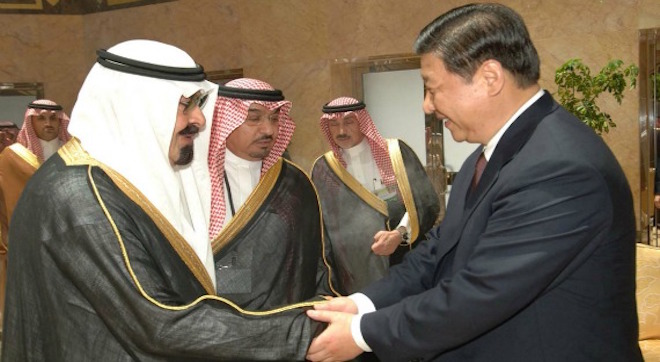
China is slowly beginning to augment bilateral diplomatic relations with regional partners, moving beyond collective action as part of their role as a permanent member on the UNSC. President Xi’s recent trip to the Middle East, the first by a Chinese president since 2009, included visits to its three largest trading partners in the region (Egypt, Saudi Arabia, Iran), signing dozens of new economic deals, particularly with Tehran. Sino-​Iranian relations in particular have been strengthened, with Tehran now named a ‘great neighbour’ in Chinese foreign policy – a term denoting a state which shares similar economic, political, and strategic interests with Beijing. China, however, must balance its interests in Iran with those in Saudi Arabia, their largest oil partner, particularly as tensions have been rising dramatically with both powers supporting opposing sides in various regional conflicts. One can also add the cessation of diplomatic relations between the two, when Saudi Arabia’s Iranian embassy was sacked following Riyadh’s execution of a prominent Shia Cleric.

Beijing remains reluctant to fully engage in the region, especially on the military front. Much of this apprehension stems from the United States’ expected reaction of more comprehensive Chinese involvement in an area historically defined by heavy American influence. Despite protests for Beijing to become more of a ‘responsible stakeholder’ in providing public security goods in support of the international system, China believes the deployment of military forces, regardless of their composition or purpose, would create anxiety in Washington, thereby drawing their strategic focus towards them vice their current fixation with Russia and its recent activities in Ukraine and Syria.

Chinese concerns regarding the lack of influence over their SLOCs including oil supply routes from the Middle East has motived the military, particularly the People’s Liberation Army Navy (PLAN), to focus towards expeditionary operations under the new mandate of ‘Open Seas Protection’ as opposed to their traditional role of coastal defence. The PLAN will continue to remain mostly active and focused in their immediate environment but have begun operating abroad in new theatres, most recently in the Bering Sea which drew much interest (and concern) in the US media. Beijing, wanting to avoid the strategic gaze of the West, has been surgical in employing them abroad, especially the Middle East. To date, Chinese military deployments have focused on protection of commercial traffic from piracy in the Gulf of Aden; assisting in the evacuation of citizens (and other foreign nationals) from conflict zones such as Yemen; and non-​combat units participating in UN peacekeeping missions. China, therefore, despite their fury following the execution of a Chinese journalist by ISIS, will most likely not deploy military assets in any large measure to the region anytime soon, especially in a combat role.

Beijing has pursued a low-​profile role in the region’s complicated political environment to avoid comprising other aspects of their foreign policy, not least relations with other major powers, most importantly the United States. Chinese leaders have and will avoid calls from some within the region, such as Egypt (which admires and wants to emulate Beijing’s successful development model of economic modernization without political pluralism), for a greater Chinese presence and leadership role to counterbalance the West. China does not necessarily lack the capacity to assume such a role (even if it lacks experience in global leadership) but will continue to play more a supporting role and rely on the other major powers to do the heavy lifting in maintaining regional stability.

Throughout this process, Beijing will continue to position itself in a supportive and non-​threatening role, allowing Russia to assume the mantle of the geopolitical ‘destabilizing other’ displacing American leadership and influence in the region. China will continue to expand its diplomatic engagements throughout the region, specifically on a bilateral level with Iran and Saudi Arabia, but these shall not result in any comprehensive change in Beijing’s current regional strategy. Assisting (but not leading) in regional stability efforts; building strong and reliable economic partnerships; and avoiding the entanglements of great power competition over influence and leadership between Russia and the United States will remain Beijing’s main objectives in the Middle East.

Adam P. MacDonald is an independent academic whose work focuses on Canadian foreign policy in Asia, Chinese naval developments, and the ongoing political transition in Myanmar. He can be reached at adampmacdonald@gmail.com. (Image courtesy of Reuters.)