Tag Archives: China

First China-India Maritime Dialogue: Beyond ‘Icebreaking’

This article originally featured at the National Maritime Foundation. It may be read in its original form here.

By Gurpreet S. Khurana

On 4th February 2016, India and China held their first-ever ‘Maritime Affairs Dialogue’ at New Delhi. While the Indian side was led by the Joint Secretary (Disarmament and International Security Affairs) in the Ministry of External Affairs (MEA), the Chinese delegation was led by the Assistant Minister of the Chinese Ministry of Foreign Affairs (MFA). Given that the two sides agreed to institutionalize a dialogue, the inaugural event was indeed ‘seminal.’ Although the details of the discussions are not yet available in the public domain, this essay attempts to extrapolate the open-source reports, and ‘look beyond’ it in context of emerging imperatives.

Since the turn of the new millennium, or even earlier, it began to be realized and acknowledged world-wide that the texture of future security and geopolitical environment in the ‘resurgent’ Asia will depend much upon how the two resident regional powers – India and China – will shape their relations at the bilateral level. The two countries have traditionally been continental neighbours. However, since at least a decade ago, the waters of the Indo-Pacific have become an arena for a maritime interface between the two in diverse arenas encompassing geopolitics, economics and security issues. The need, therefore, for the two countries to institutionalize a maritime dialogue has been long overdue. It may be recalled that the foreign ministers of two sides had first decided to initiate the maritime dialogue nearly four years ago in March 2012. Such an arrangement is essential to foster cooperation, while also preventing unproductive competition and confrontation.
W020160206349057173647
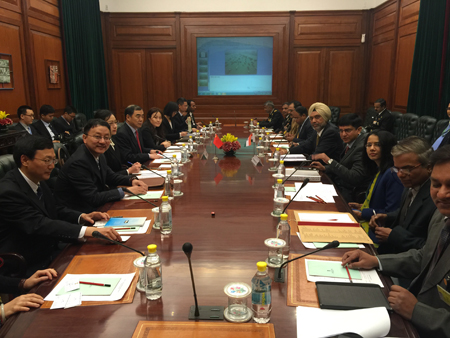
Representatives of India and China meet for inaugural Maritime Dialogue. Photo Source: PRC MFA.

Soon after the first Dialogue, the Indian MEA issued a press-release indicating its essentials. It states: 

The dialogue covered issues of mutual interest, including exchange of perspectives on maritime security, developments in international regimes such as UNCLOS (United Nations Convention on the Law of the Sea, 1982) and (the other) IMO (-related treaties) and prospects for maritime cooperation”.

The Chinese MFA press-release on the Dialogue states:  

Both sides introduced their respective maritime development strategies and their respective stance and views on current maritime security situation, and agreed to enhance policy dialogue and expand practical cooperation in such areas as marine scientific research, navy exchanges, fishery and navigation in a joint effort to ensure maritime security and harmony.”

The ‘exchange of views and perspectives on maritime security’ may have begun with the two sides drawing satisfaction from the successful multinational anti-piracy mission in the Gulf of Aden, wherein India and China have been coordinating their policies and naval operations since 2008, including at the ‘Contact Group on Piracy off the Coast of Somalia’ (CGPCS). The discussions may have also included other issues relating to good order at sea in the Indo-Pacific region.

The “international regimes” are likely to have been discussed in the context of the developments in the South China Sea (SCS) relating to the maritime-territorial disputes, freedom of navigation, and resource exploration. These discussions would have been valuable for both sides. For India, it is necessary to tell China its position on its hydrocarbon exploration in the SCS and its growing naval engagements with the other SCS littoral countries. To China, it was an opportunity to present its perspectives, achieve transparency of policies, and allay concerns of the regional countries over its increased politico-military assertiveness in the region.

It seems, however, that the first India-China Maritime Dialogue was essentially an ‘ice-breaker,’ and in their own ways, both sides had envisaged their objectives to be rather limited, rather than symbolic. Since the Indian side was led by a Joint Secretary, the representation from the ‘functional’ agencies/ navy would have been pitched at the ‘Director/ one-star’ level or even below. From China’s perspective, the dialogue seems to have been accorded even lesser significance. The photograph released by the Chinese MFA indicates that the Chinese side did not have any naval representation at all, at least not in uniform.

Notably, two days earlier, a Chinese delegation under the same leadership was in Islamabad for the second China-Pakistan Maritime Dialogue; the first dialogue having been held in Beijing in July 2014. Since Pakistan’s delegation was headed by an Additional Secretary of the Foreign Ministry, functionaries much above the ‘Director/ one-star’ level would have been represented. The Islamabad event itself, the higher level of representation and the indicative scope of the discussions encompassing ‘maritime connectivity’, ‘security of international shipping lanes’ (ISL), ‘marine scientific research’, ‘search and rescue’ and ‘naval and coast-guard cooperation’ reveal the difference.
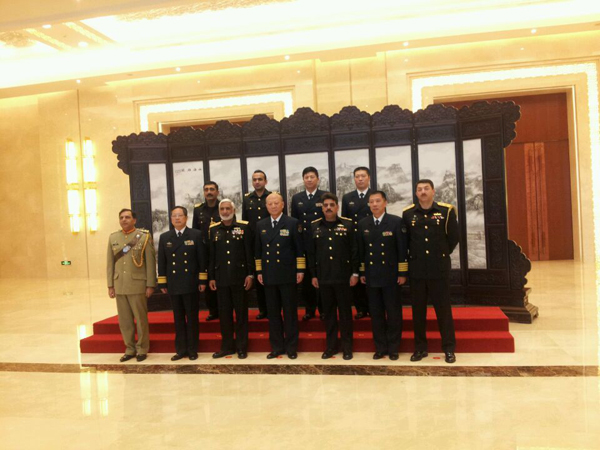
001aa0ba3c16167de95152
Admiral Muhammad Zakaullah, Chief of the Naval Staff of Pakistan, arrives in Beijing on an official visit  to China at the invitation of Admiral Wu Shengli, Chief of the PLA Navy in March 2015. [Photo/China.org.cn].
On the Dialogue in New Delhi, neither the Indian nor the Chinese official report mentions any discussion on China’s ‘Maritime Silk Road’ (MSR) initiative, which is surprising. Further, the discussions on ‘practical cooperation’ on each of the issues mentioned in the Chinese MFA report is unlikely to have gone beyond China gauging whether and to what extent India is amenable to the prospect of cooperation on a particular issue. The mention of ‘marine scientific research’ is particularly instructive. It is a pointer to China’s emergence as a major maritime power and its intent to undertake such research in the Indian Ocean, with major strategic implications for India.

The next round of the India-China Maritime Dialogue is planned to “be held in Beijing on a mutually convenient date.” The agenda for this – and the ensuing dialogues – may need to be more ‘encompassing’, and include key issues that hold the key to a ‘harmonious’ maritime interface between the two countries. Most of these substantive issues broadly relate to China’s strategic intent in the Indian Ocean. These include ironing out the prevailing ambiguities of China’s MSR initiative, the rationale behind its emphasis on cooperating on ‘marine scientific research’’, and an agreement on a naval code of conduct for both force deployments and unintended tactical encounters, which could then be reciprocated by India with regard to its own naval units in the western Pacific.  

To address these issues, Dr. Ouyang Gouxing of China’s Hainan Academy for World Watch (HNIWW) aptly recommends a 2+2 Dialogue, wherein both sides are represented at the apex level by their respective foreign and defence ministries. He adds that the Chinese delegation would need to include a PLA Navy contingent from its South Sea Fleet (SSF), which is being integrated to the South War Zone responsible for China’s Indian Ocean strategy. India may also need to upgrade its naval participation accordingly. Hopefully, in due course, the two sides would be able to transcend bilateral issues and develop sufficient mutual trust to contribute to maritime security and stability in the Indo-Pacific region.

Captain Gurpreet S Khurana, PhD is Executive Director, National Maritime Foundation (NMF), New Delhi. The views expressed are his own and do not reflect the official policy or position of the NMF, the Indian Navy, or the Government of India. He can be reached at gurpreet.bulbul@gmail.com.

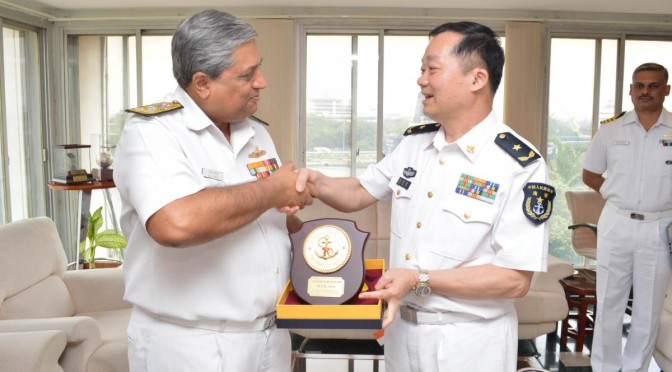
Featured Image: Rear Admiral Han Xiaohu, Commander PLAN Training Ship Task Group, and Rear Admiral Li Jianjun, Assistant Chief of Staff and Political Commissar of PLA Dalian Naval Academy visited the  Headquarters, Eastern Naval Command to meet with Vice Admiral Anil Chopra, Flag Officer Commanding-in-Chief of the Indian Navy on May 19, 2014. Source: Indian Navy.
Sea Control 114 – South China Sea with CAPT James Fanell

seacontrol2For a discussion on the South China Sea, Sally DeBoer, our Book Review Editor, brings in CAPT James Fannell (USN, Ret), the former Director of Intelligence and Information Operations (N2) for the US Pacific Fleet.  During the course of his thirty year career, CAPT Fanell specialized in Indo-Asia Pacific security affairs, with an emphasis on the Chinese navy and its operations. CAPT Fanell is an experienced public speaker noted for his candor and expertise. He is currently a government fellow for the Geneva Center for Security Policy and the author of Red Star Rising.

Download this week’s episode here!

[otw_shortcode_button href=”https://cimsec.org/buying-cimsec-war-bonds/18115″ size=”medium” icon_position=”right” shape=”round” color_class=”otw-blue”]Donate to CIMSEC![/otw_shortcode_button]

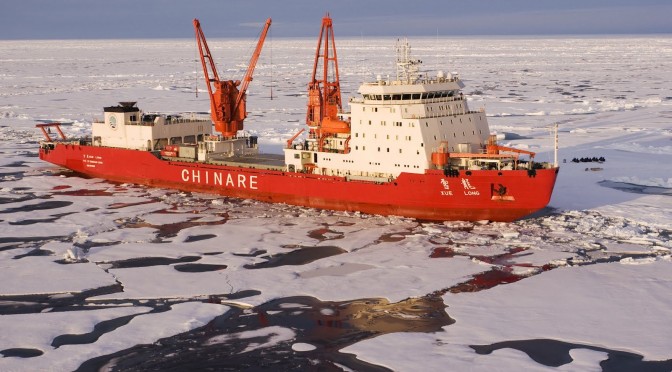
China’s Arctic Engagements: Differentiating Reality From Apprehension

The following article was originally featured by the Conference for Defense Associations Institute. It is republished with permission, and may be read in its original form here.

CDA Institute Security & Defence Blogger Adam MacDonald, an independent scholar on Canadian foreign policy and Asia-​Pacific security, looks at China’s approach to the Arctic.

China’s increasing Arctic engagements overall have been welcomed by the region’s stakeholders. There are, however, arguments in the media and some academic quarters that China’s growing involvement threatens to destabilize the region. Beijing, despite the absence of Arctic territory, is unilaterally asserting itself into the regional institutional architecture, challenging the pre-​eminent role of the Arctic states and their sovereign rights, while their ‘Arctic envy’ to secure regional shipping lanes and resources currently is manifested through political and economic manoeuvring. In the future China may become more forceful in these endeavours, including possible military deployments in the North.

Much of these commentaries are imprecise and speculating at best, largely ignoring the pathways and processes China’s Arctic endeavours have evolved. Lack of specifics on how and why China constitutes a threat to the region, also, demonstrate these arguments derive from the more generalized (yet still problematic) ‘Assertive China’ narratives which have become dominate in Western analyses of Chinese foreign policy. Clearly, China is actively trying to alter the power dynamics in its immediate environment of East Asia. But it is premature to talk of a revisionist challenge to the international system writ large guiding the entirety of Beijing’s foreign engagements. Before assigning China’s Arctic activities to an underlying revisionist agenda, therefore, it is important to further analyze the lines of engagement Beijing is actually pursuing.

China does not have an official Arctic Policy due to the low importance of the region within their broader foreign policy strategy, which is focused on immediate access to resources. The Arctic, though, is an area of long-​term interest motivating Chinese leaders to begin a ‘nascent stage of formulation’ in terms of constructing a regional strategy. Chinese academia, media and the military, also, have become more vocal and engaged in this process.

China’s Arctic engagements originate from and are still dominated by scientific research projects, specifically pertaining to climatic and regional weather phenomenon. These endeavours have increased significantly over the past decade including the 2004 establishment of the Yellow River Station in Spitsbergen, Norway; the creation of the China-​Nordic Research Center in Shanghai in 2013; and the construction of an Aurora Station in Iceland. China, as well, is looking to establish an Arctic research centre in Canada and is building a second scientific icebreaker in conjunction with Finland. Some commentators are quick to dismiss Beijing’s scientific endeavours as camouflaging other more malign political goals, but one should not dismiss the fact that China faces massive environmental and climate change challenges, which motivates much of their scientific and climate work internationally.

Bilateral economic relations is the second line of China’s Arctic engagements. Central Asia, the Middle East, and Africa remain Beijing prioritized regions for resource acquisition but the Arctic states, particularly the Nordic countries, have developed robust resource development projects with China. The strongest of these relationships is with Iceland, where China signed a Free Trade Agreement in 2013 and was awarded its first exploration license in the region for oil in the Dreki area. Chinese companies, as well, have invested billions into mineral-​rich Greenland, a protectorate of Denmark. These relations, however, have not been entirely unproblematic. Iceland’s parliament blocked a land-​purchase deal of a Chinese developer due to concerns over what the land would be used for and investments in Greenland have caused local anxieties over Chinese dominance in the economy, including the possible (but overhyped) importation of thousands of Chinese workers. China has also made inroads into the Canadian and particularly Russian energy markets, the latter following the post-​Crimea sanctions régime that left Moscow short of capital and partners for Arctic resource development. But Ottawa and Moscow, more so than the Nordic states, are wary of the consequences of Chinese economic activities in the North. China’s ability and willingness, however, to invest significantly in these remote areas (particularly Greenland), requiring possibly decades of development before profitable returns are generated, motivates many Arctic stakeholders to engage Chinese companies despite concerns about their government ties and overall environmental and labour standards.

China, finally, has been energetic in gaining entry into the Arctic governance structure and acceptance as a legitimate and non-​threatening stakeholder. After two failed attempts, in 2013 China (along with a host of other Asian countries) were accepted by the Arctic Council, the pre-​eminent regional organization, as Permanent Observers. Despite having no voting rights, Permanent Observers are allowed to take part in seminar discussions and participate in the organization’s working groups. One of the major conditions China (and other applicants) had to meet was acceptance of the Nuuk Criteria which includes acknowledging the pre-​eminent role and responsibility of Arctic states in regional affairs; their sovereignty and sovereign rights; and recognizing the United Nations Convention on the Law of the Sea as the legal régime governing the Arctic. This measure alleviated concerns associated with a more active China by showing their willingness to abide by the rules and conditions of the regional régime.

Chinese leaders, nevertheless, do assert that the Arctic possess certain trans-​regional characteristics which necessitate the involvement of non-​Arctic states (a position held by a number of other Asian states) and as a ‘Near Arctic State’ has a legitimate role to play. Despite some frictions, including over issues of extended maritime zoning claims by the Arctic coastal states which China sees a possibly marginalizing non-​Arctic states access to the North, Beijing has decided to become part of the regional structure and not attempt to create parallel organizations and mechanisms to pursue its interests.

Contrary to portrayals of China as an assertive and bellicose outsider, Beijing’s actions have been conducted through legal and accepted channels, including participating at a low and non-​intrusive level in the regional political architecture. Acknowledging the differences between Beijing and some Arctic actors over issues of maritime rights and the role of non-​Arctic states in regional governance, there is very little evidence of China becoming more aggressive in these pursuits. The Arctic, furthermore, is a stable region characterized by an ever evolving rule-​bound régime populated by developed states, including the world’s two nuclear superpowers, and the absence of war and failed states: conditions which heavily influence the pathways and processes China is and will pursue their interests in the future.

China’s interests in the Arctic, furthermore, align with their broader foreign policy goals of diversifying energy and resources suppliers, securing trade routes and becoming more active in global and regional governance instruments commensurate with their growing great power status and role. Speculations of China’s ‘aggressive’ posturing in the Arctic, however, will undoubtedly continue to inaccurately colour any discussion of the rising power’s actions in the Arctic; far more than any other Non-​Arctic, and particularly Asian, state involved in the region.

Adam P. MacDonald is an independent academic whose work focuses on Canadian foreign policy in Asia, Chinese naval developments, and the ongoing political transition in Myanmar. He can be reached at adampmacdonald@gmail.com. (Image courtesy: alexshakun​.blogspot​.com.)

Members’ Roundup: March 2016 Part One

By Sam Cohen

Welcome to part one of the March 2016 members’ roundup. Over the past month CIMSEC members have examined several international maritime security issues, including an increase in Russian naval activities and deployments, recent U.S. naval exercises demonstrating the Fleets’ application of the distributed lethality concept, laser technologies and the U.S. defense acquisition program and as usual, the increasingly tense security environment in the Asia-Pacific.  

Paul Pryce begins the roundup in the Asia-Pacific with a discussion, on what he refers to as, the new era in Singaporean defense procurement. In his article at Offiziere, Mr. Pryce highlights that previous procurement strategies for the country’s Navy have focused on acquiring mainly European designed vessels, either built specifically for Singapore or purchased following a short period of service in the initial European country. However, the planned construction of eight indigenous Independence-class littoral mission vessels beginning in 2016 and the expected procurement of a domestically built light aircraft carrier through 2021 suggests that the Singapore’s shipbuilding capacity and overall maritime force projection capabilities are becoming increasingly strengthened – a significant implication for Singapore’s role in South East Asian security dynamics.

[otw_shortcode_button href=”https://cimsec.org/buying-cimsec-war-bonds/18115″ size=”medium” icon_position=”right” shape=”round” color_class=”otw-blue”]Donate to CIMSEC![/otw_shortcode_button]

Alex Calvo, for Asian Military Review, discusses the challenge Taiwan faces in securing a replacement for its four aged hunter-killer submarines (SSKs), two of which are vintage Tench-class World War II boats while the other two were commissioned in the Netherlands in 1987 and 1988. Mr. Calvo explains how Europe has become reluctant to support Taiwanese military procurement needs for fear of angering China while the United States no longer produces SSKs. He suggests that Taiwan may look to Japan as an alternative source for its SSK replacement largely due to recent efforts by the Japanese shipbuilding industry to win the contract for the Royal Australian Navy’s SSK procurement requirements while also noting a lack of other feasible alternatives.

Kyle Mizokami, for Popular Mechanics, discusses China’s plans to establish aircraft carrier battle groups tasked with defense of the country’s territorial sovereignty, maritime rights and overseas interests both regionally and perhaps globally. Mr. Mizokami highlights the nature of China’s first operational aircraft carrier, the Liaoning, as he explains its training role and limited capacity to carry large numbers of combat capable aircraft. However, he also notes that China has confirmed the construction of the Dalian carrier, which will have more hangar space for support and combat aircraft – but will still only displace about 50 000 tons, or half that of a modern U.S. carrier.

Leaving the Asia-Pacific, Dave Majumdar outlines the implications of Russia’s planned massive live-fire nuclear exercise being conducted by two Project 955 Borei-class ballistic missile submarines deployed with the Northern Fleet. In his article at The National Interest, Mr. Majumdar explains how one of the missile boats will sequentially launch all sixteen of its RSM-56 Bulava missiles at a depth of 164ft while highlighting that such an exercise, whether a U.S. or Russian ballistic missile boat, would only launch their entire payload in conflict as part of full-scale retaliatory or offensive nuclear strike. In a second article at The National Interest, Mr. Majumdar discusses the spotting of a Russian Project 667 BDRM Delfin-class ballistic missile submarine near French territorial waters – the boat carries sixteen missiles capable of carrying four nuclear warheads each with a range of 7500 miles.

Bryan McGrath, for the War on the Rocks, provides the ‘First Principles’ that will help guide the difficult task of structuring the U.S. Navy’s future fleet. Mr. McGrath emphasizes that the Navy must be sized and shaped into a fleet that allows for both combat-credible and presence forces to be positioned globally in a manner that secures national interests while effectively deterring major power conflict. He also mentions the implementation of the distributed lethality concept, where individual platform lethality is increased even as the force becomes geographically dispersed. On this point, Mr. McGrath argues that an individual combat capacity increase should not compel policy makers to reduce the size of the fleet, as one does not necessarily balance the others strategic importance. On the same topic at The National Interest, Dave Majumdar describes a recent test of the SM-6 missile where it was revealed that the system now retains effective anti-surface capability, a major step for distributed lethality implementation across the fleet.

Members at CIMSEC were also active elsewhere during the first part of March:

CIMSEC has also recently (February) published a compendium discussing a range of strategies, challenges and policy options concerning Distributed Lethality. You can find a download link for all of the articles here.

At CIMSEC we encourage members to continue writing, either here on CIMSEC or through other means. You can assist us by emailing your works to dmp@cimsec.org.

Sam Cohen is currently studying Honors Specialization Political Science at Western University in Canada. His interests are in the fields of strategic studies and defense policy and management.

[otw_shortcode_button href=”https://cimsec.org/buying-cimsec-war-bonds/18115″ size=”medium” icon_position=”right” shape=”round” color_class=”otw-blue”]Donate to CIMSEC![/otw_shortcode_button]