Today, the Permanent Court of Arbitration released its decision on Philippines vs. China. The decision is linked below. The deadline for submissions for the CIMSEC South China Sea Security topic week will be extended from Sunday, July 17, to Sunday, July 24, to provide prospective contributors with more time to finalize their submissions. The topic week will now begin the week of July 25.
Written by Vidya Sagar Reddy, The Red Queen’s Navy will discuss the influence of emerging naval platforms and technologies in the geostrategic contours of the Indo-Pacific region. It identifies relevant historical precedents, forming the basis for various maritime development and security related projects in the region.
“Now, here, you see, it takes all the running you can do, to keep in the same place.”– The Red Queen, Through the Looking Glass, Lewis Carroll.
By Vidya Sagar Reddy
A recentRAND report underscored the significance of the strategy by certain states of employing measures short of war to attain strategic objectives, so as to not cross the threshold, or the redline, that trips inter-state war. China is one of the countries cited by the report, and the reasons are quite evident. The employment of this strategy by China is apparent to practitioners and observers of geopolitics in the Indo-Pacific region. The diplomatic and military engagements in this region call attention to the South China Sea, where China’s provocative actions continue to undermine international norms and destabilize peace and security.
Vietnam and the Philippines are the two claimants determined to oppose such actions with the support of other regional security stakeholders. They intend to shore up their military strength, especially in the maritime domain. The Philippines decided to upgrade military ties with the U.S. through an agreement allowing forward basing of American military personnel and equipment. It will receive $42 million worth of sensors to monitor the developments in West Philippine Sea. Additionally, India emerged as the lowest bidder to supply the Philippines with two light frigates whose design is based on its Kamorta class anti-submarine warfare corvette.
The recent visit of US. President Obama to Vietnam symbolizes transformation of the countries’ relationship to partners and opened the door for the transfer of lethal military equipment. Vietnam is considering the purchase of American F-16 fighters and P-3C Orion maritime patrol aircraft. Its navy is already undergoing modernization with the induction of Russian Kilo class submarines. India, which uses the same class of submarines, helped train Vietnam’s submariners. Talks with Vietnam to import India-Russia joint BrahMos supersonic anti-ship cruise missiles seem to be in an advanced stage.
But, this military modernization is concentrated on strengthening the conventional domain of the conflict spectrum, while China accomplishes its objectives by using sub-conventional forces. China’s aggressive maritime militia and coast guard are the real executors of local tactical contingencies, while its navy and air force provide reconnaissance support and demonstrate muscle power.
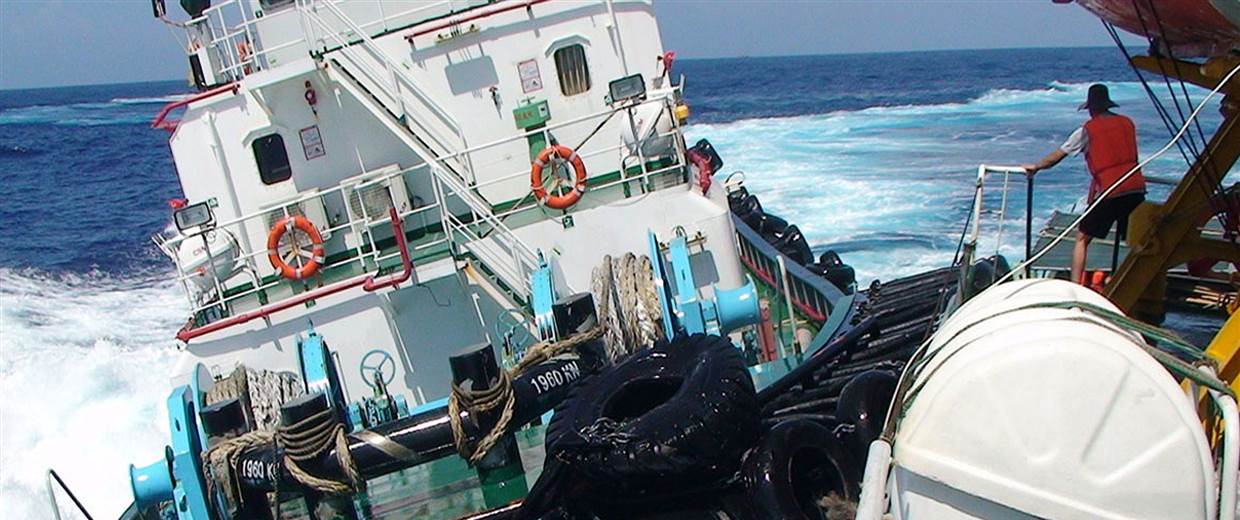
This June 23, 2014 handout photo from Vietnam’s maritime police shows a Chinese boat (L) supposedly ramming a Vietnamese vessel (R) in contested waters near China’s deep sea drilling rig in the South China Sea. (MARITIME POLICE / AFP – Getty Images)
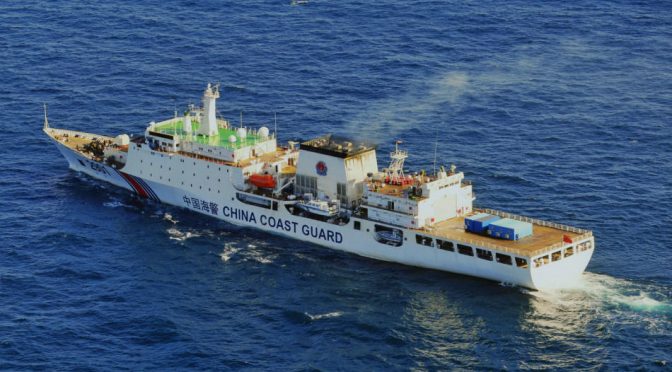
The 2014 HYSY 981 oil rig stand-off, when China’s vessels fired water cannons and rammed into Vietnamese boats, serves as a classic example of China’s use of sub-conventional forces. Some of these platforms are refitted warships, and the total vessel tonnage has far exceeded the cumulative tonnage of neighboring countries. China has also deployed coast guard cutters weighing more than 10,000 tonnes, the largest in the world. They cover maritime militia’s activities like harassing Vietnamese and other littoral fishermen from exercising their rights or defend China’s illegal fishing activities in the exclusive economic zones of other countries. Recently, they have forcefully snatched back a Chinese fishing vessel that had been detained by the Indonesian authorities for transgression.
Such provocative actions to forcefully lay down new rules on the ground need to be challenged, but using conventional air and naval assets will only lead to escalation. It is advisable to learn from China’s strategist himself in this context, Sun Tzu, who counsels that it is wise to attack an adversary’s strategy first before fighting him on the battlefield.
Therefore, both Vietnam and the Philippines must also concentrate on building up the capacity of respective coast guards and maritime administration departments with relevant assets like offshore patrol vessels (OPV) to secure the islands and exclusive economic zones. Operating independently in these areas inevitably hedges against China’s proclamation of South China Sea as its sovereign territory and requiring its consent to operate in.
Vietnam is inducting patrol boats furnished by local industries as well as depending on the pledge from the U.S. to provide 18 patrol boats. The Philippines contracted a Japanese company to build 10 patrol vessels on a low-interest loan offered by Japan’s government. It is also set to receive four boats from the U.S.
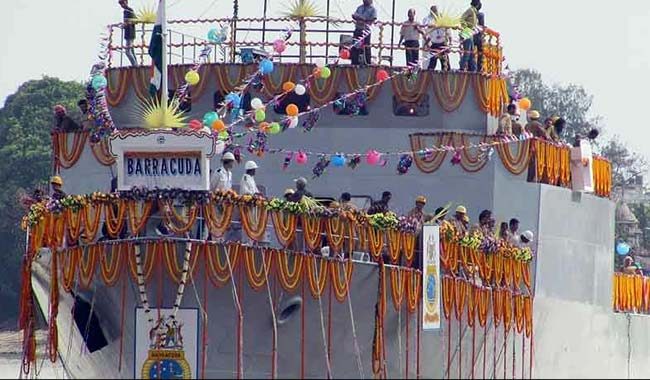
India should also take a proactive position and join its regional security partners in extending its current efforts in the Indian Ocean to the South China Sea. India has built high level partnership programs to build the capacity of its neighboring Indian Ocean countries to ensure security of their exclusive economic zones. In the process, it delivered some of its OPVs to Sri Lanka. Recently, Mauritius became the first customer of India’s first locally built OPV Barracuda. India is now building two more for Sri Lanka. Additionally, Vietnam has contracted an Indian company to build four OPVs using the $100 million line of credit offered by the Indian government.
Warship Barracuda docked in Kolkata. (Garden Reach Shipbuilders and Engineers Ltd)
Thedemand for these vessels will only grow as the strategic competition in the South China Sea escalates. India enjoys better political, historical, and security relations with the South East Asian countries, especially Vietnam. The Philippine government has underscored this relationship between India and Vietnam as the foundation for its own relations with India. Taking advantage of this situation not only improves India’s strategic depth in the region but also enhances its manufacturing capacity that is at the core of Make in India initiative.
The specific requirements like range, endurance, and armament depend on the customer countries. The more critical question at play is whether the regional security stakeholders are comfortable with the idea of upgunned coast guards along the South China Sea littoral.
The U.S. has forward deployed four of its Littoral Combat Ships (LCS) to Singapore to tackle a variety of threats emanating in the shallow waters. The ships are smaller than a frigate but larger than an OPV in terms of sensor suites, armament, mission sets, and maintenance requirements. War simulations proved that upgunned LCS can cross into blue water domain with ease and complicate an adversary’s order of the battle.
Vietnam and the Philippines could specify higher endurance, better hull strength and advanced water cannons for their OPVs to defend proportionally against Chinese vessels. In addition to manufacturing ships, India should also train Vietnamese and Philippine forces on seamlessly integrating intelligence from different assets for maritime defense.
Over time, a level of parity in the sub-conventional domain needs to be achieved and maintained to force China to either shift its strategy or escalate the situation into conventional domain whereupon the escalation dominance will shift to status quo countries.
Vidya Sagar Reddy is a Research Assistant at the Observer Research Foundation, New Delhi.
Featured Image: Chinese 10,000 ton coast guard cutter, CCG 2901. (People’s Daily Online)
This publication was originally featured on Bharat Shaktiand is republished with permission. It may be read in its original form here.
By Vice Admiral Pradeep Chauhan AVSM & Bar, VSM, IN (Ret.)
Editor-in-Chief’s Note
Part I of this two-part article introduced the geoeconomic and geostrategic imperatives that shape China’s geopolitical drives. It also presented the overarching concept of “reach” as an aid to understanding the international import of China’s military strategy. Read Part I here.
In this second and concluding part of the article series the author explores Chinese strategic intent and its ramifications. The article provides an account of the naval facilities China is promoting or constructing on disputed islands among littoral states of the Indian Ocean; assesses China’s economic linkages with African nations; and projects the growth curve of the Chinese Navy, all of which are important to keep in view while analyzing the trajectory of Chinese geo-strategic intent.
By emphasizing the factor of temporal strategic-surprise (in contrast to spatial surprise), the author offers clues to understanding the links between China’s military strategy and her geopolitical international game-moves as they are being played out within a predominantly maritime paradigm. As in the famous Chinese game of Go—perhaps a more apt analogy than chess—the People’s Republic is putting in place the pieces that will shape her desired geopolitical space. The author explores the spatial and temporal dimensions of the Chinese strategy and the related vulnerabilities of the opposing Indian establishment.
In his 2006 dissertation written at the US Army War College then-Lt. Col Christopher J. Pehrson, USAF, termed the Chinese geostrategy the “String of Pearls.” This expression, first used in January 2005 in a report to U.S. military officials prepared by the U.S. consulting firm of Booz Allen Hamilton, caught the attention of the world’s imagination. Pehrson posited China as a slightly sinister, rising global power, playing a new strategic game, as grandiose in its concept, formulation and execution as the “Great Game” of the 19th century. Despite vehement and frequent denials by Chinese leadership of any such geostrategic machinations designed at the accumulation of enhanced geopolitical and geoeconomic power and influence, the expression rapidly embedded itself into mainstream consciousness.
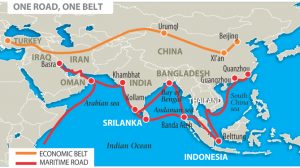
China’s One Road, One Belt economic infrastructure initiative. (Chinausfocus.com)
As a net result, for over a decade, China has chafed under the opprobrium heaped upon it for a concept that (to be fair) it had never once articulated by the state. However, in a brilliant rebranding exercise by Beijing in 2014, the world’s attention is being increasingly drawn away from the negative connotations associated with the phrase String of Pearls and towards the more benign-sounding 21st century Maritime Silk Route Economic Belt, also known as “One Road, One Belt.” This presents an alternative expression, while it nevertheless covers essentially the very same geostrategic maritime game-plays that Colonel Pehrson explained a decade ago. The new expression emphasizes transregional inclusiveness and evokes the romance of a shared pan-Asian history with the implied promise of a reestablishment of the economic prosperity that the Asian continent’s major civilizational and socio-cultural entities, namely China and India, enjoyed until the 18th century.
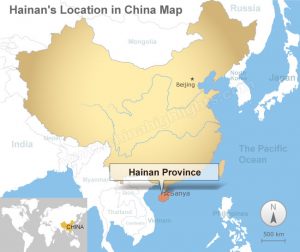
Each “pearl” in the String of Pearls construct—or in more contemporary parlance, each “node” along the Maritime Silk Route—is a link in a chain of Chinese geopolitical and geostrategic influence. For example, Hainan Island, with its recently upgraded military facilities and sheltered submarine base, is a pearl/node.
It is by no means necessary for a line joining these pearls/nodes to encompass mainland China in one of the concentric ripples typified by the Island Chains strategy. In fact, since the Maritime Silk Route is a true maritime construct, it is highly unlikely that the nodes would do so.
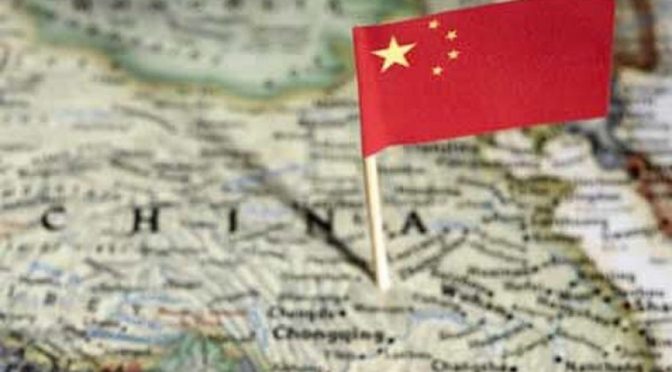
The location of Hainana Province, China. (chinahighlights.com)
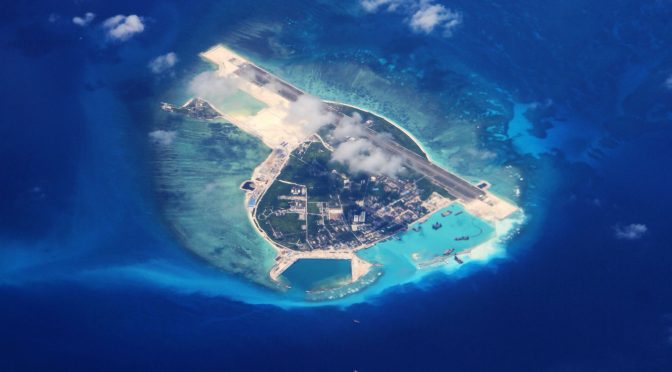
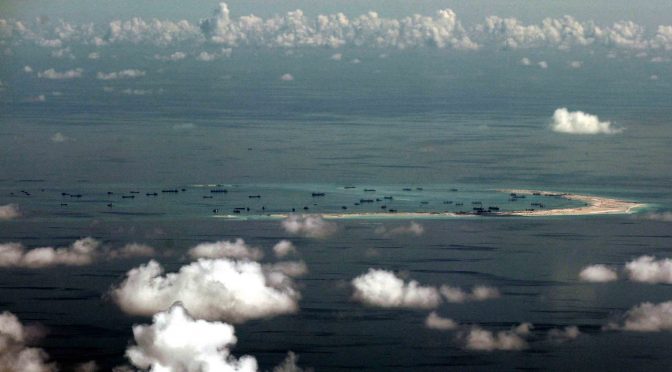
Other pearls/nodes include the recent creation of artificial islands in the Paracel and Spratly islands incorporating, inter alia, the ongoing construction/upgrade of airstrips on Woody Island—located in the Paracel Islands, some 300 nm east of Vietnam—as also on Mischief Reef and Fiery Cross Reef in the Spratly Islands. Additional pearls/nodes have been obtained through Chinese investments in Cambodia and China’s continuing interest in Thailand’s Isthmus of Kra.
China’s development of major maritime infrastructure abroad—the container terminal in Chittagong, Bangladesh; the Maday crude oil terminal in Myanmar’s Kyakpyu port; the development of ports such as Hambantota in Sri Lanka, Gwadar in Pakistan, Bagamoyo in Tanzania, Beira in Mozambique, Walvis Bay in Namibia, Kribi in Cameroon, the Djibouti Multipurpose Port (DMP), and the offer to even develop Chabahar in Iran (checkmated by a belated but vigorous Indian initiative), along with the successful establishment of a military (naval) base in Djibouti—all constitute yet more pearls/nodes. The development of an atoll in the Seychelles, oil infrastructure projects in Sudan and Angola, and the financing of newly discovered massive gas finds in offshore areas of Mozambique, Tanzania and the Comoros, are similarly recently acquired pearls/nodes. Even Australia yields a pearl/node, as does South Africa, thanks to Chinese strategic investment in mining in general and uranium-mining companies in particular, in both countries.
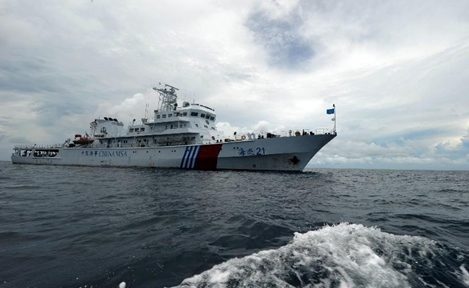
Chinese maritime policing vessel. (SCMP.com)
From an Indian perspective, China’s new strategic maritime-constructs (by whichever name) are simultaneously operative on a number of levels, several of which are predominantly economic in nature and portend nothing more than fierce competition. At the geostrategic level, however, the economy is at its apex and is China’s and India’s greatest strength and greatest vulnerability, at the same time; therefore, the economy is the centerpiece of the policy and strategy of both countries. This is precisely why, as the geographical competition space between India and China coincide in the Indian Ocean, there is a very real possibility of competition transforming into conflict, particularly as the adverse effects of climate change on resources and the available land area becomes increasingly more evident.
“Reach” has both spatial and temporal dimensions. The spatial facets of China’s geopolitical moves are evident, as illustrated in the preceding String of Pearls discussion. It is critical for India’s geopolitical and military analysts to also understand the temporal facets of this construct. The terms short term, medium term and long term are seldom used with any degree of digital precision. A nation tends to keep its collective “eye on the ball” in the short term and, by corollary, tends to assign far less urgency to something that is assigned to the long term. This ill-defined differentiation is how strategic surprise may be achieved in the temporal plane. For instance, in China, the short term generally implies 30 to 50 years. This is an epoch that is far in excess of what in India passes as the long term. Consequently, India fails to pay as close attention to developments in China as she might have were the developments to unfold in a duration corresponding to India’s own short term of 2-5 years. This distinction permits China to achieve strategic surprise, and this is as true of military strategy as it is of grand strategy and geoeconomics.
On the one hand, it should be remembered that these strategic constructs are not only about maritime infrastructure projects, involving the construction of ports, pipelines and airfields, though these developments constitute their most obvious and visibly worrisome manifestation. The strategy is equally about new, renewed or reinvigorated geopolitical and diplomatic ties between the People’s Republic of China and nation states across a very wide geographical swath (including the African littoral and the island nations of both the Indian Ocean and the Pacific Ocean). On the other hand, China’s strategic maritime constructs have some important military spin-offs, which closely align to the furtherance of geostrategic reach. Thus, by developing friendly ports of call (if not bases), facilities and favorable economic dependencies in the various pearls/nodes, the logistics involved in the event of an engagement in maritime power-projection are greatly eased.
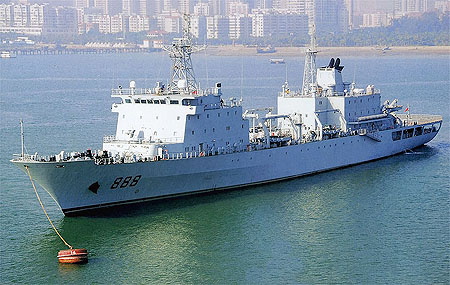
Type 904 (Dayun Class) Transport Ship (globalmil.com)
Supplementing the pearls/nodes are the Chinese Navy’s five impressive stores/ammunition supply ships of the Dayun Class (Type 904) and six underway replenishment tankers of the Qiandaohu Class (Type 903A). In addition, China requires ground control stations to meet her satellite-based needs of real-time surveillance. Unlike the United States, China simply does not have adequate ground control/tracking stations within the Indian Ocean to affect requisite ground control and real-time downlinking of her remote-sensing satellites. This forces her to deploy a number of ships (the Yuanwang Class) for this purpose. These constitute a severe vulnerability that China certainly needs to overcome. One way to do so is to establish infrastructure and acceptability along the IOR island states and along the East African littoral, as China is currently attempting to do.
The principal lack in the Chinese strategy to provide military substance to the country’s geoeconomic and geostrategic reach comes in the form of integral air power through aircraft carriers. China is rapidly learning that while one can buy or build an aircraft carrier in only a couple of years, it takes many more years to develop the human, material, logistic and doctrinal skills required for competent and battle worthy carrier-borne aviation. For nearly a decade now, China has demonstrated her ability to sustain persistent military (naval) presence in the Indian Ocean—albeit in a low threat environment. Combat capability is, of course, quite different from mere presence or even the ability to maintain anti-piracy forces, since the threat posed to China by disparate groups of poorly armed, equipped and led pirates can hardly be equated with that posed by a powerful and competent military adversary in times of conflict.
Despite the impressive growth of the Chinese Navy and the vigor of the Chinese military strategy, China may not, in the immediate present, have the combat capability to deploy for any extended period of time in support of its geoeconomic and geostrategic reach were they to be militarily contested by a major navy. However, as James Holmes points out, if India were to continue to cite shortfalls in current Chinese capability and conclude that it will take the PLA Navy at least fifteen years to station a standing, battle worthy naval squadron in the Indian Ocean, this would lull Indians into underplaying Chinese determination and the speed of that country’s military growth. This would carry the very real consequent possibility of India suffering a massive strategic surprise. Is that something that India can afford?
Vice Admiral Pradeep Chauhan retired as Commandant of the Indian Naval Academy at Ezhimala. He is an alumnus of the prestigious National Defence College.
Week Dates: July 18-22, 2016 Articles Due: July 17, 2016 Article Length: 800-1800 Words (with flexibility) Submit to: Nextwar@cimsec.org
In mid-July CIMSEC will be launching a topic week on the security situation in the South China Sea. Tensions are on the rise as China continues to defend its nine-dash claim in the South China Sea while most other claimants and regional powers strengthen security cooperation agreements with the United States. Rules based international order is being challenged as numerous militaries in the region modernize with growing defense budgets.
How may South China Sea disputes animate the geopolitics of the Asia-Pacific region? How may crises and flashpoints come about, be diffused, or escalate? How can claimants restore trust? How is the regional military balance of power trending, and what would conflict look like? How can rules based order be preserved in Asia’s maritime domain, and what does its violation warrant for the future?
Contributors are encouraged to answer these questions and more as they seek to understand the complexity of the strategic crossroads that is the South China Sea. Please submit draft contributions to Nextwar@cimsec.org.
Editor’s Note: This topic week has since concluded and the writings submitted in response to this call for articles may be viewed here.
Dmitry Filipoff is CIMSEC’s Director of Online Content. He may be contacted at Nextwar@cimsec.org.
Featured Image: Aerial view of the Yongxing Island, also known as Woody Island in the South China Sea on June 19, 2014 in Sansha, Hainan Province of China. ChinaFotoPress/Getty Images

 influence of emerging naval platforms and technologies in the geostrategic contours of the Indo-Pacific region. It identifies relevant historical precedents, forming the basis for various maritime development and security related projects in the region.