Tag Archives: Arctic

Yours, Mine, and Moscow’s: Breaking Down Russia’s Latest Arctic Claims

This article originally featured on CIMSEC on August 25, 2015, and has been updated for inclusion into the Russia Resurgent Topic Week. 

By Sally DeBoer

On August 4th, the Russian Federation’s Foreign Ministry reported that it had resubmitted its claim to a vast swath (more than 1.2 million square kilometers, including the North Pole) of the rapidly changing and potentially lucrative Arctic to the United Nations. In 2002, Russia put forth a similar claim, but it was rejected based on lack of sufficient support. This latest petition, however, is supported by “ample scientific data collected in years of arctic research,” according to Moscow. Russia’s latest submission for the United Nation’s Commission on the Limits of the Continental Shelf’s (CLCS) consideration coincides with increased Russian activity in the High North, both of a military and economic nature. Recent years have seen Russia re-open a Soviet-era military base in the remote Novosibirsk Islands (2013), with intentions to restore a collocated airfield as well as emergency services and scientific facilities.  According to a 2015 statement by Russian Deputy PM Dmitry Rogozin, the curiously named Academic Lomonsov,  a floating nuclear power plant
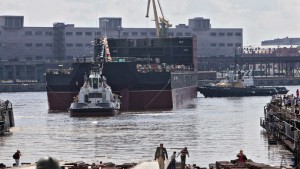
Academic Lomonsov under construction. Please click on the image for its source.

built to provide sustained operating power to Arctic drilling platforms and refineries, will be operational by 2016. Though surely the most prolific in terms of drilling and military activity, Russia is far from the only Arctic actor staking their claim beyond traditional EEZs in the High North. Given the increased activity, overlapping claims, and dynamic nature of Arctic environment as a whole, Russia’s latest claim has tremendous implications, whether or not the United Nations CLCS provides a recommendation in favor of Moscow’s assertions.

The Claim:

Russia’s August 2015 claim encompasses an area of more than 463,000 square miles of Arctic sea shelf extending more than 350 nautical miles from the shore. If recognized, the claim would afford Russia control over and exclusive rights to the economic resources of part of the Arctic Ocean’s so-called “Donut Hole.” As the New
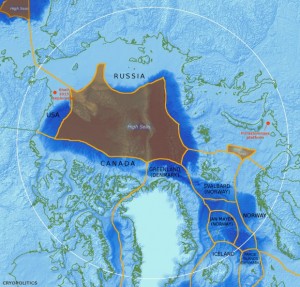
A depiction of the "Donut Hole."
A depiction of the “Donut Hole.”

York Times’ Andrew Kramer explains, “the Donut Hole is a Texas sized area of international waters encircled by the existing economic-zone boundaries of shoreline countries.” As such, the donut hole is presently considered part of the global commons. Moscow’s claim is also inclusive of the North Pole and the potentially lucrative Northern Sea Route (or Northeast Passage), which provides an increasingly viable shipping artery between Europe and East Asia. With an estimated thirteen percent of the world’s undiscovered oil and thirty percent of its undiscovered natural gas, the Arctic’s value to Russia goes well beyond strategic advantage and shipping lanes. Recognition by the CLCS of Russia’s claim (or any claim, for that matter) would  shift the tone of activity in the Arctic from generally cooperative to increasingly competitive, as well as impinge on the larger idea of a free and indisputable global common.

The Law:

As most readers likely already know, the United Nations’ Convention on the Law of the Sea (UNCLOS) allows claimants 12nm of territorial seas measured from baselines that normally coincide with low-water coastlines and an exclusive economic zone (EEZ)
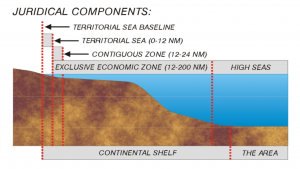
A depiction of universal claims afforded by UNCLOS

extending to 200 nautical miles (inclusive of the territorial sea). Exploitation of the seabed and resources beyond 200nm requires the party to appeal to the International Seabed Authority unless that state can prove that such resources lie within its continental shelf. Marc Sontag and Felix Luth of The Global Journal explain that “under the law, the continental shelf is a maritime area consisting of the seabed and its subsoil attributable to an individual coastal state as a natural prolongation of its land and territory which can, exceptionally, extend a states right to exploitation beyond the 200 nautical miles of its EEZ.”  Such exception requires an appeal to the Commission on the Limits of the Continental Shelf (CLCS), a panel of experts and scientists that consider claims and supporting data.  Essentially, the burden is on Russia to provide sufficient scientific evidence that its continental shelf (and thus its EEZ) extends underneath the Arctic. In any case, as per UNCLOS Article 76(5), such a continental shelf cannot exceed 350 nm from the established baseline. Russia’s latest claim is well beyond this limit; the Federation has stated that the 350 nm limit does not apply to this case because the seabed and its resources are a “natural components of the continent,” no matter their distance from the shore.

The CLCS will present its findings in the form of recommendations, which are not legally binding to the country seeking the appeal. Though Russia has stated it expects a result by the fall, the commission is not scheduled to convene until Feburary or March of 2016 and, as such, there will be a significant waiting period before any recommendation will be made.

Rival Claimants:

Russia is far from the only Arctic actor making claims beyond the 200 nautical mile EEZ. Denmark, for instance, jointly submitted a claim with the government of Greenland expressing ownership over nearly 900,000 square kilometers of the Arctic (including the North Pole) based on the connection between Greenland’s continental shelf and the Lomonosov Ridge, which spans kontinsokkel_uknearly the entire diameter of the donut hole. This claim clearly overlaps Russia’s latest submission, which is also based on the claim that the ridge represents an extension of Russia’s continental shelf. Though there is no dispute on the ownership of the ridge, both Russia and Denmark claim the North Pole.  Both nations have recently expressed a desire to work cooperatively on a resolution, though a Russian Foreign ministry statement did estimate a solution could take up to 10-15 years. Also of note: this has note always been Russia’s tune on the matter (See here and here).
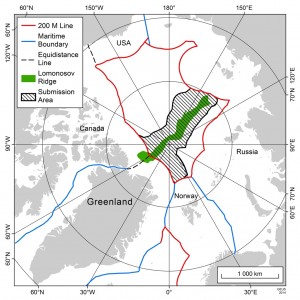
Similarly, Canada is expected to make a bid to extend its Arctic territory. Notably, Canada claims sovereignty over the Northwest Passage, a shipping route connecting the Davis Strait and Baffin Bay based on historical precedent and its orientation to baselines drawn around the Arctic Archipelago. The U.S. maintains that the Northwest Passage should be an international strait. Though they have yet to submit a formal claim to the UN’s CLCS, one has reportedly been in preparation since 2013. According to reports, Canada delayed a last-minute claim at the behest of PM Stephen Harper, who insisted the claim include the North Pole. If this holds true, Canada’s claim will likely overlap both Russia and Denmark’s submissions to the CLCS.  If the CLCS were to recognize the legitimacy of two or more states’ overlapping claims, the actors have the option to bilaterally or multilaterally resolve the issue to their satisfaction; developing such a resolution is beyond the scope of the commission.

Implications:

Likely, Russia’s submission to the United Nations is part of a larger campaign by Moscow to reassert and re-establish its influence in the international order by virtue of its status Arctic influence. Regardless of approval or rejection by the UN, Russia’s expansive claim highlights Moscow’s very serious intention to control and exploit the Arctic. As the Christian Science Monitor’s Denise Ajiri explains, “a win would mean access to sought after resources, but the petition itself underscores Russia’s broader interest in solidifying its footing on the world stage.” With much of Western Europe reliant on Russian oil and natural gas, the Arctic and its resources represent an opportunity for the Kremlin to boost their position in the international order and develop a source of sustained and significant income. Russia may be acting within the letter of the law on the issue of their claim at this time, but it’s hard to separate that compliance from the Federation’s significant investment in the militarization of the Arctic, frequent patrols along the coastline of Arctic neighbors, and expenditure on the economic exploitation of the High North. For now, the donut hole remains part of the global commons and therefore free from direct exploitation or claim of sovereignty.  The burden of proof on any one state to claim an extension of their continental shelf is truly enormous, but as experts and lawyers at the CLCS pore over these claims, receding Arctic ice combined with economic and strategic interests of the claimants will likely increase the claimants’ sense of urgency.

Sally DeBoer is a 2009 graduate of the United States Naval Academy and a recent graduate of Norwich University’s Master of Arts in Diplomacy program.  She can be reached at Sally.L.DeBoer@gmail(dot)com or on twitter @SallyDeBoer.
CIMSEC content is and always will be free; consider a voluntary monthly donation to offset our operational costs. As always, it is your support and patronage that have allowed us to build this community – and we are incredibly grateful.
Select a Donation Option (USD)

Enter Donation Amount (USD)

Russia in the Arctic: aggressive or cooperative?

Russia Resurgent Topic Week

By Laguerre Corentin

Since the early 2000s, Russia has begun to pay more attention to the Arctic when its general socioeconomic situation had improved.1 With the ice melting, other Arctic and non-Arctic countries demonstrated their interest for the region, creating territorial disputes. In the High North, Russia is often seen as taking an aggressive approach to assert its sovereignty and the West have been worried about Russia’s involvement in the region, especially after the Ukrainian Crisis and the Russian position in Syria. However, is Russia aggressive in the Arctic? We argue that Moscow is likely to promote cooperation with the Arctic states, but with its interests and national security in mind. The Arctic is of strategic importance for Russia because of its natural resources. Indeed, since the end of the Soviet era, Moscow does not see the region as a potential theatre of a strategic struggle with the West. Moreover, in its history, Russia took care to avoid escalating incidents, favoured cooperation, and the respect of international law in the Arctic because it was in its interest. Russia has learned that it could use the law and international organisations to its advantages. Putin’s aggressive tone seems more to fulfil domestic purposes rather than represent Russia’s intentions in the Arctic. To support our thesis it is useful to look at the country’s historical reliance upon legislation and treaties in the region, its current interests, and its emphasis on cooperation in the resolution of disputes.

[otw_shortcode_button href=”https://cimsec.org/buying-cimsec-war-bonds/18115″ size=”medium” icon_position=”right” shape=”round” color_class=”otw-blue”]Donate to CIMSEC![/otw_shortcode_button]

A history of reliance on legislation

Lincoln E. Flake argues that Russia’s current posture on the Continental Shelf is “a natural extension of Tsarist and Early Soviet policies on Arctic land territory”. Russia’s approach to the arctic issues seems to be impacted by previous policies.2 The first experience in claiming land and maritime control in the greater Arctic region occurred in its North American territories with the 1821 Ukase of Alexander I that had both a land and a maritime component. When the neighbouring states rejected the maritime component of the decree, the sole attempt by the Russian government to enforce it was the seizure of the USS Pearl in 1822, but the vessel was released and the maritime component of the decree was abandoned. Each time the Tsarist government tried to enforce a contested decree; it yielded to pressure and abandoned its maritime claims.3 Later, the Soviet government took advantage of treaties to advance its positions. As an example, the 1920 Svalbard treaty assured the Norwegian recognition of the Soviet government. Inadvertently, this treaty was favourable to the USSR by creating a demilitarised zone at the door of its Arctic sector. This event likely demonstrated to the Kremlin that sovereignty issues could be resolved through international treaties to Russia’s advantage. Each time, the authorities used the law to respond to sovereignty issues. Moscow developed a more detailed legislation about its control over the North Sea Route when it was handicapped from preventing foreign military navigation along its Arctic coastline. Moreover, Russia engaged in efforts to arrive at international treaty-based regimes favourable to its claims. This approach led to international conferences that ultimately resulted in the 1982 UNCLOS agreement, which was a resounding victory for Soviet aims in the Arctic.4

Russia’s renewed interests in the Arctic

Today, Russia considers the Arctic as a region of strategic importance for its national security due to the presence of the two-thirds of the Russian sea-based nuclear bases, and the direct access to the Arctic and Atlantic oceans provided by the Kola Peninsula. However, with the end of the Cold War, the region has lost its former military strategic significance as a zone of potential confrontation with the US/NATO.5 Principally, the Arctic is relevant to Russia’s economy and security because Moscow views a prosperous and secure supply of energy as a means of projecting its power in the world. Thus, the Arctic is directly linked to its economic interests. Around 20 percent of its gross domestic product is generated north of the Arctic Circle, as are 20 percent of Russia’s total exports in energy.6 On 18 September 2008, then-President Dmitri Medvedev approved the Foundations of the State Policy of the Russian Federation in the Arctic Up to and Beyond 2020. The document defined the Russian interests in the region – developing the resources in the Arctic, turning the NSR into a unified national transport corridor, maintaining the region as a zone of peace and international cooperation and transforming the Arctic as a “leading strategic resource base”.7 In addition, Russia’s National Security Strategy to 2020, released in May 2009, confirms the importance of the energy sector and connects the country’s success with its status as an energy provider, noting that energy-related issues and regions like the Arctic, the Caspian Sea and Siberia are an important component of its security planning.8

An emphasis on cooperation

In line with the approach developed in the early 2000, the 2013 Concept directs foreign policy to “strengthen Russia’s trade and economic position within the system of world economic relations”, and to use the “capabilities of international and regional economic and financial organisations” to support its economic interests. The Concept shows Russian willingness to work with institutions – particularly the UN – and to be more active internationally. A stated objective of its foreign policy has therefore been to emphasise institutions and issues that elevate its power status. If Putin was critical of Western initiatives and opposed them while employing a more aggressive tone, Russia has committed to more multilateral governance in the Arctic than other countries. Moreover, the Foundations of the State Policy of the Russian Federation in the Arctic for the Period Up to and Beyond 2020 identifies the Arctic as a zone of cooperation. The document asserts Russia’s willingness to work bilaterally and within the framework of regional organisations. Moscow has also taken care not to allow minor skirmishes to escalate.9 These elements balance the plans to extend the Northern fleet’s operational radius and the reinforcement of combat readiness on the Arctic coast. Furthermore, different Russian documents reveal that military security is not a priority, the emphasis being placed on economic concerns. This approach suggests that Russian threat perception is less concerned with strategic confrontation than with challenges to navigational assertions. In this regard, Russian military developments in the Region can be seen as a response to an anxiety over navigational-related interests and not a militarization in anticipation of a struggle over natural resources. Indeed, many of the recent military moves, like the reopening of a Soviet-era base in the Arctic to “ensure the security and effective work of the NSR”, are aligning with the protection of maritime spaces.10 Moreover, Moscow seems more interested to project its power by economic means than military ones because a key source of its power and influence in the world comes from its energy sector. Thus, this reduces the need for an aggressive posture.11

Conclusion

In conclusion, Russia relied on international law and cooperation in the Arctic through different periods of its history. Today, Russia is still a strong supporter of the UNCLOS as a tool to resolve regional disputes and insists upon the scientific basis of its territorial claims. According to Dmitri Trenin, Russia bases its Arctic strategy upon international law and agreements, and its actions in the Arctic may have seemed aggressive in part because they occurred in a context of worsening relations with the West. Russia may oppose Western objectives, but there is a stated commitment to international law and Russia “has shown itself a committed, rule-abiding participant”.12 Moreover, Russia’s current interests in the region do not seem to promote an aggressive posture because they concern principally the economic sector. As 97 percent of the region’s oil and gas deposits are found in undisputed EEZ seabed of littoral states, with the Russian EEZ accounting for 80 percent of the gas, the risk of conflict around natural resources in the High North is likely to remain limited.13

Laguerre Corentin has a  M.A.  in War Studies from King’s College London and presently works as a research assistant at the Institut de Recherche Stratégique de l’Ecole Militaire (IRSEM), which depends from the French Ministry of Defense.

Read other contributions to Russia Resurgent Topic Week.

[otw_shortcode_button href=”https://cimsec.org/buying-cimsec-war-bonds/18115″ size=”medium” icon_position=”right” shape=”round” color_class=”otw-blue”]Donate to CIMSEC![/otw_shortcode_button]

1 Alexander Sergunin & Valery Konyshev, “Is Russia a Revisionist Military Power in the Arctic?”, Defense & Security Analysis 30:4 (2014), 327

2 Flake, “Forecasting Conflict in the Arctic: the Historical Context of Russia’s Security Intensions”,76-78

3 Idem, 80

4 Idem, 80-82, 86-87

5 Sergunin & Konyshev, “Is Russia a Revisionist Military Power in the Arctic?”, 324, 326

6 Kari Roberts, “Why Russia Will Play By the Rules in the Arctic”, Canadian Foreign Policy Journal 21:2 (2015), 119

7 Sergunin & Konyshev, “Is Russia a Revisionist Military Power in the Arctic?”, 327

8 Roberts, “Why Russia Will Play By the Rules in the Arctic”, 119

9 Idem, 116-119

10 Lincoln E. Flake, “Forecasting Conflict in the Arctic: the Historical Context of Russia’s Security Intensions”, The Journal of Slavic Military Studies 28:1 (2015), 91-92

11 Roberts, “Why Russia Will Play By the Rules in the Arctic”, 116-118

12 Idem, 114, 116

13 Flake, “Forecasting Conflict in the Arctic: the Historical Context of Russia’s Security Intensions”, 89

Bibliography

Flake, Lincoln E. 2015. “Forecasting Conflict in the Arctic: the Historical Context of Russia’s Security Intensions”. The Journal of Slavic Military Studies 28:1, 72-98

Roberts, Kari. 2015. “Why Russia Will Play By the Rules in the Arctic”. Canadian Foreign Policy Journal 21:2, 112-128

Sergunin, Alexander & Konyshev, Valery. 2015. “Is Russia a Revisionist Military Power in the Arctic?”. Defense & Security Analysis 30:4, 323-335
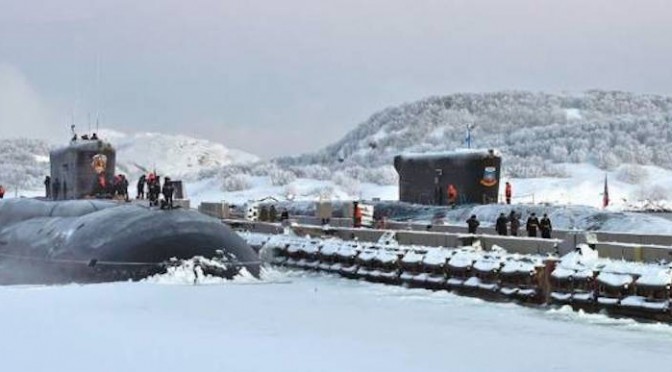
The Russian bear

An Arctic Nuclear Weapon-​Free Zone: Can there be Cooperation Under the Counterforce Dilemma?

CIMSEC content is and always will be free; consider a voluntary monthly donation to offset our operational costs. As always, it is your support and patronage that have allowed us to build this community – and we are incredibly grateful.
Select a Donation Option (USD)

Enter Donation Amount (USD)

The following piece is by Conference of Defense Associations Institute guest contributor Nancy Jane Teeple and can be found in its original form here.  It is republished with their permission.

The promise of stability-​enhancing and confidence-​building measures under the New START agreement is waning. Obama’s Prague Agenda and New START (Strategic Arms Reduction Treaty) signed between the United States and Russian Federation in Prague on 8 April 2010, hoped to see reductions in nuclear stockpiles and delivery systems by 2018 – an agreement made at a time of significantly reduced tensions between the former nuclear competitors. The renewal of tensions between the West and a revanchist Russia under President Putin, particularly apparent in the Ukraine crisis, threatens the longevity of arms control.

The possible results of this trend are worrisome. We could see the deterioration of the Intermediate Range Nuclear Forces (INF) treaty and any prospects for global disarmament enshrined in the Nuclear Non-​Proliferation Treaty (NPT), and promoted by groups like Ploughshares and the Nuclear Security Project. These conditions have implications for proposals for an Arctic nuclear weapon-​free zone (NWFZ) promoted by notable individuals from foundations such as the Canadian Pugwash Group, Gordon Foundation, and Science for Peace.

The fear of nuclear weapon use for the most part declined since the end of the Cold War. The reduction of tensions between the East and West encouraged bilateral arms control negotiations not seen since détente in the 1970s. The emergence of movements promoting a world without nuclear weapons reinforced notions that the nuclear era was over, and that remaining stockpiles had to be destroyed to prevent potential accidents. Not surprisingly, nuclear weapons are considered by many to be a relic of the Cold War.

However, following the rise of Putin, the emergence of asymmetric threats, and new near-​peer competitors such as China, the Bush administration withdrew from the Anti-​Ballistic Missile (ABM) Treaty and pursued rapid modernization of the US nuclear triad in order to counter the threat of weapons of mass destruction (WMD) from rogue nations and terrorists. These actions reinvigorated the security dilemma between the US, on one side, and China and Russia, on the other, with the latter two viewing the development of offensive nuclear weapons systems as threatening – in so far as the development of counterforce capabilities geared towards targeting another state’s nuclear arsenal can be seen as both a challenge to their second-​strike capabilities and a repudiation of mutually assured deterrence. A new arms race ensued. Both China and Russia are modernizing their own nuclear arsenals, and Russia has ignited a new Cold War over the North with the renewal of long-​range

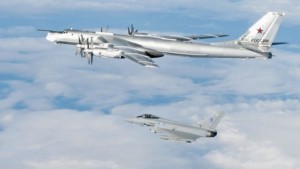
A Russian Tu-45 bomber seen during an interception in 2011. (Source: Crown Copyright, via IHS Jane's 360)
A Russian Tu-45 bomber seen during an interception in 2011. (Source: Crown Copyright, via IHS Jane’s 360)

bomber patrols near the airspace of NATO member Arctic states.

Geopolitically, the Arctic may become a region of military confrontation, particularly with the rapid militarization by the Arctic-​5 states (Canada, Norway, Denmark, Russia, and the United States), especially Russia, in enhancing their Arctic capabilities to defend economic interests in the region. In addition, although the United States, Russian, and NATO articulate an interest in reducing their nuclear arsenals and missions, they also reaffirm reliance on a credible deterrent capability so long as nuclear weapons are in the world.

This is the context within which global players must consider the feasibility of an Arctic NWFZ. Is such an initiative in the national interests of the United States and Russia? Would such a régime provide the stability needed for further cooperation on arms control and disarmament? What sort of role could smaller but influential states, such as Canada, play in encouraging bilateral negotiations to consider reducing nuclear forces in the Arctic? These are the questions that must guide any Arctic NWFZ initiative. Options must also be considered that involve compromises and concessions in order to minimize possible defections. What sort of agreement could find receptivity in both the United States and Russia?

An Arctic NWFZ must be tailored to the unique geographical and geopolitical character of the region and boundary options may not start out as comprehensive zones. Inclusion and exclusion zones involving the seabed, subsea, surface, and airspace must be considered. It might be prudent to explore provisions from existing NWFZs and other regional treaties banning nuclear weapons, such as the Antarctic Treaty, Seabed Treaty, and Outer Space Treaty. Limited geographical zones have been proposed, such as the Northwest Passage, which would open up opportunities either for resolution of the disputed status of the strait, or provide options for joint Canada-​US monitoring and enforcement.

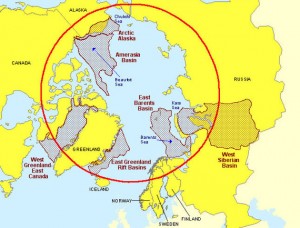
Another option involves establishing an exclusion zone in

Source: US Geological Survey

the Canadian Basin, located north of the Beaufort Sea. If Canada’s claim to the seabed that extends into the Basin is recognized by the United Nations Commission on the Limits of the Continental Shelf, Ottawa may be able to promote a NWFZ through administering its sovereign rights to protect the sea life by prohibiting nuclear-​carrying vessels that pose a threat to the environment.

In establishing an Arctic NWFZ régime that would be receptive to the US and Russia, a potential option has been proposed by experts at Pugwash. This would be a treaty to prevent nuclear weapons in the entire region above the Arctic Circle. In order to be strategically feasible, this option would have to be adapted to the counterforce postures of the US and Russia by allowing the continuation of nuclear deterrence operations, as well as the replacement of nuclear warheads with conventional alternatives.

The modernization of the US nuclear triad is already being adapted for conventional counterforce options on both ballistic missile and air delivery systems. Russia is also developing a hypersonic conventional delivery system – an answer to the US Conventional Prompt Global Strike program. Like the United States, Russia’s air and sea-​based deterrents can be outfitted with conventional warheads. This option acknowledges the reality that Russia’s Northern Fleet, which includes its ballistic missile submarines, is based mainly above the Arctic Circle. Russia would not likely be receptive to any arrangement that would restrict its sea-​based deterrent, placing it at a strategic disadvantage to the United States.

These options may have been possible before the spring of 2014. However, under current conditions getting the US and Russia to the negotiating table to consider new arms control agreements does not seem feasible. Relations between the US/​NATO and Russia can be characterized by Russia’s mistrust of NATO in Eastern Europe, accusations on both sides of violating the INF Treaty, Russia’s perception of the threat posed by US offensive counterforce weapons, Russia’s growing declaratory reliance on nuclear weapons, and the growing military and economic competition in the Arctic pitting Russia against the other Arctic states. Russia’s annexation of Crimea in early 2014, followed by military interventions in Ukraine’s eastern provinces of Donesk and Lukhansk, has intensified conditions of mutual mistrust, threat, and uncertainty.

Such conditions tend to militate against the potential for an Arctic NWFZ and must be mitigated before the nuclear powers are likely to consider cooperation. Unfortunately, a new détente is very unlikely in the foreseeable future.

This article originally featured at the CDA Institute and can be found in its original form here.

Nancy Jane Teeple is a Doctoral Candidate in Political Science at Simon Fraser University. Her areas of study include nuclear strategy, arms control, Arctic security, and intelligence. (Featured image courtesy of Russian Defence Policy blog.)

Collective Defense in the High North: It’s Time for NATO to Prioritize the Arctic

By Sally DeBoer

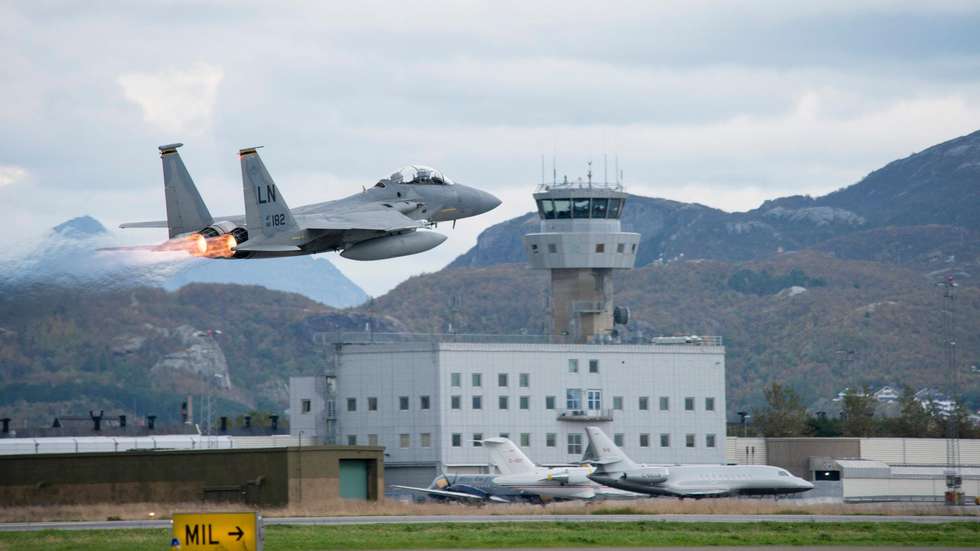
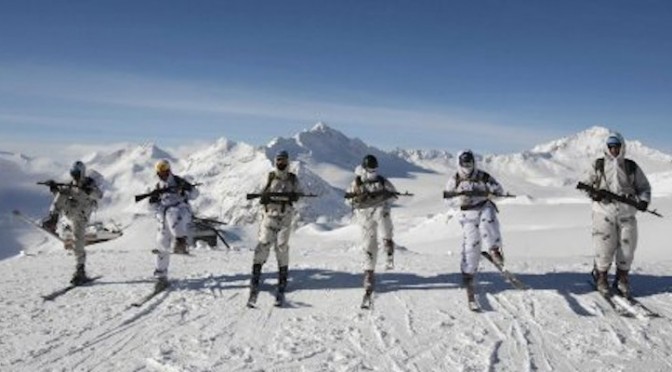
In late May of this year, NATO, along with Sweden and Finland, participated in the Arctic Challenge Exercise (ACE) 2015. The aerial exercise, which included more than 100 aircraft and 4,000 ace_4personnel, predictably ruffled a few feathers in Moscow; Russia responded by mobilizing their nascent but formidable ‘Arctic Brigade’ for an unannounced inspection. Russia’s ambitions in the Arctic (and in general) are thinly – if at all – veiled. Russia unabashedly considers itself the preeminent actor in the High North. Recent remarks by U.S. Coast Guard Commandant Paul F. Zukunft seem to codify this self-assessment. On July 8th, Zunkunft conceded that the U.S. is “not even in the same league as Russia right now” (this assessment was based on a comparison between U.S. and Russian Arctic investment and infrastructure). The discussion of the changing Arctic landscape is hardly new, nor is it limited to re-freezing Cold War tensions. The United States, NATO, and their Nordic allies have a vested interest in building and sustaining a meaningful presence in the High North. While a good start, ACE and other exercises like it won’t be sufficient to secure not only these actors’ self-interested notions but also the idea of the Arctic (and its rapidly opening maritime corridors) as a freely accessible extension of the global commons. The U.S. and their arctic-minded allies should encourage NATO to make the Arctic a higher priority now.

NATO’s stance on the Arctic has, to this point, been non-committal. As recently as 2013, NATO outright rejected idea of establishing a strong direct military presence in the Arctic High North, citing laudable diplomatic hopes that cooperation would win out over confrontation in the region. It’s possible, but unlikely, that a lack of meaningful counterweight in the High North will lead to more cooperative regimes or greater adhesion to existing legal precedents. The Arctic is dynamic and should be treated as such. The following analysis provides just a few reasons to support a defined, consistent, and robust role for NATO in the Arctic.

Arctic actors, including many NATO member states like the U.S., Iceland, and Norway, have much to gain economically from a rapidly opening Arctic in terms of both resources and newly navigable shipping routes. The Arctic is often described as a vast storehouse of resources – oil and natural gas, other minerals, fisheries, and forests- and the prospect that climate change will permit increased exploration for, and exploitation of, these presumed resources has generated a great deal of interest, both public and private.[1] The High North has long been a lynchpin of the Russian petro-state. Indeed, as of 2013 eleven percent of Russia’s GNP, 93 percent of its natural gas, and 75 percent of its oil came from the Russian Arctic.

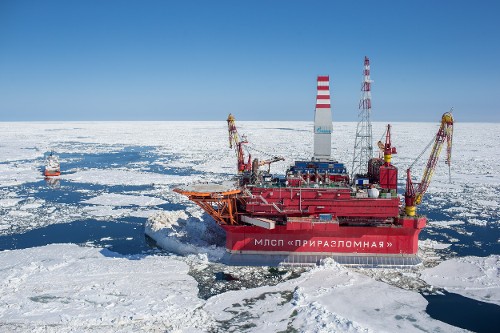
Gazprom's pioneering Arctic drilling platform Prirazlomnaya
Gazprom’s pioneering Arctic platform Prirazlomnaya

With access to these lucrative resources increasing and costs to exploit them decreasing, so too will conflict over access to those resources increase. In addition to tangible reserves, climate change has also opened previously impassable shipping lanes, some of which overlie disputed sovereignty claims. The national interests of NATO and allied actors with either Arctic real estate or interests would be best served by a consistent, cohesive NATO policy on the Arctic that would serve as a counterweight to Russia’s economic ambitions; a prospect that has thus-far eluded the alliance.

A sustained allied naval presence has been, over the past several decades, been the primary arbiter of freely accessible global maritime arteries as an extension of the global commons. This protection must extend to the Arctic, particularly as new shipping routes progressively open. The Northwest Passage just to the north of Canada could become an economically viable shipping route, passable most of the year, by mid-century. Russia’s rather extensive territorial claims in the Arctic encroach on the Northern Sea Route

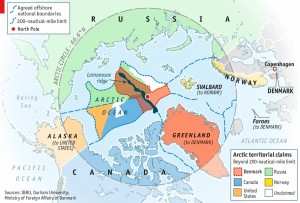
Map of Arctic territorial claims (2015)

above Siberia, an issue of particular concern to the U.S. Thus far, efforts to resolve disputes over the High North have been cooperative and civil, but that civility has never been significantly challenged. As the Heritage foundation’s Luke Koffey and Daniel Kochis argue, “NATO should consider the implications of Russia’s recent aggressive military behavior; NATO is a collective security organization with five members that are also Arctic countries and two close allies (Finland and Sweden) with Arctic territory. NATO’s commitment to a consistent and robust presence in the High North would be the surest protection of continued rules-governed behavior if (and likely when) tensions rise. Rather than contribute to tensions in the High North (which, this author predicts, will be the narrative Russia will pursue in response to a more cogent NATO Arctic policy), NATO’s presence and prescience, if such a policy is meaningfully pursued, would be a stabilizing force that would ensure free access to newly navigable waters and accessible resources in accordance with international law and orderly management of territorial claims.

The practicalities of achieving the consensus necessary within NATO to move forward with such a step cannot be overlooked. Historically, the alliance has struggled with a general scarcity of consensus. U.S. leadership on the issue of the Arctic will be indispensable in convincing member states with no direct Arctic interests (and plenty of competing security concerns) to move forward with policy and action on the High North, as well as convincing fellow arctic actors that non-Arctic member states deserve their share of influence in NATO’s Arctic policies. Despite any challenges inherent in alliance operations, supporting a greater and more carefully defined role for NATO in the changing Arctic remains far preferable, in this author’s estimation, to a unilateral attempt to provide a counterweight in the High North.

A possible first step might be to cooperatively drafting a statement of intention on NATO’s intentions and intended role in the Arctic, officially acknowledging NATO’s interests and stakes in the region. Further, continued and broader participation in exercises like ACE send a clear signal to Arctic allies like Finland and Sweden, along with the international community at large, that NATO is prepared to face the unique challenges inherent in Arctic operations. The sooner that NATO can find cohesion and take action on their Arctic policy, the better. Already playing from behind in terms of investment and strategy, a comprehensive NATO Arctic policy and presence will provide the best chance to sustain not only for NATO members’ and allies’ economic interests but also the concept of the changing Arctic as an extension of the global commons.

[1] Le Miere, C., & Mazo, J. (2013). Economic Opportunities. In Arctic Opening: Insecurity and Opportunity. The International Institute for Strategic Studies.

Sally DeBoer is an associate editor for CIMSEC.  She is a graduate of the United States Naval Academy and a recent graduate of Norwich University’s Master of Arts in Diplomacy program. She can be reached at Sally.L.DeBoer(at)gmail(dot)com.