With One Hand Tied: Naval Auxiliaries and Their Ability to Conduct Belligerent Acts

By David T. Lee

Introduction

It is an oft-repeated axiom of international law that vessels which serve as auxiliaries to a state’s armed forces may not lawfully commit a belligerent act in an international armed conflict. The presence of civilian personnel aboard many auxiliaries (including those employed by the U.S. Navy) raise law of war rules governing the use of civilian personnel in armed conflict. But why should ship type – particularly auxiliaries – be a factor in assessing the lawfulness of committing belligerent acts? Instead, it should be considered they be able to do so in the same manner as warships.

Warship or Auxiliary?

The similarities between warships and naval auxiliaries are striking. Naval auxiliaries are vessels under exclusive military control for non-commercial service. Both warships and naval auxiliaries are led by a person subject to the orders or direction of a military chain of command, to potentially include a geographic combatant commander, Navy component commander, or a task force commander. Even with recognizing the different statuses of individuals serving aboard naval auxiliaries, personnel aboard both types of vessels typically may incur some degree of adverse administrative, civil, and disciplinary measures from the military for any failure to follow those orders. While there are nuances in how governments may acquire vessels for the exclusive use of its military forces, some of which may include time-chartered or voyage-chartered vessels, all naval auxiliaries share a warship’s right to exercise sovereign immunity because both conduct only non-commercial government service. Finally, both are lawful military targets in international and non-international armed conflicts, regardless of whether the ship is manned by uniformed military personnel or civilians. Yet despite being subject to hostile attacks, naval auxiliaries may only lawfully act in self-defense.

The limitation imposed on naval auxiliaries makes little sense and has important operational implications. It harkens to an earlier era seeking to protect unarmed mariners. But with the targeting leash loosened, the desire or need to impose legal restrictions on ships based on how they contribute to the fight is unclear. Until the rule changes, U.S. Navy auxiliaries have been intentionally designed and utilized to perform only supporting tasks which fall well within current legal norms. These include providing logistical support, or serving as air or seaborne launch pads to transport troops and ammunition. But there is an increasing desire to expand the functions which auxiliaries can execute, including electronic attack, intelligence collection, command and control, and mine countermeasures. To the extent these and other missions could be construed as belligerent acts, the current rule straitjackets auxiliaries in armed conflict. As the potential list of activities performed by auxiliaries expands, the legal restriction against belligerent acts by auxiliaries has imposed an unnecessary hurdle in operational planning and execution.

The presence of civilians aboard many naval auxiliaries should not impose a limitation on belligerent actions based on ship type. Recognizing that noncombatant civilians may not directly participate in belligerent acts, the possibility for the vessel to exercise combatant functions remains undiminished so long as there are personnel aboard who may lawfully carry them out. The domestic legal hurdles in activating or deputizing civilians to serve in a combatant capacity does not eviscerate the underlying principle authorizing naval auxiliaries to conduct belligerent acts. An auxiliary ship manned exclusively by uniformed military personnel (as is the norm for many countries such as Japan) certainly should raise no concerns warranting imposition of any legal limitations about whether it commits belligerent acts or not. Accordingly, even if there may be legal restrictions on who commits such acts, there should be none based on the class of ship or the functions it performs.

Origins of the Prohibition

The current prohibition against belligerent acts by auxiliaries may originate in large part as a legacy of pre-World War I conventions seeking to protect civilian merchant ships from unnecessary harm. Consistent with notions of fairness among the advanced powers at the time, the 1909 London Declaration Concerning the Laws of Naval War imposed a requirement on warships to distinguish between the enemy’s warships and their merchant ships. If a warship encountered an enemy merchant ship, they were generally not authorized to immediately attack and destroy it even if they had war-sustaining equipment and supplies aboard. Instead, warships were required to first search the merchant ship and take it to a prize court if contraband was found. They could destroy it only in exigent circumstances after safeguarding its crew.The presumption was that even public vessels (but not warships) under the orders of an enemy government were manned by noncombatant civilians unable to inflict harm to any warship. This guidance was reaffirmed by the 1936 London Treaty, and the U.S. considers these procedures legally valid even today. In exchange for these protections, merchant ships were reasonably prohibited from engaging in belligerent acts, but could act in self-defense.2

Yet there was strong recognition that at some point, any vessel controlled by a belligerent government should be treated akin to a warship. During the negotiation of the 1907 Hague Convention Relating to the Conversion of Merchant Ships into Warships, the British delegation suggested the establishment of a special category of warships called ‘auxiliary vessels’ covering neutral or enemy merchant ships which directly aid the enemy’s military forces.3 Although the proposal was subsequently withdrawn, the parties did create a construct allowing the targeting of enemy merchant ships converted into warships. Notably, the conversion process did not require any physical alterations to the merchant vessel which would give it the ability to fight with traditional warships; it only required the ship to be commanded by individuals commissioned by their government, subject to military discipline, and under government control – administrative changes allowing both the ship and its crew to lawfully fight as combatants.4 Even though it did not directly authorize auxiliaries to conduct belligerent acts, the convention established a path allowing merchant ships and other support vessels to do so.

Disconnect Between Targeting and Conduct

Problems implementing the conversion process in World War I led to a relaxation of the targeting rules against belligerent merchant ships while keeping in place the restrictions against belligerent acts. States such as the U.S. continued to demand an evaluation of armament to determine if a merchant ship was actually a targetable warship. But after this evaluation process exposed German submarines to harm, all merchant ships became eligible targets, and the protections bestowed by pre-war conventions were rendered useless. Any ship conducting war-sustaining activities was targeted and sunk by belligerents during the war, regardless of whether it was legally characterized as a warship or not. Yet even armed merchant ships ordered by a belligerent government to attack enemy submarines (i.e. ships that had arguably been converted into warships) did so at considerable legal risk. One British merchant ship captain trying to ram a German submarine was subsequently executed by the Germans as an illegal combatant.5 Because he acted prior to the issuance by the British Admiralty ordering all British-flagged merchant ship masters to take such offensive measures, it is unclear whether the German court would have found him guilty subsequent to the Admiralty’s orders.

The Shipping Act of 1916 strengthened the U.S. military’s authority to directly control the U.S.-flagged merchant marine fleet in wartime. The law authorized placement of its merchant marine under direct U.S. government control for use as an auxiliary force in support of military wartime needs. The law made a clear distinction between the Naval Reserve, which included civilian ships available for requisitioning by the government, and naval auxiliaries, which were ships used by the U.S. government for its military needs in support of the combatant forces, and manned by a crew subject to its direction. When the law was invoked after the U.S. entered the war in 1917, some vessels reported to a civilian Shipping Board, and others came under direct Navy or War Department control. In practice, ships under military control were armed only for defensive purposes, and unlike their British counterparts were never directed to attack the enemy. Nonetheless, for purposes of the 1907 Hague Convention, they were arguably converted into warships because the government had direct control over the actions of a crew subject to military discipline. Otherwise, they were essentially auxiliaries which lost the targeting protections afforded under the 1909 London Declaration without an accompanying legal right to engage in belligerent acts.

World War II strengthened in practice the legal right of armed merchant ships to engage in belligerent acts because they were so closely integrated with the combatant fleets. Both sides treated them in the same manner as warships, both in terms of targeting them, as well as in the scope of belligerent activity they performed. The Allies struggled to prosecute German Grand Admiral Karl Doenitz for violating a provision of the London Naval Treaty of 1930 affirming the requirement to avoid destroying merchant ships unless necessary, and only after safeguarding the lives of merchant ship crews prior to destruction. Doenitz was ultimately acquitted of the charge in large part because the Allies also practiced unrestricted submarine warfare, targeting enemy merchant ships and merchant mariners because they were deemed combatants integrated with fighting forces.6

Establishing a New Rule

Even as World War II saw the de facto incorporation of each side’s merchant marine into their armed forces, the U.S. continues to restrict auxiliaries from committing belligerent acts based on its interpretations of the law of naval warfare, while also recognizing them as lawful targets in international armed conflict. It carefully scrutinizes the intended mission of each ship to determine if it needs to be ready to commit belligerent acts. If it does, it is commissioned as a warship (i.e. with a “USS” designation) rather than brought into service as an auxiliary (i.e. with a “USNS” designation). Any changes in mission may require adjustments in the ship’s status. Although seemingly just a paper drill, the reality is that it significantly impacts manning, maintenance, planning, and operations, and reduces the flexibility of the operational commander in executing desired missions.

There should be no prohibition against auxiliaries committing belligerent acts. They are fully integrated into naval forces for the sole purpose of prosecuting the conflict onto the enemy, and as such are lawful targets. Indeed, the enemy will evaluate the ship’s targetability based on the platform rather than the personnel aboard, whether military or civilian. Potential law of war restrictions on embarked civilian personnel to exercise combatant functions are only administrative impediments that can be adjusted consistent with domestic law procedures, and should have no bearing on whether the execution of belligerent acts should be limited based on ship type. When subject to the direction of the armed forces on non-commercial service, naval auxiliaries are not innocent merchant ships posing no threat. These vessels execute a vital military mission and as such are lawful targets as much as any traditional warship. To the extent naval auxiliaries have the capacity to commit belligerent acts, it should be lawful for them to do so.

Commander David Lee is a military professor at the Stockton Center for the Study of International Law, located at the U.S. Naval War College in Newport, RI. He most recently spent five years practicing international and operational law in support of U.S. Naval Forces Europe/Africa and U.S. SIXTH Fleet in Naples, Italy.

References

1. 1909 Declaration Concerning the Laws of Naval War, Chapter IV.

2. 1913 Manual of the Laws of Naval War, Article 12.

3. Proceedings of the Hague Peace Conferences, Vol. I, Oxford University Press (New York: 1920), 235.

4. 1907 Hague Convention Relating to the Conversion of Merchant Ships into Warships, Articles 2-7.

5. Charles Dana Gibson, Merchantman? Or Ship of War, Ensign Press (Camden, ME:  1986) 46.

6. Id., 119-121.

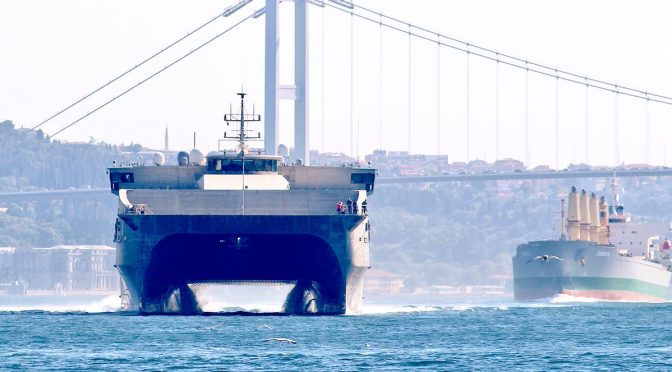
Featured Image: USNS Carson City (T-EPF- 7) entering the Black Sea on Aug. 15, 2018. Photo by Yörük Işık, @YorukIsik.
Call for Articles: Integrated Naval Force Structure Topic Week

By Dmitry Filipoff

Submissions Due: November 4, 2019
Week Dates: November 11-15, 2019
Article Length: 1000-3500 words
Submit to: Content@cimsec.org

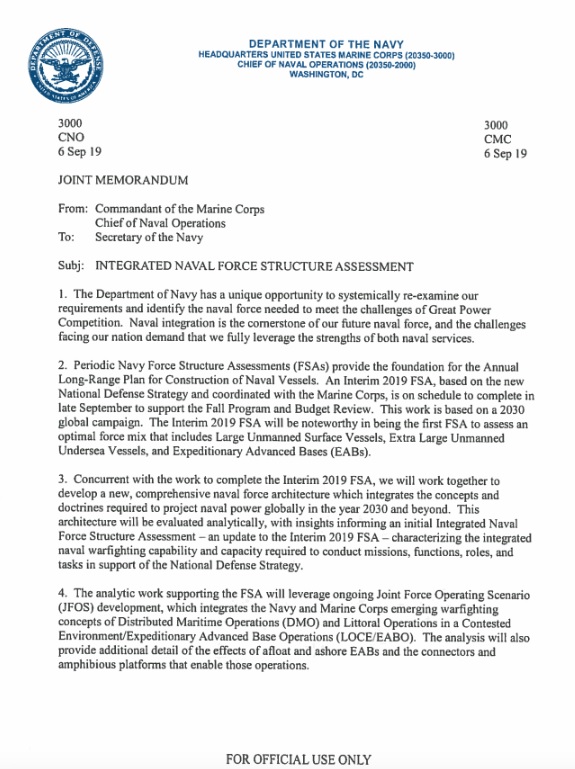
The U.S. Navy and Marine Corps are initiating an Integrated Force Structure Assessment to help chart the course of their future composition.

This force structure assessment process is unique in its emphasis on unmanned platforms by considering “an optimal force mix that includes Large Unmanned Surface Vessels, Extra Large Unmanned Undersea Vessels, and Expeditionary Advance Bases.” 

It may also look to overhaul the Marine Corps’ force structure, where in reference to its longstanding use of large, expensive platforms the new Marine Commandant Gen. Berger wrote in his planning guidance that they must “seek the affordable and plentiful at the expense of the exquisite and few when conceiving of the future amphibious portion of the fleet.”

The assessment hopes to nest future force structure within emerging warfighting concepts such as Distributed Maritime Operations (DMO), Littoral Operations in a Contested Environment (LOCE), and Expeditionary Advanced Base Operations (EABO). (Click below to read the memo from the Navy’s Chief of Naval Operations and the Marine Commandant.)

What ships and platforms will best serve the national security interests of the nation, capture technological opportunities for advantageous capabilities, and meet the challenge of great power competition? Authors are invited to answer these questions and more. Please send all submissions to Content@cimsec.org

Dmitry Filipoff is CIMSEC’s Director of Online Content. Contact him at Content@cimsec.org

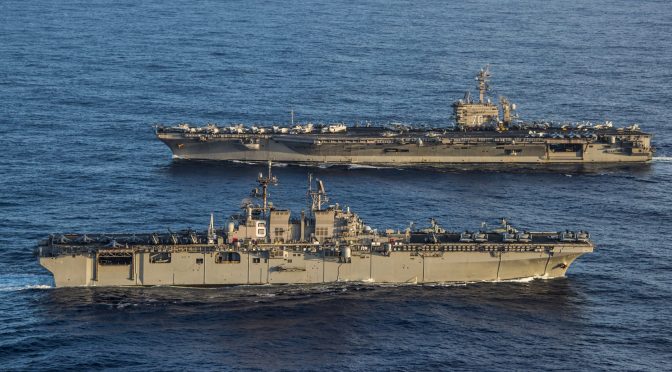
Featured Image: PACIFIC OCEAN (Jan. 20, 2018) Amphibious assault ship USS America (LHA 6), front, transits the Pacific Ocean next to Nimitz-class aircraft carrier USS Carl Vinson (CVN 70). (U.S. Navy Photo by Mass Communication Specialist 2nd Class Sean M. Castellano/Released) 180120-N-BL637-0045

Notes to the New CNO Week Concludes on CIMSEC

By Dmitry Filipoff

Last week CIMSEC featured articles submitted in response to our Call for Articles requesting short submissions where contributors offered their suggestions to the U.S. Navy’s new Chief of Naval Operations, Admiral Michael Gilday. From future warfighting considerations to the management of the force, authors provided a variety of hard-hitting insights.

Below are the articles and authors that featured during the topic week. We thank the authors for their excellent contributions. 

Two Unaddressed Problems in the Surface Navy” by Matthew Harper, CDR, USN (ret.) 

“A lot has been written about the troubles of the U.S. Navy’s surface force, but two underlying institutional problems have not been fully addressed. The failure to address these flaws promises that the U.S. Navy’s surface force will continue to risk generating less capable Sailors who are more risk averse and less tactically astute.”

Prepare for Autonomous Undersea Conflict” by David Strachan

“Undersea warfare is entering an era of profound transformation due to the increasing sophistication and proliferation of unmanned systems. But while their roles, missions, and concepts of operation have been thoroughly analyzed, the ultimate deployment of autonomous, expendable vehicles in a shadowy, hostile environment could unfold in ways that have yet to be fully imagined.”

Make Crew Endurance an Operational Warfighting Imperative” by Captain John Cordle, USN (ret.)

“The Navy owes Sailors a culture that maintains its people with the same rigorous mindset and planning as the maintenance of its ships and aircraft. Proper crew rest and sleep hygiene not only improve the daily performance and long-term endurance of our personnel in stressful environments, but best practices will lead to better long-term health outcomes when our Sailors leave the service.”

Reestablish the Strategic Studies Group” by Commander Chris O’Connor, USN, and Lieutenant Commander Ryan Hilger, USN

“The SSG’s original mandate, to develop and propose innovative warfighting concepts against peer competitors (initially the Soviet Union), is quite relevant today. The new CNO should reestablish the SSG along these lines to develop a new generation of strategists and operational concepts for Navy and Marine Corps warfighting.”

Recapitalize Sealift or Forfeit the Next Great Power War” by Stephen M. Carmel

“In the U.S., at least in terms of sealift, incrementalism is our watchword and even then we don’t execute on that minimal vision. The focus is always on doubling down on failed programs and policies that brought about the current state of affairs when bold, innovative thinking that does not repeat the mistakes of the past is required.”

Every Sailor a Cyber Warrior” by Lieutenant Douglas Kettler, USN

“The next level of fleet-wide cyber education should show the Sailor how the domain impacts their lethality and arms them with the education to recognize, respond, and overcome adverse cyber effects. Through the new creed of ‘every Sailor a cyber warrior,’ the CNO will be able to leverage his experience at Tenth Fleet to arm the Navy with the foundational skills necessary to fight and prevail in twenty-first century network-centric warfare.”

Defend and Advance Core Undersea and Network Capabilities” by John T. Kuehn, Ph.D., Commander, USN (ret.)

“The Navy must emphasize fielding proven technology. Do not bank on emergent technology that only currently exists on paper and in formulas, and is not something that can be fully operationalized into the fleet we have by 2030.”

To Win Great Power War, Treat Information As a Strategic Resource” by Lieutenant Commander Robert “Jake” Bebber, USN

“The Navy and Joint Force should be part of a national strategy that harvests information resources and controls critical information industries while denying that leverage to our adversaries. This requires new operational concepts, deeper relations with partners, allies, and industry, and a re-thinking of current personnel recruitment, training and retention.”

Restore Authority and Accountability” by Commander Rob Brodie, USN

“The cause of the Fitzgerald and McCain collisions was the administrative chain of command’s decisions to send untrained officers to the fleet while also replacing intuitive with non-intuitive ship control consoles without training support. But instead, only the operational chain of command was held accountable for the loss of life.”

Tackle Force Dynamism and Administrative Structure For a Stronger Navy” by Petty Officer Second Class Jacob Wiencek, USN

“The CNO should focus on his role of training, developing, and administratively overseeing the U.S Navy, specifically in two key areas that are adversely affecting the fleet: administrative and personnel structure, and force dynamism.”

The Navy Reserve is Broken” by Lieutenant Blake Herzinger, USN

“Navy reservists are ready and eager to serve, but what message do they receive when they arrive on deployment and are told the duties they have arrived to execute are unimportant or nonexistent? Administrative problems have administrative solutions, but without attention from above, they will languish and Sailors will suffer the consequences.”

Junior Personnel: The X-Factor in Great Power Competition” by Lieutenant Adam Johnson, USN, and Lieutenant Junior Grade John Maslin, USN

“Incorporating a non-discriminatory dataset from the junior ranks into senior-level decision-making could be an ‘X-factor’ for several reasons. First, it would provide senior leaders with crowdsourced, deckplate-level data that, in many cases, they are currently not receiving. Harnessing these collective insights from a generation that has grown up in a technology-fueled world that is entirely dissimilar from the early experiences of our senior leaders could pave the way for new strategies for how the Navy conducts business.”

Kill the Darlings and Pet Programs” by Lieutenant Commander Ryan Hilger, USN

“It is time to kill our darlings. We cannot deploy the Navy the nation needs with the many pet programs we have. Underperforming programs must go. Follow Secretary Esper’s lead and hold ‘Night Court’ for the Navy…”

Don’t Forget Seapower’s Dry Foundation” by J. Overton

“Important as that role is, bases’ size, location, and presence means they are continuously carrying out effective naval strategy. Some of that is direct and traditional – overhauling ships, fueling aircraft, training submariners. But much of that is better described as ‘collateral strategy’ – using the means available through local presence to establish global ends. “

Improve Mutual Cooperation with Small and Medium-Sized Navies” by VADM. (Ret) Omar Eduardo Andujar-Zaiter, DRN

“The CNO should include in his working plan a desire to better understand and collaborate with small and medium-sized Navies of nearby democratic countries with the aim of earning bilateral cooperation for USN objectives. For this the CNO may connect through person-to-person visits and calls to the leaders of these navies to earn a better understanding of how other international naval forces operate and contribute to regional security.”

Please Stop Making Sailor-Soldiers” by Lieutenant Zachary George, USN

“It is time again to get the reserves back to sea. The CNO must direct the Chief of the Navy Reserve and the Chief of Naval Personnel to quickly make both the Reserve Surface Force and the greater global force management process a system that mobilizes Sailors into Sailors, and not Sailors into soldiers.”

Dmitry Filipoff is CIMSEC’s Director of Online Content. Contact him at Content@cimsec.org

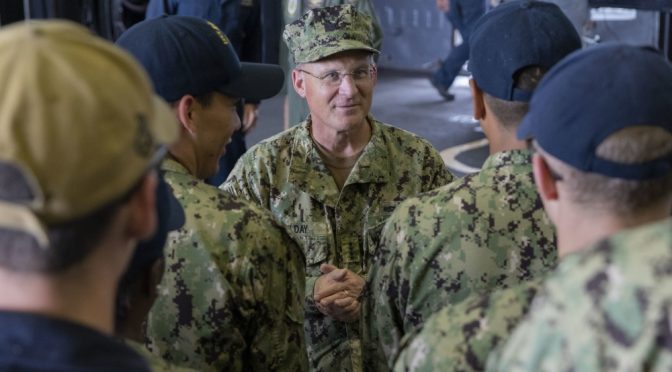
Featured Image: NORFOLK (Aug. 27, 2019) Chief of Naval Operations (CNO) Adm. Mike Gilday visits with Sailors aboard USS Kearsarge (LHD-3). (U.S. Navy photo by Chief Mass Communication Specialist 2nd Class Nick Brown) 

Please Stop Making Sailor-Soldiers

Notes to the New CNO Topic Week

By Lieutenant Zachary George, USN

Over the last 18 years, the Navy Reserve has served as the nation’s third land army, filling gapped Army billets in the War on Terror in the Middle East and Africa. Through its Expeditionary Combat Readiness Centers (ECRC) in Norfolk and San Diego, it has perfected the art of making Navy Sailors into soldiers. This includes stripping Sailors of their coveralls and giving them a sea bag’s worth of combat helmets, flak jackets, and desert boots, after which, they are sent to Fort Jackson, South Carolina for three weeks of basic soldiering skills. As the Navy actively contests a resurgent Russia and an emerging China, both EUCOM and PACOM are calling for more Naval Reservists to fill sea billets, ensuring special missions and regular warships are fully manned and ready. Unfortunately, the ECRCs are not ready for this shift, being unable to send reserve Sailors back through fleet damage control trainers or even issuing them required firefighting coveralls. While the rest of the fleet is shifting to the high-end fight, it’s time for the CNO to radically change the ways the Navy sources, trains, equips, and sends out reserve Sailors to sea-going mobilizations.

Unlike the reserve naval aviation component that still operates and maintains actual combat and logistical aircraft, the reserve surface force decommissioned all of its reserve ships in the late 1990s, leaving coastal riverine squadrons as their only platforms. While some experience and in-rate training can be gained on small boats, those rates, such as Operational Specialists, Sonar Technicians, Electronics Technicians, require hands-on experience on the advance and complex systems found only on warships. Additionally, some reserve sailors in sea-going rates are pure reservists with no sea time, so they are have zero training outside boot camp in damage control and shipboard organization. Some might not know how to even read a ship’s bullseye, a placard that explains how to navigate a ship’s interior.

The solutions? First, add a maritime training week to ECRC after the initial administrative week. This week would include ship tours, wet/fire trainers, and classes about the 3M preventative maintenance system. Next, accelerate and expand the “Reserve Component to Sea Initiative” by shutting down large headquarters reserve units and instead, man the fleet. This ensures that the Sailors drill and train when not mobilized with their active duty brothers and sisters, and can squeeze into fleet training and specialized courses when available. This shift allows reservists to mobilize with their shipmates, vice just showing up to ECRC and then deploying to a thrown-together military detachment with no training or zero workup time.

It is time again to get the reserves back to sea. The CNO must direct the Chief of the Navy Reserve and the Chief of Naval Personnel to quickly make both the Reserve Surface Force and the greater global force management process a system that mobilizes Sailors into Sailors, and not Sailors into soldiers.

Lieutenant Zac George is a reserve surface warfare officer, currently mobilized as the Military Detachment Assistant Officer-in-Charge onboard USNS YUMA (T-EPF 8) in SIXTH FLEET.

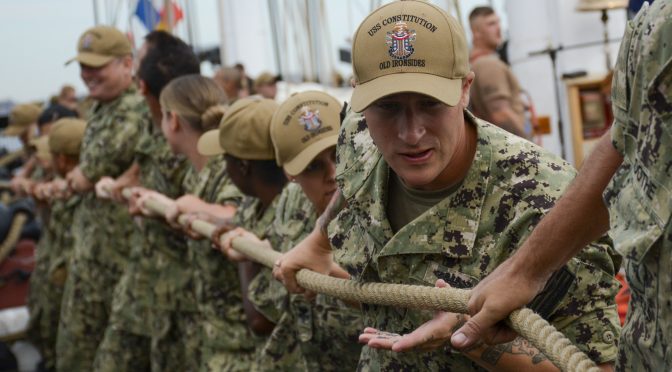
Featured Image: BOSTON (Aug. 23, 2019) Chief petty officer selects, Sailors who have been selected for the paygrade of E-7, come together for Chief Heritage weeks aboard the oldest commissioned warship afloat in the world, USS Constitution. (U.S. Navy Photo by Mass Communication Specialist 3rd Class Casey Scoular/Released)190823-N-SM577-0053

Fostering the Discussion on Securing the Seas.